
Archive
Book Review: The Coin by Glen Cadigan
 Summary:
When Richard’s physicist professor uncle dies tragically in a plane crash and leaves him his coin collection, he is shocked to find a brand-new dime from 2012. The only thing is, it’s 1989. A note from his uncle states that the coin is important. Richard thinks the answer to the mystery might be in his uncle’s personal diaries he also left him, but he’s not a physicist and can’t decipher them. As the year 2012 approaches, Richard increasingly wonders what the coin is all about.
Review:
I had previously reviewed a book by Glen Cadigan, Haunted
Richard’s first-person narration follows a style similar to that used often in older scifi; it reads as if the main character is writing everything down in his journal for longevity. It’s a cozy narration style that works well for the slow-moving mystery it tells.
This narration style also helps establish Richard into a well-rounded character quickly. The reader almost immediately feels an intimacy with Richard as he discusses his sorrow at his beloved uncle’s sudden death, why he was close to his uncle, and his thoughts on the mysterious coin. The uncle is, perhaps, less well-rounded but only in the sense that the reader comes to know him only through the eyes of a loving relative. It thus makes sense that mostly his good qualities come through.
Cadigan artfully maneuvers Richard’s handling of the mystery from the days before the internet to present. Richard first employs old-fashioned research techniques to try to figure out the mystery then loses interest. With the advent of the internet, though, he regains interest and starts researching again. This is completely realistic and reads just like what a person might have done.
Some basics physics of time-travel and time-travel theories are included. They are written at the right level for a general audience reading a scifi book, neither talking down to nor being too technical.
What really made me enjoy the book was the resolution to the mystery. I should have seen it coming, but I did not, and I always enjoy a surprise that feels logical when I think back on it.
So why four stars and not five? The novella left me wanting something more. It felt almost too short. Like there was something left out. Perhaps more time spent on Richard’s researching of the mystery or snippets from the uncle’s journals or some photos of the uncle and his airplane might have helped it feel more fully fleshed-out and real. The old-school narration style was enjoyable but some additions of some of the types of things a person might put in their journal would help it feel more complete. Even some simple sketches or perhaps a poem by Richard about his uncle, since he’s in the humanities, would have helped.
Overall, this novella is a fun new take on the storytelling method of having a character write in their journal about a mystery. The science is strong enough to be interesting but not too challenging, and the result of the mystery is surprising. Some readers might be left wanting a bit more to the story. Recommended to fans of scifi classics such as The Time Machine

If you found this review helpful, please consider tipping me on ko-fi, checking out my digital items available in my ko-fi shop, buying one of my publications, or using one of my referral/coupon codes. Thank you for your support!
4 out of 5 stars
Length: 41 pages – novella
Source: Kindle copy from author in exchange for my honest review

Book Review: The City of Time and Memory Part I by J. A. Childress (Series, #1)
 Summary:
Zak wakes up from a night of drunken revelry to find himself in his apartment but not his apartment building. His apartment is now part of a massive structure of multiple different architectural styles that looks like it goes on forever. Plus his bathroom is missing. Shreya wakes up in her car in a parking garage to Hungry Eyes playing on the radio and an ominous car nearby nicknamed “Die Pflaume.”
Review:
This first entry of a new serial does a quick job establishing a strong setting but just when the action gets going, it leaves the reader hanging.
When I accepted this review copy, I must admit that I didn’t realize it was the first entry in a serial, I thought it was in a series. Serials offer small episodes of an overarching story in bite-size chunks the reader picks up. Think of it as reading an episode of your favorite tv series. I think it would help if this was marketed more clearly as a serial, since certain readers love that reading experience and others aren’t too keen on it. Making it clearer that it’s a serial will help it better reach the right readers.
A good serial entry will read much like an episode in a tv show with a large, overarching plot, but also a smaller plot that can be told in one episode that is, ideally, tied to the overarching plot in some way. This gives the reader the satisfaction of completing a piece of smaller plot but also keeps them engaged in the series as a whole. This serial does a good job setting up the overarching plot. People are waking up in what appears to be an alternate universe that is possibly punishing them for something they did that they can’t remember with sinister beings chasing them or tormenting them from afar. It’s a good mystery, but it is just getting going when the serial entry stops. This would be ok, but the big weakness of the serial entry is that there is no self-contained smaller plot. Thus, instead of feeling any sense of satisfaction of having learned something or completed one mystery, the two main mysteries of the overarching plot are just getting going and then stop abruptly. Without the presence of a second, self-contained, smaller plot for this entry in the serial, this just leaves the reader feeling cheated out of getting the whole story, rather than the dual experience of satisfaction at the wrap-up of the smaller plot and intrigue at the larger plot.
The setting of the alternate universe is well-established and delightfully creepy. Everything being just a little bit off is creatively written without being in the reader’s face. The author also includes a drawing of a mysterious symbol that Zak sees, which helps build the atmosphere.
In contrast, Zak and Shreya feel a bit two-dimensional, but this is possibly because they have such a short time in which to be established. Similarly, the demonic character who chases Zak comes across as corny, straight out of a B movie, not frightening like he is, presumably, supposed to. The world building is so good that the two-dimensional good guys and cheesy bad guys stick out like a sore thumb.
The one flaw in the writing style is there are way too many similes. At times it feels that every other sentence contains one. Any descriptor used too much can go from artful to annoying. A lighter hand on these would be helpful in future entries.
Overall, this first entry in the serial establishes a delightfully creepy alternate universe where everything is just off. The lack of a smaller, self-contained plot in addition to an overarching plot will make this frustrating to read, unless the reader has the next entry at hand to read immediately. Recommended primarily to horror fans who like their horror in small bites and enjoy the concept of a serial who won’t mind waiting a bit for the conclusion to the mystery in future entries.
If you found this review helpful, please consider tipping me on ko-fi, checking out my digital items available in my ko-fi shop, buying one of my publications, or using one of my referral/coupon codes. Thank you for your support!
3 out of 5 stars
Length: 37 pages – novella
Source: Kindle copy provided by author in exchange for my honest review

Book Review: The Big Time by Fritz Leiber (Series, #1)
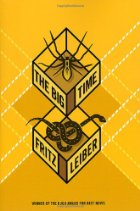 Summary:
It’s the Time War, and the Spiders and Snakes are battling each other up and down the timeline in an attempt to give time the ultimate outcome they each are hoping for. Nobody knows precisely who the spiders and snakes are, but they briefly resurrect humans and ask them if they want to participate in the war. Those who say yes become the soldiers, nurses, and the Entertainers who provide rest and relaxation for the soldiers in the waystation. One waystation is about to hit a ton of trouble when a package shows up and a soldier starts talking mutiny.
Review:
I’m a fan of time-travel as a scifi trope, and I liked the concept of a time war, so when I saw this sitting on my virtual ARC pile, I figured it would be a quick, appealing read. The book is less about time-travel, and more a type of scifi game of Clue, with everyone trapped in a waystation instead of a house trying to figure out who turned off the machine that connects them to the galaxy, rather than solve a murder.
The book takes place entirely within the waystation. The waystation exists outside of time to give the time soldiers a place to recuperate without the pressures of time travel. All but one of the soldiers are men, and most of the Entertainers are women. The one female soldier is from ancient Greece, the clear idea being that her era of women are the only ones tough enough to be soldiers. This definitely dated the book and led to some eye-rolling on my part. On the plus side, the book is narrated by a woman, and she is definitely one of the brains of the bunch. There thus is enough forward-thinking that the sexist distribution of time soldiers doesn’t ruin the book; it’s just irritating.
The crux of the book is the soldiers wondering who, exactly, is telling them what to do up and down the timeline and worrying that they are ruining time, not to mention the planet Earth they once knew. The soldiers are told they’re on the side of the good guys, yet the good guys are insisting that Russia must be stopped at all costs, even if that means the Germans winning WWII. Thus, the soldiers are awkwardly paired up with Nazis in the fight. It’s interesting to force the Allies to attempt to see Germans in a different light. However, the whole idea that Russia (and Communism) will ruin the world is just a bit dated. It’s easy to get past, though, since the dilemma of how to know if who you are following is making the right choices is a timeless one.
The attempted mutineer ends up trying his mutiny because he falls in love with one of the Entertainers.
I decided they were the kind that love makes brave, which it doesn’t do to me. It just gives me two people to worry about. (loc 10353)
The attempted mutiny against the cause is thus kind of simultaneously blamed on love and on the woman behind the man starting the drama. It’s true that love makes people do things they wouldn’t ordinarily do, but I do wish the characters were more even-handed in dealing out the blame for the mutiny to both halves of the couple. On the plus side, it is left unclear if the mutiny is a good or bad idea, so whether the idealistic couple in love are right or not is up to the reader to decide.
The final bit of the book dives into theories about time-travel, time, and evolution. It’s a bit of a heady side-swipe after the romping, Clue-like plot but it also shows how much of an impact the events of the book have on the narrator. At the beginning, the narrator states it was a life-changing sequence of events, and the wrap-up deftly shows how it impacted her.
Overall, this is a thought-provoking whodunit mystery set in an R&R waystation in a time-travel war. Some aspects of the book did not age particularly well, such as the hysterical fear of Communism and the lack of women soldiers, but the heart of the book is timeless. How do you know if those in charge are right or wrong, does love make you see things more or less clearly, and does evolution feel frightening and random when it’s happening. Recommended to scifi fans with an interest in a scifi take on a Clue-like story.
If you found this review helpful, please consider tipping me on ko-fi, checking out my digital items available in my ko-fi shop, buying one of my publications, or using one of my referral/coupon codes. Thank you for your support!
3 out of 5 stars
Length: 128 pages – novella
Source: NetGalley

Book Review: Hungry For You by A. M. Harte

Summary:
A collection of zombie-themed short stories and poetry with the twist that they all have to do with romantic relationships in some way, shape, or form.
Review:
This is a solid collection of short stories and poetry that can be enjoyed one at a time or inhaled in one sitting. I went for the one sitting option.
In some stories Harte sticks to zombie tropes but in not all. The ones where she varies or surprises the reader in some way are definitely the stronger ones. She has an ability to imagine multiple different possible zombie apocalypses that are all, if not equally believable, still believable. Her dialogue is a definite strength, reading as incredibly realistic in the midst of fantastical happenings.
Where she excels though, and where I would encourage her to focus future horror writings, is when she uses the zombies and zombie apocalypse as a metaphor or an instigator for something in a relationship from women’s perspective. My three favorite stories from the collection–“Dead Man’s Rose,” “Seven Birds,” and “Alive”–all feature this element. In “Dead Man’s Rose,” the zombie is a metaphor for an abusive lover who refuses to grant the woman her freedom. In “Seven Birds” the surprise of the zombie apocalypse coincides nicely with an unexpected break-up (I particularly enjoyed that female character’s reaction to both). In “Alive” the female character must deal both with the zombie apocalypse and the emotional fall-out after a one-night stand with a co-worker. These are all three things modern women face in relationships and getting to see them take place in a world infested with zombies (one of my favorite kinds) was such a welcome change! Too often, especially in zombie movies, we see the apocalypse from a man’s perspective and not from a woman’s. I found myself saying to Harte in my head, “Ignore the male perspective and switch to just writing from the female perspective, because you do it so well!” For instance, it’s not every day in a female zombie fiction fan’s life that you come across a resonant passage like this:
When I am lonely for boys what I miss is their bodies. The smell of their skin, its saltiness. The rough whisper of stubble against my cheek. The strong firm hands, the way they rest on the curve of my back. (location 1206)
Never have I come across a passage in zombie fiction that so struck at the heart of what it is to be a modern straight woman, and to have that followed up by oh no zombies was just awesome.
There are a few shortcomings though. A couple of the stories simply felt too short, and a couple of them–“A Prayer to Garlic” and “Arkady, Kain, & Zombies”–just didn’t make much sense to me. I think the former would have benefited from being a bit longer with more explanation, whereas the latter actually felt too long and had a couple of plot holes that I couldn’t wrap my mind around. This collection is periodically more British than at other times. One short story revolves around tea to an extent that I’m afraid a Boston gal like myself just couldn’t quite relate to. I know that those more British stories will definitely appeal to the type who love Doctor Who for instance, though. I also really wish it included a table of contents. That would be super-helpful in revisiting those stories readers would like to revisit.
Overall this book is definitely worth the add to any zombie fan’s collection, but particularly to female zombie fans. It’s different and fun simultaneously.
If you found this review helpful, please consider tipping me on ko-fi, checking out my digital items available in my ko-fi shop, buying one of my publications, or using one of my referral/coupon codes. Thank you for your support!
4 out of 5 stars
Length: 122 pages – novella
Source: Smashwords copy from the author in exchange for my honest review
Buy It (Amazon. Not available on Bookshop.org)
Book Review: A Doll’s House by Henrik Ibsen

Summary:
It’s Christmas time and Nora is eagerly getting ready for the holidays with her husband, Torvald, their children, and their friend Dr. Rank when her old friend, Christine, shows up in town. Christine is recently widowed and is looking for work. Nora, who appears flighty and silly at first, informs Christine that she saved her husband’s life when they were first married by taking a loan from, essentially, a loan shark to pay for them to take a trip to Italy. He remains unaware of both the loan she is working on repaying and the fact that his life was ever in danger. Unfortunately, things come to a head when the man who loaned her the money, Krogstad, threatens to reveal all to her husband.
Review:
This three-act dramatic play was first performed in 1879. It explores the nature of domestic relationships in a way that still holds relatability and power today. The play accomplishes this using the same set design of the Helmer family’s living room throughout all three acts. I found myself impressed by the different feelings evoked by the identical set in each act.
Get the full text of this review by clicking here! (It is 7 paragraphs total with 604 words).
4 out of 5 stars
Length: 88 pages – novella/short nonfiction
Source: Audiobooks app for the iTouch, iPhone, and iPad.
Buy It (Amazon or Bookshop.org)
 Support my work with a tip or browse my shop for curated book club guides, how to guides, cross-stitch patterns, and more!


This work by Amanda Nevius is licensed under a Creative Commons Attribution-Noncommercial-No Derivative Works 3.0 United States License.
 Opinions of a Wolf