
Archive
Book Review: We Don’t Talk About Carol by Kristen L. Berry
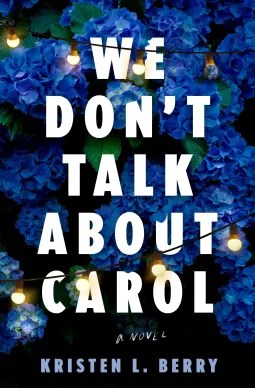
A psychological thriller about missing Black girls, fertility stress, and intergenerational trauma’s impact on mental health.
Summary:
In the wake of her grandmother’s passing, Sydney Singleton finds a hidden photograph of a little girl who looks more like Sydney than her own sister or mother. She soon discovers the mystery girl in the photograph is her aunt, Carol, who was one of six North Carolina Black girls to go missing in the 1960s. For the last several decades, not a soul has talked about Carol or what really happened to her. But now, with her grandmother gone and Sydney looking to start a family of her own, she is determined to unravel the truth behind her long-lost aunt’s disappearance, and the sinister silence that surrounds her.
Unfortunately, this is familiar territory for Sydney: Years earlier, while she worked the crime beat as a journalist, her obsession with the case of another missing girl led to a psychotic break. And now, in the suffocating grip of fertility treatments and a marriage that’s beginning to crumble, Sydney’s relentless pursuit for answers might just lead her down the same path of self-destruction. As she delves deeper into Carol’s fate, her own troubled past reemerges, clawing its way to the surface with a vengeance. The web of secrets and lies entangling her family leaves Sydney questioning everything—her fixation on the missing girls, her future as a mom, and her trust in those she knows and loves.
Review:
Psychological thrillers are a genre I love, but they have a real diversity problem, overwhelmingly featuring white women. When I saw this take on a psychological thriller by an own voices author centering Black women’s experiences, I was so excited to receive a review copy.
Sydney has a lot going on when we first meet her. Her grandmother has recently passed away, and she and her mother and sister are cleaning out her house. There are complex family dynamics at play that get slowly revealed as the book progresses. Sydney is also undergoing fertility treatments, which has put a strain on both her mental health and her marriage.
While in the process of cleaning out the house, she discovers an aunt she never knew existed who went missing in her teens. We learn that Sydney was once was an investigative journalist, a career she abandoned after a psychiatric break on a story. But she can’t let go of trying to find out what happened to her aunt. Especially when she discovers five other teen Black girls went missing at the same time, and no one ever truly looked that hard for them.
This is an incredible set-up. Berry places missing Black girls, who historically receive little media attention, into the exact narrative space normally occupied in pyschological thrillers by:
- marital infidelity
- blackmail
- mysterious inheritances
In most psychological thrillers, those are the inciting forces. Here, systemic neglect is. (For a similar critique of this issue but in a YA horror book, check out Burn Down, Rise Up by Vincent Tirado.)
This matters because the novel positions those missing Black girls not as a shocking anomaly, but as a painful, known reality within the community. That’s where representation truly matters. It places a real life issue ifront an dcenter, then builds the psychological thriller around it.
For context, the NAACP reports that Black US Americans make up 34% of all missing persons cases but only 12.85% of the population.
In spite of Sydney’s previous psychiatric break feeling a little over the top, it was heartwarming to see how kindly and normally her husband and medical team treat it. She’s not othered; she’s just encouraged to keep the stress down. (Which, as the main character of a psychological thriller, she obviously doesn’t do very well.) I also appreciate that the climax of the book doesn’t rely whatsoever on her mental health or illness.
Despite the blurb suggesting a struggling marriage, Sydney’s marriage is quite solid. She and her husband just have a couple of difficult conversations, which makes sense with everything they have going on. I liked having a healthy marriage represented in a psychological thriller. Similarly Sydney’s relationship with her sister and mother is one of seeking repair and not one of just walking away from each other. There’s a lot of relational health in this book.
I suspected early on where the story might be heading, but the details were definitely not something I had figured out. So it was sufficiently twisty to hold my interest. That said, the pacing was just a bit off for a thriller. Perhaps because it was so grounded in reality, it was more of a pace of up and down rather than a rapidly building just can’t put it down escalation.
As I strive to provide content notes, be aware that while it is not depicted on the page, a character hears and partially witnesses the rape and murder of two young girls (hearing banging from another floor and seeing a vehicle shaking.) For representation, the cast is predominantly Black, the main character has psychiatric issues as did her father, addiction is represented but without much hope for healing, and I do not recall much if any sexual orientation diversity. One historical character is presented as possibly being on the Autism spectrum though the overall arc is not particularly positive in terms of representation.
Overall, this is a welcome, diverse addition to the psychological thriller genre. Its focus on missing Black women and girls brings a refreshingly underrepresented plot to familiar genre territory. The pacing is a little up and down. You likely will be able to put it down and sleep for the night. But it still calls for completion to resolve the mystery.
Especially recommended for:
- Readers of psychological thrillers with social commentary
- Book clubs interested in discussions about systemic neglect
- Readers looking for mental health representation in suspense
- Those wanting stories centered on missing Black women and girls
If you found this review helpful, please consider tipping me on ko-fi, checking out my digital items in my ko-fi shop, buying one of my publications, using one of my referral or coupon codes, signing up for my free monthly newsletter, or tuning into my podcast. Thank you for your support!
4 out of 5 stars
Length: 336 pages – average but on the longer side
Source: NetGalley
Buy It (Amazon or Bookshop.org)
Book Review: Last Train to Memphis: The Rise of Elvis Presley by Peter Guralnick

Considered by many to be book one of the quintessential Elvis biography duology.
Summary:
Based on hundreds of interviews and nearly a decade of research, it traces the evolution not just of the man but of the music and of the culture he left utterly transformed, creating a completely fresh portrait of Elvis and his world.
This volume tracks the first twenty-four years of Elvis’ life, covering his childhood, the stunning first recordings at Sun Records (“That’s All Right,” “Mystery Train”), and the early RCA hits (“Heartbreak Hotel,” “Hound Dog,” “Don’t Be Cruel”). These were the years of his improbable self-invention and unprecedented triumphs, when it seemed that everything that Elvis tried succeeded wildly. There was scarcely a cloud in sight through this period until, in 1958, he was drafted into the army and his mother died shortly thereafter. The book closes on that somber and poignant note.
Review:
If you know you’d be into an in-depth Elvis biography, I can tell you that this one is widely acknowledged as the best starting place for its depth of research and attempt to present a neutral viewpoint – neither one of a fan nor one of a naysayer. It’s out to find the middle-ground, and the the truth does often lie somewhere in the middle.
If you think you wouldn’t be into an Elvis biography, there’s more to this book than Elvis. It’s also the story of the American music industry in the 1950s. I learned so much about how music was made and marketed at that time, and how rock n roll changed it. It wasn’t just about the sound but about how the music was actually sold. For example, I didn’t realize how at the tie going on near-constant tour to small music venues was considered the best way to market yourself. The chapters about how Elvis’s manager, the Colonel, got him onto television and how television really started to change the music industry were fascinating. It was like an echo of TikTok in some ways. I also really enjoyed learning about Sun Records – the small, independent label that gave both Elvis and Johnny Cash their starts.
I’d previously heard a lot of the very bad things about the Colonel. It made me wonder how Elvis fell for using him as his manager to begin with. This book really brought to light the why. The Colonel may have taken a much larger percent (25%) than was usual (10%), but he also had a great business mind and really got things done. It was the Colonel who got Elvis on television and in the movies. I’d always thought the Colonel pushed Elvis into the movies but this book showed from its extensive interviews that Elvis himself was quite interested in being like James Dean. The relationship, at least at the beginning, was a lot more give and take than I’d thought. Another example is that it’s clear from the interviews that Elvis was ok with letting the Colonel be “the bad guy.” He didn’t protest or get in the way when the Colonel did something that those around him thought was squidgy. In fact, it seems like he was kind of ok with letting the Colonel be the scapegoat.
I knew from previously reading The Gospel Side of Elvis that Elvis loved gospel music and considered it his first music love. I hadn’t realized, though, how almost indifferent he felt about the music he did play. He was professional about it, but he didn’t love it the way he loved gospel. From my understanding of the book he seemed to pursue the music he thought would be the most likely to lead to success, not the one he was passionate about. It always makes me a little sad to hear of someone making a choice based on potential success than passion, although I do understand why people do that. How different things would have been if he’d pursued gospel though, huh?
This book was a little slow-going for me because I kept stopping to listen to the songs mentioned or watch the television appearances as they came up. I think that enhanced the book, and if you have the chance to read the digital book with the audio/video enhancements, I would.
Overall, this book delivers what it promises – an in-depth look at Elvis based on extensive research and interviews. But it also goes further, illuminating America’s music scene in the 1950s, and how it changed, putting us on the trajectory to the modern music scene.
If you found this review helpful, please consider tipping me on ko-fi, checking out my digital items available in my ko-fi shop, buying one of my publications, or using one of my referral/coupon codes. Thank you for your support!
4 out of 5 stars
Length: 560 pages – chunkster
Source: Library
Buy It (Amazon or Bookshop.org)
Book Review: God Bless You, Mr. Rosewater by Kurt Vonnegut

Summary:
A satire on free enterprise, money, and capitalism in America told by examining the fictional Rosewaters–an uber-wealthy American family whose ancestor acquired his wealth by essentially profiteering during the Civil War. The current Rosewater fights in WWII and returns with two crazy ideas. First, that everyone deserves to be equally happy. Second, that people who inherited wealth did nothing to deserve it. He responds to this conundrum of conscience by returning to his ancestor’s hometown and using the Rosewater Foundation to help the “useless poor.” In the meantime, a lawyer by the name of Mushari decides to attempt to prove that Mr. Rosewater is insane, and the foundation money should be handed off to his cousin, currently a suicidal, middle-class insurance man.
Review:
How to review Vonnegut? Upheld as the epitome of 20th century American writing. He is certainly prolific, and some of his books absolutely deserve the high praise (Slaughterhouse-Five
I think part of the problem stems from the fact that the first third of the book is focused on Eliot Rosewater, the next on his cousin, and the last on Eliot again. Just as I was getting into Eliot’s story, it switched to his cousin. Then when I was getting into his cousin’s story, it switched back to Eliot. To top it all off, the ending left me with little to no resolution on either one. Maybe Vonnegut’s point is that capitalism either makes you crazy or depressed with no way out? I’m not sure.
That’s not to say that this wasn’t a fun read, though. Vonnegut crafts the mid-western town Eliot lives in and the Rhodes Island seacoast town his cousin lives in with delicious detail. What is interesting about both are of course the people in the towns surrounding the main characters, and not the main characters themselves. In particular the Rhodes Island town is full of surprisingly well-rounded secondary characters from the cousin’s wife who’s experimenting in a lesbian relationship, to the local fisherman and his sons, to the local restaurant owner who is intensely fabulous (yes, the gay kind of fabulous. There’s quite a bit of LGBTQIA+ in this book). I was so interested in this town. This was a town that actually demonstrated the problems innate in some people having too much money while others don’t have enough. This was so much more interesting than Rosewater’s sojourn in Indiana. But then! Just when I was really getting into it and thinking this book might approach Slaughterhouse-Five
Much more interesting than the heavy-handed money message was the much more subtle one on the impact of war. Mr. Rosewater’s sanity issues go back to WWII. I won’t tell you what happened, because the reveal is quite powerful. Suffice to say, Vonnegut clearly understood the impact WWII had on an entire generation and clearly thought about the impact of war on humanity in general. In this way, this book is quite like Slaughterhouse-Five
Overall, if you’re a Vonnegut enthusiast, enjoy reading for setting and character studies, and don’t mind a message that’s a bit heavy-handed, you will enjoy this book. Folks just looking for a feel of what makes Vonnegut held in such high esteem should stick to Slaughterhouse-Five
If you found this review helpful, please consider tipping me on ko-fi, checking out my digital items available in my ko-fi shop, buying one of my publications, or using one of my referral/coupon codes. Thank you for your support!
3.5 out of 5
Length: 190 pages – average but on the shorter side
Source: PaperBackSwap
Buy It (Amazon or Bookshop.org)
 Support my work with a tip or browse my shop for curated book club guides, how to guides, cross-stitch patterns, and more!


This work by Amanda Nevius is licensed under a Creative Commons Attribution-Noncommercial-No Derivative Works 3.0 United States License.
 Opinions of a Wolf