
Archive
Book Review: We Don’t Talk About Carol by Kristen L. Berry
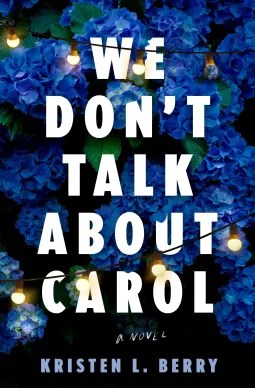
A psychological thriller about missing Black girls, fertility stress, and intergenerational trauma’s impact on mental health.
Summary:
In the wake of her grandmother’s passing, Sydney Singleton finds a hidden photograph of a little girl who looks more like Sydney than her own sister or mother. She soon discovers the mystery girl in the photograph is her aunt, Carol, who was one of six North Carolina Black girls to go missing in the 1960s. For the last several decades, not a soul has talked about Carol or what really happened to her. But now, with her grandmother gone and Sydney looking to start a family of her own, she is determined to unravel the truth behind her long-lost aunt’s disappearance, and the sinister silence that surrounds her.
Unfortunately, this is familiar territory for Sydney: Years earlier, while she worked the crime beat as a journalist, her obsession with the case of another missing girl led to a psychotic break. And now, in the suffocating grip of fertility treatments and a marriage that’s beginning to crumble, Sydney’s relentless pursuit for answers might just lead her down the same path of self-destruction. As she delves deeper into Carol’s fate, her own troubled past reemerges, clawing its way to the surface with a vengeance. The web of secrets and lies entangling her family leaves Sydney questioning everything—her fixation on the missing girls, her future as a mom, and her trust in those she knows and loves.
Review:
Psychological thrillers are a genre I love, but they have a real diversity problem, overwhelmingly featuring white women. When I saw this take on a psychological thriller by an own voices author centering Black women’s experiences, I was so excited to receive a review copy.
Sydney has a lot going on when we first meet her. Her grandmother has recently passed away, and she and her mother and sister are cleaning out her house. There are complex family dynamics at play that get slowly revealed as the book progresses. Sydney is also undergoing fertility treatments, which has put a strain on both her mental health and her marriage.
While in the process of cleaning out the house, she discovers an aunt she never knew existed who went missing in her teens. We learn that Sydney was once was an investigative journalist, a career she abandoned after a psychiatric break on a story. But she can’t let go of trying to find out what happened to her aunt. Especially when she discovers five other teen Black girls went missing at the same time, and no one ever truly looked that hard for them.
This is an incredible set-up. Berry places missing Black girls, who historically receive little media attention, into the exact narrative space normally occupied in pyschological thrillers by:
- marital infidelity
- blackmail
- mysterious inheritances
In most psychological thrillers, those are the inciting forces. Here, systemic neglect is. (For a similar critique of this issue but in a YA horror book, check out Burn Down, Rise Up by Vincent Tirado.)
This matters because the novel positions those missing Black girls not as a shocking anomaly, but as a painful, known reality within the community. That’s where representation truly matters. It places a real life issue ifront an dcenter, then builds the psychological thriller around it.
For context, the NAACP reports that Black US Americans make up 34% of all missing persons cases but only 12.85% of the population.
In spite of Sydney’s previous psychiatric break feeling a little over the top, it was heartwarming to see how kindly and normally her husband and medical team treat it. She’s not othered; she’s just encouraged to keep the stress down. (Which, as the main character of a psychological thriller, she obviously doesn’t do very well.) I also appreciate that the climax of the book doesn’t rely whatsoever on her mental health or illness.
Despite the blurb suggesting a struggling marriage, Sydney’s marriage is quite solid. She and her husband just have a couple of difficult conversations, which makes sense with everything they have going on. I liked having a healthy marriage represented in a psychological thriller. Similarly Sydney’s relationship with her sister and mother is one of seeking repair and not one of just walking away from each other. There’s a lot of relational health in this book.
I suspected early on where the story might be heading, but the details were definitely not something I had figured out. So it was sufficiently twisty to hold my interest. That said, the pacing was just a bit off for a thriller. Perhaps because it was so grounded in reality, it was more of a pace of up and down rather than a rapidly building just can’t put it down escalation.
As I strive to provide content notes, be aware that while it is not depicted on the page, a character hears and partially witnesses the rape and murder of two young girls (hearing banging from another floor and seeing a vehicle shaking.) For representation, the cast is predominantly Black, the main character has psychiatric issues as did her father, addiction is represented but without much hope for healing, and I do not recall much if any sexual orientation diversity. One historical character is presented as possibly being on the Autism spectrum though the overall arc is not particularly positive in terms of representation.
Overall, this is a welcome, diverse addition to the psychological thriller genre. Its focus on missing Black women and girls brings a refreshingly underrepresented plot to familiar genre territory. The pacing is a little up and down. You likely will be able to put it down and sleep for the night. But it still calls for completion to resolve the mystery.
Especially recommended for:
- Readers of psychological thrillers with social commentary
- Book clubs interested in discussions about systemic neglect
- Readers looking for mental health representation in suspense
- Those wanting stories centered on missing Black women and girls
If you found this review helpful, please consider tipping me on ko-fi, checking out my digital items in my ko-fi shop, buying one of my publications, using one of my referral or coupon codes, signing up for my free monthly newsletter, or tuning into my podcast. Thank you for your support!
4 out of 5 stars
Length: 336 pages – average but on the longer side
Source: NetGalley
Buy It (Amazon or Bookshop.org)
Book Review: Out of the House of Bondage: The Transformation of the Plantation Household by Thavolia Glymph (The Real Help Reading Project)
 Summary:
Thavolia Glymph analyzes the power relations between black and white southern women within the plantation household in the antebellum, Civil War, and immediately post-Civil War American South utilizing primarily slave narratives/interviews and the diaries and letters of white mistresses.
Review:
I am chagrined to admit that not only is this the first time I was late on the schedule of The Real Help Reading Project I am co-hosting with Amy, but I was exactly a week late! The lesson I have learned? Never schedule a timely thing for a holiday weekend. I apologize to Amy and everyone following along for making you wait, but at least it was Amy’s turn to host! Moving right along….
Whereas Labor of Love, Labor of Sorrow was extraordinarily all-encompassing, here Glymph narrows her focus severely to only relationships between black and white women in traditional plantation households in the American South. She, alas, stops her analysis around the turn of the 20th century, only venturing into the unique relations within the domestic work realm depicted in The Help in the epilogue. However, this book is quite valuable in that it analyzes the relationships that led up to that odd dynamic of the 1950s and 1960s.
This book covers a lot of information, but what sticks out the most to me in retrospect was how much work and effort it took to maintain a racist, unequal society. The white mistresses had this odd, completely illogical dichotomy of viewing black women both as inferior and needing their guidance and as naturally suited to hard labor. My eyes practically bugged out of my head when reading of white women teaching black women to do chores that supposedly white women were too weak to do….and yet they were perfectly capable of doing them well enough to show the black women what they wanted done. Um….what? That is the sort of illogical situation that only someone entirely committed to a belief system, no matter how wrong, will be able to come to terms with.
Similarly, the former mistresses predicted the imminent downfall of their former house slaves only to find themselves hired by these same freedwomen to sew fine dresses for them with the money they earned by working the plantation. Yet, the former mistresses persisted in believing in the racial inferiority of the freedwomen. Perhaps the most mind-boggling to me was the story of one former mistress who wound up teaching at a freed black school, yet even though she was with these children daily, she still believed in white supremacy. Why this persistent need to believe you’re better than someone else? Personally, it seems to me that the white men were so constantly judgmental of the white women that they reacted by taking it out on those society deemed inferior to them. If black free women rose to their same status, then who would they take their frustrations out on? This logic doesn’t free the white women of the guilt that they definitely deserve, but it does help to make sense of their ability to take on completely illogical stances.
I feel that I am repeating myself a bit with this project, but the books repeatedly demonstrate how inequality on any level acts as a poison to the whole society. I hope that is something that we modern readers will bare in mind in our own daily lives.
3 out of 5 stars
Length: 296 pages – average but on the shorter side
Source: BookU
Buy It (Amazon or Bookshop.org)
Please head over to Amy’s post to discuss this book!
If you found this review helpful, please consider tipping me on ko-fi, checking out my digital items available in my ko-fi shop, buying one of my publications, or using one of my referral/coupon codes. Thank you for your support!
 Support my work with a tip or browse my shop for curated book club guides, how to guides, cross-stitch patterns, and more!


This work by Amanda Nevius is licensed under a Creative Commons Attribution-Noncommercial-No Derivative Works 3.0 United States License.
 Opinions of a Wolf