
Archive
Book Review: The Girl Who Drew Butterflies: How Maria Merian’s Art Changed Science by Joyce Sidman

A beautifully illustrated middle grade biography of Maria Merian—the 17th-century artist-scientist who transformed our understanding of butterflies, nature, and the role of women in science.
Summary:
Bugs, of all kinds, were considered to be “born of mud” and to be “beasts of the devil.” Why would anyone, let alone a girl, want to study and observe them?
One of the first naturalists to observe live insects directly, Maria Sibylla Merian was also one of the first to document the metamorphosis of the butterfly. In this nonfiction biography, illustrated throughout with full-color original paintings by Merian herself, author Joyce Sidman paints her own picture of one of the first female entomologists and a woman who flouted convention in the pursuit of knowledge and her passion for insects.
Review:
For my birthday in 2024, I went to The Butterfly Place in Westford, Massachusetts—a magical indoor garden filled with butterflies. In the gift shop, I found this stunning book, and my husband bought it for me. It was gorgeous just sitting on my shelf, but when I finally read it, I was even more blown away.
Told in lyrical yet accessible prose, it is structured around the butterfly life cycle, with chapter titles that mirror each stage from egg to molting to flight. It begins with a short glossary of entomological terms that makes the rest of the book easier to navigate, especially for younger readers.
Every page includes illustrations—historic images that ground us in Maria’s time, reproductions of her own scientific watercolors, and thoughtfully placed modern visuals. The full-color format is truly stunning, making this a standout book for readers of any age.
Maria Merian was born in 1647 in Frankfurt, Germany, into a world where women were expected to remain in the home or quietly assist with family businesses. Her father was a publisher, and, after he passed away, her stepfather was a painter—giving her rare early exposure to both printing and art. Yet as a woman, she was denied access to many materials and was considered a “hobbyist,” painting in watercolors, which were viewed as an inferior medium.

From childhood, Maria was drawn to caterpillars and butterflies—despite the scientific consensus at the time that butterflies spontaneously emerged from mud. She collected caterpillars, documented their transformations, and painted them in astonishing detail. She published a caterpillar book that was well-received. Shortly after this, she left her husband and moved into a Labadist community – a secluded religious group. This allowed her to eventually achieve a divorce for religious reasons. Six years after joining the Labadist community, she left for Amsterdam where she established a business of art supplies, art, and preserved insects with her two daughters.
Years later in her 50s, she did the unthinkable—she self-funded a trip to Suriname to study tropical insects firsthand. The journey took a toll on her health, but she returned with the materials to publish her most famous scientific work. She died a few years later, having defied nearly every expectation placed on women of her time.
The writing is geared toward a middle grade audience. While accessible for the young, it’s also rich enough for adults. Difficult topics are handled with sensitivity: the challenges of being a woman in science, the expectations of motherhood, and Maria’s time in Dutch-colonized Surinam. The author acknowledges Maria’s reliance on local knowledge and her resistance to the sugar trade, while also honestly confronting her complicity in a system of enslavement.
While reading, I couldn’t help but imagine this book sitting on the shelf of one of the characters in Bloemetje, my own literary space fantasy about a Dutch company colonizing Venus—lush with plants, bees, and quiet rebellion. Perhaps I should have included a few more butterflies too.
Overall, this is a beautiful, immersive read that educates about butterflies, art, and women’s history all at once. It’s a remarkable tribute to a woman who saw the natural world differently—and helped change how the rest of us see it too. Highly recommended.
If you found this review helpful, please consider tipping me on ko-fi, checking out my digital items in my ko-fi shop, buying one of my publications, using one of my referral or coupon codes, signing up for my free microfiction monthly newsletter, or tuning into my podcast. Thank you for your support!
5 out of 5 stars
Length: 120 pages – short nonfiction
Source: Gift
Buy It (Amazon or Bookshop.org)
Book Review: The Serviceberry: Abundance and Reciprocity in the Natural World by Robin Wall Kimmerer
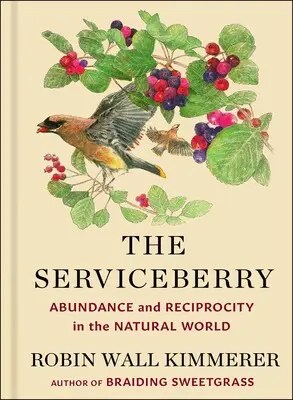
A Potawatomi author and botanist explores the concept of gift economies through the author’s reflections on nature, reciprocity, and the lessons of the serviceberry tree.
Summary:
As indigenous scientist and author of Braiding Sweetgrass Robin Wall Kimmerer harvests serviceberries alongside the birds, she considers the ethic of reciprocity that lies at the heart of the gift economy. How, she asks, can we learn from indigenous wisdom and the plant world to reimagine what we value most? Our economy is rooted in scarcity, competition, and the hoarding of resources, and we have surrendered our values to a system that actively harms what we love.
Meanwhile, the serviceberry’s relationship with the natural world is an embodiment of reciprocity, interconnectedness, and gratitude. The tree distributes its wealth—its abundance of sweet, juicy berries—to meet the needs of its natural community. And this distribution insures its own survival. As Kimmerer explains, “Serviceberries show us another model, one based upon reciprocity, where wealth comes from the quality of your relationships, not from the illusion of self-sufficiency.”
Review:
I was incredibly moved by Robin Wall Kimmerer’s Braiding Sweetgrass, which beautifully wove together the spiritual and the scientific. So, I was excited to dive into her new book, The Serviceberry, which blends natural biology with economics—yes, you read that right.
This short book is gorgeously illustrated by John Burgoyne with thematic line drawings that complement Kimmerer’s reflections. The story centers on her harvesting serviceberries, and this simple activity becomes the starting point for a profound exploration of economic systems.
I’ll admit, before reading this book, I didn’t know much about serviceberries, even though I spent my childhood picking wild berries. After reading Kimmerer’s description and researching more, I’m still not sure I’ve encountered them in the wild myself. I wonder if having a personal connection to the plant would have deepened my connection to the book, much like it did with many of the plants discussed in Braiding Sweetgrass.
The core of the book discusses gift economies—systems of mutual support that thrive on sharing abundance. Kimmerer writes:
Gift economies arise from an understanding of earthly abundance and the gratitude it generates. A perception of abundance, based on the notion that there is enough if we share it, underlies economies of mutual support. (page 75)
Kimmerer uses her own harvest of serviceberries as a metaphor: after gathering more than enough berries, she shares them with her neighbors, who might then return the generosity by baking a pie to share. She connects this to examples like Little Free Libraries and free stands giving away zucchini, offering a hopeful vision of a world where wealth is measured not by money, but by the relationships we build.
However, I struggled to fully embrace this vision. While I appreciate Kimmerer’s focus on the power of sharing, I was reading this book during a time of travel frustration—waiting overnight for a massively delayed airplane—and found myself questioning the likelihood of these ideas. The concept of abundance feels hard to grasp when faced with the reality of scarcity—especially when airlines don’t have enough seats for stranded travelers.
I also hear the idealistic rebuttal: in a gift economy, I wouldn’t need to travel far to see family because we’d all be close by, sharing our abundance. But my personal experience with things like Little Free Libraries, where people dump books in condition too bad for anyone to use, makes me question the idealism of this system. While Serviceberry presents a beautiful vision of generosity, it doesn’t address the real challenges of maintaining such systems at scale.
Despite this, I still value Kimmerer’s generosity in donating all her advance payments to support land protection, restoration, and justice. Her actions speak louder than words, and that’s something I deeply respect.
Overall, this is a quick read that challenges readers to think about economics, abundance, and reciprocity in new ways. While it didn’t convince me of the feasibility of the gift economy, it certainly provided food for thought. I recommend it to those who are interested in reimagining our current economic systems through a natural lens.
If you found this review helpful, please consider tipping me on ko-fi, checking out my digital items available in my ko-fi shop, buying one of my publications, using one of my referral/coupon codes, or signing up for my free microfiction monthly newsletter. Thank you for your support!
4 out of 5 stars
Length: 128 pages – novella/short nonfiction
Source: Library
Buy It (Amazon or Bookshop.org)
Book Review: Braiding Sweetgrass: Indigenous Wisdom, Scientific Knowledge, and the Teachings of Plants by Robin Wall Kimmerer
Summary:
Member of the Potawatomi Nation and botanist Robin Wall Kimmerer presents a series of essays on plants of North America, incorporating some memoirs from her life and her daughter’s recollections as well.
Review:
It’s difficult to describe how meaningful this book is. The description sounds so simple and yet, to me, it is a collection of scientific and Indigenous knowledge intertwined as near poetry. As an urban gardener who grew up rural among farms, I think of myself as plant knowledgeable, but I was humbled by this book. I also teach, and I found her ruminations on teaching and balancing teaching other people’s children versus your own to be beautifully honest. This book takes time to get through but because of the rich meaning in each essay. You find yourself wanting to savor it.
As a person who feels both spiritually and scientifically minded, this book spoke to me on a mind and soul level simultaneously in ways I cannot fully describe. I wish there was greater focus on teaching this way. I wish the two were not divorced from each other in our society. I think it would be healing to us all and to nature as well if they were not.
Allow me to try to pull out a few meaningful quotes to me by theme.
On morality, contentment, and consumerism:
Refusal to participate is a moral choice.
Transformation is not accomplished by tentative wading at the edge.
Balance is not a passive resting place.
In a consumer society, contentment is a radical proposition.
The consumption-driven mind-set masquerades as “quality of life” but eats us from within.
On teaching and being taught:
The professor made me doubt where I came from, what I knew, and claimed that his was the right way to think.
Teach any who will come.
I’d left my baby girls at home with their dad in order to introduce other people’s children to something they cared little about.
Facts about plants that fascinated me, include that a 3 sisters garden [growing corn, beans, and squash together the Indigenous way] yields more food than if you grew each alone, polycultures are less susceptible to pest outbreaks than monocultures, breathing in the smell of humus (the dirt, not the food) releases oxcytocin, and lichens are actually two beings together (a fungus and an alga). I also learned:
Sweetgrass thrives where it is used and disappears elsewhere.
Plantain is not indigenous but naturalized. It’s so prevalent and well-integrated that we think it’s native.
Estuaries can have the highest biodiversity and productivity of any method.
Forest ecologists estimate that the window of opportunity for cedars to get started occurs perhaps only twice a century.
I hope I have made you intrigued by this book. I loved it so much that I bought myself a copy after starting off with a digital library copy.
5 out of 5 stars
Length: 391 pages – average but on the longer side
Source: Purchased
Buy It (Amazon or Bookshop.org)

Cross-Stitch #14: Fiddleheads
I’m happy to announce that I’ve finished designing and stitching the second item in my Foraging New England line. I actually finished this a few weeks ago, but I gave the completed stitch away as a present, and I didn’t want to post it until I had given it away. Didn’t want to spoil the surprise!
The second plant featured in the Foraging New England line is: fiddleheads!
 Fiddleheads are young ferns before their fronds have unfurled. They are foraged by New Englanders for use as a vegetable, generally boiled or steamed and served alongside a main course. The pattern is stitched on oatmeal aida with the common name (fiddleheads) above the plant, and the scientific name (matteuccia struthiopteris) below it. This is done to reflect older hand-drawn plant guidebooks.
I have closed my Etsy shop, but this pattern is available as a digital download for $2.99 in my Ko-fi shop.
 Support my work with a tip or browse my shop for curated book club guides, how to guides, cross-stitch patterns, and more!


This work by Amanda Nevius is licensed under a Creative Commons Attribution-Noncommercial-No Derivative Works 3.0 United States License.
 Opinions of a Wolf