
Archive
Book Review: House of Stairs by William Sleator
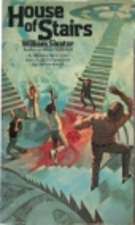 Summary:
Five sixteen year old orphans living in state institutions are called to their respective offices, blindfolded, and dropped off in a building that consists entirely of stairs and landings. There appears to be no way out. The toilet is precariously perched in the middle of a bridge, and they must drink from it as well. To eat they must bow to the whims of a machine with odd voices and flashing lights. It is starting to change them. Will any of them fight it, or will they all give in?
Review:
This book was enthralling from the first scene, featuring Peter awakening on a landing intensely disoriented and frightened. Showing a bunch of teenagers obviously in an experiment opens itself up to caricature and stereotype, but Sleator skillfully weaves depthves and intricacies to them.
The writing is beautiful, smoothly switching viewpoints in various chapters from character to character. Hints are dropped about the outside world, presumably future America, that indicate the teens are from a land ravaged by war and intense morality rules. For instance, their state institutions were segregated by gender. Sleator weaves these tiny details into the story in subtle ways that still manage to paint a clear framework for the type of cultural situation that would allow such an experiment to take place.
It is abundantly clear throughout the book that the teens are facing an inhumane experiment. Yet what is not clear at first is what a beautiful allegory for the dangerous direction society could take this story is. Not in the sense that a group of teens will be forcibly placed in a house of stairs, but that some more powerful person could mold our surroundings to make us do what they want us to do. To remove our most basic humanity. This is what makes for such a powerful story.
It’s also nice that friendship in lieu of romance is central to the plot. Modern day YA often focuses intensely on romance. Personally, my teen years were much more focused on friendship, and I enjoyed seeing that in this YA book. I also like how much this humanizes the animals facing animal testing, and Sleator even dedicates the book to “the rats and pigeons who have already been there.”
House of Stairs, quite simply, beautifully weaves multiple social commentaries into one. It is a fast-paced, engrossing read, and I highly recommend it to everyone.
5 out of 5 stars
Source: PaperBackSwap

Book Review: Feed by M. T. Anderson
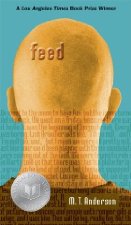 Summary:
Titus is your typical teenager of future America. He lives in a suburb where his parents program the weather. He drives an upcar. He’s got a feed–a microchip in his brain that allows him to chat silently with people, shop, look up anything he wants to know more about, etc… He’s also got a lesion, but a lot of people have those now. He is quite ordinary. But he meets a girl on a trip to the moon who is anything but ordinary. A girl who got the feed late and dares to question it.
Review:
This book has a great concept, essentially exploring what the world would be like if twitter was implanted into our brains. This is rather extraordinary given that twitter didn’t even exist yet when Anderson wrote it. It explores losing our individuality to machines and consumerism. Ceasing to care about important information due to being bombarded by inane information at all hours of the day. I just wish Anderson had taken this concept a different direction.
I immediately connected with Violet, the girl Titus meets on the moon. She’s quirky, is homeschooled, and really is a bit of a nerd who just wants a chance to try out hanging out with the popular kids and doing what they do. Titus is a complete and total asshole to her. I suppose I could forgive him for that if he showed that he learned anything from coming into contact with a person as powerful as Violet, but he doesn’t. He ditches her when she needs him most because she’s making him uncomfortable. He wants to stay in the cocoon of his feed-driven life, and nothing she does or says can change that. He clearly goes from girl to girl, using them up like paper towels or tissues, and then on to the next one. Maybe that was Anderson’s point–that the feed has dehumanized the people who have it–but it made for a less powerful book than if Titus had learned something. Anything.
Similarly some questions just aren’t answered simply because Titus doesn’t care, so we aren’t allowed to know. In particular the lesions are set up as some sinister mystery, but then we never find out why they are occurring. Nobody even really speculates as to why they’re showing up. They’re just there. I seriously doubt there’d be zero speculation over such a phenomenon, even in a future where people are obsessed with consumerism.
Overall, the concept and writing on a sentence level are good, but the story as a whole left me feeling empty and disappointed. There’s telling a bleak story, and then there’s telling a story that’s sympathetic to a jerkwad. This is the latter. If that type of story is something you enjoy, you will enjoy this book. Everyone else should look elsewhere, perhaps to The Hunger Games if you’re looking for a YA dystopia.
3 out of 5 stars
Source: Swaptree

Book Review: The World Inside by Robert Silverberg
 Summary:
Hundreds of years in the future, Earth society has dealt with the population crisis by discovering the ability to build Urban Monads (urbmons). Each building is 1,000 stories and houses around 880,000 people. This vertical hive living has allowed for most of the land to be farmland, managed by communes still living in the traditional horizontal style. It’s a beautiful day in Urbmon 116, and we’ll get to meet people from each level of the city from artistic San Francisco to academic Shanghai to ruling Louisville. Their lives of enforced zero privacy, no locked doors, mandatory acceptance of sexual requests from anyone of age, and a reverence for fertility resulting in uncontrolled population growth present a unique social situation. An academic wonders if humanity has forcibly evolved itself to naturally enjoy the Urbmon lifestyle or if it is a cultural influence forced upon them. Maybe these next few days will help him tell.
Review:
This book is such a creative imagining of a possible future, one I certainly never had thought of. Silverberg approaches his storytelling by at first making it seem as if we will be exposed to a series of vignettes about the inhabitants of Urbmon 116, but then their interconnection suddenly becomes apparent as the dual climaxes approach. I was certainly not bored with the vignette portion as the society of the Urbmon is so interesting, but the interconnection moved it from being an interesting book to a powerful book.
The World Inside is a look at what would happen if the most fundamentalist pro-lifers were to win the majority and gain great power. There is no birth control, every fetus conceived is brought to childhood (although the gender may be manipulated to maintain a balance). Interestingly, in order for this pro-life construct to gain power, they also had to make concessions to the free love folks. Everyone gets married at a very young age, but there is no such thing as sexual loyalty. People are encouraged to nightwalk–leave their own abode at some point after midnight and enter another apartment and have sex with one of the adults there. Often the husband or wife will stay in the room in spite of the sex going on in the same bed as them with their spouse. This is explained as a necessary way to maintain harmony in the building. It is intriguing to see such a lack of regard for parental loyalty to each other in a society that encourages so much procreation, yet it all makes sense.
That is really what makes this such a strong book. It’s such a plausible future, given the proper circumstances, that it gives chills, and yet Silverberg still shows the basic humanity in these people, stuck in a culture, a society that they have little to no control over. If they fail to fit into the social constructs at all, they are simply put down the chute–killed and used as fuel for the building. There is no room for real discourse or exploration of where they may have gone wrong. It’s a social construct that happened out of necessity due to humanity’s refusal to stop procreating so much. They gave up all their other freedoms for that one. Even the freedom to chose to be monogamous if you want. It is such an emotional, thought-provoking warning gong. It’s definitely a book I will hold onto and re-read.
If you enjoy scifi, dystopias, or philosophical explorations of the human condition, you will definitely enjoy this book. I highly recommend it.
5 out of 5 stars
Source: PaperBackSwap

Book Review: The Year of the Flood By Margaret Atwood
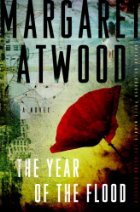 Summary:
Toby, a spa-worker, and Ren, an exotic dancer and prostitute, have both survived the waterless flood–a global pandemic that has killed almost all of humanity. They also both used to live with The Gardeners, a vegetarian cult that constantly warned of the impending apocalypse. A series of flashbacks tells how they survived the pandemic while the question of what to do now that the pandemic is mostly over looms large in their lives.
Review:
Margaret Atwood is one of my favorite authors. I love dystopian books, and she has an incredible talent for taking the current worries and news items and turning them into a near-future dystopia. Toby’s and Ren’s world prior to the waterless flood isn’t anything to be happy about. Slums dominate. Gangs run rampant. The world is now run by a giant evil corporation (which is somehow worse than a giant evil government? *shrugs*). It’s really the little things that makes this future world believable. Kids wear bracelets that have live mini jellyfish in them. Species have been spliced together to make new, more usable ones, such as the Mo’Hair–a sheep whose wool makes perfect fake hair for women. The people who don’t live in slums live in corporation-run compounds where everything they do is monitored. What makes this dystopia wonderful is how plausible it all seems.
Really, though, all of these dystopian features are just a back-drop for the real stories. Toby spends years hiding with The Gardeners and running because one man, Blanco, decided he owned her upon having slept with her. When Toby defied him, he vowed to kill her. He haunts her life for years on end. Similarly, Ren falls in love with a boy in highschool who breaks her heart yet somehow keeps coming back into her life and repeating the damage.
This is a book about mistakes. About how thinking we own the Earth and its creatures could cause our own demise. About how sleeping with the wrong man just once can haunt you for years. About how loving the wrong man can hurt you for years.
This is what I love about Atwood. She has such wonderful insight into what it is to be a woman. Insight into what haunts women’s dreams. When women talk about what scares them, it isn’t nuclear war–it’s the man in the dark alley who will grab her and rape her and never leave her alone. Toby’s Blanco is the embodiment of this fear. She sees him around every corner. She’s afraid to go visit a neighbor because he might find her on the street walking there. Setting this fear in an other world makes it easier for female readers to take a step back and really see the situation for what it is. Yes, he’s a strong, frightening man, but Toby let him disempower her by simply fearing him for years. This is what Atwood does well.
The pandemic, however, is not done so well. Too many questions are left. Where did the pandemic come from? Does it work quickly or slowly? Some characters seem to explode blood immediately upon infection, whereas others wander around with just a fever infecting others.
Similarly, the reader is left with no clear idea as to how long it has been since the pandemic started. On the one hand it seems like a month or two. On the other hand, the stockpiles of food The Gardeners made run out quite early, and that just doesn’t mesh given how much attention they gave to them prior to the pandemic.
I also found the end of the book extremely dissatisfying. It leaves the reader with way too many unanswered questions. In fact, it feels completely abrupt. Almost like Atwood was running out of time for her book deadline so just decided “ok, we’ll end there.” I know dystopian novels like to leave a few unanswered questions, but I don’t think it’s appropriate to leave this many unanswered.
The Year of the Flood sets up a believable dystopia that sucks the reader in and has her reconsidering all of her life perceptions. Unfortunately, the ending lets the reader down. I think it’s still worth the read, because it is enjoyable for the majority of the book, and I am still pondering issues it raised days later. If you’re into the environmental movement or women’s issues, you will enjoy this book–just don’t say I didn’t warn you when the ending leaves you throwing the book across the room. ;-)
4 out of 5 stars
Source: Library

Book Review: Fourth Realm Trilogy By John Twelve Hawks


Summary:
John Twelve Hawks presents us with a near-future dystopia in the Fourth Realm Trilogy—The Traveler, The Dark River, and The Golden City. In this vision of the world Earth as we know it is actually just one of six realms of parallel universes. Travelers are the only ones who can move between these parallel universes. Saints with visions of heaven and hell and motivating, compassionate people such as Buddha are examples of past travelers. They seek to keep people aware of their “Light” aka soul. An evil organization called The Brotherhood has been seeking for generations to wipe out travelers, as they believe they cause dissent. Working against The Brotherhood are Harlequins–people raised from birth to defend travelers at all costs. The Brotherhood thought they had succeeded and have started building a panopticon–a virtual prison in which everyone is constantly under surveillance for “their own protection.” However, two brothers–Michael and Gabriel–are actually travelers. Michael sides with The Brotherhood in an effort to ensnare humanity, while Gabriel teams up with Maya, a Harlequin. The two brothers thus are pit against each other in an effort to enslave or save humanity.
Review:
The Fourth Realm Trilogy is decidedly a series with a message and an agenda. “John Twelve Hawks” is actually a pen-name, and the publisher claims that he does try to live off the grid out of a concern about loss of freedom via invasion of privacy with new technology. There is skepticism as to whether this is true or a marketing hype. Regardless, whoever the author is, his main concern is definitely loss of privacy to technology, and this is abundantly evident in the trilogy.
This is a plot-driven trilogy. It reads like an action film in the feel of The Matrix. Further it is exciting because the world the characters live in looks exactly like our own, right down to the surveillance cameras in London. The only difference is these parallel universes, which is a feature I enjoyed a lot. Dystopian novels are usually either completely bound in our world or take place in an entirely different one. This trilogy utilizes both approaches, and this kept it from feeling like an updated version of 1984.
There are many characters. Thankfully, they are distinct enough that keeping track of them is relatively easy, but sometimes Twelve Hawks does not pay enough attention to character development. Particularly toward the end of the trilogy, characters will suddenly make a decision or behave in a manner that comes out of nowhere and is completely out of character. These moments are jarring and distract from the plot.
The plot itself is a good, complex one. It takes place all over this world and journeys to every single realm. Two plot sequences I particularly enjoyed were one in an off-the-grid commune in the south-west US and another in Japan. Twelve Hawks must have travelled extensively, because the descriptions scream “I’ve been there. I know what it’s really like.” There was one plot hole in The Dark River that still bothers me. I think what probably happened is there’s an explanation for the action, but Twelve Hawks neglected to write it in. However, the ending makes up for the plot hole as I was unable to predict it. I absolutely love unpredictable endings that keep me page-turning right up until the end.
Another enjoyable element of the trilogy is the violence. It is chock-full of creative deaths, and even characters who don’t die get beat up a lot–in all realms. An example of the level of violence is a scene where three characters’ limbs are simultaneously wripped off in front of an audience. However, most of the violence is more of the ninja type, due to the presence of the sword and martial-arts trained Harlequins. Twelve Hawks’s strength is writing action sequences, so these are great fun to read.
A mark against the trilogy is periodic character speeches that are obviously Twelve Hawks voicing his opinion. This a typical short-coming of dystopian novels though. Authors with a dark vision of the future can’t seem to help proselytizing in an attempt to save it. I don’t hold this against the novels, but other readers might find it more annoying. There’s essentially one speech a book.
If you enjoy Quentin Tarantino movies or want a more grown-up, spiritual version of The Hunger Games, definitely give the Fourth Realm Trilogy a chance. I doubt you’ll be disappointed.
4 out of 5 stars
Source: Bought The Traveller, borrowed The Dark River and The Golden City from the library


 Support my work with a tip or browse my shop for curated book club guides, how to guides, cross-stitch patterns, and more!


This work by Amanda Nevius is licensed under a Creative Commons Attribution-Noncommercial-No Derivative Works 3.0 United States License.
 Opinions of a Wolf