
Archive
5 More Questions About Books
You guys may remember the previous meme post I did 5 Questions About Books, which I acquired from Syosset Public Library’s Readers and Reference blog. Well, the lovely Sonia of the library, contacted me with the complete list of questions they use in case I wanted to do another meme! So here’s 5 More Questions About Books, and as before, feel free to use the meme yourself.
What book is on your nightstand right now?:
The Angry Heart: Overcoming Borderline and Addictive Disorders: An Interactive Self-Help Guide by Joseph Santoro, PhD. It’s a great book, and I highly recommend it!
What is a book you’ve faked reading?:
Bleak House by Charles Dickens. It was assigned for a required course in British literature. I attempted to read it, but after a couple of chapters and with the other homework I had going on that semester, Sparknotes became my very dear friend. For the record, I aced the exam questions on it. ;-)
What’s a book that’s changed your life?:
The Handmaid’s Tale by Margaret Atwood. I was raised in a very traditional, religious, patriarchal manner, and this book was what spurred me on to investigate other ways of looking at the world. Needless to say, I am no longer religious; I am a feminist. This book is what started me on the path to free-thought, and I will always love Margaret Atwood for that.
Can you quote a favorite line from a book?:
“…If death
Consort with thee, death is to me as life;
So forcible within my heart I feel
The bond of nature draw me to my own;
My own in thee, for what thou art is mine:
Our state cannot be severed, we are one,
One flesh; to lose thee were to lose myself.”
Adam to Eve, Paradise Lost by John Milton. One of my favorite quotes of all time.
What’s your favorite book genre?:
This should come as absolutely no surprise to anyone, but dystopian literature followed closely by scifi with horror a super-duper close third.
Book Review: The Year of the Flood By Margaret Atwood
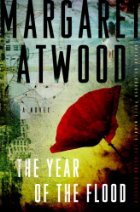 Summary:
Toby, a spa-worker, and Ren, an exotic dancer and prostitute, have both survived the waterless flood–a global pandemic that has killed almost all of humanity. They also both used to live with The Gardeners, a vegetarian cult that constantly warned of the impending apocalypse. A series of flashbacks tells how they survived the pandemic while the question of what to do now that the pandemic is mostly over looms large in their lives.
Review:
Margaret Atwood is one of my favorite authors. I love dystopian books, and she has an incredible talent for taking the current worries and news items and turning them into a near-future dystopia. Toby’s and Ren’s world prior to the waterless flood isn’t anything to be happy about. Slums dominate. Gangs run rampant. The world is now run by a giant evil corporation (which is somehow worse than a giant evil government? *shrugs*). It’s really the little things that makes this future world believable. Kids wear bracelets that have live mini jellyfish in them. Species have been spliced together to make new, more usable ones, such as the Mo’Hair–a sheep whose wool makes perfect fake hair for women. The people who don’t live in slums live in corporation-run compounds where everything they do is monitored. What makes this dystopia wonderful is how plausible it all seems.
Really, though, all of these dystopian features are just a back-drop for the real stories. Toby spends years hiding with The Gardeners and running because one man, Blanco, decided he owned her upon having slept with her. When Toby defied him, he vowed to kill her. He haunts her life for years on end. Similarly, Ren falls in love with a boy in highschool who breaks her heart yet somehow keeps coming back into her life and repeating the damage.
This is a book about mistakes. About how thinking we own the Earth and its creatures could cause our own demise. About how sleeping with the wrong man just once can haunt you for years. About how loving the wrong man can hurt you for years.
This is what I love about Atwood. She has such wonderful insight into what it is to be a woman. Insight into what haunts women’s dreams. When women talk about what scares them, it isn’t nuclear war–it’s the man in the dark alley who will grab her and rape her and never leave her alone. Toby’s Blanco is the embodiment of this fear. She sees him around every corner. She’s afraid to go visit a neighbor because he might find her on the street walking there. Setting this fear in an other world makes it easier for female readers to take a step back and really see the situation for what it is. Yes, he’s a strong, frightening man, but Toby let him disempower her by simply fearing him for years. This is what Atwood does well.
The pandemic, however, is not done so well. Too many questions are left. Where did the pandemic come from? Does it work quickly or slowly? Some characters seem to explode blood immediately upon infection, whereas others wander around with just a fever infecting others.
Similarly, the reader is left with no clear idea as to how long it has been since the pandemic started. On the one hand it seems like a month or two. On the other hand, the stockpiles of food The Gardeners made run out quite early, and that just doesn’t mesh given how much attention they gave to them prior to the pandemic.
I also found the end of the book extremely dissatisfying. It leaves the reader with way too many unanswered questions. In fact, it feels completely abrupt. Almost like Atwood was running out of time for her book deadline so just decided “ok, we’ll end there.” I know dystopian novels like to leave a few unanswered questions, but I don’t think it’s appropriate to leave this many unanswered.
The Year of the Flood sets up a believable dystopia that sucks the reader in and has her reconsidering all of her life perceptions. Unfortunately, the ending lets the reader down. I think it’s still worth the read, because it is enjoyable for the majority of the book, and I am still pondering issues it raised days later. If you’re into the environmental movement or women’s issues, you will enjoy this book–just don’t say I didn’t warn you when the ending leaves you throwing the book across the room. ;-)
4 out of 5 stars
Source: Library

Book Review: Fourth Realm Trilogy By John Twelve Hawks


Summary:
John Twelve Hawks presents us with a near-future dystopia in the Fourth Realm Trilogy—The Traveler, The Dark River, and The Golden City. In this vision of the world Earth as we know it is actually just one of six realms of parallel universes. Travelers are the only ones who can move between these parallel universes. Saints with visions of heaven and hell and motivating, compassionate people such as Buddha are examples of past travelers. They seek to keep people aware of their “Light” aka soul. An evil organization called The Brotherhood has been seeking for generations to wipe out travelers, as they believe they cause dissent. Working against The Brotherhood are Harlequins–people raised from birth to defend travelers at all costs. The Brotherhood thought they had succeeded and have started building a panopticon–a virtual prison in which everyone is constantly under surveillance for “their own protection.” However, two brothers–Michael and Gabriel–are actually travelers. Michael sides with The Brotherhood in an effort to ensnare humanity, while Gabriel teams up with Maya, a Harlequin. The two brothers thus are pit against each other in an effort to enslave or save humanity.
Review:
The Fourth Realm Trilogy is decidedly a series with a message and an agenda. “John Twelve Hawks” is actually a pen-name, and the publisher claims that he does try to live off the grid out of a concern about loss of freedom via invasion of privacy with new technology. There is skepticism as to whether this is true or a marketing hype. Regardless, whoever the author is, his main concern is definitely loss of privacy to technology, and this is abundantly evident in the trilogy.
This is a plot-driven trilogy. It reads like an action film in the feel of The Matrix. Further it is exciting because the world the characters live in looks exactly like our own, right down to the surveillance cameras in London. The only difference is these parallel universes, which is a feature I enjoyed a lot. Dystopian novels are usually either completely bound in our world or take place in an entirely different one. This trilogy utilizes both approaches, and this kept it from feeling like an updated version of 1984.
There are many characters. Thankfully, they are distinct enough that keeping track of them is relatively easy, but sometimes Twelve Hawks does not pay enough attention to character development. Particularly toward the end of the trilogy, characters will suddenly make a decision or behave in a manner that comes out of nowhere and is completely out of character. These moments are jarring and distract from the plot.
The plot itself is a good, complex one. It takes place all over this world and journeys to every single realm. Two plot sequences I particularly enjoyed were one in an off-the-grid commune in the south-west US and another in Japan. Twelve Hawks must have travelled extensively, because the descriptions scream “I’ve been there. I know what it’s really like.” There was one plot hole in The Dark River that still bothers me. I think what probably happened is there’s an explanation for the action, but Twelve Hawks neglected to write it in. However, the ending makes up for the plot hole as I was unable to predict it. I absolutely love unpredictable endings that keep me page-turning right up until the end.
Another enjoyable element of the trilogy is the violence. It is chock-full of creative deaths, and even characters who don’t die get beat up a lot–in all realms. An example of the level of violence is a scene where three characters’ limbs are simultaneously wripped off in front of an audience. However, most of the violence is more of the ninja type, due to the presence of the sword and martial-arts trained Harlequins. Twelve Hawks’s strength is writing action sequences, so these are great fun to read.
A mark against the trilogy is periodic character speeches that are obviously Twelve Hawks voicing his opinion. This a typical short-coming of dystopian novels though. Authors with a dark vision of the future can’t seem to help proselytizing in an attempt to save it. I don’t hold this against the novels, but other readers might find it more annoying. There’s essentially one speech a book.
If you enjoy Quentin Tarantino movies or want a more grown-up, spiritual version of The Hunger Games, definitely give the Fourth Realm Trilogy a chance. I doubt you’ll be disappointed.
4 out of 5 stars
Source: Bought The Traveller, borrowed The Dark River and The Golden City from the library


 Support my work with a tip or browse my shop for curated book club guides, how to guides, cross-stitch patterns, and more!


This work by Amanda Nevius is licensed under a Creative Commons Attribution-Noncommercial-No Derivative Works 3.0 United States License.
 Opinions of a Wolf