
Archive
Book Review: A Cyclist’s Guide to Crime and Croissants by Ann Claire
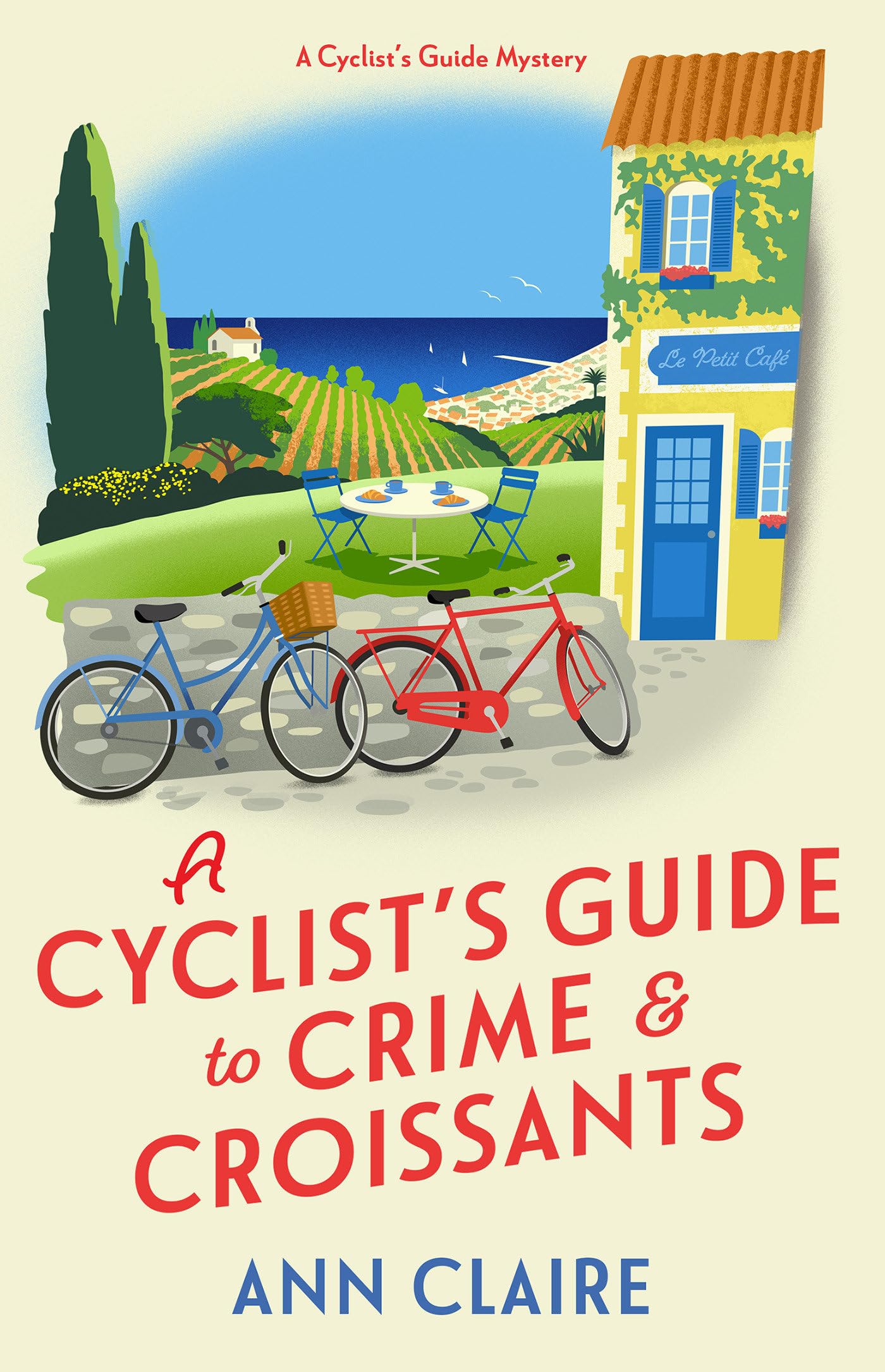
A charming cycling tour in the French countryside takes a deadly turn in this cozy mystery, perfect for fans of Emily in Paris—if Emily spoke French and solved murders between croissant breaks.
Summary:
Nine months ago, Sadie Greene shocked friends and family by ditching her sensible office job in the Chicago suburbs and buying a sight-unseen French bicycling tour company, Oui Cycle. Now she’s living the unconventional life of her dreams in the gorgeous village of Sans-Souci-sur-Mer. Sans souci means carefree, but Sadie feels enough pressure to burst a tire when hometown friends arrive for a tour, including her former boss, Dom Appleton. Sadie is determined to show them the wonders of France and cycling—and to prove she made the right move.
She hopes her meticulously planned nine-day itinerary will win them over, with its stunning seascapes, delicious wine tastings, hilltop villages, and, of course, frequent stops for croissants. When Dom drags his heels on fun, Sadie vows he’ll enjoy if it kills her. That is, until Dom ends up dead. The tragedy was no accident. Someone went out of their way to bring a permanent end to Dom’s vacation.
As more crimes—and murder—roll in, suspicions hover over Oui Cycle. To save her dream business, help her friends, and bring justice, Sadie launches her own investigation. However, mysteries mount with every turn. On an uphill battle for clues, can Sadie come to terms with her painful past while spinning closer to the truth—or will a twisted killer put the brakes on her for good?
Review:
If you’re looking for escapist literature, this cozy mystery delivers. A delightful, trope-perfect entry in the genre, it checks all the essential boxes—a murder that happens off-page? Check. A love interest suspicious of the FMC? Check. A dream career and a picturesque setting? Triple check.
One of the challenges of cozy mysteries is giving the main character an aspirational life without making them unlikable. Sadie, however, is wonderfully relatable. Her backstory is both heartwarming and tragic, making her move to France feel earned rather than enviable. She originally planned to start a bicycle tour business someday with her best friend—until tragedy struck, and her friend was killed in a hit-and-run. This loss becomes the catalyst for Sadie’s life-changing decision, and she makes it happen through a mix of financial prudence (as a former accountant) and a seller who values passion over profit. It’s a compelling, well-crafted setup.
The week of the fateful tour, Sadie’s not-quite-family but family-like friends arrive from the U.S., ostensibly to take her tour—but really, to check up on her. This dynamic adds a layer of personal drama, making the tour more than just a random mix of clients (though there are those, including a sharp-eyed reviewer). The result? Plenty of tension before the mystery even begins.
The French countryside and cuisine are absolutely lovely to read about, and you don’t have to be a cycling enthusiast to enjoy the journey. That said, I personally loved the cycling details, from the Is an e-bike cheating? debate to the hardcore Tour de France trainees Sadie encounters along the way. (If you love cycling too, check out the Bikes in Space anthology I have a short story in.)
Unlike in some cozies, the first murder (yes, first) feels eerily realistic. While I enjoy a good poisoned pie moment, this crime—especially as a cyclist—felt alarmingly plausible, adding genuine weight to the investigation.
One thing I often struggle with in cozies is the detective as a love interest—I tend to find detectives off-putting. However, this one worked for me, largely because his investigative approach felt fresh and culturally distinct. It helped maintain the escapist feel rather than making it feel like a procedural.
Speaking of characters, despite the large cast, I never once lost track of who was who. Each character felt distinct without veering into caricature. That said, the diversity felt a bit Eurocentric—the most notable examples being a Ukrainian refugee and an ex-convict. While I enjoyed both characters, I would have liked to see a bit more variety in representation given the size of the cast.
Halfway through, I was convinced I had solved the mystery. I was wrong. And once the reveal came, I could see exactly where I had been misled—not in a frustrating way, but in a deeply satisfying one.
This is a fun, immersive cozy mystery with a likeable main character, a realistic first murder, and plenty of French countryside charm. Recommended for cozy mystery fans who love an escapist read with a side of cycling, crime, and croissants.
If you found this review helpful, please consider tipping me on ko-fi, checking out my digital items available in my ko-fi shop, buying one of my publications, using one of my referral/coupon codes, or signing up for my free microfiction monthly newsletter. Thank you for your support!
4 out of 5 stars
Length: 346 pages – average but on the longer side
Source: Library
Buy It (Amazon or Bookshop.org)
Book Review: Lucy Checks In by Dee Ernst

Summary:
Lucia Giannetti needs a fresh start. Once the hotel manager of a glamorous NYC hotel and intimately involved with the hotel’s owner, Lucy had her entire future planned out. But when the owner disappears, taking millions of dollars with him, Lucy’s life as she knows it falls apart.
Two years later, forty-nine years old and unemployed, Lucy takes a job in Rennes, France to manage the Hotel Paradis. She pictures fur quilts and extravagant chandeliers, but what she finds is wildly different. Lucy is now in charge of turning the run-down, but charming hotel into a bustling tourist attraction. Between painting rooms, building a website, and getting to know Bing, the irritatingly attractive artist, Lucy finds an unexpected home. But can she succeed in bringing the Hotel Paradis to its former glory?
Review:
I have a real soft spot for romances whose main character is in a “needs a fresh start” spot in life. I was further intrigued by the age of a protagonist. I can’t remember the last time I saw a main character in a romance in her forties, let alone in her forties without kids.
Lucy has a delightful character arc. She starts off seeming a little high maintenance and self-critical, but then we get some reveals that show valid reasons for her being the way she is currently. Then we see her willingness to adapt and change. And honestly it’s easy to empathize with Lucy. She’s having to almost start over from scratch at 49 for reasons way beyond her control. I suppose one could judge her for dating the owner of the hotel but it’s realistic that a lot of people do date those they work with.
Then there’s the setting. I was at first surprised this wasn’t set in Paris (seems like all of these sorts of books are) but I enjoyed the setting of Rennes. I liked the old hotel, the apartments that were once stables. It was definitely a what a cool place to live vibe. I also think the author handled reminding us of the various languages the characters were speaking like it was a movie while still pretty much always writing in English. It was smoothly done yet necessary, and I appreciated that a big mark in Lucy’s favor for this job to begin with was her fluency in French. Because…not everyone speaks English, people.
Now, I didn’t really get hot and bothered for the romance. I didn’t dislike it either. It just was. It’s reasonably done and charming enough, I suppose, but to me the big sell of the book was the setting much more than the romance. I think I also worry a bit about Lucy’s work life and personal life becoming so entwined yet again. And not just in the romance. She’s got a close relationship with the older woman owner of the hotel too. Did the woman learn nothing from embezzlementgate?
Lucy has a brother with alcoholism. The book handles the relative with kindness, but also there’s constant wine drinking because it’s France. Lucy drinks with lunch and dinner on a seemingly daily basis. It seems like questionable behavior, but she never stops to consider it. Something that I would have hoped she’d have done at some point over the course of the book given her brother. Like even just a hm, maybe I should cut back to one glass of wine with dinner thought toward the end of the book would have been nice.
Overall, imagine this as Emily in Paris but with a 40-something main character who can actually speak French, set in Rennes, and with a focus on hotels/architecture instead of fashion. If that appeals to you, then I encourage you to pick it up.
If you found this review helpful, please consider tipping me on ko-fi, checking out my digital items available in my ko-fi shop, buying one of my publications, or using one of my referral/coupon codes. Thank you for your support!
4 out of 5 stars
Length: 288 pages – average but on the shorter side
Source: NetGalley
Buy It (Amazon or Bookshop.org)
Book Review: The Bay of Foxes by Sheila Kohler
 Summary:
Dawit is a twenty year old Ethiopian refugee hiding out illegally in Paris and barely surviving. One day he runs into the elderly, famous French writer, M., in a cafe. Utterly charmed by him and how he reminds her of her long-lost lover she had growing up in Africa, she invites him to come live with her. But Dawit is unable to give M. what she wants, leading to dangerous conflict between them.
Review:
This starts out with an interesting chance meeting in a cafe but proceeds to meander through horror without much of a point.
Although in the third person, we only get Dawit’s perspective, and although he is a sympathetic character, he sometimes seems not entirely well-rounded. Through flashbacks we learn that he grew up as some sort of nobility (like a duke, as he explains to the Romans). His family is killed and imprisoned, and he is eventually helped to escape by an ex-lover and makes it to Paris. This is clearly a painful story, but something about Dawit in his current state keeps the reader from entirely empathizing with him. He was raised noble and privileged, including boarding schools and learning many languages, but he looks down his nose at the French bourgeois, who, let’s be honest, are basically the equivalent of nobility. He judges M. for spending all her money on him instead of sending it to Ethiopia to feed people, but he also accepts the lavish gifts and money himself. Admittedly, he sends some to his friends, but he just seems a bit hypocritical throughout the whole thing. He never really reflects on the toppling of the Emperor in Ethiopia or precisely how society should be ordered to be better. He just essentially says, “Oh, the Emperor wasn’t all that bad, crazy rebels, by the way, M., why aren’t you donating this money to charity instead of spending it on me? But I will tooootally take that cashmere scarf.” Ugh.
That said, Dawit is still more sympathetic than M., who besides being a stuck-up, lazy, self-centered hack also repeatedly rapes Dawit. Yeah. That happened. Quite a few times. And while I get the point that Kohler is making (evil old colonialists raping Ethiopians), well, I suppose I just don’t think it was a very clever allegory. I’d rather read about that actually happening.
In spite of being thoroughly disturbed and squicked out by everyone in the story, I kept reading because Kohler’s prose is so pretty, and I honestly couldn’t figure out how she’d manage to wrap everything up. What point was she going to make? Well, I got to the ending, and honestly the ending didn’t do it for me. I found it a bit convenient and simplistic after the rest of the novel, and it left me kind of wondering what the heck I just spent my time reading.
So, clearly this book rubbed me the wrong way, except for the fact that certain passages are beautifully written. Will it work for other readers? Maybe. Although the readers I know with a vested interest in the effects of colonialism would probably find the allegory as simplistic as I did.
2 out of 5 stars
Source: Netgalley
Counts For:
Specific country? Ethiopia. South African author.

Book Review: Farewell by Honore de Balzac
 Summary:
Philip, a colonel in the military, lost his love Genevieve in Siberia when retreating from the Russians. Years later, he randomly stumbles upon her in a country house with her uncle, having lost her mind from her horrible experiences in Siberia with the military after they lost each other. She is only capable of saying one word. “Farewell.”
Review:
I decided to read a Balzac work due to a reference in the musical The Music Man. The elderly ladies of the town think the librarian is scandalous because she keeps works of Balzac in the library. Clearly I needed to know what all the fuss was about, so I decided to see for myself.
My first instinct is that this classic work of tragedy shouldn’t actually be that scandlous, which perhaps was the point in The Music Man. These elderly ladies are *so* ridiculous to object to Balzac. In any case, however, in retrospect I can see what is so shocking. The incredible weakness of mind and character demonstrated by both Philip and Genevieve are both irritating and depressing. I’m not sure what point Balzac was trying to make, but all I could think was that both of them needed to man up.
That’s not to say the book isn’t well-written though. The translation is lovely, and I’m sure in the original French it is even prettier. Just imagining Genevieve only being able to say “Adieu” sounds prettier than “Farewell.” The scenes are vividly described, and the reader is certainly engaged.
Overall, it is a well-told tragedy that suffers a bit from weak characterization. I recommend it to fans of tragedies and classic French literature.
3.5 out of 5
Source: Audible app for the iPod touch, iPhone, and iPad

Movie Review: The Dinner Game (1998) France Le diner de cons
 Summary:
Pierre and his friends have a recurring dinner party where they each bring an idiot. The person who brings the best idiot wins. Pierre is excited that he may have finally found a winner in Pierre–a government worker who makes models out of matchsticks and talks about them incessantly. However, he throws his back out the night of the party, and his wife walks out on him, leaving him at the hands of the bumbling Francois.
Review:
This is the French movie that is being remade/Americanized into Dinner for Schmucks, which is being released this summer. This is what led me to watch it, and I must say I don’t know why I always forget how much I enjoyed the foreign films I watched in university. They’re such a fun way to immerse yourself in another culture.
The Dinner Game plays with that classic light-handed touch often found in French films. The wit is sly, not heavy-handed. The jokes build slowly, rather like American black-and-white classic films.
I found it delightful that the writers made the choice to make Pierre basically an unredeemable douchebag who you still end up sympathizing with. It takes talent to pull that off, and it is done quite smoothly.
The movie is quite short, though, ringing in at only 81 minutes. I wanted it to last longer! Additionally, the ending was rather sudden. People who don’t like to left guessing won’t enjoy that part of it. I also felt the set-up took a bit long, particularly given the length of the film.
If you enjoy light-handed wit and a good character study, you will enjoy this film.
4 out of 5 stars
Source: Netflix

 Support my work with a tip or browse my shop for curated book club guides, how to guides, cross-stitch patterns, and more!


This work by Amanda Nevius is licensed under a Creative Commons Attribution-Noncommercial-No Derivative Works 3.0 United States License.
 Opinions of a Wolf