
Archive
Book Review: Where Late the Sweet Birds Sang by Kate Wilhelm (Audiobook narrated by Anna Fields)
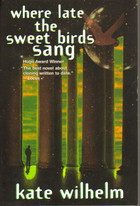 Summary:
When the world goes through an apocalypse consisting of virulent strains of the flu, lack of food, and nuclear warfare, one wealthy family manages to survive because they saw it coming. Made up of highly intelligent and highly educated people, such as doctors and scientists, the family creates a 200 bed hospital and uses this as their home base. But there is a serious fertility problem, and how they address it just might change the core of humanity.
Review:
I love reading classics of scifi. It’s endlessly fascinating how different people in different times imagine a future (or an apocalypse). This award-winning book had the bonus of being written by a woman, which isn’t always easy to find in older scifi. I also was intrigued by the cloning theme. How would someone in 1977 view something that was, as yet, nowhere near as close to a reality as it is now, with our cloned sheep?
The book starts out incredibly strongly. So strongly, in fact, that I actually had nightmares from it, which never happens to me ever. I am basically a rock of horror and scifi, but this one creeped the bejesus out of me. It’s that creepy combination of incest and cloning. The family are really not people you would want retooling the world. They’re everything that can be (and usually is) bad about the 1%. They’re selfish, self-centered, snobby, and routinely employ nepotism. I found the incest in the first third of the book talking about the first generation of the family to be an interesting metaphor for how the elite can become so backwards and grotesque from sheer isolation. It’s powerful and moving, and a scenario that will remain in my mind.
The second third of the book focuses in on a woman, Molly, from the first generation of clones. This is disturbing in its own way, because they don’t just clone everyone once and have done with it, no. They clone everyone multiple times until there are clusters of the same person at different ages wandering around. They call these clusters “brothers” and “sisters” with the name of the original person as the name of the group, even though the individual ones have their own names. It is profoundly disturbing. This second third looks at the society of clones that the original family unintentionally made. It’s fascinating in its own way and an interesting different way of telling a post-apocalypse story. Often we get only the first generation, but here we get multiple generations.
The last third, unfortunately, didn’t live up to the first two-thirds of the book. Without giving too much away, it looks at a boy who came about by natural methods who gets integrated into the clone society at the age of five. They decide not to clone him and give him brothers for unclear reasons. This last third then looks at his impact on the clone society. I didn’t feel that this worked as well for multiple reasons. For one, it’s almost as if Wilhelm freaked herself out and backed off from the profoundly disturbing story she was telling and went a more conventional direction. That was disappointing. For another, I found it disappointing that she chose to make this game-changer a boy. I expect women scifi authors to be at least a bit cognizant of the need in scifi for more female main characters. In this one, the first third is a man, the second third a woman, and the last third a boy. That is not the best stats from a woman author. I also found certain parts of this to be very boring and slow-moving compared to the first two-thirds. That makes for odd pacing in a book.
Of course, my complaints about the last third backing off, being more conventional, and being rather dull don’t take away from the first two thirds at all. They bring about so many interesting societal questions. For instance, is the incestuous nature of the elite necessarily bad or will it one day save humanity? Will cloning remove something that makes us human, even if they look right? Is it better to cling on to technology at all costs or release it and go back to simpler times? And what about sex? Is monogamy natural and polyamory unnatural? Or is polyamory more welcoming and loving than potentially possessive monogamy? The questions go on and on, which is what is great about scifi.
As for the science itself, it is quite well-done. Wilhelm clearly thought through both keeping a closed-off community alive and cloning and bringing to term embryos. She also put thought into the scientific basis for why clusters of clones would be different from individual humans, touching on psychology and twin studies. I was a bit irritated that she bases the survival of these people on cloning farm animals, when that is not a good use of their limited land resources. Studies have shown many many times that a combination of farming vitamin-rich plants and hunting/gathering are the best use of limited land resources, so this particular element rang a bit of bad science. However, I am not certain how much land usage had been studied in the 1970s, so that could possibly just be a sign of the times.
Now, I did read the audiobook, so I should touch on the narration. Overall, Anna Fields does a very good job. I really enjoyed that they chose a female narrator for a book written by a female author. It let me almost imagine that Kate Wilhelm herself was reading it to me. Fields mostly strikes a good balance of changing voices for different characters without going over the top. The one exception to this is when she narrates children. The voice for that made me cringe, but they mercifully speak only a few times. Mostly, Fields reads smoothly and is easy to follow. She narrates without accidentally putting her own interpretation onto the work, which is ideal for an audiobook.
Overall, then, this is a fascinating classic of scifi. It examines the apocalypse through the lens of the elite, thereby analyzing and critiquing them, but it also looks at possible consequences of cloning and ponders what ultimately makes us human. Although the last third of the book is a bit less creative and more conventional than the first two, it is still a fascinating read. Recommended to scifi fans, particularly those with an interest in group dynamics.
4 out of 5 stars
Source: Audible

Book Review: The Wind Through the Keyhole by Stephen King (Series, #4.5)
 Summary:
There’s a tale we have yet to hear about the ka-tet in the time between facing the man in the green castle and the wolves of the Calla. A time when the ka-tet hunkered down and learned a special billy-bumbler talent, an old tale of Gilead, and the first task Roland faced as a young gunslinger after the events at Mejis.
Review:
When I heard there was going to be a new Dark Tower book, I had basically three reactions. 1) Yay! 2) Shit he better not ruin them. 3) Guess I didn’t actually finish that series after all, did I? May have written the series review a bit too soon…..
But mainly my reaction was a skeptical excitement. I love the world of the Dark Tower and was ecstatic to be able to get more of it (yes, I know there are the young gunslinger comic books, but they feel slightly less the same to me since they are in a different format). However, I was also terrified because well we’ve all been in an instance where we mess with something that was good to the point where it’s not good anymore, right? I was worried King was going to do that to the Dark Tower. I am so so so happy to be able to say that worry was unfounded.
This book goes to show just how clearly the entire world of the Dark Tower series exists in King’s mind. The format is a story within a story within a story. The ka-tet have to hunker down to wait out a storm, so Roland starts to tell them a story from when he was a young gunslinger. Within that story, the young Roland tells someone else an old story of Gilead. The Gilead story wraps up, then the young gunslinger, then the ka-tet. A writer must know his world very well to be able to handle such a structure smoothly without confusing his reader, and King does just that. There was no confusion and each story felt fully told. Or as fully told as anything is in the world of the Dark Tower.
I’ve said before that every book in the series basically is a different genre, which is part of what makes it so fun. So what genre is this one? I’d say it’s fairy tales. Once upon a times. And fairy tales generally have a lesson to be learned within them, so what is it in these three? Well, they vary, but I would say overall it’s about leaving aside childish things and childish ways to become an adult. (And, I might add, that happens much much earlier in the Dark Tower than it does in our particular world).
I will say, although I certainly had the impression that this book was going to be about Jake and Oy, it really isn’t. It isn’t much about the ka-tet at all. It’s about Roland and the role of billy-bumblers in the world. Although, personally I wanted more billy-bumblers, but I *always* want more billy-bumblers, because they are definitely my favorite fantastical creature. I’m still holding out hope that King will write something sometime entirely about Oy or billy-bumblers. But this book is not it.
That said, I was oddly not disappointed to see far less of the ka-tet than I was expecting, because the two stories within the frame of the ka-tet are so strongly told. They are just….wow. Terrifying, horrifying, unpredictable, and hilarious simultaneously.
That’s the thing that makes any Dark Tower book fun. It contains all of those things.
Lines can go from laugh out loud humor (with a touch of truth):
Turn yer ears from their promises and yer eyes from their titties. (page 43)
To the starkly sad truth:
Those were good years, but as we know—from stories and from life—the good years never last long. (page 110)
To the simply universal:
“What if I fail?” Tim cried.
Maerlyn laughed. “Sooner or later, we all do.” (page 255)
*shrugs* I admit I’m a bit of a fan girl of the series, but even a fan girl can be sorely disappointed, and I was really and truly not disappointed at all. I laughed, I nodded, I wondered, I quaked, I wished for an illustration sometime somewhere of billy-bumblers dancing in a clearing in the moonlight. Although, speaking of illustrations, how gorgeous is the US kindle cover?! So fucking gorgeous, that’s how.
Back to the point, I was not disappointed at all. I was ultimately elated and wishing for more. And other fans will be too.
5 out of 5 stars
Source: Amazon
Books in Series:
I’m listing all of the books so you can easily see where The Wind Through the Keyhole
The Gunslinger
The Drawing of the Three
The Waste Lands
Wizard and Glass
The Wind Through the Keyhole
Wolves of the Calla
Song of Susannah
The Dark Tower
Series Review (written before we knew there would be more)
Book Review: The Walking Dead Volume 15 by Robert Kirkman (Series, #8) (Graphic Novel)
 Summary:
Everyone’s world was rocked when the zombies got through the community’s fence. Will they respond by banding together or falling apart?
Review:
Ok, before I review, the numberings need a bit of explanation. Comic books are issued very similarly to academic journals. So there are skinny issues that come out every few weeks (generally). A few of these bound together make a volume. A bunch of these bound together make a book (what we call in academia a “bound journal.”) I *was* reading the books of The Walking Dead but then I caught up to the author. I decided I didn’t want to buy issues, because they’re flimsy and you read through them very quickly, so I’m now reading the volumes. I hope that makes some semblance of sense. This will probably be the case throughout the rest of the series, because you have to wait a long time for the books, and I just am too impatient for that. My reviews will then be much shorter, because a book contains a few volumes, and I am now reviewing one volume at a time. Moving right along to the review!
This volume is basically cleaning up the mess from the action of the previous one and prepping for the action of the next one. Classic in-between chapter. What this volume really reminded me of is the infamous “Live together or die alone” speech by Jack in Lost. In fact, this volume sees Rick basically trying to turn into Jack and failing miserably. Long-time readers know I’ve never liked the guy, so personally I got a lot of schadenfreude out of seeing him be so pathetic in this volume.
That said, the survivors are definitely going for a new strategy, which will lend itself well to future fresh storylines, which any long-running series needs.
Fans of the sex will be quite happy with the developments in that area. Drama! Intrigue! Changes of partners!
Overall, it’s an enjoyable entry, if not mind-blowing, that perfectly sets things up for the next volume. Fans won’t be disappointed!
4 out of 5 stars
Source: Newbury Comics

Previous Books in Series:
The Walking Dead, Book One
The Walking Dead, Book Two
The Walking Dead, Book Three
The Walking Dead, Book Four
The Walking Dead, Book Five
The Walking Dead, Book Six
The Walking Dead, Book Seven
Book Review: Soft Apocalypse by Will McIntosh (Audiobook narrated by Erik Davies)
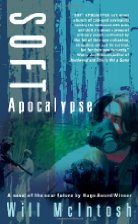 Summary:
Jasper can’t believe he’s actually homeless, although a lot more people are homeless now than used to be. But still. He got his BA in sociology. He’s worked hard. How did this happen? He’s living with a tribe of other 20-somethings. They keep hoping things will get better, but somehow they just seem to keep getting worse. The economy doesn’t improve. Home-grown terrorists known as Jumpy-jumps start routinely terrorizing people. Driving anywhere, having dependable food, actual working police forces, they’re all a thing of the past. Not all apocalypses happen overnight.
Review:
I actually hesitated over keeping this book on my wishlist, but I’m very glad I did. I found it to be not quite what I was expecting. In a good way.
I think a lot of men in particular will enjoy it, because it kind of reminds me of a Judd Apatow film. There’s this complete and utter loser guy who you entirely hate (and I suspect McIntosh hates too) but who is just so damn funny you keep reading it. A lot of apocalypse books focus in on a strong leader type, but Jasper is actually a coward who just keeps trying to squeak by. On top of that, he claims to be looking for true love, but is actually completely lacking in any understanding of women. One of his “apt” observations, for instance, consists of stating to a guy friend, “Have you noticed that fat women have been getting hotter?” He’s trying to say that the more starvation threatens, the more attracted he is to women who obviously have enough to eat. But he isn’t philosophical about it at all, and that’s kind of hilarious. He also tries to impress a girl at one point by commenting on the fact that she’s reading a book, but he says it in such a way that it’s obvious he himself doesn’t read at all, which is utterly baffling in a world that no longer has electricity or other entertainment. Basically the whole book is laughing at a cowardly dude-bro, and that’s fun.
The apocalypse itself is quite creative. As the title and blurb imply, it’s a slow one. Gradual. Things get bad and just never get better then more things get bad. It’s a creative mix of economics, homegrown terrorist groups, scientists trying to make things better but actually making it worse, and international politics. None of it came across as utterly absurd or ridiculous, which shows that McIntosh did a good job.
There are two scenes that are truly horrific, which of course I loved. There’s a very creative death scene that I think will haunt me for a long time. (Again, that’s a good thing). The plot overall is a bit meandering, but that makes sense since Jasper isn’t the most focused or proactive dude on the planet. I’m a little sad the book ended when it did. I get why McIntosh ended it there, leaving things open-ended for readers, but….I could have read about Jasper much much longer. Yes, he’s a guy I would hate beyond all reason in real life, but I guess that schadenfreude factor is what makes the book so fun.
Now, I did read the audiobook, and I have to say I was very disappointed in the narration by Erik Davies. It does not live up to the content of the book at all. My main problem with him is that he does that awful thing of putting on what he thinks is a woman’s voice every time one of them speaks, but what actually sounds like a small child and nothing like us. I actually had to stop and rewind a couple of times to double-check if I was angry at how the book was portraying women or if the narrator was making it seem like the book was portraying women as childish idiots. Suffice to say, it’s definitely the narration, not the book. Yes, Jasper objectifies women and basically calls any woman who doesn’t fit into his definition of what a woman should be “crazy,” but the whole book is laughing at him, so really the book is showing how ridiculous it is to view women like that. The narrator reading women in this childish voice really messes with that whole presentation. So, definitely don’t get the audiobook.
Overall, then, this is a fun apocalyptic scifi featuring a cowardly loser who is delightful to follow and laugh at. I highly recommend it to scifi fans who also enjoy slacker flicks, but definitely get the print or ebook versions, not the audio.
4 out of 5 stars
Source: Audible

Book Review: The Outside Boy by Jeanine Cummins (Bottom of TBR Pile Challenge)
 Summary:
Christy is a Traveller, what Irish gypsies call themselves, in the 1950s. He’s eleven, and his family is about to stay in one town for a whole 40 days and 40 nights for Lent so he and his cousin, Martin, can get ready for confirmation. Christy has always thought his mam died giving birth to him, but when his grandda dies, he finds a newspaper clipping that shows his mam holding him when he’s months old. Thus begins a quest to find out who he really is.
Review:
The particular copy I read I won on a book blog somewhere (I’m afraid I didn’t write down the name), but I also received an ARC during one of the holiday swaps one year. It’s interesting to me, then, that this book wound up on my tbr pile both because I was interested and because someone else thought I would enjoy it. And of course I did.
It is honestly, immediately abundantly clear that Christy’s mother isn’t a Pavee (a Traveller). I was thus skeptical that the story would hold my interest, since predictable ones don’t tend to. I am pleased to say that I was wrong about this on both counts. Although it’s true that Christy’s mother isn’t a Traveller, everything else about her and Christy’s history is actually quite surprising and moving. I’m glad I stuck with it.
The book examines many different issues, some universal and others specific to Irish history. There of course is the issue of identity. Who we are and what makes us that. Is it nature or nurture? The often tough relationship between fathers and sons during the son’s adolescence is also wonderfully presented. Of course a book about gypsies also addresses prejudice, stereotyping, and the norm. Cummins doesn’t sugar coat things. She shows the positive and negative aspects of Traveller culture, which is as it should be. No culture is all perfect or all bad. What the book does a great job of doing is showing how kids learn prejudice and how multiculturalism can enrich everyone’s lives. Some people are one way and some another, and neither is necessarily bad. The book also touches on the animosity between Protestants and Catholics in Ireland, as well as the very real issue of Irish society stealing babies from single mothers in that time period. I know that sounds like a lot, and honestly I’m surprised now that it’s all listed out at how much was touched upon. Cummins strikes the perfect balance of touching on real issues without ever seeming pushy or forced.
Although the storyline and characters are good, it didn’t 100% draw me in. I think it moves a bit too slowly for me in the first half or so of the book. I also, honestly, struggled to like Christy. I eventually came to understand his viewpoint and choices, but I still find him kind of annoying. His father, on the other hand, is incredibly interesting and wonderful, and I kind of wish we had a book about him instead of about Christy. But, some readers enjoy more slowly paced books and others might relate better to Christy than I did. It just personally is what made it a book I liked but didn’t love.
Overall, this book is an interesting entry in historic Irish fiction. It looks at Ireland in the 1950s through the eyes of a small band of gypsies, which is certainly a unique viewpoint. The writing is fluid, if a bit slow-moving, and the plot is not as predictable as it seems at first. Recommended to fans of historic fiction and works set in Ireland.
4 out of 5 stars
Length: 360 pages – average but on the longer side
Source: Won on a book blog (If it was yours, let me know, and I’ll link to you!)
Buy It
If you found this review helpful, please consider tipping me on ko-fi, checking out my digital items available in my ko-fi shop, buying one of my publications, or using one of my referral/coupon codes. Thank you for your support!
Book Review: Lemon Reef by Robin Silverman
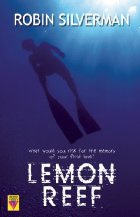 Summary:
Jenna is a high-powered, newly appointed commissioner in San Francisco where she lives with her wife and their dog. Life is good, and Jenna tries not to think too much about her rough childhood and teen years growing up in Florida. But a phone call comes in. Her first love, Del, has died diving at lemon reef at the young age of 30. The mutual friend invites Jenna to the funeral, but when she arrives in Florida, she discovers that there’s more to it than that. Del’s mother, Pascale, wants her help in getting custody of Del’s daughter, Khila, instead of her father, Talon, who Pascale insists must have murdered Del.
Review:
This book was a bit of an emotional roller-coaster to read, which of course is a sign of a good book.
The plot structure is incredibly complex and engaging without ever being confusing. There is the mystery of Del’s death, but also (for the reader) the mystery of why and how Del and Jenna’s romance ended tragically, as it is evident it did. In addition there is the powerful emotions of a first love and first romance for a pair of teens who must grow up too fast thanks to the rough circumstances they find themselves in. Silverman handles the past reminisces intermingled with the current mystery and discoveries quite eloquently. I found myself admiring her talent in plot structuring throughout.
There are no easy answers in this book, and no one is easily demonized, including Talon. Every single character has flaws and good qualities. Del stands up for her siblings but won’t stand up for her love of Jenna. Jenna loves people but can sometimes get too caught up in her own world and her own needs. Pascale was an alcoholic when Del was in highschool but successfully quits in order to be able to spend time with her granddaughter. Del’s sister Nicole breaks a lot of laws (including breaking and entering and prostitution), but she is fiercely loyal and stands up for those she loves. The complexity of the characters and the situation is part of what makes it such an emotional read. There’s no one to easily blame for the problems these women find themselves in. I think this complexity points to Silverman’s experience both as a counselor and a lawyer. She clearly understands human psychology and how problems are not always black and white but can be very gray.
The writing is lovely and fills in the framing of the plot and the characters. There are lines that just totally grab you.
Because minds do blow and hearts do break. Those are not just sayings. And wolves and roaches are not the only creatures that chew off their legs to get out of traps—human beings do that, too. (location 3058)
I also really enjoyed that while Jenna’s coming out story (told in flash-backs and reminiscing) is rather typical, Del’s is much more complex. She is bi but is uncomfortable with the fact that she likes women too. She doesn’t want people to know, doesn’t say a thing about it to her sisters, denies it even. But we find out later that there were other ways in which it was clear she did identify as bi and part of the community. I won’t say how, because I don’t want to spoil the surprise. But I found this complexity interesting. It shows how for Jenna she had to push and come out because there was no other option. Del could sometimes pass but not always and clearly it was a struggle for her throughout her whole life. This shows an understanding of what it is to be bi that I honestly was not expecting, as it is hard to find that in novels.
There were, unfortunately, a couple of things that didn’t quite live up to the rest of the book. There were a few passages that weren’t as well-written or well-edited that detracted from the overall beauty of the book. For instance, there is a scene in which a character points a flashlight at a floor but the narrator calls it the ground. Things like that that are periodically clunky. I’m sure this will improve with time, though, as this is Silverman’s first work of fiction.
I also was disappointed that we didn’t get to see very much at all in regards to how this whole drama of the first love’s mysterious death impacted Jenna’s relationship with her wife. I was hoping this would be at least touched upon in the last chapter, but instead we just see Madison show up with Jenna for the funeral. Since I had come to care for Jenna, I wanted to know how such a dramatic, emotional event would affect her new life and marriage with Madison. It seems obvious to me that such an incident would at least lead to a few discussions and maybe difficult moments between a married couple. I wanted to see that and not seeing it made Madison and Jenna’s marriage to her feel more like a prop than an actual element of Jenna’s life.
Overall, though, this is a unique work of GLBTQ lit. Its themes of reconciling with your past, coming out, being queer, and first love are all beautifully told within a plot that keeps the reader invested and interested. I highly recommend it to GLBTQ readers, but also to anyone with an interest in stories addressing the complexity of human relationships and the long-reaching impact of first loves.
4 out of 5 stars
Source: Netgalley

Book Review: Sophie and the Rising Sun by Augusta Trobaugh
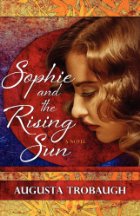 Summary:
Sophie was raised in the rural American south by her elderly widowed mother and two crazy aunts. She was always reserved and a real lady, especially after having lost the first boy she liked in the Great War. Now the year is 1941, and her neighbor Miss Anne has taken on a Japanese-American gardener. He’s not white, but he’s not quite black either, and he and Sophie have painting in common.
Review:
I was excited to see an Asian male/white female (amwf, as it’s known online) story pop up on Netgalley. They can be hard to find, and I thought the dual extra setting of the racist rural south and WWII would make it more interesting. I still don’t doubt that these positive things are what the author was going for, but it didn’t quite come through for me in the story.
Trobaugh picked an interesting writing structure that I found worked well for the story. It’s a mix of an elderly Miss Anne relating her part of the story of what she saw occur between Sophie and Mr. Oto and an omniscient third person narration. This lets the reader see both what the town saw as well as some private moments between Sophie and Mr. Oto that we would not have otherwise seen. It also helped keep the pace flowing forward.
There were also some truly beautiful sequences in the book, such as this sentence:
Too hot. Feel like Satan sucking the breath right out of this old world. (location 1631)
I am disappointed then that I felt the story itself didn’t live up to the writing. Trobaugh falls prey to some stereotyping tropes, and I don’t believe she realized she did. I genuinely believe she meant the story to be progressive, but the two minority characters in the story are two-dimensional and essentially act out the roles assigned to them in American pop culture.
In spite of falling for a white woman, everything else about Mr. Oto is stereotype 101 for Asian-American men. He is: quiet, reserved, effeminate, painfully polite, and bows all the time. The bowing really bothered me, because Mr. Oto was born in America to first generation immigrant parents. I don’t know any first generation Americans who hold on to societal norms from their parents’ country around anyone but their family. The bowing is used as a plot device to show how Mr. Oto is “different” and makes some of the rural whites uncomfortable. I kept hoping that maybe Mr. Oto was putting on an act for the white people to keep himself safe and we would see that he was actually a strong man around Sophie in private, but no. He is precisely the emasculating stereotype of an Asian-American male that we first see.
The other minority character is “Big Sally.” She is, surprise surprise, domestic help. Anyone who was here for The Real Help Reading Project will be aware of all the stereotypes surrounding black women domestic workers. The main one being of course that they’re happy to be the help and will gladly help out white women who are kind to them with their problems. Kind of the all-knowing wise woman who just so happens to scrub your floors. I was truly saddened to see Sally show up and play this role to a T. She overcleans around the white women she doesn’t like to make them feel dirty, but she has no problem stepping right in and fixing everything up for Sophie. There is a scene that made me cringe where she sits down and has a heart-to-heart with Sophie and basically sorts out all of her life problems. I know that Trobaugh thought she was writing a positive image of a black woman, but the character is pure stereotype. She exists to help Sophie and Miss Anne. She ends up being buddy-buddy with Miss Anne and living with her. In the 1940s and 1950s rural south. Yeah. Right. I’m not saying there can’t be a black woman character who is domestic help. That was indeed reality for that historical time period. But why couldn’t there be a scene where Sally and Mr. Oto talk about being othered in the town? Where they talk about the dangers to Mr. Oto after Pearl Harbor and how they are similar to some of what Sally has faced as a black woman? That would have been a truly progressive plot element, and I’m sorry the opportunity wasn’t taken.
Overall then, Trobaugh can indeed write. The book was highly readable and contains some eloquent passages. In spite of attempting a progressive message, though, the book falls to the easier method of plugging in a couple of stereotyped, two-dimensional characters. I hope in future works Trobaugh will put more work into developing truly three-dimensional minority characters. This will strengthen her work and make it more than just a piece of chick lit repeating the same old tropes.
3 out of 5 stars
Source: Netgalley

Book Review: Shadrach in the Furnace by Robert Silverberg (Audiobook narrated by Paul Boehmer)
 Summary:
After a giant volcanic eruption led to chaos and the virus wars, the world came under a one world government led by Genghis Mao based out of Mongolia. The virus wars also led to everyone being infected with organ rot, a condition that simply spontaneously starts whenever it feels like it. Only those working close to the government get the antidote. Shadrach Mordecai, an African-American, went straight from Harvard Med to being the personal doctor for the world dictator. He has implants that allow him to monitor Genghis Mao’s health through his own body, plus he is overseeing the three projects pursuing a way to keep Mao alive forever. But when Project Avatar, which would involve implanting Mao’s brain into a new body, loses its prime candidate, Shadrach realizes his position as aid to Mao might not be keeping him as safe as her previously believed.
Review:
One of my all-time favorite books, The World Inside (review), is by Robert Silverberg, so I decided I should start working on reading all of his writings. So when I saw this Silverberg book on Audible, I immediately knew where my June membership credit would be going.
There are quite a few things that make this piece of scifi stick out. First, out of the four main characters, three are people of color. Shadrach is black, Mao is obviously Mongolian, the head of Project Avatar is Native American (Navajo, I believe), and the head of the project seeking to put Mao into a robot body is headed by a white European woman. It’s an incredibly diverse cast that I really enjoyed. Plus, Shadrach gets it on with both Nikki Crowfoot and Katya (Native and European, respectively). There’s also the fascinating fact that Mao, who previously only wanted a Mongolian body, is totally into the idea of putting his brain into the body of strong, young black man. You could read this one of two ways: either as a scifi slave narrative (Mao owning Shadrach’s body) or as a progressive future where skintone doesn’t matter but the leaders still manage to be totally evil.
The scifi in the book is incredibly strong. Silverberg obviously did his brain and infectious diseases research. It was akin to reading abstracts from medical journals when Shadrach was talking about the various medical things going on with Mao’s body and with organ rot in the general population.
Religion is dealt with in an interesting manner. Most people seem to be more religious. Even the “secular” government workers follow the new religion, whose name I can’t remember I’m afraid, that involves monks and taking hallucinatory drugs. It’s obviously an idea of a futuristic religion born out of the 1970s in which it was written, but it works within the imaginary future it exists within.
Central to the novel is Shadrach’s struggle with the Hippocratic Oath. He is sworn to repeatedly save the life of an evil dictator who is willfully withholding an antidote to organ rot from the general population. It’s obviously an intense moral dilemma and the scifi setting helps the reader look at it with less emotion than if, say, we were talking about a modern setting wherein Shadrach was working for a neo-Nazi or something.
One thing that does date the book is that Silverberg made the choice of giving an exact year for when all of this is going down, and that year is 2012. I did find it an odd bit of serendipity that I just so happened to pick up this book in 2012. In a sense, then, for the modern reader it’s more like reading an alternate history. What *would* have happened if a huge natural disaster had occurred in the 1990s? Whereas in a book like 1984, it’s still the same book for modern readers as for the original readers (you just ignore the date), here the date actually has an impact on the reading of the story. The reading is different now than it probably was for people in the 1970s, but it still works. Just in a different way.
I did feel the pacing is a bit off in the book. It’s a bit up and down. There were a couple of moments earlier in the story that had the intensity level of almost a climax, whereas the climax feels….less climaxy. It took some of the tension out for me, even though I was pleased with the ultimate ending. This did make it ideal for an audiobook, though, since it was easier to come and go from it as I had time to listen. Related to the pacing issue, although most of the book is third person Shadrach’s perspective, there are a few chapters that are first person Mao’s perspective. Those threw me a bit. I’m still not sure how I felt about them. I honestly think it would take a second read in print to get a real vibe for that dynamic.
Speaking of the audiobook, the narrator, Paul Boehmer, does a phenomenal job. He gets many different accents spot on without ever seeming to be racist. He also does a great job differentiating between who is speaking and thinking and what have you. He also did an admirable job narrating the sex scenes. The tonality of his voice is spot on for the intimacy and excitement. I would gladly listen to another book he’s narrated.
Overall then this is an interesting piece of scifi that was originally written as futuristic and now reads as alternate history. It features a diverse, three-dimensional cast and provides a great setting for the moral dilemma of helping those who would harm others. I recommend it to fans of scifi that addresses moral issues.
4 out of 5 stars
Source: Audible

Book Review: The Bedwetter by Sarah Silerman (Bottom of TBR Pile Challenge)
 Summary:
Sarah Silverman is a petite, Jewish comedienne from New Hampshire who has written for SNL and has her own show The Sarah Silverman Program. This is her memoir.
Review:
This review needs a bit of backstory.
Once upon a time, I was dating a guy who is now so universally loathed by myself and my friends that we usually just refer to him as The Douche. Sometimes The Dickwad. One of his all-time favorite comics was (is?) Sarah Silverman, I’m not sure if that’s because A) he finds her funny B) she’s from NH and Jewish and he’s from NH and Jewish or C) he secretly wants to bang her. It is possible it is all three.
 In any case, I am not a fan of Sarah Silverman myself, but when I saw that she was coming to Brookline Booksmith to do a live reading and signing of her new book, I bought tickets for us to surprise him with. Because I am seriously that awesome of a girlfriend. I kid you not. In any case, I did also buy myself a book to have signed because who goes to a book signing and reading doesn’t get a copy signed?
When I say that I’m not a fan of Sarah Silverman I don’t mean oh I don’t really know I never watched or heard or blah de blah. That’s not how my relationship with my ex (The Douche) worked. He liked her, ergo I wound up watching basically everything she ever did. I don’t dislike the woman, but honestly her sense of humor is not my style. It doesn’t offend me, but it also doesn’t make me laugh. The most she might get is a snort.
You can see how non-plussed I was by the whole event from this Friday Fun! post I did about it. (You may notice that post doesn’t mention my ex at all. Painting on the wall, Amanda. But I digress). In fact, the main things that stood out to me at the event were A) how poor Sarah seemed like an introvert who really just needed to be given a cup of tea and sent away from this huge crowd and B) how mortified I was by my ex trying desperately to be all “Hey I’m from NH too!” during the book signing. Dear Sarah, if you are reading this, I was the girl cringing next in line while you somehow managed to not be like “Wow another Jew in Brookline who has been to NH. I am shocked.” Also, we compared signatures later and my name got an exclamation point and a heart, which his did not. I told him that meant you liked me better. Possibly not true, but it was fun to use during fights, so. Brownie points to you, girlfriend.
In any case! Oddly, I still had this book, unread, on my shelf, signed by Sarah, over a year after my relationship with the ex dissolved. If that doesn’t say Bottom of TBR Pile I don’t know what does. But, I think it’s important to know the backstory of I’m not a fan and I got this book going to a book signing with my douchey ex who embarrassed me in front of a celebrity and I couldn’t pick it up for over a year due to a combination of first missing my ex while simultaneously loathing him then after that faded to just not being a fan so why would I pick up a book I would probably find not funny anyway?
Because I’m ocd about my tbr pile that’s why.
So. Knowing all of this, you will understand why my review you are about to read is more like “hey I’m a librarian so who might want to read this and what would they think” as opposed to “omg I love Sarah Silverman and here’s what I think of her book.” Capiche?
This is a memoir that says a lot without actually saying all that much. Sarah tells us some things about her childhood and adult life without actually getting into the nitty gritty real details of who Sarah is. The deeper moments we get are the best in the book–when she talks about struggling with depression in her pre and early teens and about being a long-term bedwetter. Beyond that, we don’t really get to know Sarah. What makes Sarah tick. How does she feel about being an agnostic while her sister is a rabbi on a kibbutz, for instance? Or how did it feel to have a relationship so abundantly in the public eye? (Hers with Jimmy Kimmel. Side-note: I’m Fucking Matt Damon is the only thing she’s done that I find uproariously funny).
Ok, I get it, some people aren’t comfortable talking about more personal stuff (even though that’s what people want in a memoir). But she’s a celebrity. She’s got unique experiences that can’t be all *that* personal. Like maybe she could talk a bit more about what being backstage at the MTV VMAs was like. But all we get is “oh the comics don’t get to see the act right before them.” Kind of disappointing.
There’s also the fact that the memoir is not particularly linear. It kind of swoops around in an ADD manner. Some readers might enjoy that. Others might be turned off. Again, that could be the sense of humor that I just don’t get.
Overall, it’s not a bad memoir. It’s not like it was torturesome to read. It just falls short of the level of information that people kind of expect from a celebrity memoir. It’s possible that it’s an uproariously funny piece of writing, but you’d have to be a fan of Sarah Silverman’s sense of humor to be able to determine that, which I am not.
Recommended for fans of Sarah Silverman with the understanding that it’s more a piece of comedic work than a revealing memoir.
3 out of 5 stars
Source: Brookline Booksmith

Or bid on my signed copy on ebay Auction now over!
Book Review: Thieftaker by D. B. Jackson (Series, #1)
 Summary:
After spending over a decade serving hard labor in the Caribbean for mutiny and conjuring, Ethan has finally made it back to Boston. He now makes his living as a thieftaker, essentially a private investigator who hunts down stolen items, using his conjuring where necessary to help him out. But the year is 1767 and trouble is starting to brew in Boston. The Stamp Tax has been enacted, and the people don’t like it. There are even riots in the street. Against this back-drop, Ethan is asked to find a brooch that was stolen–from the body of a dead girl. He doesn’t usually take on cases involving murder, but this one is different.
Review:
It’s probably hard to tell from this blog, because they’re hard to find, but I am a real sucker for a good Boston during the American Revolution story. So when this title showed up I snapped it up. I’m glad I did because it’s an interesting take on the Stamp Act Riots.
This is an interesting piece of historic fiction, because it’s more like urban fantasy historic fiction. Is that a genre? Can it be? What on earth would we call it? In any case, I was in heaven, because I love BOTH urban fantasy and history so having both in one book was heaven. I mean first it’s breeches and three corner hats then it’s look at this illusion of a creepy little girl. Brilliant.
I struggled a bit with Ethan, which in retrospect wasn’t a bad thing. That shows he’s a realistic, well-rounded character. But let’s be honest. I’m more of a Sam Adams revolutionary type. Ethan served in the British Navy and is all “oh these hooligans.” This bothered me a lot! Especially when I got suspicious that the book as a whole would lean Tory. But! This all ends up being part of the character development, which in the end is what makes the book stronger. Ethan isn’t sure about protesting and fighting the aristocracy at first. But he changes his mind with time. This makes for a great plot-line. I like it. I do hope in the sequel we will get less of this hemming and hawing about owing things to the crown and yadda yadda. DOWN WITH THE KING. Ahem.
As a Bostonian, can I just say, I haven’t seen a book so intent on giving actual street names and buildings before, but it worked. They are totally accurate. I could completely visualize not just the streets but the entire routes Ethan was walking along. Granted, it was as if through a looking glass, since when I walk them they’re a bit different than in 1767, but still. It was very cool. I also really appreciated the depiction of the South Enders, since I spend quite a bit of time in Southie. Seeing the historical versions was really fun.
The magic portion of the book was also unique. Ethan has to cut himself to get blood to work the more powerful spells. The less powerful ones he can work with surrounding grasses, plants, etc… This makes the interesting problem that people struggle in fist-fighting him because if he bleeds he just uses it to work spells. It’s a nice touch.
So with all this glowing, why not five stars? Well, honestly, Ethan bugged me so much for the first 2/3 of the book that I kept almost stopping in spite of all the good things. He’s just such a…a…Tory. For most of the book. Instead of being angry at the man for putting him in prison for conjuring, he blames himself. Instead of being angry that the rich just keep getting richer while he struggles to pay his rent, he blames himself. You get the picture. Being irritated almost constantly by Ethan kind of pulled me out of the world and the story, which I wish hadn’t happened, because it really is such a cool world. I get what Jackson was trying to do, character development wise, but the payoff in the end was almost missed because I kept stopping reading due to being irritated with Ethan. Perhaps if his change of heart had started to show up a bit sooner it would have worked better for me.
Overall, though, this is well-researched and thought out version of Boston during the Stamp Act Riots. Fans of historic fiction and urban fantasy will get a kick out of seeing the latter glamoring up the former.
4 out of 5 stars
Source: NetGalley

 Support my work with a tip or browse my shop for curated book club guides, how to guides, cross-stitch patterns, and more!


This work by Amanda Nevius is licensed under a Creative Commons Attribution-Noncommercial-No Derivative Works 3.0 United States License.
 Opinions of a Wolf