
Archive
Book Review: The Girl Who Drew Butterflies: How Maria Merian’s Art Changed Science by Joyce Sidman

A beautifully illustrated middle grade biography of Maria Merian—the 17th-century artist-scientist who transformed our understanding of butterflies, nature, and the role of women in science.
Summary:
Bugs, of all kinds, were considered to be “born of mud” and to be “beasts of the devil.” Why would anyone, let alone a girl, want to study and observe them?
One of the first naturalists to observe live insects directly, Maria Sibylla Merian was also one of the first to document the metamorphosis of the butterfly. In this nonfiction biography, illustrated throughout with full-color original paintings by Merian herself, author Joyce Sidman paints her own picture of one of the first female entomologists and a woman who flouted convention in the pursuit of knowledge and her passion for insects.
Review:
For my birthday in 2024, I went to The Butterfly Place in Westford, Massachusetts—a magical indoor garden filled with butterflies. In the gift shop, I found this stunning book, and my husband bought it for me. It was gorgeous just sitting on my shelf, but when I finally read it, I was even more blown away.
Told in lyrical yet accessible prose, it is structured around the butterfly life cycle, with chapter titles that mirror each stage from egg to molting to flight. It begins with a short glossary of entomological terms that makes the rest of the book easier to navigate, especially for younger readers.
Every page includes illustrations—historic images that ground us in Maria’s time, reproductions of her own scientific watercolors, and thoughtfully placed modern visuals. The full-color format is truly stunning, making this a standout book for readers of any age.
Maria Merian was born in 1647 in Frankfurt, Germany, into a world where women were expected to remain in the home or quietly assist with family businesses. Her father was a publisher, and, after he passed away, her stepfather was a painter—giving her rare early exposure to both printing and art. Yet as a woman, she was denied access to many materials and was considered a “hobbyist,” painting in watercolors, which were viewed as an inferior medium.

From childhood, Maria was drawn to caterpillars and butterflies—despite the scientific consensus at the time that butterflies spontaneously emerged from mud. She collected caterpillars, documented their transformations, and painted them in astonishing detail. She published a caterpillar book that was well-received. Shortly after this, she left her husband and moved into a Labadist community – a secluded religious group. This allowed her to eventually achieve a divorce for religious reasons. Six years after joining the Labadist community, she left for Amsterdam where she established a business of art supplies, art, and preserved insects with her two daughters.
Years later in her 50s, she did the unthinkable—she self-funded a trip to Suriname to study tropical insects firsthand. The journey took a toll on her health, but she returned with the materials to publish her most famous scientific work. She died a few years later, having defied nearly every expectation placed on women of her time.
The writing is geared toward a middle grade audience. While accessible for the young, it’s also rich enough for adults. Difficult topics are handled with sensitivity: the challenges of being a woman in science, the expectations of motherhood, and Maria’s time in Dutch-colonized Surinam. The author acknowledges Maria’s reliance on local knowledge and her resistance to the sugar trade, while also honestly confronting her complicity in a system of enslavement.
While reading, I couldn’t help but imagine this book sitting on the shelf of one of the characters in Bloemetje, my own literary space fantasy about a Dutch company colonizing Venus—lush with plants, bees, and quiet rebellion. Perhaps I should have included a few more butterflies too.
Overall, this is a beautiful, immersive read that educates about butterflies, art, and women’s history all at once. It’s a remarkable tribute to a woman who saw the natural world differently—and helped change how the rest of us see it too. Highly recommended.
If you found this review helpful, please consider tipping me on ko-fi, checking out my digital items in my ko-fi shop, buying one of my publications, using one of my referral or coupon codes, signing up for my free microfiction monthly newsletter, or tuning into my podcast. Thank you for your support!
5 out of 5 stars
Length: 120 pages – short nonfiction
Source: Gift
Buy It (Amazon or Bookshop.org)
Book Review: Wildwood Chronicles Trilogy by Colin Meloy

When crows steal Prue’s little brother, she and her friend Curtis find that the Impassable Wilderness bordering Portland, Oregon, isn’t quite so Impassable after all.
Summary:
Prue and her friend Curtis uncover a secret world in the midst of violent upheaval—a world full of warring creatures, peaceable mystics, and powerful figures with the darkest intentions. And what begins as a rescue mission becomes something much greater as the two friends find themselves entwined in a struggle for the very freedom of this wilderness. A wilderness the locals call Wildwood.
Review:
A middle grade fantasy trilogy by the lead singer of my favorite band, The Decemberists. Gorgeously illustrated by his wife, Carson Ellis. If you’ve ever read The Chronicles of Narnia, this is like that except replace the Christianity with environmentalism and new age spirituality.
My favorite part of this trilogy was the various talking birds. All the animals in the Impassable Wilderness can talk, but Meloy’s love of birds really comes through. (As a fan of his songs, this didn’t surprise me at all.) The dapper outfits all the animals wear are also just too cute. It’s a trilogy with maps, and I do always love a good map to go with a story. I appreciate very much that the hero of the story is a girl with Curtis playing the sidekick.
There are really two enemies in the plot. A civil war style conflict inside the Impassable Wilderness, and the looming threat of capitalism from outside the Impassable Wilderness. I liked the idea of the latter more than the former, but the execution felt a bit too silly to me. For example, the big bad capitalists are all named the Titans of Industry (capitalized like that). One of them uses child labor in the form of orphans collected directly from Portland. It felt quite Victorian for something where the rest of the world outside of the Impassable Wilderness is quite modern.
The books are incredibly long, hitting chunkster length even for adult books. Each is over 500 pages (the last clocking in at 580.) I certainly read some long books when I was a kid, so I don’t begrudge them that per se. I do think it’s a tough sell when even the first book is super long. Regardless, I don’t think that the length is justified by the plot. While the first book is just about paced right, the latter two are not. There’s a lot of pages spent on not a lot going on. The middle book especially suffers horribly from middle book syndrome.
I liked the world, the Impassable Wilderness residents, and the illustrations. I felt the plot lacked depth, and the pacing was too slow for my taste, especially for such long books. I also found the ending to be a let-down.
Overall, this could be a good match for a reader who has a hankering for a through a secret door fantasy. Especially for the reader who loves talking animals and doesn’t mind a slower pace.
If you found this review helpful, please consider tipping me on ko-fi, checking out my digital items available in my ko-fi shop, buying one of my publications, using one of my referral/coupon codes, or signing up for my free microfiction monthly newsletter. Thank you for your support!
3 out of 5 stars
Books in Series:
Wildwood, 4 stars, length 541 pages – chunkster
Under Wildwood, 3 stars, length 559 pages – chunkster
Wildwood Imperium, 3 stars, length 580 pages – chunkster
Source: Gift
Buy It (Amazon or Bookshop.org)
Two 1980s Horse Girl Books Face Off
Will The Horse that Came to Breakfast or Maggies Wish win?
I’m doing something a little bit different this week. I’ve been going through my bookshelves to determine what to keep and get rid of. If it’s a book I don’t really remember very well, I’m re-reading it to help decide. As a person born in the 1980s, I just so happened to have two middle grade horse girl books first published in the 1980s on the shelf. I didn’t remember anything about them. So I re-read both of them. Each re-read took about an hour. Let’s get into it.

First up we have The Horse that Came to Breakfast by Marilyn D. Anderson, first published in 1987. I picked this one up first because how could I not with that title? I was intrigued! The first sentence didn’t exactly draw me in because it referred to their home as a “house trailer.” I grew up with friends who lived in trailer parks, and my dad lived in one in the last few years of his life. I’ve never heard anyone call them a “house trailer.” The only thing I can think, based on the strong horse presence in the rest of the book, was the author mainly thought of horse trailers when she heard the word trailer and so thought she needed to differentiate. But really it’s the other way around. Trailer (where people live) and horse trailer (what you use to move horses).
Anyway, the basic plot of this book is that this little girl really wants a horse but her parents just got divorced, her dad is now completely out of the picture, her mom had to move them to a trailer, and money is very tight. But one day (in literally the first page of the book) a horse shows up in their yard. It’s a miracle! But her mom points out this horse must have an owner and makes her look for it. It turns out the horse is from a struggling horse riding instruction place. The little girl ends up collecting cans on the side of the road to pay for lessons on the horse. There’s a mean girl who shouldn’t get to ride the horse. The horse’s life is in danger. The little girl has to save him. Etc…
While I was skeptical of this book at first, it really did draw me in. In spite of certain aspects being dated (like how often this little girl was completely unsupervised and doing things like collecting cans along the side of the road or performing chores for random strangers she just met), the overall plot was thoughtful and heartwarming. There was no judgment of her mother for the divorce or the current financial situation, but it also empathically depicted how difficult it can be for kids to adjust to new life situations. It also highlighted caring for your neighbors and building a sense of community. Plus, there’s a happy ending for the girl and the horse. What more can you ask for?

Next up is Maggie’s Wish, first published in 1984. I’ll be honest. I didn’t notice until right now that the author is the same as for The Horse that Came to Breakfast! It felt like two totally different people wrote these books.
The basic plot of this one is that Maggie lives on a working farm with her mom and dad. She’s been asking for a pony to no avail. But one day her dad says the farm is getting something she’s going to really enjoy. She thinks it’s going to be a pony but it turns out to be two large draft horses for working the farm. The dad thinks this will be more fun than tractors. Maggie is disappointed but grows to love the draft horses only for her dad to sell them and ultimately buy her a pony.
The overall message of this book was bizarre. I’m still not sure what it was. Only when you learn to love the disappointing thing will you get what you really wanted? Don’t worry, when your father makes one poor financial decision he’ll continue to make them meaning you’ll ultimately get your pony one day? The family in this have a not great dynamic. The mother is kind of constantly making fun of the father. Of course, it’s a little hard to blame her for being frustrated when he really is making poor financial decisions with the family business without consulting her (his business partner) at all first. But those conversations should be had away from the daughter and not through passive-aggressive comments. I’m also having a hard time understanding how a farmer in 1984 could possibly think using two draft horses would be better than using a tractor. There’s also a scene where the dad spanks his daughter and her cousins (not his own kids) for running off unsupervised and almost getting hurt when he sends the dog to find them who then spooks a cow who almost runs them over. If you know you have a farm with cows who are spooked by dogs and you’re not sure where the children are, why would you send a dog after them? I understand spanking had a different cultural understanding in the 1980s but it’s hard to sympathize with the dad here when he was at least partially responsible for the whole near death experience.
The winner is…..
The Horse that Came to Breakfast! This is the one I decided to keep. Maggie’s Wish went to the local Little Free Library.
This is a great example of how one author can grow and change over time. Anderson’s characters acted with much more logic, even when making mistakes, in her later book. The overall plot was also more complex with elements I didn’t get into for the sake of space here. The message was clear and sound, backed up by memorable characters and intertwining plots. Maybe if the first book you pick up by an author is from early in their career, consider picking up one of the later books just to see.
Somewhat infuriatingly, I will note when I went to get the purchase links, Maggie’s Wish is available both digitally and as new printings. But The Horse that Came to Breakfast is only available as used vintage copies. Why? Why?
If you found this review helpful, please consider tipping me on ko-fi, checking out my digital items available in my ko-fi shop, buying one of my publications, using one of my referral/coupon codes, or signing up for my free microfiction monthly newsletter. Thank you for your support!
Length The Horse that Came to Breakfast: 96 pages – novella/short nonfiction
Length Maggie’s Wish: 96 pages – novella/short nonfiction
Buy The Horse that Came to Breakfast (Amazon, not available on Bookshop.org)
Buy Maggie’s Wish (Amazon or Bookshop.org)
Source: I’ve owned both books since childhood.
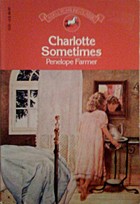
Book Review: Charlotte Sometimes by Penelope Farmer (Series, #3) (Bottom of TBR Pile Challenge)
 Summary:
When Charlotte goes away to boarding school for the first time, she’s very excited to get the bed with the particularly pretty wheels right next to the window. When she wakes up, though, the view from the window looks different, and people are calling her Clare! She discovers she’s traveled back in time to the same bed in the same boarding school, but during World War I. The next morning, though, she wakes up in the present again as Charlotte. This pattern continues, meaning both she and Clare are Charlotte….sometimes.
Review:
I picked this book up because I have an affinity for both boarding school books and time-travel books. This looked like the best of both worlds to me. A fun middle grade book that introduces to the reader to two different past time periods–the late 1960s of Charlotte’s present and the nineteen-teens of Clare’s present.
This book is the third in a series, but it is completely possible to read it as a standalone. No mention is made of the events in the first book, and the second book is actually about what Charlotte’s little sister does while she’s away at boarding school.
The concept is intriguing, because instead of time-travel happening once and landing the person stuck in the past (or future), Charlotte keeps switching, spending every other day in the 60s and every other day in the teens. (I get a migraine when the barometric pressure changes….I can only imagine how I’d feel if I time travelled! Do you think I could bring my green lamp therapy with me?)
In addition to the usual issues time-travel books bring up, such as what stays the same and what is actually different throughout time, it also brings up the key question of identity. What makes Charlotte Charlotte? Is she still Charlotte when she’s being called Clare? Why does hardly anyone notice that Clare has changed? Or Charlotte for that matter? The book thus addresses identity issues that middle grade readers might be going through, but in a subtle way through the time-travel trope.
Were you some particular person only because people recognized you as that? (page 66)
The time-travel itself is left as a fantastical mystery, rather than being given a scientific explanation. There’s something magical about the bed that only makes Charlotte and Clare switch places, but no one else. This works without an explanation because the young girls being subjected to the time-travel just accept it without explanation. This is their reality, and it doesn’t matter why it’s happening, they just have to deal with it. Some readers, though, might struggle with the fact that the time-travel itself is never explained.
The one thing that disappointed me about the book, and that I think would have made it a classic and a five star read, is that the book only explores what happens to Charlotte when the girls switch places. Clare, her experiences, and her perspective are only heard about through third parties. The book, while in third person, is entirely Charlotte’s perspective. Clare, a reserved, proper girl from the nineteen-teens must have been shocked by both the technology and the mores of the 1960s she suddenly found herself in. So much more could have been explored by telling both Charlotte’s and Clare’s story. The book misses an opportunity by only focusing on the modern day girl going back in time. The girl being thrust into the future, a future where she finds out Britain wins the war, and there is suddenly no food rationing or flu epidemic, that is such a cool story in and of itself, and Farmer just never ventures out to tell it.
Interestingly, the British band The Cure released a song called “Charlotte Sometimes” that they admitted was pulled directly from this book. Not just the title, but song lyrics are pulled from the first couple of lines of the book. Even the music video features scenes from the book. It seems to be quite a mystery who the actress was who played Charlotte in the video. She wasn’t credited, and there’s a lot of posts on the internet with people speculating about who she might be. In any case, Penelope Farmer was…not amused by the whole thing. But back to the book.
Overall, this is a book that sets up a fantastical world of time-travel within a boarding school. It utilizes the switching of two girls with each other in time to explore questions of identity in a way that surely will appeal to many middle grade readers. The book does not fully explore the story the way it possibly should have, but the young reader will probably enjoy filling in those gaps themselves. Recommended to all fans of boarding school, time-travel, or historic fiction set during World War I’s homefront.
If you found this review helpful, please consider tipping me on ko-fi, checking out my digital items available in my ko-fi shop, buying one of my publications, or using one of my referral/coupon codes. Thank you for your support!
4 out of 5 stars
Length: 174 pages – average but on the shorter side
Source: Better World Books

Previous Books In Series:
The Summer Birds
Emma in Winter


Edit note: Thanks to Vicky for pointing out it was published in 1969.
Book Review: The Prometheus Project: Captured by Douglas E. Richards (series, #2)
 Summary:
Brother/sister duo Ryan and Regan are back only this time they’re officially part of the team of scientists working in the top-secret alien city discovered deep underground in Pennsylvania. They rush off every day after school to work in the city of Prometheus. One weekend they convince their parents to let them sleep over in the city, only to wake up to discover all of the adults captured by a ruthless alien escaped convict whose mind control abilities mysteriously fail to work on the kids. It’s up to them to save not just the adults, but the earth itself from alien rule.
Review:
This follow-up to The Prometheus Project: Trapped (review) brings even more action and science than the first time around. It’s also a longer length that is more suitable for the older middle grade crowd.
Ryan and Regan’s relationship with each other has progressed from sibling tolerance to a level of respect for each other clearly due to working together in the city. It’s nice to see a healthy sibling relationship modeled in a middle grade book.
Again the plot fooled me with a twist ending I didn’t see coming, but that made perfect sense when it was revealed. This is the sort of thing I’d have loved as a middle grade reader. A mystery that manages to out-wit me without playing any tricks.
The villain is threatening without being too frightening. Although the kids’ parents are held captive, no undue violence is shown. Predominantly the scientists are held with plastic ties on their wrists and a simple verbal threat of “do this or else….” It seems an appropriate level of suspense for the age-range. The enemy is formidable, but it is possible to out-wit him.
Although the science, plot, and characters are strong, something just couldn’t let me jump from liking it a lot to loving it. Perhaps this is because I am out of the age-range intended, but it does seem to me as though sometimes the story expects a bit too little of the young reader enjoying it. I hope in future books that Richards challenges young readers a bit more with the writing in addition to the science.
Overall, this is another strong entry in this middle grade series. I firmly believe the series will keep young readers with an interest in scifi and secret government operations happily engaged while parents and guardians can have peace of mind about what they are reading.
4 out of 5 stars
Source: Won copy in exchange for my honest review from the author via LibraryThing
Previous Books in Series:
The Prometheus Project: Trapped, review
Buy It

Book Review: The Prometheus Project: Trapped by Douglas E. Richards (series, #1)
 Summary:
Ryan and Regan can’t believe their scientist parents made them move from San Diego to the total snoozefest of Pennsylvania practically overnight just so they can work at a boring science corporation, Proact. But when they accidentally overhear their parents talking, they realize there may be more to Proact than meets the eye, and they’re determined to find out!
Review:
I don’t think I realized when I entered the giveaway for this (a really long time ago, sorry about that, Richards!) that it’s a middle grade/children’s series. I don’t usually read below the YA level anymore unless I’m reading to my four year old nephew, but I am a librarian, so I put my librarian cap on for this book. I also tried to hearken back to what I would have enjoyed at the age of eight or nine.
Ryan and Regan are a cute brother/sister pair. Ryan is older and thus underestimates his sister sometimes. They tease each other, but never cruelly, and it is evident that they truly love each other. The sibling dynamic is definitely well-done. It was refreshing to see the adults depicted as adults and not idiots or mean-spirited. What Ryan and Regan accomplish is because they’re the smart kids of smart parents, not out of any short-comings of the adults.
The science is really well-done. Richards’ author bio states that he used to write for National Geographic Kids, and it shows. He explains things eloquently without talking down to kids. All of the science found in the book is factual. I would have loved stumbling upon such learning in fiction as a kid.
The ending has a twist that even I didn’t see coming, and I was sort of expecting to being a grown-up reading it, haha. It’s not cheesy or over-the-top, and I’m betting kids will love the surprise.
My main criticisms are that sometimes the descriptions of the characters focus too much on their hair and eye color to the exclusion of other things, and the book felt too short. It just seemed a bit short for the grade level. Mentally I compared it to Nancy Drew which are generally like 25% longer, and I think that length would be ideal. The sequel is longer though, so that’s a good thing.
Overall I think if you have middle grade reading level kids who like science, mysteries, or scifi you should feel completely confident in handing them this book.
4 out of 5 stars
Source: Won copy in exchange for my honest review from the author via LibraryThing

 Support my work with a tip or browse my shop for curated book club guides, how to guides, cross-stitch patterns, and more!


This work by Amanda Nevius is licensed under a Creative Commons Attribution-Noncommercial-No Derivative Works 3.0 United States License.
 Opinions of a Wolf