
Archive
Book Review: Fruit of the Dead by Rachel Lyon

A contemporary retelling of Demeter and Persephone featuring a Hades who is a pharmaceutical company executive with a private island.
Summary:
Camp counselor Cory Ansel, eighteen and aimless, afraid to face her high-strung single mother in New York, is no longer sure where home is when the father of one of her campers offers an alternative. The CEO of a Fortune 500 pharmaceutical company, Rolo Picazo is middle-aged, divorced, magnetic. He is also intoxicated by Cory. When Rolo proffers a childcare job (and an NDA), Cory quiets an internal warning and allows herself to be ferried to his private island. Plied with luxury and opiates manufactured by his company, she continues to tell herself she’s in charge. Her mother, Emer, head of a teetering agricultural NGO, senses otherwise. With her daughter seemingly vanished, Emer crosses land and sea to heed a cry for help she alone is convinced she hears.
Alternating between the two women’s perspectives, Rachel Lyon’s Fruit of the Dead incorporates its mythic inspiration with a light touch and devastating precision. The result is a tale that explores love, control, obliteration, and America’s own late capitalist mythos. Lyon’s reinvention of Persephone and Demeter’s story makes for a haunting and ecstatic novel that vibrates with lush abandon. Readers will not soon forget it.
Review:
I’ve seen some reviews from folks who entered this book clearly not knowing anything about the myth of Demeter and Persephone. I think that’s a mistake. Knowing the myth helps you know what vibes to expect from this book at least. It helps match the book properly with the readers who might enjoy it. So if you’re not already familiar, take a moment to read a quick summary. Ok. This is not a romance. This is a story of a young girl who gets abducted by the literal god of the underworld and tricked into eating something while there that will make her always have to return. It’s also the story of her mother’s desperate quest to find her.
This is a modern retelling devoid of fantasy. It takes the myth and places it in our modern world. Hades is a pharmaceutical company executive. A billionaire. He’s currently going through a legal battle to do with his very addictive pain pills. (He’s clearly an allusion to the Sackler family.) Personally, I loved the choice of a billionaire drug pusher as the stand-in for Hades.
Persephone is Cory. A just barely turned 18-year-old whose high-achieving mother wants desperately for her to go to college but who did not get in anywhere she applied. She and her mother are not getting along right now. (There are reasons for this rift beyond college that are a spoiler and are revealed later in the book.) She goes to be a camp counselor where she went to summer camp in essentially a huff. At the end of summer camp, the father of one of the children shows up to pick up the child and asks her to come to his private island to nanny the son and a daughter for a month. She has to sign an NDA. She cannot tell her mother where, exactly she is. This is the getting ripped into the underworld bit. nstead of the pomegranate seeds, what Cory is given is, naturally, the pain killing drugs. Her mother, after a bit of time and one very weird phone call, cannot shake the feeling something is wrong, and drops everything to go after her daughter. It’s kind of Taken but with a mom.
I really enjoyed the vibes of this book. It oozed danger even when nothing super insidious was happening. While things do escalate, for a lot of the book it’s not that anything is technically wrong, it just feels wrong. It’s an art form to be able to mimic that gut reaction in fiction. This was one of the stronger parts of the book. I also really enjoyed a part where different plot points came together in what one could have called a coincidence, but also could be called the gods interfering. It was astutely (and kindly) done.
However. This book chose to never use quotation marks for dialogue. Not once. This is a stream of consciousness writing technique. It’s becoming more common in modern books, although you can also see it in James Joyce, for instance. The reasons given by modern authors – like “removing the hierarchy between author and reader” – frankly make me raise my eyebrows in doubtful question. (It sounds like something a dinner party guest of Frasier’s would suggest.) It strikes me as a full-of-oneself literary technique that just forces the reader to work harder. What’s wrong with reading quickly and with easy interpretation? I found it quite distracting in this book. I had to re-read certain passages to try to figure out who said what and whether it was a thought or actually spoken out loud.
Of course the Persephone and Demeter myth is dark. It stands to reason that Hades forces himself on Persephone, and this book doesn’t shy away from that. So there are two sexual assaults. One is described as a memory. The other is described in the moment as the character is living it. There’s also a child sexual assault hinted at in flashbacks but not described in any detail. It’s more that the character is remembering how she felt when it happened than what actually happened. Finally, there’s a self-injury described.
I realize that in the myth Persephone is doomed to return to Hades for half the year forever. This can be a tricky thing to address in an updated retelling. But some aspect of what next could have been addressed. I would like to have seen just a hint of how the mother/daughter were going to try to work through this, even if they might not be successful.
Overall, this is an interesting modern retelling of the Persephone and Demeter myth. It admirably writes pharmaceutical companies as the underworld and a CEO billionaire as their god. Potential readers should be aware that this is a dark story, not a romance. It contains sexual assault. Some readers may not enjoy the complete lack of quotation marks. Recommended to readers interested in modern day retellings of mythology.
If you found this review helpful, please consider tipping me on ko-fi, checking out my digital items available in my ko-fi shop, buying one of my publications, using one of my referral/coupon codes, or signing up for my free microfiction monthly newsletter. Thank you for your support!
4 out of 5 stars
Length: 320 pages – average but on the longer side
Source: NetGalley
Buy It (Amazon or Bookshop.org)
Reading Challenge Wrap-Up: Once Upon a Time IX
 Hello my lovely readers! Once Upon a Time IX, the reading challenge I signed up for running between March 21st and June 21st focusing on reading books that fit into the categories of fantasy, folklore, fairy tales, or mythology is now over (it has been for 5 days, actually….), so it’s time to post my wrap-up!
I signed up for the level called “The Journey” reading at least one book in any of the categories named above, but I had a personal goal aiming for three books. I wound up reading a whopping NINE BOOKS. Particularly given that I used to think I didn’t like fantasy, I’m kind of blown away.
My completed reads for the challenge, in the order I read them:
- A Local Habitation by Seanan McGuire, 4 stars, review
- An Artificial Night by Seanan McGuire, 4 stars, review
- The Years of Rice and Salt by Kim Stanley Robinson, 4 stars, review
- Maplecroft by Cherie Priest, 4 stars, review
- Fables: Legends in Exile, Vol. 1 by Bill Willingham, 3 stars, review
- Cycle of the Werewolf by Stephen King, 3 stars,
not yet reviewed, review - Love in the Time of Global Warming by Lia Francesca Block, 3 stars, not yet reviewed
- Everlasting: Da Eb’Bulastin by Rasheedah Prioleau, 4 stars, not yet reviewed
- Fated by S. G. Browne, 3 stars, not yet reviewed
Unfortunately, as you can tell, I fell a bit behind actually reviewing the books during the challenge. Ah well. This just means you can expect to see more fantasy reviews coming up now through July!
Have you enjoyed the influx of fantasy on my blog? Did you participate in the challenge too?
Book Review: The Years of Rice and Salt by Kim Stanley Robinson
 Summary:
Imagine a world where the Black Death of the 14th century wiped out the majority of the European population, rather than one-third of it. This is the world Robinson imagines, one where Buddhism and Islam rise as the two major religions of the world (with no religion a close third). See the history of the world through the eyes of two souls who keep reincarnating in different cultures, struggling to better both themselves and their world that could easily have been ours.
Review:
I originally picked this book up because I have long held a fascination with the various religions of the world (I was actually a Religious Studies minor in undergrad). The “what if” at the center of the book seemed like a great starting place to me. Indeed, what if most of the followers of currently largest faith (Christianity, source) had died off? What things would change and what would have stayed the same? Robinson chooses to tell this tale through reincarnating souls, which sometimes gives us a lot of access to these changes but other times leaves the reader feeling like they got just a passing breath of a culture and a century.
I didn’t realize going into this that Robinson had chosen to tell this story through the eyes of the same souls reincarnating over and over again. It’s an interesting choice that I am uncertain about as it lends a sort of “this much we know” to the spiritual side of the story. We, the readers, know that the souls of people in this world definitely exist, they go to the bardo to await judgment and reincarnation. The bardo they go to appears to reflect whatever faith they had (Muslims have their own, Buddhists have their own, etc…) The idea is also put out there that each of the faiths is a different path to the same end (enlightenment). Much as I may personally believe this idea, I’m not sure how I feel about this particular story being so mythology heavy. The History BA in me very much wanted to see a more analytical power-structure play-out, which we do get some of, but not as much as we get of the how to better our souls question. I suppose what I am trying to say is that, although I was anticipating a book that was scholarly with a dash of spiritual, what I got instead was the reverse. That’s not a bad thing, and I still enjoyed it, but it definitely wasn’t what I was expecting, and I do wonder how the story may have played out differently if Robinson wasn’t so tied to the same souls over and over again.
One aspect of the same souls reincarnating that niggled at me a bit was that throughout history, no matter where they were born (or what gender or species), their names always started with the same letters. So a character whose first name in the first incarnation started with the letter K always had a name that started with the letter K. It got so I could predict who was who and, to a certain extent, how they would act in each incarnation. On the one hand, it was a cool idea, although highly unlikely someone’s name would start with the same letter throughout time and cultures and languages. On the other hand, it distracted me from the more interesting story of the different world developing with the rise of different cultures than actually appeared in our own history.
Similarly, I think there is far too much story and richness in this idea and timeline to limit it to one book. There were multiple incarnations that I really wanted to know more of. I wanted to know the whole story of these lives and this place. Instead, the reader gets a quick glimpse into one time in their lives, and then we are left jumping ahead to the bardo to find out how they died and oh here comes the next incarnation. Perhaps the point was to make the reader feel as if each life is only a blink, but the scholar in me was left wanting to know so much more about every area and life the book briefly visited. It was like getting only a small morsel of each chocolate in a box of delicious chocolates, instead of getting to savor them all over a long period of time.
All of this said, let me now discuss the parts of the book I really enjoyed (and would have liked to have seen more of). My favorite is how Robinson reimagined the Americas. The same essential problem of real history still exists for the Native Americans even with the change of the Christians mostly dying off. Mainly, they lacked easily sourced heavy metals to make higher-tech weapons and they were susceptible to all of the germs European explorers brought with them. (I learned about this in my classes in US History for my BA, but my professors told me this whole idea is also presented in the book Guns, Germs, and Steel
Robinson does a much better job painting Islam and Buddhism with a nuanced brush. Since their cultures dominate the book, this means most of the book is much more gray area, rather than presenting everything as black and white. One element that demonstrates this, is how Robinson handles Islam and women. All sides of the arguments about Islam and women are presented here. There are incarnations of the souls that are Muslim women who argue strongly that the men are misinterpreting the Quran, what Mohammed said, etc… There are of course other incarnations that say no, the extreme fundamentalism is the right interpretation. Through showing Islam through many different lenses in a world that is different from our own, Robinson demonstrates how religion is so incredibly open to interpretation, and good and bad people can shape it to their own agendas. One passage that I think demonstrates how well Robinson walks this line is a conversation some characters have about the women wearing the veil or not:
The veil has a kind of power, in certain situations. All such signs stand for other things; they are sentences spoken in matter. The hijab can say to strangers, ‘I am Islamic and in solidarity with my men, against you and all the world.’ To Islamic men it can say, ‘I will play this foolish game, this fantasy of yours, but only if in return you do everything I tell you to.’ For some men this trade, this capitulation to love, is a kind of release from the craziness of being a man. So the veil can be like putting on a magician queen’s cape…. Or it can be like putting on a slave’s collar, certainly. (page 592)
If this passage appeals to you in how it presents the various nuances and gray areas of religion and culture, then a lot of this book will appeal to you.
One final issue with the book I will note that may turn off some readers is that out of all the many incarnations, only two are in Native American bodies (and then, they are both Native Americans in North America. South America is completely left out for incarnations, although incarnations visit there). Similarly, there are no incarnations to Australia, New Zealand, Central America, or any island nation anywhere (Caribbean, Pacific Islands, United Kingdom, Iceland). There is only one incarnation where one of the souls is in an African, and that African is a slave on a Chinese slave ship who then goes to China (we thus spend very little time in Africa, just at the beginning on the slave ship). One character in an incarnation mentions that in the past she went to Africa but the reader does not see her time there. I definitely think that it’s a weakness that so many areas of the world are left out. For instance, I have zero idea what happened in Australia now that it clearly was never a penal colony of the UK (since the UK never existed). Similarly, it seems Africa would be very different with all the changes in global power, and yet the only passing mention we get of modern Africa in the later incarnations is that one of the characters visits there to fight against Female Genital Mutliation (FGM). If so much else changed, why not in Africa?
I know it may seem like I listed out a lot of issues, but it is a very long book that tackles a huge task. My review is almost as if I was reviewing an entire series in one fell swoop. Each individual part had issues, as did some of the overarching ideas, but I mostly really did enjoy reading it. It’s a fascinating thought experiment that wasn’t as well executed as it could have been, but parts of it were brilliant. I also enjoyed the feminist themes throughout. Men and women are both just souls, reincarnating into a woman is not a punishment. In fact, neither gender nor race is a punishment for previous incarnations, just species. Similarly, the more a society advances the more equal their genders and races are. There is a lot of thought given to what it means to be a woman in various areas of the world, which could easily have been passed over or not handled well.
Overall, this is a book that tackles a huge philosophical question in a fantastical way. It is a large task that probably would have been better suited to a series to fully flesh-out the world, the lives, and the nuances in both. Readers interested in spiritual questions with a tendency to view all religions as different paths to the same enlightenment and a curiosity about how the world might be different with different religions in the lead will be most suited to the book. Readers interested in a more thorough exploration of an alternate history will most likely be disappointed by the reincarnation aspect and the brief time spent in each time period and culture.
If you found this review helpful, please consider tipping me on ko-fi, checking out my digital items available in my ko-fi shop, buying one of my publications, or using one of my referral/coupon codes. Thank you for your support!
4 out of 5 stars
Length: 763 pages – chunkster
Source: PaperBackSwap

Counts For:
Bottom of TBR Pile Challenge
and
Reading Challenge: Once Upon a Time IX
Hello my lovely readers! Many book bloggers are familiar with Carl of Stainless Steel Droppings’ two big reading challenges he runs every year. I often participate in the fall challenge for reading horror/thriller/mystery/etc… but I have never participated in the spring challenge for reading fantasy, because I used to think I don’t like fantasy. I’ve discovered that I’m wrong. I do like fantasy, just mainly urban fantasy and fantasies that are not set in a Medieval Europe style setting. So I thought that this year I would participate in Once Upon a Time IX!
Once Upon a Time IX focuses on reading books that fit into the categories of fantasy, folklore, fairy tales, or mythology between March 21st and June 21st. I’m signing up for the level called “The Journey.” Read at least one book in any of those categories. I’m hoping to read more than one but I was worried if I signed up for a higher level it would feel like too much pressure to me. My personal goal right now is three books.
Books I already own that fit the challenge are listed below. I’d love to hear from you in the comments if there’s one you’d particularly like to recommend to me from my list!
- Carpe Jugulum by Terry Pratchett
- Cycle of the Werewolf by Stephen King
- Deadtown by Nancy Holzner
- Fables Vol. 1 by Bill Willingham
- Fated by S. G. Browne
- A Local Habitation by Seanan McGuire
- The Nonborn King by Julian May
- Tales of the Cthulhu Mythos by H. P. Lovecraft
- Unshapely Things by Mark Del Franco
- The Veiled Mirror by Christine Frost
- Watership Down by Richard Adams
- The Years of Rice and Salt by Kim Stanley Robinson
Book Review: The Underworld King by Ranjit More (Series, #1)
 Summary:
Drumila, four-armed king of the daityas, seeks to take them above ground to escape their enemy the naagas, giant flame-breathing serpents. Meanwhile, Krishna (the highest-ranking god) sends his daughter, Nandini, to Earth in human form to weaken Drumila and keep him from crossing the barrier from Earth into the higher plains. Unfortunately, Nandini ends up liking Drumila a bit more than they bargained for.
Review:
I was excited to have a fantasy based in a non-European mythology submitted to me, and wow is this different from the typical European-based fantasy. In a good way. This is a dense, different fantasy with a strong learning curve unless the reader is already very familiar with Hinduism.
The basic story reads just like mythology. This has pros and cons. On the plus side, it feels quite fantastical. On the minus side, some of the plot points can be cringe-worthy (such as an unwanted kiss that could have turned into a rape if the female character hadn’t suddenly 180ed from zero interest to desire) and the characters can be a bit two-dimensional. This will bother some readers, but those who enjoy mythology, in spite of its shortcomings, will appreciate this read. Personally, I generally prefer if authors update and modernize their mythological rewritings a bit more, but not all readers feel that way.
The author is well-aware that Hindu mythology won’t be familiar to many Western readers, so he offers an extensive footnotes that are well hyperlinked in the ebook that explain both definitions of words and various aspects of Hindu mythology. This means that the reader learns a lot but it does also slow down the reading of the book and breaks up the immersion in the world. The footnotes are a good idea but perhaps if some of the words and concepts were better incorporated and explained within the writing itself then there could be fewer footnotes that offered greater explanations of more value.
The ending is a bit abrupt. It’s clear this is intended to be the first book in a series, but an extremely abrupt ending like this one makes it difficult to feel like the reader got a full book out of the deal. It feels more like the pilot of a tv show than the first book in a series.
I would give this book a more full review, but it has been pulled from publication since the review copy was sent to me. I really wish when authors and/or publishers choose to do this that they would notify those of us with review copies. While I enjoyed the read enough to not regret reading it, it feels rather silly for me to bother reviewing a book no one else can get their hands on anymore.
Overall, this is a fantasy book set firmly in the tradition of Hindu mythology that will best appeal to readers who enjoy the traditional features of mythology and don’t mind an abrupt ending.
If you found this review helpful, please consider tipping me on ko-fi, checking out my digital items available in my ko-fi shop, buying one of my publications, or using one of my referral/coupon codes. Thank you for your support!
3 out of 5 stars
Length: 252 pages – average but on the shorter side
Source: Kindle copy from author in exchange for my honest review
Buy It Currently not available for purchase.
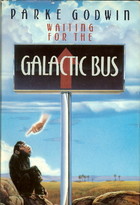
Book Review: Waiting For the Galactic Bus by Parke Godwin (Series, #1) (Bottom of TBR Pile Challenge)
 Summary:
When two brothers from an incorporeal alien species get left behind on a spring break visit to prehistoric Earth, they decide to put their, as yet uncertified, evolutionary development skills to work by prodding along the the evolutionary process on Earth. In doing so, they accidentally create a species with a spirit tied to a body for a certain amount of time that then is tied to the idea of an afterlife. They also manage to turn themselves into Earth’s spiritual mythology.
Review:
An ingenious take on the aliens made humans concept with two overlapping plots, a tongue-in-cheek take on world religions, and a wry wit.
This take on aliens made humans makes humans the result of the bumbling activities of aliens from a species that controls evolution in the universe. However, these aliens are currently uncertified, unsupervised, and basically the frat boys of outerspace. At least at first. Thus, instead of it all being some evil experimental conspiracy, the direction of life on Earth is much more of an accident of floundering fools. Granted, the fools grow and change over the time that they spend on Earth waiting for their ride back from spring break, but the fact remains that evolution on Earth is a result of the experiments of two aliens who are not yet fully trained. This is also used to explain the phenomenon of souls in bodies and then souls that have an afterlife. All other species have souls that can either choose to be in or not in a corporeal body. This is the result of the two aliens, Barion and Coyul, not staying within the rules of evolution.
We thus get to the other really creative part of the book. Since the souls are unfotunately tied to bodies that die, when the bodies die, the souls don’t know what to do or where to go, and so humanity creates the idea of the afterlife, with the two aliens serving as the rulers of the two options (again, created by humans). The aliens thus are kind of forced into the roles of God and Satan. The way afterlives go, though, is generally more the result of what the various humans think it will be or think they deserve. The aliens have mostly tried to stay out of the way, but when they hear rumblings that remind them on the beginning of the nightmare that was Nazi Europe in the American midwest, they decide to dive on in and try to fix it.
Clearly the plot and setting are extremely engaging and thought-provoking. I could truly talk about them for hours. They are creative and a vision of the world I enjoyed visiting. The characterization of the two aliens is a bit weak though. I mixed them up a lot, constantly forgetting who was God and who was Satan. I honestly can’t remember right now if Barion or Coyul plays Satan. I wish they had been characterized more clearly, as this would have strengthened the story.
Overall, this is a unique take on aliens creating humans, featuring a rollicking and thought-provoking plot. The characterization can be a bit weak but the action-packed plot and vibrant setting generally make up for it. Recommended to scifi or fantasy fans looking for an extraterrestrial take on mythology.
4 out of 5 stars
Source: PaperBackSwap

 Support my work with a tip or browse my shop for curated book club guides, how to guides, cross-stitch patterns, and more!


This work by Amanda Nevius is licensed under a Creative Commons Attribution-Noncommercial-No Derivative Works 3.0 United States License.
 Opinions of a Wolf