
Archive
Book Review: The Ballad of Black Tom by Victor LaValle

Tommy is a hustler just taking care of himself and his dad in 1920s Harlem when an old white man invites him to play at his private shindig in his home.
Summary:
Charles Thomas Tester hustles to put food on the table, keep the roof over his father’s head, from Harlem to Flushing Meadows to Red Hook. He knows what magic a suit can cast, the invisibility a guitar case can provide, and the curse written on his skin that attracts the eye of wealthy white folks and their cops. But when he delivers an occult tome to a reclusive sorceress in the heart of Queens, Tom opens a door to a deeper realm of magic, and earns the attention of things best left sleeping.
A storm that might swallow the world is building in Brooklyn. Will Black Tom live to see it break?
Review:
The Lovecraft universe is a fascinating example of an author creating a world that then becomes the playground for a lot of other people’s imaginations. Legally! Beyond a story being technically set in a Lovecraft universe with Lovecraft characters, though, there’s an entire genre of speculative horror that sprung out of it called cosmic horror. Think Eldritch Gods. Secret societies. Tentacles.
I love cosmic horror. (I even have published a cosmic horror short story.) The thing is, though, most cosmic horror fans have a complex relationship with the genre because of Lovecraft’s blatant racism and xenophobia. So a lot of modern authors, fans of the universe itself but not the person, are writing their own cosmic horror stories that turn Lovecraft’s racism and xenophobia on its head. Enter The Ballad of Black Tom.
The author of this novella is a Black man who decided to take one of Lovecraft’s most xenophobic short stories (“The Horror at Red Hook“) and reapproach it from the perspective of a minor secondary character – Black Tom. Tommy lives in 1920s Harlem with a dad who’s a talented musician while he himself is not. He is, however, able to convince white folks outside of Harlem that he’s a talented musician and so he goes there to hustle them. He also has a variety of other side hustles including procuring magical items for people.
The first thing that struck me about this book was how it put a minoritized Lovecraft character front and center. I also noticed how Tommy doesn’t go by the name “Black Tom.” That comes later and, even when it does, Tommy is claiming the name from a place of power.
Part of the terror that Lovecraft’s characters often feel is that of potentially losing their place of privilege. Tommy is living in a blatantly racist society where he can’t even take a train too far out of his neighborhood without someone questioning or harassing him. Instead, what he has to lose is his community in Harlem. Something it takes him a while to figure out. Some of what tears that away from him is the cosmic horror. But some of that is the day-to-day horror of being Black man in 1920s Harlem. (Warning for police brutality in this book).
This novella hits all the notes a reader might want in a cosmic horror – existential dread, elder gods, a little blood, cult rituals. But it does it without the cringe-inducing racist asides. I found it easier to empathize with Tommy than I had with a main character in a cosmic horror in a while. Of course he wants the elder gods to come tear things up. Of course he does. What I wasn’t expecting was the note of…what have I done?…at the end or that I would agree with that too.
I will say, I didn’t enjoy was when the perspective shifted to that of the police officer. I would have preferred remaining in Tommy’s perspective throughout. There was also a hint that a song Tommy’s dad taught him would come back up in a meaningful way, and it didn’t. Perhaps I missed it.
Overall, this is a wonderful entry into the Lovecraft universe that gives voice to a character Lovecraft had maligned, written from an own voices perspective.
If you found this review helpful, please consider tipping me on ko-fi, checking out my digital items available in my ko-fi shop, buying one of my publications, using one of my referral/coupon codes, or signing up for my free microfiction monthly newsletter. Thank you for your support!
4 out of 5 stars
Length: 149 pages – novella
Source: Library
Buy It (Amazon or Bookshop.org)
Get the Book Club Discussion Guide
A beautifully graphic designed 2 page PDF that contains: 1 icebreaker, 9 discussion questions arranged from least to most challenging, 1 wrap-up question, and 3 read-a-like book suggestions
View a list of all my Book Club Guides.
Book Review: Death by Dumpling by Vivien Chien (Series, #1)

Summary:
Lana Lee didn’t expect to be hostessing at her family’s restaurant. But when she dramatically walks out on her job, Ho-Lee Noodle House in the Asian plaza of Cleveland seems to be her only option. When the plaza’s property manager, Mr. Feng, turns up dead next to a pile of her restaurant’s dumplings, the focus quickly shifts from Lana’s life to clearing the restaurant – and their chef – from suspicions of murder.
Review:
It’s no secret if you’re a fan of cozy mysteries that they’re hurting for diverse representation. When I saw this title, I was excited for a Chinese-American leading lady and also for the dumpling recipes I anticipated coming with it, as many cozies come with recipes or craft patterns.
The setting of this book feels very real, it reminded me of the “Asian plazas” I’ve seen in the Midwest when visiting my in-laws. The variety and types of stores and restaurants, as well as the description of where it was in relation to Cleveland rang as real to me.
The majority of the characters in this book are Chinese-American – including the murder victim and all of the potential suspects Lana works her way through. Lana is biracial – her mother is Chinese-American, and her father is white. Lana’s best friend is white, and the police detective (who we all know is the love interest, since that’s how it works in cozies) is also white. In spite of all this representation, I must mention that there was one cringe-inducing moment where sitting cross-legged is described as “Indian-style.” A good reminder that just because a book features an underrepresented group doesn’t necessarily mean it will be fully inclusive.
My lack of engagement with the love interest I don’t think is the fault of this book in particular – he was the generic police detective you see in cozies. I think it’s just that I have increasingly come to a negative perception of policing and I couldn’t get past his job in my head.
I was disappointed to discover that in a book revolving around a Noodle House and murder by dumplings – there were no recipes! I just kept re-flipping through the end of the book asking – really? A missed opportunity that would have knocked the book up a whole star for me.
With regards to the mystery, this was one of those rare cozies with a plot I could not 100% predict. A definite mark in its favor and something that kept me reading. I also must mention that Lana has a pug named Kikkoman (after the soy sauce). Important to the plot? No. But important to joy in certain scenes for sure.
Overall, if you’re a cozy mystery fan looking for some diversity or variety in your next read, I recommend giving this one a try. Just don’t come into it expecting recipes.
3 out of 5 stars
Length: 328 pages – average but on the longer side
Source: Library
Buy It (Amazon or Bookshop.org)
If you found this review helpful, please consider tipping me on ko-fi, checking out my digital items available in my ko-fi shop, buying one of my publications, or using one of my referral/coupon codes. Thank you for your support!
Book Review: The Empress of Salt and Fortune by Nghi Vo (Series, #1)
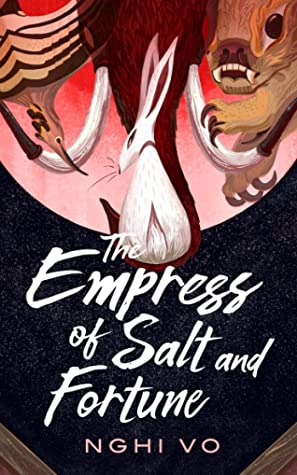
Summary:
Chih, a non-binary cleric, is on a walking journey when they meet an elderly woman, Rabbit, with a story to tell. Chih ends up staying and listening to Rabbit’s tale while cataloging the archives of her things. It slowly is revealed just how much of history Rabbit was quietly witness to and participant of.
Review:
The summary I read was nothing like the one I wrote above and, therefore, I was under the misimpression from the combination of the summary and the title that this was a magical realism book featuring an actual rabbit. I also didn’t know how each chapter would start with essentially an archives finding aid that Chih is writing. There was a time in my life when I wrote finding aids for work, and I must be honest – I didn’t enjoy it. The combination of these two things didn’t put me in a great headspace for this book. However, I do think it’s a good read when it finds its audience, and that’s what I’m hoping to do here.
This book features a non-binary main character whose sidekick is a fabulous talking bird. Female/female love is also well-represented here. It is set in a fantasy world inspired by Asian period dramas with dashes of fantasy (like the talking bird). The entire premise revolves around respecting and listening to an elder – treating her as important simply because she is elderly. It of course then turns out that she has a pivotal role in history, but Chih would have never known that if they hadn’t listened to her. Those who love the history of items will also likely really enjoy reading the descriptors of Rabbit’s possessions at the start of each chapter. While this is a short book (novella length), it is the first in a series, so you can visit its world, and, if you like it, you can keep on going with the rest of the series.
Recommended to those looking for a fantasy with an Asian period drama fantasy written by an own voices author with a dash of magical realism and queerness.
3 out of 5 stars
Length: 112 pages – novella/short nonfiction
Source: Library
Buy It (Amazon or Bookshop.org)
If you found this review helpful, please consider tipping me on ko-fi, checking out my digital items available in my ko-fi shop, buying one of my publications, or using one of my referral/coupon codes. Thank you for your support!
Book Review: The Conductors by Nicole Glover

Summary:
Hetty Rhodes was once enslaved, but she ran away with her sister, only her sister was caught while she escaped. She began returning south to try to free her sister, but with her repeated trips became a Conductor on the Underground Railroad, alongside a man named Benjy, using their magic to help others escape. Now the Civil War is over and she and Benjy, who is now her husband, have built a life for themselves in Philadelphia. He’s a blacksmith, she’s a seamstress, and they both solve crimes in their spare time that the white authorities can’t be bothered with. When one of their friends turns up dead in an alley, their investigation takes them throughout Black Philadelphia on a hunt for answers.
Review:
The premise of the worldbuilding for this book reminded me of Thieftaker (review), the first in the Thieftaker Chronicles, which I really enjoyed, only set in the 1800s rather than the 1700s and with a Black woman lead rather than a white man. I say this as I was excited and thought this was a good thing. I remember thinking at the time that I wished there were more alternate history fantasy books and I was excited when the next one I saw brought such diversity to the genre.
I liked the magic in this book. I thought it was a great analogy for colonizing culture versus Black and Indigenous culture. The colonizing culture (Sorcery) requires the use of tools (wands) but the wands make that magic very powerful. The Black and Indigenous cultures use Celestial magic, which doesn’t require tools (they draw sigils instead). It can become very powerful but takes more study and time to become so. Anyone with magic being able to pick up a wand and wreak some havoc with very little knowledge as an analogy for weapons like guns I thought was great.
The book also demonstrates the community the Black folks of Philadelphia built up, which included those who freed themselves by running away, those who were freed by the Civil War, and those who were born free. There is a male/male relationship included among Hetty’s friend group, as well as a woman who experienced infertility and adopted a baby.
What didn’t work for me was the order in which the plot was told. The book starts in post-Civil War Philadelphia with Hetty and Benjy (her husband) working together to solve cases, in much the same way they used to work together as Conductors on the Underground Railroad. How Hetty escaped, met Benjy, and how they worked together as Conductors was told through a series of broken up flashbacks throughout the book. For me, this didn’t work. I was much more heavily invested in the stories being told in the flashbacks than in the present mystery, largely because a lot of the present storytelling relied upon the relationship between Hetty and Benjy and, without the full flashbacks, I had no understanding of the relationship between Hetty and Benjy. I needed to know why they were, for example, married but just for propriety’s sake. I needed to know why they decided to work together as Conductors in the first place. What finally pushed them to get married? I was so confused and felt so much like I was dropped into the middle of a pre-existing world that I went and double-checked to make sure I hadn’t accidentally started with the second book in a series. Characters, even beyond Benjy and Hetty, kept talking about things that had recently happened in a way that felt like they had happened in a previous book. For example, the character who adopted a baby, the line about that felt like how the second book in a series will remind you of what happened in the first with that having been a key plot point in the first. I would say, in general, that for me, everything would have worked better if the first book in the series had been how Hetty and Benjy met and became Conductors together, maybe ending with them solving their first case as investigators after the War. Then this could have been the second book, perhaps with some additional flashbacks to inform us of some things from during the War.
I am sure that there are others that will read that paragraph and think “oh I like that vibe,” and that’s great. I hope this review helps this book find its audience. For me, though, I simply don’t like being dropped into the middle of the story.
3 out of 5 stars
Length: 384 pages – average but on the longer side
Source: NetGalley
Buy It (Amazon or Bookshop.org)
If you found this review helpful, please consider tipping me on ko-fi, checking out my digital items available in my ko-fi shop, buying one of my publications, or using one of my referral/coupon codes. Thank you for your support!
 Support my work with a tip or browse my shop for curated book club guides, how to guides, cross-stitch patterns, and more!


This work by Amanda Nevius is licensed under a Creative Commons Attribution-Noncommercial-No Derivative Works 3.0 United States License.
 Opinions of a Wolf