
Archive
Rereading the Chronicles of Narnia as a Progressive, Queer Christian Adult – Books 1 & 2

What does The Chronicles of Narnia look like through the eyes of a queer, progressive Christian rereading the series as an adult?
Summary:
The Lion, the Witch, and the Wardrobe – Four children sent to the countryside to escape the bombing of London of WWII open a door in their host’s home and enter Narnia. In the land beyond the wardrobe, the children meet the White Witch, discover the Magic, and meet Aslan, the Great Lion, for themselves. In the blink of an eye, their lives are changed forever.
Prince Caspian – Narnia . . . where animals talk . . . where trees walk . . . where a battle is about to begin.
A prince denied his rightful throne gathers an army in a desperate attempt to rid his land of a false king. But in the end, it is a battle of honor between two men alone that will decide the fate of an entire world.
Review:
This post kicks off a new kind of review for me—a reread series. I was raised in a fundamentalist Christian household, but through a long and winding journey, I’ve found my spiritual home in progressive Christianity, which affirms queer folks like me and focuses on social justice. Over the years, people from all backgrounds have asked me what I think of Narnia. I’ve been surprised by how widely beloved it is—even among children who weren’t raised in Christian environments.
My strongest early memory of Narnia comes from Jesus Camp, where it was one of the few books counselors were allowed to read to us. I remember sitting around the fire, half-listening to something about a silver chair. At the time, I didn’t connect with the stories. I often reject things that feel forced on me, and Narnia was everywhere. Maybe I also felt misled—there’s a hint of World War II at the beginning, which is one of my special interests, but the story quickly shifts to an icy kingdom ruled by a talking lion. Later, I heard critiques of how C.S. Lewis portrayed female characters and wondered if I had sensed that as a child, too.
This year, I decided to revisit the series through audiobooks. I’m reading in publication order, rather than chronological. I want to experience the books as readers did when they first came out—and hear Lewis’s voice as it developed over time.
Before I go further, I want to be clear: I don’t dislike all of Lewis’s work. I loved The Screwtape Letters—I’m a sucker for a good epistolary story—and I found Mere Christianity thoughtful and compelling during my faith journey. So this isn’t a hit piece. It’s an honest reflection on how these stories read to me now, as an adult queer woman of faith.
So what stood out to me in The Lion, the Witch, and the Wardrobe?
I can absolutely see the appeal. The idea of a secret world just through the wardrobe—a place full of talking animals that needs a savior—is enchanting. The allegory of Aslan’s sacrifice on the stone table, often critiqued by secular readers as too jarring and confusing, struck me as a strong, nuanced theological metaphor. It makes sense within Christian theology, and Lewis presents it with clarity.
But I now also understand why I didn’t enjoy these books as a child: the representation of gender roles. The female characters feel flat and constrained. Susan comes off as petty and unlikable. Lucy, while kind, is so passive that her forgiveness becomes a personality trait. The girls aren’t allowed to fight because “that’s not what girls do,” as the narrator—not a character—tells us. That omniscient narration gives the sexism an unchallenged authority. The White Witch is the only powerful female character, and of course, she’s the villain. Her assertiveness and autonomy are equated with evil.
As a progressive Christian who attends a church led by a woman pastor, I find this particularly disheartening. From the very beginning, Jesus uplifted women—Mary Magdalene, Martha, the Samaritan woman. Early church leaders like Lydia and Phoebe helped shape the faith. But those stories often get overshadowed by patriarchal interpretations. I see that dynamic echoed in Narnia.
Another theme that troubled me is the normalization of violence—especially how it’s gendered. Peter is praised for killing a wolf. Boys are encouraged to wield swords and lead armies. Meanwhile, Jesus rebuked Peter for cutting off a soldier’s ear and modeled nonviolence, even in moments of great personal risk. Paul and Silas stayed in a prison after an earthquake freed them, sparing the jailer’s life. Their faith led them to protect others, not conquer them.
In Prince Caspian, the battles escalate. The girls observe from a distance. And we learn that the children’s prior reign left Narnia in ruins, with many of the original inhabitants dead or scattered. The colonial undertones are hard to ignore. The children are outsiders who arrive, rule, and leave—upending the local ecosystem and political structure in the process. Even as a fantasy, it raises hard questions about heroism and power.
As a child, I didn’t like being told what girls couldn’t do. As an adult, I feel equally uneasy watching kind-hearted Peter be shaped into a glorified conqueror. The lens Lewis offers here reflects more about the cultural assumptions of his time—especially about gender and empire—than it does the radical love and subversive power of the Gospel.
That said, I’m curious to keep going. I remember The Silver Chair more vividly than the others, and I’m interested to see how it holds up. I’m not reading these books expecting them to reflect my beliefs. But I am reading them with both a theological imagination and a desire to understand the appeal of these stories. Perhaps we can craft new, long-lasting fables for our youth full of the values of equality and social justice.
If you found this review helpful, please consider tipping me on ko-fi, checking out my digital items in my ko-fi shop, buying one of my publications, using one of my referral or coupon codes, signing up for my free microfiction monthly newsletter, or tuning into my podcast. Thank you for your support!
3 out of 5 stars (The Lion)
3 out of 5 stars (Caspian)
Length: The Lion: 180 pages – average but on the shorter side; Caspian: 240 pages – average but on the shorter side
Source: Library
Buy It (The Lion: Amazon or Bookshop.org; Caspian: Amazon or Bookshop.org)
Book Review: Gone Girl by Gillian Flynn
 Summary:
On Nick and Amy Dunne’s fifth wedding anniversary, Nick comes home from working at the bar he co-owns with his sister to find his wife gone. The door is wide open, furniture is overturned, and the police say there is evidence that blood was cleaned up from the floor of the kitchen. Eyes slowly start to turn toward Nick as the cause of her disappearance, while Nick slowly starts to wonder just how well he really knows his wife.
Review:
I’d been wanting to read this since it first came out, but when the previews for the movie came out, I knew I also wanted to see the movie, and I just had to read the book first. Because one should always read the book first. A friend head me talking about it and offered to loan me her copy, and I flew through the book in just a couple of days. Even though I had guessed whodunit before I even started to read it, I was still swept up in a heart-racing read.
There have been many reviews of Gone Girl, so I am going to try to focus my review in on why I personally loved it, and also address a couple of the controversies about the book. Any spoilers will be marked and covered toward the end of the review. Please note that this review is entirely about the book and does not address the movie at all.
The tone of the book sucked me in from the beginning. How the book alternates between Nick’s current life and Amy’s diary of the early years of their relationship clearly showed that the relationship started out strong and fell apart, and I wanted to see how something so romantic could have gone so awry. Amy’s diary entries simultaneously sound feminine and realistic. She swears to the same extent that my friends and I do, and I loved seeing that in romantic, feminine diary entries. Nick’s portions, in contrast, perfectly demonstrated the measured response to a disappearance that could easily happen if a relationship was on the rocks a bit at the time. Nick’s reactions felt very realistic to me, and I appreciated it.
Even though I predicted the whodunit, I still found the end of the book to be thrilling, as exactly how it happened was not something I was able to predict.
If you don’t want any spoilers and just want to know why you should read the book, let me just say that anyone who has been in a long-term relationship will find the complex relationship between Nick and Amy frightening and chilling and will be left giving their partner side-eye periodically throughout the book. If you like the idea of a book that makes you freaked out at the thought of how truly awry a relationship can go, then you will enjoy this thriller.
On to the spoilers.
*spoilers*
This book has been accused of misogyny for three reasons. Nick’s internal dialogue, the character of Amy, and the fact that Amy falsely accuses an ex-boyfriend of rape. I did not find this book to be misogynistic at all, and I will now address each of these points.
Nick clearly struggles with how he relates to women due to the fact that his dad is a misogynistic bastard. It is realistic for a good person to struggle with bad internal dialogue due to hearing such dialogue from a parent. This is a very real thing that happens, and that people go to therapy for. The very fact that Nick fights against this internal dialogue shows that he knows that it’s wrong and is trying to win out over it. Just because one character has misogynistic internal dialogue does not make an entire book misogynistic nor does it make that character misogynistic. It just makes the book realistic. In fact, I find the fact that Nick ultimately defeats his internal misogynistic dialogue by realizing that it’s ok to hate women who are actually horrible but not all women to be really progressive. Some women are horrible people. Nick learns to turn his internal “women are bitches” dialogue into “Amy is a bitch,” and I think that’s awesome. Now, this point is related to the next point, the character of Amy.
There is at least one strain of feminism that thinks that it’s anti-woman to ever portray any women as bad or evil. There is also the strain of feminism that just says men and women are equal and should be treated equally. I am a member of the latter portion. It is equally harmful to never want to admit to women’s capability for evil as it is to say all women are bad or all women are childlike or etc… There are bad women in the world. There are evil women in the world. Women are not automatically nurturing, women are not automatically good at mothering, women are not automatically goddesses. Women are capable of the entire spectrum of evil to good, just like men are. It is unrealistic to act like women are incapable of evil, when we in fact are. This is why I find the portrayal of Amy as a narcissistic sociopath to be awesome. Because there are women just like her out there in the world. I was continually reminded of one I have known personally while I was reading the depiction of Amy. The patriarchy hurts men and women, and one way that it does so is with the assumption that women are incapable of evil. Nick and Amy’s other victims are unable to get people to believe them about Amy because Amy is able to externally project the virginal good girl image that the patriarchy expects of her. They don’t expect her to be evil. She appears to be a card-carrying, patriarchy-approved cool girl, therefore she is not evil and Nick and the others are delusional. It’s an eloquent depiction of how the patriarchy can hurt men, and I think that a lot of people are misinterpreting that a misogynistic slant.
Finally, the false rape accusation. Yes, it is extremely unlikely to happen. (An analysis in 2010 of 10 years of rape allegations found that 5.9% were able to proven to be false and 35.3% were proven to be true. The remaining 58.8% fell into a gray area of not being proven either way. Source) However, this means that false allegations of rape do indeed happen. 5.9% is not zero, and this isn’t even taking into account the gray cases that couldn’t be proven either way. Just because we have a problem with rape in this country and with rape culture does not mean that every accusation of rape is actually true. Just as not all men are rapists, not all women are truth-tellers. And let’s not forget that men can be raped, and women can be falsely accused of rape as well. Amy’s false rape accusation also fits well within her character development. As a teenager, she falsely accused a friend of stalking her. Then she accuses this man she dated in her 20s of raping her. Then she frames her husband for her murder. It’s a clear downward spiral, and the false rape accusation, complete with faking restraint marks on her arm, is a realistic warm-up to her insane attempt at framing her husband for her own murder. It fits within the character. It is not a malicious, useless, throwaway plot point. It fits who Amy is, and real life statistics support that it could indeed happen.
All of these aspects of Amy and Nick and Amy’s relationship are part of what made me love the book. I am tired in thrillers of so often seeing only men as the sociopathic evil. I have known women to be sociopaths in real life and in the news, and I like seeing that represented in a thriller. I also appreciate the fact that Nick is by no stretch of the imagination an innocent golden boy. He has some nasty internal thoughts, and he was cheating on Amy. And yet I was still able to feel sympathy for the cheating bastard because he gets so twisted up in Amy’s web. It takes some really talented writing to get me to sympathize with a cheater at all, so well done, Gillian Flynn.
Finally, some people really don’t like the end of the book. They wanted Amy to get caught or someone to die or something. I thought the ending of the book was the most chilling of all. Nick is unable to find out a way to escape Amy, so he rationalizes out their relationship to himself (she makes me try harder to be a better person or face her wrath), and ultimately chooses to stay in the incredibly abusive relationship for the sake of their child when he finds out she was pregnant. It is realistic that Nick is concerned that if he divorces her he won’t be able to prove anything, she may falsely accuse him of things, and he won’t end up able to see his child. This is something people on both ends of divorced worry about, and Nick has proof that Amy is unafraid to fake major crimes just to get even with him. It is so much more chilling to think of Nick being trapped in this toxic relationship, justifying it to himself along the way, in an attempt to protect their child. Bone. Chilling. Because it could, can, and does happen.
Overall, the book is an excellent depiction of how the patriarchy hurts men as well as women, depicts a chilling female sociopath, and manages to be thrilling even if you are able to predict the twist.
*end spoilers*
Recommended to thriller fans looking for something different but don’t be surprised if you end up giving your significant other funny looks or asking them reassurance seeking questions for a few days.
If you found this review helpful, please consider tipping me on ko-fi, checking out my digital items available in my ko-fi shop, buying one of my publications, or using one of my referral/coupon codes. Thank you for your support!
5 out of 5 stars
Length: 415 pages – average but on the longer side
Source: Borrowed

Counts For:

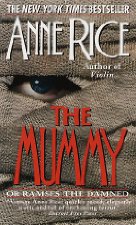
Book Review: The Mummy by Anne Rice (series #1)
 Summary:
Julie Stratford’s father is a retired shipping mogul who now spends his time as an archaeologist in Egypt. He uncovers a tomb that claims to be that of Ramses the Damned, even though his tomb was already found. Everything in the tomb is written in hieroglyphs, Latin, and Greek, and the mummy is accompanied by scrolls claiming that Ramses is immortal, was a lover of Cleopatra, and can and will rise again.
Review:
I’m a fan of Anne Rice. Her Vampire Chronicles are a lovely mix of social commentary, lyrical writing, and all the best tropes of genre fiction, so I was excited to stumble upon a cheap copy of The Mummy in the second-hand section of the bookstore. I wanted to love it. I really did. But whereas the Vampire Chronicles contain valid social commentary, this is so stereotypical of mainstream romance a la The Titanic that I was sorely disappointed.
Again, the language is lyrical and gorgeous. Rice without a doubt is incredibly talented at putting together sentences that read like a rich tapestry of old. There is no rushing to get the story out as is so often found in more modern writing. It’s fun to indulge the senses and oneself in the scene.
The plot, though, ohhhh the plot. It’s so mainstream romance it hurts. And yes, I know I read and enjoy (and write) paranormal romance, but the difference is that PNR is oftentimes tongue in cheek. It knows it’s ridiculous and over the top and doesn’t take itself too seriously. It’s meant to be fun and ridiculous. Rice is being serious here, however, and that’s why the plot bugs me. Let’s look at it for a second, shall we?
Girl is engaged to the perfect guy but she mysteriously does not think she loves him. Girl meets immortal man who is so hot he would be voted hottest man alive every year forever. Girl immediately “falls in love” with immortal guy. Girl ditches perfect guy for immortal guy. Girl and immortal guy have lots of the hot hot sex. Immortal guy causes a series of unfortunate events in pursuit of his ex-lover. Girl insists she still loves guy but cannot forgive him. Girl decides life is pointless without immortal guy. Girl attempts to kill herself. Immortal guy saves her. Girl forgives immortal guy. Girl agrees to become immortal too. Yay happily ever after.
Like….just……there are SO MANY parts of that that piss me the fuck off. So. Many. The main female character (Julie) is a shallow douchebag in spite of claiming to be a modern, progressive woman. She does not “fall in love” with Ramses. She falls in lust with him. He gives her tinglies in all the right places. He ditches her to pursue his ex-lover (Cleopatra). She, at first, rightfully tells him she can’t forgive him for that. But then she TRIES TO OFF HERSELF. OVER A GUY. And the only reason she doesn’t succeed is douchebag saves her. I just….wow. Not a plot I can respect. Not a plot that gives us anything different from the patriarchal rigamarole so often forced upon us. Anne Rice. I am disappointed.
Then there’s the odd eurocentrism at work in the narration. Even though Julie’s father loves Egypt and Ramses is, um, Egyptian, for some reason everything modern and European is what is impressive to everyone. I suppose I could maybe (maybe) forgive that, but then there’s the fact that the elixir that makes people immortal also for some mysterious reason turns their brown eyes blue. So nobody immortal has brown eyes. I don’t think I need to unpack why that’s offensive for you all. I trust you can figure that out for yourselves. Unlike Rice.
So, essentially, The Mummy is a beautifully written book that is destroyed by a kind of offensive, all-too-common plot and Eurocentrism. Even beautiful writing can’t overcome that.
3 out of 5 stars
Source: Harvard Books

 Support my work with a tip or browse my shop for curated book club guides, how to guides, cross-stitch patterns, and more!


This work by Amanda Nevius is licensed under a Creative Commons Attribution-Noncommercial-No Derivative Works 3.0 United States License.
 Opinions of a Wolf