
Archive
Book Review: The Department of Magic by Rod Kierkegaard, Jr.
 Summary:
Di Angelo and Farah thought they were getting a typical, boring DC government job. But it turns out they have been assigned to the Department of Magic, and whether they like it or not, their horogaunt boss is having them face down demons, shifters, and more in repeated robberies to gather the pieces of George Washington in the hopes to bring him back to life to fight off the ancient Mexican gods who were stirred out of slumber by all the talk of the ancient Mayan prophecy of the end of the world in 2012.
Review:
I have not hated a book this much since finishing Anne Rice’s The Wolf Gift in February (review). On the plus side, this means you all get to enjoy an angry Amanda take-down style review. On the minus side, I had to suffer through this horrible thing. But this is what book reviewers do. We suffer through things and tell you about them so you don’t have to.
This book has a triple-whammy of awful. It has so many grammar and spelling mistakes that I can’t believe it ever made it through an editor (oh but it did!). The plot is confusing and ill-paced. Finally, and most importantly, it is so prejudiced I had to double-check that this wasn’t a pen-name for Ann Coulter. Too often I’ve made these assertions in the past but been unable to truly show them to you since it was a library book or some such. Enter: the kindle. But first let me quickly explain the plot/structure/pacing issues.
So Farah and Di Angelo aka Rocky are hired by this mysterious department in the US government. There is a lot that makes zero sense about the department. First, it appears to only consist of Rocky, Farah, and their boss Crawley (a horogaunt). Anyone who has worked in the US government *raises hand* knows that they do not underhire. They overhire. So this just makes the author look like he knows nothing about government.
Throughout the book, Farah and Rocky have this problem of carrying out covert operations for the department and almost getting arrested and wanted for murder and blah blah blah. Um, excuse me. This is the motherfuckin government. If they want George Washington’s sword they “borrow” it. If they can’t “borrow” it, they send in government agents and protect them from prosecution because, I reiterate, this is the motherfuckin government. A department that supposedly exists to keep America aligned with the goddess America and protected from demons and vampires and what-have-you that no one else knows about would probably be a Big Deal on the inside. So this plot point makes no sense.
Then there’s the pacing issues. The pacing goes up and down and up and down and the reader keeps prepping for a climax only to get none. I think you see the analogy I am going for here. And it sucks.
Moving right along, let’s get to just a few of the more egregious grammar, spelling, and other writing I caught in this *laughs hysterically* edited book.
rung off. (location 385)
Americans hang up. No one in this book is British. The narrator is not British. This is stupid.
He could feel her hot breath, fetid as a zoo animal’s gorged on fresh meat. (location 752)
This is a bad analogy, as any high school student can tell you, because the vast majority of people don’t KNOW what a zoo animal’s breath smells like. An analogy is supposed to help a reader connect an unknown thing to a known thing.
Kabbala (location 858)
This is not how you spell Kabbalah.
Then she pulled both of their caps off and bit him on the mouth. (location 1889)
No, this is not a scene between one of our heroes and a demon. This is supposed to be Farah romantically kissing Rocky. Was that the image you got from that? Didn’t think so.
The most terrifying form devils or demons can take. No one has lived to describe them. (location 1889)
This comes from the federal book on beasts and demons that our heroes read and start every chapter with an excerpt from. Question. If no one has ever lived to describe these demons then a) how do you know they exist and b) how the hell are you describing them in this book?!
Her face was beautiful, appearing radiantly soft-cheeked and virginal in one instant, a rotting grinning skull, a death-mask in the next. (location 3922)
If you are writing a sentence comparing something from one instant to the next, you can’t compare three things! Two. Two is your limit.
Ok, but obviously I wouldn’t hate a book this hard for bad plot and some (ok a lot of) writing problems. I’d give advice and encouragement. The hating on the book comes from the prejudice hitting me left and right. It was like running the obstacle course in Wipe-Out! I can’t and won’t support or recommend a book to someone else as not for me but maybe for them when it’s this painfully prejudiced throughout. Let’s begin, shall we?
Look, hon, you know you’ve got zero will-power. Honestly you’re like a lesbian. You go out with this guy a couple times, you’ll move in together on your third date. I see him all day, every day. I don’t want him underfoot when I come home too. Plus he’s too poor for you. (location 741)
Oh look! Homophobia! The sad part is you can tell that Kierkegaard thinks he’s being funny when he’s just flat-out offensive. To top off this delightful bit of dialogue, we’ve got classism. And I feel I should mention the man they are talking about is an Iraq War vet. But he’s poor. And clearly that is what matters in dating. Homophobia is not quite this blatant throughout the rest of the book, although we do have a *delightful* scene in which Bobbi (a girl) shows up to seduce Rocky, who she thinks is gay, since Farah spread a rumor that Rocky is gay to keep her fiancee from being upset that she’s working with a man. Yeah. That happened.
There is more blatant classism, though.
Baltimore is the blue-collar ugly step-sister of the white-collar Washington DC metropolitan area. (location 1250)
Noooo, comparing hardworking people with blue collar jobs to the ugly stepsisters in Cinderella is not offensive at all.
*sighs*
Also, pretty much every demon “disguises” themself as a homeless person. This means almost every homeless person our heroes run into is a demon. Seriously.
And what about women?
The reason I’m so into Nineteenth Century romantic literature, I guess, is because I love anything that reminds me of growing up with my mom and my sisters and gets me inside women’s heads. (location 1214)
Yes! Let’s just go ahead and say that Jane fucking Austen represents every woman’s head everywhere in the 21st century. That’s just awesome.
Speaking of women, I will say this. Farah is the more talented of the duo in climbing, which is nice. However, she and every other woman are presented as shallow and obsessed with fashion. Also, a baby is born, and Farah turns overnight into a doting mother-figure when she was a sorority-sister type girl mere hours before. Meanwhile, the actual mother fails at parenting, and the only explanation for this utter lack of ability with babies is that she is a vampire.
I’m not sure what the precise word is for it….xenophobia perhaps? But Kierkegaard makes it abundantly clear that only Protestants have the whole religion thing right.
White or “good” magic, he told her, already had a name. It was called “prayer.” And even prayer, unless directly addressed to God the Creator, is in essence a Luciferian transaction, because it relies on the intercession of intermediaries, such as saints or boddhis, and inevitably involved some sort of quid pro quo. (location 1545)
Speaking of religion, no hateful book would be complete without some anti-semitism tossed in there, would it?
Freemasons–A Lucifer-worshipping conspiracy cult dedicated to Zionist one-world government, heirs of the Christ-murdering Pharisees and the Knights Templar. (location 1596)
Christ. Murdering. Pharisees. He actually went there. And not only are they the Christ killers but! They also secretly run the world through a Satan-worshipping secret organization!
I would have thrown the book across the room at this point, but it was on my kindle, and I love my kindle.
And finally. To round it all out. We’ve got some good, old-fashioned American racism.
First we have the black man who spoke entirely normally until this sentence:
You got any questions you need to axe me, you know where I live. (location 1193)
Then we have the Asian-American man who can’t pronounce his own name:
There they consecutively picked up a squat red-faced Asian named Robert, which he pronounced as “Robot,” and a noisy and vituperative older black man in a water-sodden daishiki named Walkie-Talkie. (location 3225)
Beyond these blatant examples there’s the fact that every person of color is either actually a demon in disguise or working for the seedy underground of some sort of organization. The exception to this is Farah, who is Lebanese-American, but Kierkegaard takes extreme care to point out that she is NOT Muslim. She’s one of the Christian Lebanese-Americans. She also basically acts just like a white sorority girl but with an exotic look!!
See? See? I just. *sighs* The only people who might not be horribly offended by this book are the type of people I don’t really want to recommend books to anyway, except to be like “Here, read this book that might make you realize what a douchebag you are being, like say some classics of black literature or books on how hard it is to be gay in an evangelical family or maybe read about the real history of the Bible.” You see my point.
The only people who would enjoy this book are people who have this same prejudiced world-view against basically everyone who isn’t a white, straight, Protestant, American male. So, I guess, if that’s you, have at it? But it’s riddled with spelling, grammar, and plot problems, so you won’t enjoy it anyway. So hah.
1 out of 5 stars
Source: Netgalley
Reading Project Wrap-up: The Real Help–Helping Put “The Help” in Historical Context
On September 3, 2011, myself and Amy of Amy Reads announced our intention to co-host a reading project devoted to reading the list of recommended reads put out by the Association of Black Women Historians in response to the incredible popularity of Kathryn Stockett’s book (and later, movie) The Help. It’s hard to believe that we’ve already completed reading all 10 books. I sort of feel like I took a mini class on the history of black women’s labor in the US, and I’m so glad I did.
Although I was a US History major (and also English) in undergrad, I tended to focus more on colonization, westward expansion, and World War II. The Civil War was not a thing of mine, nor was the Great Migration or the Civil Rights movement. It may sound silly, but when you’ve only got 8 to 10 courses, some of which are taken up by requirements, to cover all of US history, some things just don’t get covered, especially if you don’t already have an interest in them. So, although I knew right away that something was WRONG with The Help, it was difficult for me to elaborate exactly what. I knew it was wrong for a white woman to be putting words in black women’s mouths about a time period that is so recent and still stings. I knew that having the main, white character come in and rescue the black help was wrong. And I knew that putting such a rosy color on a time period that was anything BUT rosy was revisionist and distasteful. But I didn’t know enough about black women’s history to say much beyond that.
Well, thanks to this project, I know so much more now. I know enough to elaborate in more detail what is offensive about The Help. But before we talk about that, I want to talk about some of the things that I learned.
In the first read, A Million Nightingales
The first nonfiction book–Labor of Love, Labor of Sorrow: Black Women , Work, and the Family, from Slavery to the Present
Our second fiction book–The Book of Night Women
The next nonfiction read was the memoir Coming of Age in Mississippi
Our next read was Like One of the Family: Conversations from a Domestic’s Life
Out of the House of Bondage: The Transformation of the Plantation Household
We then read The Street
To ‘Joy My Freedom: Southern Black Women’s Lives and Labors after the Civil War
Our final fiction read was Blanche on the Lam
Our final read was Living In, Living Out: African American Domestics in Washington, D.C., 1910-1940
So, given all of that, how would I characterize what is wrong with Kathryn Stockett’s The Help now? I would say it drastically oversimplifies the serious, life-threatening, soul-stealing world of racism in the American south and also innate in the employer/servant dichotomy. It places the reins of social change in the hands of a kind white woman who views the help like one of the family, when in reality it was through the courage and strength of black women that the civil rights movement had any chance at all. And they certainly did not view themselves as a member of the family for whom they worked for disgustingly low wages. It seeks to rewrite history in a way that will assuage white guilt (most likely foremost the white guilt of the author) and retroactively removes the very real civil rights agency demonstrated by black women in the south from them. It is a racist book because it oversimplifies and dumbs down what is a complex and sad chapter in American history that everyone should clearly understand for what it was to prevent us from ever reliving it.
Now, I know not everyone has the time or the energy to read all of the books on this list. So what are my recommendations?
If you want a popular-style, fun book to read instead of The Help, I recommend you pick up Blanche on the Lam
If you are more interested in the civil rights movement and the involvement of domestic help in it, then I suggest you pick up the memoir Coming of Age in Mississippi
If you like short stories and want to hear the voice of the real help from the 1950s, then I suggest you pick up Like One of the Family: Conversations from a Domestic’s Life
If you really enjoy a well-researched, well-documented piece of nonfiction in your life and want a much clearer understanding of race in the populous southern city of Atlanta, then definitely pick up To ‘Joy My Freedom: Southern Black Women’s Lives and Labors after the Civil War
Finally, if you want a short nonfiction read that quickly covers some of the issues innate in racially based domestic help through the voices of the women who lived it, then you should pick up Living In, Living Out: African American Domestics in Washington, D.C., 1910-1940
I am very grateful to the Association of Black Women Historians for taking the time to assemble and post this list. I learned so much from reading through it and am now able to eloquently defend my stance on why it’s sad and wrong that The Help became such a popular read. I encourage you all to follow your gut and question when something is popular that just doesn’t seem quite right to you. Read up on the real history and find the little-known gems of fiction that are brave enough to confront the real issues. The publishing industry will only change what it puts out and pushes on the public when we change our demands. I can say that Amy and I already saw at least two of the books on the list go from unavailable on the Kindle to available in the time that we worked on this project. We hope that this at least in a small part had to do with a new demand for the titles due to the release of the list from the ABWH or maybe even from ourselves talking about these lesser-known books on the blogosphere.
What I ask of each of you readers in conclusion is to choose just one book from the list to read. Challenge yourself and try something that isn’t “popular.” You’ll be surprised at what you discover and learn.
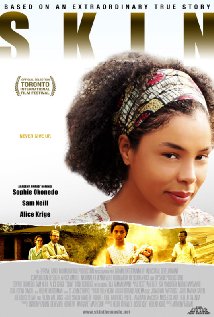
Movie Review: Skin (2008) South Africa
 Summary:
Based on a true story, Sandra Laing was born black to two white parents. Something that is an interesting anomaly of unacknowledged or unknown ancestors, but unfortunately for Sandra it was oh so much more than that. Sandra was born in South Africa during Apartheid, and her white Afrikaner parents were members of the National Party. This film chronicles her fascinating life from a young girl hidden from the sun in the hopes that her skin would lighten as she grew older to a young runaway marriage to striking out on her own with her children.
Review:
I know movie reviews have been scarce around here. That’s mostly because since I joined the gym my evening free time is spent either there or reading. This weekend though I had a cold and a bit of a fuzzy head from a fever so I randomly chose an interesting looking movie from my Netflix recommendations. I had no idea when I chose it that Sandra Laing’s story is a true one. I didn’t realize this bit of information until the end credits. I thought it was one of those “what if” scenarios and knowing that this actually happened makes the whole thing incredibly painful.
We know that innate parental unconditional love is a myth. And if there was ever a true story that should unequivocally dispel this myth once and for all, it’s Sandra’s. Is there anything more abusive, more unloving than raising your child in a culture that hates her and doing, really, nothing about it? Although her parents did fight to have her classified as white and not colored (so they could keep custody of her, because apparently children had to be raised by parents of the same race during Apartheid), they did little else to protect her. Indeed, by her teen years her father was pressuring her to behave for white boys who were being verbally cruel at best or attempting to rape her at worst on dates. It’s little wonder Sandra ran off to be with a black man she met. Your role as a parent should be to protect your child and prepare her to take care of herself in the real world and advocate for herself. But Sandra’s parents’ racism clouded everything so much that the most they did was attempt to hide her.
Of course, the problem then became that Sandra was raised in a privileged background, and that’s all some of the black South Africans could see when they looked at her, including her own husband. He says to her at one point, “You still think of yourself as white.” I find it fascinating how people can become so wrapped up in their own problems resulting from inequality that they fail to see the pain inflicted by it on others, even others that they love.
The actress who plays the older Sandra does a great job showing her progression from a hopeful teen to a downtrodden factory worker at the end of Apartheid. The trauma from a life where everyone judged her either on her own skin tone or that of her parents is abundantly evident on the actresses’ face.
That said, while the topic is incredibly important and the true life events heart-breaking, I don’t think the movie itself does the real story true justice. The actors and actresses did a fine job with what they were given, but even basic googling shows that the story was cleaned up for a mainstream audience, which I think was a very poor decision on the part of the filmmakers. Sandra’s life was actually more difficult than they even give her credit for. For instance, she left home at only 15 (she seems much older in the film), her first husband already had a first wife, she actually had six children not two, etc…. (Essence, The Guardian, Women and Hollywood)
Personally, I view this movie as a gateway to the far more fascinating nitty gritty true story. I’m adding the book by the journalist Judith Stone about her work with Sandra to attempt to figure out her past called When She Was White
4 out of 5 stars
Source: Netflix Instant

Book Review: Blanche on the Lam by Barbara Neely (Series, #1) (The Real Help Reading Project)
 Summary:
Blanche’s employers failed to pay her on time, and now she has some bad checks. She had no idea that bouncing a few checks would land her with a 30 day jail sentence, though, so when she gets the chance, Blanche goes on the lam. She decides to take a temporary job she had originally decided against as a way to hide out. She’s going to be the help for a family on a week-long vacation in the countryside. Naturally, things can never be simple, and Blanche starts to suspect one of the family members is a murderer.
Review:
It’s hard to believe Amy and I are on our penultimate book for the project, not to mention the final fiction book on the list. And what a book! If I had to pick one of the fiction books we read to hand to fans of The Help to get a much more real representation of black women in domestic service, this is definitely the book I would hand them.
Somehow this tiny mystery novel (called a Kriminalroman in German, which I think sounds much better) manages to cover pretty much every aspect of black female domestic workers’ lives that we’ve discussed throughout the project. Blanche faces: police and criminal justice prejudice, stinginess on the part of wealthy employers, rape at the hands of a white male employer, classism, employers’ racist attempts to control her body, non-traditional family structure, and much much more. Yet facing all of those odds, Blanche remains determined and strong. She is not someone who needs OR wants a white woman (or man) to come along and rescue her. I think Blanche’s personality is best summed-up here:
She always returned to domestic work. For all the chatelaine fantasies of some of the women for whom she worked, she was really her own boss, and her clients knew it. She was the expert. She ordered her employers’ lives, not the other way around. She told them when they had to be out of the way, when she would work, and when she wouldn’t. (page 86)
That’s one of the wonderful things about this book. It turns the whole white woman saving the help thing from The Help on its head. Blanche is the one who saves the white family in this book, and then she refuses to accept help from them in return, beyond clearing up her ridiculously unfair legal troubles. Instead of taking a cushy job with them, she leaves, because she is her own woman.
Now, all of that said, I was personally a bit distracted from the race and class issues in this book due to the presence of the character Mumsfield. Mumsfield is the cousin of the sinister family members, and he has Down’s Syndrome. I don’t think all of my readers know this, but my niece has Down’s, so I certainly am a bit sensitive to the portrayal of it in literature. Knowing and loving a person with Down’s removes a lot of the misperceptions of it that exist in the world. At first, I was concerned that Neely had fallen for these things. Mumsfield at first seems too trusting, too caring, a real simpleton. But by the end of the book, Blanche realizes that she hadn’t really listened to what Mumsfield was actually saying earlier in the week. If she had, she would have realized that while Mumsfield is kind and giving, he’s not stupid. Knowing Mumsfield also helps Blanche see that her experiences as a black woman in America have made her racist against white people, when not all of them are bad. Thus, I am pleased to report that Mumsfield is actually an accurate and positive portrayal of people with Down’s.
Now, I will say, personally I’m not generally into the typical mystery novel. I like to get my genre reading from urban fantasy, pnr, and cozies. I am well aware, though, that a lot of people love this kind of book, and it is definitely well-done. It has all of the well-loved aspects of the genre, plus manages to address race, class, and even Down’s Syndrome. It is absolutely a worthwhile read.
3 out of 5 stars
Length: 215 pages – average but on the shorter side
Source: Library
Buy It (Amazon or Bookshop.org)
Discussion Questions:
- How do you feel about Blanche’s initial jail sentence and her decision to go on the lam?
- Blanche sees Mumsfield as an exception to the rule when it comes to white people, aka it’s unusual for them to be kind. Do you think this is an unfair assessment?
- Blanche assesses her caring for Mumsfield as a symptom of “Darkies Disease” aka when the help start acting like the idealized Mammies. What do you think of this assessment?
If you found this review helpful, please consider tipping me on ko-fi, checking out my digital items available in my ko-fi shop, buying one of my publications, or using one of my referral/coupon codes. Thank you for your support!
Book Review: Brothers (and Me): A Memoir of Loving and Giving by Donna Britt
 Summary:
Now in her fifties, Donna Britt, an award-winning and ground-breaking black, female journalist, takes a look back at her life to see what has influenced her the most. She is unsurprised to find that her life has largely been affected by loving and giving to brothers–black men she’s both related to and not. From growing up surrounded by three blood brothers, to loving brothers, to raising them, Britt discusses the universal influence heterosexual women’s love for men has on their lives, as well as the unique aspect of loving a race of men persecuted in the United States and raising her three boys in the face of the odds stacked against them.
Review:
Britt’s career as a writer shows in her memoir. It is the most well put-together memoir I’ve read in quite some time. Each chapter looks at a key event in her life in order of it being lived, but also looks at the impact those events had on her as a person. She does this by starting with a photograph and an anecdote related to the event, then moves on to describing the event in detail. Everything in her life, though, is impacted by her brother, Darrell’s, death at the hands of two policemen in his early 20s. This terribly unjust incident and how it flavors the rest of her life is the simplest and most effective anti police brutality message I’ve ever read. Was her brother threatening the officers? Maybe. But all it would have taken was for those two men to aim to stop rather than to kill to prevent the loss of someone’s loved one. Britt says later in her memoir that she knows that those officers just saw “a crazy black man” and not a person, and it is now her goal to always see the person, not the stereotype.
Britt, like other memoirists I’ve enjoyed, never takes a “poor me” attitude or tone, in spite of the fact that she really could given the loss of her brother, being raped, and a first marriage to a man who soon got lost in cocaine addiction. Not to mention her second husband’s affair. Yet, through all of this, Britt’s resilience is evident. She constantly tries to improve not just the world but herself. Britt has an ability to look at herself without rose-tinted glasses. She knows her own faults, primarily that she’s a perfectionist and expects too much from people. I think that’s what makes her so relatable and sympathetic. She’s an imperfect person struggling in an imperfect world, but that doesn’t mean she isn’t right about the injustices she’s seen throughout her life.
I think any female reader who has a brother can understand the other central question in Britt’s memoir–How exactly did these boys who were our brothers who loved us and pranked us and guarded us with their fists when we were young grow up into these baffling men? Boys are easy to understand. Men, not so much. That’s even the case with Britt’s own brothers, one of whom grew from a rebel into a religious man who changes his name from Steve to Melech and whom she barely speaks to anymore. Why is it when boys become men and we go from girls to women that communication becomes so hard? Hard, but rewarding and not impossible. Sure, no answers are offered, but it’s nice to see this experience through someone else’s eyes.
Beyond social justice and the universal communication difficulties between men and women, Britt’s memoir also clearly demonstrates an issue that is sometimes hard to explain–that of privilege. Those born with privilege sometimes have a hard time understanding what, exactly, it is those without it are speaking about. I sometimes wonder myself if I’d understand privilege if I’d been born a white MAN instead of a white WOMAN. Britt with a gift of subtlety makes this clear. She talks about needing to be extra perfect, extra good in order to combat the stereotype of the useless black children. Of feeling like she’s representing the entire race when she’s the only black student in her graduate class. Of the fact that maybe if her brother had been white and acting crazy the cops might not have shot him. Of being extra concerned when her son shoplifts because he probably wouldn’t get away with just a slap on the wrist if he got caught. Instead of talking loudly about privilege, it’s simply evident throughout her entire life and the lives of those around her. I would hope that anyone reading this would start to see how inequality survives today, even if it’s not as institutionalized as it once was.
Overall, this is a powerful memoir by a humble woman that again demonstrates why it’s important to listen to the life stories of those older than us. There is always something to learn or to relate to from their life journey. I, naturally, don’t always agree with Britt or her choices, but I respect her commitment to living the best life she can.
I recommend this memoir to fans of the genre, especially, but also to those with an interest in racism in 20th century America and relationships between men and women.
4 out of 5 stars
Source: NetGalley

Book Review: To ‘Joy My Freedom: Southern Black Women’s Lives and Labors After the Civil War by Tera W. Hunter (The Real Help Reading Project)
 Summary:
Hunter examines the lives of southern black women, particularly southern domestic workers, by narrowing her focus in on the development of the city of Atlanta after the Civil War. Since many ex-slaves moved to Atlanta and then migrated again north during the Great Migration decades later, this makes for an excellent focal point for the topic. By examining black women’s lives in Atlanta both in and out of their employer’s homes, she is able to dissect the roles of race, class, and gender in the elite’s attempts to maintain dominance in America.
Review:
I’ve said throughout the project that the nonfiction books have come up a bit short for me. Although they’ve contained valuable information, they haven’t been the most readable. Nonfiction can tell a story too, and Hunter does exactly that. She explores so much more than just the women’s lives in relation to their employers. Atlanta truly comes to life as we see the women commute to work via bicycle so as to avoid racist trolley lines and kick up their heels on the interracial Decatur Street after dark. We also get to see the empowering role of secret societies in black women’s lives, as well as reclamation of performing in black face and the terrifying resurgence of the Ku Klux Klan. It is impossible not to be moved and outraged by the tale of these women’s struggles. The book addresses three issues: classism, racism, and sexism.
In spite of Americans being told repeatedly that the American Dream is available to all if you work hard enough, Hunter quickly shows how the poor are fighting a losing battle and on top of it are demonized by the wealthy. For instance, the use of debt to keep the poor enslaved:
Poor women often borrowed money in meager amounts, less than one dollar at a time, amassed running accounts for several months or years, and repaid ever-accumulating interest in small installments. Many moneylenders were usurious. It was common for borrowers to pay 250 to 3500 percent interest on small sums, which exacerbated poverty with interminable debt. Fannie Holman, a washerwoman, borrowed between $60 and $90 over a two- or three-year period. Though she would repay over $1,000, the creditor applied it to defray the interest but not the principal of the loan. (page 134)
Similarly, upper class employers’ attempts to control every aspect of their employee’s lives, claiming a right over their bodies:
Dance halls were a menace, declared Proctor, because “the servant class tried to work all day and dance all night.” He warned employers that household laborers would not perform well if they used their leisure unproductively—dancing instead of resting in preparation for the next day of work. (page 179)
Hunter via maps and clear explanations demonstrates how the wealthy acquired the highest land in Atlanta most conveniently near shopping and such, while the poor and blacks were forced into the lowest land that, in addition, sewage was dumped into. These conditions combined with the poor housing provided by slumlords made a perfect scenario for disease, and yet the poor were blamed for the outbreak of tuberculosis in the city and even accused of exposing wealthy whites to it:
Tuberculosis signified more than a purely physiological condition. The disease became a medium for “framing” tensions in labor and race relations, with the rhetoric cloaked in scientific and medical legitimacy. (page 187)
Of course, the fact that black workers were poor was no coincidence. The entire city conspired since the Civil War to make black Americans poor and keep them that way. The wealthy whites, and in a lot of cases the poor whites, wanted black people out of sight and out of mind unless they were actively in service to them
Jim Crow and domestic labor thus represented contradictory desires among urban whites striving to distance themselves from an “inferior race,” but dependent on the very same people they despised to perform the most intimate labor in their homes. (page 105)
Segregation was not a system imposed entirely from above; it also helped to advance the interests of white workers, who were able to gain status from their position in the social hierarchy above all blacks. (page 119)
Jim Crow parks were designed not simply to put white urbanites closer to nature, but also to give them moments of reprieve and distance from blacks in order to channel racial friction in “wholesome” directions. (page 147)
Of course, on top of having their fight for the right over their own bodies and lives depicted by the ruling white class as them being uppity servants and uppity blacks, women had the additional injustice of having their femininity and womanhood called into question.
Like the defiant women in Galveston, strikers in Atlanta showed little attachment to prevailing middle-class conventions of femininity. As they did on other occasions, working-class women used street fights to settle disputes that jeopardized their unity and engaged in militant resistance. (page 89)
The moral implications of women consuming intoxicating substances troubled many middle-class blacks and whites. Women not only evaded laws prohibiting them from entering saloons, they frequented bar room “annexes,” they drank alcohol in alleys and streets, and they sold beer from their homes. (page 165)
I usually don’t quote this much, but the whole book is just so good. The three-way injustices faced by black working class women is palpable throughout. Facing one alone would be daunting enough, but facing three feels terrifyingly insurmountable even just reading about it, let alone living it. And yet some black domestic workers did pull through in spite of the odds and do great things. Women like Carrie Steele.
Former slave Carrie Steele, a stewardess and cook at the train station, volunteered her time as a probation officer for children in trouble with the law. This experience and her childhood as an orphan inspired her to start an orphanage in 1890. She believed that many of the children she came in contact with had fallen on hard times because they had no families to take care of them. Steele raised money to purchase four acres of land and the orphans’ first home by selling her own house, writing and selling her autobiography, and soliciting funds from generous individuals, black and white. By 1898 the Steele orphanage consisted of a brick building, hospital, and schoolhouse, and more than two hundred children had passed through its portals since its founding. (page 142)
Inspirational. Humbling. Awe-inspiring. Words that describe both Carrie Steele’s life and the book as a whole. Read it.
Source: Public Library
Discussion Questions:
- Why do you think Decatur Street was allowed to continue in spite of being the only known location in Atlanta where the races mingled?
- Hunter values the dance halls for the role of letting off steam and embracing black culture they played in black Americans’ lives. How do you feel about them?
- In spite of viewing black Americans as “unclean,” white Atlantans persisted in sending their laundry out to black homes to be washed. Why do you think people were able to hold onto such illogical dichotomies?
- Given the depiction of of everything stacked against them, do you view drug dealers, bootleggers, prostitutes, etc… differently now than you did before?
If you found this review helpful, please consider tipping me on ko-fi, checking out my digital items available in my ko-fi shop, buying one of my publications, or using one of my referral/coupon codes. Thank you for your support!
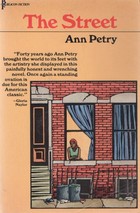
Book Review: The Street by Ann Petry (The Real Help Reading Project)
 Summary:
In 1944 Lutie Johnson believes that all it takes is hard work to succeed, so when she finds an apartment in Harlem that she can move into with her son, Bub, she sees it as a step up. Get him away from her dad’s gin-drinking girlfriend and all the roomers packed in the house. But it seems as though her hard work does nothing against the street and the walls that the white people build around the colored people brick by brick.
Discussion:
It’s hard to believe that Amy and I only have three books left after this in our project. Although we rather arbitrarily assigned the order of the books, I’m glad this one came toward the end. I doubt I would have understood the events in it or valued its perspective as much without the nonfiction reading we did prior.
The book is exquisite in the way it demonstrates how a racist society tears families apart. Hearing about black men being unable to find work in our nonfiction readings felt so cold and stark; I was left unable to understand why that would cause a man to leave his family. But through Lutie I came to understand. At first she doesn’t understand how her husband could cheat on her and be so fine with them breaking up, but eventually she does understand. He couldn’t find work in the city as a black man. She finds work as a maid in a white family’s house. She’s gone most of the time. He feels emasculated. Now, I know my feminist followers will object to this, but I remind you, this was not a choice on black families’ parts back then. It was forced upon them. Anything that is forced upon you can cause real self-esteem problems. As Lutie says, how can one manage a family in conditions like that?
Petry also clearly demonstrates how this break up of the home then leads to a generation of lost children. with Lutie working all day, her son, Bub, comes home to an empty, dank apartment. He takes up with the wrong crowds, because it’s scary to be in the apartment alone. He’s only eight. It’s easy to understand how he makes bad judgment calls, especially when his mother is constantly worrying about money around him. Seeing it spelled out with “real” people makes it all more understandable than the numbers and statistics found in Labor of Love, Labor of Sorrow. In Lutie’s case, her family fell apart twice before she even really realized it was happening.
The other strong element in this book was the hopelessness of the capitalistic American Dream. Not just the hopelessness of it, but the harmfulness of it. Lutie herself realizes that she never thought of anything but keeping her family afloat until going to work for the wealthy white family in Connecticut where she “learned” that all it takes is hard work and perseverance to become wealthy. What a false lesson. What a horrible thing to believe at face value. Yet, Lutie does, and it influences almost every single decision she makes for herself and Bub that leads to their ultimate downfall. Yes, part of their downfall is absolutely brought about by racism, but part is brought about by her believing in the system and not rebelling against it.
For instance, instead of spending what little time she does have outside of work with Bub teaching him and helping him, Lutie spends it pursuing a singing career. After being gone working in civil services all day, she leaves Bub alone at night yet again. Similarly, she penny-pinches and yells at Bub so much that Bub starts to believe that they are desperate for money, when in fact his mother is just attempting to save up to move to a better neighborhood. I get the value of a better neighborhood, but I think Lutie underestimates the value of her own impact on her son. She studies angrily at night instead of making the studying a bonding thing. She tells him he can’t stay up and read because of the cost of the electricity, which just blew my mind because you would think she would want him to read. It all adds up until Bub is not only almost constantly alone but also worrying about money at the age of eight. I can’t help but think if Lutie had just focused on making their home the best she could and making Bub feel happy and safe that it might have come out better. I’m not judging Lutie. It’s so incredibly easy to get caught up in the capitalistic belief system, especially when you’ve been scrambling your whole life and see money as a way to combat racism. I found myself constantly wishing and hoping that Lutie would stumble across some sort of progressive society that would help her fight for justice. Of course, in the real world, that doesn’t often happen, and Petry does an amazing job depicting real life in the real Harlem of the 1940s.
Of course, Lutie and her family are not the only ones unhappy. Although she only works for them for a few chapters in the book, the white family from Connecticut is profoundly unhappy, and Lutie sees it. The husband and wife ignore each other. The husband is raging with alcoholism. The wife is so focused on affairs that she ignores her son. The son just wants attention and can only get it from the maid. The brother-in-law kills himself on Christmas morning.
Why do I bother pointing this out? Well, it’s just further evidence the constant theme throughout our reading project. Racism and inequality hurt everyone in the society. Some more than others, yes, but it hurts everyone. The true values of life–love, time, companionship, laughter–they’re lost amidst the fight to maintain inequality and acquire money. And that’s largely what slavery was all about, wasn’t it? Establishing a plantation to become filthy rich instead of a farm where you make ends meet. And the perceived need for a plantation leads to a desire for cheap labor which leads to slavery which leads to maintaining racism in your head to justify it. And after Emancipation, the desire to hold onto your filthy wealth leads you to judge others as below you when they’re not. And racism is an “easy” way to do that.
But where does that leave those caught in the system? For Lutie, it leaves her a truly lost cause and her son yet another black boy with a record. Revolution and change takes time, effort, bravery. Even in the simple day to day decision to choose quality time over money. To choose to go against the American, consumer grain and just try to make a quality life for yourself. It’s fascinating and appalling how deeply entrenched in our culture the perception of wealth equaling quality of life is, yet it’s there. I think, to me, that is what is most appalling in the idea of “The Help.” Most people do not need a maid. Unless you are in a wheelchair or missing limbs or blind or have some other physical limitation, you do not need a maid. And yet some classes of society view it as necessary to make someone else clean up after them in their own home. Nobody is above cleaning up the filth from themselves and their own family. Nobody. And in the meantime, those that they hire to clean it up must do double-duty and clean up two homes and are left without enough energy for quality time with their own family. It honestly disgusts me.
Source: Public Library
Please head over to Amy’s post to discuss this book!
Book Review: Out of the House of Bondage: The Transformation of the Plantation Household by Thavolia Glymph (The Real Help Reading Project)
 Summary:
Thavolia Glymph analyzes the power relations between black and white southern women within the plantation household in the antebellum, Civil War, and immediately post-Civil War American South utilizing primarily slave narratives/interviews and the diaries and letters of white mistresses.
Review:
I am chagrined to admit that not only is this the first time I was late on the schedule of The Real Help Reading Project I am co-hosting with Amy, but I was exactly a week late! The lesson I have learned? Never schedule a timely thing for a holiday weekend. I apologize to Amy and everyone following along for making you wait, but at least it was Amy’s turn to host! Moving right along….
Whereas Labor of Love, Labor of Sorrow was extraordinarily all-encompassing, here Glymph narrows her focus severely to only relationships between black and white women in traditional plantation households in the American South. She, alas, stops her analysis around the turn of the 20th century, only venturing into the unique relations within the domestic work realm depicted in The Help in the epilogue. However, this book is quite valuable in that it analyzes the relationships that led up to that odd dynamic of the 1950s and 1960s.
This book covers a lot of information, but what sticks out the most to me in retrospect was how much work and effort it took to maintain a racist, unequal society. The white mistresses had this odd, completely illogical dichotomy of viewing black women both as inferior and needing their guidance and as naturally suited to hard labor. My eyes practically bugged out of my head when reading of white women teaching black women to do chores that supposedly white women were too weak to do….and yet they were perfectly capable of doing them well enough to show the black women what they wanted done. Um….what? That is the sort of illogical situation that only someone entirely committed to a belief system, no matter how wrong, will be able to come to terms with.
Similarly, the former mistresses predicted the imminent downfall of their former house slaves only to find themselves hired by these same freedwomen to sew fine dresses for them with the money they earned by working the plantation. Yet, the former mistresses persisted in believing in the racial inferiority of the freedwomen. Perhaps the most mind-boggling to me was the story of one former mistress who wound up teaching at a freed black school, yet even though she was with these children daily, she still believed in white supremacy. Why this persistent need to believe you’re better than someone else? Personally, it seems to me that the white men were so constantly judgmental of the white women that they reacted by taking it out on those society deemed inferior to them. If black free women rose to their same status, then who would they take their frustrations out on? This logic doesn’t free the white women of the guilt that they definitely deserve, but it does help to make sense of their ability to take on completely illogical stances.
I feel that I am repeating myself a bit with this project, but the books repeatedly demonstrate how inequality on any level acts as a poison to the whole society. I hope that is something that we modern readers will bare in mind in our own daily lives.
3 out of 5 stars
Length: 296 pages – average but on the shorter side
Source: BookU
Buy It (Amazon or Bookshop.org)
Please head over to Amy’s post to discuss this book!
If you found this review helpful, please consider tipping me on ko-fi, checking out my digital items available in my ko-fi shop, buying one of my publications, or using one of my referral/coupon codes. Thank you for your support!
Book Review: The Book of Night Women by Marlon James (The Real Help Reading Project)
 Summary:
This is the story of Lilith. A mulatto with green eyes born on a plantation in Jamaica to a mama who was raped at 14 by the overseer as punishment to her brother. Raised by a whore and a crazy man, all Lilith has ever wanted was to improve her status on the plantation. And maybe to understand why her green eyes seem to freak out slave and master alike. Assigned to be a house slave, Lilith finds herself in direct contact with the most powerful slave on the plantation–Homer, who is in charge of the household. Homer brings her into a secret meeting of the night women in a cave on the grounds and attempts to bring Lilith into a rebellion plot, insisting upon the darkness innate in Lilith’s soul. But Lilith isn’t really sure what exactly will get her what she truly wants–to feel safe and be with the man she cares for.
Discussion:
This is the third book and second fictional work for The Real Help reading project I’m co-hosting with Amy, and it totally blew me away. A reading experience like this is what makes reading projects/challenges such a pleasure to participate in. I never would have picked up this book off the shelf by myself, but having it on the list for the project had me seek it out and determined to read it within a set length of time. Reading the blurb, there’s no way I would imagine identifying with the protagonist so strongly, but I did, and that’s what made for such a powerful experience for me. The more I read literature set in a variety of times and places, the more I see what we as people have in common, instead of our differences.
There is so much subtle commentary within this book to ponder that I’m finding it difficult to unpack and lay out for you all. Part of me wants to just say, “Go read this book. Just trust me on this one,” but then I wouldn’t be doing my job as a book blogger, would I?
Depicted much more clearly here than in any of our reads so far is how detrimental a society based upon racism is for all involved. There is not a single happy story contained here. Everyone’s lives are ruined from the master all the way down to the smallest slave girl. It is a circle of misery begetting misery begetting misery.
Homer was the mistress’ personal slave and many of the evil things that happen to her was because the mistress was so miserable that she make it her mission to make everybody round her miserable as well. (page 415)
Nobody is happy. Everyone lives in misery and fear. The whites are afraid of a black revolt. The blacks are afraid of being whipped or hung. Everyone is afraid of Obeah (an evil witchcraft similar to voodoo). People start to lash out at each other in an attempt to better themselves. For instance, the Johnny-jumpers are male slaves who are pseudo-overseers given power over the other slaves to beat them. It is simply a system exploiting everyone and for what? From the book it appears to be to maintain Britain’s position of power in the world. The system is evil, and it does not simply beget misery, but despair as well. It brings out the worst in everyone.
A strong theme in this book is that of race being a construct rather than an innate true difference in people. Since Lilith is bi-racial, she has trouble simply aligning herself with one side or the other. Although at first she hates white people, she comes to deeply care for a white man. She comes to see people as individuals and not their race, but alas that thought process is far too advanced for the time she is living in, and she senses this.
She not black, she mulatto. Mulatto, mulatto, mulatto. Maybe she be family to both and to hurt white man just as bad as hurting black man…..Maybe if she start to think that she not black or white, then she won’t have to care about neither man’s affairs. Maybe if she don’t care what other people think she be and start think about what she think she be, maybe she can rise over backra and nigger business, since neither ever mean her any good. Since the blood that run through her both black and white, maybe she be her own thing. But what thing she be? (page 277-8)
It’s impossible not to have your heart break for Lilith, a woman whose whole life revolves around race when all she ever wants is to feel happy and safe, an impossible dream represented for her by a picture from a child’s book that her foster slave father let her take from him. The picture is of a sleeping princess with a prince near her, and Lilith’s obsession with this image follows her throughout her life, until she finally tells herself:
She not no fool, Lilith tell herself. She not a sleeping princess and Robert Quinn is not no king or prince. He just a man with broad shoulders and black hair who call her lovey and she like that more than her own name. She don’t want the man to deliver her, she just want to climb in the bed and feel he wrap himself around her. (page 335)
I found myself wishing I could scoop Lilith and Robert up and place them on an island where they could just be together and raise their mixed race babies and just be happy, but that’s not what happened then, and that’s the dream we must keep fighting for, isn’t it? A world where people can just love each other and be happy and not be forced into misery for economic gain of a person or a business or a nation.
I know it sounds like wishful thinking, but that’s really what I got out of this book. If we don’t want to live in a world that dark, we must embrace love in all its forms. Love begets love, but hate begets hate. Don’t like corporate greed or nationalism overtake your capacity to see the humanity in everyone–the capability for powerful good or powerful evil present in us all. Perhaps this is a bit off-topic for The Real Help Reading Project, but that is the old passion from a youthful me in undergraduate classes that this book reignited, and that is what makes me want everyone to read it.
Source: Public Library
Buy It

Please head over to Amy’s post to discuss this book!
Reading Project: The Real Help–Helping Put “The Help” in Historical Context (Co-hosted With Amy of Amy Reads)
What’s a Reading Project?
I am really excited to be doing my first social justice themed reading project, which is different from a reading challenge. A reading challenge challenges you to broaden your reading horizons. A reading project takes a topic that matters to you (or that should matter to you) and creates a reading list about that topic by people who know to help you learn about it, as well as drive discussion on such an important topic. Now, allow me to explain the genesis of and reasons behind my first reading project.
What Led to the Project
I’ve grown to become good friends with Amy of Amy Reads over the past year, and when Kathryn Stockett’s The Help blew up in literary circles then became a movie, well, both of our ires got up. We discussed back and forth the issues via gchat, tumblr, and twitter, sending articles and mini-rants to each other and just generally being peeved that so much of the population got swept up into something so offensive to both black and white women in 2011 for goodness sake.
Let me explain to you in my own words my problem with The Help. Stockett is a white woman who grew up in the south with black maids. She claims that when her maid died she felt regret at never having gotten to know her as a real person, so she decided to write this fiction book about black maids in her home state in the 1960s. Right away, I was offended that her instinct was to write a fictional account instead of, oh I dunno, maybe making an effort to fight racism by befriending black people?
For those who don’t know, The Help is about a college educated white woman who comes home and interviews the black maids in her town and publishes their stories. I cannot really wrap my mind around the thought that Stockett thought of doing a project like this, but instead of being an editor of a collection of memoirs and real-life scenarios by black domestic workers she chose to fictionalize the whole process.
This leads me to one of my largest points. The Help is Stockett living in a fantasy land version of history. One of the first things you learn as a history major is to NOT romanticize the past. You have to get up close and personal with how ugly it truly was. Shows like Leave It To Beaver completely leave out real issues like racism, classism, sexism, etc… This is what Stockett is repeating. She regrets her relationship with her own black maid, so she writes a truly mary-sue style book wherein a college educated white woman gets to know the black female domestic workers and comes to their aid. This isn’t reality. This isn’t a harmless feel-good book/movie. It’s Stockett’s fantasy method of dealing with the racism she grew up with. Why not instead have written a book about a white woman who goes to college in the north and comes to regret the racism she was raised with? Who confronts the fact that she spent more time being cared for by a black woman than her own mother? That would have been real. That would have been something respectful to talk about. Instead, though, she chose to write a fantasy version of the 1960s American South where the racism really isn’t so bad and a white female activist isn’t put into any danger by her activism.
The whole thing is offensive. It’s offensive to black and white women. It’s offensive to black domestic workers of the past and present. It’s offensive to white women who faced real danger and estrangement from their families protesting racism. It’s offensive to the black people who stood up for themselves and fought racism without any white people coming along and telling them they should. And yet people are happily taking the blue pill and revising history.
Thankfully, not everyone is doing that. Slowly Amy and I started to see similar reactions to our own throughout the web. Here are just a few examples:
Indeed, with regard to the white children for whom they cared, black women often felt levels of “ambiguity and complexity” with which our “cowardly nation” is uncomfortable. Yes, my grandmother had a type of love for the children for whom she cared, but I knew it was not the same love she had for us. (Shakesville)
The Help is billed as inspirational, charming and heart warming. That’s true if your heart is warmed by narrow, condescending, mostly racist depictions of black people in 1960s Mississippi, overly sympathetic depictions of the white women who employed the help, the excessive, inaccurate use of dialect, and the glaring omissions with regards to the stirring Civil Rights Movement in which, as Martha Southgate points out, in Entertainment Weekly, “…white people were the help,” and where “the architects, visionaries, prime movers, and most of the on-the-ground laborers of the civil rights movement were African-American.” The Help, I have decided, is science fiction, creating an alternate universe to the one we live in. (Roxanne Gay)
And indeed, the stories of black domestic workers during the Civil Rights Movement are compelling narratives that deserve to be told. But by telling them through the lens of the benevolent white onlooker (Emma Stone’s “Skeeter” in The Help, who records the stories of the maids), it dilutes the message and impact. The black women who struggled during that time are strong enough to stand on their own. They don’t need an interpreter to serve as a buffer between them and the audience, to make their experiences more palatable for today’s viewers. (Kimberley Engonmwan)
It’s frustrating because in these narratives—written by privileged Whites—Black people are always passive. Things are done to them or for them, but they are never the agents of their own liberation. (And sorry, but no, telling the Nice White Lady about your shitty boss isn’t being an agent of your own liberation—not when Black women were actually organizing against Jim Crow, segregation, lynchings and violence, and the intimidation of Black voters.) (Feministe)
What really pushed it over the edge for me, though, and got me going from stewing to activisting (that is a word because I say so) was when someone tweeted a link to the American Black Women Historian’s response to The Help that is not only eloquently put, but also includes a suggested reading list at the end. The reading list got my wheels turning and next thing I knew I was emailing Amy to suggest we do something with that list.
What the Project Is
There are 10 books on the suggested reading list, 5 fiction and 5 nonfiction. For the next five months we will be hosting a project to read one fiction and one nonfiction book and discuss the content and issues raised. One blogger will host each book. For the first month, Amy will be hosting the nonfiction book, and I will be hosting the fiction book. Other bloggers with an interest in the project are welcome to host! Just email me and (opinionsofawolf [at] gmail [dot] com) and Amy (amy.mckie [at] gmail [dot] com) to let us know your interest and what book you might like to host the discussion for.
The fiction book will be discussed on the second Saturday of the month, and the nonfiction book will be discussed on the fourth Saturday of the month. The first Saturday of the month will wrap-up the previous month’s discussions and announce the next two books.
So next Saturday I will be discussing A Million Nightingales
On the 24th, Amy will be discussing Labor of Love, Labor of Sorrow: Black Women , Work, and the Family, from Slavery to the Present
We encourage you to join in with us on the project to stop letting people revise history. Get to know the facts behind the history of black domestic workers in the United States and read fictionalized accounts of the experiences written black writers, all recommended by educated historians.
Books of the Project
Fiction:
Like One of The Family: Conversations from a Domestic’s Life
The Book of Night Women
Blanche on the Lam
The Street
A Million Nightingales
Non-Fiction:
Out of the House of Bondage: The Transformation of the Plantation Household
To ‘Joy My Freedom: Southern Black Women’s Lives and Labors after the Civil War
Labor of Love, Labor of Sorrow: Black Women , Work, and the Family, from Slavery to the Present
Living In, Living Out: African American Domestics and the Great Migration
Coming of Age in Mississippi
 Support my work with a tip or browse my shop for curated book club guides, how to guides, cross-stitch patterns, and more!


This work by Amanda Nevius is licensed under a Creative Commons Attribution-Noncommercial-No Derivative Works 3.0 United States License.
 Opinions of a Wolf