
Archive
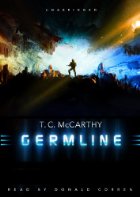
Book Review: Germline by T. C. McCarthy (Series, #1) (Audiobook narrated by Donald Corren)
 Summary:
Oscar is a reporter and lands an assignment with Stars and Stripes to go over to Kazakhstan and report on the new war between the US and Russia over resources needed for technology. This is a new kind of warfare. One fought mostly underground, and with the soldiers permanently wearing suits. Plus they’re fighting side-by-side with Genetics–human-looking robots who are all female and all look alike. Oscar started out just wanting a Pulitzer in between his drug addiction, which is easily fueled in Kaz. But Kaz changes people.
Review:
It’s been a while since I ventured in military scifi. I usually stick with the more sociological/psych experiment or cyberpunk areas of the genre, but this one just stuck out to me. I think its combination of aspects is just intriguing–a drug addicted journalist, a future war on earth, underground warfare, and robots. It certainly held my attention and flamed my interest in military scifi, plus it wound up counting for the MIA Reading Challenge, which was an added bonus.
Oscar is a well-rounded character. At first he seems flat and frankly like a total douchebag, but that’s because he’s a depressed drug addict. We learn gradually what landed him there and how he grows out of it with time. It’s an interesting character development arc because although many arcs show how war leads to alcoholism or drug addiction, in Oscar’s case although it at first makes his addiction worse, it ultimately helps him beat it. Because he ultimately snaps and realizes that the drugs are not helping the problems. They’re just making them worse. This is so key for anyone struggling with an addiction to realize. Pain in the present to feel better in the future. And McCarthy does an excellent job showing this progression without getting preachy. Sometimes you want to throttle Oscar, but you ultimately come to at least respect him if not like him. I wasn’t expecting such strong characterization in a military scifi, and I really enjoyed it.
The world McCarthy has built is interesting. The war itself is fairly typical–first world countries butting heads over resources in third world countries. But the content of the battles and the fighting methods are futuristic enough to maintain the scifi feel. There are the Genetics of course, and they are used by both sides. It’s interesting that the Americans use only female Genetics, and that is explained later on. There are also different vehicles and weapons that are scary but still seem plausible. Of course there’s also the suits the soldiers permanently wear, the front-line tunnels (the “subterrene”). It all adds up to a plausible future war.
Now, I will say, some of the battle scenes and near misses that Oscar has seem a bit of a stretch. I know odd things happen in war, and anyone can get lucky, but. Everyone’s luck runs out eventually. It seemed sometimes as if McCarthy wrote himself into a corner then had to figure out a way to make his main character survive. Escaping danger is fine, and necessary for the book to continue. But it should seem like a plausible escape. And if you have one that seems miraculous, it seems a bit excessive to me to have more than one.
The audiobook narrator did a fine job, in my opinion. He didn’t add anything to the story but he also didn’t detract from my enjoyment. I will note, however, that he pronounced “corpsman” wrong, saying the “s,” which is supposed to be silent. This only came up a few times and didn’t really bother me, but some readers, particularly ones who have been in the military themselves, might be bothered. Nothing else was mispronounced, and the voices used fit the characters nicely.
Overall, this piece of futuristic military scifi showcases both war and addiction in an engaging manner. Some readers may be off-put by Oscar at first, but stick it out. It takes many interesting turns. Recommended to scifi fans, whether they generally like military scifi or not.
4 out of 5 stars
Source: Audible

Counts For:
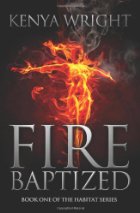
Book Review: Fire Baptized by Kenya Wright (Series, #1)
 Summary:
The humans won the supe-human war, and now all supernaturals are confined to caged cities whose bars are made up of every metal that is harmful to supes. They also all have a brand on their forehead letting everyone now immediately what type of supernatural they are–crescent moon for shifter, full moon for vampire, wings for fairy, X for mixbreed, which is what Lanore just happens to be. Lanore is hoping to be the first mixie to graduate from the caged city’s university, and she also works on the side with another mixie, Zulu, to run a mixie civil rights group. The purebloods by and large hate mixies. As if her life wasn’t already complicated enough, one night Lanore witnesses a murder, and the murderer turns out to be a serial killer. Now Lanore is on his list.
Review:
I am so glad I accepted this review copy. The branding of supes and caged cities was enough to show me that this is a unique urban fantasy series, but I wasn’t aware that it’s also a heavily African-American culture influenced series, and that just makes it even more unique and fun.
It’s not new to parallel supe civil rights issues with those of minorities, but they often flounder. Wright’s book depicts the complexities eloquently. Making a group within the supes that the supes hate makes it more closely parallel the real world. The addition of the brands on the foreheads also makes the supernatural race immediately identifiable just as race is in the real world by skin color. The caged cities are also a great analogy of inner city life and how much of a trap it can feel like. The fact that Lanore accidentally witnesses a murder on her way home from school is something that can and does happen in the real world.
The other element that I really enjoyed is how Wright brings the African-American religion of Santeria into the mix. She provides multiple perspectives on the religion naturally through the different characters. Lanore doesn’t believe in any religion. MeShack, her ex-boyfriend and roommate, does, and it helps him in his life. And of course the serial killer also believes in Santeria but is going about it the wrong way, as Lanore eventually learns. The book naturally teaches the reader a few things about Santeria, which is often maligned and misunderstood in America. But it does it within the course of the story without ever feeling preachy.
The sex scenes (we all know we partially read urban fantasy for those) were hot and incorporated shifter abilities without ever tipping too far into creepy beastiality land. They were so well-written, I actually found myself blushing a bit to be reading them on the bus (and hoped no one would peak over my shoulder at that moment).
The plot itself is strong through most of the book. The serial killer is genuinely scary, and Lanore doesn’t suddenly morph into some superhero overnight. She maintains her everywoman quality throughout. I wasn’t totally happy with the climax. I didn’t dislike it, but I also think the rest of the book was so well-done that I was expecting something a bit more earth-shattering.
There are two things in the book that knocked it down from loved it to really liked it for me. They both have to do with Zulu. Zulu is a white guy, but his beast form is a black dude with silver wings. I am really not sure what Wright is trying to say with this characterization and plot point. It wasn’t clear when it first happens, and I was still baffled by the choice by the end of the book. In a book that so clearly talks about race, with an author so attuned to the issues innate in race relations, it is clear that this was a conscious choice on her part. But I am still unclear as to why. Hopefully the rest of the books in the series will clear this up for me. My other issue is with how possessive Zulu is of Lanore. He essentially tells her that she’s his whether she likes it or not, and she goes along with it. Why must this theme come up over and over again in urban fantasy and paranormal romance? A man can have supernatural powers and not use them as an excuse to be an abusive douche. I’m just saying. But. This is part of a series, so perhaps these two issues will be addressed in the next book. But for right now, I’m kinda sad that Lanore chose Zulu.
Overall, this is a unique piece of urban fantasy. The tables are turned on the supes with them in caged cities, and the creative use of forehead brands and the existence of mixed-breed supernaturals are used intelligently as a commentary on race relations in the United States. I highly recommend it to urban fantasy fans and am eagerly anticipating reading the next entry in the series myself.
4 out of 5 stars
Source: Kindle copy from author in exchange for my honest review

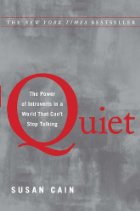
Book Review: Quiet: The Power of Introverts in a World That Can’t Stop Talking by Susan Cain
 Summary:
Cain explains how the Extrovert Ideal became the norm in Western culture then proceeds to define the reality of the existence of both introverts and extroverts, not just among humans, but in the non-human animal kingdom as well. She explains the pluses and minuses of both personalities and provides advice for individuals, parents, and businesses in bringing out the best potential in both.
Review:
This book has been all the rage among book bloggers, which probably isn’t that surprising. Readers tend to be introverts, and the book’s title certainly implies that it’s all about us. In actuality though, although the book does have a focus on introverts, it also contains lots of information on extroverts and how we are all different but equally valuable to the world. Indeed, the Introduction features a statement that basically defines the point of the book as a whole:
Our lives are shaped as profoundly by personality as by gender or race. And the single most important aspect of personality—the “north and south of temperament,” as one scientist puts it—is where we fall on the introvert-extrovert spectrum. (page 2)
After the Introduction, the book is divided into four parts: The Extrovert Ideal, Your Biology Your Self, Do All Cultures Have an Extrovert Ideal, and How to Love How to Work. As someone who was a History major in undergrad, I found the first section completely fascinating. It explains how western culture, particularly American culture, went from an introvert ideal to an extrovert one. It, not surprisingly, was all tied up with the Industrial Revolution. Before the Industrial Revolution people mostly interacted with people they had known most of their lives or who they would have time to get to know. After, if you wanted to make it in the business world, you had to make an amazing first impression. This push to give off the aura of friendly and awesome edged out the prior expectation to develop a moral character. This section also talks about how Evangelical Protestants take the Extrovert Ideal to an even greater extreme:
If you don’t love Jesus out loud, then it must not be real love. It’s not enough to forge your own spiritual connection to the divine; it must be displayed publicly. (page 69)
I’ve taken the Meyers-Brigg personality test multiple times at various points in my life. I am always solidly an INTJ. The I is for introvert. I was also raised Evangelical (although I am now an Agnostic). This section rocked my world. I even mentioned on GoodReads that it basically explained my life to me. Cain talks about how difficult it can be to be an introverted child or young person being raised in a culture of Extrovert Ideal. I wasn’t just raised in the American one (who just so happen to be the most extroverted people on the planet, page 186), but I was also raised in the most Extrovert Ideal culture within that culture–Evangelical. It’s no wonder I had some issues figuring out who I am and being ok with that. I can barely fathom what a difference it would have made in loving and accepting myself if I’d even just been told it is just as ok to worship alone in the woods as to be loud and proud about it in public.
The next section is more sciencey and discusses the biology behind personality differences. This section can definitely be empowering as it lets people know precisely how you became an introvert or extrovert. The overarching philosophy is that more sensitive babies, as in ones who are more easily startled or frightened of strangers, are predispositioned to become introverts. Nurture also affects this, of course. Cain discusses the good qualities of both highly sensitive and less sensitive kids and how how they are raised can either bring out the good or the bad in either natural temperament. Of course this is a great area for parents and those who work with kids, but it also explains to the reader how they got this way and what false ideas they might have about themselves. For me, this is the section that explained to me why I’m so passionate about causes like vegetarianism and mental illness advocacy. Introverts tend to be oriented around causes. An example of an introvert/extrovert pair who both got things done in their own way that Cain uses is Eleanor and Franklin Roosevelt. This is a wisely chosen example because both are people to look up to who played to their own personality strengths.
Personally I wasn’t so into the next section. As compared to the other sections that are three chapters, this one consists of only one. It essentially compares Asian culture to Western culture since Asian culture tends to idealize introversion over extroversion. I felt that this chapter was a bit rushed and less in-depth. Cain tried to cover both the experiences of Asian-Americans and all Asian culture as a whole. I understand that she wanted to address multicultural understandings of personality, but it does seem that this topic could be a book in and of itself. It felt a bit similar to the instances when in my job as an education and reference librarian that I tell a student their topic is too broad to possibly cover in one paper (or one thesis). It seems that a quick chapter on introversion versus extroversion worldwide could have been mentioned in the first section as a comparison without devoting a whole section to it. Similarly, the issues specific to immigrants to America from nations with an Introvert Ideal would have worked well in a different section. This would have felt more integrated and flowed better.
The final section contains advice on using your personality to your advantage in your life and also on how to strike a compromise with someone you care about of a different personality type. Overall, this section was well-written, although I felt not enough attention was given to “pseudo-extroverts,” introverts who have learned to pass as extroverts. This is a fascinating topic, particularly to an introvert who is constantly mistaken for an extrovert. I think this is the reality for a lot of people, and it deserved a bit more attention and research. For instance, Cain says in passing:
Emotional labor, which is the effort we make to control and change our own emotions, is associated with stress, burnout, and even physical symptoms like an increase in cardiovascular disease. (page 223)
I really wanted to know more about this! Particularly since I care so much about health and wellness. It almost seemed as if pseudo-extroversion deserved its own chapter.
The rest of the section though was great and quite helpful. I think if everyone followed the advice in it on dealing with other personality types and creating a loving environment for kids on both ends of the introvert/extrovert spectrum that we would have a much more positive world. Perhaps her best piece of relationship advice is A Free Trait Agreement.
A Free Trait Agreement acknowledges that we’ll each act out of character some of the time—in exchange for being ourselves the rest of the time. (page 221)
So for a couple consisting of an introvert and an extrovert they will go out some Friday nights and stay in and snuggle and read others. Preferably about 50/50. Mutual compromise. It’d be good to keep this in mind more often.
Overall, this is a well-written, accessible book regarding personality psychology and the history of it. It does flounder in some places and could have used another once-over for structure and focus, but it is well worth your time to read.
4 out of 5 stars
Source: Amazon

Friday Fun! (In Which I Walk Across All of Boston and Blog Tour Updates)
Hello my lovely readers!
Another busy week at work this week (as it will be until the end of September, so be prepared to hear that sentence repeatedly). I finally got my booty outdoors this week, though, and I have the tan-lines to prove it!
On Sunday, I went for a long (accompanied) walk along the Charles River. It was completely gorgeous, but I did manage to get a bit of a burn. According to my dad, I do this every year and always along the Charles. Oops? Maybe next year I’ll finally remember to put on sunblock….
On Tuesday (my work-week Monday), I was meeting up with someone in the North End for gelatto, which I totally did not end up eating, but anyway. I decided that since he couldn’t make it there until 7 at the earliest and I had a couple of hours to kill, I would walk it. Bad. Idea.
My work is on the south side of Boston, so I basically walked across the entire city. In flat pretty sandals. And now I have the shin splints to prove it. Again, oops? You may have noticed that I don’t always manage to think my plans all the way through. On the plus side, I got to see the Public Gardens and got a sandwich from the Clover food truck in Boston Common. On the minus side, my shins were too sore for zumba on Wednesday.
I know, I know. #firstworldproblems
Anyway, after all that walking, instead of gelatto I had a glass of sangria, because that is obviously infinitely better. :-D
Also, the best street for gelatto in the North End is Hanover Street, not Salem Street. Just fyi.
Anyway, so that was my super-exciting week! Now on to the weekly Waiting For Daybreak
It was a much busier week this week, which was of course exciting!
Wickedly Bookish interviewed me. Check that out to find out my self-publishing advice!
Wickedly Bookish also hosted a giveaway that is still open. If you have yet to win a copy, definitely consider entering.
Ellie Hall posted a review (that is also cross-posted to 1889 Labs) where she says, “The story flies by and it is thoroughly engrossing, with periods of action and adrenaline nicely balanced by periods of memory and self-reflection. The sense of danger and suspense is well developed, and the narrator’s doubts and fears are easily understood.”
The Book Hoard‘s review says, “If anyone had told me that I’d enjoy a zombie apocalypse a year ago, I’d have told them they were nuts. However, I have come to enjoy a few zombie apocalypse stories like Waiting For Daybreak.”
The Book Hoard is also hosting a giveaway that is still open. That’s two! Two chances to win a copy! Ah-ha-ha.
Last but not least, Persephone’s Winged Reviews posted a review stating, “At the end of the day, it’s much more about Frieda trying to find out what normal means in a world gone wrong instead of a zombie book. I believe that it is a fresh take on zombies in the fiction genre.”
Thanks once again to every single participating book blogger! I truly appreciate you giving me (and my writing) time and space on your blogs.
To all my loyal blog readers, happy weekends! *waves*
Book Review: Across the Table / Dancing on Sunday Afternoons by Linda Cardillo (Bottom of TBR Pile Challenge)
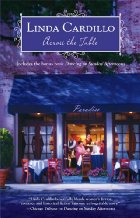 Summary:
This book actually consists of two different books packaged together into one. They are both standalones, not in a series together.
Across the Table
Follow three generations of an Italian-American Boston family, starting with Rose, who marries a navy seaman right before WWII breaks out. The family ultimately buys a restaurant on Salem Street in the historic North End, and food and the family business both help keep the family together through trials and heart-aches.
Dancing on Sunday Afternoons
Cara goes to care for her grandmother, Giulia, who has fallen and broken her hip on a visit back to the old country of Italy. While visiting her, Giulia reveals to her the story of her first love who died when Cara’s father was just a baby.
Review:
This book made it onto my tbr pile because I found it on trash day on top of a neighbor’s recycling pile. It was one of those cases where obviously someone had given up actually packing for their move and was just chucking it all. The book was in pristine condition, so I yoinked it away (along with two others). Shocker: when I opened this to read it, I discovered that it’s signed by the author. I also didn’t realize until I started reading it that there’s actually two totally separate books in it. The cover only says the first title and mentions a bonus book in rather small type. So this one was full of surprises!
Across the Table
This story is based on the author’s family history, and you can honestly tell. It’s full of so much heart and reality. It’s not your typical romance or women’s fiction. The family felt entirely real, and you could understand why they made the choices they did, even if you wouldn’t have done the same thing. I found Rose by far to be the most interesting, but that’s not really a surprise. I’ve always had a thing for the 1940s, and her life in that decade was simultaneously unique and typical. She spent a couple of years before the war on a tropical island (whose name I cannot remember, I apologize) with her husband. It all felt very South Pacific, but she states that spending this time there gave her and her husband a solid base for the rest of their lives together. They had to really depend on each other. She also said that living there made her question the racism she was raised in and ultimately stop her racist thoughts and actions. They were never extreme, just that avoidance of people visibly different from you that you sometimes see. I also loved that the story is based to solidly in Boston. Cardillo obviously grew up here or visited family a lot here, since she understands simple things like how it takes an hour at least to get from the North End to Cambridge, or how different one side of the river is from the other. The family business and food aspects were also perfectly handled. Just enough to set the atmosphere but not so heavy-handed you wonder if the author forgot about the relationships at the heart of the story. There’s also a nice touch of an uncle/brother/son who is gay, and his Catholic family’s reaction to this is a positive, refreshing change. Perhaps even more so since the reader knows the story is based on a real family. Overall, I absolutely loved this book. It had everything I like in both historic and women’s fiction.
5 out of 5 stars
Dancing on Sunday Afternoons
In contrast, this book was far more tedious and full of cliches and….well basically everything that I don’t like about historic and women’s fiction. Giulia’s immigration story and her family are not particularly easy to empathize with. Her family is incredibly wealthy in Italy, and everyone worries more about appearances than about actually doing the right thing. Even Giulia’s rebellion of marrying the man she wants to marry isn’t all that admirable. She only does it ultimately with the family’s blessing, and her reaction when her husband dies is appalling. (This is not a spoiler. You learn in the first chapter that Giulia’s first husband died). I know that old families really could be like this, but I guess it made less sense being told this way since Giulia was telling the story to her modern granddaughter. I didn’t see any wisdom of age coming through in the telling. I know when my older family members tell me something from their youth, they also discuss what they learned from it. They try to impart some wisdom on me so I don’t make similar mistakes or so that I’m willing to take similar risks. Giulia’s story just doesn’t feel like an elderly person relating to a young family member. I suppose if you really love historic, clean romance novels, you might enjoy this one more than I did. Personally I need this genre to have something extra to really grab me.
3 out of 5 stars
Overall, then, I must average the two books out. I loved the first, but felt that I was not the target audience for the second. It is worth noting that the second was actually Cardillo’s first novel, so her second book was a big improvement. I’ll be keeping my eye on this author, particularly for more work set in Boston. As far as recommendations go, I recommend these books to fans of historic fiction with a focus on romance and women’s personal lives.
4 out of 5 stars
Source: recycling bin

Book Review: Addicted by S. A. Archer and S. Ravynheart (Series, #2)
 Summary:
If a human is touched once by a Sidhe, they become addicted….heroin addict level addicted. Since London’s Sidhe died, she now has to periodically put her private investigator for paranormal clientele job aside in order to seek out more Sidhe for a fix. This time, a bunch of young vampires say they know where she can have a changeling teleport her to an enslaved Sidhe….for a price.
Review:
Series of fast-paced novellas are becoming more popular in urban fantasy and paranormal romance. I know I enjoy them as a kind of single-serving of ice cream. Fun and delicious and able to get through in those 40 minutes your bread is in the oven or something. I read the first book in the Touched series, and since I enjoyed it, Archer, one of the authors, was kind enough to send along the next entry in exchange for my honest review. It was still fun, but not quite as well-written as the first.
The world of the paranormal in the UK and Ireland that Archer has created continues to be creative and engaging. While some of her paranormal creatures are typical (such as the vampires) others are more unique, like the changelings and fairies. For instance, having a changeling run the whole come party and suck the blood or touch a Sidhe thing was pretty unique! In other series, that would definitely be the sort of thing run by vampires.
Unfortunately, I didn’t find the characterizations as good this time around. London comes off as a bit flat, as do the vampires around her. Most distressing to me, though, as an American reader is her American character she put in. London meets a guy when doing a job for the changelings. She can tell he is American because, I kid you not, he is wearing a flannel shirt and a cowboy hat. Erm, ok. More annoying though is the fact that this American dude twice says, “shite.” Americans don’t say “shite,” except perhaps for some 20-something hipsters who are trying to be ironic. This 40-something mercenary is definitely not a hipster. He would say “shit.” If you are going to have a character from a country besides your own, you really need to fact-check how they speak, and especially how they swear. He’s not a major character, and I probably would have noticed it less if this was a book and not a novella. He was a lot more noticeable since he was present for most of the novella.
Overall, then, the world is interesting but the characters could use a bit of work. If you’re just looking for some light, quick urban fantasy to brighten up your day, though, it might be worth your 99 cents. Personally, though, I won’t be continuing on with the series.
3.5 out of 5 stars
Source: Kindle copy from author in exchange for my honest review

 (
(Friday Fun! (New Book Blogger/Bookstore Opportunity and Blog Tour Updates)
Hello my lovely readers!
This was honestly a very long week for me. Work has been very busy, and I had a couple of stressful personal situations come up. No worries though. All is well now. :-)
*knock on wood*
I’m glad I planned ahead and took a vacation day this week. I went for a very long walk along the Charles just taking in nature and the sounds of summer around me. Then I went home and baked muffins. By wisely taking downtime moments like this throughout the week, my stress levels weren’t quite so bad.
In any case, today I just want to let my fellow book bloggers know of a new opportunity. Little Red Reviewer and her friend Darkcargo have taken it upon themselves to start an awesome project entitled Bookstore Bookblogger Connection. This is entirely a labor of love in which they are attempting to match up book blogger reviews (currently of just scifi and fantasy) to bookstores to be add to their displays. It’s good publicity for the book bloggers, and a neat new way for bookstores to find books to recommend. See Little Red Reviewer’s announcement post here, and the official Bookstore Bookblogger Connection website here.
Finally the weekly update for the Waiting For Daybreak
Ellie Hall graciously hosted a guest post in which I explain how the tagline for the tour, “What is normal?” relates to the book.
Eva’s Sanctuary interviewed me. Among other things, you can hear many more details about my busy medical librarian job.
Eva’s Sanctuary also offered a review, stating, “This is a unique zombie tale, but well worth the read. I think you will be quite surprised.”
Last but not least, today Lily Element posted a review, suggesting it to readers, “if you want something different and enjoy zombie books.”
That’s it for this week. Happy weekends all!
Mini Movie Reviews #2
 Good Hair
USA
2009
PG13
Documentary
Public Library
5 out of 5 stars

This is one documentary you need to believe the hype about. Chris Rock decided to make it after his daughter (not even five years old yet) asked him why she doesn’t have good hair. This documentary then looks at the world and culture of African-American hair. It covers everything from perms to weaves to hair shows. Chris Rock interviews famous and not famous people alike with a certain charm and intelligence that gets them to really open up. I think the scene that best demonstrates the feel of the whole movie is when Chris Rock is interviewing a white male scientist about sodium hydroxide, which is the perm that African-Americans use to straighten their hair. The scientist has just shown Chris how quickly sodium hydroxide eats through raw chicken, and Chris says, “You know black people put that on their hair.” Horrified, the scientist says, “Really?! Why would they do that?!” Chris says, “To look like white people.” Epic. Silence. The documentary is smart, because it doesn’t run around blaming white people for this whole culture among African-Americans against natural hair. It kind of blames everybody, and it does it in a witty, intelligent manner.
 The Wolf Man
USA
1941
PG
Horror
Netflix
4 out of 5 stars

Another from the 100 Horror Movies To See Before You Die list I’ve been working my way through. A wayward son of a British aristocrat comes home to hopefully reestablish himself in the little town. He starts to pursue an engaged gal, but while doing so, gets bit by a wolf. Naturally, he turns into a werewolf. I think what’s the creepiest about this film is how the main character goes about pursuing the engaged girl. He starts off by watching her through a window and then hitting on her in her father’s shop in possibly the creepiest manner ever. She resists….at first. But then doesn’t. The whole film sort of feels like a judgment on both him for being a creeper and the engaged girl for being seduced by the bad boy instead of sticking with her nice, stable man. Kind of a nice change of pace from more modern films, eh? The special effects aren’t as good as some others from this same time period that I’ve watched, but they’re still fairly decent. It’s a fun change of pace if you enjoy shapeshifters. Also the “British accents” are pretty much nonexistent.
 The House Of Usher
USA
1960
Not Rated
Horror
Netflix
5 out of 5 stars

When this movie started, I thought it was going to be cheesy. But I was very wrong. It turns out that this is an adaptation of a Poe story, and it is completely frightening, even with outdated special effects. Essentially, this guy wants to marry this girl, but her brother insists that the Ushers need to let the family die out. He also claims the house itself is evil. I won’t tell you what happens from there, but suffice to say the tension builds perfectly until you are on the edge of your seat for the climax. Vincent Price plays the brother and let me tell you, he is a legend for a reason. When I finished this one, I was actually nervous to go to bed. Which never happens to me.
PS There is a 2007 remake. Ignore it. Ignore it so hard.
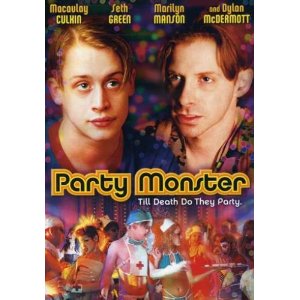 Party Monster
USA
2003
R
Biography
Netflix
3 out of 5 stars

This is based on the true story of a murder during the 1980s ecstatic clubbing days (see what I did there?), which was written about in Disco Bloodbath
 Dracula
USA
1931
Unrated
Horror
Netflix
5 out of 5 stars

This movie really doesn’t need much explanation. It’s a classic (chosen for preservation) for good reason. I have read Dracula, and I was flabbergasted at how good the adaptation was. Modern film adaptations could learn a thing or two from this production. Bela Lugosi as Dracula is still deliciously creepy, instilling chills. Two cool things to know. One, originally there was an epilogue in which the audience is told vampires are indeed real that has been forever lost so the ending does feel a bit abrupt (because it’s not actually the ending). Also, the entire movie was shot simultaneously on the same sets in Spanish (with Latin* actors).
Book Review: January First: A Child’s Descent into Madness and Her Father’s Struggle to Save Her by Michael Schofield

Edit, April 22, 2021:
In light of the recent news about the Schofield family, I have made the decision to remove my usual purchase links from this page. I am leaving the review up as it accurately reflects how I understood the memoir at the time it came out. It is not entirely clear what is going on in this family, but what is clear is that DCFS removed January and her brother from their home with their mother. Their father was no longer living with them but rather with his new wife and baby in the midwest (the baby was being born the night the children were removed). January has recently turned 18. Whether she chooses to tell her story one day or find privacy with her adulthood, I hope she finds peace.
End of Edit.
Summary:
Michael and Susan thought their daughter, January’s, high energy levels and vivid imagination were the result of her high IQ, but when she turned five her imaginary friends started to tell her to do bad things like hit her baby brother or throw herself out of windows. Soon it became apparent that her imaginary friends were actually hallucinations. What followed was a harrowing struggle to get their daughter diagnosed and treated.
Review:
It’s rare to see a memoir by a father. There are a ton of memoirs by mothers but not a lot by fathers, particularly not by fathers of daughters. Put this together with the fact that Jani (her parents’ nickname for her) has childhood-onset schizophrenia, and you have one unique book.
This is an excellently told memoir. It opens with Michael speaking about having his daughter’s diagnosis now and struggling with all the barriers toward a normal life presented not just by her illness but by the world we live in. He talks about how some people argue that it’s impossible to diagnose a child with a mental illness, let alone schizophrenia, and of course some people even suggest that Jani is possessed by demons. He gets the denial. It’s scary to see a child consumed by an illness that is completely arbitrary in choosing its victims. But he says,
Denial is not going to help Jani or any of the other mentally ill and schizophrenic children I have come to know. What they need is acceptance. What they need is for us to be telling them “your illness does not define you.” We cannot go inside their minds and “fix” them. But we can fix the world so they can live in it. (location 90)
That speaks very strongly toward the whole reason I created the Mental Illness Advocacy Reading Challenge, and I knew then that this was going to be not just a unique read, but a challenging and good one.
After the introduction, Michael tells the story in a linear fashion. He does a good job remembering how he felt in the early days. His immense pride at his daughter’s high IQ and creative mind coupled with a determination to help her succeed and be herself. It’s fascinating to see, as an outsider, how early there were warning signs that something was not quite right with Jani but that Michael and Susan (her mother) attributed to a positive cause. I think that’s typical of parents and indeed of anyone who loves someone. They were looking for the best. Believing in the best for their daughter. They may be that moderately annoying couple on the play date who just insist their daughter with inappropriate behavior is gifted, but seeing it from Michael’s perspective makes that make sense. Most people (with the exception of parents with Munchausen by Proxy Syndrome) don’t want to believe that their child is sick. So of course you exhaust every other option first.
This of course makes Jani’s move toward violent behavior at the age of five that much more heart-breaking to read. I’ve heard and read stories and documentaries of how difficult it is for parents of young adults who become schizophrenic but at least they are adults. To have this happening to your five year old is completely terrifying. How do you control a child for whom no punishments seem to work? Who is more concerned with appeasing her hallucinations than with obeying her parents?
I certainly don’t agree with all the parenting choices the Schofields made in the first five years of her life (and for the record, neither do all of the psychiatrists), but none of their choices would create schizophrenia. Being overly lenient with your kids won’t make them hallucinate and become this violent at the age of five. This is one of those occasions where you don’t always agree with the choices the memoirist made, but you’re also not right in the heat of the battle. It’s far easier to say, “oh, you should have done this,” when it’s not your child who’s being lost to a mental illness right before your eyes.
That’s the thing about this memoir. Michael is so obviously completely honest. He tells things that happened that don’t present him in the best light. He is completely forthcoming in his own shortcomings, but he reiterates over and over how much he loves his daughter and wants to keep his family together. This combination does for this memoir what a lot of memoirs don’t have: it lends a complete sense of validity to the story as a whole. Michael is so honest about the emotional struggle of it all that even though you may not like him as a person, you respect him as a father.
This level of honesty combined with his writing ability make this memoir a strong call. A call to parents of children who are other-abled (whether mentally or physically) that they are not alone. It’s also a call to the rest of us who are not one of these parents to take a moment to think how difficult it must be and go easier on the parents and the child. I know I for one might think the next time I see a kid throwing an epic tantrum, “Maybe that child has an illness” instead of “Sheesh, do a better job, parents.”
Overall, this is a well-written memoir presenting the unique perspective of a father caring for a daughter with a mental illness. It also provides one of the few accounts of childhood-onset schizophrenia. Highly recommended to parents with special needs children, as well as to anyone who enjoys memoirs and the different perspectives reading them can bring.
4 out of 5 stars
Source: Netgalley
Buy ItSee note above.

Counts For:
Book Review: Animal Rights Poetry: 25 Inspirational Animal Poems, Vol 1 by Jenny Moxham (Series, #1)
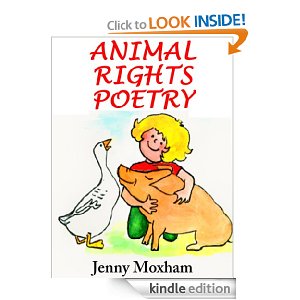 Summary:
A collection of 25 poems focusing on a variety of animal rights issues by British animal rights activist Jenny Moxham.
Review:
I picked this up because one of the blogs I follow mentioned it was on sale (for 100% off), and I figured there had to be at least one poem in there that I would find inspirational. Of course, there was.
The poems are mostly written in rhyme, a vibe that feels very similar to Mother Goose style children’s poetry. Some of them worked better than others, but it’s certainly a fine style choice. It’s easier to remember rhymes than almost any other sort of poetry.
Personally, I preferred the poems that contained solid arguments to use when debating animal rights issues. My favorite, is this one:
FOOD FOR THOUGHT
I’ve often heard it said by folk
Who relish eating meat,
“The animals were put on Earth
For human beings to eat.”Well if God made them just for us,
Explain it, if you can,
Why they arrived one hundred million
Years ahead of man(location 95)
I was less of a fan of ones addressing particular events, because I think those would be less useful in more general animal rights work. I also was surprised by how many of the poems were about Christmas. Perhaps Christmas is a meatier affair in the UK, but in a book with only 25 poems, having five about one holiday felt like a bit much.
Overall, Moxham’s talent and passion do shine through, but a more varied and longer collection would have been more enjoyable. Recommended to those with an interest in memorable phrases to use in animal rights work.
3 out of 5 stars
Source: Amazon

 Support my work with a tip or browse my shop for curated book club guides, how to guides, cross-stitch patterns, and more!


This work by Amanda Nevius is licensed under a Creative Commons Attribution-Noncommercial-No Derivative Works 3.0 United States License.
 Opinions of a Wolf