
Archive
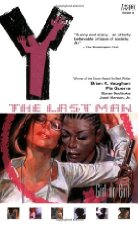
Book Review: Y: The Last Man: Girl on Girl by Brian K. Vaughan (Series, #6) (Graphic Novel)
 Summary:
We catch up with Yorick, 355, and Dr. Mann on board a freighter headed for Australia by way of Japan. They seem to have abandoned their hunt for Ampersand the monkey for now. The captain of the ship is gorgeous and has the hots for Yorick, but trouble arrives in the form of an Australian submarine. Is it the freighter or the submarine that is the pirates?
Review:
So the title is sort of a double entendre. We do get an excellent lesbian sex scene (inter-racial no less!), but we also have the war between the submarine of women and the ship of women. Haha, well played, Vaughan!
The great thing about this entry in the series is that by itself it has a lot of very cool elements, but it also moves the plot forward. We find out some about what’s been happening on the other side of the globe since the men died, characters hook up, and we get some really good action. It gets us places (specifically moving across the ocean), but it doesn’t feel like a filler book the way #4 did.
Plus, the Pacific Islander ship captain is really hot and badass.
Overall, this is an excellent entry in the series that is entertaining and moves the plot forward. Fans will not be disappointed.
5 out of 5 stars
Source: Public Library

Previous Books in Series
Y: The Last Man: Unmanned
Y: The Last Man: Cycles
Y: The Last Man: One Small Step
Y: The Last Man: Safeword
Y: The Last Man: Ring of Truth
Book Review: The Rabbi’s Cat 2 by Joann Sfar (Series, #2) (Graphic Novel)
 Summary:
The talking cat with the big ears who offers insightful commentary on his rabbi master and life in Algeria in the early 20th century is back. The rabbi’s daughter is fighting with her husband (also a rabbi), and the cat is quite happy with that. It means more snuggles from his mistress, Zlabya. Of course, the talking cat also has a couple of adventures. First he and a snake tag along with the famous Malka and his lion on a trek around the desert. Then, a stowaway Russian Jew shows up in Zlabya’s house, and he understands the cat! Soon a rag-tag bunch are off looking for the mysterious lost city of Jerusalem. We thus get to see a lot of Africa through the cat’s eyes.
Review:
I have to say, I didn’t enjoy this sequel quiiite as much as the original. I suspect that the fact that I was less familiar with the topics the cat is offering snarky commentary on had something to do with this. I really don’t know much about Northern Africa or the “lost city of Jerusalem,” so I’m sure I missed some of the inside jokes. Whereas the previous book was mostly about Jews in Algeria and the French occupation, this book seems to talk a lot more about the relative merits of the various monotheistic religions and why can’t we all just be friends.
While on their various treks, the groups run across some Muslim tribes who state that Jews are their brothers who they respect, but it is still their duty to attempt to get them to convert. The rabbi eloquently states that he is too old to learn a new language for prayer, and he is sure god will understand. Similarly, the Russian Jew falls in love with an African woman (I am uncertain from which country), and they ask the rabbi to marry them. He says he can only marry two Jews, and she states she is glad to take her husband’s god as her own. Exasperated, the rabbi states it is not that simple, she must study for years, but then relents when seeing how in love they are and says that god will understand. The cat too has learned when to hold his tongue around extremists, although he still offers commentary to the other animals, whether over an obsessive Muslim prince or a Kabbalistic elderly rabbi. What is incited repeatedly in this book is extremism in favor of tolerance and love, which is certainly always a good message.
The other message is never to judge someone as less intelligent than you simply because they speak a different language or their ways are different. I really like how this is carried over into the animal kingdom where the cat even seeks to understand the snake. At first the cat thinks the snake just willy-nilly bites people and animals, but then he realizes that this is his only tool of friendship. And yet although we should seek to understand, the cat also doesn’t hang around too long anyone who is extremist or annoying. The Muslim prince and the English explorer (who thinks the Algerians don’t bathe) are both quickly dumped by the traveling group.
While these are all good messages, I must say I missed the no holding back talking cat of the first book. I suppose he’s older and wiser, but I like him precisely because I can’t imagine a talking cat ever actually holding his tongue. Seeing him do so in this book made me kind of sad. Also, I feel like the story of Zlabya and her husband got dumped partway through and never picked back up. We know they’re fighting a lot, but then we just leave them and go off on an adventure across Africa. It felt like a final chapter was missing from the book.
Overall, this is an interesting look at the intersection of many cultures, religions, and races on the continent of Africa through the unique eyes of a rabbi’s cat, a wandering lion, and a friendly snake. If you enjoyed the first book, you shouldn’t skip this one.
3.5 out of 5 stars
Source: Public Library

Previous Books in Series:
The Rabbi’s Cat
Counts For:

Specific country? Algeria, primarily
Movie Review: Guess Who’s Coming to Dinner (1967)
 Summary:
A liberal couple’s beliefs are challenged when their daughter comes home from a Hawaiian vacation with a surprise fiance who just so happens to be black.
Review:
I am chagrined to say that I saw the awful, horrible 2005 remake of this classic prior to seeing the classic version. That attempt at humor (that was totally unfunny) thus had me coming at this film rather skeptically, but it was in my suggested films pile on Netflix, and given that I’d just finished up The Real Help Reading Project, I thought a classic 1960s film exploring the black/white issues in America just might be interesting. It certainly was not what I was expecting.
First, the cast is absolutely stellar, featuring Katharine Hepburn, Sidney Poitier, Katharine Houghton, Spencer Tracy, Beah Richards, Cecil Kellaway, and Isabel Sanford. These people have serious acting chops, and I doubt a lesser cast could have pulled off this film. In particular, I cannot imagine another person in the role of the mother than Katharine Hepburn. Now THERE is an actress.
The film feels more like watching a dramatic play in three acts. There is a lot of dialogue and emotional speeches. It may feel a bit heavy-handed to the modern viewer, but it must be remembered the world this film was made in. One line really reminds the viewer, when the young couple are reminded that their relationship is still illegal in sixteen or seventeen states. Wow, ok, suddenly both sets of parents’ concern that their children are choosing an incredibly tough life for themselves doesn’t seem like such an over-reaction. It puts the whole film a bit more into perspective.
That’s what the film is really about. It isn’t about either set of parents being prejudiced against a skin color. They’re concerned that the prejudice of the world will make the marriage unbearable for their children. The movie is about choosing to stand up and hold on to the ones you love in the face of prejudice. That’s a powerful message and not at all the issue I was expecting to come to the surface in this film.
Now consider all of those to be reasons to watch this classic that’s a classic for a reason. I now want to talk about one character whose presence was totally different to me since doing The Real Help–that of the white family’s maid, Tillie. Tillie’s role seems to be that of reassuring the (white) audience that not just the white parents are concerned about this black man John. She immediately is in fisticuffs over the whole thing. She tells John, “I don’t care to see a member of my own race getting above himself. ” She threatens him that she knows his type and although he may be able to fool the white folks, he’s not fooling her. She even says, “Civil rights is one thing. This here is somethin else!” The daughter tells Tillie that she loves her and loving John is no different, and the parents even have her come sit down for the big finale stating that she’s “one of the family.” What is fascinating about this completely false and stereotyped role of Tillie in this film is that it is there in the midst of a forward thinking main plot. It is as if the filmmakers wanted to give the audience the familiar, non-threatening, stereotyped role of the trustworthy black help that is in favor of the status quo to help them feel more comfortable during the film. Perhaps that is the case. But even if the choice was deliberate and worked for the audience at the time, I personally found the role to be Tom-ing and distracting from the much better main storyline. However, it is also fascinating how a movie with a role like this *still* is better than The Help.
Overall, this is a classic deserving of the title. Although it is a bit dated, if the audience bares in mind the actual world of race and racism at the time the film was produced, they will be surprised at how progressive it actually was.
4 out of 5 stars
Source: Netflix

Book Review: Devil Tree by Steve Vernon
 Summary:
In a valley near a river in the wood near Indian territory lies a tree. A tree that sends out its roots throughout the valley and demands blood. It is in this valley that the godsman Lucas and his wife Tamsen find themselves wrecked and at the mercy of not just the man Jonah Duvall and his Indian bride Jezebel, but also at the mercy of the tree.
Review:
I decided to dip my toe into magical realism via a genre I love–horror. It turns out it’s not a genre that works for me, although Vernon does it well.
Magical realism is a style in which magic is blended into the real world and characters view it as a natural, normal part of the world. It is more realistic than fantasy but less realistic than traditional horror, for instance. Personally, I could not get into an evil tree that wouldn’t let the inhabitants leave the valley. I think, perhaps, I would have if the characters themselves had been more modern, but they have an antiquated magical feel to them as well.
The books’ main themes are sexual disloyalty and cannibalism. The story seems to be saying that these negative qualities are possible in all humans, but the tree draws them out. All I can say is that although these themes are ones that interest me, they just didn’t do it for me in this story. I reiterate that I think the issue is simply that magical realism is not my style.
The tale is not badly told, although the strongest portions of the story are the flashbacks to Tamsen’s and Lucas’s lost prior loves. Those tales are unique and beautiful, and I can’t help but wonder what made the author choose to tell them as flashbacks instead of as the central piece.
It is difficult to write a review of this book, for although I recognize that it is well-written, it is simply not for me. Some combination of the style and the order in which things are told just didn’t work for me, although there is nothing easily pin-pointed as being wrong with it.
Overall, this is a well-written story that will appeal to fans of both the grotesque and magical realism. You must have a tough stomach to be able to handle this tale, but also an ability to immerse yourself in a world of magic just below the surface.
3 out of 5 stars
Source: Kindle copy from author in exchange for my honest review

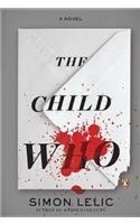
Book Review: The Child Who by Simon Lelic
 Summary:
A gruesome murder has thrown a British county up-in-arms, and Leo Curtice finds himself the attorney randomly assigned to defend the murderer–a 12 year old boy who killed and sexually assaulted an 11 year old girl. He finds himself seeking to understand what would make a 12 year old kill and finding more empathy for the boy than those around him think is allowable. Meanwhile, threats start coming in against his own family, including his 15 year old daughter.
Review:
This is a ripped from the headlines style novel that falls far short of others in its genre. Apparently, Britain has a real problem with child murderers. The thing is, though, when you’re writing a ripped from the headlines type story, your fictional version needs to bring something to the table that the real life stories and newspaper articles can’t or don’t. 
It’s also problematic when you google about child murderers in Britain and the stories that come up are far more fascinating than the novel you just read. Stories like Robert Thompson and Jon Venables, two ten year olds who tortured and murdered a two year old. Or Mary Bell an eleven year old who killed and tortured other children without remorse. In contrast our story here is about a twelve year old boy who hits on an eleven year old, is rebuffed, and proceeds to knock her down, bludgeon her, and assault her with a stick. Horrible? Yes. But with far more motive than two ten year olds abducting and killing a two year old. See the difference? The true to life stories push us to question and understand human development and behavior. The fake one seems rather easily written off as a vicious twelve year old who can’t handle the word no from a girl he likes. It’s as if the author was trying to play off of a phenomenon in Britain but missed the crux of what makes it so fascinating. Twelve is hardly a youth in the way that ten is.
Then there is the whole side-plot about Curtice’s daughter. From the beginning of the book you think she was murdered eventually somehow in some connection with the case. Wanting to find out how this occurred is what keeps the reader interested and the plot moving in spite of the problems addressed earlier. This, though, is ultimately a red herring of a plot point. The daughter was a runaway. Yes, the father didn’t know it at first, but she just ran away because of all the stress from the case. That’s it. As a reader, it felt like Lelic played a dirty trick on me, and I really didn’t like that.
Ultimately, Lelic tried to write a ripped from the headlines style story akin to Room
2 out of 5 stars
Source: Netgalley

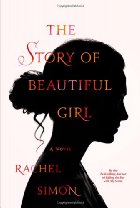
Book Review: The Story of Beautiful Girl by Rachel Simon
 Summary:
Martha, a retired, widowed schoolteacher, thought her life was pretty much over until one night when a young intellectually disabled white woman and a deaf black man show up on her doorstop in the rain holding a newborn baby. Soon people from a nearby mental institution show up to take them back away. The young woman, Linny, seems terrified and asks Martha to hide the baby. The man, Homan, escapes. Martha goes on the lam to keep the baby girl out of the institution, and Linny and Homan fight against all odds attempting to reunite their family.
Review:
I received the audiobook version of this as a gift for one of the holiday swaps I participated in in December. It was my first time reading the audiobook version of a modern story, as I’m a cheapskate and usually just get ones for free that are out of copyright. It was thus an entirely different experience to be forced to slow down when reading this piece of historic fiction about a very dark secret in American history–mental institutions. The amount of time that Linny and Homan are forced to spend simply waiting for their lives to get better. Waiting for people to recognize their humanity. It hit me much harder than if I had been able to read this in a couple of hours. (Each disc is about 1 hour long, and there are 10 discs). The wrongness of it all. The amount of time and lives wasted simply because the able-minded and able-bodied didn’t seek to understand or to grant these people the basic human right of self-direction.
The story itself is told from multiple viewpoints–Linny, Homan, Martha, Kate (a caregiver at the institution), and later Julia (the baby daughter when she grows up). Mostly Simon does a great job switching among the different voices, particularly representing Linny. She does not overinflate her internal dialogue to be that of a person with an average IQ, but she still clearly represents Linny’s humanity. I am a bit skeptical of the voice given to Homan though, mostly his tendency to give people bizarre nicknames like “roof giver.” I know that neither
Simon nor I know a deaf person who is unable to communicate with those around him, so really it is all guess-work as to what his internal dialogue would be like. But I can’t help but feel like it’s not quite there. On the other hand, his confusion and frustration at people talking around him, over him, and treating him like he’s stupid just because he’s deaf is very well done.
In retrospect, I’m not quite sure why so much time was devoted to Martha and Julia when Julia was a baby. Her story doesn’t end up being nearly as important as the Homan/Linny romance, so this focus feels a bit like a red herring. I would definitely shorten those chapters.
The use of artwork and items of visual significance to the characters is gorgeous though. Lighthouses are a central feature, and I don’t even like lighthouses myself, but I still found myself moved by how important the visual arts can be to people. This is a book that, surprisingly, winds up being almost a battle cry for the arts. For their value in helping us connect with each other and hold on to our humanity. I think any artist or someone who is a fan of the arts would appreciate this book for that reason.
On the other hand, Simon is clearly a person of some sort of faith, with a belief in god and the tendency for things to all work out right in the end. I’m…not that type of person. So when characters wax eloquent about god or an overall plan or the ability of evil people to repent and turn good, well, it all feels a bit more like fantasy than historic fiction to me. I probably would have been irritated by this less if I had had the ability to skim over those parts though.
In the end, though, I came away from this book appreciating its uniqueness and all the good qualities it had to offer. It demonstrates through a beautiful story why it’s so important not to institutionalize the mentally ill or mentally challenged. It shows the power of love to overcome race and disabilities. It is the story of the power and beauty of resiliency.
Overall, I recommend this work of historic fiction to fans of historic and contemporary fiction, advocates of the mentally ill or mentally challenged, and those just simply looking for a unique love story.
4 out of 5 stars
Source: Gift

Counts For:
Book Review: Living In, Living Out: African American Domestics in Washington, D.C., 1910-1940 by Elizabeth Clark-Lewis (The Real Help Reading Project)
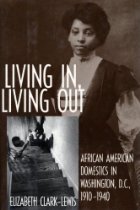 Summary:
Clark-Lewis’ grandmother was part of the great migration of African-American women from the south to Washington, DC who then took on domestic work in the homes of the rich and powerful. Through her grandmother, Clark-Lewis was able to contact many of the elderly women who were part of this movement and assemble their oral histories. Utilizing their histories, she paints a picture of the typical life of the African-American women like her grandmother.
Review:
It’s hard to believe this is the final book in The Real Help Reading Project. I’ll be posting my wrap-up later this week, so be sure to check that out for reflections on the project overall. For right now, though, let’s talk about the last book.
In comparison to other pieces of nonfiction on the list, like Labor of Love, Labor of Sorrow
What I found most interesting was how these rural women were raised by their families specifically to do domestic labor.
Your people all trained you to do service work. It was what they all knew you had to learn—period. Now, maybe a teacher, aunt, or somebody would tell you that you could do other work, but you knew that you’d do service work. You knew, and sometimes you’d think about doing different work—but you knew it wasn’t to be. ‘Specially at home—service was all there was for you. They knew it. You knew it. (page 43-4)
I think if I hadn’t read and learned about the conditions in the south for African-Americans I would find this to be a very defeatist attitude, but really it was just practical. The girls’ families were just trying to give them the tools they needed to succeed as best they could in the culture they were in. Although the adult women look back on their hardworking childhoods with a bit of bitterness at the loss of the ability to be just a child, they also acknowledge that these tools helped them succeed in life.
Another interesting thing is that sending the women north had nothing to do with advancing their lives but everything to do with helping and saving the family and the family farm. The family unit was very strong for all of these women, even at a distance. They helped distant and close relatives in DC with childcare and other labor and sent all or the majority of their pay home to the family farm. This really fights the stereotype in American media about the weak or non-existent African-American family unit. I was, indeed, impressed at how these families managed to stick together across such a distance and among the different cultures of the north and south.
The other issue this book addresses that none of our other nonfiction reads really did was how dehumanizing it was for African-American women to “live in” aka to live within the house they were working as a servant for.
Living in you had nothing. They job was for them, not your life. [From the] time I could, I started to try to get something that let me have some rest. A rest at the end of the day. That’s why you try to live out. You’d be willing to take any chance to live out to just have some time that was yours. (page 124)
Personally I don’t find this surprising at all, since I feel a real need for personal space away from my job, and I think most, if not all, people do. However, the culture at the time seemed to think that African-Americans didn’t need that. I’m sure part of that thought process was due to racism.
If there is one thing that this book demonstrates above all else, though, as have many in this project, it’s that no matter what the family the domestic help labors for thinks, they themselves do not see themselves as “like one of the family.”
She [the domestic worker] was proud that they [the family she worked for] “didn’t even know where I lived.” She did not consider them nice people, friends, family, or even good employers. She worked for them strictly for the money. Period! Yet they insisted that she was “just like family. (page 188)
Things like this….they kind of give me the willies. What kind of a culture and society are we cultivating where this sort of disparity of perceptions of a working arrangement can exist? Employers shouldn’t be able to think an employee is “like one of the family” while that worker is simultaneously thinking the employers are bad people. I understand that we all fake it to survive, but it shouldn’t have to be that way. We should be able to do our jobs and be happy and have positive relationships with our employers. That, to me, is a basic human right, and I think one thing that this book demonstrates is that this is only possible in a job where the domestic help lives out. Where they come in, do the cleaning (in their own clothes, not a uniform), and leave. It is true that some people are frail and need help with those tasks or are so busy they can’t find the time to do it but can afford to pay someone else to. But it should be about getting the task done. Getting in and out. Not forcing uniforms and groveling upon people. That’s just evidence of classism at its worst.
Source: Public Library

Discussion Questions:
Note, originally Amy was going to host the discussion, but since she lost her book during all of the traveling she has to do for work, I thought I’d go ahead and post some questions for everyone. I am sure she will get her hands on another copy eventually. Alas, this book isn’t as readily available in Canadian libraries.
- The women in the book point out that their families wanted them to stay working with one family for their whole lives as “live ins.” Why do you think their parents wanted that?
- Clark-Lewis points out the value in gathering oral histories from the elderly. Have you ever gathered any oral histories and what did you learn from them?
- The women specifically point out how being in a city and exposed to other ways of doing things led them to defy their families, sometimes with bad consequences. What do you think about this sort of impact city life has on migrants from the countryside?
- One woman who grew up with the domestic worker quoted from page 188 working in her home referred to her as like one of the family, but the worker did not see it that way. What do you think leads children with domestic help in the home to see them like family when even the help does not see themselves that way?
Book Review: The Wolf Gift by Anne Rice
 Summary:
Reuben Golding is a talented new journalist who feels as if he is floundering around with no direction in his family of wealthy, talented people. That all changes when he’s bitten in a mysterious attack while writing about an old house on the seacoast. He shortly discovers that the bite has turned him into a man wolf–like a werewolf, but with the ability to change every night. Oh, and also he has an insatiable desire to devour those who smell like evil. His quest for answers about his new situation will open up a whole new world to him.
Review:
It needs to be said that having read only Anne Rice’s earlier books, I somehow missed the memo that she went from atheist to Catholic in the early 2000s. As an agnostic myself, one of the things I love about her earlier novels, beyond the poetic writing, is this search for meaning without belief in a god that the characters demonstrate. So. I was less than thrilled to find god all up in my werewolves. *growl*
But it of course is more than philosophical differences that make this book bad. The writing is just….not what it used to be. The pacing is off. Parts of the novel wax eloquent about the redwood forests, but then action sequences feel like Rice was trying to mimic the style of pulp authors like Palahniuk. (Something that she does poorly, btw). I get wanting to try a new style, but you need to pick one or the other. The up and down almost randomness of the style changes made it difficult to get into the story.
Then we have the story itself. If Rice had gone just slightly more absurd, this would make an excellent humorous novel. Of course, it’s not meant to be. A perfect example is one scene that I keep thinking over just for the giggles it gives me. The scene, is supposed to be one of the pivotal, more serious ones in the book, naturally. Reuben is in his wolf form and having just run through the forest eating animals, he stands on his hind legs and spins in a circle while singing the Shaker song “Simple Gifts.” And then a woman in a cabin sees this and naturally they have the hot hot beastiality sex. (Note: I do not actually find this scene hot at all. In fact I find it really fucking disturbing, and I don’t find ANYTHING disturbing usually). It isn’t like scenes of sex and violence in other novels that are part of an overall narrative designed to help you understand something. It’s not an allegory of anything either. It just is there because….yeah, I don’t know why it’s there, actually.
Then we have the wonderful presence of an atheist character who is clearly there so Rice can lecture atheists via her book. Oh you silly atheists! Of course there’s a god! The whole of nature is reaching toward him and yadda yadda yadda *eye-roll* This is just bad writing. It’s such an obvious attempt to be able to directly lecture the readers that it’s painful to see. Particularly after knowing that Rice is capable of actual eloquent writing.
Also the whole entire concept of having werewolves actually be evil-fighting do-gooders is like a furry version of Batman. And who wants that? Nobody, that’s who.
Speaking of Batman, if I have to read one more book about a poor little privileged white boy, I’m going to lose my mind. Aww, poor Reuben, he has a high-achieving lawyer girlfriend who loves him, a surgeon mother, a giving brother, and a professor father, but Reuben is bad at science and everyone tells him a 23 year old can’t write. People need to take him seriously! Poor Reuben. And Reuben claims he changes after getting the “wolf gift” but he really doesn’t. He still whines to anyone who will listen and runs around trying to tell everyone else what to do but never bothers to actually force himself to grow up. He could have been an interesting main character if the wolf gift actually challenged and changed him. But it doesn’t. He’s still the same, whiny, privileged rich kid. Only now he’s surrounded by the slightly creepy doting wolf pack.
Oh, and Rice? Wolf packs don’t consist of only one gender, idiot. Research? Have you heard of it?
Overall, this was an incredibly irritating and frustrating read that I disliked so much I’m not even going to do my usual of passing on my reviewer’s copy to my dad. This one is going in the recycling bin. And you all should give it a pass as well.
1 out of 5 stars
Source: Copy from the publisher in exchange for my honest review

Movie Review: Skin (2008) South Africa
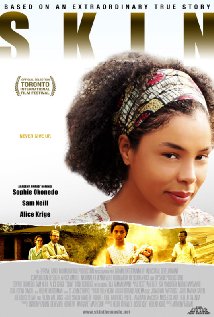 Summary:
Based on a true story, Sandra Laing was born black to two white parents. Something that is an interesting anomaly of unacknowledged or unknown ancestors, but unfortunately for Sandra it was oh so much more than that. Sandra was born in South Africa during Apartheid, and her white Afrikaner parents were members of the National Party. This film chronicles her fascinating life from a young girl hidden from the sun in the hopes that her skin would lighten as she grew older to a young runaway marriage to striking out on her own with her children.
Review:
I know movie reviews have been scarce around here. That’s mostly because since I joined the gym my evening free time is spent either there or reading. This weekend though I had a cold and a bit of a fuzzy head from a fever so I randomly chose an interesting looking movie from my Netflix recommendations. I had no idea when I chose it that Sandra Laing’s story is a true one. I didn’t realize this bit of information until the end credits. I thought it was one of those “what if” scenarios and knowing that this actually happened makes the whole thing incredibly painful.
We know that innate parental unconditional love is a myth. And if there was ever a true story that should unequivocally dispel this myth once and for all, it’s Sandra’s. Is there anything more abusive, more unloving than raising your child in a culture that hates her and doing, really, nothing about it? Although her parents did fight to have her classified as white and not colored (so they could keep custody of her, because apparently children had to be raised by parents of the same race during Apartheid), they did little else to protect her. Indeed, by her teen years her father was pressuring her to behave for white boys who were being verbally cruel at best or attempting to rape her at worst on dates. It’s little wonder Sandra ran off to be with a black man she met. Your role as a parent should be to protect your child and prepare her to take care of herself in the real world and advocate for herself. But Sandra’s parents’ racism clouded everything so much that the most they did was attempt to hide her.
Of course, the problem then became that Sandra was raised in a privileged background, and that’s all some of the black South Africans could see when they looked at her, including her own husband. He says to her at one point, “You still think of yourself as white.” I find it fascinating how people can become so wrapped up in their own problems resulting from inequality that they fail to see the pain inflicted by it on others, even others that they love.
The actress who plays the older Sandra does a great job showing her progression from a hopeful teen to a downtrodden factory worker at the end of Apartheid. The trauma from a life where everyone judged her either on her own skin tone or that of her parents is abundantly evident on the actresses’ face.
That said, while the topic is incredibly important and the true life events heart-breaking, I don’t think the movie itself does the real story true justice. The actors and actresses did a fine job with what they were given, but even basic googling shows that the story was cleaned up for a mainstream audience, which I think was a very poor decision on the part of the filmmakers. Sandra’s life was actually more difficult than they even give her credit for. For instance, she left home at only 15 (she seems much older in the film), her first husband already had a first wife, she actually had six children not two, etc…. (Essence, The Guardian, Women and Hollywood)
Personally, I view this movie as a gateway to the far more fascinating nitty gritty true story. I’m adding the book by the journalist Judith Stone about her work with Sandra to attempt to figure out her past called When She Was White
4 out of 5 stars
Source: Netflix Instant

Book Review: Hellsbane by Paige Cuccaro (Series, #1)
 Summary:
Emma Jane Hellsbane has always had the ability to sense other people’s emotions, and she turned that into a comfortable career as a “psychic.” All that changes when the cute jock from highschool who mysteriously disappeared halfway through senior year lands on her doorstep with a clawed stomach. She swiftly finds out that he’s a nephilim–half human, half fallen angel–and so is she. Without intending to, Emma Jane finds herself swept into the war between the angels and the fallen, as well as attempting to pay off the debt for her father’s sin.
Review:
This was a classic case of not a bad book but I’m not the right audience for it. I definitely don’t think the summary of the book that I read was quite as clear about the book’s Christian leanings as the one I just wrote for ya’ll. If it was, I wouldn’t have picked it up.
What we have here is what I’m thinking is probably a new category of Christian fiction I was completely unaware of –Christian paranormal clean romance. Now, I know at least two of my followers who would absolutely LOVE this book for exactly those reasons. Alas, that’s exactly why I didn’t like it.
The Christian mores and doctrines have a strong presence. We even go so far as to have Emma Jane come from a Catholic family but be an agnostic herself until hell and heaven literally show up on her doorstep. As an agnostic myself, I found it rather patronizing to have an agnostic character proven wrong by flesh and blood angels and demons. Y’know, like that would ever actually happen in real life? The whole scene just felt smug. On the other hand, I could totally see as a Christian enjoying seeing someone convert from agnostic back to Catholic. And yes, this book is heavily Catholic. There is a lot of talk of saints and levels of sin and etc… This of course means that there are things that I just don’t agree with (like the whole Emma Jane being held responsible for her father’s sin), but that’s only natural considering that this book is geared toward people who believe in those sorts of things. Kind of like how I can’t stand The Chronicles of Narnia for similar reasons.
The fact that this is a Christian romance also means that there is ZERO SEX. There is one pretty tame kiss. If you want clean romance, this is your book, but if you’re like me it, um, is not.
The only thing that bothered me that I can’t chalk up to not being the target audience is the surprising lack of racial diversity in a book set in Pittsburgh. Seriously, woman, I know there are black people in Pittsburgh! And we’re not just talking oh the characters are white. They all seem to be blonde-haired, blue-eyed white people. This would make sense maybe in um….Wisconsin perhaps. Not Pittsburgh. Cuccaro really should focus on more diversity in her future books.
These things said, Cuccaro is generally a good writer. The plot is complex, the characters well-rounded, and the sentences are well-written.
Overall, this book is well-written for its target audience–Christian, probably Catholic readers looking for some clean paranormal romance. If this sounds like you, you should check it out.
3 out of 5 stars
Source: Netgalley

 Support my work with a tip or browse my shop for curated book club guides, how to guides, cross-stitch patterns, and more!


This work by Amanda Nevius is licensed under a Creative Commons Attribution-Noncommercial-No Derivative Works 3.0 United States License.
 Opinions of a Wolf