
Archive
Book Review: The Walking Dead, Book Six by Robert Kirkman (Series, #6) (Graphic Novel)
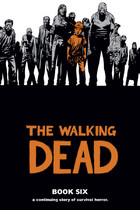 Summary:
The group continues to slowly lose their collective minds, although it is quickly made evident that they haven’t gone as crazy as some groups when they find themselves stalked by living cannibals. Toss in a preacher who failed to protect his flock and what turned out to be a pack of lies from the scientist, and it’s no wonder the group is suspicious when a couple of men approach and offer them refuge in an idyllic community just outside of DC. They in their state of PTSD can’t stop seeing danger around every corner and don’t even realize the dangerous ones just might be themselves.
Review:
You know how they say you can always find someone in the world worse off than you? Well, the first part of book 6 seems to be all about proving that’s true, perhaps in a way to humanize the group prior to how abundantly evident their loss of humanity is in contrast to the DC compound. That isn’t to say I particularly enjoyed the cannibalism plot-line. I can see its value, yes, but I also feel like we’d already seen how bad humanity can go in Woodbury, and if people are going to be eating people, that’s what you have zombies for. So the first half of the book is kind of meh to me.
On the other hand, seeing our group in the DC compound is delicious. I think one of the pieces of artwork in the appendix at the back explores the contrast eloquently. Michonne is dressed up talking to a group of women at a party, but she’s hiding a sword behind her back. The group has become so used to constantly being turned on and at war with the zombies and other survivors that they cannot relax. Classic PTSD. It’s fascinating to see how even Carl can recognize that they are no longer like these people who’ve been able to have downtime in the zombie war. Anybody who understands war and trauma at all would know that these people need special care. Even just the way they clump up and sleep all together in spite of being offered separate quarters is a symptom of PTSD, and yet the DC group makes Rick a cop. Um….ok. A seriously questionable choice there, but then again, the mayor of DC did used to be in politics. And we all know how smart those types can be. *eye-roll*
In any case, it’s obvious that this book is setting things up for a show-down between our traumatized group and the DC folks. I’m enjoying seeing our main guys turn slowly evil, and I’m curious to see how far Kirkman is willing to take it. That said, the first half of the book with the cannibals seemed kind of unnecessary to me. I’d rather have seen more zombies. Overall, it moves the plot forward, but that plot momentum is left mostly to the second half of the book. Worthy of the series and hopefully book 7 will live up to the build-up.
4 out of 5 stars
Source: Public Library

Previous Books in Series:
The Walking Dead, Book One
The Walking Dead, Book Two
The Walking Dead, Book Three
The Walking Dead, Book Four
The Walking Dead, Book Five
Book Review: Succubus Blues by Richelle Mead (Series, #1) (Bottom of TBR Pile Challenge)
 Summary:
Georgina Kincaid is a succubus. Has been for hundreds of years. She’s currently assigned to the demon district of Seattle, but she’s not really feeling being a succubus anymore. Oh, sure, she still needs to eat sexual energy from men, but she tries to keep it to the low-lifes, like cheaters, and avoid the good guys. Thankfully her demon boss lets her lack of stealing souls for the bad side slide. All in all, life is pretty good for Georgina. Her favorite author is even coming to do a reading at the bookstore she works at! But one night a vampire is killed and threats start coming in against all the baddies in Seattle–including Georgina.
Review:
Sometimes the books I’ve read for the Bottom of TBR Pile Challenge make me wonder what the hell past Amanda was thinking, and other times they make me realize that past Amanda was still me…..and I really do love to love the bad guys. And hoo boy is this book ever about the bad guys! Also, sex. Lots of sex. I mean, a succubus has gotta eat.
Getting an urban fantasy that isn’t all about a demon slayer but instead is about the demons is just awesome. It is really fun to be rooting for the succubus, demons, and vampires, but not in a Sookie Stackhouse sort of way. These guys are the other side of the war, and are they ever fun. It’s obvious that Mead is aware that she’s flipping the typical story on its head from a delicious tongue-in-cheek scene in which an angel’s helper shows up completely covered up and mocking Georgina’s sexy succubus outfit and blushing at all the swear words the bad crowd tosses around. And it’s so true! The good guys wouldn’t be *fun*. The good guys would be boring, and they sure as hell wouldn’t say fuck.
Also, it’s nice that for once we pop into the middle of the main character’s life instead of meeting her right when she gets her powers. It lends more depth to the character, adds mystery, and lets us just get on with the supernatural. This makes for a much faster moving plot as well, which is definitely appreciate. Plus, there’s the historical aspect to Georgina’s flashbacks, and that’s always fun.
The sex scenes are well-written. Um, really well-written. *coughs* The love interest is realistically attractive and intelligent, which is pure win. For once we aren’t stuck with a gorgeous, perfect man. We have an imperfect one who is still totally loveable.
So what’s keeping it from five stars for me? I’m not a fan that Georgina has somehow turned into a reluctant succubus. I want my succubus to steal men’s life energy and LIKE IT. But I get it that this makes Georgina more lovable to probably just about everyone else. I am still hoping that this reluctance will change in the next book. Haha.
Overall, this is a delicious urban fantasy that I highly recommend to fans of the genre who enjoy steamy sex and rooting for the bad guys.
4 out of 5 stars
Source: PaperBackSwap

Book Review: Tundra 37 by Aubrie Dionne (Series, #2)
 Summary:
Gemme is the Matchmaker for her generation on board the Expedition a spaceship that has been headed toward Paradise 18 for hundreds of years and multiple generations in the hopes of saving humanity from extinction due to the failure of Earth. The ship is driven by a pair of seers–twins from Old Earth who have been kept alive an abnormally long amount of time by being hooked up to machines and virtually made part of the ship. The seers make a mistake for the first time in hundreds of years and end up in a meteor shower and having to crash-land on the barely inhabitable ice planet Tundra 37. Gemme finds herself reassigned from Matchmaker to the exploratory team Alpha Blue with the hunky Lieutenant that the computer system matched her with just before blowing off into space during the meteor shower. Can she land the hunk without anyone knowing about the match? And will the colonists manage to survive Tundra 37?
Review:
Although this is the second book in the series, which I didn’t realize at first, it appears that each book follows a different spaceship that left Earth, so I really do not think it’s necessary to read them in order. I didn’t feel like I was missing anything, for instance.
It’s been a while since I read a book this bad that came from a publishing house, but it does happen. This is part of why I firmly believe it shouldn’t matter if a work is self-published or indie published or traditionally published. Bad books happen everywhere. Although it definitely is more baffling when something like this slips through a publishing house. (Then again, Twilight happened…..)
There is just so much wrong with this book. The characters struggle in this odd land between one-dimensional and three-dimensional. They’re two-dimensional? The structure itself is odd. We jump around at illogical points between Gemme/Lieutenant, the Seers’ lives on Old Earth, and the little crippled girl on the ship, Vira. I’d just get interested, finally, in one of the plots and then get yanked over to another one, only to have it happen all over again. Actually, the Seers’ lives are interesting and unique. I wish Dionne had simply told their story and ignored the total snoozefest that is the love interest between Gemme and the Lieutenant. These are all moderately minor things though that I could still see another reader enjoying, if it weren’t for the things that make zero fucking sense. There’s so many of them, I’m just gonna go ahead and bullet-point them for ya’ll.
- When the ship first crash-lands, the Seers (telekinetic, all-knowing types) announce that they have enough fuel to keep everyone warm and everything running for three months. Mysteriously, this number changes to three days without any explanation.
- Seriously, how could one person’s entire career be matchmaking one generation that fits on-board a space-ship? Plus, all she does is double-check the matches the computer sets up. This could be done in a day or two. A week at the most.
- NOBODY noticed little Vira’s telekinetic powers before now? Puhleeze.
- Supposedly the Seers’ eggs have been randomly implanted into random women for all the generations on-board the ship in the hopes of getting another Seer. Nobody knows this except the Matchmakers. Fact: The Seers are African-American. Double-fact: It appears almost everyone else on-board the ship is white. And you expect me to believe nobody noticed the random inter-racial babies popping up?! When these people mate for life? Apparently the facts of genetics that are so important to these people are completely unnoticed when it comes to race. HUH
As if these inconsistencies were not enough, there’s also the fact that Dionne simply tries to do too much throughout the book. Among the ideas and storylines going in this rather short book (thank god), we’ve got:
- People reliving their past lives in their dreams.
- Soulmates from past lives finding each other.
- The humans’ attempts to survive on Tundra 37.
- The explanation of how this ship got in the air in the first place.
- One seer’s love story.
- The story of the seers’ relationship with each other on Old Earth.
- How Old Earth went to hell.
- Vira being telekinetic and hiding it.
- An “evil entity” on board the ship.
- The mysterious orb.
- The mysterious beacon.
- The Gemme/Lieutenant/Luna love triangle (wtf is with the love triangles in romance novels?!)
Basically, the problem is, you can either tell the story of the Seers’ lives or the story of the colonist’s lives on Tundra 37. You can’t really do both. It’s confusing and jarring and seriously that orb/beacon thing was totally unnecessary for either one. This is honestly an understandable problem. Authors sometimes get too much going at once. But how it made it through editing and to publication in this format is beyond me. Could it be a typical outerspace, clean romance? (There is no sex). Sure! Is it the way it is now? Hell no! How it is now is a confusing mess that’s simply exhausting to read. Not what your typical romance reader is looking for or, really, any reader for that matter. Definitely give this one a pass.
2 out of 5 stars
Source: NetGalley

Previous Books in Series:
Paradise 21

Book Review: The Broken Sword by Joseph Robert Lewis (Series, #2)
 Summary:
The international bunch from the first book is back, this time with their lives intersecting in Espani. Taziri is now flying the Halycon 2, which is an airplane instead of an airship. Major Zidane is working as flight security, and Keenan is her copilot. Qhora and Lorenzo are married and living in Madrid running a fencing school. One day, Taziri’s flight drifts a bit off-course, while bringing passengers from Italia to Mazigh, and they happen to spot a brand-new Espani warship that promptly shoots at them. Forced down over Espani, Taziri takes her passengers to Lorenzo’s home, where they stumble into the middle of his personal quest to find the skyfire stone. A stone that fell from heaven in the frigid northern part of Espani, and that is supposed to emit heat that Lorenzo hopes will save the faith of his fellow Espanis.
Review:
In the first book, Lewis surprised me by writing a steampunk that I actually enjoyed. In this one, he managed to do that with a fantasy. Definitely impressive.
Whereas the first book focused on Taziri and the Mazigh steampunk science, this one focuses in on Espani–a culture that shuns science and instead trusts in faith. This is certainly not a set-up that would lead me to be sympathetic toward Lorenzo at all, and yet. It’s hard to blame someone for having faith in a country where people routinely interact with ghosts and water spirits. Eventually it comes to make sense why the Espani are so steeped in their faith and why it’s important to Lorenzo. It is his culture, after all. His culture, his land, his people. He’s afraid that the steampower and innovations from the southern nations are going to overpower and ruin Espani. It’s a culture clash from history only turned a bit on its head with Europe being the one to cling to the old ways. I think addressing the issue this way makes it more understandable and thought-provoking for the reader.
My complaint in the first book was there was too much exposition and it took too long to get the action going. Not a problem here! The plot jumps right in with both feet and sweeps along at a good, steady pace. The method of switching character perspectives in each chapter also works better in this book than in the first one. Perhaps this is because we know and understand them better, but I also think that the overall plot is just better and more tightly structured this time around.
The settings evoked are again stunning, only this time the direct opposite of Mazigh. The frozen north is something I have an affinity for myself, having grown up near the Canadian border in Vermont, and Lewis demonstrates how weather affects culture quite well.
Not to be outdone, Syfax imitated her [taking a shot of vodka] and almost choked on the burning in his throat, but he held it back and managed a grin. “You drink this for fun?”
“No, I drink it to get drunk, major. When you live in a climate like this, some nights are best spent with your brain on fire, burning your blood from the inside out.” (location 1929)
Can I also say, this book has a very hot, sex-positive, sex scene, and I like it, and can we get more of that please? ;-)
Two things I didn’t like quite so much. First, Taziri’s plot again mostly involves her wanting to get back to her family and missing her daughter. This feels a bit too much like a repeat of the first book. Second, where were all the Espani women? I cannot think of a single significant one encountered in a whole book set there. This made me sad after the large presence of females in the first book. Qhora talks about Espani female gentility and such, but we don’t ever really see it.
Overall, this is a fulfilling follow-up to the first book that does not suffer from the middle book in the trilogy plight that so often occurs to book two. The setting is different, and the action is tighter. I’m excited to read the final book in the trilogy and am certain fans of the first book will not be disappointed by this one.
Oh, and Lewis? Can you please write something set in the New World? I need more giant, purring tigers in my life.
4 out of 5 stars
Source: Kindle copy from the author in exchange for my honest review

Previous Books in Series:
The Burning Sky
Book Review: Y: The Last Man: Ring of Truth by Brian K. Vaughan (Series, #5) (Graphic Novel)
 Summary:
Yorick, Dr. Mann, and Agent 355 (not to mention Ampersand) have finally made it to California, which surprisingly has managed to mostly avoid the chaos taking over the rest of the US. Dr. Mann is hard at work attempting to figure out why Yorick and Ampersand have survived for so long. Meanwhile, the crazed assassins who broke off of 355’s Culper Ring are in hot pursuit of the whole bunch.
Review:
I’m pleased to say that this entry in the series returned to the former glory of volume 3 and avoided the oddness of volume 4.
Perhaps what’s best is how much Yorick is growing as a character. Finally! He actually has sex! And makes plans. And thinks things through. But not always, so he’s still him.
There is a lot of productivity in the storyline too. I like that Dr. Mann actually considers a fantastical explanation for Yorick’s survival so far. It adds another aspect to her character and the storyline as well. In fact this choice of believing known fact or believing in a fantasy is a recurring theme in this entry in the series, and one that I really enjoyed.
The art continues to be good, the storyline moves right along, Yorick is less annoying, plus sex! Definitely a worthwhile entry in the series.
5 out of 5 stars
Source: Public Library

Previous Books in Series
Y: The Last Man: Unmanned
Y: The Last Man: Cycles
Y: The Last Man: One Small Step
Y: The Last Man: Safeword
Book Review: Falling For Me: How I Hung Curtains, Learned to Cook, Traveled to Seville, and Fell in Love by Anna David
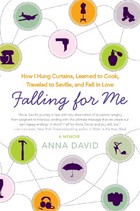 Summary:
Anna David is a successful writer in her mid 30s living in NYC when an overwhelming depression hits her. She’s still single. What’s wrong with her? While fighting off tears in the self-help section, she finds a copy of Sex and the Single Girl by Helen Gurley Brown, which was a bestseller in the 1960s. Essentially a guide to being happy single while still keeping an eye open for Mr. Right, Anna instantly connects with Helen Gurley Brown and decides to spend the next year challenging herself and taking advantage of everything being single has to offer.
Review:
It should really need no explaining why I picked this book up. I’ve always been the relationship type (even when I tried not to be), but I also won’t settle for just anybody, and sometimes that combination leads to some ennui. I was hoping I would find a connection to and insight from Anna, and I was certainly right about that.
The very first chapter has Anna breaking down in line for food in her head, basically saying, “I’m going to be alone forever,” and going on from there adding that she’ll be the crazy old maid cat lady and going further and further on into ridiculousness that really doesn’t seem that ridiculous when it’s your brain saying it to yourself. I knew instantly that Anna and I would get along.
As opposed to a lot of other single gal memoirs, the focus is neither just love yourself the way you are nor fake everything to land a man. It’s more like….Do you have any idea how lucky you are to even have this phase in your life? You’re single! You can do anything, go anywhere, decorate however you want, and etc… Anna realizes that she hasn’t been taking full advantage of the things being single affords to her. Things like deciding to house swap and live for a month in Seville (try doing that with a baby) or taking French classes in the evening or spending the day rollerblading and winding up in a park in the sun. So Anna isn’t just trudging along being herself. She’s pushing herself to try new things, go new places, and yes the future Mr. Anna may be there, but even if he’s not, she’s still having a fun time doing it.
The book also addresses another common issue among single women and, well, people in general–grass is always greener syndrome. Anna eventually realizes that she seems to think all of her problems will just disappear if and when she gets married, when that is really not the case at all if you pay an iota of attention to married couples.
One specific line in S&SG that I keep thinking of—“I’ve never met a completely happy single girl or a completely happy married one”—and how it’s helped me to see that I’m somehow convinced that getting to the next stage will make me instantly joyous. (page 36)
The other thing that is sooo relatable that Anna talks about is how it’s so easy to become so desperate for a partner that you start trying to change yourself for him or worry constantly about whether or not you’re good enough for him, when that’s not how dating is supposed to work!
You spend all your time trying to manipulate a guy into wanting you to be his girlfriend when what you should be doing is enjoying yourself and then later figuring out if you even want him as a boyfriend. (page 205)
There are definitely things about Anna that I don’t like or I disagree with (for instance, she eats veal and foie gras, ahem, the book almost got thrown across the room at that point), but even though we’re different, we’re also the same. We’re two single gals who are wondering why everyone else seems to be coupling up but me? What Anna slowly realizes over her year-long experiment is that there is no timeline for love and marriage. It’s not like it’s a game of musical chairs and she’ll be left the only one without one. Maybe her music is just playing at a different speed. I think that’s a really important thing to remember and touching to see someone else struggling with, because it’s far too easy to start pressuring ourselves and the men we date into situations that just aren’t right for either of us. It’ll happen when it happens.
This is a rare instance when I feel the need to sort of reveal the ending. I was worried the book would end with Anna abundantly happy in a relationship, kind of like Eat, Pray, Love, which honestly would only have made me more depressed. Like the book was all about yay singlehood but I still landed a man, right? But no. Who Anna falls in love with is not a man, but herself.
Here’s what I’ve come to understand: I used to not really believe I deserved thick, gorgeous panels for my windows or to pull books from a bookshelf specifically selected for my apartment. It didn’t occur to me that I was worth cooking homemade chicken soup for or dressing in beautiful clothes. I thought I was half a person because I didn’t have a partner but that when I had one, I’d do those things for him. Now I see that I’m entirely whole so that if and when I find him, we can be two whole people together, not the person and a half we would have been. (page 305)
Yes, yes, yes! Finally. A book about being single and loving yourself and taking care of yourself and being a whole person as just you. Sure, the professionals tell us that, but it’s super-nice to get to hear it from a gal who could easily be somebody I have bimonthly cocktails with.
I highly recommend this book to any single ladies in their 20s and up. It’s a nice reminder that we’re not the only ones learning to love ourselves and be patient for the right person.
4 out of 5 stars
Source: Public Library

Book Review: The Sparrow by Mary Doria Russell (Series, #1) (Bottom of TBR Pile Challenge)
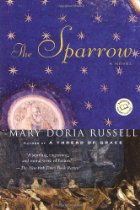 Summary:
It is the year 2060, and the Jesuit priest Emilio Endoz has been found on the planet Rakhat by the second Earth ship to travel there. Found in a whorehouse and killing a native inhabitant in front the UN members’ eyes, they nonetheless strap him into his original spaceship and send him back to the Jesuits. There he is treated for his horrifying wounds and through a series of flashbacks and current conversations with the various Jesuit committee members assigned to his case, we slowly see how everything that started out so right went so horribly wrong on Rakhat.
Review:
It may have been a while since it made it onto my tbr shelf, but I still have a crystal clear memory of why I acquired this book. I entirely blame Little Red Reviewer, who just so happens to be the only other female scifi fan who book blogs that I’m aware of. (Feel free to enlighten me to more in the comments). Her review that religion is there but in a questioning way that honors the tradition of scifi made me give this book with a Jesuit priest and mission at its core a chance. I’m glad I did.
This is a first contact story that takes the all-too-infrequent route of Earth finding the inhabited planet first and sending a mission to them. There’s so much more than that that makes this book unique, though. The future Earth just barely has the technology to make it to Alpha Centauri, and only the most tech-savvy are aware of it. Thus, we’re not an incredibly advanced civilization making first contact, just one slightly more so than Rakhat. I’d say a fair comparison might be late 19th to early 20th century earth to early to late 21st century Earth. It’s a short span of difference. Additionally, Russell made the intriguing choice of the first contact being run by missionaries, instead of a political unit. When you think about it, it makes perfect sense. Who tended to be first to the New World? Religious groups. Who can organize themselves quickly and have vast finances? Religious groups. Having first contact be missionaries makes so much sense that I’m shocked I didn’t think of it first.
That said, thankfully this book is not a love letter to organized religion or mission work. It is instead a complex, scientific, and anthropological study of the human condition, the difficulties of vastly different cultures meeting, linguistics, and much more. At its core it is all about why does god (if there is a god) let evil happen, especially to good people who are serving him? These issues are more easily addressed and made further complex by having agnostics, non-practicing Catholics, and a Jewish woman members of the mission team. The non-believers are about at even numbers with the priests. In fact, the deeper into the book I got, the more it tore at my heart-strings. Varying types of questioners are represented, and of course it’s possible to identify with many of them, particularly for a reader who once was religious but is not anymore. There’s the priest who is secretly gay, the Jewish woman who was wounded terribly by war but comes to learn to love again, the Father Superior who thinks he may be seeing the formation of a real live saint, the priest questioning the very existence of god, and the agnostic who wants to have the beautiful aspect of faith that she sees in those around her.
This book reads, it sounds a bit odd to say, almost like an agnostic’s prayer. Of course agnostics don’t pray, but if they did pray, the pain and wondering and intelligence found in this book would all be there.
We are, after all, only very clever tailless primates, doing the best we can, but limited. Perhaps we must all own up to being agnostic, unable to know the unknowable. (page 201)
The problem with atheism, I find, under these circumstances…is that I have no one to despise but myself. If, however, I choose to believe that God is vicious, then at least I have the solace of hating God. (page 394)
People more into science than the questioning human spirit will find plenty for themselves as well. The science of linguistics is astoundingly well presented. The way the two “sentient” species on Rakhat have evolved is also incredibly well thought-out and realistically drawn. The problems of poverty and war on earth are briefly explored too.
All of these things said, I do feel it took a bit too long to get things set up and moving. Granted, I tend to be a bit of an action-focused reader, so others may not have a problem with that. It was still a draw-back of the book for me though.
I sort of feel like I’m not doing the experience of reading this book justice. Suffice to say if you’ve ever questioned whether or not to have faith and love your big questions to be wrapped in well-thought-out scifi, this is the book for you.
4 out of 5 stars
Source: Better World Books

Counts For:
Book Review: Blanche on the Lam by Barbara Neely (Series, #1) (The Real Help Reading Project)
 Summary:
Blanche’s employers failed to pay her on time, and now she has some bad checks. She had no idea that bouncing a few checks would land her with a 30 day jail sentence, though, so when she gets the chance, Blanche goes on the lam. She decides to take a temporary job she had originally decided against as a way to hide out. She’s going to be the help for a family on a week-long vacation in the countryside. Naturally, things can never be simple, and Blanche starts to suspect one of the family members is a murderer.
Review:
It’s hard to believe Amy and I are on our penultimate book for the project, not to mention the final fiction book on the list. And what a book! If I had to pick one of the fiction books we read to hand to fans of The Help to get a much more real representation of black women in domestic service, this is definitely the book I would hand them.
Somehow this tiny mystery novel (called a Kriminalroman in German, which I think sounds much better) manages to cover pretty much every aspect of black female domestic workers’ lives that we’ve discussed throughout the project. Blanche faces: police and criminal justice prejudice, stinginess on the part of wealthy employers, rape at the hands of a white male employer, classism, employers’ racist attempts to control her body, non-traditional family structure, and much much more. Yet facing all of those odds, Blanche remains determined and strong. She is not someone who needs OR wants a white woman (or man) to come along and rescue her. I think Blanche’s personality is best summed-up here:
She always returned to domestic work. For all the chatelaine fantasies of some of the women for whom she worked, she was really her own boss, and her clients knew it. She was the expert. She ordered her employers’ lives, not the other way around. She told them when they had to be out of the way, when she would work, and when she wouldn’t. (page 86)
That’s one of the wonderful things about this book. It turns the whole white woman saving the help thing from The Help on its head. Blanche is the one who saves the white family in this book, and then she refuses to accept help from them in return, beyond clearing up her ridiculously unfair legal troubles. Instead of taking a cushy job with them, she leaves, because she is her own woman.
Now, all of that said, I was personally a bit distracted from the race and class issues in this book due to the presence of the character Mumsfield. Mumsfield is the cousin of the sinister family members, and he has Down’s Syndrome. I don’t think all of my readers know this, but my niece has Down’s, so I certainly am a bit sensitive to the portrayal of it in literature. Knowing and loving a person with Down’s removes a lot of the misperceptions of it that exist in the world. At first, I was concerned that Neely had fallen for these things. Mumsfield at first seems too trusting, too caring, a real simpleton. But by the end of the book, Blanche realizes that she hadn’t really listened to what Mumsfield was actually saying earlier in the week. If she had, she would have realized that while Mumsfield is kind and giving, he’s not stupid. Knowing Mumsfield also helps Blanche see that her experiences as a black woman in America have made her racist against white people, when not all of them are bad. Thus, I am pleased to report that Mumsfield is actually an accurate and positive portrayal of people with Down’s.
Now, I will say, personally I’m not generally into the typical mystery novel. I like to get my genre reading from urban fantasy, pnr, and cozies. I am well aware, though, that a lot of people love this kind of book, and it is definitely well-done. It has all of the well-loved aspects of the genre, plus manages to address race, class, and even Down’s Syndrome. It is absolutely a worthwhile read.
3 out of 5 stars
Length: 215 pages – average but on the shorter side
Source: Library
Buy It (Amazon or Bookshop.org)
Discussion Questions:
- How do you feel about Blanche’s initial jail sentence and her decision to go on the lam?
- Blanche sees Mumsfield as an exception to the rule when it comes to white people, aka it’s unusual for them to be kind. Do you think this is an unfair assessment?
- Blanche assesses her caring for Mumsfield as a symptom of “Darkies Disease” aka when the help start acting like the idealized Mammies. What do you think of this assessment?
If you found this review helpful, please consider tipping me on ko-fi, checking out my digital items available in my ko-fi shop, buying one of my publications, or using one of my referral/coupon codes. Thank you for your support!
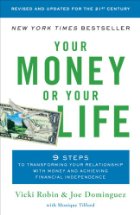
Book Review: Your Money or Your Life: 9 Steps to Transforming Your Relationship with Money and Achieving Financial Independence by Vicki Robin and Joe Dominguez
 Summary:
Dominguez achieved Financial Independence at the ripe old age of 30 and proceeded to provide his method to friends who encouraged him to offer it as a class. He finally wrote a book, and this edition is revised and updated for modern times by his friend and fellow achiever of Financial Independence, Vicki Robin. Offering steps and mind-set changes, not magic formulas, they promise that if you follow the steps, you can be Financially Independent in 5 to 10 years, no matter how much debt you are currently in or how much money you make.
Review:
It took me an astoundingly long time (for me) to read through this book, partly because the information really does alter your world-view, and partly out of a desire to let each step sink into my mind before reading the next one. I took sixteen pages of typed notes, something I haven’t done since grad school (ok, ok, undergrad….). The information is just that good.
What is Financial Independence? It’s when you’re out of debt and making enough income off of safe investments that you do not have to work for a living. This frees you up to do what you want with your life, whatever that may be. Some people volunteer, others start a business, some spend their time with family, some travel, the options are endless.
The steps are simple and straight-forward, but they all come back to the central idea that money is something we trade our life energy for. It seems obvious when you hear it spelled out that way, but personally it was not routine for me to think of my money and spending in that manner. Not anymore. When I was a work-study student and got to keep all my money, no taxes, no commute time, no work wardrobe to buy, no work lunches, it was easy to think “Ok, I have to work this many hours to buy this thing.” Grown-up, real world work isn’t that obvious. So figuring out my “real wage” by calculating out how many hours I actually spend working (including commute and lunch break), the cost of working (work wardrobe and T pass), reveals that one hour of my life equals $7. I figured this out back in December. Trust me, it completely changed my spending habits. It’s abundantly clear when you look at my mint.com account.
So, I can say that the early steps definitely have changed me. Can I tell you this book will work, and I will be Financially Independent in 5 to 10 years? No. I have no clue yet. I can tell you, though, that the steps are real and not toted as magic. It will take a lot of work. That, combined with the effects on me of the early steps, are enough for me to say that this book is worth it. It teaches you to be in control of your life, instead of letting money and the “American Dream” control you. But let me tell you the nine steps, just to prove to you that none of them are a “magic formula” type thing.
- Make peace with your past
- Track your life energy
- Tabulate monthly
- Ask yourself the three questions for each category during your monthly tabulation: a) Did I receive fulfillment, satisfaction and value in proportion to life energy spent? b) Is this expenditure of life energy in alignment with my values and life purpose? c) How might this expenditure change if I didn’t have to work for a living?
- Make a wall chart where you can plot your monthly expenditures, total income, and investment income in three different colors to help you see change and progress over time.
- Value your life energy by minimizing spending
- Value your life energy by maximizing income
- After you’ve tracked on your Wall Chart for a while, calculate your Crossover Point–the point in the future where your investment income and expenditures meet and “cross over.”
- Become knowledgeable and sophisticated about long-term income-producing investments and manage your finances for a consistent income sufficient to your needs over the long term.
If these steps intrigue you and you have a desire to become Financially Independent, then I strongly encourage you to read this book. In fact, I encourage everyone to read at least the first few chapters to learn how to have a different relationship with money. One where you are in control of it and thus regain control of your life.
5 out of 5 stars
Source: Public Library

Book Review: Death Island by Joan Conning Afman
 Summary:
In future America the prisons are so overcrowded that the government needed to come up with a new idea. So they started sending the worst criminals to a remote island to live out their lives (or deaths). Naturally, this Lord of the Flies style punishment is also a nationally televised weekly reality tv show. When Danny is wrongfully accused of serial killing five women with an axe, including his own wife, this reality tv show becomes his stark….reality.
Review:
At this point, the idea of a reality televised punishment type thing run by the government is relatively passe. A trope of the dystopian scifi genre, even. However, Afman does bring a unique twist to this basic idea that keeps the book fresh and engaging.
For instance, the inhabitants of the island are not forced to pit themselves against each other. They sort of naturally divided up into the Village, the Tribe, and the loners. The Village consists of those men who feel badly about their crimes and are trying to live out their lives with some semblance of normalcy. A lot of them have formed couples and shacked up. The Tribe are basically the psychopathic killers who periodically get drunk on their homemade rum and randomly attack others on the island. The loners are relatively self-explanatory. Having this type of conflict naturally happen instead of forcing it upon the participants is a nice throwback to The Lord of the Flies.
On the other hand, the fact that Danny proclaims his innocence and is innocent makes the plot far less appealing to me. There’s no real moral ambiguity at the center that would drive the reader to question her own belief system or the concept of justice in general. It’s odd to me that Afman chose Danny as the main character when there is a minor character on the island who admittedly committed a crime but perhaps for the right reasons. This is where the meat of a real story would lie. Choosing Danny instead makes it sort of like those tv shows people put on for background noise but don’t pay any real attention to.
Of course, Danny is not the entire plot. We also have the minister’s wife, Charlie, who firmly believes in Danny’s innocence and works toward freeing him. She provides the connection to the real axe murderer and a really odd romance layer to the book. Seeing the program how those in America do is interesting, but wouldn’t it be more interesting to travel around to various viewing parties in the US? Perhaps to those who are blood-thirsty to the casual viewers to family members of those sent to the island, even. Instead, every time Charlie’s plot interrupts Danny’s it’s distracting.
All of those things said, it’s not that the book is badly written. It’s not. It’s just not amazing or even very good. It’s just good. It entertains for a couple of hours and then is easily tossed aside. Perhaps for some people that’s enough. Personally I was hoping for more.
Overall, I recommend this book to those who are a fan of the concept looking for a light, quick read.
3 out of 5 stars
Source: LibraryThing’s EarlyReviewers

 Support my work with a tip or browse my shop for curated book club guides, how to guides, cross-stitch patterns, and more!


This work by Amanda Nevius is licensed under a Creative Commons Attribution-Noncommercial-No Derivative Works 3.0 United States License.
 Opinions of a Wolf