
Archive
Movie Review: Wo Ai Ni (I Love You) Mommy (2010)
 Summary:
This documentary follows the adoption of Fang Sui Yong, an 8 year old Chinese girl, by the Sadowsky’s, a Jewish family from Long Island. The filmmaker seeks to highlight the particular issues faced when adopting older children internationally.
Review:
This is one of those films that shows how difficult life can be, and that sometimes there is no good choice. There’s only the iffy choice that’s a bit better than the alternative. Sui Yong (who now goes by “Faith,” so I”ll call her that for the rest of the review) didn’t want to leave China. She was quite happy living with her foster family, and had never seen a white person before. This is all the film tells us at first, so you immediately wonder, why can’t Faith stay with the foster family? It turns out that foster families can’t adopt the children they’re caring for in China, and it is unlikely Faith would have stayed with them for her whole childhood. Additionally, Faith is special needs with a club foot and dropped wrists. Her foster parents state that she would face great difficulty in China, being treated as an outcast. Her foster parents want her to be adopted. They see that her future in China is very bleak.
That doesn’t mean that her transition to the US went perfectly, of course. The culture shock Faith faces is severe, even if just looking at going from hearing Mandarin and Cantonese to hearing English all the time. Donna Sadowsky is obviously a tough love type mom, believing that being firm will be the fastest way to help Faith acclimate. Personally I believe she was a bit too tough. Some of the learning could have been made into a bit more of a game. More understanding could have been shown for her special needs. But I only saw a brief film of two years of the time they spent together. It’s almost impossible to tell Faith’s personality from that much film. Maybe they tried taking it a bit easier on her, and she slacked off too much. Maybe the doctors told them Faith could do certain things that it turned out she couldn’t. It’s hard to tell.
An interesting element of the film is the fact that the filmmaker, a one-woman team, speaks Mandarin, and so translates sometimes for the family. This of course means that she has a direct impact on the story she’s documenting. It’s quite interesting to watch and to consider how much documenting a story impacts it.
Overall, this is a very interesting documentary. Many people are hesitant to adopt older children. This film shows that it can be done, as well as the great need for families for older and special needs children internationally. It brings up interesting questions regarding international and transracial adoption, as well as demonstrating how quickly the American consumer culture impacts children. I highly recommend it to anyone with an interest in international adoption or the issues related to it.
4 out of 5 stars
Source: PBS website
Book Review: Ender’s Game by Orson Scott Card
 Summary:
Humanity survived the second Bugger invasion by pure luck. Now they’re determined to be prepared for a third invasion and actively train children in Battle School, seeking the child who could be the commander to save humanity. They think Ender, with his ability to perceive and understand null gravity spaces, just might be that commander, but Ender isn’t so sure.
Review:
Card has created a rich, complex, entirely believable future where individual sacrifice is vital to the survival of the human species. This goal makes the adults’ treatment of the children in Battle School justifiable and allows Card to create a story where children are simultaneously treated as adults and misled by them. Adults will recognize the feeling of being pawns to those in control of society. Children and young adults will appreciate that the children characters are treated as adults in smaller bodies. It’s a fun narrative set-up.
The world-building is excellent. The complex scenes of the Battle School, Battle Room, and videogames the children play are all so clearly drawn that the reader truly feels as if she is there. Readers who also enjoy videogames will particularly enjoy the multiple videogame sequences in which the narrative action switches focus to the videogame. This isn’t just for fun, either. It’s an important feature that comes to play later in the book. In fact, it’s really nice to see videogaming being featured in a future as something important to society and not just recreational. It’s a logical choice to make in scifi too, as the military is moving increasingly toward using weapons that are manned by soldiers behind the lines with videogame-like controls.
These fantastic scenes are all set against a well-thought-out human society reaction to multiple alien invasions. In spite of the threat of a third invasion, there is still violent nationalism brewing under the surface. Politicians must worry about their image. Dissenting voices can be heard on the internet. The teachers of the Battle School must worry about the retributions for their actions, even as they make the choices that will hopefully save humanity. The people in this future are still people. They act in the sometimes stupid and sometimes brilliant ways people act. They don’t miraculously become super-human in the face of an alien threat. I really enjoyed this narrative choice, as I get really sick of the super-human trope often found in scifi.
The ending….I don’t know if I’ll ever be able to make up my mind on how I feel about the ending. I definitely didn’t guess it ahead of time, which is a nice change, but I can’t decide how I feel about it. The fact is, I liked part of it, and I didn’t like another part of it. I think I may have found the ultimate message a bit too idealistic, and Ender too gullible.
*spoiler warning*
Here’s the thing. The Bugger queen claims that the Buggers didn’t know that humans were sentient creatures, and Ender believes her, but I call bullshit. Humans and Buggers built cities that were similar enough so that humans could live in Bugger buildings. In spite of being drastically different from an evolutionary stand-point, it’s still obvious that humans were sentient enough to build cities and spaceships. That should have been a warning sign. So ultimately, I view the queen larva and message to Ender as a last-ditch effort to come back from the brink of extinction and beat humanity, and Ender fell for it. Of course I don’t want to argue for the extinction of an entire species. I’m a vegetarian. I’m pretty much against the killing of species of any kind, but the fact remains that the Buggers attacked humans twice. What were they supposed to do? Sit back and let themselves get wiped out? I’m not one of these nutters who says don’t kill the polar bear attacking you, and in this case, the polar bear had already attacked twice. I like the message of a possible peaceful coexistence, but I don’t think it was very realistic in that world, and I was left feeling that Ender didn’t really learn anything from his experience.
*end spoilers*
Overall, however, Card has achieved near perfection in telling a unique, scifi story. The world is entrancing and draws the reader in, and the reader is left with multiple philosophical questions to ponder long after finishing reading the book. It is a book I definitely plan on re-reading, and I highly recommend it to scifi and videogaming fans.
5 out of 5 stars
Source: Amazon

Movie Review: Shortcut to Happiness (2004)
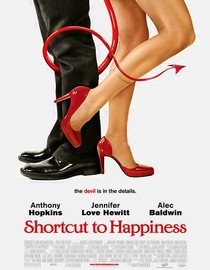 Summary:
Jabez Stone loves writing, and he wants to be a good writer, but he also wants to be a famous one. When his friend sells his manuscript for a lucrative sum, and Jabez follows this news up by having one of the worst days of his life, he tells the mirror that he’d sell his soul for that success. Of course the devil comes knocking in the form of a beautiful woman to cut that deal, but fame isn’t all it’s cracked up to be.
Review:
Even though they’re all rather obvious and quite predictable, I’ve always enjoyed “sells soul to devil” stories as a sort of movie comfort food. Yes, we all know what’s going to happen in the end, but the selling the soul part and the part immediately after when everything is going right are actually quite entertaining to watch. The thing is, these movies can easily go bad if they’re not careful. There’s fun cheesy, and then there’s eye-rolling cheesy. Unfortunately, this movie is one of the latter.
It features a fairly impressive cast–Alec Baldwin, Jennifer Love Hewitt, Dan Akroyd, and Kim Cattrall–yet they for the most part fail to deliver. Jennifer Love Hewitt clearly tries; it’s not her fault she was miscast. For some reason many of these movies persist in casting Barbie doll fake plastic type actresses in the role of the devil, when it’s obvious a classic femme fatale would be much more accurate. The devil should be glamorous, not fake. It’s much harder to see through glamor than fake bullshit. Dan Akroyd does a good job, but he is underutilized. As for Baldwin and Cattrall, I had no idea these two can’t actually act, but they can’t. Either that, or they can only act one type of role. Baldwin behaves in exactly the same manner here as he does in 30 Rock

In spite of the casting, the movie still could have been decent with a good script, which is why the first half of the movie is quite watchable. Unfortunately, it takes a serious nose-dive in the second half of the movie from interesting exploration of human behavior to….a court room trial? Held in a cemetery? With a jury consisting of people from Jabez’s past and famous authors such as Hemingway? What the fuck?! The whole entire court room scene, which seems to last forever, is from so far out of left field and so painfully boring that it really, truly ruins the movie. This is the classic example of how the ending can ruin an entire story. Seriously, don’t start out being all “yay NYC capers! Plus, the devil!” and then slam us with a court room scene more boring than Law and Order
That said, I still actually watched the whole movie. Granted, I was playing Angry Birds on my iTouch most of the time, but the fact remains I did finish it. So it is watchable, but it certainly is not high-quality viewing. If you have time to kill and are a fan of any of the actors I mentioned or are a fan of selling soul to the devil stories, you won’t hate it, but there are definitely better films out there to kill time with.
2 out of 5 stars
Source: Netflix
Buy It It appears not to have been released on DVD. Interesting.
Book Review: Crime Scene at Cardwell Ranch by B.J. Daniels
 Summary:
Dana doesn’t want to sell the family ranch in Montana, but her siblings are insistent and without her mother’s new will, she doesn’t have a leg to stand on. The sale gets held up when a body is discovered in an old well on the ranch. A new marshal is brought in from out of town to investigate, and it’s none other than Hud, Dana’s ex-fiancee. Can they find the killer? Can Dana save the ranch from her greedy siblings? Will renewed love overcome old hurts?
Review:
This is a Harlequin romance novel, and they are not meant to be super-serious or make you ponder life. It’s light reading akin to viewing the hot summer blockbuster movie. So does it do its job?
The murder storyline is just complex enough to be compelling but not so complex that too much thinking is required, so plot-wise, Daniels does a good job. The characters are fairly well-rounded, and Daniels eloquently presents a true-to-life modern Montana and not the romanticized vision of the old west often seen in books. (My brother used to live in Montana, so I’m speaking from experience here). Hud and Dana are sigh-inducing as a couple, but are also still believable. Their love story could happen in real life, so that makes for an enjoyable read.
However, Harlequin romances are definitely supposed to be romance. I was expecting at least one good sex scene. What you get is a scene that, I kid you not, consists almost entirely of he kissed her breasts, there was passion, they went to sleep. I’ve seen better sex scenes in historical fiction that wasn’t even marketed as romance. Is this a Harlequin thing? Are they supposed to be that clean? I definitely remember them being a lot more hot and heavy when I was 15, but well, that was 9 years ago. In any case, this sex scene left much to be desired. Much.
The book also suffers from a lack of good editing. This definitely isn’t Daniels’ fault. Daniels makes mistakes most writers will make periodically in a book this long, but the editor failed to catch them. I’d say there are around five easily noticeable errors in the book. I find it easy enough to roll my eyes and continue on. If that sort of thing bothers you, though, you should be aware.
Overall, Daniels provides an intriguing modern day crime mystery set in rural Montana with a touch of romance and sex that happens off the page. If you like light, fairly clean genre fiction with a dash of intrigue, you will enjoy this book.
3 out of 5 stars
Source: Amazon

Book Review: God Bless You, Mr. Rosewater by Kurt Vonnegut

Summary:
A satire on free enterprise, money, and capitalism in America told by examining the fictional Rosewaters–an uber-wealthy American family whose ancestor acquired his wealth by essentially profiteering during the Civil War. The current Rosewater fights in WWII and returns with two crazy ideas. First, that everyone deserves to be equally happy. Second, that people who inherited wealth did nothing to deserve it. He responds to this conundrum of conscience by returning to his ancestor’s hometown and using the Rosewater Foundation to help the “useless poor.” In the meantime, a lawyer by the name of Mushari decides to attempt to prove that Mr. Rosewater is insane, and the foundation money should be handed off to his cousin, currently a suicidal, middle-class insurance man.
Review:
How to review Vonnegut? Upheld as the epitome of 20th century American writing. He is certainly prolific, and some of his books absolutely deserve the high praise (Slaughterhouse-Five
I think part of the problem stems from the fact that the first third of the book is focused on Eliot Rosewater, the next on his cousin, and the last on Eliot again. Just as I was getting into Eliot’s story, it switched to his cousin. Then when I was getting into his cousin’s story, it switched back to Eliot. To top it all off, the ending left me with little to no resolution on either one. Maybe Vonnegut’s point is that capitalism either makes you crazy or depressed with no way out? I’m not sure.
That’s not to say that this wasn’t a fun read, though. Vonnegut crafts the mid-western town Eliot lives in and the Rhodes Island seacoast town his cousin lives in with delicious detail. What is interesting about both are of course the people in the towns surrounding the main characters, and not the main characters themselves. In particular the Rhodes Island town is full of surprisingly well-rounded secondary characters from the cousin’s wife who’s experimenting in a lesbian relationship, to the local fisherman and his sons, to the local restaurant owner who is intensely fabulous (yes, the gay kind of fabulous. There’s quite a bit of LGBTQIA+ in this book). I was so interested in this town. This was a town that actually demonstrated the problems innate in some people having too much money while others don’t have enough. This was so much more interesting than Rosewater’s sojourn in Indiana. But then! Just when I was really getting into it and thinking this book might approach Slaughterhouse-Five
Much more interesting than the heavy-handed money message was the much more subtle one on the impact of war. Mr. Rosewater’s sanity issues go back to WWII. I won’t tell you what happened, because the reveal is quite powerful. Suffice to say, Vonnegut clearly understood the impact WWII had on an entire generation and clearly thought about the impact of war on humanity in general. In this way, this book is quite like Slaughterhouse-Five
Overall, if you’re a Vonnegut enthusiast, enjoy reading for setting and character studies, and don’t mind a message that’s a bit heavy-handed, you will enjoy this book. Folks just looking for a feel of what makes Vonnegut held in such high esteem should stick to Slaughterhouse-Five
If you found this review helpful, please consider tipping me on ko-fi, checking out my digital items available in my ko-fi shop, buying one of my publications, or using one of my referral/coupon codes. Thank you for your support!
3.5 out of 5
Length: 190 pages – average but on the shorter side
Source: PaperBackSwap
Buy It (Amazon or Bookshop.org)
Movie Review: Kick-Ass (2010)
 Summary:
Highschooler Dave wonders why no one in real life ever tried to be a super-hero, so he orders a wet suit, dubs himself “Kick-Ass” and sets out to attempt vigilante justice. Lucky for him in his ineptitude, someone has thought of being a a superhero–ex-cop Big Daddy and his 9 year old daughter Hit Girl. Their activities land them on the mob’s hit list, and pandemonium ensues.
Review:
This is a concept–blundering wannabe superheroes–that could easily fall flat on its face, but it doesn’t. The addition of Big Daddy and Hit Girl to the scene really change the entire feel of the movie. They’re not so much superheroes as vigilantes–think Kill Bill only with superhero costumes. They bring reality back into Kick-Ass’s daydreaming. In the real world, fighting the bad guys often have serious consequences. It’s not all youtube glory.
This was based on a graphic novel, and the bright colors in the costumes help bring that feel in. The fight sequences aren’t stylized like anime, rather they feel like a typical action movie, but that was a wise choice given the basic message in the movie. Shots are smooth and stylish without reading as cartoonish.
Apparently, some people find the character of Hit Girl offensive. This surprised me since she was by far my favorite in the film. Where I see her as possessing admirable grit, raw talent, and a propensity to speak her mind others see a little girl killing people and using the c-word. I think those people are taking things a bit too seriously. Hit Girl is clearly a little girl who enjoys what she does and is being true to herself. Little girls aren’t always sugar and spice and everything nice.
Overall, Kick-Ass is a fun movie that will appeal to fans of superhero and action films alike. I highly recommend it.
4 out of 5 stars
Source: Netflix

Book Review: 600 Hours of Edward by Craig Lancaster
 Summary:
Edward likes facts and order, and his life revolves around them. Every morning when he gets up he records the weather in his town of Billings, Montana, as well as the time of his awakening. Every night at 10pm he watches a taped episode of Dragnet. He buys the same groceries every week on Tuesday and does his best to avoid left-hand turns when driving. Edward does not work. He has a hard time interacting with people. He can’t seem to understand them, and they have a hard time understanding him. But 600 hours of his life are about to happen and change everything, daring him to open back up to the world and give it a chance. Daring him to step outside of his comfort zone to make his life more than he ever dreamed it could be.
Review:
This is an extraordinary look into the mind of someone with Asperger’s syndrome. Asperger’s syndrome is an autism spectrum disorder that causes great difficulties in social interaction, odd language use, and repetitive behavior commonly compared to obsessive-compulsive disorder. In lieu of presenting us with an odd neighbor who we later discover has the illness, Lancaster brings us into the mind of the person with Asperger’s syndrome and shows us how the world looks to him. Edward finds the world to be a rather confusing, disorderly place. He can see when his behavior upsets people, but he doesn’t understand why. His attempts to make sense of the world via rituals are heart-wrenching to read. Yet the narrative also does an excellent job of demonstrating the good intentions of someone with Asperger’s who doesn’t realize his behavior is frightening or abnormal.
Edward’s life may be full of rituals, but it also is full of people–his parents, his therapist, his neighbors, his old high school workshop teacher. The commonality between them all is that they see the good in Edward and are willing to work with him and be patient in order to keep him in their lives. They see him for the good man struggling with an illness that he is. Of course, Edward is not left with a free ride. The people around him expect him to do what he can to function better from taking his Fluoxetine every day to faithfully attending his appointments with Dr. Buckley and pushing his own boundaries. It is a message of the hope that is possible when everyone involved works to overcome a mental illness.
There were two draw-backs to the book, however. One was that the repeated summaries of Dragnet episodes every chapter were quite dull. I think after a couple, the reader would still have gotten the point of ritual by saying “then I watched Dragnet” without actually summarizing the episodes. It was a lot of narrative space taken up to make a point that was already made with the much shorter recording of the weather and waking times every morning. This is minor and easily skimmed over though. My other issue is actually that I think the book ended too soon. I think the point at which it ended was chosen for some sense of supposed literary quality rather than telling the whole story. I would like to have seen at least a bit more of Edward’s transformation. It felt a bit short-lived.
Overall this book helped me understand people with Asperger’s syndrome better than I ever had before. I highly recommend it to fans of contemporary fiction, fans of memoirs as it reads like one, and people seeking to understand Asperger’s syndrome better.
4 out of 5 stars
Source: free copy from the author via the LibraryThing Member Giveaway program

Series Review: The Hunger Games Trilogy by Suzanne Collins (spoiler warning)
Introduction:
Since I’m starting to finish up a bunch of series I’ve been reading for quite some time, I decided it’d be nice to reflect on the series as a whole after finishing. I tend to do this in my head anyway, and it’ll be nice to get it out in writing. Needless to say, there will be spoilers for every entry in the series. This is about analysis and reflection and conversation with others who have read the series. If you’re the type who likes spoilers before reading a series, you’re of course welcome as well.
 Summary:
The Hunger Games trilogy is a post-apocalyptic dystopia set in the small nation of Panem, which we assume is what is left of livable land in what used to be the USA. Panem is divided into 12 districts. It is a dictatorship that faced a rebellion previously by the 13th district. Every year each district, except the Capitol, must send one girl and one boy, chosen by lottery, to participate in the Hunger Games–a reality show in which they must fight to the death until only one survivor is left. Katniss lives in District 12 and volunteers to go in place of her younger sister, Prim. She forms an alliance with the boy from her district, Peeta. When they are left the only ones standing, they grab poisonous berries, planning to thwart the Capitol by leaving no survivors. They, of course, are stopped and are paraded around as engaged lovers for a year. The President is angry at them, but they believe themselves to be relatively safe from his wrath as national heroes. The next year, however, it is announced that this year’s Hunger Game will consist of the victors from the previous games. It is believed that this act of violence will help squash the rebellion that is brewing. Some of the victors plot with the rebels, however, and Katniss and some other victors escape with their aid and join in on the revolution, with Katniss the symbol of the rebellion.
Review:
I first stumbled upon this series last summer. I’m not sure how exactly, but given that I love dystopias, and it is one, it’s not too surprising. I loved that for once in YA lit there was a main female character who was interested in something besides the mysterious new boy at school or make-up. She is focused on survival and caring for her family. I also enjoyed how she is presented as powerful, strong, and deadly. It’s a nice change of pace from what generally is out there for teens to read. I thought the teens fighting to death as punishment concept was unique, and was ranting about it one day to someone else who said, “That sounds a lot like Battle Royale.” And that’s when my entire view of the series started to change.
I watched the Battle Royale movie, which is based on the manga series of the same name, and I was flabbergasted to discover the exact same basic concept of a corrupt government forcing teens to battle each other to the death once a year. There was less backstory on the characters, and Battle Royale has the teens actually behaving as sexual beings and is more violent, but the basic driving plot is the same. Battle Royale, the manga and the movie, was released in 2000. The first book of the Hunger Games was released in 2008. I immediately investigated to see if Collins admits an influence or even discusses a similarity between her trilogy and the Japanese series. She does not. She claims her influences were purely from watching reality tv and war coverage, as well as from Greek myths. She never discusses the similarity between her own books and Battle Royale. This is disrespectful at best. Most writers are influenced by other writers, and there’s nothing wrong with that as long as it is acknowledged. Yet Collins refuses to even acknowledge the similarities between her own books and Battle Royale. She doesn’t have to admit to swiping the idea and Americanizing it (although, I personally believe that is what happened). She doesn’t even have to say she was influenced by it (this is what I believe she should do). She should at least talk about how the two are similar and recommend the Battle Royale series to fans of her own series. It’s the only respectful thing to do. Now that that’s out of the way, let’s ignore for the moment the questionable origins of the story and focus on the content.
 Katniss spends the entire series struggling against forces that are bigger than herself. She sides with the rebels only to find herself questioning them as well, and in the end, she causes the death of both President Snow (inadvertently) and President Coin (directly by shooting her). Katniss claims she wants things to be different, yet all she sees is power hungry people all around her. She winds up doubting in humanity as a species, wondering at a species that repeatedly sacrifices its children for their own amusement and gain. I agree that humanity is pretty fucked, although for different reasons than Katniss’, so I enjoyed seeing this viewpoint in print. I was therefore a bit saddened to see in the epilogue that Katniss winds up settling down with Peeta and having babies in District 12 (and apparently doing nothing for the rest of her life?). This sounds to me like she didn’t know what to do with her depression or her accurate viewpoint of the world, so she just decided to hunker down and live it out as quietly as possible. You would think that someone who had seen what she had seen would find comfort and solace in working to improve things for others who suffer instead of living in luxury in the victor’s village. Of course, Collins doesn’t have to provide a positive ending, but the thing is, I believe that she thinks she did. Katniss goes through all of this and winds up with the “American Dream”–the white picket fence, husband, and babies. It feels like a serious cop-out to the critics of her much more realistic first two books to me.
I was similarly disappointed to see a love triangle introduced in the second book. Why must every YA author include a love triangle? What is up with that? I was enjoying Katniss falling for Peeta and realizing Gale might just be her childhood best friend/crush, but then she whips around changing her mind constantly between the two of them. Peeta and Katniss have the bond of the arena, an experience Gale cannot possibly share or understand. Katniss continually behaves in a disloyal manner to Peeta in a way that seriously makes me doubt the quality of her character. She acknowledges this in the third book when Peeta, upon returning from being tortured, tells her all the ways in which she has been cruel to him and to others, and they are true. Gale knows it too, as he tells Peeta in the third book that Katniss will choose whoever helps her survive better. In the end that’s pretty much what she does. Gale failed her by designing the bombs that killed her sister. Peeta is the only one who understands her pain, so Peeta is the one she “falls in love with,” yet everything about Katniss is so self-centered that I was left wondering why she should wind up with anybody at all. That said, I did enjoy that Katniss recognized that herself and Gale were too similar to be together. They both had too many violent tendencies to make a healthy couple, so she went with her opposite–the calm, peaceful Peeta. They balance each other, and that aspect of the romance made me smile.
Katniss’ original selfless love of her sister Prim gradually disappears over the course of the trilogy. When the bombers are coming to District 13, she forgets about her sister entirely, and it is Gale who ensures she gets to the lower levels safely. By the end of the series, Katniss has lost all the beauty of her personality found in the first book. She went from a selfless love to a self-centered, revenge-driven person who will sacrifice almost anyone in her quest to kill Snow. Even though she periodically has glimmers of recognition that everyone has been wronged by the Capitol, and indeed, some people more than herself. Finnick who was forced to give his body away to anyone he was told to in the Capitol. Johanna and Annie who were tortured. Peeta who was brainwashed. She has glimmers of sympathy, but overall she has essentially turned into an automaton, a Terminator, if you will. Yet Collins still writes her with a sympathetic tone. Why?
I have no issue with blood, violence, graphicness, or battle scenes used in the context of a story. That’s not what bothers me about the trajectory of the Hunger Games. What bothers me is that Katniss realizes the hopeless situation the human species is in, something I entirely agree with. She then proceeds to let it turn her into the worst humanity has to offer. She then realizes this and instead of working to change things, she just gives up. She gives up and bows her head and succumbs to a submissive life. The Katniss of the first book would do anything to defy the expectations and mores of society, but in the end, she sees that society has not really changed with the change of rule. Indeed, the most active thing she does is also one of the worst. She votes in favor of having another Hunger Game featuring the children of the Capitol. Maybe this is realistic and most people would either join the evil or give up, but I’d hoped for more in a series so beloved by so many teenage girls. Yes, the world sucks. Yes, it’s a constant struggle. Yes, it hurts and you may never succeed, but never stop trying. That was the message of the first two books, and yet it was entirely tromped on by the final entry in the series. Perhaps I shouldn’t be surprised by that, given the ethics of the author.
3.5 out of 5 stars
Source: library, borrowed, and Amazon
Buy It (Amazon or Bookshop.org)
Books in Series:
The Hunger Games, review
Catching Fire
Mockingjay, review
ETA Note: I wrote this post before the series was a hit or popular and long before a movie was on the horizon. Before most of America had read the books. I didn’t read them or write about them to get blog hits or because they are popular. I read them because they happened to be in my public library. I long ago stopped responding to comments on this post, because I don’t want to spend my time discussing a trilogy that I didn’t even like that much. Note that I made this decision long ago, as I haven’t responded to anything since May of 2011. When leaving a comment, please be sure to see my comment policy.
Book Review: Mockingjay by Suzanne Collins (series, #3) (spoiler-free)
 Summary:
Katniss has been rescued by the rebels and is living in District 13 along with refugees from District 12, Haymitch, Johanna, and Finnick. Peeta and Annie are still in the clutches of the Capitol, and every day Katniss is plagued with thoughts of what torture they must be suffering at the hands of President Snow. The rebellion is sweeping across Panem, and the leader of the rebels, President Coin, wants Katniss to be the symbol of the revolution–the Mockingjay. It is as if the arena has consumed all of Panem, and there is no escape for Katniss.
Review:
This is a better wrap-up to a story than in other trilogies I have seen, but compared to the first two books, it is definitely found a bit wanting. Without the structure of the Hunger Games or the Quarter Quell, Collins struggles a bit at maintaining a consistent storyline and action. She additionally seems to have suffered a bit of a guilt complex over the delicious gore in the first two books, and here spends many pages dwelling on the emotional impact of the violence to the extent that Katniss winds up sounding a lot like Harry Potter in book 5 of that series, and we all know how annoying everyone found him. Granted, Katniss has more reason to be upset than Harry ever did, but one can only take so many emotional breakdowns before it starts to seem as if Katniss is weak, rather than the strong heroine we grew to love in the first two books.
There is a war on, so of course action scenes do exist. They are a bit hit or miss, however. Interestingly, the ones that work the best are the ones that read like battles and are the least similar to the games in the first two books. I believe this is because the battle scenes allow us to see Katniss developing from a victim of traps set by the Capitol to a soldier. The ones that read more like traps feel like a step back from a character development point of view. However, fans will find enough fast-paced action scenes to keep them happy.
The writing continues to be painfully sophomoric, only with the starting and stopping of the action, it is far more noticeable. I know this is being told from Katniss’ point of view, but it could really stand to have at least a few less cliche metaphors and sentence fragments. Challenge the minds of your YA readers at least a little, please, Collins.
Those interested in the series for the love triangle, or who enjoy the love triangle a lot will not be disappointed, no matter whether they are Team Peeta or Team Gale. Although personally I still don’t understand just what is so irresistible about Katniss, beyond that, the emotions are handled in a realistic manner. What impacts the final choice is more than just the emotions of Katniss, and I actually enjoy the final message Collins leaves her teen readers with about relationships in general. Whichever fella you’re in favor of, the moment the final choice is realized is still a tear-jerking one.
Overall, Mockingjay is a satisfying end to the series, but does not live up to the power of the first two books. Fans will by no means regret having started the series, however.
3.5 out of 5 stars
Source: Amazon

Thumbing Through Thoreau: A Book of Quotations by Henry David Thoreau compiled by: Kenny Luck illustrated by: Jay Luke and Ren Adams
 Summary:
This nonfiction work is a collection of Thoreau quotes. The quotes are divided into sections: society and government, spirituality and nature, and love. Each page features one quote printed in an artistic font and a black and white illustration of some element of nature.
Review:
This is one of those coffee table books that most people will know right away whether it’s up their alley or not, and there honestly isn’t that much to say about it in a review. If you really enjoy Thoreau, then an illustrated book of his quotes will probably be something you’ll like. However, personally, much as I like Thoreau, the illustrations don’t particularly strike my fancy, so I feel that this book fails to impress. That may be partly due to the fact that I’m a local and have been to Walden Pond multiple times myself, and I find that black and white line drawings tend to, in general, fail to live up to photography of nature. Art is definitely relative though, so you might quite enjoy the illustrations. You can check out galleries of sample illustrations here and here and decide for yourself.
Overall, I’d recommend a print copy of this book to fans of Thoreau who also enjoy the illustrations. It’s not for me, but I’m sure it will strike the fancy of some people quite well.
3 out of 5 stars
Source: free eBook from the publisher, Tribute Books

 Support my work with a tip or browse my shop for curated book club guides, how to guides, cross-stitch patterns, and more!


This work by Amanda Nevius is licensed under a Creative Commons Attribution-Noncommercial-No Derivative Works 3.0 United States License.
 Opinions of a Wolf