
Archive
Book Review: Undead and Unwed by MaryJanice Davidson (Series, #1)
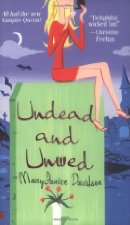 Summary:
Betsy was a 30 year old secretary (previously a model, previously a college drop-out) living in Minneapolis, and she was quite content with her life. Oh, a good date would have been nice, but at least she got to drool over the hot detective assigned to figure out who assaulted her a few weeks ago outside an Italian restaurant. Everything was fine. Until she got hit by a car one slippery night in front of her house and woke up undead in the morgue the next day. Even that would have been fine, but the local vampires keep insisting she get involved in vampire politics. True, a lot of the vampire rules don’t seem to apply to her. For instance, holy water only makes her sneeze, but why should she bother with vampire politics when she could be doing more important things like getting her designer shoes back from her stepmother?
Review:
This is not paranormal romance. I repeat. This is not paranormal romance! It is, however, what I have chosen to dub paranormal chick lit. Undead and Unwed reads like a Sophie Kinsella novel if it was set in the frigid midwest and had a pleasant back-drop of vampires.
Betsy is one of those main characters who you really think you would hate in real life. In fact, I hated her so much in the first bit of the book that I almost stopped reading it. Statuesque blonde who used to be a model who was too good for college and is illogically obsessed with designer shoes? Blergh. The thing is, though, when she gets turned into a vampire we see the happy-go-lucky, humorous, good souled person underneath. What a flip from typical vampire books, eh? But it works. Betsy is a flawed main character. What a nice change of pace! But she isn’t so flawed that we can’t sympathize with her and enjoy her presence.
Choosing to make Betsy a prophesied mighty vampire puts an interesting twist on the typical paranormal trope. She’s not a non-vampire with interesting powers who shakes up the vampire community, and she’s also not some regular newbie vamp learning the ropes. She’s a vampire who the typical rules don’t apply to, but on top of that, she calls it like she sees it. She laughs at the ridiculous names, pomp, and circumstance the vampires in the area have chosen to burden themselves with. She’s a breath of fresh air, if you will. These combine to make a truly amusing read.
Of course, there is sex, and it’s not badly written at all. The vampire elements are played up more here than they are in series like the Sookie Stackhouse series. Additionally, some readers might be turned off by the revelation that when a vampire feeds on a human, they must also have sex with them so the human gets a similar release. I found this to be a call-back to the grittier vampires such as the type Anne Rice wrote, but I get it that some readers might be a bit skeeved out by that.
Overall, Undead and Unwed is a delightful northern piece of paranormal chick lit that will have you laughing or at least smiling in a wittily bemused fashion. I recommend it to lovers of paranormal and chick lit alike, and I plan on reading the rest of the series.
4 out of 5 stars
Source: PaperBackSwap

Book Review: Scott Pilgrim’s Finest Hour by Bryan Lee O’Malley (Graphic Novel) (Series, #6)
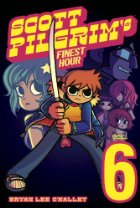 Summary:
Ramona Flowers disappeared,and Scott Pilgrim has spent the last four months of his life wallowing in depression in an apartment his parents paid for playing videogames and avoiding fighting the last evil ex, Gideon. His friends have got on with their lives, and they finally get around to trying to get Scott to face up to his past. Will he fight Gideon? Will he have casual sex with any of his exes? Will Ramona show back up?
Review:
I loved this book so much. It’s one of those endings to a series that makes you like the previous entries in the series even more. I’m going to have a hard time writing this review without devolving into a bunch of random squeeing, so please bare with me.
O’Malley successfully ties up all the ends without being too cute. The answer to what the subspace is makes sense and fits in with the story well. It also doesn’t talk down to the reader’s intelligence at all. Similarly, why Scott likes Ramona so much gets answered. Them dating just makes a lot more sense after reading this book.
The action and the gaming and pop culture shout-outs that fans loved in the first five books are still present here. I’m particularly fond of O’Malley’s choice to use 8-bit type drawing to depict characters’ overly idealistic memories of past relationships. All of the other gaming references are still there as well, such as where characters get their weapons from.
O’Malley’s drawing has noticeably improved this time around. My main complaint in previous books of the female characters being hard to tell apart has been addressed. I had no issue telling them apart this time around. Plus, O’Malley still pays attention to background details that make it worth looking closely at the scenes, such as setting one scene in a bookstore that’s going out of business with signs that say “Please Help Oh God” in the background.
I know some people won’t like how little attention is paid to secondary characters in this volume. That didn’t bother me, because I was so caught up in Scott’s storyline, and it is called Scott Pilgrim after all. It’s not like the secondary characters aren’t there. It’s just that their personal storylines get tied up quickly. It didn’t bother me, but it might bother some.
The only thing that bothered me at all was that there is one section of the book where the pages go blank for a bit. I’ve always felt that’s a trite story-telling mechanism, and I don’t like the message it sends. However, I just flipped past them and continued on my way instead of taking the dramatic pause I assume we are supposed to take.
These are really minor flaws when it comes to a series like this. It could have easily fallen apart or failed to tie up the important questions in the end. Instead, O’Malley addresses what is a common issue for a lot of 20-somethings in a creative manner, fleshed out with gaming and pop culture references and humor that makes it entertaining while simultaneously being touching. I highly recommend the entire series to 20-something lovers of graphic novels or older graphic novel enthusiasts who can still relate to what it is to be in your 20s.
5 out of 5 stars
Source: Amazon

Previous Books in Series:
Volume 1: Scott Pilgrim’s Precious Little Life
Volume 2: Scott Pilgrim vs. the World
Volume 3: Scott Pilgrim and the Infinite Sadness
Volume 4: Scott Pilgrim Gets It Together
Volume 5: Scott Pilgrim vs. the Universe
Review of first 5 books
Book Review: The Forest of Hands and Teeth by Carrie Ryan (Series, #1)
 Summary:
Mary’s world is tightly controlled by the Sisters and the Guardians. The Sisters show the village how to find favor with God via the yearly and daily rituals. The Guardians check and maintain the fence that keeps the Unconsecrated out. The Sisters says the Unconsecrated came with the Return as a punishment to the people. This is why they must maintain God’s favor. But Mary dreams of the tales of the ocean and tall buildings her mother told her about, and her mother’s mother for generations back. She will need those dreams when her world is turned upside down with a breach of the fence. They’ve happened before, but never like this.
Review:
This is an interesting take on the traditional zombie tale. In lieu of starting with the outbreak or just after the outbreak, Ryan envisions what life would be like for the descendants of the few who’ve managed to survive. Of course the sheer number of zombies in the world means it’s impossible for the few survivors left to kill them all, so they must live with constant vigilance. In the case of Mary’s village, they’ve turned to religion to maintain the level of control required to keep them all safe. This is the strongest portion of the book as it leads to interesting questions. The threat outside the fence is indeed real. Mary’s questions are making it difficult for the Sisters to maintain the control needed and prevent panic in the village. On the other hand, the Sisters aren’t exactly being honest with the population or giving them a happy life. They’re just giving them a life.
Where the action supposedly picks up with the breach of the fence is where the book sort of left me behind. The fact of the matter is, I wound up caring more about the village than Mary, and I don’t think I was supposed to. Where I was supposed to be rooting for Mary, I found myself rooting for the community, the group of survivors. Mary’s individualism rings as starkly selfish to me in light of the very real threat around them. This is odd because generally I’m in favor of people being themselves and not necessarily following the group, but that’s different when a crisis is being faced. I found myself wishing it had read more like Elizabeth Gaskell’s classic Cranford, which is a study of a town and not an individual.
Of course, that’s not the type of book Ryan set out to write. She set out to write a book about a girl in a future where zombies are a fact of life. She writes beautifully, with exquisite sentences that read more like an 18th century novel than a 21st century one. I also am certain that the teenage audience this YA book is aimed at will be rooting for Mary in her quest to find herself and her dreams.
If you are a teen or a teen at heart looking for an adventure tale with a touch of romance, you will enjoy this book. If traditional zombies are what you are after, however, you should look elsewhere.
3.5 out of 5 stars
Source: PaperBackSwap

Book Review: I Am Not a Serial Killer by Dan Wells
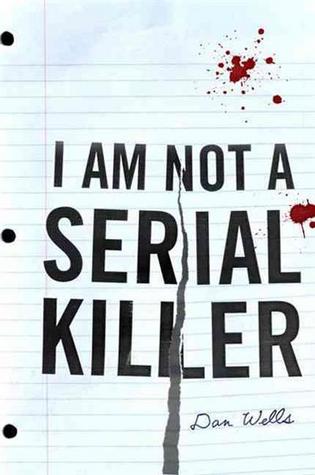 Summary:
Fifteen year old John Wayne Cleaver has an odd fascination with the bodies he helps cremate in the family mortuary. He also has difficulty feeling any emotions. He even has been studying serial killers for years. He is not one, however. At least, not yet. His therapist believes John may have Antisocial Personality Disorder, but both he and John hope John can learn to control his illness, an illness John refers to as Mr. Monster. However, when bodies start appearing on the streets of the town gruesomely murdered, John wonders how long he can keep Mr. Monster in check.
Review:
I originally had high expectations for this book. Then I had to wait for it so long that they waned, and I felt that it was probably just going to be a watered down YA version of Dexter. Then I grabbed it for my camping trip because I am insane and love to terrify myself when sleeping in the middle of nowhere in the woods with strange men with hatchets I don’t know a mere campsite away. It didn’t turn out to be a watered down Dexter. It also isn’t terrifying. The best word I can think to describe this book is relatable.
Dan Wells chose to write a YA book about mental illness and couch it with some supernatural features and a premise that will appeal to any teens, not just those struggling with a mental illness themselves. These were both smart moves as it makes I Am Not a Serial Killer more widely appealing. However, he not only chose to depict a mental illness, he chose to depict one of the ones that is the most difficult for healthy people to sympathize with and relate to–antisocial personality disorder. John Cleaver has no empathy, and this baffles those who naturally feel it.
Yet Wells manages to not only depict what makes John scary to those around him, but also how it feels to be John. He simultaneously depicts the scary parts of having a mental illness with the painful parts for the one struggling with it. John makes up rules for himself to try to control his behavior. He has to think things through every time he interacts with people or he will do or say the wrong thing. John is fully aware that he doesn’t fit in, but he wants to. He wants to be healthy and normal, but he also wants to be himself, which at this point in time includes the behavior that is his illness.
Of course, this is a book about a serial killer, and it delivers there. The death scenes hold just the right level of gruesomeness without going over the top. Anyone with a love of the macabre will also enjoy the mortuary scenes, which depict the right combination of science and John’s morbid fascination. There also is a tentatively forming teen dating relationship that is simultaneously sweet and bit nerve-wracking.
I feel I would be amiss not to mention that there is some self-harm in this book. It is very brief and is clearly shown as a part of John’s illness. In fact for the first time in reading about it in any book I can say the author handled it quite well, depicting the self-injurer and his reasons for doing so sympathetically and correctly, but without making it seem like something the reader should copy.
Overall this book delivers the thrills and chills it promises, but does so without demonizing John Cleaver. It depicts what it feels like to have a mental illness in a powerful, relatable manner while still managing to be a fast-paced YA thriller. I highly recommend it to anyone who enjoys YA, books dealing with mental illness, or thrillers.
5 out of 5 stars
Source: PaperBackSwap

Book Review: A Song for Summer by Eva Ibbotson
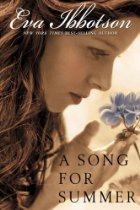 Summary:
Ellen’s staunchly feminist, progressive family found themselves flabbergasted by their daughter’s preference for honing her homemaking skills. However, with time they came around, and they are pleased to see her leave for a house matron position at a boarding school in Austria. Her childhood has prepared her for dealing with the eclectic, progressive teachers, but the little school has more problems to face than unusual teaching styles and the lonesomeness of the children of wealthy world travelers. Trouble is brewing in Europe in the shape of the Nazi movement in Germany. Of course, Ellen may have found an ally in the form of Marek, the school’s groundskeeper.
Review:
I have been fascinated with WWII ever since I was a very little girl. Also, I have no issue with feminists cooking meals for people or keeping house. Feminism is about men and women being able to do what makes them happy, not just what they’re “supposed” to do. I therefore expected these two elements to come together to make for an intriguing read. Unfortunately, I was wrong.
The main problem is Ellen. I simply don’t like her. I can’t root for her. I can’t enjoy any scene she’s in. In fact, I wanted multiple times to shove her into the lake the school is on. Now, I don’t have to like a main character to enjoy a book, but I do need at least one other character in the book to dislike her, so I’m not going around thinking something is wrong with me. However, everyone in the entire book simply loves Ellen. They frequently call her “angelic,” and everyone essentially worships the ground she walks on. Every man of anywhere near a suitable age for her falls madly in love with her. I can give that a pass in paranormal romance, as there’s a lot of supernatural stuff going on, but this is supposed to be a normal girl. Not every man is going to fall in love with her. It’s just preposterous! That doesn’t happen! Ellen is, simply put, a dull, boring woman with no true backbone. If this was a Victorian novel, she’d be fainting every few pages.
Then there’s Marek, her love interest, who I also completely loathed. Everything he does, even if it’s helping others, is for purely selfish reasons. He also has a wicked temper and frequently dangles people out of windows. Why Ellen becomes so obsessed with him is beyond me.
Ibbotson also obviously scorns many ideals that I myself hold dear. Any character who is a vegetarian or against capitalism or in favor of nudity is displayed as silly, childish, or selfish. There is a section in which the children are being taught by a vegetarian director and some of them switch to being vegetarian as well, and of course Ellen finds this simply atrocious and worries about the children. Naturally, the director is later villainized. Clearly anyone who eats “nut cutlets” for dinner simply cannot be normal. I expect an author’s ideals to show up in a book, but the book’s blurb certainly gave no indication that a book taking place largely at a progressive boarding school would spend a large amount of its time mocking those same values.
In spite of all that I can’t say that this is a badly written book. Ibbotson is capable of writing well, I just don’t enjoy her content at all. After finishing it, I realized it reminded me of something. It reads like a Jane Austen novel, and I absolutely loathe those. So, if you enjoy Jane Austen and WWII era Europe settings, you’ll enjoy this book. Everyone else should steer clear.
2.5 out of 5 stars
Source: PaperBackSwap

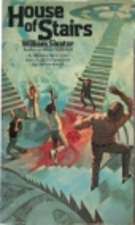
Book Review: House of Stairs by William Sleator
 Summary:
Five sixteen year old orphans living in state institutions are called to their respective offices, blindfolded, and dropped off in a building that consists entirely of stairs and landings. There appears to be no way out. The toilet is precariously perched in the middle of a bridge, and they must drink from it as well. To eat they must bow to the whims of a machine with odd voices and flashing lights. It is starting to change them. Will any of them fight it, or will they all give in?
Review:
This book was enthralling from the first scene, featuring Peter awakening on a landing intensely disoriented and frightened. Showing a bunch of teenagers obviously in an experiment opens itself up to caricature and stereotype, but Sleator skillfully weaves depthves and intricacies to them.
The writing is beautiful, smoothly switching viewpoints in various chapters from character to character. Hints are dropped about the outside world, presumably future America, that indicate the teens are from a land ravaged by war and intense morality rules. For instance, their state institutions were segregated by gender. Sleator weaves these tiny details into the story in subtle ways that still manage to paint a clear framework for the type of cultural situation that would allow such an experiment to take place.
It is abundantly clear throughout the book that the teens are facing an inhumane experiment. Yet what is not clear at first is what a beautiful allegory for the dangerous direction society could take this story is. Not in the sense that a group of teens will be forcibly placed in a house of stairs, but that some more powerful person could mold our surroundings to make us do what they want us to do. To remove our most basic humanity. This is what makes for such a powerful story.
It’s also nice that friendship in lieu of romance is central to the plot. Modern day YA often focuses intensely on romance. Personally, my teen years were much more focused on friendship, and I enjoyed seeing that in this YA book. I also like how much this humanizes the animals facing animal testing, and Sleator even dedicates the book to “the rats and pigeons who have already been there.”
House of Stairs, quite simply, beautifully weaves multiple social commentaries into one. It is a fast-paced, engrossing read, and I highly recommend it to everyone.
5 out of 5 stars
Source: PaperBackSwap

Movie Review: Under the Yum Yum Tree (1963)
 Summary:
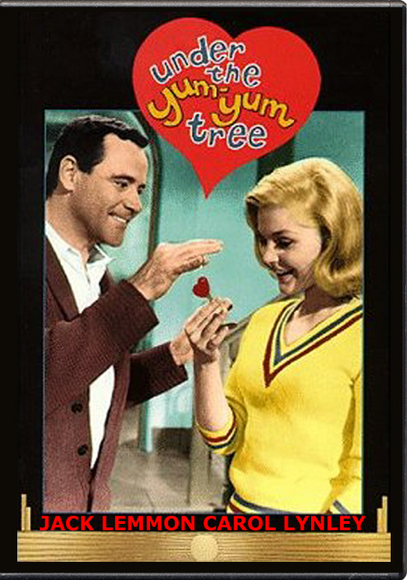
Robin is a sensible college student who firmly believes a successful marriage is about the science, not the emotions. She convinces her boyfriend David, who just wants to get married already, that they should live together without sleeping together first to see if they are emotionally compatible. Her aunt is not only her college professor, but also a recent divorcee, and Robin and David move into her old apartment. Unbeknownst to them, Aunt Irene moved out due to a messy break-up with the lecherous landlord, Hogan, who lives across the hall. Hogan is determined to craftily break up the couple so he can sleep with Robin himself, and David and Robin struggle to determine the right way to have a modern relationship.
Review:
Some in the modern audience would find the entire concept of this movie too laughable to be viewable, but if you’re aware of the situation of the sexes in the late 1950s and early 1960s, it was actually quite a progressive movie for the time period. Divorce is acknowledged via Robin’s aunt, Irene, and she is not demonized as a slimy divorcee. She is a woman who has learned that relationships are not always simple, but also what is important to bring to them. In fact, she gives the climactic speech of the film about relationships. Then there’s the fact that Robin’s and David’s sexual feelings are acknowledge, and David even questions how much it would actually hurt their future together if they were to sleep together before getting married. Robin worries that young people are rushing into marriages due to “glandular urges.” These are quite sensible concerns voiced in a climate in which “proper” people did not engage in premarital sexual relationships, and the characters’ feelings are actually highly relatable.
Of course, the film is not entirely a serious one. It address what was then a modern concern under the guise of slapstick. It also utilizes one of my favorite comedy techniques wherein one room has multiple doors and windows, and the characters come and go either just missing each other or only briefly encountering each other. One particularly delightful scene features a drunk Robin reciting e. e. cummings in an attempt to seduce David. If any of these types of humor are favorites of yours, you will find yourself laughing at this movie.
I should also mention that this film features Jack Lemmon in an early role, as well as Dean Jones, who frequently does push-ups. Talk about your old-time eye candy. It also has an opening sequence, used frequently in 1960s movies, wherein a young lady and man dance around to a song written for the film together. It’s cute and really sets the tone for the movie.
Also, cat lovers should be aware that there is a cat in this movie who plays a rather important role both to the plot and the slapstick humor. I love how older movies insert cats into the storylines in a way in which modern films just don’t anymore. Cats weren’t the props to crazy cat lady jokes. They were part of the story.
If you enjoy old movies, the questioning of society’s sexual mores, or slapstick humor, you will definitely enjoy this film.
4 out of 5 stars
Source: Netflix

Book Review: Slither by Edward Lee
 Summary:
Nora and Loren are polychaetologists–worm scientists. They are asked by their college to accompany a National Geographic photographer to an island off the coast of Florida to help her photograph a rare worm. They are accompanied by a member of the military, as it is an island that is unused military property. Also coming surreptitiously to the island are two criminal brothers and their mutual girlfriend to check on their pot growing operation and a group of four college students looking to party. What they don’t know is that the island is gradually becoming infested with a parasitic worm. Only this worm isn’t microscopic. It’s huge and has multiple, gruesome ways of using its hosts. As the various groups try frantically to avoid the worms and their ova, it seems that someone in toxin-blocking suits is watching them.
Review:
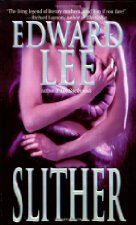
I originally picked this book up and read its blurb because of the cover. I mean, look at that! Such a striking piece of art. Upon reading the description, I decided it sounded a bit like a slightly more phallic Michael Crichton-esque book. In a way, it certainly is. It has the group with scientists attempting to solve a situation that is putting civilians at risk. The similarities kind of end there, however.
This is definitely a horror book, but I wouldn’t call it a scientific horror book. There’s nothing particularly plausible about any of it. I’d absolutely classify it more as the B-type movie gross-out fest. Lee does the gross-out part well. I found myself continually surprised and disgusted by the various things the worms do to human beings. The worms are…well, they’re so gross that it took me a bit longer than usual to read this book because I couldn’t read it right before bed or while I was eating. So he’s definitely good at that!
The book blurb hints at exciting sexual tension, but the sex veers much more strongly toward sexual abuse or gross sex than fun, crazy sex. I didn’t particularly find this bothersome, although a bit sad for the characters. However, I know some readers find that triggering, so you should be aware.
I enjoy watching B films with silly effects and bad dialogue, but it’s a lot more tedious to read awful dialogue than it is to hear it, for some reason. The dialogue really, truly is atrocious. Particularly bad is when Nora talks or thinks. It’s like Lee has never been around a nerdy woman in his life. It’s not much better when he’s writing anyone’s thoughts. They all have the most inane thoughts I’ve ever read. This actually was so tedious to get through that I almost gave up on the book a few times in the beginning. I’m glad I didn’t, because the end is absolutely a surprise. Not so much in the who survives sense, but in the mystery of the worms. It was a satisfying payoff, but I wish he’d either gotten to it sooner.
I feel that overall this is a decent horror book. It’s entirely possible that the beginning just didn’t jive with me, but would with others. I recommend it to fans of gross out horror who don’t mind flimsy dialogue.
3 out of 5 stars
Source: PaperBackSwap

Book Review: The Woman in White by Wilkie Collins
 Summary:
Originally serialized in 1859 to 1860 then published in book form in 1860 this epistolary novel is considered one of the first mystery novels. Walter Hartright is an artist who gets hired to be a drawing master for two half-sisters Laura Fairlie and Marian Halcombe. He and Laura soon fall in love, but they cannot be together due to class differences and Laura’s prior promise to her now deceased father to marry Lord Percival Glyde. A mysterious woman dressed all in white warns Laura against her marriage, calling Lord Glyde evil. However, Laura is reluctant to renege on her final promise to her father and proceeds with her marriage, sending herself, Marian, and Walter into a spiral of intrigue and danger.
Review:
I love slow-moving, epistolary novels, particularly gothic ones read on a long, hot summer day. One of my finest reading memories is of enjoying Dracula while working on a summer internship at a national park on a peninsula with four beaches. So I came to this gothic, mysterious, epistolary novel with high expectations. At first they were met, but as the plot proceeded I came more and more to want to smack Collins upside the head.
Without giving away too much, suffice it to say that the slowly building tension indicates a truly serious infraction on Lord Percival Glyde’s part that turns out to be not particularly shocking at all. At least to my American mind. Suffice it to say, it revolves around title holding, something which I find baffling and laughable. Why should anyone care if Laura is Mrs. Glyde or Lady Glyde? Her life seems more boring than the servants’ anyway. I thought I would be reading a novel that was more about revealing the treachery and debauchery of the upper class. Instead I got a book about bourgeois problems, which, I’ve indicated elsewhere on this blog, I simply cannot relate to and find completely annoying. I get it that some people enjoy that, but the desire to maintain a tense, mysterious illusion around the book led me to believe it’s something it wasn’t. That is frustrating, to say the least.
Beyond the disappointing mystery there’s of course the typical problems found in early 1800s literature. The sexism comes from Marian’s own mouth, which is surprising given that she is a depicted as a strong woman. She often will lament the short-comings of “her sex.” Actually, the entire situation between Walter, Marian, and Laura is baffling. Laura is a weak, foolish girl who Walter falls and stays head over heels in love with. I cannot fathom why that would be when he spends an equal amount of time with Marian, who is a strong, thoughtful, intelligent woman. Laura is described as beautiful, whereas Marian is described as possessing a beautiful body but an unfortunately masculine face. This leads me to believe Walter is rather shallow, as I see no reason beyond Laura’s beauty for his devotion to her. I know sexism is to be expected in older novels, but I would at least hope for a hero who loves the heroine for something beyond her beauty.
That said, the novel certainly gives modern women a new appreciation for our current situation. The women in The Woman in White are constantly downtrodden by the men around them who believe it is entirely within their right to dictate to them everything about how they should behave, speak, dress, etc… It appears that the only thing the women have control over is when to leave the men to their wine after dinner. In fact the couple presented as the happiest and most well-functioning is that of Count Fosco and his wife, and they only function well due to the fact that she obeys his every command. Mrs. Fosco is described as a woman who prior to meeting the Count was loud, obnoxious, and always yammering on about women’s rights. Count Fosco, apparently, “fixed all that,” and she is now such a pleasant woman to deal with. The only woman who does not base her entire existence around a man is Marian, and that is due to her bizarre, near worshipful devotion to Laura. It makes me shudder to think if those had been my options as a woman–existing purely for the whims of a man, downtrodden and outcast, or pure devotion to a sister. Yeesh.
I did enjoy listening to the book. It felt a bit like listening to an old-time radio program, which I’m sure is due to its origin as a serial novel. Those who enjoy the slower pace of older novels and can relate to the bourgeoisie will probably enjoy it. If either of those elements turns you off, however, you should look elsewhere.
2.5 out of 5 stars
Source: Librivox recording via the Audiobooks app for the iTouch and iPhone

Movie Review: The Fly (1986)
 Summary:
Seth Brundle’s future is looking up. He is on the verge of completing a teleportation machine and is dating the journalist who is chronicling his creation of this wonderful new invention. One drunken night brought on by unwarranted feelings of jealousy, he makes himself the first human test subject for teleportation. Unfortunately, a fly teleports along with him, and the machine merges their DNA, beginning Seth Brundle’s gradual, gruesome transformation into Brundlefly.
Review:
A horror movie hasn’t made me cringe and shriek to an extent like The Fly did in a long time. I love a good horror movie, and the filmmakers hit all the right notes to make a viewing a mind-tingling, gross-out pleasure. The urban loft sets are the perfect back-drop to the scientific horror. The 80s clothes and hairstyles enhance the visual appeals instead of distracting from it. The dialogue is ideal, having the characters say just enough to keep the story going but not too much to distract from the visual horror.
Seth Brundle’s gradual transformation is a terrific mix of his body gruesomely changing and him visibly losing his mind. Jeff Goldblum does a fantastic acting job, showing the remnants of Brundle’s human mind and the emerging of his Brundlefly mind. He manages to pull this off through the grotesque make-up, and it is this superb acting that really makes the horrific scenes read as real and not fake, B-movie material.
I have not enjoyed a horror movie this much in ages. If you’re a fan of horror or 1980s films, you absolutely must watch The Fly. I doubt you will be disappointed.
5 out of 5 stars
Source: Netflix

 Support my work with a tip or browse my shop for curated book club guides, how to guides, cross-stitch patterns, and more!


This work by Amanda Nevius is licensed under a Creative Commons Attribution-Noncommercial-No Derivative Works 3.0 United States License.
 Opinions of a Wolf