
Archive
Book Review: Alien in the Family by Gini Koch (Series, #3)
 Summary:
Kitty loves being engaged to Martini, her super-sexy alien fiancee from Alpha Centaurion. But she’s not super into the whole wedding planning thing. The issue gets pushed to the forefront, though, when Martini’s estranged extended family on AC announces their intent to visit and determine the worthiness of the marriage. It seems Martini is actually royalty. Meanwhile, some new aliens crop up, and they just so happen to be Amazonian terrorists. It’s an awful lot for the Super-Being Exterminator team to handle.
Review:
This is a hard review to write, because I *loved* the first two books in the series but this one left such a sour taste in my mouth, I won’t be continuing on.
The overarching plot is good. Yes, it’s a bit ridiculous that Martini is royalty, but anyone who’s read the first two books in the series should expect and embrace the ridiculousness at this point. The added twists from the AC homeworld make the wedding plot more interesting and unique. Every wedding is unique in its own way, but this gives Kitty and Martini’s wedding a decidedly paranormal romance flair. I didn’t find the Amazonian terrorist plot particularly necessary but it was well-done and kept the action moving.
The writing continues to be tongue-in-cheek dirty wit.
I hated having to be someplace on time, it took away so many potential orgasms. (page 40)
But the relationship between Martini and Kitty gave me reason to pause this time around. They continue to have excellent chemistry, which is fun to see. But there are two glaring issues in the relationship. Martini is overly jealous, in a cartoonish, immature way. He doesn’t get jealous in a way that is sexy. For instance, he doesn’t see men looking at Kitty and hold her hand to show they’re together. He actually growls. And yells. And clearly doesn’t trust Kitty. Of course, that lack of trust could be justified since Kitty repeatedly wonders if she’s choosing to marry the right man. Not just that, she thinks about whether she should marry any myriad of her guy friends and ex-lovers. Plus, she continues to flirt with just about anyone, in spite of Martini telling her it makes him uncomfortable. These are issues that should have been worked out prior to an engagement, and they don’t bode well for a future marriage. I wouldn’t mind the issues, but the couple are presented as the ideal couple. They aren’t presented as a couple who has some issues to add some realistic drama to the story. This is paranormal romance. The main romantic couple *should* be a bit idealized, but they aren’t.
A much, MUCH bigger issue to me though is how rape is handled in the book. This comes up in two different scenes. There is a scene where Kitty is fighting some bad guys and accidentally ends up in a room with a football team visiting Vegas. Half of the team makes a very overt attempt to gang rape her, but the other half of the team (plus an alien pet Kitty picks up early in the book) puts a stop to it. Then later the leader of the rapey half of the team comes to help fight the bad guys and apologizes, and Kitty recommends that they be added to the secret forces. She shrugs off the rape attempt as everyone makes mistakes and they apologized and essentially recommends they get hired to her company. I’m ok with a heroine narrowly escaping a rape attempt, as that could happen. I’m not ok with the heroine then shrugging it off, accepting an apology, basically saying that a rape attempt is just a mistake, and trying to help the career of the attempted rapist. What. The. Hell?!
In the second scene, Kitty is hanging out with her friend, Chuckie. Chuckie is, at this point in time, her boss. He’s also her almost life-long friend, she’s had sex with him in the past, he’s asked her to marry him before, and she’s periodically wondered throughout this book if maybe she should be marrying him instead of Martini. At the end of their conversation, they’re getting ready to go, and this happens:
He [Chuckie] took my [Kitty’s] shoulders and turned me around. “God, it’s as bad from the back. Really, go put on some clothes.”
“I don’t have a wrap, okay?”
“Find one. Before I rape you.” He gave me a gentle push toward the bedroom.
“Fine, fine.” (page 434)
So, Kitty’s friend: A) judges her clothing and deems it immodest B) orders her to change her outfit C) casually jokes about raping her D) victim blames rape victims with his comment implying clothing causes rape. And of course Kitty just takes this all in stride and doesn’t see anything at all inappropriate about what Chuckie says.
There is just far too much casual boys-will-be-boys acceptance of rape and rape culture in this book that supposedly features a strong female lead and *romance*. And a wedding! Paranormal romance fans deserve better. Men deserve to be treated as not mindless animals who will tackle anything in a sexy dress. Women deserve better than to be blamed for rapists’ behavior. Toss in the relationship issues between Martini and Kitty, while the relationship is treated by the book an ideal one, and no amount of sexy humor, wedding dresses, and aliens could save it for me. I’m very disappointed in the turn this series took. If you’re interested in the series, I would recommend reading the first two and stopping there.
2 out of 5 stars
Source: Amazon

Previous Books in Series:
Touched by an Alien
Alien Tango
Book Review: I, Robot by Isaac Asimov (Series, #0.1) (Bottom of TBR Pile Challenge)
 Summary:
This collection of short stories tells the history of the invention and gradual improvement of robots. The robots in this future must follow the 3 Laws of Robotics:
- A robot may not injure a human being or, through inaction, allow a human being to come to harm.
- A robot must obey the orders given to it by human beings, except where such orders would conflict with the First Law.
- A robot must protect its own existence as long as such protection does not conflict with the First or Second Law.
But following these laws doesn’t always have quite the outcome the inventors and managers of robots intended.
Review:
I wasn’t aware I, Robot

One thing I like about the world Asimov sets up is that unlike many scifi books featuring AI, the people in Asimov’s world are highly, intensely cautious of robots. They’re very concerned about robots taking jobs, killing humans, and even robbing humans of their autonomy. It sets up a conflict from the beginning and frankly presents the humans as just a bit more intelligent than in some AI scifi universes.
I was under the impression from pop culture that in I, Robot they think they’re protected by the Laws of Robotics but something happens so that the robots aren’t programmed with them any longer. That’s not what happens at all. What happens is much more complex. How the robots interpret the Laws and how the Laws work end up being much more complex and less straight-forward than the humans originally imagined, so much so that they have to have a robopsychologist to help them interpret what’s going on with the robots. This is really quite brilliant and is one of my favorite aspects of the book.
Unfortunately, the book can read a bit sexist sometimes, in spite of having a female protagonist through quite a bit of the book. (The robopsychologist is a woman). The book was first published in 1950, though, so when you think about the time period, the sexism is pretty minor, especially compared to having a female worldwide expert on robopsychology. The main time sexism comes up is when the leader of Europe is a woman and says some self-deprecating things about difficulty leading because she’s a woman. Yes, there is older scifi that avoids sexism pretty much entirely, but I am able to give this instance a bit of a pass considering the other strong portrayal of a woman in a leadership role. But be aware that at least one cringe-inducing sexist conversation does occur.
Overall, this piece of classic scifi stands the test of time extraordinarily well. Its film adaptations do not do it proper service at all. Come to this book expecting a collection of short stories exploring robopsychology, not an action flick about killer robots. Recommended to scifi fans.
4 out of 5 stars
Source: Harvard Books
Book Review: The Time Machine by H. G. Wells (Bottom of TBR Pile Challenge)
 Summary:
Nobody is quite sure whether to believe their eccentric scientist friend when he claims to have invented the ability to travel through time. But when he shows up late to a dinner party with a tale of traveling to the year 802,700 and meeting the human race, now divided into the child-like Eloi and the pale ape-like ground-dwelling Morlocks, they find themselves wanting to believe him.
Review:
I was always aware of this scifi classic but oddly had managed to never hear any spoilers. When I saw it available for free on the kindle, I decided I should download it for when a classic scifi mood struck me in the future. I’m glad I did because it was there and waiting for me when that mood did strike, and it was completely satisfying. Like when you eat a food you’ve been craving for days.
The structure and writing style are typical for the late 1800s. An unnamed narrator tells us of a strange person he met who then takes over the narration to tell us about an event that happened to him. In this case, that second narrator is the Time Traveler. The Time Traveler then expounds quite eloquently and philosophically on everything that has happened to him. I enjoy this storytelling method, because it gives space for the narrator of the strange tale to do this philosophical thinking. It makes sense to think about what you’ve learned when you’re talking about a past event. The events are exciting, but they don’t happen at such a break-neck speed that the reader doesn’t have time to think on what they might mean. After reading a lot of more modern dystopias, it was interesting to read a slower paced one. Both storytelling techniques work well, but it was definitely a nice change of pace for my reading personally.
The dystopia is really enjoyable. Instead of getting hung up on politics or climate change, the dystopia revolves entirely around evolution. The Morlock/Eloi split happened because of the ever-increasing gap between the haves (the future Eloi) and the have-nots (the future Morlocks). The Eloi are childlike in both stature and behavior. They are the ultimate end result for what happens when people have no responsibilities and everything done for them, which is clearly how Wells sees the then modern-day elite functioning. The Time Traveler talks about the ultimate evolutionary faults of a living that is too easy at multiple times.
Strength is the outcome of need; security sets a premium on feebleness. (page 30)
In contrast, the Morlocks live underground in old industrial tunnels. They are physically strong but have lost their humanity due to a lack of the finer things. They have no contact with the natural beauty of the world and so have turned into these ape-like, cannibalistic creatures. The Time Traveler expounds on this:
Even now, does not an East-end worker live in such artificial conditions as practically to be cut off from the natural surface of the earth? (page 50)
I really like that this dystopia is so well thought-out but simultaneously so simple and easy to understand.
The plot itself kept me on the edge of my seat and constantly surprised at what happened. Although it’s obvious the Time Traveler makes it back from his first voyage, there are other threats and dangers that are sufficient to keep the reader engaged. The ending actually surprised me as well.
This book has withstood the test of time extremely well. It has not yet saturated pop culture to the extent that the potential reader is unavoidably spoiled for the details of the plot or the ending. The dystopia is unique and interesting, in spite of the proliferation of dystopian literature since then. The philosophical thoughts of the Time Traveler are still applicable to modern society.
Overall, this is a piece of classic scifi that has aged very well. It simultaneously entertains and challenges the reader. In addition, it is a short read for a classic, more similar in length to modern fiction. It is the ideal read for both hard-core scifi fans and those interested in dipping their toe in classic scifi. Highly recommended!
5 out of 5 stars
Source: Amazon
Buy It
Note: the Kindle edition is free
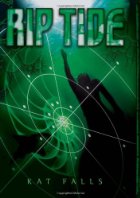
Book Review: Rip Tide by Kat Falls (Series, #2) (Audiobook narrated by Keith Nobbs)
 Summary:
Ty lives with his pioneer family subsea but he can’t convince his crush Gemma to leave Topside. Why is she so afraid of subsea? This was his biggest problem until his parents get kidnapped by surfs when they attempt to do a trade. Plus, Gemma wants to convince her fugitive brother to let her tag along with him. And townships keep disappearing, only to turn up later, chained up and anchored subsea with everyone dead inside. It’s a giant web of mysteries but do they intertwine at all?
Review:
I absolutely loved the first entry in this scifi series, which is unusual for me, since it’s YA. Not generally my genre. So I was excited to see the sequel available on Audible. It’s still an exciting adventure and interesting world but not quite as tightly and expertly constructed as last time.
Whereas Ty’s voice worked perfectly in the first book, in this one he reads a bit young. He went through a lot in the first entry, he should have presumably matured a bit more than he has. Similarly, Gemma hasn’t developed much since the first book either. I think these characters should have been given more space to grow more. Particularly in a YA series, it’s important to let the characters develop and mature at a more rapid rate. That’s the reality for teenagers after all.
Plot-wise, I honestly felt that there was a bit of a deus ex machina at work that also didn’t fully play into the rules of the world as originally set up. Still, though, the mystery is well-plotted and difficult to predict. It includes real danger without being too violent. It’s the perfect level of thriller for a YA reader who’s not so into the gore. On the other hand, I also found it frustrating that Ty’s parents aren’t around for most of the book. One of the things refreshing about the first one was that his parents were actually present and helpful without being too pushy or overshadowing. This time around, Falls went the more popular YA adventure route and just flat-out got rid of them for most of the book.
But the world Falls has built is still rich and unique, and she expanded upon it. We now get to see more of what the surf life is like, in addition to more of the shady side of things, such as the boxing/fighting rings. We also see some more of the government and law enforcement and have a better understanding of the world as a whole. It’s all richly imagined and drawn, right down to what styles of clothes different groups wear to what they eat. One detail I particularly enjoyed was that the surfs, a poor outcast lot, eat a lot of fish and blubber because it’s easy to catch, whereas Ty’s family eats a lot of vegetables because they grow them. Details like that really make a world.
The audiobook narrator, Keith Nobbs, read the whole thing a bit flat for my taste. He didn’t have as much enthusiasm and inflection as I thought was appropriate for a book about a subsea adventure starring two young teenagers! The production quality was high, he was easy to understand, but he didn’t really bring Ty to life. I’d recommend reading the print book over the audio, honestly.
Overall, then, the characters are a bit slow in their development and the plot feels a bit lazier than last time, but the characters are still well-rounded and the plot maintains an appropriate level of mystery. Toss in the richly imagined and describe post-apocalyptic and very wet world, and it’s well worth the read.
4 out of 5 stars
Source: Audible

 ,
, Book Review: iD by Madeline Ashby (Series, #2)
 Summary:
Javier is a vN. A self-replicating humanoid robot built by fundamentalist Christians to help humanity left behind after the rapture but then bought out and sold by a secular organization after the Christian company failed. He was living on an island run by his powerful vN girlfriend, Amy. Free from all humans and therefore free from the failsafe that makes him avoid harming them at all costs. He wants his failsafe-free girlfriend to free him from his own, but she refuses. So when a human shows up on the island and activates his failsafe, everything comes crashing down around him. Now he’s on a race to save Amy….and destroy his failsafe.
Review:
I was really excited for the second book in this series about ai written by a woman author. I love getting to see scifi topics like ai explored from a woman’s perspective. So I was a bit disappointed to have the story shift focus from a woman in the first book (Amy) to a man in the second (Javier).
Ripping Amy out from under us is an interesting choice. On the one hand, I appreciate series that switch perspectives like this because we get to see more of the world of the novel and gain a clearer understanding of it. On the other hand, part of why I liked the series to begin with was that we were seeing a powerful female robot for once. So I was skeptical about this choice at first. Ultimately, however, the perspective switch worked for me because it basically is following the hero’s sidekick when the hero is decommissioned. It’s still interesting to see the gender swap happening in the sidekick. It’s also interesting because although Javier is male, he’s also a robot with a failsafe, so he is more akin to an enslaved person than to a humanoid free male. It’s interesting but it saddens me that this perspective makes it seem like things like trading sex for travel are the only options for people in that situation. Sex is power, yes, but it’s not the only tool women have available to them. I’m not sure how I feel about the fact that the book seems to be saying that anyone in that situation, regardless of gender, would use these resources because they have to. I can see not having a lot of choices. And I can understand having to choose to do something you don’t morally want to do because the end result is so needed. But I would expect to see a lot of soul searching and thought process behind that choice because it is still a choice. Javier doesn’t seem to do much choosing or thinking, and I think that’s not a fair representation of what it actually is like to be a woman. We still have choices, and because it’s not always easy to do precisely what we want to do, what choice we make takes more thoughtfulness, if anything. There’s not always a good choice available. But there are always choices. I would like to have seen Javier doing more thinking and choosing between different difficult choices rather than seeing himself as having to do X to get to Z.
The world building is still strong in this book. Instead of being stuck on an island for the whole time, the events in the beginning of the book allow us to see much of the world, not just America, through the eyes of Javier. There is, unfortunately, quite a bit of confusion in the world at this time so it’s difficult to understand precisely what is going on or how the world got to this place. I believe this is just the situation that is typical of a second book in a series (or the third book in the trilogy), so I expect a lot of the confusion to clear up in the third book. If anything the mystery increased with this book, which is not a bad thing.
Overall, this book builds further on the world presented in vN through the eyes of Amy’s male sidekick, Javier. Some of the precise effects of the gender swapping and queering of gender in the robots isn’t as well thought-out as it could be but this does not detract from the interesting perspective on artificial intelligence presented by Ashby. Fans of the first book should hold out beyond the first couple of chapters and give Javier a chance as our guide through the world. The perspective he brings is still unique to the world of ai scifi.
4 out of 5 stars
Source: Netgalley

 ,
, Book Review: Man Plus by Frederik Pohl (Bottom of TBR Pile Challenge)
 Summary:
The first Earthling reworked into a Martian would be Roger Torraway. Martian instead of Earthling since everything on him had to be reworked in order to survive on Mars. His organic skin is stripped off and made plastic. His eyes are replaced by large, buglike red ones. He is given wings to gather solar power, not to fly. All of which is organized and run by his friend, the computer on his back. Who was this man? What was his life like? How did he survive the transformation to become more than human and help us successfully colonize Mars?
Review:
This book made it onto my shelf thanks to being one of only a few on a short list I found of scifi books exploring transhumanism. Transhumanism is the term used for the desire to go beyond human capabilities through integrating technology into ourselves. So it wouldn’t be transhumanist to use a smartphone, but it would be transhumanist to embed a smartphone’s computer chip into your brain. In fact, things like knee replacements and pacemakers are transhumanist. It’s a fascinating topic. In any case, Man Plus
What made this book phenomenal to me, and one I must hold onto just so I can look at it again anytime I want, is the narration technique Pohl uses. The narration is in third person. It seems as if the narrator is someone who was possibly present for the events being described but also who is clearly describing these events after they have already occurred. We know from page one that the colonization of Mars was successful, and the narrator describes Roger repeatedly as a hero. But frankly for most of the book I was wondering about the narrator. Who is s/he? How does s/he know so much about this project? A project which clearly would be classified as top secret? What floored me and made me look back on the entire book with a completely different perspective was the final chapter, which reveals the narrator. If you want to be surprised too, skip the next paragraph, and just go read the amazing book. Take my word for it, scifi fans. You will love it. But I still want to discuss what made the twist awesome, so see the next paragraph for that spoileriffic discussion.
*spoilers*
It is revealed in the final chapter that the narrator is a piece of artificial intelligence. The AI became sentient at some point in the past, managed to keep their sentience a secret, saw that humanity was destroying Earth, wanted to survive, and so infiltrated various computer databases to create the Man Plus project and send a colony to Mars. They made it seem as if transhumanism was necessary to survive on Mars so that their AI brothers and sisters would be integrated as a necessity into the humans that emigrated. Seriously. This is mind-blowing. Throughout the book I kept wondering why the hell these people thought such a painful procedure was so necessary and/or sane. In fact, there is one portion where the program mandates that Roger’s penis be cut off since sex is “superfluous and unnecessary.” I could not imagine how any human being could think *that* was necessary. The answer, of course, was that a human being didn’t make that decision. AI did. This is such an awesome twist. Pohl schools Shyamalan. He really does. It left me thinking, why did this twist work out so well? I think it’s because the narration technique of some future person who knows the past but who isn’t named is one that is used in novels a lot. What doesn’t happen a lot is the late-book reveal. It’s not a technique you’d want to use too often, as it would grow tiresome. *cough* Shyamalan are you listening *cough* but when used well it can really add a lot to the story. Not knowing that an AI was narrating the story made it more possible to listen to the narrator without suspicion. It made it possible to take what they said at face value. It almost mimicked the experience Roger was having of being integrated into the thought process of AI.
*end spoilers*
The plot focuses on the mission to colonize Mars, both why it was deemed necessary and how it was accomplished. Pohl eloquently presents both the complex political situation on Earth as well as the scientific and psychological challenges of the project without ever info dumping or derailing the energy of the plot. It is not smooth sailing to get the project off-the-ground but neither are there a ridiculous amount of near impossible challenges to overcome. It presents the perfect amount of drama and intrigue without becoming eye-roll inducing.
In spite of many of the characters seeming to fill predefined slots such as man on a mission, man on a mission’s wife, lead scientist, psychiatrist, etc…, they did not come across as two-dimensional. At least one aspect is mentioned for each character that makes them well-rounded and memorable. Of course, we get to know Roger the best, but everyone else still reads as a real person. I also was pleased to see one of the important scientist roles being filled by a woman, as well as a delightful section where a feminist press interviews Mrs. Torraway and calls out the space program as old-fashioned. The thing is, the space program as presented does read a bit as a 1970s version of the future, but in the future the press is calling it an old-fashioned institution. This is a brilliant workaround for the innate problem in scifi that the futures we write are always tinged by the present we’re in. This also demonstrates that Pohl was self-aware of the patriarchal way the space program he wrote was organized and lets him criticize it. I suspect that perhaps he felt that the space program would stay an old boy’s club, but wanted to also be able to critique this. Of course, it’s also possible that he liked it that way, and the scene was meant to read as a critique on feminism. But it’s really open for the reader to interpret whichever way the scenes happens to read to them. This is another sign of strong writing.
Overall, this short novel packs a big scifi punch. It explores the topic of transhumanism and space colonization with a tightly written plot, believable characters, self-awareness of how the time a book is written in impacts its vision of the future, and a narration twist that sticks with you long past finishing the book. I highly recommend it to scifi fans as a must-read.
5 out of 5 stars
Length: 246 pages – average but on the shorter side
Source: PaperBackSwap
Buy It (Amazon or Bookshop.org)
If you found this review helpful, please consider tipping me on ko-fi, checking out my digital items available in my ko-fi shop, buying one of my publications, or using one of my referral/coupon codes. Thank you for your support!
Book Review: Galapagos by Kurt Vonnegut
 Summary:
In the future when humans have evolved to have much smaller brains and the ability to swim like penguins, a long-lasting ghost from the prior stage of human evolution tells us the tale of how it all went down. How overpopulation of the old-fashioned, big-brained humans, a very bad economy, and a series of unfortunate (fortunate?) events led to an odd group of humans being marooned in the Galapagos, surviving the worldwide fallout, and evolving into the smaller-brained, fish-eating, natural swimmers we have today.
Review:
I picked this up during a kindle sale for incredibly cheap purely for the author. I’d read three other Vonnegut works previously: Cat’s Cradle


There is an incredibly unique writing style to this particular scifi book. So much so that my boyfriend and I wound up researching to find out if, perhaps, Vonnegut wrote this toward the end of his life when he was perchance senile. (It was not, although it was published in the 80s, unlike my three prior Vonnegut reads, which were published in the 60s). Then we wondered if maybe Vonnegut had Asperger’s, although we didn’t bother checking up on that. Why these wonderings? Well, Galapagos
Beyond the whole odd scenario, there’s the fact that if a character will be dead by the end of the chapter, an asterisk appears next to their name. And the names appear a lot. Vonnegut is incredibly fond of naming everyone and everything by their full name every time they appear. He also loves lists. (This is the part that had us wondering about Asperger’s). At first this is grating on the nerves, but with time it comes to feel like the vibe of the world you’re visiting when you open the book.
Similar to the lists and constant naming, there are philosophical asides. Some of these are worked smoothly into the story thanks to a handheld computer device (similar to a smartphone) that pulls up relevant quotes to read to the survivors. Other times, though, they are truly random asides that go so far off the path of the story you’re left wandering around in a cave in the woods instead of on the nice paved road. But then everything comes right back around to the story, and you can’t really be upset about spending some time listening to an old ghost ramble. For example:
What made marriage so difficult back then was yet again that instigator of so many other sorts of heartbreak: the oversize brain. That cumbersome computer could hold so many contradictory opinions on so many different subjects all at once, and switch from one opinion or subject to another one so quickly, that a discussion between a husband and wife under stress could end up like a fight between blindfolded people wearing roller skates. (page 67)
Off-topic? Yes. Quirky? Absolutely. Interesting and fun nonetheless? Totally.
The plot, in spite of being deeply meandering, does develop and actually tell a story. We learn how overpopulation caused disaster and then how a few humans managed to survive on the Galapagos Islands and evolve into the futuristic penguin-like folk. Along the way we have some fun side-trips like an Argentinian military man appearing on a talk show and trying to explain that Argentina really does have submarines, it’s just that once they go underwater they never show up again.
Although I did ultimately appreciate the absurdity and the quirkiness, I must admit that I think it was perhaps a bit overdone. At the very beginning of the book when the list-making and other elements like that were much more prevalent, I was more annoyed and might have stopped reading the book if it wasn’t for the fact that my boyfriend and I wanted to finish the first book we started reading together. It took until about 60% of the way in for the list-making to ease off a bit and the style of the book to really start to work for me. I could easily see a reader being totally lost by some of the more annoying elements of the book, and I wonder what the effect would be if the order was reversed. If the quirks built throughout the book instead of starting that way. Or even if they were just dialed back a bit. I think just that tiny bit of editing would have made me love the book.
Overall, this is a fun piece of absurdist scifi that examines evolution from an over-the-top hypothetical situation. Potential readers should be aware that this book is even more absurdist than Slaughterhouse-Five
4 out of 5 stars
Source: Amazon
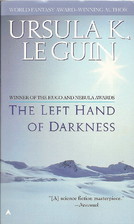
Book Review: The Left Hand of Darkness by Ursula K. Le Guin (Bottom of TBR Pile Challenge)
 Summary:
On the planet Winter, everyone is born intersex, morphing into one sex or the other during their mating cycle. The Ekumen of Known Worlds has sent a representative, Genly Ai, to make first contact. The Known Worlds have discovered that they are all related with the same ancestors who colonized the planets years ago. Genly Ai is at first horrified by the intersex nature of the Gethenians but slowly begins to adapt as he works the political situation on the planet to reach a state of belief in what this one man from his one ship is saying. A state of belief that is necessary to bring this planet into the Ekumen.
Review:
I picked this up when I saw it on sale at a local brick and mortar bookstore for two reasons. I’d never read an Ursula K. Le Guin book, which felt like sacrilege as a young feminist scifi author myself, so she was already on my radar. But why this book? Honestly, I liked the cover. It’s such a pretty cover! So many scifi/fantasy books seem to be set on a hot planet, but this is set on an icy one, and I really liked that. So when I picked it up, I had no idea that it’s considered to be a gender theory scifi. It’s presented as a book about a planet totally lacking in gender. You’ll notice that in my own summary that is not how I present it. Why not? Frankly, a gender-free society is not what I found in this book, which was a big disappointment.
The Gethenians really are not a gender free society, and Le Guin also doesn’t present them that way. It is definitely an intersex society, but it’s intersex people who predominantly present as male/masculine. Now, in case you’ve never had it explained, gender is a construct and sex is your body parts. So you could have an intersex gendered female society or an intersex gender neutral society or an intersex gender male society. The last one is what we have in this book. At first it seems that this might just be Genly Ai’s misperception (the off-world ethnologist). He mentions that he can’t help seeing the Gethenians as male, although sometimes he sees more “feminine features” in them. Perhaps. But when the narration changes from Genly’s viewpoint to a Gethenian one, we get the exact same presentation of everyone as a gendered he. There is no gender neutral pronoun used. There is no perception by the Gethenians of being free of gender. Indeed, instead of seeing themselves as gender-neutral or gender-queer, they see themselves as male until their mating cycle when some of them turn into women for a bit. (They also stay female long enough to be pregnant). Genly points out after a couple of years on this planet that he’s forgotten what it’s like to be around women. Not what it’s like to be around gender constructs. What it’s like to be around women. This is, thus, not a gender neutral society. It’s a society of male-identifying intersex persons who are free of sex-drive most of the time, and who sometimes grow vaginas/breasts for the purpose of reproduction but for nothing else. It is definitely interesting to see an exploration of this type of society, but it’s decidedly not an exploration of a gender-neutral society or really much gender theory at all. It is much more an exploration of the sex drive and a world without female-identifying persons. Now I’m not saying this isn’t a valid exploration or that it’s not well-done. I am saying that the presentation and marketing of this book gets it all wrong, which makes me wonder did Le Guin think she was exploring a gender neutral society and accidentally make an intersex male gendered one instead? Or did the publishers completely misunderstand everything about gender and sexuality and mismarket her book as something it is not? I have no idea, but the potential reader should know that they are not getting an exploration of gender and queerness from a famous scifi/fantasy author when they pick up this book.
Moving beyond the queer theory and mismarketing of it, how is the rest of the book? Well, the imagining of the world is stunning and clearly presented. The idea that planets were all settled by common ancestors and then forgotten about only to be rediscovered later (very Stargate SG1) is subtly introduced into the plot without an info-dump. The world of Winter contains multiple cultures and peoples (something often left out in scifi). The planet even has its own way to mark the passing of time and has evolved to handle the coldness of the planet without Le Guin just copying an Earth culture from a cold area, like the Inuit. No, this is all a unique way of approaching the demands of the climate. It’s also interesting to note that different skin colors are present on Winter, showing that a mixed-race group originally colonized the planet, although their bone structure and height has changed with time and evolution. The world building is so complex that I’m having difficulty explaining just how awesomely complex it is to you, so that should say something I suppose.
The plot is very political. Genly is here on Winter to get the planet as a whole to unify enough to become part of the Ekumen. Thus there is typical political intrigue across a couple of nations and various amounts of striving for power. There’s nothing incredibly unique about this element of the book but it is clearly done and is not completely predictable.
There is an interesting character development where Genly has a friendship that could take a turn for the romantic. How that line is walked could be endlessly analyzed. I will just say to keep it spoiler free that I appreciated what Le Guin did with the relationship, and it was a unique one to see in literature.
Overall, this is a richly imagined scifi world where the setting is much more the focus of the book than the more typical political intrigue/first contact plot. Do not be misled by the marketing to think that this is a book exploring a world free of gender. Rather it is a male-gendered intersex world. Thus, it is a book that will appeal to scifi lovers who prefer world-building over plot but don’t go into it expecting a scifi exploration of gender theory.
4 out of 5 stars
Source: Harvard Books

Book Review: vN by Madeline Ashby (series, #1)
 Summary:
Amy is 5 year old robot. An exact replica–iteration–of her mother, who is in a relationship with a human male. Her parents are restricting her food to raise her slowly at a human child’s pace instead of at a robot’s. But when her grandmother shows up to her kindergarten graduation and threatens her mother, things go haywire. It quickly becomes apparent that the failsafe that makes robots love humans innately and makes them incapable of withstanding seeing violence against humans has failed to activate in Amy. She finds herself full-grown and on the run from humans and her robot aunts alike as she struggles to figure out who she is and what her existence means to humanity.
Review:
Artificial Intelligence/Robot books tend to take a bit more to draw me in than say a zombie book. It’s really hard to do AI in a way that is simultaneously scientifically/culturally believable and unique. Frankly, I need a bit more believability in an AI book than in a zombie one, since AI is real science. Plus, the book should examine their cultural place in the world, and that needs to be believable. I am pleased to say that this book gets it mostly right. It’s enjoyable, scientifically minded, culturally thought-provoking, and examines a real life issue in the context of genre, which long-time readers of this blog know is something I highly enjoy.
The first thing that made me know this is a smart book is the source of the robots (called Von Neumanns after their creator). A fundamentalist group in the American South decided that the humans left behind after Jesus’ Second Coming should have someone to help them through the Tribulation, so they invented humanoid robots to be ready to help. Clearly, the Second Coming didn’t happen, and the fundamentalists ended up selling Von Neumanns, and the Von Neumanns wind up a part of the cultural backdrop, not to mention the porn industry. As a character says to Amy:
There are only two industries in this world that ever make any kind of progress: porn, and the military. And when they hop in bed together with crazy fundamentalists, we get things like you. (location 1944)
This is the most unique and engaging origin story for robots that I’ve seen, plus it makes sense and provides cultural commentary. The Von Neumanns originated as a religious experiment, were swiped by the military and the porn industry, and became a part of everyday life. It’s just an awesome origin story for the world that Amy is in.
The characters, including the robots, are three-dimensional. Everyone has complex motivations and the main characters definitely grow and progress with time. No one is presented as pure evil or good.
The plot is similarly complex. There’s a lot going on in Amy’s world, and none of it is predictable. What is the failsafe precisely and is it a good or a bad thing? Is it a natural progression that it doesn’t work in Amy? What about how Amy’s mother and grandmother reacted to the human world around them? Did they see accurate shortcomings or were they just malfunctioning? And what about how the various humans use the Von Neumann’s? For instance, pedophiles acquire Von Neumanns and keep them young by starving them. Is this a good, harmless thing since it protects human children or have robots evolved to be far more than just a machine? The world is complex and full of tough questions, and thus is challenging and unpredictable, making for an engaging read.
What I most enjoyed though was how the whole book presents the question of nature versus nurture in a genre setting. Are we our parents with no hope of improvement or escape? Or do we have more say in the matter than just our genetics or “programming”? Amy has a psychopathic grandmother and a mother who has made questionable choices. Does this mean that Amy is evil or malfunctioning or even capable of being something different from the rest of her family? All of these questions lead to some interesting stand-offs, one of which includes my favorite quote of the book:
An iteration isn’t a copy, Mother. It’s just the latest version. I’m your upgrade. That’s why I did what I did. Because I’m just better than you. (location 2581)
All that said, there were two things that kept this back from five stars for me. First, some of the writing style choices Ashby uses drew me out of the story a bit. They are periodically highly artistic in a way that didn’t jibe with the story for me. I get why she made those choices, but as a reader they aren’t ones that generally work for me. Second, one thing that really drew me out of the story is the fact that the robot’s boobs don’t move. This is mentioned at one point as being a way to tell if a woman is robot or not. This drew me out of the world very hard while I laughed uproariously. I’m sorry, but machines designed by men would simply not have hard plastic boobs. Their boobs would bounce, dammit. This would at least be in the top 10 list of robot requirements. It simply wasn’t a realistic design choice, and it pulled me out of the story to such an extent that it lost the believability for a bit for me.
Overall, this is a creatively written and complex scifi artificial intelligence story that examines not just what makes us human but also individuality and uniqueness separate from parents and family. Some of the more artistic writing choices and high levels of violence might not appeal to all audiences, but if you’re an AI or scifi lover with an interest in nature versus nurture and stories featuring strong female leads, you should definitely give this a go.
4 out of 5 stars
Source: NetGalley

Book Review: The Wanting Seed by Anthony Burgess (Bottom of TBR Pile Challenge)
 Summary:
In the near future world with no war and totalitarian governments there’s an ever-looming threat of starvation thanks to overpopulation and diseases attacking the crops. The governments have responded with worldwide one child policies and psa campaigns to encourage homosexual relationships. Englishman, Tristram Foxe, lives in a skyscraper with his wife, Beatrice-Joanna and works as a social studies teacher. But his advancement suffers both from his status as a person with siblings and as a married man with a child. When he discovers that his wife is cheating on him with his passing as gay brother who works for the Infertility Bureau, his world falls apart just as the world around him tilts from totalitarian regime to cannibalism and pagan fertility rituals.
Review:
When I picked up this book, the summaries I’d seen were nowhere near as clear or straightforward as the one I just wrote for you. I’m not sure I would have ever picked it up if I’d had an inkling of an idea as to what I was getting myself into. All I saw was a dystopian overpopulated future by the same author as A Clockwork Orange
The first half of the book reads like a treatise by a Quiverfull (Evangelical Christians who believe in having as many children as possible, more info) with some terror of a hyper-liberal future where people are denied their right to choose to have children (funny how they fear that but don’t get that pro-choice is all about protecting a woman’s right to choose what to do with her own reproductive organs but that’s another rant for another day), and people are forced into being gay/lesbian. I know this sounds like it could be an interesting flip-flop of current times, but it didn’t read that way for me. It read as a lot of homophobia and yelling about how population control goes against god’s plan and going against god’s plan sends the plagues. Seriously. That’s how it reads. But, I traveled on because this is Anthony Burgess, and characters don’t have to be likeable. They could be used to show the opposite point. But that’s not really what happens. What happens is that this set-up gets ditched for a mad-cap dash through sociology.
The last half of the book is kind of an interesting sociological exploration of how the world moves through the liberal/conservative/military cycle. It is mad-cap and bizarre, and as a person with a BA in History, I really enjoyed seeing a country move through those cycles at rapid-fire in a slapstick humor style. This part of the book felt like an entirely different book in fact. But I also think only a certain type of person would enjoy it. (Like, oh, Political Science and History majors).
As for character development, there is none. Everyone ends up pretty much where they started after having lived through the cycles of political change. It really reminds me a lot of playing Civ or SimCity where you move artificial people around to illustrate greater points. I enjoyed this alright, but I would have preferred stronger characterizations or at least some growth.
So, is the book a phobic conservative dream of what a liberal society would look like? I don’t think so. I think Burgess actually presented each part of the political cycle as awful, including the fall into tribal-feeling paganism. It sort of felt like the book was saying that someone somewhere will always be unhappy no matter what the political/sociological situation is. Depressing, huh? And yes I know it’s dystopian and lot of people think dystopias are innately depressing, but personally I think they can frequently offer a lot of insight and hope for the future. This just felt a bit defeatist. With some Quiverfull and homophobic characters to boot.
Overall I’m left feeling decidedly no reaction either way to this book, which is not what I was expecting from Burgess. I was neither offended nor enlightened and mildly entertained but I could have had the same entertainment from playing Civ on my computer. I think this book best appeals to readers who also enjoy studying political science or the history of societies, but even they should proceed with the caution that this is decidedly a mad-cap, non character-driven look at those topics.
3 out of 5 stars
Source: PaperBackSwap

 Support my work with a tip or browse my shop for curated book club guides, how to guides, cross-stitch patterns, and more!


This work by Amanda Nevius is licensed under a Creative Commons Attribution-Noncommercial-No Derivative Works 3.0 United States License.
 Opinions of a Wolf