
Archive
Book Review: Blonde Bombshell by Tom Holt (Bottom of TBR Pile Challenge)
 Summary:
A sentient bomb is hurtling through outer space toward Earth, better known to the bomb creators as Dirt. You see, Dirt’s music is making the inhabitants of Ostar (a canine species) completely loony. But the bomb stops in its tracks and orbits around Dirt to try to figure out whatever happened to the *first* bomb that the Ostars sent out. Dirt doesn’t seem to have any sophisticated defense system to speak of, so what gives? Meanwhile, Lucy Pavlov, the creator of new computer programming protocols that led to a leap in technology, is seeing unicorns in her forest. Also a bank security executive is trying to figure out just how, exactly, money is teleporting out of banks. In between getting very drunk and trying to forget about that one time aliens stole his dog.
Review:
This made it onto my TBR pile thanks to multiple comparisons to Douglas Adams’ Hitchhiker’s Guide to the Galaxy
The plot is complex without being confusing. It revolves around three people (well, one is a bomb) who are connected in mysterious ways they just don’t know yet. It kept me guessing, managed to surprise me a few times, and had some delightfully creative elements, such as the fact that the bomb can create probes to send down to Earth that appear to humans like organic matter. Or even the fact that the bomb can sit there and slowly decide whether or not to go off. Clever.
I also appreciated an imagined future where people have handheld devices that are given a simple name rather than compounding a bunch of words together. The former makes more sense since in reality that is what companies do. (For instance, Google Glass or iPad as opposed to handheldpersonaldevice. Don’t laugh. I’ve seen something very similar to that in scifi). In this book the iPhone device is the Warthog. With no further explanation given. This is scifi done well. The reader can tell what a Warthog is from how the characters use it. Holt never over-explains.
The characters were rather two-dimensional, but that works well for the humor, not to mention for the fact that one of them is a bomb. If a character has a good heart but is a lazy drunk because aliens stole his dog, well that’s enough for the reader to know in a book like this. Motivation enough is present for the characters to be recognizable as people and to move the plot forward.
As for the humor, I found it quite witty, although not quite as gut-wrenching as Hitchhiker’s Guide to the Galaxy
Now, I was a bit let-down by the ending. I didn’t really like the final plot twist. It kind of….creeped me out a bit and left me on a bit of a down note instead of the delightful upswing I felt throughout the rest of the book. I think other people might enjoy it more than me. It really depends on your feelings about people and pets and having pets. It’s not enough of a let-down to keep me from recommending or enjoying the book. It was just enough to keep it from 5 stars.
Overall, this is a delightfully witty piece of scifi with a unique plot. Recommended to scifi humor fans, particularly those who enjoy Douglas Adams.
4 out of 5 stars
Source: PaperBackSwap

Book Review: The Caline Conspiracy by M. H. Mead
 Summary:
In near future Michigan, a geneticist is murdered by his pet caline–a new pet created by gene splicing to have all the best characteristics of dogs and cats combined and guaranteed to be docile. His widow doesn’t believe that their beloved pet could possibly have done the killing so she hires private investigator Aidra Scott to prove her innocence. But as Aidra digs deeper into the mystery she finds far more intrigue than the possibility of a framed pet. This intrigue could rock a nation already debating geneticism.
Review:
I was intrigued primarily by the idea of calines. As an animal lover I couldn’t help but be fascinated by the idea of a caline. While the calines are pulled off well, they are not the focus of the book. This is definitely a near future scifi mystery, and it’s well-done.
The plot is a typical murder mystery with a twist. The pet is possibly framed, and the pet was created in a lab by geneticists. While I had my suspicions about whodunit early on, I must admit I wasn’t entirely right, plus there was an added twist at the end that I didn’t see coming. The plot will definitely keep you reading, even if you’ve read a lot of mysteries.
That said, there was at least one dead-end in the plot that I found frustrating. Aidra goes to visit the fringe group that protests genetic manipulation and gets tossed out on her ass, but we never really find out why the group was so hostile or much else about that angle into the whole thing really. Between that and the twist at the end, I was left wondering if a follow-up novel is intended, although all signs indicate the authors don’t intend to write one. If they don’t, I must say I found that the plot left me hanging a bit.
The main character is a single mother of a young teenage boy. This is different from what we see in a lot of mystery, and I enjoyed the new perspective. The cast was also quite diverse, which is appropriate for the setting. The characters were fairly well-rounded for a mystery novel. One thing that did bug me is that some Britishisms slipped into the American text. Long-time readers know that this is an issue that really bugs this particular reviewer. The authors (M. H. Mead is a pen-name for a pair of writers) try to explain this away by mentioning that Aidra is originally from the UK. While that explains some of her own Britishisms, it doesn’t explain why they sneak into the narration.
Overall, this is a fun scifi mystery. It consists of an interesting germ of an idea with a few plot twists to keep the reader guessing. It could use a few more tweaks, but fans of the mystery genre will enjoy it.
4 out of 5 stars
Source: Kindle copy provided by authors in exchange for my honest review.

Book Review: Roadside Picnic by Arkady and Boris Strugatsky
 Summary:
When the aliens landed, they ignored humanity. Stopping briefly on their way somewhere else. Leaving behind mysterious random detritus, much like the remains left behind a roadside picnic. Redrick happened to live in one of the towns visited, and as a result has become a stalker. He sneaks into the Zone to gather alien artifacts to sell on the black market. Soon his whole life–and those of everyone in the town–becomes dominated by the Zone.
Review:
When I saw that this was Russian scifi from the Soviet era, I knew that I needed to pick it up, if for no other reason than that I’d never seen any before. This new print has been returned to the authors’ original vision, with the heavy edits (really, censorship) removed. It also starts with an introduction by Ursula K. LeGuin. I want to highlight one thing she says about scifi that I think truly illuminates its power.
Soviet writers had been using science fiction for years to write with at least relative freedom from Party ideology about politics, society, and the future of mankind. (location 22)
Scifi provides an opportunity for writers and readers to remove the shackles of whatever society they are currently living in and imagine the other. I think that’s a very powerful tool, and I commend the Strugatsky brothers for utilizing it in such a way from behind the Iron Curtain. They had to fight for years to get some version of this book published, in spite of being well-known and respected authors. That is a commitment to their art that is truly admirable. Now, on to the review of the actual book.
The germ of the idea is truly brilliant and is immediately clear. This idea of an alien race stopping by for a picnic, essentially, and ignoring humanity like so many ants. It’s so different from the more egotistical interpretation of alien visitations that we usually see. The book was worth the read for that alone. The early scenes are vivid and clearly establish this post-visitation situation where the Zone the aliens landed in is uninhabitable, and the government and scientists are trying to study it while stalkers sneak in (at great risk to their lives) to extract artifacts for the black market. Similarly, the artifacts that the stalkers (and government) find and bring out of the Zone are wonderfully imagined. It is easy to see that the authors probably knew exactly what the aliens used the items for whereas the characters in the book are clueless. Trying to find any use they can for them.
The book though is truly about Redrick. It uses the scifi setting to explore this man who really just wants to escape the rat race and have a comfortable life with his family. He chooses to attempt to be his own boss by being a stalker in the Zone and is repeatedly thrown in prison for it. We never really see him as a whole man, since we only saw him after the Zone. It is as if the presence of the Zone gave him hope, and the repeated failures slowly rob him of his life energy.
My whole life I’ve been dragged by the nose, I kept bragging like an idiot that I do as I like, and you bastards would just nod, then you’d wink at each other and lead me by the nose, dragging me, hauling, me, through shit, through jails, through bars…Enough! (location 2295)
In spite of this excellent set-up and interesting character arc, the book didn’t fully satisfy me. I found Redrick difficult to sympathize with. He thinks he is a slave to the system, but really he is choosing to be a slave to money. He could have left the town and the Zone behind multiple times to go live a life with his family, but he doesn’t. I understand others might interpret his freedom of movement differently from me, but that is how I saw his situation. It seems most of his problems come from a love of not just money but a love of wealth. So although I periodically sympathized with what he was saying, I didn’t ultimately sympathize with him.
What I truly found disappointing though was the ending. Without giving too much away, suffice to say that while the rest of the book was realistic scifi, couched in darkness and despair, the ending was surprisingly positive in a deus ex machina manner. It felt like a real cop-out, particularly compared to the rest of the book. Whereas most everything else was innovative, this was generic, ho-hum, and disappointing. While I was still glad to have experienced Redrick’s world, the ending kept the book from truly grasping me or blowing my mind.
Overall, then, this book is an important piece of both Russian and scifi literature. It has enough uniqueness of setting to it to keep the well-versed reader of both genres interested but beware that the main character might not be entirely sympathetic, and the ending is a bit disappointing. Recommended to fans of Russian or scifi literature.
3.5 out of 5 stars
Source: Netgalley

Book Review: Above Ground by A. M. Harte (Series, #1)
 Summary:
Lilith Grey has spent her entire life living below ground–among the lucky descendants of the humans who escaped there before catching the virus that turned the rest of humanity into monsters from fairy tales. But one day Lilith and her friend Emma get temporary vaccines and go above ground to a tourist theater to view these vampires and shapeshifters in person. When everything goes horribly wrong, Lilith finds herself whisked away from the carnage on the back of a werewolf. Can she ever get back below ground?
Review:
I was hesitant to accept a YA book for review, since the genre is not one I tend to enjoy. But I had previously read and thoroughly enjoyed a book by this indie author, so I decided to give it a go. Her other work, Hungry For You
The basic concept is intriguing. Many post-apocalyptic stories feature humans living in bomb shelters or other similar underground enclosures but not for the reasons put forth in this novel. This unique twist is what I’ve come to expect from Harte’s writing, and it definitely was the part of the story that kept me reading. Seeing how the mutated humans lived above ground versus how the non-mutated lived below ground was intriguing and interesting. I wish more time had been spent building this world and less on the emotions of the main character (not to mention her friend, Emma, and the werewolf, Silver). The scifi explanations for the fantastical creatures was also engaging, but again not enough time was spent on it. Similarly, while the typical werewolves and vampires exist among the infected above ground, there are also the more unique such as the ewtes who mutated to live in the water but can walk on the ground with water tanks. Actually, I could have easily spent an entire book among the ewtes. They were far more interesting than our stereotypical main character Lilith. The world and minor characters are what kept me reading….not the plot or main characters.
The initial plot set-up is painfully stereotypical. Clueless teenage girls wind up in danger. Two men save them. One is an angst-ridden werewolf. The other is a mysterious, handsome intelligent fella. The girls protest they can care for themselves but the reader can see they can’t really. The main teenage girl feels inexplicably pulled to the werewolf angst man. The werewolf angst man feels drawn to the teenage girl and angsts about it. And on we go. The last few pages of plot, thankfully, didn’t take the typical turn, but honestly the pay-off was incredibly minor compared to the rest of the stereotypical YA plot. Even just making it a teenage boy from below ground saved by a female werewolf would have been a change enough to make me more interested. I also was disappointed to see no depth or examination of the human condition here, which I saw in Harte’s previous work. I was excited to see what depth she could bring to YA but she didn’t even bring an empowered female main character to the genre. Quite disappointing.
Ignoring my own quips with the plot and main characters, the book simply does not read like a solid first entry in a series. It gives the reader mere tastes of what we want to know from a first book in a series, like who the DEI are and why everyone is afraid of them, while lingering on things like how the main character craves the werewolf. That is fine if it was a paranormal romance, but it feels more like it is meant to be a post-apocalyptic/dystopian style novel. A clearer world needs to be established and characters more fully fleshed-out if they are to hold up a whole series. There has to be a clear world and a three-dimensional main character set up before the danger if the reader is to feel any connection or caring at all. As it is, I mostly just wanted to wander off and follow the ewtes.
Overall, then, this is definitely a book for YA fans only. It’s the basic plot from YA with a twist set in a unique future world that was fun to visit. YA fans will have to try it out for themselves to determine how much they will enjoy that visit.
3 out of 5 stars
Source: Kindle copy received from author in exchange for my honest review

Giveaway! The author is running a giveaway along with her month long blog tour. Check out the rafflecopter for details!
Friday Fun! (Updates! Boston Organics, Halloween, and Hurricane Sandy)
Hello my lovely readers! I know you can all tell I’ve been very busy since there hasn’t been a Friday Fun from me in….over a month. I am pleased that I managed to at least keep a few posts trickling in, but even so I have three books waiting to be reviewed. No one thing in particular has kept me busy, it’s just….life is busy! So, beyond my usual work, reading, exercising, cooking, general hanging out, what have I been up to?
First off, a friend told me all about Boston Organics, and I signed up for it! Basically you get a box of fresh produce delivered to your door either every week or every other week. You can choose organic or organic and local. I chose organic and local. So far it has been totally awesome and removed my sense of boredom I had recently acquired over choosing recipes. Getting produce chosen and sent to me challenges my cooking skills, and I’m really enjoying it! Plus knowing that my food is coming locally, organic, and fresh makes me feel good both about what I’m feeding myself (and my boyfriend), but also makes me feel good about supporting local farmers.
Of course Halloween also happened. Friends of mine are on the organizing committee for a Boston area scifi/fantasy group (I am so nerdy), and so boyfriend and I went to their costume party. We were Gem and Sam from Tron, and it was awesome. My friends did a great job organizing, and it was the nicest Halloween I’ve had in a while. We also carved pumpkins! Since my current work in progress is set in the Lovecraft universe, I decided to do Cthulhu!

Ia ia Cthulhu fthagan!
Hurricane Sandy also arrived. Thankfully, it really did not affect Boston very much. Most people either didn’t have work or got sent home mid-day. The T stopped running partway through the day as well. I briefly lost power, but frankly Nstar did an amazing job maintaining power to homes in Boston during this storm. I was a bit disturbed that my building was shaking, but truly nothing adverse happened. My cat spent the morning trying to dive out the window to chase the wind-whipped leaves (her survival instinct is clearly amazing *eye-roll*) but by afternoon needed some serious snuggles. I actually had to wrap her up in her favorite fuzzy blanket to calm her poor little kitten nerves. I was saddened to see that the National Park I worked at through Americorps in New Jersey suffered severe damage. Almost every single historical building was flooded, but more importantly, the dunes that the endangered piping plovers nest on were demolished. It’s very sad, and I can only hope that Americorps will have enough funding to send larger conservation teams than usual there in the spring.
Currently, I’m revving up for Thanksgiving this week! Since neither boyfriend nor I can make it home to our respective home states to visit, we’ll be making our own vegetarian Thanksgiving. The planned menu is chili and pumpkin pie with vegan maple whipped cream. Nom!
Be expecting some book reviews to come up! I’m hoping to get caught up writing them this weekend.
Happy weekends all!
Book Review: Fuzzy Nation by John Scalzi (Audiobook narrated by Wil Wheaton)
 Summary:
Jack Halloway–disbarred lawyer now contracted prospector on the planet Zarathustra–just wants to collect his massive amount of money from discovering a large sunstone vein. He seems to be doing fairly well at finagling ZaraCorp into giving him the sizable portion of the profits that he totally deserves, but one day some local creatures that he dubs Fuzzies invite themselves into his home. Small and cat-like, only with hands, the Fuzzy family quickly endear themselves to him. When he shows them to his ex-girlfriend, a biologist, she starts to suspect that they are sentient. And sentience would mean a cessation of all mining on the planet. What’s a morally ambiguous guy to do?
Review:
I picked this up for three reasons. 1) It was on sale at Audible. 2) I read John Scalzi’s The Android’s Dream
This book is interestingly a reimagining of a YA series written in the 1960s (starting with Little Fuzzy
Scalzi’s writing is humorous, although, with the exception of the first couple of chapters, not to the laugh out loud level found in The Android’s Dream
As an animal rights advocate, I appreciated the basic storyline that just because you can’t hear creatures communicating doesn’t mean they don’t have relationships and caring amongst themselves. I wasn’t a fan of the way that sentience was determined with such a human bias or that killing a Fuzzy is only considered truly heinous if it is established that they are sentient. I would have preferred an ultimate conclusion rejecting speciesism, rather than the quite conservative focus on proving the human-like qualities of the Fuzzies.
Wil Wheaton’s narration was great for the first half of the book. It’s Wil Wheaton. If you’re not sure if his acting style is for you, just look up his scenes in The Big Bang Theory
I don’t often comment on the cover, but I must say that I don’t think that this cover does the book justice. I particularly dislike it when a cover tries to draw out an alien creature that frankly comes across as much more adorable within the book. Also, even the background of the planet itself doesn’t look right.
Overall, this is a witty piece of scifi with adorable alien creatures that call to mind websites like Cute Overload. I recommend it to fans of scifi who also enjoy some courtroom proceedings in their reading.
4 out of 5 stars
Source: Audible

Book Review: American Science Fiction: Four Classic Novels 1953-56
 Summary:
The Library of America collects together great pieces of American literature into themed books. This can be anything from an author, to writing on aviation, to the Harlem Renaissance, to transcendentalism. Clearly this is a collection of classic 1950s scifi, in particular covering the time period from 1953 to 1956. The books included in the collection, in order of publication date, are:
The Space Merchants
More Than Human
The Long Tomorrow
The Shrinking Man 
Review:
This is my second Library of America read, and I think I’m officially addicted. There’s something delightful about burying yourself in a topic or theme of American literature complete with useful notes that are not overwhelming but still give you enough background knowledge to come away with more than just the joy of reading the books but some understanding of the time period and genre. Since this collection gathers up books written by different authors, I will review the books individually but first I want to say that any Library of America book is always worth your time. Just be sure to choose a topic or author that interests you.
The Space Merchants
This was my favorite book in the collection by far. I’ve been telling anyone who will listen that it is basically Mad Men IN SPACE. What is not to love about that?! In addition to that, it can sometimes be difficult to be sucked in by older scifi because even if the theme or ideas it addresses was new in its time, I’m from a later time and have heard it a million times already. This book somehow manages to be unique in spite of all the books about a future awash in consumerism that I’ve read. I think what gives it the unique edge is the dual focus on advertising and the conservationist movement. Also the relationship between the main character and his doctor wife is progressive and refreshing. She is smart, her own person, has her own career and ideas, and she is still depicted in a positive light. Also the idea of a trial marriage is essentially the couple living together before getting married, which was surprising to see in something from the 1950s. It also manages to be witty while addressing hard-hitting issues. It’s the perfect scifi.
5 out of 5 stars
More Than Human
This book in contrast was dull and borderline offensive, repeatedly, throughout. Sturgeon utilizes lyrical prose to the extent that the plot suffers. He gets so caught up in making the language beautiful that the plot gets shoved to the side, and the reader is left wondering what, precisely, is going on. The book is divided into thirds, and the first third is the most confusing of all. Sturgeon repeatedly changes perspectives between different characters with no rhyme, reason, warning, or even signal. There’s not even handy squiggly lines letting you know you’re into a new section. This improves a bit in the final two sections of the book, but only a bit. The borderline offensiveness comes in with three of the characters. There are twin girls who can teleport, and beyond their teleportation skills their most identifiable characteristics are: 1) they never keep their clothes on and 2) they are black. They of course are referred to as “Negro” or “colored” throughout the book, which is better than the baby with Down’s Syndrome who is described as a “mongoloid,” and never even is given a name but is simply referred to as “Baby.” The crux of the idea–that people come together with different psychic abilities as the next step of evolution–is creative and interesting, but the execution is dull and drags.
3 out of 5 stars
The Long Tomorrow
It’s not an unheard of idea for a post-apocalyptic society to revert to less technology-laden ways of doing things, but the execution is certainly unique here. Many people are fascinated by Mennonite and Amish culture, and this takes that culture and adapts it to a scifi, post-nuclear future. It is definitely engaging. The plot is strong and consistent. I was particularly impressed with how Brackett shows the passage of time when nothing necessarily happens, such as when the main character spends a few months laying low and helping with the crops. Motivation is clear, and the setting is well-done. I was disappointed though with the very narrowly envisioned role for women. It makes sense that women would be put into traditional roles in the groups modeled after the Mennonites and the Amish, but even the most progressive group presented in the book still seems to think women can only cook and clean. It’s disheartening. The male main characters spend their time striving for knowledge and indeed the point of the book seems to be about the need humans have to acquire knowledge, but it also gives the impression that this should only be embraced in men. The one female character who shows any similar leanings is fairly quickly quashed back to the home. I found this extra disappointing since this is the only book in the collection written by a woman. The rest of the read is enjoyable and imaginative though.
4 out of 5 stars
The Shrinking Man
This book feels the most formulaic of the bunch, perhaps because this trope has made its way so solidly into scifi. Some person finds something about themselves slowly changing and they can’t do anything to stop it. Toss in the ant-sized person, and it struggles to find anything unique to say. I’m no expert, so perhaps this was the first book to have this kind of plot, but the fact remains that there’s nothing that makes this one stick out as special. In fact, as a child of the 90s, I found myself repeatedly thinking that Honey, I Shrunk the Kids

3 out of 5 stars
In Conclusion
This is an interesting collection of 1950s scifi that clearly shows what scientific advancements had people thinking and concerned, primarily nuclear war/weapons/power but also the newly highly commercialized culture, as well as possibilities in psychiatry. A couple of the books fall short of being truly entertaining in modern times, but they are still interesting to anyone who enjoys the history of scifi. Additionally, The Long Tomorrow
4 out of 5 stars
Source: NetGalley

Book Review: Germline by T. C. McCarthy (Series, #1) (Audiobook narrated by Donald Corren)
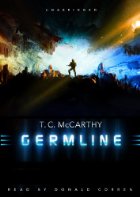 Summary:
Oscar is a reporter and lands an assignment with Stars and Stripes to go over to Kazakhstan and report on the new war between the US and Russia over resources needed for technology. This is a new kind of warfare. One fought mostly underground, and with the soldiers permanently wearing suits. Plus they’re fighting side-by-side with Genetics–human-looking robots who are all female and all look alike. Oscar started out just wanting a Pulitzer in between his drug addiction, which is easily fueled in Kaz. But Kaz changes people.
Review:
It’s been a while since I ventured in military scifi. I usually stick with the more sociological/psych experiment or cyberpunk areas of the genre, but this one just stuck out to me. I think its combination of aspects is just intriguing–a drug addicted journalist, a future war on earth, underground warfare, and robots. It certainly held my attention and flamed my interest in military scifi, plus it wound up counting for the MIA Reading Challenge, which was an added bonus.
Oscar is a well-rounded character. At first he seems flat and frankly like a total douchebag, but that’s because he’s a depressed drug addict. We learn gradually what landed him there and how he grows out of it with time. It’s an interesting character development arc because although many arcs show how war leads to alcoholism or drug addiction, in Oscar’s case although it at first makes his addiction worse, it ultimately helps him beat it. Because he ultimately snaps and realizes that the drugs are not helping the problems. They’re just making them worse. This is so key for anyone struggling with an addiction to realize. Pain in the present to feel better in the future. And McCarthy does an excellent job showing this progression without getting preachy. Sometimes you want to throttle Oscar, but you ultimately come to at least respect him if not like him. I wasn’t expecting such strong characterization in a military scifi, and I really enjoyed it.
The world McCarthy has built is interesting. The war itself is fairly typical–first world countries butting heads over resources in third world countries. But the content of the battles and the fighting methods are futuristic enough to maintain the scifi feel. There are the Genetics of course, and they are used by both sides. It’s interesting that the Americans use only female Genetics, and that is explained later on. There are also different vehicles and weapons that are scary but still seem plausible. Of course there’s also the suits the soldiers permanently wear, the front-line tunnels (the “subterrene”). It all adds up to a plausible future war.
Now, I will say, some of the battle scenes and near misses that Oscar has seem a bit of a stretch. I know odd things happen in war, and anyone can get lucky, but. Everyone’s luck runs out eventually. It seemed sometimes as if McCarthy wrote himself into a corner then had to figure out a way to make his main character survive. Escaping danger is fine, and necessary for the book to continue. But it should seem like a plausible escape. And if you have one that seems miraculous, it seems a bit excessive to me to have more than one.
The audiobook narrator did a fine job, in my opinion. He didn’t add anything to the story but he also didn’t detract from my enjoyment. I will note, however, that he pronounced “corpsman” wrong, saying the “s,” which is supposed to be silent. This only came up a few times and didn’t really bother me, but some readers, particularly ones who have been in the military themselves, might be bothered. Nothing else was mispronounced, and the voices used fit the characters nicely.
Overall, this piece of futuristic military scifi showcases both war and addiction in an engaging manner. Some readers may be off-put by Oscar at first, but stick it out. It takes many interesting turns. Recommended to scifi fans, whether they generally like military scifi or not.
4 out of 5 stars
Source: Audible

Counts For:
Book Review: Where Late the Sweet Birds Sang by Kate Wilhelm (Audiobook narrated by Anna Fields)
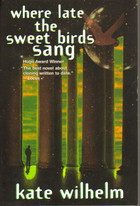 Summary:
When the world goes through an apocalypse consisting of virulent strains of the flu, lack of food, and nuclear warfare, one wealthy family manages to survive because they saw it coming. Made up of highly intelligent and highly educated people, such as doctors and scientists, the family creates a 200 bed hospital and uses this as their home base. But there is a serious fertility problem, and how they address it just might change the core of humanity.
Review:
I love reading classics of scifi. It’s endlessly fascinating how different people in different times imagine a future (or an apocalypse). This award-winning book had the bonus of being written by a woman, which isn’t always easy to find in older scifi. I also was intrigued by the cloning theme. How would someone in 1977 view something that was, as yet, nowhere near as close to a reality as it is now, with our cloned sheep?
The book starts out incredibly strongly. So strongly, in fact, that I actually had nightmares from it, which never happens to me ever. I am basically a rock of horror and scifi, but this one creeped the bejesus out of me. It’s that creepy combination of incest and cloning. The family are really not people you would want retooling the world. They’re everything that can be (and usually is) bad about the 1%. They’re selfish, self-centered, snobby, and routinely employ nepotism. I found the incest in the first third of the book talking about the first generation of the family to be an interesting metaphor for how the elite can become so backwards and grotesque from sheer isolation. It’s powerful and moving, and a scenario that will remain in my mind.
The second third of the book focuses in on a woman, Molly, from the first generation of clones. This is disturbing in its own way, because they don’t just clone everyone once and have done with it, no. They clone everyone multiple times until there are clusters of the same person at different ages wandering around. They call these clusters “brothers” and “sisters” with the name of the original person as the name of the group, even though the individual ones have their own names. It is profoundly disturbing. This second third looks at the society of clones that the original family unintentionally made. It’s fascinating in its own way and an interesting different way of telling a post-apocalypse story. Often we get only the first generation, but here we get multiple generations.
The last third, unfortunately, didn’t live up to the first two-thirds of the book. Without giving too much away, it looks at a boy who came about by natural methods who gets integrated into the clone society at the age of five. They decide not to clone him and give him brothers for unclear reasons. This last third then looks at his impact on the clone society. I didn’t feel that this worked as well for multiple reasons. For one, it’s almost as if Wilhelm freaked herself out and backed off from the profoundly disturbing story she was telling and went a more conventional direction. That was disappointing. For another, I found it disappointing that she chose to make this game-changer a boy. I expect women scifi authors to be at least a bit cognizant of the need in scifi for more female main characters. In this one, the first third is a man, the second third a woman, and the last third a boy. That is not the best stats from a woman author. I also found certain parts of this to be very boring and slow-moving compared to the first two-thirds. That makes for odd pacing in a book.
Of course, my complaints about the last third backing off, being more conventional, and being rather dull don’t take away from the first two thirds at all. They bring about so many interesting societal questions. For instance, is the incestuous nature of the elite necessarily bad or will it one day save humanity? Will cloning remove something that makes us human, even if they look right? Is it better to cling on to technology at all costs or release it and go back to simpler times? And what about sex? Is monogamy natural and polyamory unnatural? Or is polyamory more welcoming and loving than potentially possessive monogamy? The questions go on and on, which is what is great about scifi.
As for the science itself, it is quite well-done. Wilhelm clearly thought through both keeping a closed-off community alive and cloning and bringing to term embryos. She also put thought into the scientific basis for why clusters of clones would be different from individual humans, touching on psychology and twin studies. I was a bit irritated that she bases the survival of these people on cloning farm animals, when that is not a good use of their limited land resources. Studies have shown many many times that a combination of farming vitamin-rich plants and hunting/gathering are the best use of limited land resources, so this particular element rang a bit of bad science. However, I am not certain how much land usage had been studied in the 1970s, so that could possibly just be a sign of the times.
Now, I did read the audiobook, so I should touch on the narration. Overall, Anna Fields does a very good job. I really enjoyed that they chose a female narrator for a book written by a female author. It let me almost imagine that Kate Wilhelm herself was reading it to me. Fields mostly strikes a good balance of changing voices for different characters without going over the top. The one exception to this is when she narrates children. The voice for that made me cringe, but they mercifully speak only a few times. Mostly, Fields reads smoothly and is easy to follow. She narrates without accidentally putting her own interpretation onto the work, which is ideal for an audiobook.
Overall, then, this is a fascinating classic of scifi. It examines the apocalypse through the lens of the elite, thereby analyzing and critiquing them, but it also looks at possible consequences of cloning and ponders what ultimately makes us human. Although the last third of the book is a bit less creative and more conventional than the first two, it is still a fascinating read. Recommended to scifi fans, particularly those with an interest in group dynamics.
4 out of 5 stars
Source: Audible

Book Review: Soft Apocalypse by Will McIntosh (Audiobook narrated by Erik Davies)
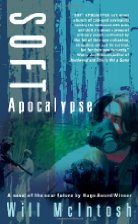 Summary:
Jasper can’t believe he’s actually homeless, although a lot more people are homeless now than used to be. But still. He got his BA in sociology. He’s worked hard. How did this happen? He’s living with a tribe of other 20-somethings. They keep hoping things will get better, but somehow they just seem to keep getting worse. The economy doesn’t improve. Home-grown terrorists known as Jumpy-jumps start routinely terrorizing people. Driving anywhere, having dependable food, actual working police forces, they’re all a thing of the past. Not all apocalypses happen overnight.
Review:
I actually hesitated over keeping this book on my wishlist, but I’m very glad I did. I found it to be not quite what I was expecting. In a good way.
I think a lot of men in particular will enjoy it, because it kind of reminds me of a Judd Apatow film. There’s this complete and utter loser guy who you entirely hate (and I suspect McIntosh hates too) but who is just so damn funny you keep reading it. A lot of apocalypse books focus in on a strong leader type, but Jasper is actually a coward who just keeps trying to squeak by. On top of that, he claims to be looking for true love, but is actually completely lacking in any understanding of women. One of his “apt” observations, for instance, consists of stating to a guy friend, “Have you noticed that fat women have been getting hotter?” He’s trying to say that the more starvation threatens, the more attracted he is to women who obviously have enough to eat. But he isn’t philosophical about it at all, and that’s kind of hilarious. He also tries to impress a girl at one point by commenting on the fact that she’s reading a book, but he says it in such a way that it’s obvious he himself doesn’t read at all, which is utterly baffling in a world that no longer has electricity or other entertainment. Basically the whole book is laughing at a cowardly dude-bro, and that’s fun.
The apocalypse itself is quite creative. As the title and blurb imply, it’s a slow one. Gradual. Things get bad and just never get better then more things get bad. It’s a creative mix of economics, homegrown terrorist groups, scientists trying to make things better but actually making it worse, and international politics. None of it came across as utterly absurd or ridiculous, which shows that McIntosh did a good job.
There are two scenes that are truly horrific, which of course I loved. There’s a very creative death scene that I think will haunt me for a long time. (Again, that’s a good thing). The plot overall is a bit meandering, but that makes sense since Jasper isn’t the most focused or proactive dude on the planet. I’m a little sad the book ended when it did. I get why McIntosh ended it there, leaving things open-ended for readers, but….I could have read about Jasper much much longer. Yes, he’s a guy I would hate beyond all reason in real life, but I guess that schadenfreude factor is what makes the book so fun.
Now, I did read the audiobook, and I have to say I was very disappointed in the narration by Erik Davies. It does not live up to the content of the book at all. My main problem with him is that he does that awful thing of putting on what he thinks is a woman’s voice every time one of them speaks, but what actually sounds like a small child and nothing like us. I actually had to stop and rewind a couple of times to double-check if I was angry at how the book was portraying women or if the narrator was making it seem like the book was portraying women as childish idiots. Suffice to say, it’s definitely the narration, not the book. Yes, Jasper objectifies women and basically calls any woman who doesn’t fit into his definition of what a woman should be “crazy,” but the whole book is laughing at him, so really the book is showing how ridiculous it is to view women like that. The narrator reading women in this childish voice really messes with that whole presentation. So, definitely don’t get the audiobook.
Overall, then, this is a fun apocalyptic scifi featuring a cowardly loser who is delightful to follow and laugh at. I highly recommend it to scifi fans who also enjoy slacker flicks, but definitely get the print or ebook versions, not the audio.
4 out of 5 stars
Source: Audible

 Support my work with a tip or browse my shop for curated book club guides, how to guides, cross-stitch patterns, and more!


This work by Amanda Nevius is licensed under a Creative Commons Attribution-Noncommercial-No Derivative Works 3.0 United States License.
 Opinions of a Wolf