
Archive
Book Review: Dark Life by Kat Falls (Series, #1) (Bottom of TBR Pile Challenge)
 Summary:
Ty was the first person born subsea. His family are settlers on the bottom of the ocean, a new venture after global warming caused the Rising of the seas. Ty loves his life subsea and hates Topside. One day while adventuring around in the dark level of subsea, he stumbles upon a submarine and a Topside girl looking for her long-lost older brother. Helping her challenges everything Ty believes in.
Review:
This is one of those rare YA books that gives me renewed hope for the genre. There are no stupid love triangles. The adults are intelligent and good parents. There are bigger worries than who you’re taking to prom. There’s adventure but no gratuitous violence. Romance but in a healthy way. Basically, it’s everything you’d hope for in a YA book. I’d gladly hand this to any teen or preteen looking for a good read and feel happy in doing so too.
The post-apocalyptic setting is unique, intelligent, well thought-out, and supported by science. Creating a new American frontier under the ocean is delightful, and Falls draws on the American pioneer experience in cute, tongue-in-cheek ways. For instance, the settler kids call their parents “Ma” and “Pa.” They earn their acres by successfully farming them for 5 years (a common time-frame in the old west). Plus, the world is different beyond subsea as well, reflecting drastic changes that would occur with such a huge change in the world. There are people called “floaters” who live in houseboats. Those who still live on land live in huge skyscrapers, and everyone sends their kids to boarding schools. Perhaps most interestingly is the fact that ever since the falling of the land into the ocean the US has been under “emergency law.” A harrowing possibility to any astute YA reader today.
Ty and Gemma are adventurous and intelligent yet still flawed in their own ways. Gemma can be too impulsive, Ty too cautious. This is naturally part of what makes them a good potential couple. They balance each other. Similarly, Ty’s parents are smart and caring, yet still capable of being wrong sometimes, even though well-intentioned. They’re an example of the type of parent we hope most kids will have. In contrast, Gemma is an orphan with an evil boarding school mistress to provide an adult for kid to hate.
The plot is deliciously complex and for once I actually did not guess the ending. It left me surprised and happy simultaneously. Falls does not take the easy way, but she also doesn’t use any lame deus ex machinas.
I feel my review is not doing this book justice. Suffice to say it is a richly complex world she has created, filled with characters that are worthy of being looked up to but with interesting scifi elements to keep the interest level high. I found myself never wanting to leave the subsea world and sort of wishing living subsea was an option in real life.
Overall, I recommend this to fans of YA scifi, but also to anyone with a curiosity about what it might be like to live on the bottom of the ocean as a new pioneer.
5 out of 5 stars
Source: PaperBackSwap

Book Review: Z for Zachariah by Robert C. O’Brien (Bottom of TBR Pile Challenge)
 Summary:
Sixteen-year-old Anne Burden has been living alone in her family’s farming valley ever since nuclear war left everything around the edges dead. She’s created a quiet, calm life for herself and the animals left alive until one day she sees smoke on the horizon. A man enters the valley in a radiation-proof suit. At first Anne is cautious but then happy to no longer be alone. Soon, however, the man’s sinister side starts to show.
Review:
This is a complex, thought-provoking with a surprise ending that is a bit….off-putting.
Anne Burden is a surprisingly pulled together gal for someone who just lost everyone and everything she knew to nuclear holocaust. She has a surprising amount of faith and is accepting of her fate. Her buddhist-like nature is admirable, but does seem a touch unrealistic.
There are many complexities in the plot that have no easy answers and keep the reader thinking. Is the man a bad guy or has the radiation poisoning simply addled his brains? Is it best to stay put where you are temporarily safe or take a risk and seek out other survivors? What things are ok to do to survive and what things are not? These deep questions, questions that have nothing to do with the school dance or which boy to choose are refreshing to see in YA. Putting the main character into extreme situations allows O’Brien to bring up more serious life questions. Although I don’t always agree with Anne’s decisions, I do respect her thought process.
The ending came kind of out of left field for me, and I am still dissatisfied with it. Anne’s decision to run instead of to stay and fight is an odd choice for a YA book. In fact the book reads very pacifistic, almost dangerously so. Running is not always an option. Sometimes you have to stand and fight. Hold your ground. Similarly, I do not believe the man would have given Anne any genuine tips on which direction to go out of sudden remorse. It seems out of character and done simply to give a more eloquent couple of closing paragraphs.
Thus, the book is a fast-paced read with important life questions. The main character makes some questionable decisions, though, and I am not entirely comfortable with the ultimate message it contains. I recommend it to fans of YA or post-apocalyptic fiction capable of taking the message with a grain of salt.
4 out of 5 stars
Source: PaperBackSwap

Book Review: The Cause by Clint Stoker
 Summary:
In an overpopulated future, a city stands where there are not familial or close relationships, but everyone celebrates every night. Air was recently relocated to a new position as a purger, and he slowly discovers the sinister side of the city.
Review:
This is an interesting concept that is poorly executed, badly edited, and takes a turn for the worse at the end.
Anyone who follows this blog knows that I love an overpopulation scifi story. Stoker has an interesting take on it–the world is overpopulated so constantly at war. A city arises where the residents can stay young forever but must follow a series of articles that removes the true joy of living from them. The problem is that I just stated that more succinctly than Stoker does at any point in the novel.
What we have here is the classic example of a good idea poorly executed. The basic concept is great. But the main character’s flashbacks and current thoughts are difficult to read. I found myself constantly skimming the flashbacks, because they were so confusing to read and lent so little to the story.
More upsetting though were the constant errors that had less to do with typos or difficult grammar and more to do with poor understanding of the English language. Examples:
A golden metal sat at the top of his desk. (location 2879)
Won’t even know your there (location 3148)
I thought we we’re in this together (location 4225)
He put Air to sleep so he could remain innocent in the cities eyes (location 4509)
A transport past by (location 4588)
You can’t bring people back once their dead. (location 5050)
I am ti sro and you are the villain. (location 5083)
Anybody, understandably, would be frustrated with this amount of errors.
Perhaps more distressing is the “surprise” ending, which to me was just confusing. Essentially, five infants are killed every 50 years to keep the city of 30 million people alive, yet the science of that is never explained. The key to scifi is plausible science, yet Stoker ignores that entirely. It’s a good idea, but without plausible explanations and good writing, it falls flat. I’d recommend he gets a solid editor before his next attempt.
2 out of 5 stars
Source: Kindle copy from the author in exchange for my honest review

Book Review: The Prometheus Project: Captured by Douglas E. Richards (series, #2)
 Summary:
Brother/sister duo Ryan and Regan are back only this time they’re officially part of the team of scientists working in the top-secret alien city discovered deep underground in Pennsylvania. They rush off every day after school to work in the city of Prometheus. One weekend they convince their parents to let them sleep over in the city, only to wake up to discover all of the adults captured by a ruthless alien escaped convict whose mind control abilities mysteriously fail to work on the kids. It’s up to them to save not just the adults, but the earth itself from alien rule.
Review:
This follow-up to The Prometheus Project: Trapped (review) brings even more action and science than the first time around. It’s also a longer length that is more suitable for the older middle grade crowd.
Ryan and Regan’s relationship with each other has progressed from sibling tolerance to a level of respect for each other clearly due to working together in the city. It’s nice to see a healthy sibling relationship modeled in a middle grade book.
Again the plot fooled me with a twist ending I didn’t see coming, but that made perfect sense when it was revealed. This is the sort of thing I’d have loved as a middle grade reader. A mystery that manages to out-wit me without playing any tricks.
The villain is threatening without being too frightening. Although the kids’ parents are held captive, no undue violence is shown. Predominantly the scientists are held with plastic ties on their wrists and a simple verbal threat of “do this or else….” It seems an appropriate level of suspense for the age-range. The enemy is formidable, but it is possible to out-wit him.
Although the science, plot, and characters are strong, something just couldn’t let me jump from liking it a lot to loving it. Perhaps this is because I am out of the age-range intended, but it does seem to me as though sometimes the story expects a bit too little of the young reader enjoying it. I hope in future books that Richards challenges young readers a bit more with the writing in addition to the science.
Overall, this is another strong entry in this middle grade series. I firmly believe the series will keep young readers with an interest in scifi and secret government operations happily engaged while parents and guardians can have peace of mind about what they are reading.
4 out of 5 stars
Source: Won copy in exchange for my honest review from the author via LibraryThing
Previous Books in Series:
The Prometheus Project: Trapped, review
Buy It

Book Review: The Prometheus Project: Trapped by Douglas E. Richards (series, #1)
 Summary:
Ryan and Regan can’t believe their scientist parents made them move from San Diego to the total snoozefest of Pennsylvania practically overnight just so they can work at a boring science corporation, Proact. But when they accidentally overhear their parents talking, they realize there may be more to Proact than meets the eye, and they’re determined to find out!
Review:
I don’t think I realized when I entered the giveaway for this (a really long time ago, sorry about that, Richards!) that it’s a middle grade/children’s series. I don’t usually read below the YA level anymore unless I’m reading to my four year old nephew, but I am a librarian, so I put my librarian cap on for this book. I also tried to hearken back to what I would have enjoyed at the age of eight or nine.
Ryan and Regan are a cute brother/sister pair. Ryan is older and thus underestimates his sister sometimes. They tease each other, but never cruelly, and it is evident that they truly love each other. The sibling dynamic is definitely well-done. It was refreshing to see the adults depicted as adults and not idiots or mean-spirited. What Ryan and Regan accomplish is because they’re the smart kids of smart parents, not out of any short-comings of the adults.
The science is really well-done. Richards’ author bio states that he used to write for National Geographic Kids, and it shows. He explains things eloquently without talking down to kids. All of the science found in the book is factual. I would have loved stumbling upon such learning in fiction as a kid.
The ending has a twist that even I didn’t see coming, and I was sort of expecting to being a grown-up reading it, haha. It’s not cheesy or over-the-top, and I’m betting kids will love the surprise.
My main criticisms are that sometimes the descriptions of the characters focus too much on their hair and eye color to the exclusion of other things, and the book felt too short. It just seemed a bit short for the grade level. Mentally I compared it to Nancy Drew which are generally like 25% longer, and I think that length would be ideal. The sequel is longer though, so that’s a good thing.
Overall I think if you have middle grade reading level kids who like science, mysteries, or scifi you should feel completely confident in handing them this book.
4 out of 5 stars
Source: Won copy in exchange for my honest review from the author via LibraryThing

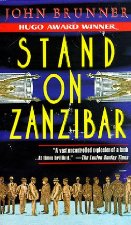
Book Review: Stand on Zanzibar by John Brunner
 Summary:
In the near-future humanity is increasingly facing over-population and all its consequences. In reaction to this, most world governments have established population laws and eugenics boards. In this overly crowded, information overloaded, perpetually on the brink of war society exist Donald and Norman, healthy bachelors who must live as roommates due to the housing crisis. Donald is a dilettante, an information specialist on reserve to be activated as a spy when needed for the US government. Norman is a Muslim African-American working his way up the corporate ladder of the most important technology firm in the world–GT. GT houses the world’s most brilliant computer named Shalmaneser. The intertwining lives of these two oddly well-suited roommates gradually unfold amid digressions into the lives of those they come into contact with and information from the modern-day philosophies and advertizing.
Review:
What is most memorable and striking about this book is not so much the story, although that is fairly unique, but the way in which it is told. Brunner does not simply tell the main storyline, he also immerses the reader into the world the characters live within. To that end, the main storyline (continuity) is interspersed with chapters focusing in on minor characters (tracking with close-ups, essentially short stories), plunging the reader into the middle of the advertizing of the time (the happening world), and works of importance to the world (context). The result is that, although it takes a bit of work to get into the book, in the end the world these characters exist in is much more vivid and clear in the reader’s mind, thus allowing her to more fully understand the characters.
Sometimes this method of writing is a bit difficult to read, of course. For instance, one chapter takes place at a party, and Brunner simply streams all of the conversation together as you would hear it if you were at the party yourself. You catch snippets of bits of different conversations taking place, but never an entire one all at once. It’s the most immersive party scene I’ve ever read, but also took me an inordinate amount of time to get through.
It was also refreshing to have one of the main characters in a futuristic scifi book be a minority. This in and of itself made Stand on Zanzibar a unique, interesting read, and I believe Brunner did a good job portraying both Norman’s struggles with still prevalent racism and presenting him as a well-rounded character.
The major themes of the book, beyond the incredibly meta presentation style, are the very real threat of the loss of privacy and the dehumanization of dependence upon artificial intelligence.
The dehumanizing affect of overpopulation is evident in the language employed by the characters early on in the book.
Not cities in the old sense of grouped buildings occupied by families, but swarming antheaps collapsing into ruin beneath the sledgehammer blows of riot, armed robbery and pure directionless vandalism. (page 52)
These are no longer human cities. They are crawling ant-piles. The vision of piles of swarming ants is simply not a pleasant one. This concept of humanity as a pest is carried even further in a poem from one of the context chapters entitled “Citizen Bacillus,” which begins:
Take stock, citizen bacillus,
Now that there are so many billions of you,
Bleeding through your opened veins,
Into your bathtub, or into the Pacific
Of that by which they may remember you. (page 115)
Not only is this poem taking into account the increasingly suicidal tendencies of the human population in this future society (something that is seen in the animal kingdom when a population becomes overcrowded), but it also is blatantly calling humans a bacteria (bacillus).
The book repeatedly addresses through vignettes, samples of books of the time period, and the lives of the main characters that overpopulation leaves people without enough room to think and figure themselves out in.
True, you’re not a slave. You’re worse off than that by a long, long way. You’re a predatory beast shut up in a cage of which the bars aren’t fixed, solid objects you can gnaw at or in despair batter against with your head until you get punch-drunk and stop worrying. No, those bars are the competing members of your own species, at least as cunning as you on average, forever shifting around so you can’t pin them down, liable to get in your way without the least warning, disorienting your personal environment until you want to grab a gun or an axe and turn mucker. (page 77-8)
In the book “turning mucker” is when a person inexplicably loses their mind and attacks strangers near them. This happens increasingly throughout the book. Thus Brunner’s main point that humans are our own worst enemy is repeated throughout the book.
Added on top of this is the fact that artificial intelligence is outpacing humans. The characters literally cannot keep up with the information overload. They have nightmares about it. They simultaneously depend on the computers and dread them. When one goes awry, they hardly know how to continue on, but simply flounder around. Chad Mulligan (one of my new favorite literary characters) sums it up eloquently:
What in God’s name is it worth to be human, if we have to be saved from ourselves by a machine? (page 645)
Thus, Stand on Zanzibar through postulating an overpopulated future that is overly dependent on technology demonstrates the very real dangers humans pose to ourselves if we outpace either our own minds or our environment’s ability to house us. It is a brilliant read for the meta-literature aspect alone, but the content is also challenging and thought-provoking. I highly recommend it to scifi fans.
4 out of 5 stars
Source: PaperBackSwap

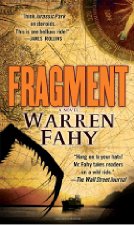
Book Review: Fragment by Warren Fahy (Series, #1)
 Summary:
When the floating reality tv show SeaLife receives a distress beacon coming from a remote island, it looks like their ratings are going to improve. Henders Island has not been visited since the 1700s, and the scientists aboard the Trident are excited at the possible new species they could find. Unfortunately, the species aren’t as benign as they thought.
Review:
This was recommended to me by a couple of friends who know I’m a huge Michael Crichton fan as a Crichton-esque reading experience. I can definitely say that this falls solidly in the hard, plausible scifi genre that has been so empty since Crichton’s passing.
Fahy takes the concept of an island splitting off from the rest of civilization and evolving separately and runs with it. The creatures he comes up with are fantastic and frightening yet simultaneously plausible, which is part of what makes the thrills so thrilling. Similar to Crichton, there are long passages of science explained at a level easily understandable by anyone with a high school diploma. Also, there are passages that at first seem unimportant but later are revealed to be connected and important.
The characterization is strong enough for a thriller of this sort, although that of the main characters could be a bit stronger. Everyone is easy to tell apart, however, and their motivations are clear, something that can be difficult to pull off at the fast pace of a thriller. In future writings, I do hope that Fahy’s main characters will be a bit more well-rounded, however.
The pacing is a bit bumpy with some passages that remove the previously built-up suspense. Although this was necessary to explain the science, it does seem that it could have been worked in more smoothly. The last quarter of the book, however, is paced perfectly with no interruptions and just the right amount of suspense.
One of the highlights of the book is definitely the inclusion of the reality tv show. It lends it a current real vibe. Things are recorded as they happen. The world sort of knows what’s going on, but not quite. The military has to get involved. Everything reads as very plausible and realistically connected to how the modern world actually works. Plus the scenes involving the reality tv producers are just good comic relief.
I absolutely plan on reading Fahy’s future works, and definitely recommend this to fans of Crichton style scifi.
4 out of 5 stars
Source: PaperBackSwap


Movie Review: Them! (1954)
 Summary:
When a small southwestern town sees a spate of sugar theft mixed with mysterious deaths, a scientist and his daughter are brought in to investigate. They soon discover that a new breed of giant ants have mutated from local nuclear testing and must fight against the odds to preserve the human dominance of earth.
Review:
I watch classic horror movies more for the lols than anything, but every once in a while, one manages to actually stand the test of time and still scare me.
Anyone who knows much about ants knows that they actually are rather awful creatures. They’re vicious, disturbingly strong for their size, and single-minded to the point of obsession. That’s the perfect recipe for a formidable opponent if they were any larger. Combine this with the very real threat of nuclear mutation, and you have the recipe for an ideal horror film.
Something the classic movies did better than today is establish a strong plot-line. The action is not constant. It is interspersed with scenes in which the characters attempt to figure out what is going on and determine what to do about it. This ups the tension for the inevitable “battle the monster” scenes that eventually play out.
Of course a strong idea and plot can still be undermined by outdated special effects. These effects, however, have truly stood the test of time. The ants look frightening, not comical. The scenes are shot in such a way that it all appears to be fairly real, particularly for the decade. When the sound effect given to the ants–a sort of high-pitched squealing–is added in, it becomes quite easy to suspend disbelief.
If you enjoy a good creature feature as well as an old movie periodically, you won’t regret your time spent watching Them!
5 out of 5 stars
Source: Netflix

Book Review: I Am Legend by Richard Matheson
 Summary:
A worldwide virus pandemic has turned most of the world’s population into vampires–both alive and undead. Robert Neville might, quite possibly, be the only uninfected left. Every day he goes out on his quest to simply kill the vampires while they sleep. Every night he curls up in sound-proofed home drinking whiskey and listening to records. Will anything ever save him from this monotonous existence?
Review:
It’s difficult to read a highly influential scifi book that inspired both the trend of writing of a worldwide pandemic and the original Night of the Living Dead and find that you actually are a bit unimpressed by it. I was simply expecting more from such an influential book.
Claustrophobic. That is the best word to describe the book, and it is also what Matheson excels at. Depicting the effects of painful ostracism and loneliness on a person’s psyche. For Robert isn’t alone per se. He is surrounded by those infected with the virus. Yet he can’t hang out with them or converse logically with them. They are entirely at odds, and whereas the infected have each other, Neville has no one. What this book depicts is what happens when the world moves on, and someone is left behind. This is truly well done and what makes the book periodically powerful.
Yet it struggles with things, particularly the most simple story-telling and pacing. The order of events is disjointed and difficult to make sense of. Neville is a rather unsympathetic character because we only get rare glimpses into his past life before the apocalypse. His relationship with Ben Cortman, an infected neighbor, is built up to be important and influential, yet it is dropped at the last minute. One plot point in particular toward the end of the book truly makes very little sense. The actions of the infected seem to be ludicrous at best. At the base of it, we see Neville’s insanity much more clearly than we see his previous sanity, which makes his gradual changes due to loneliness less powerful. Thus, both the characterization and the plot suffer from a certain ever-present disjointedness.
This reads as a great idea that was a bit poorly executed. Perhaps this is why it has inspired so much other creativity. The germ of the idea is excellent and easy to ponder upon in spite of a far less sophisticated story-telling. I thus mostly recommend this to fans of the worldwide pandemic or Night of the Living Dead franchise to see where it all started. Those who are intrigued by the look at ostracism may enjoy it as well, but others probably should steer clear.
3 out of 5 stars
Source: Borrowed

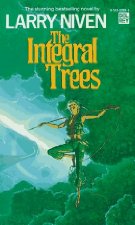
Book Review: The Integral Trees by Larry Niven (Series, #1)
 Summary:
Humans settled on a planet far from Earth after mutinying from their spaceship. Generations later, their descendants have formed various tribes and cities ranging in civilization from tribal to bronze age level of technology. What makes the planet unique is its lack of gravity. Most people live in “integral trees” or in “jungle clouds” with varying amounts of pull (gravity) due to the presence of the tree. In this peek at their existence, we follow a bunch of intrepid people who survive when their tree dies only to find themselves marooned in the sky, along with the flying animals, pools of water, flying fish, and more.
Review:
This book is the definition of classic hard scifi. The world is complex, alien, and unique. It manages to simultaneously be barbaric and technologically advanced in some ways. Everything is as alien from our own lives as we could possibly imagine, from what the people eat to how their cultures are to how people interact.
It takes a bit to get into the book. At first the concept of the planet and how people live on it is overwhelming. But Niven introduces things slowly, so by the time you’re reading about a jungle cloud with people with prehensile toes, it’s easy to imagine and doesn’t slow you down at all in the story. Yet simultaneously it is obvious from looking back to the beginning of the book that Niven always has a clear understanding of how his world works, even if it’s not entirely clear to the reader yet. This is the definition of good writing, and especially good scifi.
The characters have a tendency to be a bit one-dimensional and flat. This is possibly due to all of the attention being paid to the world the story is set in. However, the story still would be improved with more three-dimensional characters. One character in particular goes from a female warrior to a married woman to a concubine and seems to take it all a bit too much in stride for someone who started out as a woman warrior. It felt a bit as if Niven was changing the characters to fit the situation rather than seeing how the characters he had already developed actually would react.
There is definitely a bit of a tinge of male fantasy to the whole story. Even the jungle cloud women who participate equally in their society end up being sister wives to one guy. Personally, I thought given the way women were treated in the story that it must have come out in the 1950s or 1960s, but a quick check shows it came out in 1984. That’s a bit….disturbing. While it’s certainly logical that some cultural things will not be ideal on a foreign planet such as this, the status of women in the novel reads less as a commentary and more as something the author would very much like the world to look like.
Overall, this is an enjoyable hard scifi novel with a rich setting, weak characters, and questionable mores. I recommend it to lovers of hard scifi, but most others probably would not enjoy it.
3 out of 5 stars
Source: PaperBackSwap

 Support my work with a tip or browse my shop for curated book club guides, how to guides, cross-stitch patterns, and more!


This work by Amanda Nevius is licensed under a Creative Commons Attribution-Noncommercial-No Derivative Works 3.0 United States License.
 Opinions of a Wolf