
Archive
Book Review: The Dead and the Gone by Susan Beth Pfeffer (Series, #2)
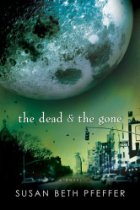 Summary:
Seventeen-year-old Alex Morales works hard with his eyes on a good college. He even works in a local pizza joint to pay for his own private Catholic school uniforms to help his Mami and Papi. Papi is in Puerto Rico for his mother’s funeral and Mami is working late when an asteroid strikes the moon and everything changes. New York City is struck by flooding and loss of infrastructure. Alex is left alone to care for his two younger sisters, Julie and Briana, and slowly he begins to think that maybe things will always be this bad. Maybe Mami and Papi will never come back, the moon will never look right again, and there will never be a world where he can go to college and not be left caring for his little sisters.
Review:
I inhaled the first book in this series, in spite of the scientific flaws (which I addressed in my review of the first book). Miranda’s journal ends so abruptly that I was eager to get to the next book right away. I was surprised, then, when the second book starts back before the moon is struck with an entirely different family in a different area of the country. This book shows Pfeffer’s abilities as a writer by showing the same apocalyptic event seen in the first book from the perspective of an entirely different family.
Miranda’s family is suburban-rural, agnostic/atheist humanist, blended (divorced parents with one remarried), and white. Alex’s family is urban (NYC), Latino, and devotedly Catholic. Both families are given room to have strengths and flaws, most of which have nothing to do with where they live, their ethnicities, or their religions (or lack of one). I honestly was startled to see Alex and his and his sisters’ strong faith treated with such respect in this book after Miranda’s lack of faith was treated with equal respect in the first. It’s easy, particularly in a book written as a journal, to mistake a character’s beliefs for an author’s, and Miranda, a teenage girl, has very strong beliefs. This book reminded me that those beliefs were just Miranda’s, just as Alex’s beliefs are just his, and it shows how well Pfeffer is able to write characters.
Some readers may find it odd and frustrating to go back in time to relive the apocalypse over again with different characters. I personally enjoyed it, because the world falling apart is one of the best parts of post-apocalyptic fiction for me. I also liked having the opportunity to see differences in how the apocalypse plays out based both on the location (suburban/rural versus urban) and the characters’ personalities and reactions. However, that said, I can see how this set-up of two vastly different sets of characters in books one and two could be off-putting to certain readers. Some religious readers may be turned off by the first book and Miranda’s staunch atheism. Those who read the first book and enjoy it for precisely that reason may similarly be turned off by the second book’s heavy Catholicism and faith. The diversity is a good thing but it also makes it hard to pinpoint an audience for the series. Those who are open to and accepting of other belief systems would ultimately be the best match but that’s a demographic that can sometimes be difficult to find or market to. However, if a reader is particularly looking for a diverse set of viewpoints of the apocalypse that is more than just characters’ appearances, this series will be a great match for them.
It should also be mentioned that this book is not a journal. It is told in third person, from Alex’s viewpoint, although the dates are still mentioned. It makes sense to do it this way, since Alex definitely does not come across as a character with the time or the inclination to keep a journal. It would have been interesting to view the apocalypse from the viewpoint of a boy who did keep a journal, however.
The plot makes sense and brings in enough danger without being overly ridiculous. It would have been nice to have maybe started the book just a bit earlier in the week to see more of Alex’s day-to-day life before the disaster. Instead, we learn about it through flashbacks, which makes it a bit harder to get to know him than it was to get to know Miranda.
Overall, this is a surprising and enjoyable second book in this post-apocalyptic series that lets readers relive the apocalypse from the first book over again with a different set of characters. This approach lends diversity to the series, as well as bringing in a greater variety of scenarios for those who enjoy the apocalypse process. Recommended to those looking for a diverse presentation of beliefs and how those impact how characters deal with an apocalypse.
If you found this review helpful, please consider tipping me on ko-fi, checking out my digital items available in my ko-fi shop, buying one of my publications, or using one of my referral/coupon codes. Thank you for your support!
4 out of 5 stars
Length: 341 pages – average but on the longer side
Source: Library

Previous Books in Series:
Life As We Knew It
Book Review: Life As We Knew It by Susan Beth Pfeffer (Series, #1) (Bottom of TBR Pile Challenge)
 Summary:
Miranda’s journal starts out like any other teenage girl’s diary. Worries about school, her after-curricular activities, and wondering how her family will work out with her dad having a brand-new baby with his new wife. But when a meteor strikes the moon things start to change. Slowly at first but with ever-increasing speed. Tsunamis wipe out the coasts. Volcanoes erupt. And soon Miranda finds herself, her mother, and her two brothers struggling to survive in a world that increasingly bares no resemblance to the one she once knew.
Review:
I’m a sucker for journal entry books, even though I know rationally that no diary ever has as much content and exposition as is contained in these fictional works. In addition to the journal format, I liked the premise for the dystopian world Miranda finds herself in. It’s very different from a lot of the other ones out there, since it’s 100% gradual natural disaster. This book lives up to the expectations set by its summary, offering a fun journal entry take on a natural disaster that turns into a dystopia.
Miranda, who lives in semi-suburban Pennsylvania, starts out the journal as a very average teenage girl, adapting to her parents’ divorce and father’s subsequent re-marriage, her older brother being away for his first year of college, and hoping to convince her mother to let her take up ice skating again. The book clearly yet subtly shows her development from this young, carefree teenager through angst and denial and selfishness in the face of the disaster to finally being a young woman willing to make sacrifices for her family. Miranda is written quite three-dimensionally. She neither handles the disaster perfectly nor acts too young for her age. While she sometimes is mature and sees the bigger picture at other times she simply wants her own room and doesn’t understand why she can’t have that. Pfeffer eloquently shows how the changes force Miranda to grow up quickly, and this is neither demonized nor elevated on a pedestal. Miranda’s character development is the best part of the book, whether the reader likes her the best at the beginning, middle or end, it’s still fascinating to read and watch.
Miranda also doesn’t have the perfect family or the perfect parents, which is nice to see a piece of young adult literature. Her parents try, but they make a lot of mistakes. Miranda’s mother becomes so pessimistic about everything that she starts to hone in on the idea of only one of them surviving, being therefore tougher on Miranda and her older brother than on the youngest one. Miranda’s father chooses to leave with his new wife to go find her parents, a decision that is perhaps understandable but still feels like total abandonment to Miranda. Since Miranda is the middle child, she also has a lot of conflict between being not the youngest and so sheltered from as much as possible and also not the oldest so not treated as a semi-equal by her mother like her oldest brother is. This imperfect family will be relatable to many readers.
Miranda’s mother is staunchly atheist/agnostic/humanist and liberal, and this seeps into Miranda’s journal. For those looking for a non-religious take on disaster to give to a non-religious reader or a religious reader looking for another perspective on how to handle disasters, this is a wonderful addition to the YA dystopian set. However, if a reader has the potential to be offended by a disaster without any reliance on god or liberal leanings spelled out in the text, they may want to look elsewhere.
I know much more about medical science than Earth science or astronomy, but I will say that when I was reading this book, the science of it seemed a bit ridiculous. An asteroid knocks the moon out of orbit (maybe) so the tides rise (that makes sense) and magma gets pulled out of the Earth causing volcanoes and volcanic ash leading to temperature drops Earth-wide (whaaaat). So I looked it up, and according to astronomers, an asteroid is too small to hit the moon out of orbit. If it was large enough to, it would destroy the moon in the process. Even if for some reason scientists were wrong and the moon could be knocked out of orbit, even in that scenario, the only thing that would happen would be the tides would be higher. (source 1, source 2) I know dystopian lit is entirely what if scenarios, but I do generally prefer them to be based a bit more strongly in science. I would recommend that reading this book thus be accompanied by some non-fiction reading on astronomy and volcanology. At the very least, it’s good to know that you can safely tell young readers that this most likely would not happen precisely this way, and this book is a great opening dialogue on disasters and disaster preparedness.
Overall, this is a fun take on the dystopian YA genre, featuring the journal of the protagonist and dystopia caused primarily by nature rather than humans. Potential readers should be aware that the science of this disaster is a bit shaky. The story featuring an agnostic humanist post-divorce family makes it a welcome diversifying addition to this area of YA lit.
If you found this review helpful, please consider tipping me on ko-fi, checking out my digital items available in my ko-fi shop, buying one of my publications, or using one of my referral/coupon codes. Thank you for your support!
4 out of 5 stars
Length: 337 pages – average but on the longer side
Source: PaperBackSwap
Book Review: Brains: A Zombie Memoir by Robin Becker (Bottom of TBR Pile Challenge)
 Summary:
Jack Barnes once was a college professor, but now he’s a zombie. A zombie who can think. Think, but not talk. He can, however, still write. So he keeps a memoir of his quest to gather other thinking zombies and bring their case for equality to their creator, the man who started the whole zombie outbreak.
Review:
I picked this up during the height of the zombie craze in the used book basement of a local bookstore for dirt cheap. (It looked brand new but only cost a couple of dollars). I’m glad I got it so cheap, because this book failed to deliver the sympathetic zombies I was looking for.
The idea of thinking zombies who challenge the question of what makes us human is interesting and is one multiple authors have explored before. It’s not easy to make cannibalizing corpses empathetic. Zombies are so naturally not empathetic that to craft one the reader can relate to is a challenge. Without at least one zombie character the reader empathizes with, though, this whole idea of maybe zombies are more than they seem will fail. And this is where this book really flounders. Jack was a horrible person, and he’s a terrible zombie. And this is a real problem when he narrates a whole book whose plot revolves around zombies demanding equal treatment. Jack is a snob, through and through. It feels as if every other sentence out of his mouth is him looking down upon someone or something. This would be ok if he grew over the course of the novel. If his new zombie state taught him something about walking in another person’s shoes. But no. He remains exactly the same throughout the book. He has zero character growth away from the douchey snobby professor who looks down on literally everyone, including those within his own circle. This isn’t a mind it’s fun or even enlightening to get inside of. It’s just annoying. As annoying as fingernails on a chalkboard.
The plot is ok. Jack gathers other thinking zombies and heads for Chicago to find the man who created the zombie virus and convince him to advocate for them. Their standoff is interesting and entertaining. But the ending beyond this standoff is unsatisfying.
It also bugs me that this is a memoir written by this guy but it is never clear how this memoir made it into the reader’s hands. With a fictional memoir, I need to know how I supposedly am now reading something so personal. I also had trouble suspending my disbelief that a slow zombie managed to have time to write such descriptive passages crouched in a corner at night.
Overall, this is an interesting concept that is poorly executed with an unsympathetic main character. Recommended that readers looking for a zombie memoir pick up Breathers: A Zombie’s Lament
If you found this review helpful, please consider tipping me on ko-fi, checking out my digital items available in my ko-fi shop, buying one of my publications, or using one of my referral/coupon codes. Thank you for your support!
2 out of 5 stars
Length: 182 pages – average but on the shorter side
Source: Harvard Books

Counts For:

Book Review: Old Man’s War by John Scalzi (Series, #1)
 Summary:
John Perry joined the Colonial Defense Force on his 75th birthday. Americans aren’t allowed to be colonists in outer space, but they can defend the colonies in the outer space army. Old folks join for many reasons from boredom to having always wanted to see outer space, even though details of what goes on out there are kept secret from Earth. In spite of all the secrecy, the rumor is that those who join the CDF get to be young again, and who wouldn’t want a second chance at life?
Review:
Multiple friends have read this book and loved it, and of course I found the idea intriguing, who wouldn’t? So when a friend offered to loan me his copy, I took him up on it right away. I was not disappointed in the world Scalzi has created, it is endlessly fascinating, but the main character’s arc failed to be quite so interesting to me.
I can’t imagine how anyone would not find the basic premise of this book interesting. Outer space colonies that are kept a mystery from Earth. Only certain countries allowed to colonize (primarily those suffering from population overload). Top it off with a colonial army made entirely up of old people who supposedly get to be young again? Completely. Fascinating. And Scalzi really comes through on the science of all of this, the politics, and manages to have some surprises in there, in spite of the what seems to be very straight-forward book summary. And the world beyond the soldiers and the colonists is utterly fascinating as well. The aliens are incredibly creatively imagined, not just in their looks but in their cultures. They feel real. And that extends to the battles and spaceships as well. The worldbuilding here is phenomenal. It is an example of how scifi worlds should be built.
The main character, though, as well as his character development arc, fail to live up to the incredible worldbuilding. John Perry, from early on, is talented at war, in spite of having only been an advertising slogan writer for his whole life. He has no real life experience that would make one think he would be good at war. Additionally, even when he is doing battle, he’s kind of flat on the page. He doesn’t jump off as the leader he supposedly is supposed to naturally be. Other characters feel that way, but not John. In fact, I frequently found myself far more interested in the secondary characters around John than in John himself. I was willing to give this a bit of a pass since, well, the character has to live for us to continue to see the wars he’s fighting, and maybe Scalzi has a thing for unlikely heroes. But his character arc takes an odd turn at the end that really bothered me.
*spoiler warning*
John meets a special forces woman who is in his dead wife’s body. Basically, his dead wife’s DNA was used as a base to build a genetically enhanced body. Ok, I’m fine with that, even if it seems unnecessary. But then John becomes obsessed with her, and she with him, even though she is very clearly NOT his wife. Then at the end, he asks her to move to a colonial farm with him when they retire. And she says yes. Whaaaaat?! This isn’t romance; this is gross! The special forces woman has as much in common with John’s wife as her sister would at this point, since they have messed with the DNA so much. This is like John pursuing his dead wife’s sister, who is emotionally only 6, since she was put into a fully adult body 6 years ago and had no life prior to that. It’s gross. It is not romantic. And I really think the reader is supposed to see it as romantic, when instead it squicked me out far more than any of the aliens in the book, including the ones with slimy appendages or the ones who eat humans.
*end spoilers*
Overall, this is an utterly fascinating scifi world with a bit of a ho-hum main character. The ending may disappoint some readers, and Scalzi’s politics can come through a bit obviously sometimes. However, those at all intrigued by the plot summary or interested in high quality scifi world building should check it out.
If you found this review helpful, please consider tipping me on ko-fi, checking out my digital items available in my ko-fi shop, buying one of my publications, or using one of my referral/coupon codes. Thank you for your support!
4 out of 5 stars
Length: 355 pages – average but on the longer side
Source: Borrowed

Blind Date With a Book Win Reveal!
Hello my lovely readers!
The Little Red Reviewer, a blog I’ve followed since I started my own, had the brilliant idea to do a blind date with a book giveaway a few weeks ago. For those of you who don’t know, a blind date with a book is when a library/bookstore/person wraps a book up and puts a few clues about what the book might be about on the cover. The idea is that you’re matched by concepts instead of cover or blurb. I hadn’t seen this in giveaway form before, and I thought it was super brilliant of Redhead to use it for a print book giveaway. Imagine my delight when I won one of the books!
It arrived still wrapped, just as it had been pictured on her blog.
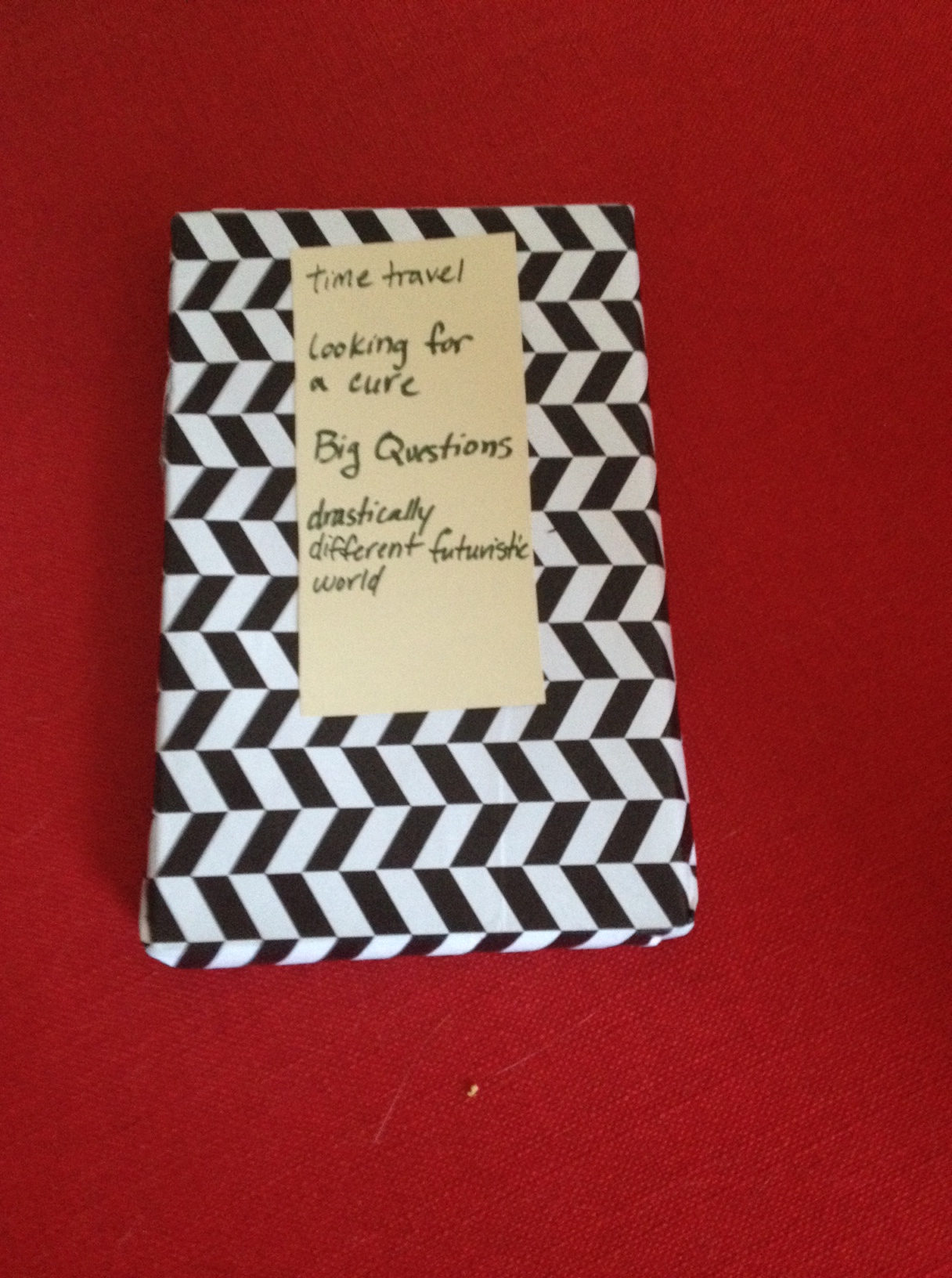
Since I knew I had won before Redhead mailed out the books (obviously, as I had to provide her my mailing address), I’d had weeks to wonder what book, exactly I was getting! You guys are lucky I manged to be patient enough to take a picture of the wrapped book before unwrapping it. :-P
Anyway, I unwrapped the book to reveal my mystery book date!
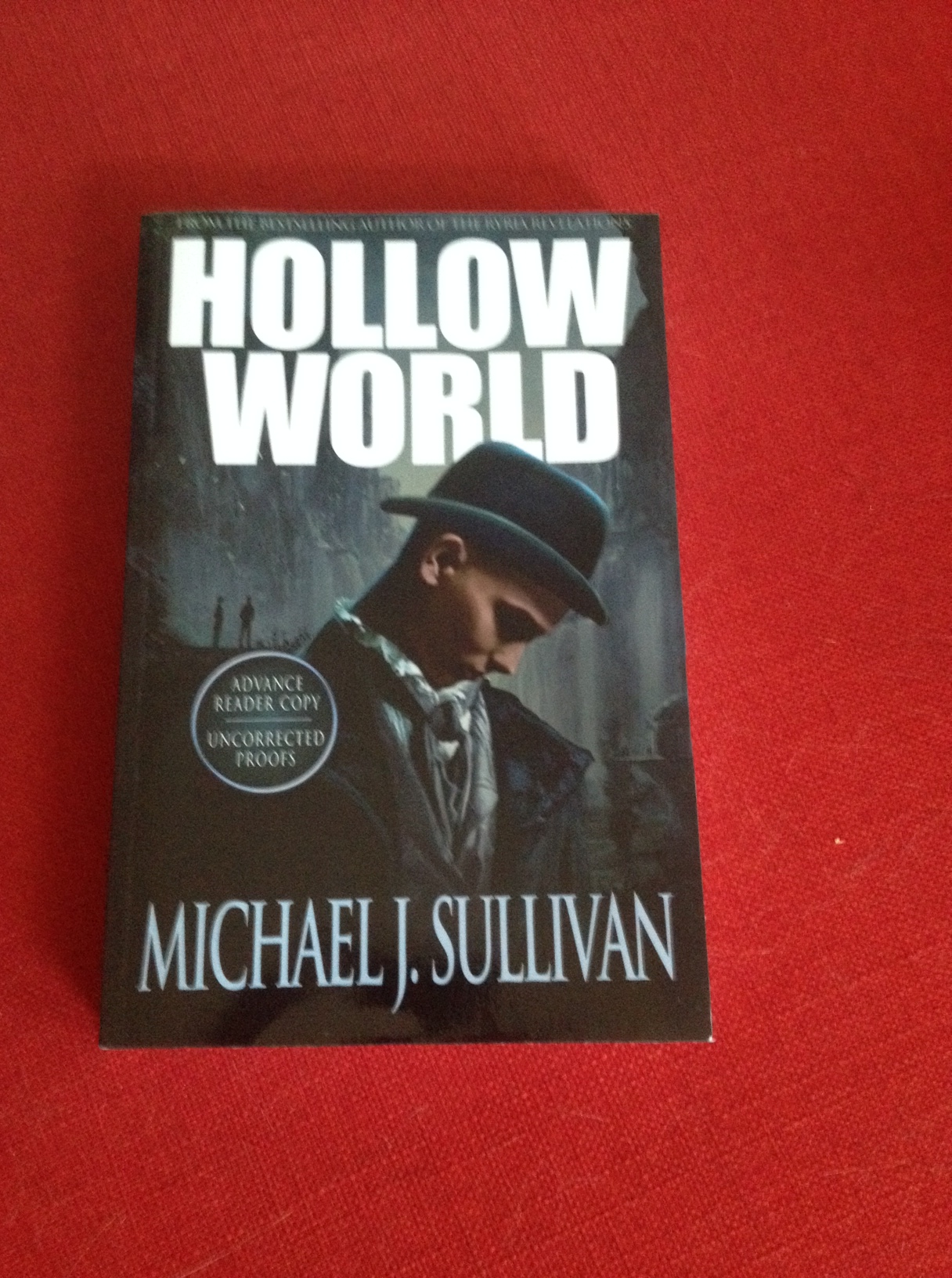 The book I won is Hollow World
Ellis Rogers is an ordinary man who is about to embark on an extraordinary journey. All his life he has played it safe and done the right thing, but when faced with a terminal illness, he’s willing to take an insane gamble. He’s built a time machine in his garage, and if it works, he’ll face a world that challenges his understanding of what it means to be human, what it takes to love, and the cost of paradise. He could find more than a cure for his illness; he might find what everyone has been searching for since time began…but only if he can survive Hollow World.
I have to admit, I’m pretty darn excited to read it. A time machine built in a garage? What appears like it might possibly be a retro future world? Yes, please!
Thanks to Redhead for hosting such an awesome giveaway! I might have to steal the idea in the future for one of my own. ;-)
Giveaway Winner: The Running Game by L. E. Fitzpatrick (INTERNATIONAL)
 The giveaway winner of one ebook version of The Running Game
Comment #1 Amanda Ramsay McNeill!
Amanda, your email as entered in the comment form has been provided to the author who will send along the ebook to you.
Thanks for entering!
Book Review: The Postmortal by Drew Magary (Bottom of TBR Pile Challenge)
 Summary:
John Farrell got The Cure before it was legal. Three painful shots, and now he’ll never age, although he can still be killed by accidents, murder, and disease. It doesn’t take long before public pressure forces governments to legalize The Cure, in spite of the concerns, sometimes expressed in the form of terrorist acts, of those who believe in natural aging. Of course, nobody listens, because who wants to age? But slowly the world starts to change in more ways than becoming increasingly overpopulated. We’ve reassembled what happened when The Cure was legal through combining John’s blog entries with news articles from his time period, as a cautionary tale.
Review:
I actually bought this when it was released because it sounded so intriguing to me. A futuristic epistolary novel looking at overpopulation is right up my alley. Unfortunately, I got so busy that I didn’t have time to read it right away. I was happy to be able to finally pick it up. The book presents an interesting dystopia but the storytelling struggles increasingly throughout the book, falling flat at the end.
The book starts out incredibly strong. Magary strikes the right balance of realistic personal blog entries with snippets of news, twitter/facebook feeds, etc… to tell the early story of The Cure. The world building doesn’t suffer at all, with a clear near-future established, and John’s character is immediately easy to understand. The years immediately after The Cure is legalized are similarly well-told, with Magary choosing interesting and realistic consequences to The Cure, including violent anti-Cure extremists, peaceful anti-Cure moderates, bohemian everlasting youth, those who build fortresses around themselves and their families, and even internet trolls who take their trolling out into real life.
The world slowly establishes to the point where it’s clearly too overpopulated, and various governments make various choices about how they’re going to deal with that, and John gets caught up in the control side of the US government’s choices. It is here, midway through the book, where things stop being so well-written and thought out and stop working quite so well.
First, the parameters of The Cure seem clear early on in the book. It appears that it cures not just aging but any illness that could be correlated to being the result of aging, such as heart disease. It is clearly listed out that The Cure protects you from many things but not extreme things like AIDS or being smashed by a safe. Later on in the book, though, those who have The Cure but have a real age of elderly start having diseases that tend to show up late in life, such as cancer and heart disease. This shakiness of exactly what The Cure does is a real problem in the book’s world building. The reader expects one set of parameters but then gets a different one.
Second, although early in the book Magary strikes a great balance of realistic blog entries, news articles, and twitter/facebook feeds, as the book continues on, this balance drops off, and the book reads more and more like a straight-forward first-person narration, with only the occasional news article. This makes it harder to believe these are real blog entries, particularly as they get more and more unrealistically long as John becomes busier and does more dangerous tasks.
Similarly, as the world becomes more complex, some of the world building choices make less and less sense. For instance, a certain country chooses to periodically blow up its cities with nuclear bombs in order to control its population. It’s hard to imagine any country dumping nuclear waste into itself just to control population. Surely even just bombs with less environmental impact would be chosen. Similarly, a certain type of violent gang becomes rampant across the US but their motivations or reasons for turning so violent and bloody are never examined. Are they striving to be the only people left? Do they just enjoy causing chaos? Dehumanizing them makes it easy to other them, which in turn makes the dystopic future less frightening, as it’s only the crazy, monstrous people who form into violent gangs. Some of these limits come from the fact that our main character, whose blog entries we’re reading, isn’t a particularly inquisitive person. He tumbles along and doesn’t seem to care much about anything, particularly in the final portions of the book. Yes, he is probably depressed, but even early on he never seems that interested in other viewpoints. The rare two occasions where we get glimpses into something besides his day-to-day life are once at the behest of his job, and once because his son implores him to come to his church. In other words, it takes extraordinary circumstances for John, our narrator, to investigate anything other than what is right in front of his face, which makes for a story that’s missing a lot of information about this dystopic future, particularly when we only get John’s perspective for hundreds of years. The story would probably have been better served by analyzing multiple different people’s blogs. Perhaps John’s, his son’s mother’s, his son’s, his partner’s at work, a troll’s, etc…. This would have given the same epistolary feel but also more information about the dystopic world and more depth.
Finally, the ending takes a sharp turn into manic pixie dream girl land, that I found incredibly frustrating. John makes a sudden, completely inexplicable, unrealistic change in personality thanks to a manic pixie dream girl showing up (a female character who exists only to show up and show a depressed male character the meaning of life. Full exploration of this trope). Given the whole rest of the book, the ending was completely out of left field, and frankly felt lazy. A much richer, deeper ending could have been written that went right into the depth and darkness of John’s soul, giving him no miraculous last-minute redemption. Instead his character does a complete 180 and gives the reader an unexpected, and unearned, ending.
Given all of these complaints, why am I still giving the book three stars? The world it sets up is awesome. It’s a dystopia I want to visit again and again. The first third of the book handles the futuristic, tech-savvy epistolary novel really well, and that’s hard to do. Finally, most of my complaints have to do with the author not giving me enough, not taking things deep enough, dark enough, not living up to the writing in the first third of his own book. It’s a sign of a good book to leave me wanting more, and that’s why I’m still happy I read it. It’s a creative vision of a dystopic future that I hadn’t seen before, and I would love to see more books set in it. Recommended to fans of dystopias who won’t mind a frustrating ending.
If you found this review helpful, please consider tipping me on ko-fi, checking out my digital items available in my ko-fi shop, buying one of my publications, or using one of my referral/coupon codes. Thank you for your support!
3 out of 5 stars
Length: 369 pages – average but on the longer side
Source: Amazon

Book Review: Nexus by Ramez Naam (Series, #1)
 Summary:
Science is moving forward to and through transhumanism to posthumanism, and no society seems to quite know how to handle it. China is using the tech in their armies, Thailand is interested in its use to enhance meditation and zen, and the US government banned many of the different treatments and drugs after they were used by cults to make cloned children into killing machines. Kaden Lane knows about the potential dangers, but he and his lab partners are still invested in making their brain nanotechnology drug, Nexus, work. It makes minds meld together, able to feel others’ suffering, and they think it will lead to world peace. Samantha Cataranes was a victim of a transhumanist mind control cult as a child, now she fights on the side of the FBI putting a stop to any science deemed too dangerous. When Samantha and Kaden meet, their worlds and worldviews start colliding.
Review:
I had honestly kind of forgotten what this book was about, beyond it being scifi, by the time I picked it up to read it. I thus was able to experience most of it as a surprise. It’s a book that’s a modern twist on cyberpunk with plenty of action to boot.
Jumping far enough ahead that some transhumanist elements already exist is a smart move. It lets the book think forward further than the initial transhumanist elements that it’s generally easy to see the advantages of, like fully functional robotic hands, into the grayer areas with things like cloning and mind control and making soldiers who are super-soldiers. This is a more interesting ethical dilemma, and the book doesn’t take very long to set up the world and get into it.
Nexus itself is a fascinating drug that combines nanotech and drugs. It’s easy to see that the author knows his science and has extrapolated into a possible future with a lot of logic based on current science. That’s part of what makes reading the book so fascinating and slightly frightening. It feels like an actual possibility.
The world building is done smoothly, incorporating both in-plot mentions and newspaper clippings and internal briefings to establish what is going on in the greater world around Kaden and Samantha.
The characterizations are fairly strong. Even if some of the secondary characters can seem two-dimensional, the primary characters definitely are not. Seeing a woman as the world-wise, transhuman strong fighter, and the man as the physically weaker brains was a nice change of pace. Additionally, the book embraces the existence of gray areas. “Bad guy” characters aren’t necessarily bad, and “good guys” aren’t necessarily good. This characterization helps tell the nuanced gray area story of the overarching plot.
The beginning of the book was weaker than the middle and the end. The first chapter that has a character testing out Nexus by using it to land sex with a hot woman almost made me stop reading the book entirely. It felt like some pick-up artist douchebro was imagining a future where tech would make him irresistible to women. Frankly, that whole first chapter still feels extremely out of place to me now. It doesn’t fit into the rest of the presentation of the character throughout the book. It feels like an entirely separate story altogether. I would encourage potential readers to skim it, since it barely belongs, then get to the rest of the book.
After the first chapter, the next few chapters feel a bit overly rose-colored lenses at first. Almost as if the author sees no gray areas and only the potential good in humans. Thankfully, this is mostly the rose-colored lenses of a main character that quickly fall away for the more nuanced storytelling of the rest of the book. But it did induce a few eye-rolls before I got further along.
The middle and end of the book look at human potential for both good and evil within the context of both science and Buddhism. It’s fascinating stuff, and makes a lot of sense since quite a bit of modern psychiatry is working hand-in-hand with ideas from Buddhism, particularly about meditation. This is where the more interesting insights occurred, and also where I felt I could embrace the book a bit more.
Each of us must walk our own ethical path. And together, men and women of ethics can curb the damage of those without. But for you…if you keep vital knowledge from others, then you are robbing them of their freedom, of their potential. If you keep knowledge to yourself, then the fault is not theirs, but yours. (loc 5597)
Overall, this cyberpunk scifi that mixes transhumanism and posthumanism with nanotechnology, fighting big governments, and Buddhism tells a fascinating tale full of gray areas that will appeal to scifi fans. Some may be turned off by the first few chapters that lack the nuance and likeable and strong characterization of the rest of the book, but it’s worth it to skim through the first few chapters to get to the juicier middle and end.
If you found this review helpful, please consider tipping me on ko-fi, checking out my digital items available in my ko-fi shop, buying one of my publications, or using one of my referral/coupon codes. Thank you for your support!
4 out of 5 stars
Length: 460 pages – average but on the longer side
Source: Netgalley

Book Review: Tower of Glass by Robert Silverberg (Audiobook narrated by Stefan Rudnicki)
 Summary:
Simeon Krug, creator of androids, has a new vision. Earth is receiving a transmission from deep space, and he’s determined to answer it. He’s building a tower in the Arctic tundra, a tall tower that reminds many of the Tower of Babel. With this tower he will send a return transmission to whoever is sending the message to Earth. He also has his androids building a spaceship, to be entirely manned by androids, to try to reach those sending the transmission. However, the androids he designed that now outnumber and serve humans have other things on their minds. They want to be recognized as equal to humans, their brothers of the womb. While some seek this politically, others seek it spiritually, worshiping their creator Krug.
Review:
Robert Silverberg wrote one of my all-time favorite books (The World Inside
I loved the idea of this book, and I love books about ai/androids/robots. I thus was horrified when within the first chapter we discover that the “androids” are, in fact, clones. They’re not machines at all. They are genetically engineered humans, created in vats, and whose genetic code is changed enough to give them plasticine skin so that humans can tell themselves apart from them. I like the concept of GMO humans vs non-GMO humans. I like the idea of the vat versus the womb. I cannot, however, tolerate the fact that everyone calls these folks androids. That is not what an android is! (Merriam-Webster definition of android). It really put a sour note on the whole book for me, and the misnomer is never explained. Did Krug just call them androids to make people think of them as robots when they actually aren’t? If that’s the case, he himself would not think of them as androids. But he does. He calls them machines. What scientist would genetically manipulate humans and then call the outcome machines? It just makes no sense, and in a scifi book, it’s something I can’t look past.
The plot is a bit of a bait-and-switch. The reader thinks it’s going to be about the tower, the possible aliens, etc… In fact this is the backdrop to the story of the “androids” fighting to have their humanity recognized. I liked that the book was ultimately not the Tower of Babel retelling I originally thought it was going to be, but potential readers might want to know that the “androids” and their fight for human rights are actually the focus of the book.
Readers should also be ready to have every minute detail of the “android” religion worshiping Krug outlined for them. While that type of scifi book definitely has its audience, it might be different from the one expecting the tower story. The one aspect of the telling of the “android” religion that I found incredibly annoying was how they recite their DNA strands as prayer. Think of it as like a Catholic person saying the rosary. Only instead of words, it’s series like “AAA-ABA-ACA-CCC-BBB-AAA,” and it goes on for a very long time. Perhaps this is less annoying to read in print than to hear in an audiobook, but going on for such long stretches of time each time an “android” prays seems unnecessary.
The characters are all fairly well-rounded. There is Krug, his son, a high-ranking “android,” Krug’s son’s “android” mistress, a couple of “android” politicians, and more. There are enough characters to support the complex plot, and it’s fairly easy to get to know all of them. The “androids” are also given the same amount of characterization as the humans.
The audiobook narrator was somewhere between pleasant and unpleasant to listen to. He has a very deep voice that doesn’t fluctuate much for various characters or narration. It works really well for Krug but not so great for the female characters. If the narrator’s female voices were better and if he emoted more for emotional scenes, his narration would be more enjoyable. Between this fact and the reading of the DNA mentioned earlier, I definitely recommend picking up the print over the audiobook version.
Overall, the book presents an interesting world of GMO humans worshiping their creator and seeking freedom while he is entirely focused on the project of communicating with the stars. The misuse of the term “android” throughout the book will likely bother most scifi readers. Some readers may find some aspects of the “android” religion a bit dull. Recommended to scifi readers more interested in the presentation of future religions than in contacting deep space or hard science.
If you found this review helpful, please consider tipping me on ko-fi, checking out my digital items available in my ko-fi shop, buying one of my publications, or using one of my referral/coupon codes. Thank you for your support!
3 out of 5 stars
Length: 208 pages – average but on the shorter side
Source: Audible

Giveaway: Stinger Stars by Paul Bussard (US and Canada Only)
 This giveaway is now over! Thank you all for entering!
It’s time for the fifth giveaway of 2014 here at Opinions of a Wolf. Lots of the indie authors whose books I accepted for review in 2014 also were interested in me hosting a giveaway at the time of my review, so there will be plenty more coming up in the future too.
There is ONE signed PRINT version of Stinger Stars
What You’ll Win: One signed print copy of Stinger Stars
How to Enter: Leave a comment on this post stating what creature you think might secretly be more intelligent than we give it credit for.
Who Can Enter: US and Canada only
Contest Ends: August 5th. Two weeks from today!
Disclaimer: The winner will be contacted via email by the blogger to acquire their mailing address to send the print book. The blogger will then provide the mailing address to the author. The author will send the winner the print book. The blogger is not responsible for sending the book. Void where prohibited by law.
 Support my work with a tip or browse my shop for curated book club guides, how to guides, cross-stitch patterns, and more!


This work by Amanda Nevius is licensed under a Creative Commons Attribution-Noncommercial-No Derivative Works 3.0 United States License.
 Opinions of a Wolf