
Archive
Book Review: The Broken Sword by Joseph Robert Lewis (Series, #2)
 Summary:
The international bunch from the first book is back, this time with their lives intersecting in Espani. Taziri is now flying the Halycon 2, which is an airplane instead of an airship. Major Zidane is working as flight security, and Keenan is her copilot. Qhora and Lorenzo are married and living in Madrid running a fencing school. One day, Taziri’s flight drifts a bit off-course, while bringing passengers from Italia to Mazigh, and they happen to spot a brand-new Espani warship that promptly shoots at them. Forced down over Espani, Taziri takes her passengers to Lorenzo’s home, where they stumble into the middle of his personal quest to find the skyfire stone. A stone that fell from heaven in the frigid northern part of Espani, and that is supposed to emit heat that Lorenzo hopes will save the faith of his fellow Espanis.
Review:
In the first book, Lewis surprised me by writing a steampunk that I actually enjoyed. In this one, he managed to do that with a fantasy. Definitely impressive.
Whereas the first book focused on Taziri and the Mazigh steampunk science, this one focuses in on Espani–a culture that shuns science and instead trusts in faith. This is certainly not a set-up that would lead me to be sympathetic toward Lorenzo at all, and yet. It’s hard to blame someone for having faith in a country where people routinely interact with ghosts and water spirits. Eventually it comes to make sense why the Espani are so steeped in their faith and why it’s important to Lorenzo. It is his culture, after all. His culture, his land, his people. He’s afraid that the steampower and innovations from the southern nations are going to overpower and ruin Espani. It’s a culture clash from history only turned a bit on its head with Europe being the one to cling to the old ways. I think addressing the issue this way makes it more understandable and thought-provoking for the reader.
My complaint in the first book was there was too much exposition and it took too long to get the action going. Not a problem here! The plot jumps right in with both feet and sweeps along at a good, steady pace. The method of switching character perspectives in each chapter also works better in this book than in the first one. Perhaps this is because we know and understand them better, but I also think that the overall plot is just better and more tightly structured this time around.
The settings evoked are again stunning, only this time the direct opposite of Mazigh. The frozen north is something I have an affinity for myself, having grown up near the Canadian border in Vermont, and Lewis demonstrates how weather affects culture quite well.
Not to be outdone, Syfax imitated her [taking a shot of vodka] and almost choked on the burning in his throat, but he held it back and managed a grin. “You drink this for fun?”
“No, I drink it to get drunk, major. When you live in a climate like this, some nights are best spent with your brain on fire, burning your blood from the inside out.” (location 1929)
Can I also say, this book has a very hot, sex-positive, sex scene, and I like it, and can we get more of that please? ;-)
Two things I didn’t like quite so much. First, Taziri’s plot again mostly involves her wanting to get back to her family and missing her daughter. This feels a bit too much like a repeat of the first book. Second, where were all the Espani women? I cannot think of a single significant one encountered in a whole book set there. This made me sad after the large presence of females in the first book. Qhora talks about Espani female gentility and such, but we don’t ever really see it.
Overall, this is a fulfilling follow-up to the first book that does not suffer from the middle book in the trilogy plight that so often occurs to book two. The setting is different, and the action is tighter. I’m excited to read the final book in the trilogy and am certain fans of the first book will not be disappointed by this one.
Oh, and Lewis? Can you please write something set in the New World? I need more giant, purring tigers in my life.
4 out of 5 stars
Source: Kindle copy from the author in exchange for my honest review

Previous Books in Series:
The Burning Sky
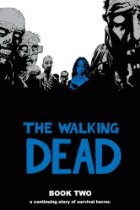
Book Review: The Walking Dead, Book 2 by Robert Kirkman (Series, #2) (Graphic Novel)
 Summary:
The rag-tag group of survivors of the zombie apocalypse stumble upon a prison with two circles of fences just in time. With the warm weather more zombies are active now that they’re no longer frozen. Of course they also discover locked in the cafeteria three surviving inmates. Attempts to make the odd mix of original survivors, inmates, and the farmers into one group might be a task too huge to overcome. Especially when you add in a mysterious woman who arrives with two pet zombies she leads by chains.
Review:
Now that Kirkman has the post-apocalyptic zombie world firmly established, he is more free to move his characters around within it, seeing how different personalities and mores react to an entirely reordered society. This leads to some interesting storylines, such as the May/December romance, suicide pacts, and the idea of a fresh start for the living inmates. It does, however, also lead to some….overly dramatic speeches, let’s say. One in particular reminded me of the infamous “Live together, die alone” speech from Lost, only this one goes, “You kill; you die!” I had to stop reading for a minute to giggle. The close-up of the sheriff’s overly dramatic face had me in stitches, and I”m pretty sure that wasn’t the intended reaction, lol.
That said, though, all of the drama and death and zombies is exactly what one is looking for in a zombie graphic novel. If anything gives a writer an excuse to be overly dramatic, it’s a rag-tag bunch of survivors of the zombie apocalypse. Death and chaos are what we’re looking for here, while also addressing survival issues like farming and people having nervous break-downs. There’s also a creative zombie lore twist that I won’t spoil for you, but that is highly enjoyable.
Overall, Kirkman finds more stable footing in this second entry in the series. It’s chaotic, high-speed disasters, violence, and sex. If that’s what you look for in your graphic novels, I highly recommend this one.
4 out of 5 stars
Source: Public Library

Previous Books in Series:
The Walking Dead, Book 1 
Book Review: The Egyptian by Layton Green (Series, #2)
 Summary:
Dominic Grey, previously a government worker and before that a champion jiu-jitsu fighter, is now working for Professor Viktor Radek on private detective cases frequently involving religious mysteries and the occult. His first case seems straight-forward enough–retrieve a vial stolen from a biomedical company in Egypt. But there’s more to this biomedical company than meets the eye, and Dominic soon finds himself racing around the globe from New Jersey to Bulgaria to Cairo in an attempt to unravel a mystery involving what just might be the elixir of life.
Review:
This follow-up to The Summoner (review) lives up to the excitement and global noir feel of the original without retracing the same steps. This holds promise for the series as a whole as one issue in writing serial detective novels is keeping everything fresh for the reader.
Green has either traveled the world extensively or done a ton of research, as his writing shows an intimate knowledge of the various areas of the world Dominic’s work takes him that is only evidenced by those who have been there. It is easy to tell when a writer intimately knows the setting they are speaking of, and this is clear in Green’s work. This lends an extra edge of excitement to the work.
Dominic’s character develops at a believable rate in this entry of the series. Who he is at the core is still the same, but his work and his encounters with a variety of people lead him to question himself, his life, and his intentions. I also appreciated that instead of pulling a 007 and moving on to the next woman without thinking much of his love interest from the first book, Nya, Dominic struggles with his emotions about the women he sleeps with. He is certainly no saint when it comes to the opposite sex, but the way he deals with women strikes a believable middle.
Unfortunately, Viktor does not feature as prominently this time around, and he also appears to be on a bit of a downward slope in his fondness for absinthe. I hope his character will be addressed more fully in the next entry in the series.
Two of the new characters added this time around are particularly enjoyable–Veronica (the love interest) and Jax (an international mercenary). I actually fell for Jax much harder than I’ve fallen for Dominic. He is from small town America with no ties to family, completely confident in the most rural corners of the world. He’s brassy, witty, and clearly has a bit of a good streak buried in him somewhere. I think both the ladies and the men reading the series will enjoy his presence, and I hope he’ll pop up in later entries (or even get his own spin-off series). Veronica is enjoyable for different reasons. She’s a career woman starting to question where her life is heading and falls for the guy she can’t have. It may seem cliche, but that sort of thing happens all the time in real life. She’s sympathetic without being pathetic. Also, personally, I found her a lot more enjoyable than Nya. She’s more assertive with Dominic; let’s just leave it at that. ;-)
The writing style itself still struggles in places on the sentence level. Sometimes Green tries too hard to sound philosophical, and it comes across as forced. Similarly, some paragraphs lean a bit too heavily on showing, not telling. The instances of this occurring are fewer than in the previous book, though, and it is obvious that Green is working hard on improving his craft. Personally, I did not find that these instances distracted me from the exciting plot at all.
Overall, The Egyptian is a fast-paced, unpredictable detective mystery, perfect for those looking for a light-weight, page-turner for their evenings or the beach.
4 out of 5 stars
Source: Free kindle copy from the author in exchange for review
Buy It
Note: The Egyptian and The Summoner are on sale for 99 cents for this release weekend only (August 27th and 28th)

Previous Books in Series:
The Summoner, review
Book Review: The Vampire Lestat by Anne Rice (Series, #2)
 Summary:
Lestat, the maker of Louis and Claudia, takes center stage here to tell his own origin story, as well as explain why he has chosen to come out as a vampire rock star in the 1980s. Starting with his beginnings as a rural member of the ruling class prior to the French Revolution, we discover the origins of the Vampire Theater, as well as the origins of vampires themselves.
Review:
The Vampire Lestat is an excellent example of an incredibly well-executed character study. Although we learn things about vampires and their origins, the real crux of the story is who Lestat is. Why he acts the way he acts. How his innate personality affects his life and the lives of those around him. We see how over the course of time he may adapt to new ages and customs, but he is still Lestat. What makes him who he is does not change in spite of all his experiences. This doesn’t mean he doesn’t learn anything, but instead it simply means he is who he is. It is a remarkable example of how people are simply who they are.
Lestat is much more sympathetic a character than Louis. Whereas Louis mostly sits around pouting about what happens to him, Lestat is a fighter.
I never despair! Others do that, not me. I go on fighting no matter what happens. Always. (page 199)
He’s more than a fighter though; he’s also desperate for love. He did not choose to become a vampire. It happened to him, and now he is conflicted as to how to find love when he is essentially a monster.
You sense…my bitterness that I’m evil, that I don’t deserve to be loved and yet I need love hungrily. (page 355)
What truly makes Lestat Lestat though is his impulsivity. Lestat just does things because they feel like something he absolutely must do. He does not concern himself with consequences; he simply acts. This makes those vampires who love him simultaneously frustrated and amazed. They love him for his lack of restraint, but they also worry for him and themselves.
Beyond the great example of studying a character at length, though, Rice’s writing is simply beautiful to read. There as an elegance and a flow to it that pairs up perfectly with the story of a centuries old rock star vampire. I actually read about three pages aloud on skype to a friend simply to revel in how beautiful the language is. For example:
Laughter. That insane music. That din, that dissonance, that never ending shrill articulation of the meaninglessness. (page 358)
This is the type of writing that is a pleasure to read. It feels like treating yourself to a glass of fine wine for your brain. I highly recommend it to all. You do not have to be a fan of vampires to appreciate the language and rich character study it contains.
5 out of 5 stars
Source: PaperBackSwap


Previous Books in Series:
Interview with the Vampire, review
Book Review: Rage by Jackie Morse Kessler (Series, #2)
 Summary:
Melissa Miller is your typical 16 year old–mom, dad, annoying sister, a jerk of an ex-boyfriend–with one small difference. She deals with her emotions by cutting herself. She keeps a razor in a locked box in her closet and pulls it out when she gets overwhelmed. One night she accidentally cuts too deep, and Death shows up with an option. Either die now or become one of the Horsemen of the Apocalypse–War. Missy chooses the latter option, and as she gets to know the other Horsemen and her job as War, she starts to realize she needs to face the rage inside her.
Review:
Speaking as someone who knows a lot about mental illness, self-injury is one of the illnesses that people who don’t have it have the most difficulty understanding. It seems bizarre to those who don’t self-injure, even as for the self-injurer those moments of cutting or burning or whatever chosen method are the best coping mechanism they can come up with. It’s not easy for those who don’t self-injure to understand, which is why I am so impressed at how well Morse Kessler has grasped the inner workings of the self-injurer in order to write such a well-rounded, sympathetic character as Missy.
Missy is simultaneously relatable as a typical teenager, for instance she gets horribly embarrassed at a party one night, but she also has this deep, dark, misunderstood secret. Gradually other teens find out and are either concerned or lash out at her due to their fear and lack of understanding, but Missy feels that she can’t confide in even the sympathetic ones. In perhaps one of the most powerful passages, the reader gets to see exactly why Missy cuts, while she simultaneously explains why she can’t explain it to her sister.
She could tell her that she turned to the blade because she wanted to live and sometimes pain was the only thing that kept her alive. She could tell her that she was terrified of things she couldn’t even begin to name, that friends could be fickle and lovers could be false. She could try to explain all of that and more, and maybe her sister would understand. But trust was as fragile and cutting as a crystal sword. (page 100)
That is perhaps the most clear, succinct explanation of self-injury I’ve seen outside of nonfiction clinical books. Missy’s reasons for cutting are clear, even as it becomes more and more evident to the reader that this coping mechanism is not truly addressing Missy’s real problems.
Of course, the fantasy element comes to play here again, and it works perhaps even better this time around. Giving the fantasy personas for Missy to talk to and express herself to gives her a safe space to think out her emotions instead of cutting them out. There are also a few cameos from Famine, which is fun to see after reading the first book. The fantasy also works here because it helps give the book a distance that makes it less triggering. There are intense emotional moments, but then Death shows up with a humorous quip to lighten the situation. It addresses the real problems without getting bogged down in over-emotionality.
This book will give self-injuring teens a way to see themselves reflected in literature and accepted and loved for who they are. It will give them a chance to maybe address their own emotions and issues. Similarly, non-self-injuring teens will hopefully become more empathetic to their peers who struggle with it. It’s a book that is simultaneously enlightening but not preachy. I highly recommend it to teens and those who work in mental health or with teenagers.
5 out of 5 stars
Source: Amazon

Previous Books in Series:
Hunger, review
Counts For:

Book Review: Mr. Monster by Dan Wells (Series, #2)
 Summary:
John Wayne Cleaver, diagnosed sociopath and assistant in his family’s morgue, is trying to recover from the aftermath of the demonic serial killer that was haunting Clayton County until a few months ago. A few months ago when he let loose his own inner sociopath, otherwise known as Mr. Monster, and killed the demon. For the sake of the town. Now he is struggling to get Mr. Monster back under control as well as deal with new feelings for his neighbor, Brooke, both of which would be easier if the demon hadn’t killed his therapist. In spite of all this, things seem to be slowly calming down–until new dead bodies start showing up.
Review:
In a series such as this, the second book is rather crucial. In the first book, we see John trying to deal with his mental illness in the normal ways, only to be confronted with an abnormal solution. He takes it. The next book must then show not only if John continues down this path, but also why, not to mention set up the structure so that he may continue down this path indefinitely for most of the rest of the series. Wells definitely accomplishes this tough task, although not quite as smoothly or uniquely as he set up the initial plot and character of John in the first book.
One thing that this book suffers from is uneven pacing. Whereas the first book used the classic thriller scenario of gradually amping up the tension, here the tension rises and falls so frequently and to such different levels that it’s a bit off-putting. It provides too many moments where it’s not too distressing to put the book down and go do something else. It is only the last few chapters of the book that hold the same tension as in the first entry in the series. This is problematic when this is supposed to be a thriller, but understandable given all of the set-up and developments that Wells must pull off.
The new demon is definitely well-done and scary in his own way, although I must say I guessed who he was pretty much the instant he showed up in the book. Thus, what was shocking was not who the demon is, but what he does to his victims, why, and how he pulls it off. This part is creative and thankfully it is evident that the demons in the series will be variable and non-formulaic. This is essential if the elements of surprise, disgust, horror, and delight are to remain.
Yet the focus is not just on the demons, thankfully. Wells skillfully still includes the issues John faces as someone struggling with a rather non-sympathetic mental illness, making him alternately relatable and grotesque. John struggles. He is sometimes unlikable, but he tries so damn hard. Similarly, Wells continues to develop the messed-up family structure John has to deal with, an issue that is absolutely relatable to most readers of YA lit. There is much more going on here than demon fighting. Indeed, even John’s first romantic interest is addressed.
I feel the need to say to animal lovers, particularly ones who love the wonderful kitties among us, that there is a very distressing scene in this book involving a cat that almost made me stop reading it. I do think Wells handles it well, including the aftermath, but if you find animal cruelty incredibly upsetting, um, either skip this book or skim that section. You’ll know when it’s coming.
Overall, this entry in the series does well for all the tasks it had to do to smoothly connect the set-up in the first book to the running themes of the rest of the series. Although the pacing struggles a bit, characterization is still strong, as are surprising plot points. I’m interested to see what Wells does with the next book in the series, and I recommend this one to fans of psychological and paranormal thrillers alike.
4 out of 5 stars
Source: PaperBackSwap

Previous Books in Series:
I Am Not a Serial Killer, review
Counts For:
 Support my work with a tip or browse my shop for curated book club guides, how to guides, cross-stitch patterns, and more!


This work by Amanda Nevius is licensed under a Creative Commons Attribution-Noncommercial-No Derivative Works 3.0 United States License.
 Opinions of a Wolf