
Archive
Book Review: The Last of the Demon Slayers by Angie Fox (series, #4)
 Summary:
Lizzie is back from Greece with her hunky griffin boyfriend, Dimitri, and the geriatric witch biker gang (not to mention her talking dog Pirate and Pirate’s pet adolescent dragon Flappy) with plans to help the witches finally set up a real home at a New Jersey biker bar after years on the run. Of course nothing has ever gone according to Lizzie’s plans since the day she turned 30 and inherited her demon slayer powers. Naturally, her birth father shows up in a pillar of fire begging her to help free him from a bad situation with an even badder demon in California. Thus, Lizzie and the gang wind up following fairy trails across the country in an attempt to stop the demon, who just so happens to be out to kill demon slayers too.
Review:
Ah, this series. I have such a love/hate relationship with this series! That’s mainly because I love everyone except Lizzie and Dimitri. Why why is everyone else in this world so hilarious and relaxed, whereas Lizzie and Dimitri are basically THAT couple. You know THAT couple. They’re the ones who met each other during freshman orientation week and proceeded to have the perfect dream relationship throughout all four years of college and promptly moved in together and got engaged after. They’re the ones where the girl whines and bitches to you about some minor fight she had with her dude during your junior year when you’ve barely slept in three days and haven’t had a date in months. THAT COUPLE. It’s hard to root for that couple.
On the other hand, though, there’s everyone else. The geriatric biker witches are amazeballs. I would pay good money to have a bunch of older women like that in my life. They’re strong, empowered, and bound and determined to live their life to the fullest no matter what society says they should be doing. Interestingly, grandma gets a boyfriend this entry, and Lizzie is none too happy about it. Grandma tells her unequivocally that old people have sex. Yes! What? Lizzie is the only one who should be making everyone eye-roll with her sexy antics? I think not.
Then of course there’s Pirate and Flappy. Hilarious animal characters hit my heart *right here*. I would put up with almost anything just to see Pirate trying to train Flappy to sit. Seriously. Fox has a real talent for writing animal dialogue that is believable without being too sophisticated. It’s clear she has some critters in her life. For instance, Pirate runs up to Lizzie excited to see her yelling “Lizzie! Lizzie! Lizzie!” and then proceeds to beg for food. Typical doggy.
The plot definitely thickens in this entry. I’m not sure I’m totally happy with how it has. Essentially, it turns out there are actually more demon slayers, and as a Buffy fan, this just irritated me. I don’t like being told there’s only one only to have more show up. Either there are a lot of slayers or there aren’t. Plus, did we really have to make the new slayer so feminine? Lizzie is already a pretty extraordinarily feminine slayer. It’d be nice to have some variety. On the other hand, the rest of the plot of the supernatural world is interesting. There’s Lizzie’s father plus a visit to purgatory. I’m betting that the next entry will start to confront the presence of “good” supernatural creatures, since we’ve now visited hell and purgatory. If Dante taught me anything, it’s that that leaves only one place to go.
It’s interesting how I can’t stop reading this series even though I can’t seem to make up my mind how much I like it. I’ve rated entries everywhere from 3.5 to 5 stars. I think in general the experience of the hilarious side-kicks and minor characters off-sets the annoying main couple enough that I can kinda sorta mostly ignore them. There’s also always the hope that they’ll break up, which I root for in every book.
Overall, if you’ve stuck with the series this far, you’ll enjoy this entry. It takes the focus off the griffins and puts it back on Lizzie and her biological family. The ever-expanding cast of characters all fit together smoothly and hilariously.
3.5 out of 5 stars
Source: Amazon

Previous Books in Series:
The Accidental Demon Slayer, review
The Dangerous Book for Demon Slayers, review
A Tale of Two Demon Slayers, review
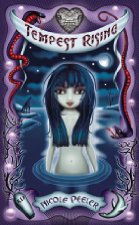
Book Review: Tempest Rising by Nicole Peeler (series, #1)
 Summary:
Jane True lives in a small coastal town in Maine and cares for her father, a stubborn fisherman who refuses to leave his hometown. This means Jane is stuck in a town where everyone pretty much thinks she’s crazy. Everyone except the lesbian couple who run the local bookstore where she works. Even Jane thinks there’s something off about herself what with swimming near the deadly whirlpool The Sow in the ocean in the middle of the night in the winter on a regular basis. But then a neighbor winds up dead, mysterious people show up, and Jane finds out she’s half-selkie, and nowhere near as crazy as she once thought.
Review:
First things first. I absolutely, completely, 100% love the character of Jane True. If she lived in my neighborhood, we’d definitely be the best of friends. She’s smart and loyal with a biting, classic yankee sense of humor. At the same time though, she’s human, flawed, and makes mistakes but not the sort of mistakes that would make you hate her. I also really related to her relationship with her father, as mine has the same debilitating heart disease that her father has. Seeing her see in him the same, strong, blue collar daddy who raised her and who now is struggling with an illness was really refreshing to see in a paranormal romance. It seems like dads tend to be absent in the genre in general, when let’s face it, a lot of women’s dads remain an integral part of their life, even when grown-up.
The storyline itself is fairly complex, and it was a delight to see modern rural New England in literature. The characters also take a random jaunt up to Quebec, which honestly we definitely do periodically. I’ve been to Canada more times than I’ve been to the American south for instance. The settings were fabulous and well-envisioned. Normally I would complain about Jane’s love interest, but it’s obvious to me that she’s going to outgrow him with time.
The one thing I actually didn’t like about the book was the sex scenes, which is kind of problematic for a paranormal romance since that’s kind of half the point. Jane insists her man uses a condom. Ok, fine, write that in there once and then we’ll assume that they have safe sex for the other encounters. The thing is though, Mr. Man Candy complains about having to use a condom every single time, and every single time asks her if they really have to….by dangling the wrapped condom in her face. This is not sexy behavior! This is reason to ditch a guy behavior. She said use it, that means use one until she says otherwise quit being a baby. And frankly, quit ruining my sexy reading by turning into an asshole right before the sexy times. The whole entire sex scene situation is problematic throughout the book, and just gets worse each time they do it. There’s one scene in particular when Jane is down on her hands and knees, and the dude is behind her, and he dangles the condom in her face. Like randomly he’s behind her, she’s getting excited, he’s touching happy places, then bam there’s a condom in her face. WTF. This is not how paranormal romance should work. I get it that we’re not supposed to 100% like the guy, and this is part of the way of showing us he’s an asshole, but still. I hope the whole sex scene situation improves in the next book.
Overall, the character is a rich, engaging, Mainiac with a biting sense of humor, and the world Peeler has created is diverse and engaging. Hopefully the boyfriend situation improves in the later books. Given how much I like the main character (which is rare in paranormal romance), I’ll definitely be reading the next entry. If she sounds engaging to you as well, and you like paranormal romance, you’ll most likely enjoy this book.
3.5 out of 5 stars
Source: Amazon


Book Review: The Vampire Lestat by Anne Rice (Series, #2)
 Summary:
Lestat, the maker of Louis and Claudia, takes center stage here to tell his own origin story, as well as explain why he has chosen to come out as a vampire rock star in the 1980s. Starting with his beginnings as a rural member of the ruling class prior to the French Revolution, we discover the origins of the Vampire Theater, as well as the origins of vampires themselves.
Review:
The Vampire Lestat is an excellent example of an incredibly well-executed character study. Although we learn things about vampires and their origins, the real crux of the story is who Lestat is. Why he acts the way he acts. How his innate personality affects his life and the lives of those around him. We see how over the course of time he may adapt to new ages and customs, but he is still Lestat. What makes him who he is does not change in spite of all his experiences. This doesn’t mean he doesn’t learn anything, but instead it simply means he is who he is. It is a remarkable example of how people are simply who they are.
Lestat is much more sympathetic a character than Louis. Whereas Louis mostly sits around pouting about what happens to him, Lestat is a fighter.
I never despair! Others do that, not me. I go on fighting no matter what happens. Always. (page 199)
He’s more than a fighter though; he’s also desperate for love. He did not choose to become a vampire. It happened to him, and now he is conflicted as to how to find love when he is essentially a monster.
You sense…my bitterness that I’m evil, that I don’t deserve to be loved and yet I need love hungrily. (page 355)
What truly makes Lestat Lestat though is his impulsivity. Lestat just does things because they feel like something he absolutely must do. He does not concern himself with consequences; he simply acts. This makes those vampires who love him simultaneously frustrated and amazed. They love him for his lack of restraint, but they also worry for him and themselves.
Beyond the great example of studying a character at length, though, Rice’s writing is simply beautiful to read. There as an elegance and a flow to it that pairs up perfectly with the story of a centuries old rock star vampire. I actually read about three pages aloud on skype to a friend simply to revel in how beautiful the language is. For example:
Laughter. That insane music. That din, that dissonance, that never ending shrill articulation of the meaninglessness. (page 358)
This is the type of writing that is a pleasure to read. It feels like treating yourself to a glass of fine wine for your brain. I highly recommend it to all. You do not have to be a fan of vampires to appreciate the language and rich character study it contains.
5 out of 5 stars
Source: PaperBackSwap


Previous Books in Series:
Interview with the Vampire, review
Book Review: Rage by Jackie Morse Kessler (Series, #2)
 Summary:
Melissa Miller is your typical 16 year old–mom, dad, annoying sister, a jerk of an ex-boyfriend–with one small difference. She deals with her emotions by cutting herself. She keeps a razor in a locked box in her closet and pulls it out when she gets overwhelmed. One night she accidentally cuts too deep, and Death shows up with an option. Either die now or become one of the Horsemen of the Apocalypse–War. Missy chooses the latter option, and as she gets to know the other Horsemen and her job as War, she starts to realize she needs to face the rage inside her.
Review:
Speaking as someone who knows a lot about mental illness, self-injury is one of the illnesses that people who don’t have it have the most difficulty understanding. It seems bizarre to those who don’t self-injure, even as for the self-injurer those moments of cutting or burning or whatever chosen method are the best coping mechanism they can come up with. It’s not easy for those who don’t self-injure to understand, which is why I am so impressed at how well Morse Kessler has grasped the inner workings of the self-injurer in order to write such a well-rounded, sympathetic character as Missy.
Missy is simultaneously relatable as a typical teenager, for instance she gets horribly embarrassed at a party one night, but she also has this deep, dark, misunderstood secret. Gradually other teens find out and are either concerned or lash out at her due to their fear and lack of understanding, but Missy feels that she can’t confide in even the sympathetic ones. In perhaps one of the most powerful passages, the reader gets to see exactly why Missy cuts, while she simultaneously explains why she can’t explain it to her sister.
She could tell her that she turned to the blade because she wanted to live and sometimes pain was the only thing that kept her alive. She could tell her that she was terrified of things she couldn’t even begin to name, that friends could be fickle and lovers could be false. She could try to explain all of that and more, and maybe her sister would understand. But trust was as fragile and cutting as a crystal sword. (page 100)
That is perhaps the most clear, succinct explanation of self-injury I’ve seen outside of nonfiction clinical books. Missy’s reasons for cutting are clear, even as it becomes more and more evident to the reader that this coping mechanism is not truly addressing Missy’s real problems.
Of course, the fantasy element comes to play here again, and it works perhaps even better this time around. Giving the fantasy personas for Missy to talk to and express herself to gives her a safe space to think out her emotions instead of cutting them out. There are also a few cameos from Famine, which is fun to see after reading the first book. The fantasy also works here because it helps give the book a distance that makes it less triggering. There are intense emotional moments, but then Death shows up with a humorous quip to lighten the situation. It addresses the real problems without getting bogged down in over-emotionality.
This book will give self-injuring teens a way to see themselves reflected in literature and accepted and loved for who they are. It will give them a chance to maybe address their own emotions and issues. Similarly, non-self-injuring teens will hopefully become more empathetic to their peers who struggle with it. It’s a book that is simultaneously enlightening but not preachy. I highly recommend it to teens and those who work in mental health or with teenagers.
5 out of 5 stars
Source: Amazon

Previous Books in Series:
Hunger, review
Counts For:

Book Review: The Land of Painted Caves by Jean M. Auel (Series, #6)

Summary:
All of Ayla’s unique life situations–from being adopted by the Clan to living in a valley by herself to her long Journey with Jondalar–have been combining to make her into a great, powerful woman. In this final entry in the Earth’s Children series we witness her transformation from Ayla to Zelandoni shaman of the Zelandonii.
Review:
As a fan of the Earth’s Children series since the age of 15, there is just no way I can review this epically disappointing, long-awaited finale to the series without spoilers. So, be warned, this whole post is going to contain spoilers, because there is just no way I can possibly not talk about everything that went horribly awry here.
First there is the incredibly huge issue of plot. The book is divided into three sections. The first section is entirely Ayla wandering around looking at caves with Zelandoni. Which would be fine. If the caves had anything particularly unique about them or anything exciting happened in the caves or if we weren’t told repeatedly “here’s a horse painting, here’s a cave lion painting, here are dots that mean something to the Zelandoni but I won’t ever tell you what they mean because where would the fun in that be?” Oh sure, there are hints that something more exciting might happen, but nothing ever does. It’s like Auel thought about putting action in, but then decided it’d be way easier to talk more about the badly painted and scratched in horses in these caves that for some reason the Zelandonii think are so incredibly sacred. Oh yeah. I remember why. Because they’re supposedly the vagina of the Earth Mother. Think about that for a second. These people are worshiping in sacred vaginas.
Then we have the second section which mysteriously jumps forward four years in Ayla’s acolyte training because for some reason we couldn’t possibly be interested in that, oh no, there’s nothing interesting about ceremonies or studies. Instead, we get to jump ahead four years and go on Ayla’s Donier tour. Do you know what Ayla’s Donier tour is? Going around Zelandonii territory to look at MORE CAVES. This traveling could possibly be interesting. We have foreshadowing multiple times that something bad is going to happen to Ayla, particularly that a band of evil bad rapist men are going to kidnap her and drag her off. But no. They grab her and Jondalar somehow miraculously goes from in front of the evil band of rapist men to behind them, breaks the leather-thong assisted choke-hold the dude has on Ayla, and saves her from them. Then the Zelandoni beat them to death in an instance of mob justice. Well. At least something sort of happened?
The third section jumps ahead two more years (skipping almost all the rest of Ayla’s acolyte training) to yet another summer meeting, which Ayla has to come to part-way through because she had to stay back to complete her final assignment of training. Ayla has a vision in a cave (oh, we’ll get to that in a minute) and then goes to the summer meeting where she walks in on Jondalar getting naked sexy head from the one woman in the Ninth Cave of the Zelandonii immune to liking Ayla. No, I am not joking. Jondalar, the oh I am Ayla’s soulmate and we will be together forever and I love her so much has totally been cheating on her for almost the entire last two years of her acolyte training. Because she was busy. Because a man has needs. Because the ho offered herself to him and why on earth would Jondalar say no? I am not joking, that is the tone of the book in the whole revelation of cheating thing. PLUS, the whole cave knew about it and hid it from Ayla to protect her feelings. Ayla, naturally, knows jealousy is taboo in Zelandonii society, so instead of confronting the cheating bastard she first has sex at a Mother Ceremony (ahem, orgy) with the dude Jondalar hates most in the Ninth Cave, and then she decides life isn’t worth living and tries to kill herself with the Clan root. This from a woman who has three horses, a wolf, and a freaking 6 year old daughter to look after. The only thing that saves her, naturally, is Jondalar’s undying love. It took all of my self-control not to throw my kindle across the room. Well, and also my intense love for my kindle.
So for two-thirds of the book nothing really happens, and then in the last third our two heroes both turn into loathsome people. Good. Times.
Ok, so, the plot takes a complete nose-dive off Niagara Falls without a barrel while holding your beloved kitten. What about the supposedly key element of the book and series? What world-changing thing does this special woman, this powerful shaman, bring about? Allow me to quote the new verse of the Earth Mother’s Song that is revealed to Ayla at the climax:
Her last Gift, the Knowledge that man has his part.
His need must be spent before new life can start.
It honors the Mother when the couple is paired,
Because woman conceives when Pleasures are shared.
Earth’s Children were blessed.
The Mother could rest. (page 540)
Yes. That is right, people. The reason for this woman existing is to reveal to these dim-wits that sex, not the Earth Mother mixing spirits, causes babies. Allow me to repeat that. Ayla’s big contribution to pre-historic society is to teach these people the birds and the bees.
I wish I could say it gets better from there, but it doesn’t. First Ayla has to convince the other shamans (Zelandoni) that this is true. They, naturally, don’t want to believe it. The lead Zelandoni convinces them that they must tell the people in a huge ceremony, because this will be life-changing. Then we have, quite possibly, the most eyeball-widening, face-palming, head:desk inducing passage I have ever read. The ceremony, meetings, and Mother’s Celebration that go along with it. I won’t put you through the pain of all of it, but allow me to show you a good sample. The passage in which the lead Zelandoni explains what to call the men who are also parents:
He is a far-mother, a fa-ther. It was also chosen to indicate that while women are the Blessed of Doni, men may now think of themselves as the Favored of Doni. It is similar to ‘mother,’ but the fa sound was chosen to make it clear that it is a name for a man, just as ‘fa’lodge’ is the name for the men’s place. (page 676-7)
I just…..there are no words for the inanity of it all.
Then, of course, all the men overnight turn into possessive, abusive, over-aggressive douchebags since now they know that their sperm has magical powers. The book ends with the very heavy-handed suggestion that this revelation is what caused the move from matriarchy to patriarchy.
Oh, but it gets better. To put one final touch of absurdity on the whole thing, we also finally get to find out what happened to the Neanderthals (Clan). Ayla still has the black stone that contains a piece of every Clan member’s spirit in it from when she was a medicine woman for them. A vision reveals to her that when Broud cast her out with the death curse, she forgot to leave the stone behind and thus caused the death of the entire Clan. Yeah. Really. That’s what happens. All of this build-up, and we find out that Ayla reveals the birds and the bees, kills matriarchy, and kills the Neanderthals. What. The. Fuck.
As if the meandering plot and completely inane and horrifying huge reveals weren’t bad enough, something happened to Auel’s writing style. I like to call it “let me give everything really long names and repeat myself a lot” Just one example of the plethora of overly long names is “Zelandoni Who Was First Among Those Who Served The Great Earth Mother.” That would be less painful, maybe, if Auel didn’t also repeat herself all the time. Almost every time the lead Zelandoni shows up, we are reminded that she is a very large woman. Almost every time Ayla speaks, someone notices her foreign accent. Almost every time someone sees Jonayla (kill me now with that name), someone notices that she has Jondalar’s eyes. Enough already! We know! Stop telling us!
Between the meandering plot, completely what the fuck ending, and simply bad writing, I can’t recommend this book to anyone. My best advice to fans of the series, or those interested in it, is to pretend that it ends with The Mammoth Hunters and Jondalar riding off into the sunset with Ayla. Just pretend it stops there. Ignore his people. Ignore Ayla’s calling. Ignore the Journey. Just ignore the whole thing. Take the characters and world back from Auel who completely mistreated them and let them exist in your mind the way they were at the end of The Mammoth Hunters. Do not waste your time or hurt your brain reading this book. Just…..don’t.
1 out of 5 stars
Source: Amazon

Previous Books in Series:
The Clan of the Cave Bear
The Valley of the Horses
The Mammoth Hunters
The Plains of Passage
The Shelters of Stone
If you found this review helpful, please consider tipping me on ko-fi, checking out my digital items available in my ko-fi shop, buying one of my publications, or using one of my referral/coupon codes. Thank you for your support!
Book Review: Undead and Unemployed by MaryJanice Davidson (Series, #2)
 Summary:
Betsy may have dealt with the fact that she’s an undead blood-sucker, but she certainly is not ready to deal with the idea of being queen of the vampires for 1,000 years. Or mated to the horribly tricky Sinclair. The sexy, tricky Sinclair. She is focused on more important things, like her new job selling designers shoes at Macy’s. But when vamps start popping up dead a second time, her duty calls whether she wants to listen or not.
Review:
If somebody asked me to hand them the quintessential chick lit summer beach read, I’d toss the Queen Betsy series at them. Light, short, set in a cool climate, and one guaranteed hot sex scene per book. Great literature it ain’t, but I’ve definitely read far worse paranormal romance in my time, plus Davidson always manages to get at least a few chuckles out of me.
The one thing that baffles me is that I truly hate Queen Betsy. She is everything I loathe in *coughs* certain women: shallow, conceited, wears too much make-up, obsessed with shoes, self-centered. Yet for some reason I can’t help rooting for her. Maybe it’s that she didn’t ask to be queen of the vampires and yet still manages to rise to the occasion when needed that makes her bearable. This is a long series, and I do hope that Davidson will see fit to give us a good character arc for Betsy. Going from a shallow 20-something to a fully grown-up queen. I could dig that.
In the meantime, the storyline here in the second book was actually a bit more interesting than the first, although the mystery was quite easy to solve. Unfortunately, the laughs weren’t quite as frequent, which is what made the first book so enjoyable, but they are still present. Who reads paranormal chick lit for more than a few hours of giggles and horribly unrealistic vampire sex that knocks chunks of plaster out of the ceiling? If that’s what you’re looking for, you won’t go wrong with the Queen Betsy series.
3.5 out of 5 stars
Source: PaperBackSwap

Previous Books in Series:
Undead and Unwed, review
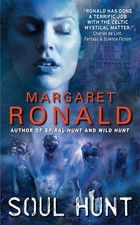
Book Review: Soul Hunt by Margaret Ronald (Series, #3)
 Summary:
Native Bostonian Evie Scolan is an adept bicycle courier and has her first real relationship in a while. Of course, her life isn’t quite that simple. First, she’s The Hound with an uncannily adept sense of smell that helps her find things. Plus her boyfriend is a werewolf. Then there’s the whole try to keep the magical Undercurrent in Boston under control so her beloved city doesn’t fall apart thing. Not to mention the death sentence given to her by yet another sector of the Undercurrent giving her only until Midwinter to pull everything together. Plus the Sox are sucking this season.
Review:
Yet again, I accidentally picked up a book that is partway through a series. I’ve noticed this is a lot easier to do when it’s an ebook than a print book, because the print book tends to have a giant “3” or something on the binding, whereas the ebook gives you zero clue that this is part of a series. Work on that, publishers. Due to this fact, I spent the solid first half of the book trying to figure out what the heck was going on in Evie’s world. Unlike paranormal romance that tends to offer up a quick recap of the important details, it would appear that urban fantasy isn’t so keen on that. Well, that and Ronald’s world she has created is incredibly complex and hard to understand fully part-way into a series.
That aside, however, how is it for an urban fantasy novel? Well, the fantasy element is strong and intensely connected to elements of urban living from good and bad neighborhoods to trolley tracks to old, abandoned buildings, to secret tunnels and ghosts. This has it all if you’re after some seriously steeped fantasy.
Further, as a Bostonian myself, I can tell you that Ronald gets the local slang and layout of the neighborhoods right. Personally, I think she’s a bit heavy-handed with the Red Sox love demonstrated by Evie. I don’t really think Evie would be thinking about the Sox season sucking when she’s currently facing death, but maybe I’m just not enough of a fanatic myself. Hah.
I think, perhaps, that why I couldn’t get into this partway through the way I could other series I started in the middle is that I don’t like Evie, and the mythos of the Undercurrent is way more confusing than it should be. I can’t think of very much that’s appealing or redeeming about Evie as a character, which is problematic when she’s the heroine. Similarly, she’s not beautifully broken or anything. She reads as just…..average. The fact that this is the case when she also has this weird supernatural nose is saying something. Make Evie evil! Make Evie kick-ass! Just don’t make her so dull that I have zero doubt that I wouldn’t give her a second glance if I happened to see her on the streets of Boston.
Similarly, the mythos of the Undercurrent seems to change to suit the author’s needs. Maybe I was missing plot twists from missing the earlier books, but it all just seems so much more complex than it needs to be. Plus, what exactly makes Evie repeatedly go up against demigods when her only supernatural talent is the nose thing? It just doesn’t make sense to me. That and the whole part dog thing is just….ew.
I came into this wanting to love it, as I do with any book set in my home of Boston. The fact is though, too much turned me off from it. It is a fairly well-written urban fantasy, though, and a nice change from the typical southern setting we see. I’d recommend it to urban fantasy fans looking for a change of scenery who don’t mind a rather ordinary heroine who’s basically part dog.
3 out of 5 stars
Source: Amazon

Previous Books in Series:
Spiral Hunt
Wild Hunt


Book Review: Hunger by Jackie Morse Kessler (Series, #1)
 Summary:
Lisabeth Lewis thought it was just a nightmare. Death coming to her when she tried to commit suicide with her mom’s antidepressants and offering to make her Famine–one of the four horsemen of the apocalypse–instead of letting her die. It’s just all way too ironic, her as Famine. After all, she’s fat. She has to watch what she eats very carefully. The Thin voice tells her all the time exactly how many calories each bit of food is and how much exercise it’ll take to burn it off. Yes. Lisabeth Lewis is fat. So why would Death assign Famine to her anyway?
Review:
When I heard the concept of this new YA series–each horseman of the apocalypse representing and dealing with a mental health issue relevant to teens–I was incredibly skeptical. Writing about mental illness in a way that teens can relate to without talking down to them as well as in a responsible manner is difficult enough without having a fantasy element present. Toss in the fantasy and I was worried this would either read like one of those old 1950s cautionary films shown in highschools or would miss dealing with the mental illness entirely. Boy was I wrong. Kessler has found such a unique, creative way to address a mental illness yet cushions it in the fantasy so that it isn’t too in your face. It’s the ideal scenario for teens reading about it, but it’s also enjoyable for adults.
The fantasy element is very tongue-in-cheek. It strongly reminds me of Buffy the Vampire Slayer in style. For instance, Death resembles a heroin-chic dead rock star, and he speaks in a mix of classic English and mocking teen speak to Lisa.
“Thou art Famine, yo,” Death said. “Time to make with the starvation.” (Location 661)
It quickly becomes apparent that Death and the Horsemen aren’t entirely what they initially seem to be. Indeed, they seem to function to get Lisa out of her own head and problems and to look at the greater world around her. She literally travels the world on her horse and sees real hunger, and it affects her. It doesn’t make her feel guilty for being anorexic, but it makes her want to be better so she will be strong enough to help others. That’s a key element of any mental illness treatment. Getting the person to see outside of themselves, and Kessler has personified it through the Four Horsemen.
She, Lisabeth Lewis, seventeen and anorexic and suicidal and uncertain of her own path–she’d done something that mattered. She’d ignored her own pain and had helped others. Maybe she wanted to live after all. (Location 2007)
Of course the non-fantastical passages dealing with Lisa’s anorexia and her friend’s bulimia are incredibly realistic. If they weren’t, the book would immediately fail as the whole thing would ring false to the teens reading it. Her anorexia is dealt with as a very real thing even as the Four Horsemen are presented as either truth or hallucinations of her starved mind. This is key. The anorexia cannot be presented as an element of fantasy.
I was concerned the ending would be too clean-cut. I won’t give any spoilers, but suffice it to say, Kessler handles the ending in a realistic, responsible manner. There are no easy solutions, but there are solutions to strive for.
Overall, Hunger takes the incredibly real problem of anorexia and presents it with a touch of fantasy to help bring the reader not only into the mind of the anorexic but also outside of herself to look at the bigger picture. It is an inspiring, fresh take on YA lit dealing with mental illness, and I highly recommend it to fans of YA lit as well as those interested in literature dealing with mental illnesses.
5 out of 5 stars
Source: Amazon

Counts For:

Book Review: Touched by an Alien by Gini Koch (Series, #1)
 Summary:
Katherine “Kitty” Katt manages to get released early from a dull day of jury duty only to find herself confronted with an angry man who sprouts wings and starts flinging knives from their tips toward everyone in the vicinity. Kitty attacks and stops him and quickly finds herself sucked into a world she was unaware existed. A world of alien refugees defending Earth and themselves from a bunch of fugly alien parasites. She soon discovers her ordinary parents are more involved in this secret world than she would ever have dreamed. On top of that, she’s increasingly finding herself falling for one of the alien hunks who announced his intentions to marry her almost immediately upon meeting her.
Review:
I received a free Kindle edition of the second book in the series, Alien Tango, last year and read it without realizing at first that it was part of a series. I immediately fell in love with the world and Kitty and decided I needed to go back and read the first entry in the series. This reverse approach definitely gave me a different perspective on the story, but it certainly didn’t make me love it any less.
What makes this series epically entertaining is well-established in this first entry. First, the paranormal element is aliens in lieu of something more widely used. Everything has the clean, secret government agency tinge to it instead of the dirty mafia feel many other paranormals elicit. The aliens are aliens, yes, but they’re also a secret government agency. Imagine Men in Black only the men in black are all aliens.
Second, Kitty Katt is a heroine who clearly epitomizes the modern woman. She can take care of herself, but that doesn’t mean she doesn’t like having a man around too. She’s smart, witty, sassy, and sexy, but she has her flaws and weak spots too. She has sex on the day she meets a man, but she’s still aware enough of social norms that she takes care to attempt to hide that fact from the majority of people around her. On the other hand, she herself doesn’t regret that act in the slightest. She so clearly reflects what it is to be a modern American woman that I can’t help but applaud Gini Koch. I hope to see more heroines like Kitty Katt in the near future.
The action itself is vastly entertaining, particularly if you enjoy scifi. The fugly parasites are imaginative, disgusting, and frightening simultaneously. The Big Bad is scary and crafty. The solution to the Big Bad is seriously entertaining. I honestly cannot say enough good things about the scifi in this book.
Overall, Gini Koch’s Kitty Katt series has not failed to leave me glued to my iPod screen yet. It’s sharp, modern, unique, and vastly entertaining. I practically throw copies at lovers of paranormal romance to read, but also highly recommend it to fans of scifi and modern heroines as well.
5 out of 5 stars
Source: Amazon

Series Review: The Dark Tower Series by Stephen King (spoiler warning)
Introduction:
I post series reviews after completing reading an entire series of books. It gives me a chance to reflect on and analyze the series as a whole. These series reviews are designed to also be useful for people who: A) have read the series too and would like to read other thoughts on it or discuss it with others OR B) have not read the series yet but would like a full idea of what the series is like, including possible spoilers, prior to reading it themselves or buying it for another. Please be aware that series reviews necessarily contain some spoilers.
 Summary:
“The man in black fled across the desert, and the gunslinger followed.” This famous opening line begins the distinctly American fantasy epic tale of Roland the gunslinger’s quest for the Dark Tower. In this fantasy, there are multiple parallel universes, referred to as whens and wheres. The one Roland inhabits that is home to the Dark Tower and beams that keep all the worlds together and operating functionally just so happens to distinctly resemble the old American wild west. Gunslingers in this world are like the knights of the round table in old England, and Roland is the last of his kind. He’s on a quest both to reach the Dark Tower and save it and the beams, as  they seem to be breaking. Through the course of his quest, Roland draws three new gunslingers and a billy-bumbler to become his ka-tet–his family bound by ka (fate) not blood. These new gunslingers all come from America, but from different whens and versions of America. Eddie is a heroin addict. Susannah is an African-American woman from the 1960s who is missing both of her legs from the knees down and has Dissociative Identity Disorder (more commonly known as multiple personality disorder). Jake is a boy from a wealthy family in NYC that hardly pays attention to him. Oy is a billy-bumbler; a creature from Roland’s world that looks a bit like a dog with a long snout and a curly tail but is able to talk. After training and bonding together, they continue on their quest for the Dark Tower. A quest that leads them through old ruined cities in Roland’s world, gangster territory
  and rural Maine in America, a countryside farming community where almost all births are twins, and much much more. The ultimate questions of ka, how the worlds are bound together, and just what role this gunslinger has to play in all of it loom at the center of this epic tale.
Review:
The interesting thing about the Dark Tower series is that each book has its own unique vibe, feel, and style to it, yet they together work to make up a complete whole that has its own unique feel to it too. Because of this, certain entries  in the series may appeal less to some people than others. For instance, I did not enjoy Wizard and Glass, because it was essentially a slow-paced wild west romance story, yet I know some readers enjoy that entry immensely. Similarly, I love Song of Susannah for both its horror and the way King structured it using song stanzas to correlate with the sections of the book, yet I know some people who found it too dense for one entry in the series. The thing is though, to me, the Dark Tower is more about the experience of reading the series as a whole than the individual books. I’m perfectly willing to work through a book or a few chapters that aren’t quite the genre I prefer, because I know that will change up later on and whatever is being discussed is important to the story as
  a whole. It frankly is interesting to read a series that explores so many different genres within itself. It makes the whole concept of parallel worlds more believable as each area they go through feels different.
The characterization at first seems simplistic. There’s Roland the gunslinger. He’s got a one-track mind in pursuit of the tower. He’ll do anything to reach it, even if it’s questionable. Is he justified in his vehemence? It’s hard to tell at first. Similarly, the man in black who he is originally pursuing is extraordinarily one-dimensional. He is just an evil magician, and that is all. Similarly, when Eddie, Susannah, and Jake are first drawn into Roland’s world, they are also one-dimensional. Eddie is just the junky. Susannah is the crazy woman with multiple  personalities. Jake is a lonely, frightened little boy. Yet as the series progresses, King gradually develops the characters to be rich and multi-dimensional. Their characters are so intensely vivid, including even Oy, that I actually found myself crying as bad things happened to various members of the ka-tet. Eddie overcomes his addiction, as well as the emotional wounds inflicted on him by his older brother to grow up and become a true man. Susannah does not lose her multiple personalities, but she learns to work with them. They are a part of her, and she grows to accept that. She stops being bitter about her accident and her lot in life and comes to be self-sufficient and caring of those around her. Jake quickly grows to become a confident young man who cares for his ka-tet, but especially Oy and Roland. Finally, Roland gradually learns to open himself up to relationships. Although
  the tower still calls to him, he finds himself questioning if maybe the ka-tet is better than the tower.
The horror elements in the series definitely live up to what one would expect from King. There are disgusting moments, such as a man sick from the weed drug in Roland’s world that makes users go insane. There are also truly terrifying moments such as when a baby boy turns into a spider and eats his own mother via her breast. Then there are mentally disturbing themes such as the children who get stolen by the wolves and are returned with their brains completely ruined. It is later discovered that their brain power was fed to telepaths in service of the Crimson King who is seeking to destroy all the worlds. Whatever flavor of horror suits you best, you will find it in the series.
The themes of love and building your own family and being at the hands of fate are what truly carry the series, though. These themes are what make the reader care about the horrors that are happening to Roland and his ka-tet. They’re what makes it possible to suspend disbelief about multiple worlds being held together by a tower, a rose, and beams. The ideas of self-sacrifice, serving your purpose, and caring for others who ka has brought into your life are powerful and subtly expressed. To me the whole concept of making your own family is the most endearing part of the series, and I loved seeing it portrayed in such a subtle, tender manner.
Of course what really brought the series to a whole new level for me is the ending. It blew me away. It was completely unexpected. Roland reaches the tower after having lost his ka-tet. He goes in and climbs with each floor displaying items and smells to represent each year of his life. He reaches the top door and pulls it open only to realize, horrified at the last moment, that he is being pulled through back to the desert where the series began. The voice of the tower speaks to him about his journey. That he’s done it before. That he’s learning a little each time. It points out that Roland realized his mistake in not taking a few moments to pick up the horn of Eld, so this time, it is strapped to Roland’s side, where it wasn’t originally. For a moment Roland remembers what has just occurred, but soon he just feels it was all a mirage. A heat-induced daydream of finally reaching the dark tower. He continues on, ending the series with the same sentence it began with.
Personally, I feel that this puts the series in a whole new light. Who exactly is this Roland that he is so important that he has to redo this quest until, presumably, he gets it right? Why did King choose to tell us about one of the times he didn’t get it right? What did he get wrong? What lessons is Roland supposed to be learning? Will Roland ever escape the cycle or is it some sort of hell punishment he’s doomed to repeat forever? Of course, it all reads a bit like the belief in reincarnation and learning something each life cycle. In any case, it made me personally want to immediately start rereading the series, searching for clues about the repetition of the journey. It brings the series to a whole new philosophical level that truly elevated it in my mind from a fun fantasy to an epic.
Overall, there are parts of the series I didn’t enjoy, and due to the vast variety of genres represented in the series, most people will probably dislike or struggle with at least bits of it. However, when the series is put together and all the pieces click together in your mind, it becomes an unforgettable, completely American epic. A wild west fantasy is unique, and the themes and philosophical questions explored underneath the entertaining prose make for something even deeper than that. I am incredibly glad I took the time to read this series, and I would recommend it to anyone. It is well worth the time invested.
5 out of 5 stars
Source: borrowed, Harvard Book Store
Books in Series:
The Gunslinger, review, buy it
The Drawing of the Three, review, buy it
The Waste Lands, review, buy it
Wizard and Glass, review, buy it
Wolves of the Calla, review, buy it
Song of Susannah, review, buy it
The Dark Tower, review , buy it


 Support my work with a tip or browse my shop for curated book club guides, how to guides, cross-stitch patterns, and more!


This work by Amanda Nevius is licensed under a Creative Commons Attribution-Noncommercial-No Derivative Works 3.0 United States License.
 Opinions of a Wolf