
Archive
Book Review: Pink Slime by Fernanda Trías translated by Heather Cleary
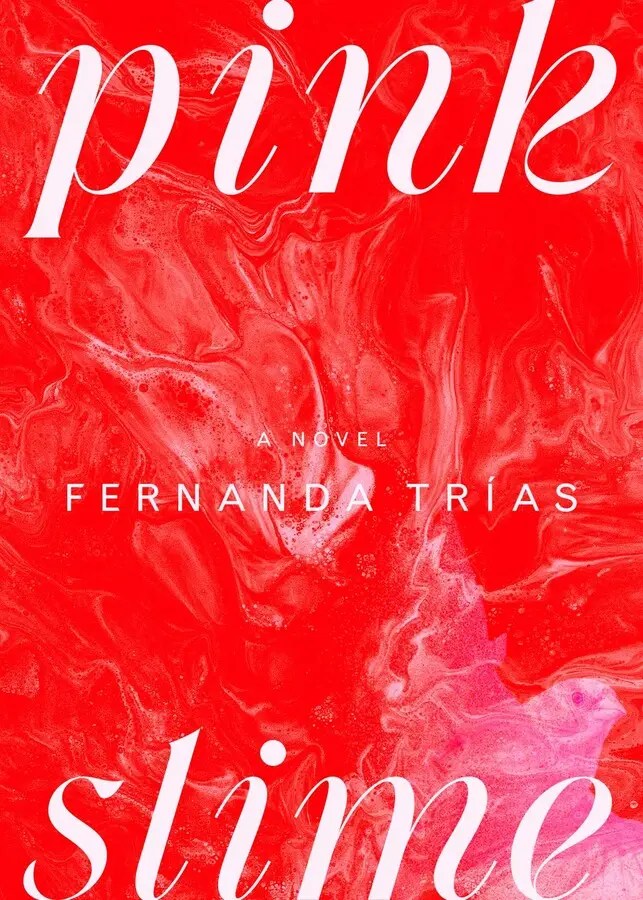
A quiet dystopian novel from a Uruguayan author about a woman navigating love, caregiving, and survival as a mysterious plague and environmental collapse unravel the world around her.
Summary:
In a city ravaged by a mysterious plague, a woman tries to understand why her world is falling apart. An algae bloom has poisoned the previously pristine air that blows in from the sea. Inland, a secretive corporation churns out the only food anyone can afford—a revolting pink paste, made of an unknown substance. In the short, desperate breaks between deadly windstorms, our narrator stubbornly tends to her few remaining with her difficult but vulnerable mother; with the ex-husband for whom she still harbors feelings; with the boy she nannies, whose parents sent him away even as terrible threats loomed. Yet as conditions outside deteriorate further, her commitment to remaining in place only grows—even if staying means being left behind.
Review:
You might be asking, “What possessed you to pick up a book about a plague, Amanda? Haven’t you seen enough of that in the last five years?” Fair question. When I saw Pink Slime on NetGalley, the description there led me to believe the focus wasn’t so much on the plague, but rather on the pink slime—something in the vein of Soylent Green. If you’re not familiar, the horror in Soylent Green centers on a disturbing twist about what people are unknowingly consuming. That’s the kind of dystopian horror I could be in the mood for.
Alas, Pink Slime isn’t really about the pink slime at all. It’s more about environmental collapse and the slow unraveling of society due to a strange, algae-driven plague.
I appreciated the way the main character’s life is quiet but emotionally complex. She still feels responsible for her recently ex-husband, who’s now in a clinic suffering from a chronic form of the plague that usually kills its victims. She visits him, possibly because she still loves him, at least a little. Her mother lives nearby in the same unnamed coastal South American city and demands occasional visits. And most pressingly, she periodically cares for a young boy with Prader-Willi Syndrome, whose wealthy parents provide food allotments but largely leave him in her care.
Her relationships with all three are emotionally layered—she provides meals, bathes, and protects them, yet often feels completely alone. It’s a quiet reminder of how caregiving can be both deeply intimate and deeply isolating. (If you’re interested in another take on post-apocalyptic isolation—this time with zombies—check out my own novel, Waiting for Daybreak, where a woman navigates survival and mental health in the midst of a very different kind of plague.)
I also found the plague itself intriguing. While the government claims it’s contagious, most cases appear to stem from exposure to toxic algae blooms, blown in by ocean winds. Residents are alerted by alarms to rush indoors and seal their windows. This unique concept allowed me to read the story from a dystopian distance rather than sending me back into pandemic fatigue.
That said, the novel’s language and structure make it a challenging read. Each chapter begins with a poem. The prose is often flowery and nonlinear, with frequent shifts in time and tense. While this might feel beautifully disorienting for some, for me it made the already slow, quiet apocalypse feel even slower. I suspect the translation was a difficult task. Though well-crafted, I imagine this book reads more naturally in its original Spanish. And while I’d love to do a comparison, my Spanish isn’t up to the task—so I’ll have to leave it to bilingual readers to weigh in. Readers more familiar with Uruguayan culture or more comfortable with poetic, nonlinear narratives may connect more deeply with the text than I did.
Diversity in the book is limited. No characters’ races are clearly described, and there are no overt LGBTQIA+ identities represented. The child with Prader-Willi Syndrome adds some disability representation, which I found compelling. It’s rare to see this condition, in which children lack a full signal and thus feel hungry all the time, represented in fiction. The narrator clearly loves and cares for the child, even while grappling with the challenges of caregiving. Readers should be aware, however, that some descriptions veer into fatphobic or ableist territory. Still, the overall portrayal felt realistic in terms of how society often responds to visible disabilities.
Overall, this is a quiet dystopian novel that offers a unique perspective on care, collapse, and isolation. It’s a challenging read on multiple levels: structurally, linguistically, and emotionally. But for readers curious about contemporary Latin American literature, especially from Uruguay, it offers insight into a distinct literary voice. Just don’t go into it expecting Soylent Green.
If you found this review helpful, please consider tipping me on ko-fi, checking out my digital items in my ko-fi shop, buying one of my publications, using one of my referral or coupon codes, signing up for my free microfiction monthly newsletter, or tuning into my podcast. Thank you for your support!
3 out of 5 stars
Length: 240 pages – average but on the shorter side
Source: NetGalley
Buy It (Amazon or Bookshop.org)
Movie Review: Soylent Green (1973)
 Summary:
In the then moderately distant future of 2022, the world has turned to being a congested chaos due to overpopulation and global warming. People survive on various colors of food-like paste sold by Soylent, the favorite of which is Soylent Green. When a police man is called in to investigate the murder of an unusually wealthy man, he realizes it all has to do with the Soylent Corporation and makes a sinister discovery.
Review:
Obviously I came at this movie knowing the “spoiler” that Soylent Green is people. What scifi nerd hasn’t heard that quote? Still, even coming in knowing the big secret, I was expecting more from this film. By far the most enjoyable portion takes place in the wealthy man’s condo where we learn women have come to be attached to condo’s as part of the “furniture” and are passed along with the condo from owner to owner. In return for being the lady of the house, they get safety, security, and food. A whole other story could be told with what is essentially a return to the caveman way of doing things. Unfortunately, this gets glossed over for the supposedly more interesting plot line.
The story is told like a 1970s futuristic version of a film noir. We have the detective fighting all odds to get to the nitty gritty truth of the story. Of course, this is the 1970s version of a future dystopia. As such, the wealthy dwellings look straight out of a 1970s porno, and the unfortunate dystopic surroundings of the poor look eerily similar to a hot and sweaty version of communist Russia. It’s an odd dichotomy that doesn’t quite work.
I was waiting for the film to move from setting up the dystopia to slowly building the horror up, but it never happened. Honestly, given the intensely overpopulated surroundings these people live in and severe lack of food, I actually came away thinking that recycling the dead almost seemed logical, and being a vegetarian, that’s quite the leap for me to make! Clearly the film missed its mark somehow. When the policeman rants about the humans being treated as cattle, all I could think was how earlier in the film both he and a friend drooled over a slab of beef. Why should I be horrified that he feels as if he’s being treated like cattle when he would willingly treat cattle exactly the same way? I was left with no sympathy for him, only for the women who get passed along as furniture with the condo’s in this future.
Overall, Soylent Green had the potential to tell an interesting story of a future where women revert back to their old subservient roles as a survival tactic. Instead, it unfortunately veers off toward a storyline I find unsympathetic and that rings as falsely horrifying given the general set-up of the movie. There are far better 1970s horror films out there, as well as better dystopias.
2 out of 5 stars
Source: Netflix

 Support my work with a tip or browse my shop for curated book club guides, how to guides, cross-stitch patterns, and more!


This work by Amanda Nevius is licensed under a Creative Commons Attribution-Noncommercial-No Derivative Works 3.0 United States License.
 Opinions of a Wolf