
Archive
Book Review: Thieftaker by D. B. Jackson (Series, #1)
 Summary:
After spending over a decade serving hard labor in the Caribbean for mutiny and conjuring, Ethan has finally made it back to Boston. He now makes his living as a thieftaker, essentially a private investigator who hunts down stolen items, using his conjuring where necessary to help him out. But the year is 1767 and trouble is starting to brew in Boston. The Stamp Tax has been enacted, and the people don’t like it. There are even riots in the street. Against this back-drop, Ethan is asked to find a brooch that was stolen–from the body of a dead girl. He doesn’t usually take on cases involving murder, but this one is different.
Review:
It’s probably hard to tell from this blog, because they’re hard to find, but I am a real sucker for a good Boston during the American Revolution story. So when this title showed up I snapped it up. I’m glad I did because it’s an interesting take on the Stamp Act Riots.
This is an interesting piece of historic fiction, because it’s more like urban fantasy historic fiction. Is that a genre? Can it be? What on earth would we call it? In any case, I was in heaven, because I love BOTH urban fantasy and history so having both in one book was heaven. I mean first it’s breeches and three corner hats then it’s look at this illusion of a creepy little girl. Brilliant.
I struggled a bit with Ethan, which in retrospect wasn’t a bad thing. That shows he’s a realistic, well-rounded character. But let’s be honest. I’m more of a Sam Adams revolutionary type. Ethan served in the British Navy and is all “oh these hooligans.” This bothered me a lot! Especially when I got suspicious that the book as a whole would lean Tory. But! This all ends up being part of the character development, which in the end is what makes the book stronger. Ethan isn’t sure about protesting and fighting the aristocracy at first. But he changes his mind with time. This makes for a great plot-line. I like it. I do hope in the sequel we will get less of this hemming and hawing about owing things to the crown and yadda yadda. DOWN WITH THE KING. Ahem.
As a Bostonian, can I just say, I haven’t seen a book so intent on giving actual street names and buildings before, but it worked. They are totally accurate. I could completely visualize not just the streets but the entire routes Ethan was walking along. Granted, it was as if through a looking glass, since when I walk them they’re a bit different than in 1767, but still. It was very cool. I also really appreciated the depiction of the South Enders, since I spend quite a bit of time in Southie. Seeing the historical versions was really fun.
The magic portion of the book was also unique. Ethan has to cut himself to get blood to work the more powerful spells. The less powerful ones he can work with surrounding grasses, plants, etc… This makes the interesting problem that people struggle in fist-fighting him because if he bleeds he just uses it to work spells. It’s a nice touch.
So with all this glowing, why not five stars? Well, honestly, Ethan bugged me so much for the first 2/3 of the book that I kept almost stopping in spite of all the good things. He’s just such a…a…Tory. For most of the book. Instead of being angry at the man for putting him in prison for conjuring, he blames himself. Instead of being angry that the rich just keep getting richer while he struggles to pay his rent, he blames himself. You get the picture. Being irritated almost constantly by Ethan kind of pulled me out of the world and the story, which I wish hadn’t happened, because it really is such a cool world. I get what Jackson was trying to do, character development wise, but the payoff in the end was almost missed because I kept stopping reading due to being irritated with Ethan. Perhaps if his change of heart had started to show up a bit sooner it would have worked better for me.
Overall, though, this is well-researched and thought out version of Boston during the Stamp Act Riots. Fans of historic fiction and urban fantasy will get a kick out of seeing the latter glamoring up the former.
4 out of 5 stars
Source: NetGalley

Friday Fun! (Thanksgiving, Cooking)
Hello my lovely readers! I hope those of you who celebrate had a wonderful Thanksgiving. I had a great time with my dad. We ordered in Thai food, which he’d never had before. (I believe it was a hit). I showed him one of my favorite indie bookstores. He took me grocery shopping! (Which has been wonderful for me, I can tell you). We spoiled my kitty rotten and went to a couple of my favorite pubs. It was a wonderful weekend, and I hope to get to see him again very soon!
This week I got to see my friend Nina for the first time in around a month. We went for a super long walk together in the random Indian summer weather we had at the beginning of the week and made this stir-fry out of baby bok choy, onions, pepper, garlic, parsnips, carrots, and fake steak tips (they were soy). Oh, and sesame seeds!
Those of you book bloggers who are looking for projects and/or challenges for 2012, please be sure to check out my Diet for a New America page and my Mental Illness Advocacy 2012 page. Even if you don’t choose to participate in them, any mentions on your blogs, facebook, and twitter are most welcome! These types of things are always more fun the more people participate!
Also, if you missed it, I have an international giveaway currently running thanks to the author. Be sure to check that out too!
This weekend I’ll be training in the gym, going to a tree trimming party, and editing zombies. Also hopefully cooking something up in the slow-cooker to freeze into single servings for lunches. Busy busy!
Happy weekends all!
Book Review: Y: The Last Man: Cycles by Brian K. Vaughan (Series, #2) (Graphic Novel)
 Summary:
Yorick and his monkey, Ampersand, (the last males on Earth) continue their reluctant quest to help the government find a way to fix the disease that killed all the other men or at least to clone new men. Their train trip from Boston to California is caught up in Ohio, though, where they stumble upon an oddly utopian town of women. Meanwhile, Yorick’s sister, Hero, and the Amazons continue their quest to rid the Earth of the last man. Plus there’s a mysterious Russian woman who keeps insisting a spaceship with men on it is going to land.
Review:
Now that the premise of the post-apocalyptic world is set up, Vaughan’s story really picks up speed. There is much less explaining and far more action this time around. There are now multiple plot lines and mysteries beyond Yorick’s main one going as well, which helped, because let’s be honest, Yorick isn’t that likeable.
About 1/3 of this entry is set in Boston, primarily around Fenway and the train station. I think having the Amazons duke it out in front of Fenway Park was a pretty nice touch too.
I don’t recall laughing with the first entry, but this one had me laughing out loud on the bus then having to explain to my companions around me what was so funny. The line?
Killing’s easy. Like….like doing laundry!
It is a random, quirky sense of humor that I really enjoy, although I do expect that it might not strike some people as humorous.
The artwork continues to be bright and easy to follow. I really appreciated the preliminary sketches featured in the back of the book. It was most surprising to see that agent 355 originally was white and gradually was changed to black. I’m glad Vaughan made the move, but I do wonder what brought it on!
Overall, if you like a post-apocalyptic graphic world with biting wit and gender commentary, you’re going to enjoy this book.
5 out of 5 stars
Source: Public Library

Previous Books in Series:
Y: The Last Man: Unmanned
Book Review: Wolf Hunt: The Burning Ages by Sebastian P. Breit (series, #1)
 Summary:
It’s the future, and the world is in another semi-cold war between NATO and BRIC (Brazil, Russia, India, China). A NATO group of British, American, and German naval ships is being sent to Brazil on a mission, but part-way there they are all zapped back in time to 1940. With the chance to change history for the better, what will they decide to do?
Review:
I first want to point out that Breit is German and wrote this in English himself; it is not a translation. I have to say that I wonder why he made that choice as the plot certainly seems to have more of a European than an American appeal, but I am impressed at his effort to write in his second language.
The summary of the book makes the plot sound fast-paced, but in fact it is actually distressingly slow-moving. It takes about 1/3 of the book for the all-important time-traveling event to happen. I spent the whole first part of the book just waiting and wondering when it was going to happen, because once the basic politics of the world and character traits were set up, it’s just a waiting game. The naval mumbo-jumbo filling up the rest of the space just wasn’t necessary. This issue carries on throughout the book with half of the sailors spending a solid amount of their time stranded on an island, for instance. Since this is marketed as a fast-paced historical thriller, perhaps somewhat like the style of The Da Vinci Code it quite simply needs to move along faster. Intense naval specifics and codes are not necessary. Fast-moving plot is.
Breit also needs to invest in a British and American editor each, as the British and American characters say and do things that are just flat-out wrong in British and American English respectively. One that really slapped me across the face is that one of the characters is from Boston, but everyone refers to him as a “Bostoner.” People from Boston are called “Bostonians.” I have never once in my life heard anyone say “Bostoner,” and I live in Boston. Another example is at one point one of the Americans reads another American’s birthdate from off an id and says it the European way “11 September 2001,” instead of the American way “September 11th, 2001.” This is one of those instances where the author needs to have his facts straight in order for the story to be believable. Nothing makes me not believe a character is American quite like having him get a bunch of American English wrong.
Additionally, as a woman and an author, the way the female characters are handled is distressing to me. Just one example is that a bunch of the stranded female sailors are attacked on the island by some of the locals in an attempt at rape. These women who had the exact same training as their male counter-parts are apparently completely incapable of saving themselves, but instead have to be rescued by their male comrades. But it gets worse. Later when the captain of the ship is relating the event to another man, he asks if the women were alright. The captain responds by saying that the doctor said they were fine. The doctor. Apparently nobody bothered to ask these women if they were raped (HINT: I’m pretty sure women can tell if they’ve been raped or not). Plus no one seems to care that these women are clearly not going to be emotionally ok after almost getting raped, and not once do any of the female characters who were attacked say anything about it with their own voices. This is just completely inexcusable. It’s a removal of women’s voices from ourselves, and it’s insulting to a female reader.
There’s the issue of European bias expressed through the American characters. For instance, one American character expresses shame at how Americans only speak one language. First of all, the rate of bilingualism in the US is actually rising, so following the arc of the future, there should be more bilingual Americans, not less. Second, I’ve never once heard an American express woe in an all-encompassing way like that by saying something like “It’s so sad Americans aren’t bilingual.” People say, “I wish I was fluent in another language,” or “I wish I was fluent in Japanese,” but they just don’t put it that way. That whole paragraph sounded like a European using an American character as a puppet to say what Europeans think of Americans. Yeesh.
I also have problems with the German characters though. A bunch of them express the desire to stop the Holocaust not to save lives but to save the German people from harboring the shame and guilt for generations to come. Um, what? That’s your concern oh time-traveling Germans? Having been to Germany myself on a student exchange and visited Dachau, etc… I can say that I have a hard time imagining any of the kids my age at the time (15ish in the early 2000’s) focusing in on that as opposed to stopping a bad thing from happening because it’s evil and wrong. I can only imagine that generations even further along would be even more focused in on stopping a genocide as opposed to saving some broad idea of German honor. It’d be like having a time-traveling modern American decide to stop the Trail of Tears to save us from shame as opposed to doing it to save innocent Cherokees. The whole thought just makes my brain hurt.
To sum up, Breit shows ability as a writer that needs to be worked on and honed. I’d recommend either getting a good editor who can handle both British and American English or switching to writing in German. He also needs to work on tightening up his plot. Normally I’d say, nice first effort keep trying, but due to the opinions and biases and presentation of women present in this first attempt, I’m afraid I can’t say that. It’s readable, but why would you want to read it anyway?
2 out of 5 stars
Source: Ebook from author in exchange for my honest review

Book Review: The Birth House by Ami McKay
 Summary:
Dora Rare is rare indeed. She is the first female born to the Rare family Scots Bay, Canada in generations. Her dark hair and brownish skin reflecting the family’s Micmac heritage make her stick out like a sore thumb in the area. However, Scots Bay’s midwife, Miss B., has always taken a shining to Dorrie, and she trains her in the ways of midwifery. The early 1900s are a tough time for midwives and women, though. Soon the area is threatened by World War I and male obstetricians, not to mention all the obstacles rural women have always had to face from violent, drunk husbands to too many children.
Review:
This book was quite honestly painful to read, for it lays out so clearly what it is that makes being a woman difficult in society. Although some things in modern day have improved, for instance we western women have the right to birth control, in other ways things have remained painfully the same. There are still areas of the world where men have more control over women’s bodies than they do. It is often still expected for women to be pure when men are not. Women often feel that they must put up with the wrongdoings of their husband simply to keep the home and family life that they so desperately desire, and on and on.
The book itself is told as a mix of third person narrative and Dora’s journal with clippings from the various newspapers. This style suits the story well, as we are allowed to see Dora from both outside and inside her own head. The characters are fairly well-rounded, although the motivations of those who are not Dora are not always the clearest or the most sympathetic, but as most things are from her perspective, that is understandable.
Of particular interest to me, especially with my knowledge of psychology, was the portions of the book dealing with how women are often accused of being insane simply for reacting to the injustices foisted upon them. I discussed this topic at length in multiple women’s studies and feminism classes. The idea that the just rage of the trodden upon is often depicted by the rulers as insanity. This is beautifully depicted in this book for Dora, struggling against many injustices and feeling rightfully irritated and angry, is informed by a male doctor that she is suffering from hysteria–a peculiarly female ailment resulting from female organs. Her anger and fighting back is thus tagged with a name that let’s others dismiss it as an illness, rather than a just reaction. McKay eloquently depicts this entire issue without being too heavy-handed.
I was also surprised and delighted to see a portion of the story take place in Boston during the women’s suffrage movement in the United States. I’m assuming McKay must have visited my city, for she perfectly describes the North End from the buildings to the atmosphere of walking those streets. This accuracy allowed me to travel back in time to a period of injustices in my own city, not to mention the molasses flood. It was indeed a delight to read of Boston from a women’s rights perspective for once instead of always reading of the Irish mafia.
The main point of the book comes across throughout it in a gentle way. The idea that we must continue to struggle and give but not give up or the oppressors will win.
Never let someone take what’s rightfully yours. You can give all you want in life, but don’t give up. (page 337)
It is simultaneously encouraging, uplifting, and depressing to realize that women throughout time have struggled with similar issues. Yet things are gradually improving, and thus we must not give up for the sake of future generations of women.
This book beautifully depicts the history of women’s rights in the early 1900s. It is a painfully beautiful read that I recommend all women, as well as men sympathetic to the cause, read.
4 out of 5 stars
Source: PaperBackSwap


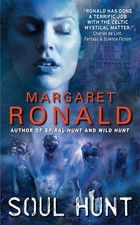
Book Review: Soul Hunt by Margaret Ronald (Series, #3)
 Summary:
Native Bostonian Evie Scolan is an adept bicycle courier and has her first real relationship in a while. Of course, her life isn’t quite that simple. First, she’s The Hound with an uncannily adept sense of smell that helps her find things. Plus her boyfriend is a werewolf. Then there’s the whole try to keep the magical Undercurrent in Boston under control so her beloved city doesn’t fall apart thing. Not to mention the death sentence given to her by yet another sector of the Undercurrent giving her only until Midwinter to pull everything together. Plus the Sox are sucking this season.
Review:
Yet again, I accidentally picked up a book that is partway through a series. I’ve noticed this is a lot easier to do when it’s an ebook than a print book, because the print book tends to have a giant “3” or something on the binding, whereas the ebook gives you zero clue that this is part of a series. Work on that, publishers. Due to this fact, I spent the solid first half of the book trying to figure out what the heck was going on in Evie’s world. Unlike paranormal romance that tends to offer up a quick recap of the important details, it would appear that urban fantasy isn’t so keen on that. Well, that and Ronald’s world she has created is incredibly complex and hard to understand fully part-way into a series.
That aside, however, how is it for an urban fantasy novel? Well, the fantasy element is strong and intensely connected to elements of urban living from good and bad neighborhoods to trolley tracks to old, abandoned buildings, to secret tunnels and ghosts. This has it all if you’re after some seriously steeped fantasy.
Further, as a Bostonian myself, I can tell you that Ronald gets the local slang and layout of the neighborhoods right. Personally, I think she’s a bit heavy-handed with the Red Sox love demonstrated by Evie. I don’t really think Evie would be thinking about the Sox season sucking when she’s currently facing death, but maybe I’m just not enough of a fanatic myself. Hah.
I think, perhaps, that why I couldn’t get into this partway through the way I could other series I started in the middle is that I don’t like Evie, and the mythos of the Undercurrent is way more confusing than it should be. I can’t think of very much that’s appealing or redeeming about Evie as a character, which is problematic when she’s the heroine. Similarly, she’s not beautifully broken or anything. She reads as just…..average. The fact that this is the case when she also has this weird supernatural nose is saying something. Make Evie evil! Make Evie kick-ass! Just don’t make her so dull that I have zero doubt that I wouldn’t give her a second glance if I happened to see her on the streets of Boston.
Similarly, the mythos of the Undercurrent seems to change to suit the author’s needs. Maybe I was missing plot twists from missing the earlier books, but it all just seems so much more complex than it needs to be. Plus, what exactly makes Evie repeatedly go up against demigods when her only supernatural talent is the nose thing? It just doesn’t make sense to me. That and the whole part dog thing is just….ew.
I came into this wanting to love it, as I do with any book set in my home of Boston. The fact is though, too much turned me off from it. It is a fairly well-written urban fantasy, though, and a nice change from the typical southern setting we see. I’d recommend it to urban fantasy fans looking for a change of scenery who don’t mind a rather ordinary heroine who’s basically part dog.
3 out of 5 stars
Source: Amazon

Previous Books in Series:
Spiral Hunt
Wild Hunt


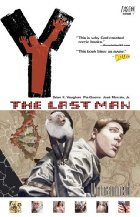
Book Review: Y: The Last Man: Unmanned by Brian K. Vaughan (Graphic Novel) (Series, #1)
 Summary:
The world is changed overnight when all the men and boys in the world mysteriously drop dead. Factions quickly develop among the women between those who want the world to remain all female and those who would like to restore the former gender balance. One man is mysteriously left alive though–Yorick. A 20-something, underachieving magician with a girlfriend in Australia. He desperately wants to find her, but the US government and the man-hating Amazons have other ideas.
Review:
As soon as I heard the concept for this series, I knew I had to read it. Plenty of scifi books have explored other planets consisting entirely of women or an Earth of just women decades after the men died out, but very few go to the immediate after-math of the loss of men. I like that one man is left alive. It lends a scientific mystery to the social aspects of a planet suddenly full of just women. Yorick’s characterization is perfect. He’s laid back enough that there’s not constant angst over the situation, but intelligent enough that he gives the different factions a run for their money. I also appreciate that Vaughan didn’t have all the women suddenly singing kumbaya and holding hands. The fighting, violence, and disagreements among the women are honestly a far more accurate representation of how things work. Women are people, and people fight and disagree. That certainly isn’t a realm that belongs to just men. Vaughan gives an even-handed, fair representation of women covering everyone from women mourning the loss of rock stars to women set world domination and everything in between. I commend Vaughan for that.
The art work is full-color and impactful. Periodically there are full-page illustrations instead of panels. This apocalytpic world isn’t dark. It’s full of light, passion, and energy. Everyone is drawn consistently, and it is not at all difficult to tell people apart. One of the most impactful pages features a close-up of one of the Amazon women with one of her breasts cut (or burnt) off. It’s a very powerful image.
I also appreciated that around 1/4 of this issue takes place in Boston, and Boston is accurately drawn and represented. I love that Boston is key to the story for the scientific community here. It’s tiring always seeing us represented as just the center of the Irish-American mafia. I hope Boston pops up again in future installments. It’s nice seeing my city in print.
Unmanned does an excellent job of quickly setting up the dystopian world where only one man is left alive. The artwork is compelling, and the storyline fairly represents the broad spectrum of female personalities. If the basic concept of this dystopia intrigues you at all, I highly encourage you to try it out.
4 out of 5 stars
Source: Amazon

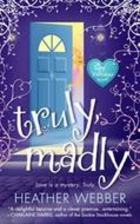
Book Review: Truly, Madly by Heather Webber (ARC, Feb 2010)
 Summary:
Boston socialite Lucy Valentine isn’t too keen on running the family’s matchmaking business while her mother and father take a necessary trip out of country to let a scandal settle down. You see, she lost the family’s genetic ability to see auras that has led to their matchmaking success. When she was a kid, she was hit by an electrical surge that removed her ability to see auras and replaced it with an ability to see lost objects when her palm touches the owner’s palm. When a potential client shakes her hand, and she sees a dead body wearing his ring, she gets caught up in a bit more adventure than she ever thought her ability would lead her into. It doesn’t hurt that she manages to enlist the aid of the hunky private investigator whose office shares the matchmaking business’s building.
Review:
I was excited to discover a book set in Boston that has nothing to do with the Irish mob or the Kennedy’s. Unfortunately, I have this problem with reading about the modern wealthy. I simply can’t identify, and it tends to irritate me unless the book is all about how they’re a serial killer or something. Lucy is decidedly in with the Boston wealthy. Her family owns a building on Newbury Street; they employ a driver; and she has a trust fund. Of course she refuses the trust fund, but she’s still living in a cute, perfect cottage on her grandmother’s land in the South Shore. She calls her grandmother by her first name, “Dovie,” and her mother “Mum.” *shudders* I cringed every time she said either.
On the plus side, once I manage to overlook the whole poor rich girl scenario, the plot is good. It is full of twists and turns that have a slight supernatural bent without going full-tilt building an entirely populated other world of faeries, sprites, vampires, etc… that is seen in a lot of paranormal fiction. Lucy’s attraction to Sean, the PI, is believable and progresses at a good rate. The main mystery actually managed to surprise me with the ending, so that’s a major mark in its favor.
I also enjoyed the little life details Webber put into the story, Lucy’s cat’s activities, exactly what T lines are nearby where the action is happening, etc… However, I did not like Lucy’s personality quirk of doing math problems in her head when she was nervous. I don’t know what it is with romance writers lately having their characters do some annoying thing when they’re nervous, but to me it screams that Webber couldn’t figure out a better way to signal this emotion to the reader.
On the whole, it was a fun mystery plot with a dash of paranormal set in Boston marred by the choice of making the main character part of the wealthy elite with an annoying, unnecessary personality quirk. If you enjoy paranormal and wealthy characters, you will enjoy this book.
3 out of 5 stars
Source: Received from publisher, St. Martin’s Paperbacks, through LibraryThing‘s Early Reviewers program
Projected Publication Date: February 2010

 Support my work with a tip or browse my shop for curated book club guides, how to guides, cross-stitch patterns, and more!


This work by Amanda Nevius is licensed under a Creative Commons Attribution-Noncommercial-No Derivative Works 3.0 United States License.
 Opinions of a Wolf