
Archive
Book Review: The Woman in White by Wilkie Collins
 Summary:
Originally serialized in 1859 to 1860 then published in book form in 1860 this epistolary novel is considered one of the first mystery novels. Walter Hartright is an artist who gets hired to be a drawing master for two half-sisters Laura Fairlie and Marian Halcombe. He and Laura soon fall in love, but they cannot be together due to class differences and Laura’s prior promise to her now deceased father to marry Lord Percival Glyde. A mysterious woman dressed all in white warns Laura against her marriage, calling Lord Glyde evil. However, Laura is reluctant to renege on her final promise to her father and proceeds with her marriage, sending herself, Marian, and Walter into a spiral of intrigue and danger.
Review:
I love slow-moving, epistolary novels, particularly gothic ones read on a long, hot summer day. One of my finest reading memories is of enjoying Dracula while working on a summer internship at a national park on a peninsula with four beaches. So I came to this gothic, mysterious, epistolary novel with high expectations. At first they were met, but as the plot proceeded I came more and more to want to smack Collins upside the head.
Without giving away too much, suffice it to say that the slowly building tension indicates a truly serious infraction on Lord Percival Glyde’s part that turns out to be not particularly shocking at all. At least to my American mind. Suffice it to say, it revolves around title holding, something which I find baffling and laughable. Why should anyone care if Laura is Mrs. Glyde or Lady Glyde? Her life seems more boring than the servants’ anyway. I thought I would be reading a novel that was more about revealing the treachery and debauchery of the upper class. Instead I got a book about bourgeois problems, which, I’ve indicated elsewhere on this blog, I simply cannot relate to and find completely annoying. I get it that some people enjoy that, but the desire to maintain a tense, mysterious illusion around the book led me to believe it’s something it wasn’t. That is frustrating, to say the least.
Beyond the disappointing mystery there’s of course the typical problems found in early 1800s literature. The sexism comes from Marian’s own mouth, which is surprising given that she is a depicted as a strong woman. She often will lament the short-comings of “her sex.” Actually, the entire situation between Walter, Marian, and Laura is baffling. Laura is a weak, foolish girl who Walter falls and stays head over heels in love with. I cannot fathom why that would be when he spends an equal amount of time with Marian, who is a strong, thoughtful, intelligent woman. Laura is described as beautiful, whereas Marian is described as possessing a beautiful body but an unfortunately masculine face. This leads me to believe Walter is rather shallow, as I see no reason beyond Laura’s beauty for his devotion to her. I know sexism is to be expected in older novels, but I would at least hope for a hero who loves the heroine for something beyond her beauty.
That said, the novel certainly gives modern women a new appreciation for our current situation. The women in The Woman in White are constantly downtrodden by the men around them who believe it is entirely within their right to dictate to them everything about how they should behave, speak, dress, etc… It appears that the only thing the women have control over is when to leave the men to their wine after dinner. In fact the couple presented as the happiest and most well-functioning is that of Count Fosco and his wife, and they only function well due to the fact that she obeys his every command. Mrs. Fosco is described as a woman who prior to meeting the Count was loud, obnoxious, and always yammering on about women’s rights. Count Fosco, apparently, “fixed all that,” and she is now such a pleasant woman to deal with. The only woman who does not base her entire existence around a man is Marian, and that is due to her bizarre, near worshipful devotion to Laura. It makes me shudder to think if those had been my options as a woman–existing purely for the whims of a man, downtrodden and outcast, or pure devotion to a sister. Yeesh.
I did enjoy listening to the book. It felt a bit like listening to an old-time radio program, which I’m sure is due to its origin as a serial novel. Those who enjoy the slower pace of older novels and can relate to the bourgeoisie will probably enjoy it. If either of those elements turns you off, however, you should look elsewhere.
2.5 out of 5 stars
Source: Librivox recording via the Audiobooks app for the iTouch and iPhone

Book Review: Breakfast at Tiffany’s: A Short Novel and Three Stories by Truman Capote
 Summary:
Breakfast at Tiffany’s
A nameless narrator recalls the eccentric 19 year old neighbor he once had in New York City–Holiday Golightly. He reflects on their friendship of just over one year, and wonders where she is now.
“House of Flowers”
Ottilie works as a prostitute in Port Au Prince. She lives in a beautiful house with fine things, but one day at a cock fight, she falls in love and leaves the city for the country with her new husband. Will she regret her decision?
“A Diamond Guitar”
A man in prison for 99 years plus 1 day in a tropical location is well-respected by the other prisoners for his ability to read. One day, a new inmate arrives serving a 2 year sentence. He is young, beautiful, and can play the guitar wonderfully.
“A Christmas Memory”
A man recalls his early Christmases spent with an older relative who had never wandered far from home, but had a love of life the other adults in his family mistook for a bad influence.
Review:
I read this book due to watching Breakfast at Tiffany’s (review) and really enjoying it. Various friends told me they were curious to know my reaction to the different ending in the book, so I decided to read it.
Capote’s strength as a writer is in setting the scene. I could vividly picture the scenes in every single story, despite their vastly different settings. This is what made the stories readable in spite of their plotlines being not particularly my cup of tea. I felt that Capote just approached the edge of something phenomenal, biting, and truthful, but then stopped. Stories that could have been touching and powerful were therefore decidedly average.
What I loved about the movie version of Breakfast at Tiffany’s is that it took a loving look at someone with mental issues and showed how she could get better. There is none of that hope in the short novel. Holly comes off entirely as someone out to use other people, and there is an unforgivable scene with her cat. I came away hating Holly, whereas I felt I was made to understand a possibly unlikable person in the film. This made the short novel quite disappointing and is exemplary of everything I disliked in this collection of Capote’s works.
That said, his writing style is highly readable, and I enjoyed the message in “A Christmas Memory” very much, even if the title is entirely uncreative.
My advice to any who love the film is to skip this if they wish their opinion of the characters to remain untarnished. Those who enjoy mid 20th century American short fiction will enjoy this collection, however.
3 out of 5 stars
Source: PaperBackSwap

Book Review: Love Among the Chickens by P. G. Wodehouse
 Summary:
Jeremy Garnet, a novelist, is living a relatively quiet bachelor life in London when his old school friend Stanley Ukridge shows up. Ukridge is starting a chicken farm with his wife, Millie, and wants “Garnie old boy” to come stay with them. He’ll get to write in the country in exchange for a few hours of work a day. In spite of the fact that Ukridge is planning to run the chicken farm without any prior knowledge or studying “the better for innovation, my boy,” Garnie takes him up on it. Of course, life with the eccentric Ukridge surrounded by chickens isn’t quite the quiet writing environment Garnie was planning on. Not to mention the Irish professor neighbor’s lovely daughter that Garnie can’t quite get out of his head.
Review:
There’s no doubt about it. Wodehouse is pleasantly droll. It was, however, necessary for me to remind myself a few times of the time period this was written in as certain portions had the feminist in me going “Whaaaat?!”
Ukridge and Millie are a delightful couple. He’s got zany ideas; she’s endlessly supportive. He clearly is madly in love with her and vice versa. They’re exactly the sort of people I would want as neighbors, because you’d never get bored with them around. Ukridge doesn’t mean to do wrong by anybody. He just doesn’t get how society thinks it should function. He does everything his own way, and Millie is along for the ride.
Wodehouse also manages to actually create personalities in the animals that are around from Bob the dog to Edwin the cat to Aunt Elizabeth the evil chicken (named after the aunt that didn’t want Millie to marry Ukridge). The animals are a part of everything that is going on. The characters actually talk to them, interact with them, and the animals respond. It’s something that happens in my own life, but that I don’t usually see in books, so I was delighted to see it here.
On the other hand, chickens are only half of the title, and I must say, I was not fond of the love half. Garnie’s relationship with Phyllis just hit all the wrong notes for me. First, Garnie claims to have fallen in love with her at first sight upon seeing her on the train, yet at that portion of the book all he talks about is how lovely her eyes are. Sounds more like lust to me. Then there’s the fact that Phyllis’s personality stinks. She’s dull, boring, and frankly rude. She’s square under her egotistical father’s thumb too. I don’t see what Garnie sees in her. Then of course there’s the fact that Garnie pretty much stalks her for a portion of the book. He goes to her father’s farm every night after dusk, sits in the bushes, and listens to her sing. That’s creepy, but when he tells her later, she laughs and is delighted. People! Stalking is not romantic. Gah!
I wish Wodehouse had simply written about Ukridge and Millie, as they are clearly the couple that is actually interesting. In spite of the fact that he didn’t do that though, I really liked this book. People who appreciate a book for the scenes in it and not the overarching plot will like it as well.
4 out of 5 stars
Source: Librivox recording by Mark Nelson via the Audible app for the iTouch and iPhone

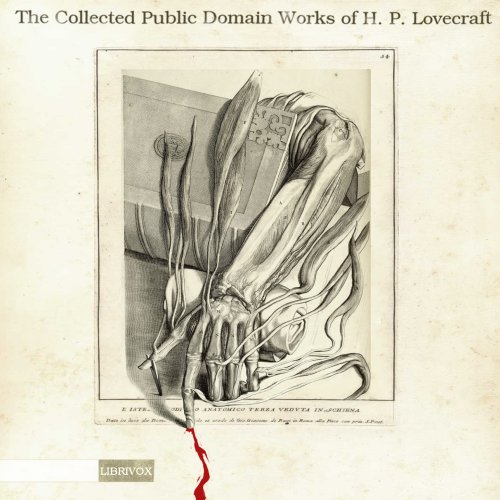
Book Review: The Collected Public Domain Works of H. P. Lovecraft
 Summary:
Lovecraft was an American author of horror living during the late 19th and early 20th centuries. He has a bit of a cult following, largely due to a creature featured in some of his stories known as Cthulu. (I’d link, but your experience will be much more amusing if you google “cthulu”). Some common themes in his horror include eerie things coming from ocean depths, scientific reanimation of corpses, human-like apes, the dreamworld, and ancient myths being fact. This collection includes 24 short stories–The Alchemist, The Beast in the Cave, Beyond the Wall of Sleep, The Cats of Ulthar, Celephais, The Crawling Chaos, Dagon, The Doom that Came to Sarnath, Ex Oblivione, Facts Concerning the Late Arthur Jermyn and His Family, Herbert West: Reanimator, Memory, The Music of Erich Zann, The Nameless City, Nyarlathotep, The Picture in the House, Polaris, A Reminiscence of Dr. Samuel Jackson, The Statement of Randolph Carter, The Street, The Terrible Old Man, The Tomb, The Tree, and The White Ship.
Review:
I decided I needed to actually read some Lovecraft after getting swept up in the Cthulu subculture last December through Cthulumas hosted on Tor.com. So I searched Librivox via the Audible app and found this collection. Unfortunately, there was no Cthulu in it. Also unfortunately, I wasn’t too impressed by most of the stories.
I think the main issue is that a lot of the horror just didn’t age well. Lovecraft’s stories depend largely on the unknown, only a lot of what was unknown in his time is known now. For instance one of his stories focuses around the mystery of the North Star, which isn’t so mysterious anymore. They also depend on unexplored territories on the continents, whereas now it’s space that is unexplored. I can’t get into the character’s mindset of fear when he reads simply as naive and uneducated.
His stories that center around the hypothetical reanimation of the dead are some of the best ones. They read like a mix of zombie and Frankenstein, and it works because we still don’t know what happens after death. Herbert West: Reanimator was one of the only stories to give me the actual chills.
I would be amiss not to mention the racism evident in his stories. Any that feature Africa talk of a pervasive fear of what lies in the depths of the continent and repeatedly mention apes mixing with men. Even if he was unaware that he was harboring racism, these read at the very least as being anti-miscegenation. It’s hard to listen to stories whose horror centers around fear of what people look like as opposed to what they may be capable of doing.
Similarly, he read as being anti-science. Any scientists in his short stories are portrayed as sticking their noses where they don’t belong. Apparently, we can never fathom the universe, so we better not. It’ll hurt us if we try. I found myself rolling my eyes at the sleep stories. They were all so ridiculous when I know doctors and researchers studying sleep. It’s really not this dangerous other-world he presents it to be.
Where Lovecraft is at his strongest is when he veers from his typical themes. My loyal readers probably won’t be surprised at all that one of the most pleasurable reads to me was The Cats of Ulthar, which basically presents animals as sentient and capable as humans.
I can only hope that the Cthulu stories fall more in the category of Herbert West: Reanimator and The Cats of Ulthar. The rest wrought a decided “meh” reaction from me. I’d recommend them only if you have no issue reading horror centering around unknowns that are now known.
2 out of 5 stars
Source: Librivox recording via Audible app for the iTouch and iPhone
Book Review: Beowulf by Anonymous/Unknown
 Summary:
This classic, epic poem tells the story of the life of Beowulf, a Geat warrior. In his youth, Beowulf assists the Danes who are being terrorized by a monster named Grendel. He defeats Grendel and Grendel’s mother single-handedly in hand to hand combat. When the Geatish king dies, Beowulf acts as guardian of the kingdom while the prince grows up. All is well until a dragon starts to terrorize the land.
Review:
Having read The Odyssey, The Iliad, and The Aeneid and liking them all quite well (in spite of the fact that The Aeneid is a Roman rip-off of the Greek epics) I was expecting something somewhat different from Beowulf than what I got. Although the adventures in these epics generally center around one or two characters, they are also the tales of the history of an entire people. Since Beowulf conducts pretty much all of his battles on his own, I don’t really get that vibe from Beowulf. It also is odd to me that these people seem to have a real talent for pissing off monsters buried deep in the Earth. Whereas the other epic poems are about battles between nations and the impact that has on individuals, this is really just about some guy who goes around killing monsters that people have managed to royally piss off. It’s kind of like reading a videogame in which every level consists of one monstrous boss.
Maybe this whole difference in tone is due to the fact that this pagan history is being told by a Christian narrator, whereas the other epics are told by pagan narrators. There’s definitely a vibe of “oh those silly old pagans” to Beowulf, which makes it rather hard to relate to the characters.
On the other hand, just as in the other classic, epic poems, the language is beautiful. Since I listened to this as an audiobook, I got to really listen to it. Hearing epic poetry read aloud is almost always better than reading it, as the oral tradition is where they came from. Bloody scenes manage to come across as exquisite due purely to the language being used.
If you enjoy epic poetry, you’ll definitely enjoy Beowulf. However, if you’re new to epic poems, I’d recommend you start with The Odyssey instead.
3 out of 5 stars
Length: 245 pages – average but on the shorter side
Source: Librivox recording via Audiobooks app for the iTouch
Buy It (Amazon or Bookshop.org)
If you found this review helpful, please consider tipping me on ko-fi, checking out my digital items available in my ko-fi shop, buying one of my publications, or using one of my referral/coupon codes. Thank you for your support!
Book Review: Setting Free the Bears By John Irving
 Summary:
John Irving is an American writer best-known for The World According to Garp and A Prayer for Owen Meany. Setting Free the Bears is his first novel and is set in Europe as opposed to New England. Hannes Gaff has failed his exam at university in Vienna. Distressed he goes to a motorcycle shop where he meets Siegfried Javotnik. Siggy convinces Gaff to buy a motorcycle together to adventure across Europe. Their adventure takes a side-turn though when Siggy becomes obsessed with letting loose the zoo animals in Vienna and Gaff becomes obsessed with a girl named Gallen.
Review:
Irving utilizes a storytelling technique I’ve always particularly enjoyed–a character finding a notebook and the character and reader reading that notebook together. Here Siggy’s voice is bookended by Gaff’s. I had a difficult time getting into the book and was frustrated with it at the end. It wasn’t until reflection that I realized I enjoyed Siggy’s story, but not Gaff’s.
Siggy is an excellent character. Through his notebook we see how his parents’ unconventional meeting and marriage as a result of uncontrollable war circumstances has made him the slightly crazy person he is today. Personally I think he is just misunderstood, which is why I had issues with Gaff worrying about going crazy like Siggy. Siggy isn’t crazy; he’s just unconventional.
Gaff, on the other hand, is not a well-rounded character. He is someone who I don’t understand and couldn’t relate to. Although his crush on Gallen is the catalyst for a key plot point, I actually felt that he had infinitely more feelings for Siggy. There’s nothing wrong with that, but it did make some plot points feel forced.
Overall, this is a typical 1960s generation book. Siggy and Gaff feel like the middle lost generation. Their parents were defined by the war, but they are defined by nothing. All that matters about their lives is their pre-histories–how their parents met and were impacted by the war. They are left meandering through history on a motorcycle attempting to figure out exactly how things turned out this way from the few clues the war-time people will let them have. Those who enjoy this theme of the 1960s will enjoy this book. Others who enjoy Irving’s writing style would be better off reading The World According to Garp.
3 out of 5 stars
Source: Library

Book Review: The Tenant of Wildfell Hall By Anne Bronte
 Summary:
Cited as the feminist antithesis to her contemporary Austen’s romantic 19th century ramblings, Anne Bronte’s best-known novel presents the much more dire image of the very real risk of marriage in a time where the wife loses all her human rights to her husband. Gilbert Markham becomes infatuated with the widow Helen Graham who has moved into his neighborhood with her son, but rumors soon start to spark up around her. When he confronts her about her conduct, she shows him her diary. There he learns her travails and sufferings at the hands of her still very much alive husband.
Review:
I came to this book with high expectations. I heard of it simply as the one of the earlier feminist novels written in response to such works as Austen’s. I felt this opened the door to many possibilities, but perhaps I was thinking about this with too much of a 21st century brain. What held The Tenant of Wildfell Hall back was the relentless presentation of Helen as the picture of Christian piety. Given the fact that Helen behaves quite willfully and controversially for the time period by leaving her husband’s home to live separately from him, this was probably quite necessary for Bronte’s contemporaries to find Helen a sympathetic character. For me though her severeness sometimes had me siding with her tyrant of a husband in my mind. He calls her cold and calculating. Well all she ever talks about is living piously now to be joyous in heaven after death. I would find that cold and calculating as well.
This book does hold value for the modern feminist though if we re-position ourselves to look at it through the lens of how society at the time has messed up both Helen and her husband, Arthur. Society tells Helen that it is her job as a woman to be the pious one. Although single men may go cavorting about she must sit respectably at home or go out to supervised dances. Men may behave however they desire as long as they settle down after marriage. This belief leads Helen to make her foolish, egotistical mistake of thinking that marrying Arthur is alright for she can change him after they are married. To a certain extent Arthur makes the same mistake. He has been told the ideal wife is a highly pious one, so he marries Helen thinking she will save him when, in fact, they are the most mis-matched couple ever.
Arthur enjoys cavorting, playing cards, and drinking. Helen refuses to do these things out of piety and nags Arthur not to do them. They both come to realize they are mis-matched, but in their society divorce is a painful embarrassment to both parties. Helen doesn’t even consider it for Christian reasons; Arthur in order to save face. This leads to their gradual loss of caring for each other, although Arthur’s comes much faster and more brutally when he carries out an affair with the wife of a visiting friend.
Arthur no longer wants Helen, but she is his wife and he would be a laughing-stock if he couldn’t control her, so he starts abusing her emotionally–repeatedly telling her it disgusts him to see her pale skin, for instance. He also carries out the afore-mentioned affairs with her full knowledge and at first forbids her from having any of her own. I am not condoning Arthur’s ill-treatment of Helen. He made the situation far more worse than society alone would have had them make it. He could, for instance, have allowed them to set up separate households, which was sometimes done. He at least could have shown her the respect she deserved as a human being, but instead he came to view her almost as a hated prison guard. This would not have been the case if they could have parted ways amicably.
I must admit what struck me far more than the restrictive society was Helen’s restrictive religion. She almost constantly lives only thinking of her reward after death in Heaven. She possesses nearly no joy for her beliefs require that she squander her life away serving a man who hates her. The only reason she even leaves him for a time, relieving some of her pain, is because she believes her duty to raise a pious son outweighs her duty as a wife, so she is justified to remove her son from the soul-risking influence of his father. Helen’s faith seems to bring her no joy, but instead demand she behave as a judging marble statue.
Although The Tenant of Wildfell Hall is not an obvious feminist manifesto, it as an excellent rendition of the oppression of 19th century society on both men and women. Reading of their struggles and realizing as a 21st century observer that there is essentially no way out for either of them beautifully demonstrates how far we’ve come. Bronte’s writing style is complex enough that what could be a bit of a boring, straight-forward tale remains interesting throughout. She changes perspectives a few times via diaries and letters. She does suffer from the 19th century literature trap of overly extensive descriptions of settings, but these are easily skimmed. An excellent example of 19th century literature, I wish Bronte’s realistic work was assigned more often in literature classes than Austen’s fluffy, unrealistic drivel.
3.5 out of 5 stars
Source: Library

 Support my work with a tip or browse my shop for curated book club guides, how to guides, cross-stitch patterns, and more!


This work by Amanda Nevius is licensed under a Creative Commons Attribution-Noncommercial-No Derivative Works 3.0 United States License.
 Opinions of a Wolf