
Archive
Book Review: Peyton Place by Grace Metalious
 Summary:
Peyton Place appears to be a picturesque small town in New Hampshire. But over the course of the novel, the secret passions, lies, and cruelties of its various inhabitants are revealed. From a single mother lying both about her daughter’s age and being a widow to the school janitor who drinks to dull the ache of his wife’s cheating to what exactly is buried in the sheep pen in the Cross’s yard. Small town life is anything but simple and picturesque.
Review:
This book was first recommended to me on either LibraryThing or GoodReads for being similar to The Group (review), another book written in the mid 1900s featuring an ensemble cast. I wound up ultimately picking it up because I read that it was quite scandalous when it first came out and it was the inspiration behind the first successful nighttime American soap opera of the same name (source). Additionally, I grew up in Vermont but spent a lot of time in New Hampshire, since I grew up on the Vermont border with New Hampshire. I even went to high school in New Hampshire (public school, my town in Vermont was too small for a high school so bussed us out to other ones nearby). I was curious to see if any element of the book would successfully evoke New Hampshire to me. I often find that books set in New Hampshire just don’t ring true with the New Hampshire I know. What I found was a book that almost gave me chills at how well it depicted a typical New Hampshire small town, but also was nowhere near what I would in my modern mind describe as scandalous, although I can see why it was at the time.
The story explores the intersecting lives of many town folk in the 1940s and 1950s, but primarily focuses on Constance MacKenzie, her daughter Allison, and her daughter’s friend from the wrong side of the tracks, Selena Cross. Constance is a frigid woman who has tamped down her sexuality in an attempt to raise her daughter who she conceived out of wedlock while having an affair with a married man in the right way. She has gone so far as to lie about her daughter’s age and to lie about being a widow to help her daughter seem “acceptable.” Allison grows up over the course of the novel, first having typical teenage angst, then moving away to NYC to become a writer. Selena Cross suffers from a good-for-nothing stepfather, living in a shack, and living with a mother who is not all mentally there. Through their eyes and lives we see snippets of the lives of many others in the town.
Here are the things that were considered scandalous when the book was first published: rape of a stepdaughter by a stepfather (you can probably guess who), abortion (which was illegal at the time), men locking themselves in a basement to go on a bender for weeks at a time. Things that were probably also considered scandalous but to less of a degree: teenage sex, out of wedlock sex, middle school aged boy spying on a couple having sex, murder in self-defense. I had to sit here and think for a bit to remember what was possibly deemed scandalous. It mostly just seemed like a very eventful book to me, and honestly I was just a bit surprised that nothing more scandalous happened. (Apparently, Metalious originally wrote the book with having a father rape a daughter, but the publisher made her change it because America wasn’t ready yet. Oh my how times have changed. Source). The only part of the book that really bothered me at all in the way that perhaps people were once scandalized was the depicted of Constance’s relationship with her new boyfriend. Basically she is frigid and he has to get her to open up and accept her sexuality in order to be her true self. That’s a fine plot, but the way it’s done often verges on the border of “she said no but ignore it because she really means yes.” I understand in the 1950s when this was written that it was progressive to have a woman character learning to open up and embrace her sexuality, so I shouldn’t be too harsh with modern critiques. Certainly the character herself deems what occurred between her and her boyfriend as lovemaking. But I definitely don’t think this portion aged well, and it soured my enjoyment of that particular chapter, and Constance’s plot as a whole.
I found the two abortion plots to be particularly poignant and important. Even though abortion is now legal, a lot of the arguments for and against it in the book are still heard today. I found the two abortions in the book to be an important reminder of why it’s important for abortion to be legal and also why it’s important to educate about safe sex at the same time.
What really made me enjoy the book though was its depiction of small town New Hampshire life. It just rang as so very true to me, right own to the scandals. I think too often people get this idealistic picture of small town life, and that is just not the reality for people who actually live there. People in small towns are just as human as people in cities. The real difference is that it’s hard to change your reputation in a small town. Similarly, small towns are more able to be a law in and of themselves. If the people agree on something, no outsiders can make them change their tune. That can both be a blessing and a curse. If you are interested in New Hampshire, this book certainly presents it in an unvarnished way. From the scenery to the proximity of Vermont to the mills and the problems with the mills to the way the small towns block out those who aren’t from here. If what the reader is looking for is a real representation of small town New Hampshire, they should certainly look no further.
One side-note: I find the story of the author’s life and how her book was received to be quite fascinating. For instance, how it was mostly received as chick lit, in spite of the fact that if the same story had been written by a man it would have been considered serious literature. I also find how the author found the information to inspire the story, as well as how she reacted to fame to be fascinating. If you want to read more about the former, I recommend picking up this edition of the book, as it has a great foreword talking about the history of the book from a women’s studies perspective. If you’re interested in the latter, I recommend reading this article from Vanity Fair about her life.
Overall, it is easy to see how this book was scandalous in its time, although it mostly holds no shock value today. Readers interested in small town New Hampshire life with a side of multiple overlapping juicy plots will not be disappointed.
If you found this review helpful, please consider tipping me on ko-fi, checking out my digital items available in my ko-fi shop, buying one of my publications, or using one of my referral/coupon codes. Thank you for your support!
4 out of 5 stars
Length: 384 pages – average but on the longer side
Source: PaperBackSwap

Counts For:
Bottom of TBR Pile Challenge
Book Review: The Years of Rice and Salt by Kim Stanley Robinson
 Summary:
Imagine a world where the Black Death of the 14th century wiped out the majority of the European population, rather than one-third of it. This is the world Robinson imagines, one where Buddhism and Islam rise as the two major religions of the world (with no religion a close third). See the history of the world through the eyes of two souls who keep reincarnating in different cultures, struggling to better both themselves and their world that could easily have been ours.
Review:
I originally picked this book up because I have long held a fascination with the various religions of the world (I was actually a Religious Studies minor in undergrad). The “what if” at the center of the book seemed like a great starting place to me. Indeed, what if most of the followers of currently largest faith (Christianity, source) had died off? What things would change and what would have stayed the same? Robinson chooses to tell this tale through reincarnating souls, which sometimes gives us a lot of access to these changes but other times leaves the reader feeling like they got just a passing breath of a culture and a century.
I didn’t realize going into this that Robinson had chosen to tell this story through the eyes of the same souls reincarnating over and over again. It’s an interesting choice that I am uncertain about as it lends a sort of “this much we know” to the spiritual side of the story. We, the readers, know that the souls of people in this world definitely exist, they go to the bardo to await judgment and reincarnation. The bardo they go to appears to reflect whatever faith they had (Muslims have their own, Buddhists have their own, etc…) The idea is also put out there that each of the faiths is a different path to the same end (enlightenment). Much as I may personally believe this idea, I’m not sure how I feel about this particular story being so mythology heavy. The History BA in me very much wanted to see a more analytical power-structure play-out, which we do get some of, but not as much as we get of the how to better our souls question. I suppose what I am trying to say is that, although I was anticipating a book that was scholarly with a dash of spiritual, what I got instead was the reverse. That’s not a bad thing, and I still enjoyed it, but it definitely wasn’t what I was expecting, and I do wonder how the story may have played out differently if Robinson wasn’t so tied to the same souls over and over again.
One aspect of the same souls reincarnating that niggled at me a bit was that throughout history, no matter where they were born (or what gender or species), their names always started with the same letters. So a character whose first name in the first incarnation started with the letter K always had a name that started with the letter K. It got so I could predict who was who and, to a certain extent, how they would act in each incarnation. On the one hand, it was a cool idea, although highly unlikely someone’s name would start with the same letter throughout time and cultures and languages. On the other hand, it distracted me from the more interesting story of the different world developing with the rise of different cultures than actually appeared in our own history.
Similarly, I think there is far too much story and richness in this idea and timeline to limit it to one book. There were multiple incarnations that I really wanted to know more of. I wanted to know the whole story of these lives and this place. Instead, the reader gets a quick glimpse into one time in their lives, and then we are left jumping ahead to the bardo to find out how they died and oh here comes the next incarnation. Perhaps the point was to make the reader feel as if each life is only a blink, but the scholar in me was left wanting to know so much more about every area and life the book briefly visited. It was like getting only a small morsel of each chocolate in a box of delicious chocolates, instead of getting to savor them all over a long period of time.
All of this said, let me now discuss the parts of the book I really enjoyed (and would have liked to have seen more of). My favorite is how Robinson reimagined the Americas. The same essential problem of real history still exists for the Native Americans even with the change of the Christians mostly dying off. Mainly, they lacked easily sourced heavy metals to make higher-tech weapons and they were susceptible to all of the germs European explorers brought with them. (I learned about this in my classes in US History for my BA, but my professors told me this whole idea is also presented in the book Guns, Germs, and Steel
Robinson does a much better job painting Islam and Buddhism with a nuanced brush. Since their cultures dominate the book, this means most of the book is much more gray area, rather than presenting everything as black and white. One element that demonstrates this, is how Robinson handles Islam and women. All sides of the arguments about Islam and women are presented here. There are incarnations of the souls that are Muslim women who argue strongly that the men are misinterpreting the Quran, what Mohammed said, etc… There are of course other incarnations that say no, the extreme fundamentalism is the right interpretation. Through showing Islam through many different lenses in a world that is different from our own, Robinson demonstrates how religion is so incredibly open to interpretation, and good and bad people can shape it to their own agendas. One passage that I think demonstrates how well Robinson walks this line is a conversation some characters have about the women wearing the veil or not:
The veil has a kind of power, in certain situations. All such signs stand for other things; they are sentences spoken in matter. The hijab can say to strangers, ‘I am Islamic and in solidarity with my men, against you and all the world.’ To Islamic men it can say, ‘I will play this foolish game, this fantasy of yours, but only if in return you do everything I tell you to.’ For some men this trade, this capitulation to love, is a kind of release from the craziness of being a man. So the veil can be like putting on a magician queen’s cape…. Or it can be like putting on a slave’s collar, certainly. (page 592)
If this passage appeals to you in how it presents the various nuances and gray areas of religion and culture, then a lot of this book will appeal to you.
One final issue with the book I will note that may turn off some readers is that out of all the many incarnations, only two are in Native American bodies (and then, they are both Native Americans in North America. South America is completely left out for incarnations, although incarnations visit there). Similarly, there are no incarnations to Australia, New Zealand, Central America, or any island nation anywhere (Caribbean, Pacific Islands, United Kingdom, Iceland). There is only one incarnation where one of the souls is in an African, and that African is a slave on a Chinese slave ship who then goes to China (we thus spend very little time in Africa, just at the beginning on the slave ship). One character in an incarnation mentions that in the past she went to Africa but the reader does not see her time there. I definitely think that it’s a weakness that so many areas of the world are left out. For instance, I have zero idea what happened in Australia now that it clearly was never a penal colony of the UK (since the UK never existed). Similarly, it seems Africa would be very different with all the changes in global power, and yet the only passing mention we get of modern Africa in the later incarnations is that one of the characters visits there to fight against Female Genital Mutliation (FGM). If so much else changed, why not in Africa?
I know it may seem like I listed out a lot of issues, but it is a very long book that tackles a huge task. My review is almost as if I was reviewing an entire series in one fell swoop. Each individual part had issues, as did some of the overarching ideas, but I mostly really did enjoy reading it. It’s a fascinating thought experiment that wasn’t as well executed as it could have been, but parts of it were brilliant. I also enjoyed the feminist themes throughout. Men and women are both just souls, reincarnating into a woman is not a punishment. In fact, neither gender nor race is a punishment for previous incarnations, just species. Similarly, the more a society advances the more equal their genders and races are. There is a lot of thought given to what it means to be a woman in various areas of the world, which could easily have been passed over or not handled well.
Overall, this is a book that tackles a huge philosophical question in a fantastical way. It is a large task that probably would have been better suited to a series to fully flesh-out the world, the lives, and the nuances in both. Readers interested in spiritual questions with a tendency to view all religions as different paths to the same enlightenment and a curiosity about how the world might be different with different religions in the lead will be most suited to the book. Readers interested in a more thorough exploration of an alternate history will most likely be disappointed by the reincarnation aspect and the brief time spent in each time period and culture.
If you found this review helpful, please consider tipping me on ko-fi, checking out my digital items available in my ko-fi shop, buying one of my publications, or using one of my referral/coupon codes. Thank you for your support!
4 out of 5 stars
Length: 763 pages – chunkster
Source: PaperBackSwap

Counts For:
Bottom of TBR Pile Challenge
and

Book Review: The Keep by F. Paul Wilson (Series, #1) (Bottom of TBR Pile Challenge)
 Summary:
Captain Klaus Woermann isn’t a fan of the Nazis or the SS and doesn’t exactly keep this a secret. But he’s also a hero from the First World War, so the Nazi regime deals with him by sending he and a small troop to Romania to guard a pass the Russians could possibly use. They set up to guard the place in a building known as the keep. It should be a quiet assignment, but when the German soldiers start being killed one a night by having their throats ripped out, the SS is sent to investigate.
SS Major Kaempffer wishes to solve this mystery as soon as possible so he may start his new promotion of running the extermination camp for Romania. He is sure he can solve this mystery quickly.
Professor Cuza and his daughter Magda are Romanian Jews who have already been pushed out of their work in academia. They also just so happen to be the only experts on the keep. When the SS sends for them, they are sure it is the beginning of the end. But what is more evil? The mysterious entity killing the Germans or the Nazis?
Review:
It’s hard not to pick up a book that basically advertises itself as a vampire killing Nazis and the only ones who can stop the vampires are a Jewish professor and his daughter. I mean, really, what an idea! Most of the book executes this idea with intrigue and finesse, although the end leaves a bit to be desired.
The characterization of the Germans is handled well. They are a good mix of morally ethical people who are caught up in a regime following orders and see no way out (the army men) and evil men who enjoy inflicting pain upon others and are taking advantage of the regime to be governmentally sanctioned bullies, rapists, and murderers. Having both present keeps the book from simply demonizing all Germans and yet recognizes the evil of Nazism and those who used it to their advantage.
Similarly, Magda and her father Professor Cuza are well-rounded. Professor Cuza is a man of his time, using his daughter’s help academically but not giving her any credit for it. He also is in chronic pain and acts like it, rather than acting like a saint. Magda is torn between loyalty to her sickly father and desires to live out her own life as she so chooses. They are people with fully developed lives prior to the rise of the Nazis, and they are presented as just people, not saints.
In contrast, the man who arrives to fight the evil entity, Glaeken, is a bit of a two-dimensional deus ex machina, although he is a sexy deus ex machina. Very little is known of him or his motivations. He comes across as doing what is needed for the plot in the moment rather than as a fully developed person. The same could easily be said of the villagers who live near the keep.
The basic conflict of the plot is whether or not to side with the supernatural power that seems to be willing to work against the Nazis. Thus, what is worse? The manmade evil of the Nazis or a supernatural evil? Can you ever use a supernatural evil for good? It’s an interesting conflict right up until the end where a reveal is made that makes everything about the question far too simple. Up until that point it is quite thought-provoking, however.
The plot smoothly places all of these diverse people in the same space. The supernatural entity is frightening, as are the Nazis. These are all well-done.
One thing that was frustrating to me as a modern woman reader was the sheer number of times Magda is almost raped or threatened with rape, and how she only escapes from rape thanks to anything but herself. In one instance, the Nazi simply runs out of time because the train is about to move out. In another, she is saved by a man. In a third, she is saved by supernatural devices. While it is true that rape is a danger in war zones, it would be nice if this was not such a frequently used conflict/plot point for this character. Once would have been sufficient to get the point across. As it is, the situation starts to lose its power as a plot point.
The ending is a combination of a deus ex machina and a plot twist that is a bit unsatisfying. There also isn’t enough resolution, and it appears that the next books in the series do not pick up again with these same characters, so it is doubtful there is more resolution down the road. It is a disappointing ending that takes a turn that is nowhere near as powerful and interesting as the rest of the book.
Overall, this is an interesting fantastical take on a historic time period. The ending could possibly be disappointing and not resolve enough for the reader and some readers will be frustrated with the depiction of the sole female character. However, it is still a unique read that is recommended to historic fiction fans and WWII buffs that don’t mind having some supernatural aspects added to their history.
If you found this review helpful, please consider tipping me on ko-fi, checking out my digital items available in my ko-fi shop, buying one of my publications, or using one of my referral/coupon codes. Thank you for your support!
4 out of 5 stars
Length: 403 pages – average but on the longer side
Source: PaperBackSwap

Book Review: Bad Elephant Far Stream by Samuel Hawley
 Summary:
When Far Stream is still a young elephant in the late 1800s, not yet full grown and learning from her mother, aunties, and grandmother, humans trap and capture her and other members of her herd. She is shipped to America and sold to a traveling circus. Over the years, she slowly comes to be known as a bad elephant who must be put down. But is she really bad?
Review:
I was quite excited when this book was submitted to me for review. A piece of historic fiction from the perspective of an animal, focusing on animal rights problems in the circus? Such a perfect fit! This is a well-researched and written piece of historic fiction that eloquently depicts the minds of elephants as similar to and yet different from those of humans.
The book opens with a scene of a so-called bad elephant about to be executed. The humans state they are doing so humanely and nothing can be done because the elephant has gone rogue and killed too many humans. The book then flashes back to see the elephant’s life from the elephant’s perspective, leaving it up to the reader to determine if the elephant is actually bad. The humans calls her Topsy, but her elephant name is actually Far Stream. What follows in the flashback is a delicately handled and clearly exquisitely researched tale of the life of a circus elephant in the late 1800s in the US.
From the beginning, the author makes it clear that elephants are intelligent, with lives, families, and emotions of their own. Quite a bit of this is backed up by science, such as elephants crying and also mourning dead members of the herd. There are also those who think that elephants might communicate via sign language and/or telepathically, and the book fully embraces both ideas. What results in telling this tale from the elephant’s perspective is a scene of one intelligent species enslaved by another that is heartbreaking to read. What really makes the story work, though, is that the author strikes the perfect balance between showing the horror of being a circus elephant and also not fully demonizing humans. There are good humans (trainers and non-trainers) who love the elephants and treat them well but simply do not understand that elephants are more intelligent and have a richer emotional life than they give them credit for and by simply keeping them away from the roaming herd life they were made for they are hurting them.
Everything about the circus in the late 1800s in the US was clearly thoroughly researched by the author. The historic setting and ways of life flow smoothly and fit perfectly within the plot. They are presented simply as reality without any unfortunate modern commentary or forcing of unnaturally modern ideas into the plot. Reading this book truly transported me back in time, and it was fascinating and enjoyable, as well as heartbreaking.
Although the reader knows from the beginning that Far Stream will be executed, how she gets there is still a mystery and is handled delicately enough that the plot has momentum.
The one bit that didn’t really work for me is how the book presents what appears to be elephant spirituality. There is one scene where Far Stream and another elephant appear to hallucinate, and it is never entirely clear what actually happened. Similarly the ending goes to an odd spiritual place that just left me confused, rather than in the strong emotional state I was in the moments immediately prior to this. I found the elephant spirituality bits to be a touch confusing that lessened the emotional strength of the rest of the book, which came across much more matter-of-fact. Some readers may enjoy and relate to the spiritual aspect more than I did, however.
Overall, this is a piece of thoroughly researched historic fiction with a smooth moving plot and an empathetic, well-rounded main character. It clearly demonstrates how animals humans once thought were less intelligent and less emotional than we now know them to be came to be mistreated, setting up a precedent for that mistreatment that to some extent continues to this day. Highly recommended to readers who enjoy historic fiction and animal main characters.
If you found this review helpful, please consider tipping me on ko-fi, checking out my digital items available in my ko-fi shop, buying one of my publications, or using one of my referral/coupon codes. Thank you for your support!
4 out of 5 stars
Length: 272 pages – average but on the shorter side
Source: Kindle copy from author in exchange for my honest review

Book Review: Fudoki by Kij Johnson (Bottom of TBR Pile Challenge)
 Summary:
An aging empress decides to fill her empty notebooks before she must get rid of them along with all of her belongings to retire to the convent, as is expected of her. She ends up telling the story of Kagaya-hime, a tortoiseshell cat who loses her cat family in a fire and is turned into a woman by the kami, the god of the road.
Review:
I’m not usually big into fantasy, particularly not ones involving court life, but I am a real sucker for any story involving cats, especially if that cat is a tortoiseshell, since I’m the proud kitty mommy of a talkative tortie. This book didn’t just not disappoint me, it blew me away with two side-by-side, related by different, thoughtful tales.
I had no idea when I picked up the book that the empress would figure into the story quite so much. At first I was a bit irritated that she was a) getting 40% to 50% of the storytime and b) rambling off from one thought to another like elderly people tend to do. But I stayed patient, and I learned that there was more to the empress than met the eye and also that the two stories were actually informing each other. Kagaya-hime’s story shows everything the empress had secretly wished for her whole life, and the empress’s life translated into how Kagaya-hime felt trapped in her human body. It’s artfully done in a subtle way, which is part of what makes it so beautiful.
Kagaya-hime goes from a sad lost kitty with burned paws to a warrior woman, allowed along on a quest for revenge by a moderately elite rural family. She is able to earn respect from the men as a warrior because as a cat she sees no reason not to hunt or defend herself. She is a woman but no one ever took her claws away (though they may be arrows and knives now, instead of claws). Thinking of her is empowering to the empress, who always had an interest in war and politics but was forced to remain literally behind screens in gorgeous gowns that are hard to move in. It’s interesting to note that while the empress may be jealous of Kagaya-hime’s ability to do what she wants and defend herself, Kagaya-hime herself is unhappy because she simply wishes to be a cat again. It is the conclusion to Kagaya-hime’s story that allows the empress to see a conclusion to her own story (her life) that will ultimately make her feel fulfilled.
The details of ancient Japan were clearly meticulously researched. Johnson smoothly writes about the outfits, land, and battles as if she was there for them herself. The information never comes through as an info dump but instead is something that simply is, that the reader learns about naturally just by venturing into Kagaya-hime and the empress’ world. This is what knowing your history inside and out before starting writing does for historic fiction. It makes history come to life.
Overall, this is a stunning piece of historic fiction the reading of which feels like slowly sipping a well-made matcha latte. Fans of historic fiction of all sorts will be engaged, those that love cats will be enthralled, and those with an interest in women’s history will be enamored and touched by how much things change and yet still stay the same for women. Recommended to all who think they might even possibly be interested in a piece of historic fiction set in Japan featuring an aging empress and a shape-changing cat.
If you found this review helpful, please consider tipping me on ko-fi, checking out my digital items available in my ko-fi shop, buying one of my publications, or using one of my referral/coupon codes. Thank you for your support!
5 out of 5 stars
Length: 316 pages – average but on the longer side
Source: Better World Books

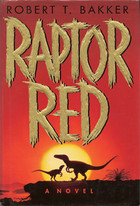
Book Review: Raptor Red by Robert T. Bakker
 Summary:
Raptor Red is one of the utahraptors who’ve newly arrived in what will one day be the western United States. Follow a year of her life as faces being both a predator and, as one of the smaller predator dinosaurs, prey.
Review:
I love dinosaurs. Who doesn’t? When I saw that this book was written by a paleontologist, I immediately was intrigued. Who better to tell a story about dinosaurs than someone who studies them extensively? The book certainly presents a realistic view of dinosaurs based on science, but sometimes the story suffers as a result of the intense attention paid to science.
First I just want to say my absolute favorite part of the book is the beginning of each chapter. Each chapter beginning has a small note in the corner about what month it is, but more importantly, it has a hilarious drawing of a dinosaur (or a few) along with a tongue-in-cheek chapter title.
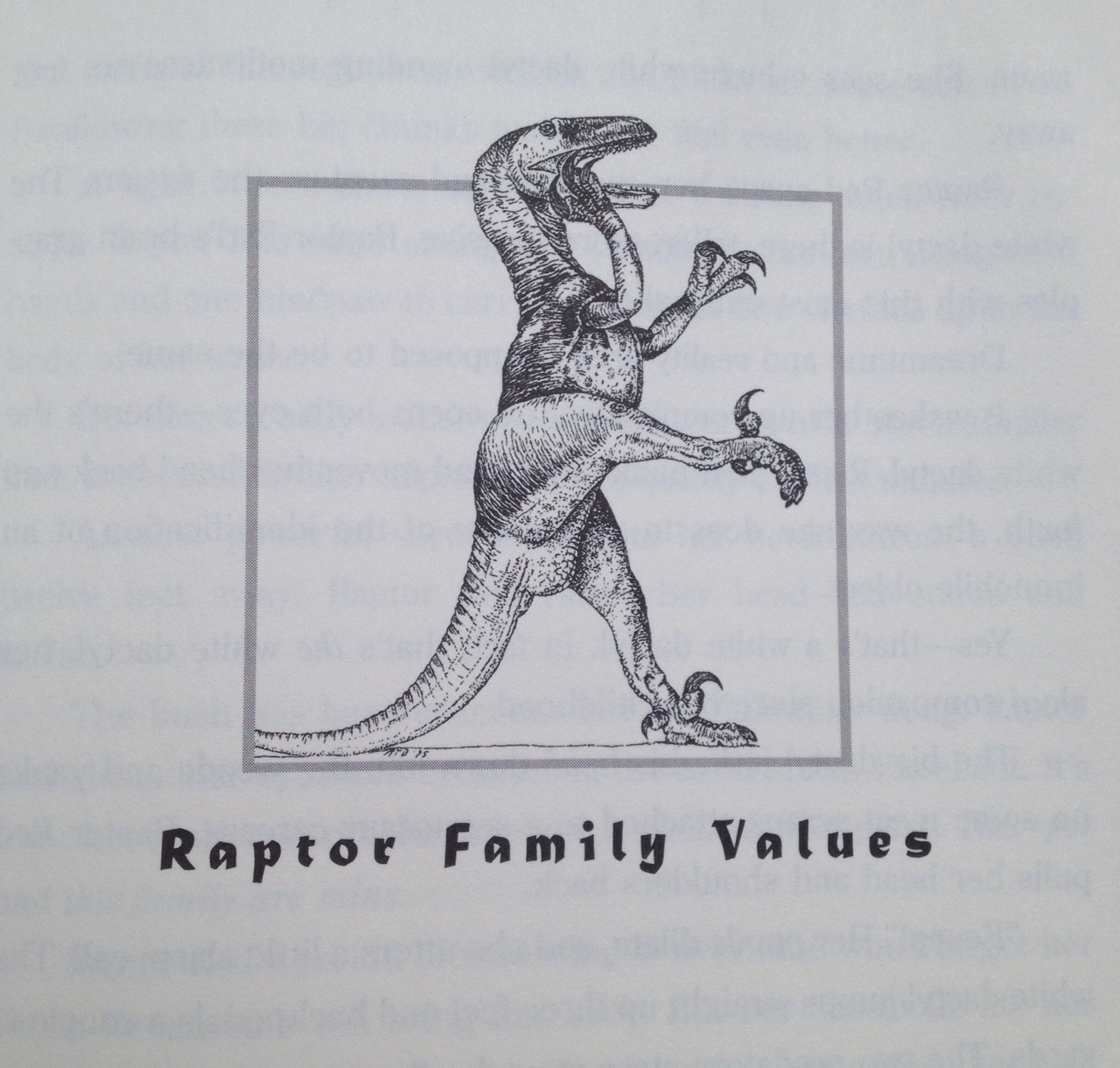
Look at that adorable dinosaur! Just look at him!
I wish that this ability to both present scientifically realistic dinosaurs and be humorous/cartoonish about them simultaneously had carried through to the writing. The overarching story that the book tells is sound. Raptor Red’s mate dies, and she reunites with her similarly widowed sister while simultaneously looking for a new mate. (This is not a spoiler, it is well-established in the first chapter). But the story on the sentence level is belabored by the author’s apparent need to couch everything in speculations. For instance, instead of just saying Raptor Red stamped her foot angrily, he’ll say something like Raptor Red was probably angry because she stamped her foot, and we know that dinosaurs stamping their foot indicated impatience, and if we believe that higher-thinking animals can feel emotions, then it was probably anger she was feeling. Passages like that really gum up the storytelling. The story would have worked better if he had some disclaimer at the beginning regarding emotions in animals, literary license, etc…, and then just ran with putting emotions on the extremely well-researched animal behavior.
The book teaches the reader a lot about dinosaurs in the context of the story, but the storytelling manner makes the reader get bogged down and realize they’re learning, instead of enjoying a story and happening to get some knowledge about dinosaurs in the process. The former makes for a tough read, in spite of enjoyable illustrations.
Overall, dinosaur enthusiasts will enjoy both the illustrations and the high level of science present in the story. Some may be frustrated by the author’s insistence on not personifying the dinosaurs, in spite of telling a very emotional story of being widowed and finding a new mate. Recommended primarily to those with a vested interest in reading everything dinosaur who won’t mind that the story sometimes suffers at the hands of science.
If you found this review helpful, please consider tipping me on ko-fi, checking out my digital items available in my ko-fi shop, buying one of my publications, or using one of my referral/coupon codes. Thank you for your support!
3 out of 5 stars
Length: 246 pages – average but on the shorter side
Source: PaperBackSwap

Book Review: Eighty Days: Nellie Bly and Elizabeth Bisland’s History-Making Race Around the World by Matthew Goodman
 Summary:
In 1889, the world was obsessed with Jules Verne’s fictional work Around the World in 80 Days
Review:
With my interest in women’s history, I was surprised when I saw this title on Netgalley that I had never heard of this race around the world, although I had heard of Nellie Bly, due to her investigative report into Bellevue Hospital (a mental institution). I knew I had to request it, and I’m quite glad I got a review copy. Goodman tells not just the story of these two women but also immerses the reader into the newly global world of the late 1890s, both the good and the bad.
Goodman starts the book by introducing us to the two women who will race around the world. He does an excellent job using primary source materials to give us both how others saw these women and how they saw themselves. For instance, in describing Elizabeth Bisland, Goodman writes:
One of her admirers, the writer Lafcadio Hearn, whom she had befriended in New Orleans, called her “a sort of goddess” and likened her conversation to hashish, leaving him disoriented for hours afterward. Another said, about talking with her, that he felt as if he were playing with “a beautiful dangerous leopard,” which he loved for not biting him. (loc 241)
While introducing the women, Goodman also talks at length about the role of women in journalism in the late 1800s and how hard it was for them to break into real reporting. Jumping off from Bisland and Bly, describes how women were blocked from many journalism positions with excuses such as that the newsroom needed to be free to swear and not worry about a lady’s sensibilities. Women were often barred to what was deemed the ladylike journalism of the society pages. The hardest part of being a hardhitting female journalist at the time wasn’t the actual reporting but instead the reception of women in the newsroom.
The successful female journalist, McDonald suggested, should be composed of “one part nerve and two parts India rubber.” (loc 465)
Bisland and Bly and their race came at the beginning of having women journalists do some form of stunt journalism, which is how they started to break into hardhitting journalism. Editors and owners discovered that readers enjoyed reading about women in stunt situations, such as learning how to stunt ride a horse, so this was their way in. Thus, even if the reader dislikes the personalities of either or both of the racers, they come away with some level of respect for them both breaking into the business.
From here, Goodman starts following the women on their race around the world. He takes the different legs of their journeys as a jumping-off point to discuss something historically relevant to that portion of the journey. For instance, during Bly’s trip on the ocean liner to Europe, he discusses how the steamships worked, from the technical aspects of the steam to the class aspects of first class down to steerage. During Bisland’s railroad trip across the United States, he discusses the railroad barons and the building of the transcontinental railroad. Thus, the reader is getting both the story of the race and historical context. It’s a wonderful way to learn, as the historical explanations flesh out the settings around and expectations of the women, and the women lend a sense of realness to the historical situations and settings being described.
After the completion of the trip (and, no, I won’t tell you who won), Goodman explores the impact of the trip on the women’s lives and follows the rest of their lives to their deaths. This part may feel a bit long and irrelevant to some readers, however often when people become famous for doing something, no one talks about the long-lasting impact of that fame or what the rest of their lives are like. Seeing how both women reacted to the trip, their careers, and others puts them in a more complete light, giving the reader a complete picture of what the race did in their lives. This complete picture of both of their lives is something I really appreciated and that also demonstrated that one shouldn’t judge people too fast. They and their lives may turn out differently than you expect at first.
What would have made me love the book is if I had come away feeling like I could respect or look up to either woman. Unfortunately, by the time I heard the full story of both of their lives, I found them both to be so deeply flawed that I couldn’t do that. I respect them for breaking into the newspaper business, and perhaps if I was a journalist myself that would be enough to make me look up to them. But each had a fatal flaw that made this not be a book about two role models but instead a book about two women. There’s nothing wrong with that, but it does keep it from being a book I would return to over and over again.
Overall, Goodman does an excellent job using the true story of two female journalists’ race around the world in 1889 to 1890 to build a solid picture of the increasingly global world of that time. The reader will come away both with having learned an incredible true story and details about the 1800s they might not have known before, told in a delightfully compelling manner. Some readers might be a bit bothered by how flawed the two women journalists are or by the fact that the book goes on past the race to tell about the end of their lives in detail. However, these are minor things that do not distract too much from the literary qualities of this historical nonfiction. Recommended to those interested in an easy-to-read, engaging historical nonfiction book focusing in on women’s history. Particularly recommended to modern, women journalists.
If you found this review helpful, please consider tipping me on ko-fi, checking out my digital items available in my ko-fi shop, buying one of my publications, or using one of my referral/coupon codes. Thank you for your support!
4 out of 5 stars
Length: 480 pages – chunkster
Source: Netgalley

Book Review: Charlotte Sometimes by Penelope Farmer (Series, #3) (Bottom of TBR Pile Challenge)
 Summary:
When Charlotte goes away to boarding school for the first time, she’s very excited to get the bed with the particularly pretty wheels right next to the window. When she wakes up, though, the view from the window looks different, and people are calling her Clare! She discovers she’s traveled back in time to the same bed in the same boarding school, but during World War I. The next morning, though, she wakes up in the present again as Charlotte. This pattern continues, meaning both she and Clare are Charlotte….sometimes.
Review:
I picked this book up because I have an affinity for both boarding school books and time-travel books. This looked like the best of both worlds to me. A fun middle grade book that introduces to the reader to two different past time periods–the late 1960s of Charlotte’s present and the nineteen-teens of Clare’s present.
This book is the third in a series, but it is completely possible to read it as a standalone. No mention is made of the events in the first book, and the second book is actually about what Charlotte’s little sister does while she’s away at boarding school.
The concept is intriguing, because instead of time-travel happening once and landing the person stuck in the past (or future), Charlotte keeps switching, spending every other day in the 60s and every other day in the teens. (I get a migraine when the barometric pressure changes….I can only imagine how I’d feel if I time travelled! Do you think I could bring my green lamp therapy with me?)
In addition to the usual issues time-travel books bring up, such as what stays the same and what is actually different throughout time, it also brings up the key question of identity. What makes Charlotte Charlotte? Is she still Charlotte when she’s being called Clare? Why does hardly anyone notice that Clare has changed? Or Charlotte for that matter? The book thus addresses identity issues that middle grade readers might be going through, but in a subtle way through the time-travel trope.
Were you some particular person only because people recognized you as that? (page 66)
The time-travel itself is left as a fantastical mystery, rather than being given a scientific explanation. There’s something magical about the bed that only makes Charlotte and Clare switch places, but no one else. This works without an explanation because the young girls being subjected to the time-travel just accept it without explanation. This is their reality, and it doesn’t matter why it’s happening, they just have to deal with it. Some readers, though, might struggle with the fact that the time-travel itself is never explained.
The one thing that disappointed me about the book, and that I think would have made it a classic and a five star read, is that the book only explores what happens to Charlotte when the girls switch places. Clare, her experiences, and her perspective are only heard about through third parties. The book, while in third person, is entirely Charlotte’s perspective. Clare, a reserved, proper girl from the nineteen-teens must have been shocked by both the technology and the mores of the 1960s she suddenly found herself in. So much more could have been explored by telling both Charlotte’s and Clare’s story. The book misses an opportunity by only focusing on the modern day girl going back in time. The girl being thrust into the future, a future where she finds out Britain wins the war, and there is suddenly no food rationing or flu epidemic, that is such a cool story in and of itself, and Farmer just never ventures out to tell it.
Interestingly, the British band The Cure released a song called “Charlotte Sometimes” that they admitted was pulled directly from this book. Not just the title, but song lyrics are pulled from the first couple of lines of the book. Even the music video features scenes from the book. It seems to be quite a mystery who the actress was who played Charlotte in the video. She wasn’t credited, and there’s a lot of posts on the internet with people speculating about who she might be. In any case, Penelope Farmer was…not amused by the whole thing. But back to the book.
Overall, this is a book that sets up a fantastical world of time-travel within a boarding school. It utilizes the switching of two girls with each other in time to explore questions of identity in a way that surely will appeal to many middle grade readers. The book does not fully explore the story the way it possibly should have, but the young reader will probably enjoy filling in those gaps themselves. Recommended to all fans of boarding school, time-travel, or historic fiction set during World War I’s homefront.
If you found this review helpful, please consider tipping me on ko-fi, checking out my digital items available in my ko-fi shop, buying one of my publications, or using one of my referral/coupon codes. Thank you for your support!
4 out of 5 stars
Length: 174 pages – average but on the shorter side
Source: Better World Books

Previous Books In Series:
The Summer Birds
Emma in Winter


Edit note: Thanks to Vicky for pointing out it was published in 1969.
Book Review: The Edible Woman by Margaret Atwood (Bottom of the TBR Pile Challenge)
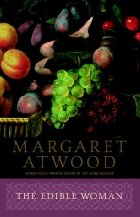 Summary:
It’s the 1960s in Canada, and Marian McAlpin is working writing and analyzing surveys for a marketing research firm. She has a feminist roommate she doesn’t quite understand, and hangs out with the three office virgins for lunch. Her boyfriend is comfortable and familiar. When he proposes to her, the office virgins think she’s hit the jackpot, her roommate questions why she’s following the norm, and her married and very pregnant friend seems hesitant about her fiancee. None of this really bothers Marian, though. What does bother her is that, ever since her engagement, there are more and more things she simply can’t eat. First meat then eggs then even vegetables! She thinks of herself causing them suffering, and she just can’t stomach them. What will happen to her if there’s eventually nothing left for her to eat?
Review:
I’m a fan of a few Margaret Atwood books, and the concept of this book intrigued me. Since I run the Mental Illness Advocacy Reading Challenge, I was also wondering if this might actually be a new take on anorexia. Unfortunately, Marian is not really anorexic, it’s more of an elaborate, overdone metaphor. Perhaps the plot is simply dated, but the interesting concept, when fleshed-out, comes out rather ho-hum.
The novel is divided into three parts, with Marian using first-person narration for the first and third parts, with third person narration taking over for the second. This is meant to demonstrate how Marian is losing herself and not feeling her own identity. It’s an interesting writing device, and one of the things I enjoyed more in the book. It certainly is jarring to suddenly go from first to third person when talking about the main character, and it sets the tone quite well.
It’s impossible to read this book and not feel the 1960s in it. Marian is in a culture where women work but only until marriage, where women attending college is still seen as a waste by some, and where there is a small counter-cultural movement that seems odd to the mainstream characters and feels a bit like a caricature to the modern reader. However, the fact that Marian feels so trapped in her engagement, which could certainly still be the case in the 1960s, doesn’t ring as true, given the people surrounding Marian. Her roommate is counter-cultural, her three office friends claim to want a man but clearly aren’t afraid of aging alone and won’t settle. Her married friend shares household and child rearing with her husband, at least 50/50. It’s hard to empathize with Marian, when it seems that her trap is all of her own making in her own mind. She kind of careens around like aimless, violent, driftwood, refusing to take any agency for herself, her situation, or how she lets her fiancee treat her. It’s all puzzling and difficult to relate to.
The Marian-cannot-eat-plot is definitely not developed as anorexia. Marian at first stops eating certain meats because she empathizes with the animals the meat came from. As a vegetarian, I had trouble seeing this as a real problem and fully understood where Marian was coming from. Eventually, she starts to perceive herself as causing pain when eating a dead plant, bread, etc… The book presents both empathizing with animals and plants as equally pathologic, which is certainly not true. Marian’s affliction actually reminded me a bit of orthorexia nervosa (becoming unhealthily obsessed with healthy eating, source) but the book itself presents eliminating any food from your diet as pathologic. Either Marian eats like everyone else or she is going off the deep-end. There is no moderate in-between.
What the Marian-cannot-eat-plot is actually used for is as a metaphor for how Marian’s fiancee (or her relationship with him) is supposedly consuming her. The more entwined with her fiancee she becomes in society’s eyes, the closer the wedding comes, the less Marian is able to consume, because she herself is being consumed. This would be quite eloquent if Marian’s fiancee or her relationship with him was actually harmful or consuming, but it certainly does not come across that way in what we see of it in the book.
Marian presents herself to her boyfriend then fiancee as a mainstream person, and he treats her that way. He does one thing that’s kind of off-the-rocker (crashes his car into a hedge) but so does she on the same night (runs away in the middle of dinner, across people’s backyards, for no apparent reason and hides under a bed while having drinks with three other people at a friend’s house). The only thing that he does that could possibly be read as a bit cruel is when she dresses up for a party he states that he wishes she would dress that way more often. It’s not a partner’s place to tell the other how they should dress, but it’s also ok to express when you like something your partner is wearing. Personally I thought the fiancee really meant the latter but just struggled with appropriately expressing it, and Marian herself never expresses any wants or desires directly to him on how they interact, what they wear, what they eat, how they decorate, etc…, so how could he possibly know? In addition to never expressing herself to her fiancee, Marian also cheats on him, so how exactly the fiancee ends up the one being demonized in the conclusion of the book is a bit beyond me. He’s bad because he wanted to marry her? Okay…… The whole thing reads as a bit heavy-handed second-wave feminism to me, honestly. Marriage seems to be presented in the book as something that consumes women, no matter if they choose it or are forced into it by society. It is not presented as a valid choice if a woman is able, within her society and culture, to make her own choices.
In spite of these plot and character issues, the book is still an engaging read with an interesting writing style. I was caught up in the story, even if I didn’t really like the ideas within it.
Overall, this is a well-written book with some interesting narrative voice choices that did not age well. It is definitely a work of the 1960s with some second-wave feminism ideas that might not sit well with modern readers. Recommended to those interested in in a literary take on second-wave feminism’s perception of marriage.
3 out of 5 stars
Source: Better World Books

Book Review: A Thousand Lives: The Untold Story of Hope, Deception, and Survival at Jonestown by Julia Scheeres (Audiobook narrated by Robin Miles)
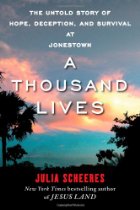 Summary:
On November 18, 1978, 918 people, mostly Americans, died on a commune named Jonestown and on a nearby airstrip in Guyana. The world came to know this event as that time that crazy cult committed mass suicide by drinking poisoned Kool-Aid. However, that belief is full of inaccuracies. Scheeres traces the origins of Jonestown, starting with its leader, Jim Jones, and his Christian church in Indiana, tracing its development into the People’s Temple in California, and then into Jonestown in Guyana. Multiple members’ life stories are traced as well, including information from their family members who, perplexed, watched their families give everything over to Jones.
Review:
I have a fascination with cults and groupthink. In spite of not being born until the 1980s, I definitely was always vaguely aware of this cult that committed suicide in the 70s, always commentated on with great disdain. I had previously read Julia Scheeres’ memoir, Jesus Land
Scheeres possesses a great talent at presenting people and events as they are with understanding for common humanity but also disdain for atrocious acts. Scheeres excels at never turning a person into a monster, but rather exposing monstrous acts and asking how things became so messed up that something like that could happen. Scheeres clearly did painstaking research for this book, reading through the FBI’s extensive archives on the People’s Temple and Jim Jones, interviewing survivors, and interviewing family members of the deceased, not to mention reading members’ journals. The facts are presented in an engaging, storytelling, slightly non-linear way, which works excellently at drawing the reader in. The book starts on the boat to Guyana, then flashes back to the origins of Jim Jones. The members of People’s Temple are carefully presented as the well-rounded people they truly were with hopes and dreams and who made some mistakes. They are not ever presented as just a bunch of crazies. Even Jones is allowed a time as a preacher passionate for social justice before he turned into the control freak, whose paranoid delusions were exacerbated by drug addiction. Scheeres takes an event that it is far too easy to put the stamp of crazy on, and humanizes it, drawing out the gray areas. And this is all done while telling an engaging, well-written, factual story.
There are an incredible number of facts in this book, and the reader learns them while hardly even realizing it, since this work of nonfiction is so readable. Among the things I never knew, I found out that the People’s Temple originally was a Christian church that was heavily socialist and then slowly turned into its own religion as Jones pulled away from the Bible, eventually declaring himself god. When Jones was in California, he was heavily involved in politics, sponsoring people such as Harvey Milk for office, and breaking voting laws by sending his church en masse to vote in districts they didn’t live in. Jones enacted weekly corporate punishment of individual members in front of all the other members. He was bisexual, having sex with both male and female members of the People’s Temple. He became obsessed with the idea of suicide to make a statement and routinely badgered the higher members of the People’s Temple into accepting suicide if he ordered it. He even tricked them multiple times into thinking that he had given them poisoned drinks, just to see who would obey and drink it. The members came to Jonestown in Guyana expecting a utopia, since Jones had lied to them, and instead got a struggling farm on the brink of disaster, being run by a man increasingly paranoid and delusional and ever more addicted to drugs. Once members were in Jonestown, they were not allowed to leave. And many wanted to. Last, but most important, the mass suicide was not a mass suicide. It was a murder-suicide. Some of the members committed suicide willingly, but others, including over 300 children, were force-fed or injected with the poison. Those who drank it drank it mixed with Flavor-Aid, a generic knock-off brand of Kool-Aid. It astounds me how much the facts of these events from as recent as 1978 are now misremembered in the collective consciousness, especially considering the fact that documentation such as the Jonestown death tape are available for free in the public archive.
Overall, this book takes a misremembered event in recent history and exposes the facts in an incredibly readable work of nonfiction. Scheeres presents the people who died in Jonestown with empathy and understanding, seeking to tell their whole life story, rather than one moment. A fascinating look at a horrible event, and a moving reminder to never give too much power or faith to one person, and how very easy it is for groupthink to take over. Highly recommended.
5 out of 5 stars
Source: Audible

 Support my work with a tip or browse my shop for curated book club guides, how to guides, cross-stitch patterns, and more!


This work by Amanda Nevius is licensed under a Creative Commons Attribution-Noncommercial-No Derivative Works 3.0 United States License.
 Opinions of a Wolf