
Archive
Book Review: The Golden Torc by Julian May (Series, #2)
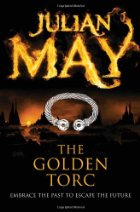 Summary:
The group of people who traveled from the future to the Pliocene past for a willful exile were split into two by the alien race, the Tanu, who, surprisingly, inhabits Earth. Half were sent to slave labor, while the others were deemed talented at mind powers, given necklace-like torcs to enhance those powers, and sent to the capital city of Muriah. In the first book, we followed the daring escape of the group sent into slavery. They then discovered that the Tanu share the Earth with the Firvulag–an alien race from their home planet that has many similarities to their own. They also organized an attack on the industrial city of Finiah. This book at first follows the adventures of the other group, the one sent to the capital city of Muriah. Through them we discover the inner workings of the Tanu, the intersections of humans and aliens, and the impact of the human/Firvulag attack on Finiah. When the time for the Great Combat between the Tanu/human subjects and the Firvulag arrives, the survivors of the escaped slave group end up coming back into contact with the group of humans in Muriah. With dire consequences.
Review:
I really enjoyed the first book in this series, finding it to be a delightful mash-up of scifi and fantasy. When I discovered my library had the next book in the series, I picked it up as quickly as possible. This entry feels more fantastical than the first, although science definitely still factors in. It is richer in action and intrigue and perhaps a bit less focused on character development.
This is a difficult book to sum up, since so very much happens. It’s an action-packed chunkster, providing the reader with information and new settings without ever feeling like an info-dump. The medieval-like flare of the Tanu and the goblin/fairie/shapeshifter qualities of the Firvulag are stronger in this entry, and it is delightful. Creating a medieval world of aliens on ancient Earth is probably the most brilliant part of the book, followed closely by the idea of torcs enhancing the brain’s abilities. May has created and weaved a complex, fascinating world that manages to also be easy enough to follow and understand. The sense of the medieval-style court is strong from the clothing, buildings, and organization of society. She doesn’t feel the need to willy-nilly invent lots of new words, which I really appreciated.
The intrigue is so complex that it is almost impossible to summarize, and yet it was easy to follow while reading it. Surprises lurk around every corner, and May is definitely not afraid to kill her darlings, following both William Faulkner’s and Stephen King’s writing advice. A lot happens in the book, the characters are tested, and enough change happens that I am excited there are still two more books, as opposed to wondering how the author could possibly tell more story. In spite of the action, sometimes the book did feel overly long, with long descriptions of vegetation and scenery far away from where most of the action was taking place.
The book is full of characters but every single one of them manages to come across as a unique person, even the ones who are not on-screen long enough to be fully three-dimensional. The cast continues to be diverse, similarly to the first book, with a variety of races, ages, and sexual preferences represented. I was surprised by the addition of a transwoman character. She is treated with a mix of acceptance and transphobia. I think, certainly for the 1980s when this was published, it is overall a progressive presentation of her. She is a doctor who is well-respected in Tanu society. However, she also is presented as a bit crazy (not because of being trans but in addition to being trans), and it is stated by one character that she runs the fertility clinic because it is the one part of being a woman that will always be out of her grasp. I am glad at her inclusion in the story but readers should be aware that some aspects of the writing of her and how other characters interact with her could be considered problematic or triggering. I would be interested to hear a transperson’s analysis of her character.
Overall, this entry in the series ramps up the action and more thoroughly investigates the world of the Pliocene Exile. Readers disappointed by the lack of information on the half of the group heading to the capital city in the first book will be pleased that their story is told in this one. Characters are added, including a transwoman doctor, and all continue to feel completely individual and easily decipherable, in spite of the growing cast list. The fast action pace sometimes is interrupted by lengthy descriptions of settings far away from the action, but overall the chunkster of the book moves along at a good pace and remains engaging. Recommended to fans of fantasy who want a touch of science in their stories and who are interested in the idea of medieval aliens.
4 out of 5 stars
Source: Library

Previous Books in Series:
The Many-Colored Land
Book Review: The Many-Colored Land by Julian May (Series, #1) (Audiobook narrated by Bernadette Dunne)
 Summary:
In the future, the universe exists in a peace-loving era that allows many alien races and humans to co-exist. People are expected to act within the confines of acceptability and are offered various humane treatment options to help if their nature or nurture sends them the wrong way. But some people don’t want to conform and would rather live in the wild, warrior-like days of old. When a scientist discovers time travel but only to the pliocene era, these people think they have found their solution. There’s only one catch. The time travel only works to the past. For decades the misfits step into the time travel vortex, not knowing what is on the other side. The government approves the solution, since it seems kind and no time paradoxes have occurred. When the newest group steps through, they will discover just what really waits on the other side of exile.
Review:
I became aware of this book thanks to a review by fellow book blogger, Resistance Is Futile. Imagine my surprise when going through my wishlist to check for audiobooks, I discovered a brand-new audiobook production of it featuring the audiobook superstar Bernadette Dunne. This is a creative, action-packed book that truly encompasses both scifi and fantasy in a beautiful way.
Since this is the first book of the series, it takes a bit to set the plot up and get to know the characters. People are sent through the time travel portal in groups, so we get to know everyone in one group prior to going through the time portal so we can follow them all after they go through it. May spends the perfect amount of time familiarizing the reader with the future world, as well as the people who are choosing to leave it. Some readers might be sad to see the imaginative future world left behind for the pliocene era, but it quickly becomes evident that the pliocene is just as richly imagined, albeit different. The pliocene era is not as straight-forward as the exiles believed, and new problems quickly arise for them. It’s not the lawless paradise they were envisioning, and while dealing with the realities of it in an action-packed manner, they also must deal with themselves. Now that they realize there is no true escape to solitude or an imagined perfect past, they must address those aspects of themselves that led them to exile in the first place. These deeper emotional issues are the perfect balance to the other, action-oriented plot. I did feel that the book ends a bit abruptly. However, it is part of a series and clearly the cliff-hanger is intentional. I prefer series entries that tell one complete smaller story within the larger, overarching plot, but this is still a well-done cliff-hanger.
The characters offer up a wide variety of experiences and ethnic and sexual backgrounds, representative of all of humanity fairly well. One of the lead characters is a butch lesbian, another is an elderly Polish-American male expert in the pliocene era, another a nun, another a frat boy style space captain. This high level of diversity doesn’t seem pushed or false due to the nature of the self-selection of exiles. It makes sense a wide variety of humans would choose to go, although the statistics presented in the book establish that more whites and Asians than Africans and more men than women choose to go. Some of the characters get more time to develop and be presented in a three-dimensional nature than others but enough characters are three-dimensional that the reader is able to become emotionally invested in the situation. My one complaint was in prominently featuring a nun in a futuristic scifi, yet again. Statistics show that less and less people are choosing to become nuns or priests. Given that this is set so far in the future with such a different culture, a religious leader of a new or currently rising religion would feel much more thoughtfully predictive of the future.
Most engaging to me is how the book mixes scifi and fantasy. Without giving too much away, the book offers a plausible scientific explanation for human myths of supernatural creatures such as fairies, elves, and shapeshifters. The presence of the inspirations for these myths give a delightful, old world fantastical feel to the story, even while May offers up scientific explanations for all of it. This is not a mix I have seen in much scifi or fantasy, and I was surprised at how much I enjoyed it.
Overall, this is a delightful new take on time-travel that incorporates some fantasy elements into the scifi. Readers looking just for futuristic hard scifi might be disappointed at how much of the book takes place in the ancient past, but those who enjoy scifi and fantasy will delight at the mixing of the two.
4 out of 5 stars
Source: Audible
Book Review: Doctor Sleep by Stephen King (Series, #2) (Audiobook narrated by Will Patton)
 Summary:
Danny Torrance didn’t die in the Overlook Hotel but what happened there haunts him to this day. Not as much as the shining does though. His special mental powers that allow him to see the supernatural and read thoughts lead to him seeing some pretty nasty things, even after escaping the Overlook. He soon turns to drinking to escape the terror. But drinking solves nothing and just makes things worse. When he sees his childhood imaginary friend, Tony, in a small New Hampshire town, he turns to AA to try to turn his life around and learn to live with the shining.
Abra is a middle school girl nearby in New Hampshire with a powerful shine. She sees the murder of a little boy by a band of folks calling themselves the True Knot. They travel in campers and mobile homes, seeking out those who have the shine to kill them for it and inhale it. They call it steam. They’re not human. And they’re coming after Abra. Abra calls out to the only person she knows with a shine too, the man she’s talked to before by writing on his blackboard. Dan.
Review:
A sequel that takes the original entry’s theme on overcoming your family origin and ramps it up a notch, Doctor Sleep
The book begins with a brief visit to Danny as a kid who learns that the supernatural creatures exist in places other than the Overlook, and they are attracted to the shine. This lets the reader first get reacquainted with Danny as a child and also establishes that the supernatural are a potential problem everywhere. The book then jumps aggressively forward to Danny as a 20-something with a bad drinking problem. It’s an incredibly gritty series of scenes, and it works perfectly to make Dan a well-rounded character, instead of a perfect hero of the shine. It also reestablishes the theme from The Shining
The way Dan overcomes both his drinking and his temper, as well as how he learns to deal with his shine, is he joins Alcoholics Anonymous (AA). In contrast to his father who tried to quit drinking on his own, Dan attempts it in a group with accountability. This then shows how much easier it is to overcome a mental illness with community support. I appreciated seeing this. I will say, however, that some of the AA talk in the book can get a bit heavy-handed. Some chapter beginnings include quotes from the book of AA, and Dan can sometimes seem a bit obsessed with it when he relates almost everything to something he learned or heard there. AA definitely plays a vital role in many people’s recovery from addiction, and it’s wonderful to see that in a work of fiction. However, it would have been better for the reader to see the role of AA more than to hear quotes from AA so often.
The big bad in this book is a band of supernatural creatures who were once human and still look human. But they change somehow by taking steam and go on to live almost indefinitely. They can die from stupid accidents and sometimes randomly drop dead. The steam is acquired by torturing children who have the shine. The shine comes out of their bodies as steam when they are in pain. They call themselves The True Knot. This troop is a cartoonish group of evil people who try to look like a troop of retirees and some of their family traveling in a camper caravan. The leader of this group is Rose the Hat–a redheaded woman who wears a top hat at an impossibly jaunty angle. I was pleased to see Rose written quite clearly as a bisexual. Her sexuality is just an aspect of who she is, just like her red hair. Seeing a bi person as the big bad was a delight. Her bisexuality isn’t demonized. Her actions as a child killer and eater of steam are. She is a monster because of her choices, not because of who she is. I alternated between finding The True Knot frightening and too ridiculously cartoonish to be scary. I do think that was partially the point, though. You can’t discredit people who seem ridiculous as being harmless.
How Abra is found by The True Knot, and how she in turn finds Dan, makes sense within the world King has created. It doesn’t come until later in the book, though. There is quite a bit of backstory and build-up to get through first. The buildup is honestly so entertaining that it really didn’t hit me until after I finished the book how long it actually took to get to the main conflict. So it definitely works. Abra is a well-written middle school girl. King clearly did his research into what it’s like to be a middle schooler in today’s world. Additionally, the fact that Abra is so much older than Danny was in The Shining
There is one reveal later in the book in relation to Abra that made me cringe a bit, since it felt a bit cliche. It takes a bit of a leap of faith to believe, and I must admit it made me roll my eyes a bit. However, it is minor enough in the context of the overall story that it didn’t ruin my experience with the book. I just wish a less cliche choice had been made.
The audiobook narrator, Will Patton, does a phenomenal job. It was truly the best audiobook narration I’ve heard yet. Every single character in a very large cast has a completely different voice and style. I never once got lost in who was speaking or what was going on. More importantly to me, as a New England girl born and raised, is that he perfectly executes the wide range of New England accents present in the book. Particularly when he narrates the character, Billy, I thought I was hearing one of my older neighbors speak. I could listen to Will Patton read a grocery list and be entertained. Absolutely get the audiobook if you can.
Overall, this sequel to The Shining
4 out of 5 stars
Source: Audible

Previous Books in Series:
The Shining
Counts For:

Book Review: Something Spectacular: The True Story of One Rockette’s Battle with Bulimia by Greta Gleissner (Audiobook narrated by Dina Pearlman)
 Summary:
Greta Gleissner finally achieved her lifelong dream of making a living just from her professional dancing. She landed the prestigious job of being a Rockette in the New York City show. She hoped that this newfound stability and prestige would cure her of her bulimia. What was there to binge and purge about when she was living her dream? But her eating disorder she’d had since a young age won’t just disappear because of her newfound success. Soon, her bulimia is putting her job–and her life–at risk.
Review:
I was immediately intrigued by the elements of this eating disorder memoir that make it different from the, sadly, so many others that exist. Greta’s eating disorder peaks in her 20s, not her teens. She was a Rockette, and she’s a lesbian. An eating disorder memoir about someone in their 20s in the dance industry who is also queer was very appealing to me. What I found was a memoir that gives insight to having an eating disorder, the impact of homophobia, and an inside look at the professional dance world told in a non-linear, honest, and engaging manner.
Greta tells her memoir in the framework of a play. There are scenes, acts, overtures, etc… This lets her address the story in a non-linear way that still makes sense. The overture, for instance, shows a dramatic moment when her eating disorder was at full tilt and destroying her life. Then she backs up to the few months before she became a Rockette. The time of auditioning then being a Rockette is interspersed with flashbacks to help us better understand her life. Finally, she enters an inpatient clinic, where we get flashbacks in the context of her therapy. It’s a creative storytelling technique that brings a freshness to her memoir.
Honesty without cruelty to herself or others is a key part of her narrative voice. Greta is straightforward, sometimes grotesquely so, about her bulimia and what it does to her. The eating disorder is not glamorized. Greta takes us down into the nitty-gritty of the illness. In fact, it’s the first bulimia memoir I’ve read that was so vivid and straightforward in its depictions of what the illness is and what it does. In some ways, it made me see bulimia as a bit of a mix between an addiction and body image issues. Greta was able to show both how something that was helping you cope can spiral out of control, as well as how poor self-esteem and body image led her to purging her food.
Greta also is unafraid to tell us about what goes on inside her own mind, and where she sees herself as having mistreated people in the past. I never doubted her honesty. Similarly, although Greta’s parents definitely did some things wrong in how they raised her, Greta strives to both acknowledge the wounds and accept her parents as flawed and wounded in their own ways. You can hear her recovery in how she talks about both them and her childhood. She has clearly done the work to heal past wounds.
The memoir honestly made me grateful the dancing I did as a child never went the professional route. It’s disturbing how pervasive body policing and addictions in general are in the dance world, at least as depicted by Greta. Similarly, it eloquently demonstrates how parents’ issues get passed down to the children, and sometimes even exacerbated. Greta’s mother was a non-professional dancer who was constantly dieting. Greta also loved dancing but her mother’s body image issues got passed down to her as well. Food was never just food in her household.
One shortcoming of the memoir is that Greta never fully addresses her internalized homophobia or how she ultimately overcomes it and marries her wife. The book stops rather abruptly when Greta is leaving the halfway house she lived in right after her time in the inpatient clinic. There is an epilogue where she briefly touches on the time after the halfway house, mentions relapse, and states that she ultimately overcame her internalized homophobia and met her now wife. However, for the duration of her time in the clinic and the halfway house, she herself admits she wasn’t yet ready to address her sexuality or deal with her internalized homophobia. It was clear to me reading the book that at least part of her self-hatred that led to her bulimia was due to her issues with her sexuality. Leaving out how she dealt with that and healed felt like leaving out a huge chunk of the story I was very interested in. Perhaps it’s just too painful of a topic for her to discuss, but it did feel as if the memoir gave glimpses and teasers of it, discussing how she would only make out with women when very drunk for instance, but then the issue is never fully addressed in the memoir.
Similarly, leaving out the time after the halfway house was disappointing. I wanted to see her finish overcoming and succeeding. I wanted to hear the honesty of her relapses that she admits she had and how she overcome that. I wanted to hear about her dating and meeting her wife and embracing her sexuality. Hearing about the growth and strength past the initial part in the clinic and halfway house is just as interesting and engaging as and more inspiring than her darker times. I wish she had told that part of the story too.
The audiobook narrator, Dina Pearlman, was a great choice for the memoir. Her voice reads as gritty feminine, which is perfect for the story. She also handles some of the asides and internal diatribes present in mental illness memoirs with great finesse.
Overall, this is a unique entry in the eating disorder memoir canon. It gives the nitty gritty details of bulimia from the perspective of a lesbian suffering from homophobia within the framework of the dance world. Those who might be triggered should be aware that specific height and weight numbers are given, as well as details on binge foods and purging episodes. It also, unfortunately, doesn’t fully address how the author healed from the wounds of homophobia. However, her voice as a queer person is definitely present in the memoir. Recommended to those with an interest in bulimia in adults, in the dance world, or among GLBTQ people.
4 out of 5 stars
Source: Audible

Counts For:
Book Review: Love Minus Eighty by Will McIntosh (Audiobook narrated by Kevin T. Collins, Eileen Stevens, and Ali Ahn)
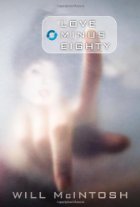 Summary:
In the future, you can live forever. But only if you can afford to pay to be medically resurrected and any injuries sustained fixed. The rest put everything they have into freezing insurance, getting cryogenically frozen in the hopes that one day, someday, they might get resurrected. At the very least, they wont’ die. But beautiful women who die too young (and too not filthy rich) get a different sort of a second chance. They get awoken and given the choice of going into the cryogenic dating facility. Men will come through and pay to wake them up and talk to them, and if they fall for them, they’ll pay to have them resurrected and their injuries healed.
In this world, three different, yet intertwined stories are told. There’s Rob. A once-musician who accidentally struck and killed a jogger in the middle of his break-up with his reality star-esque wealthy girlfriend. He proceeds to take out a loan to visit the jogger to apologize but slowly the guilt turns into something more. Then there’s Veronika, a dating coach with a bad case of unrequited love and a need to feel like she’s doing some good in the world. And finally, Mira. A lesbian who was placed into the heterosexual cryogenic dating pool back at the beginning before they bothered to wake the women and ask them if they wanted to be there.
Review:
I was immediately intrigued by this book’s premise and then realized I’d already read another scifi book by Will McIntosh and enjoyed it. That book, Soft Apocalypse

The future is a near dystopic mess of most of the wealth being in the hands of the few. While some people have foregone civilization to live off the land, the rest of the have-nots spend their time in body suits, called systems, that are basically like a full-bodied smartphone. They reminded me a bit of Google Glass. Their systems filter out all the unsightly aspects of where they live, including garbage, and they also block pop-up ads that otherwise accost you on the street. Everyone pours their little bit of money into their systems because without one you fall entirely off the social stratum. This is already creative enough to be intriguing, but then McIntosh tosses in this idea that cryogenics and resurrection has been figured out but only the wealthy can afford to be resurrected and everyone else pours all the rest of their money into freezing insurance. Then we get the cryogenic dating program aka bridesicles, and oh wow. Any scifi reader can see what an interesting setting this is.
On top of this setting, McIntosh weaves three different, yet ultimately intertwined narrators. It’s a narrative structure I enjoy but only when done well, and McIntosh mostly pulls it off. Some things sometimes felt a bit like too much of a coincidence, but for the most part the intertwining made sense. All three narrators have unique voices and perspectives. They are well-rounded with flaws, even Mira, who is frozen a lot of the time, but they also are still likable.
The plot is complex and truly had me on the edge of my seat for the last third of the book. I was rooting for the characters and did not know what would happen. An unpredictable, yet satisfying, ending plays in perfectly with the plot.
I am of two minds about the presence of Mira in the story. On the one hand, I appreciate that McIntosh took the time to think about how the heteronormativity of the bridesicle program could affect a lesbian. On the other hand, it frustrates me that she and her girlfriend have their agency removed and spend most of the story frozen and at the whim of the heterosexual people around them. Having lesbians rescued by the straight folks just kind of rubbed me the wrong way. I sort of wish there had been some modern day queer person who helped them out in some way. That was the other thing that bothered me. The only queer presence was from the past in the form of Mira and her frozen girlfriend. In such a sweeping narrative with so many characters that is also set in a city, it seems odd to me we never encountered another queer character. Particularly when one of the main characters is a dating coach.
The narration of the audiobook was wonderful. Having a different voice for each narrator really helped keep the stories straight, and each of the narrators did a wonderful job bringing their characters to life.
Overall, this book presents a richly imagined near-dystopian scifi future that gets the reader to think about if living afraid of death is truly living. The three-narrator structure lends a complexity to the plot that keeps it engaging and consistently moving forward. One of the plot choices might rub some readers the wrong way, but if the world building and narrative structure appeal, it shouldn’t be much of an issue. Recommended to scifi fans who enjoy a city setting and some romance.
4 out of 5 stars
Source: Audible
Book Review: Listening To Dust by Brandon Shire
 Summary:
A chance meeting between orphaned British writer, Stephen, and American soldier, Dustin, leads to a passionate love affair in England. But when Dustin chooses to go back home to his small Southern town to care for his mentally challenged brother, Stephen is left behind, sending letters that are never answered. He finally decides to follow Dustin home and arrives only to discover that Dustin is no more.
Review:
This is my second read by Brandon Shire. The first, The Value Of Rain
There are some commonalities in the stories. Both feature a gay man who grew up in an unaccepting family and show the impact that has on their lives. But that’s where the similarities cease. Listening To Dust
The writing is again gorgeous. Even now I can feel the hot dustiness of Dustin’s hometown and also the comforting cool greenery of Stephen’s grandmother’s French cottage. Shire elicits both place and emotions so powerfully that it is impossible not to be moved by the story.
I also really enjoyed the various commentary throughout the book on love, words, and actions. What love is, what it does, and whether words or actions are worth more.
So I guess we were both right, and both wrong about actions and words. Like the two of us, one is empty without the other. (location 1014)
The sex scenes manage to be steamy and emotional. What I might call literary sex scenes. When I read them, I felt them in my knees.
Even now I can feel the heat from your palm as you cupped the back of my head and pulled my lips those last few inches, how you opened your body and begged me with your soul. (location 1726)
Damn.
So what held me back from 5 stars? As previously stated, I wasn’t a huge fan of Stephen’s voice, although I respected his experiences. He sometimes grated on me a bit. I’m not sure if it was his slight Britishisms or how much he got hung up in his own head but he sometimes irritated me in a way that kept me from getting completely engrossed in the story. But this is a small thing, really, when compared to the story as a whole and the beautiful writing.
Overall, this is a book that sweeps the reader away to multiple, disparate places to explore both love and the far-reaching affects of a harsh family life. It should appeal to any who enjoy a heart-breaking contemporary LGBTQIA+ romance.
4 out of 5 stars
Source: Kindle copy from author in exchange for my honest review
Note: 10% of all proceeds donated to LGBT Youth Charities combating homelessness.
Book Review: A Queer and Pleasant Danger: The True Story of a Nice Jewish Boy Who Joins the Church of Scientology and Leaves Twelve Years Later to Become the Lovely Lady She is Today by Kate Bornstein (Audiobook narrated by Alice Rosengard)
 Summary:
Kate Bornstein is a playwright, gender theorist, and queer activist. She chose to write a memoir as a way to reach out to her daughter, Jessica, who is still in the Church of Scientology, and thus, must not speak to her. Her memoir talks about growing up Jewish in the 1950s, feeling like a girl inside a boy’s body. It then talks about why and how she joined Scientology (still identifying as a man, Al), climbing Scientology’s ladder, marrying, fathering Jessica, and finally getting kicked out of Scientology and becoming disillusioned. From there the memoir explains to Jessica how and why Al decided to become Kate and talks about the person behind the queer theory, trying to explain who the incredibly unique parent she has truly is.
Review:
I was feeling bad about how far behind I’ve fallen in writing up reviews for the books I’ve finished reading, but with the historic DOMA ruling in the US yesterday (giving official federal support to marriage equality), I’m really glad I had a LGBTQIA+ book in the queue ready to be reviewed. And not just any LGBTQIA+ book. An amazing one! You can’t read that title and not be intrigued. It’s impossible. I spotted it on tumblr and instantly knew I had to read it. A memoir about a transwoman who was a member of Scientology?! It’s the intersection of three topics I find fascinating.
Kate is unabashedly honest about the fact that this book exists as a letter to her daughter, Jessica. The prologue explains that this memoir came about as a way for Kate to reach out to Jessica and her children, even after Kate has passed away. This lends a tone to the book of an elderly neighbor sitting down to tell you their life story, and you finding out gradually that your elderly neighbor is, in fact, a bad ass, and age has nothing to do with how cool a person still is to this day. And Kate doesn’t hold back because of this perspective. If anything, she is more brutally honest than she might otherwise be. She wants Jessica to have a whole, clear picture of who she is. Flaws and all. One technique that I thought was brilliant for a memoir and helped establish trust in truth between the reader and the author was the fact that Kate would tell a family story she heard growing up and then say, well, that was a lie. I thought it was true, but it turns out what people told me was a lie. Given that, how can we ever know what really is true? Just because we think something is true doesn’t mean it is. It’s an excellent grain of salt to be given in a memoir.
After the prologue, Kate tells her story chronologically. Her story can be roughly summarized as the following sections: growing up a gender queer person, joining Scientology, break-down after getting kicked out of Scientology and coming to terms with her queerness, transitioning, life as a lesbian trans activist, finding BDSM, and overcoming depression and suicidal thoughts. It’s an emotional rollercoaster ride, and one cannot help but feel empathy for this person just struggling to find a place in the world. Personally, I think Kate’s life story is an excellent argument for breaking down the binary gender divide. A lot of Kate’s struggles come from the rigid gender norms and expectations placed upon her by others. It would have been much simpler for people to have let her be gender fluid, and indeed, Kate in more recent years has come to be an activist for gender fluidity and queerness (as is evidenced by her book Gender Outlaw: On Men, Women and the Rest of Us
The Scientology section was surprisingly mundane compared to what I thought actually happens in Scientology. Yes, there was abuse and lies and many other things going on that demonstrate the fallacies of L. Ron Hubbard, but honestly none of it was that much worse than religious extremists of any religion. Scientology expects its followers to cut themselves off from people deemed poisonous and to proselytize non-stop. It takes over the lives of the people in the upper-echelons, controlling every aspect of their lives. We can see all of this in Kate’s years in Scientology, and while it was interesting, none of it is shocking to anyone moderately informed on Scientology. I actually was more interested in how Kate wound up joining Scientology. Scientology teaches the the soul is genderless, and you also reincarnate. Everyone has been in both male and female bodies. Kate (then Al) found this incredibly comforting. It’s possible that his soul was just more frequently in female bodies, and so that’s why he felt like a girl inside. What an appealing concept to a confused, unsupported trans or gender queer young adult. I think this part of the book demonstrates clearly why it’s important for families and loved ones to be supportive of their LGBTQIA+ teens and young people. You don’t want a harmful group of people snapping them up with promises of understanding and caring and information that sounds more supportive than the people they live with.
Interestingly, the much more shocking section was the one in which Kate discusses discovering BDSM and getting pleasure from pain. Kate was part of a BDSM triad for quite some time, and this is addressed. It does, however, come with a warning for Jessica and readers who might not want to hear the details so they can easily skip over it and still get the most important information without getting all the details. I thought that was a nice touch from Kate, showing her maturity and openness. Of course, I read that section, and I will say that Kate had a more intense BDSM relationship than you tend to see in literature, and it was interesting to read about.
It’s also interesting to note that from the prologue Kate is honest with the reader about being diagnosed with Borderline Personality Disorder years ago. This is not something I knew coming into the book, and I don’t think Kate’s mental illness played very much into the book. I certainly think she would have had a better time coping with her mental health issues if she had had a supportive environment for her queerness. Even within the LGBTQIA+ community, she was ostracized for some of her less mainstream beliefs within that community. It’s sad that even a community of people ostracized by the larger society, people can still be unaccepting and unloving. In spite of the fact that the book talks a lot about depression, self-injury, and other mental health issues, I am hesitant to label it as counting for my Mental Illness Advocacy Reading Challenge. I don’t want the casual reader to think that I’m equating being queer with having a mental illness. However, the fact remains that Kate herself states she was diagnosed with BPD, and trans and queer people certainly can have mental illnesses. One does not cause the other, although certainly I think lack of acceptance and loving increases symptoms of mental illnesses. In any case, for this reason, I am counting this read for the challenge, but I want to be crystal clear that this is due to Kate’s BPD and NOT her queer/trans orientation.
The narration of the audiobook was perfect. Thankfully, they chose to use a female narrator throughout, which fits perfectly with the image of an older Kate Bornstein telling her life story to her daughter. Alice Rosengard was a perfect narrator. She became Kate in my mind, and there’s not a better complement you can pay a narrator than that.
I feel like I’ve rambled a lot about this book. It’s hard to succinctly discuss a memoir as unique as this one, let alone a book you love as much as I loved this one. It’s amazing. It’s unique. It does exactly what a memoir should do. It tells a unique life story in an engaging way that forces the reader to put herself into someone else’s shoes and feel empathy and maybe even come out of it with a changed worldview, however slightly. I strongly recommend this book to everyone, really, but especially anyone with an interest in LGBTQIA+ history/theory/studies or an interest in the first few decades of Scientology. I will definitely be reading more of Kate’s works, myself, and want to thank her for being a pioneer, in spite of everything.
5 out of 5 stars
Source: Audible

Counts For:

Book Review: Superior Women by Alice Adams (Bottom of TBR Pile Challenge)
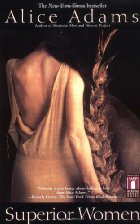 Summary:
When Californian Megan Greene runs has a steamy affair in the summer of 1943 with a Harvard student visiting the west coast for the summer, she decides to follow him back to the east coast and attend Radcliffe. There she meets four other women, three of whom it might be more accurate to call frenemies than friends. Their lives and destinies repeatedly intertwine throughout the tumultuous changes of mid-20th century America.
Review:
I kept my eye out for this book when it was named as a read-a-like to my 2011 5 star read The Group
The book covers 1940s to 1980s America, yet as the decades move on, less and less is said. The 1940s are expressed clearly with exquisite detail, and I was excited to see what would happen with the 1950s and the 1960s. But the 1950s slowed down, the 1960s were barely touched upon, the 1970s were jumped over almost entirely, and the 1980s were the final chapter of the book. The pacing was all off. I wanted to know these women in as much detail in the latter decades as in the first. Instead of feeling like I knew them more and more intimately, they increasingly became strangers to me.
One thing that I think really works against the book is it is neither an ensemble nor a one character piece. Most of the book is told about Megan, but not all of it. We get snippets of the other characters, meaning perspectives that Megan is not privy to, but not enough to ever truly know them. Since most of the book is about Megan, these bits away from her feel sort of like the story is robbing us of more time with the main character we are interested in. Similarly, reading the blurb and the title, I thought this was going to be an ensemble book, which is not what we get either. I wanted to know much more about two of the characters in particular, Peg, who comes out as a lesbian at some point in the 1960s, and Cathy, who has an affair with a priest. These two stories are wonderfully intriguing, particularly Peg’s since her love of her life is met on a mission to register black voters in the American south, and her love interest is a Latina woman. There is so much meat to that storyline, and yet it is barely touched upon while we instead listen to Megan hem and haw about her job, and Lavinia try to figure out how best to cheat on her husband. The balance of telling this ensemble piece was just entirely off.
Similarly, while big issues and events of mid-20th century America were briefly touched upon, the book never really presented a truly personal look at any of them. For instance, Megan has a friend who is bashed in a drive-by gay bashing but we never get to see Megan emotionally deal with this stark reality. She hears about it, calls him, and moves on. Similarly, as previously mentioned, Peg comes out as a lesbian, and we see a snippet of her depression caused by living the lie of being straight, but we never get to understand the emotions or impetus behind her bravely coming out and living in a visible, inter-racial lesbian relationship in the south. It is disappointing because we get a taste of really encountering these historical issues, but we never actually get to.
In spite of all these problems, I still enjoyed reading the book well enough. The plot, while frustrating, does progress forward in an interesting fashion. The characters, although frequently two-dimensional, are bright and vivid. I came away with the perspective I always have with historical fiction about women’s history. That I am grateful I was born in a different time, because we women have much more opportunities available to us now. So I appreciated my visit to that time period but it was a bit disappointing.
Overall, if you are a huge fan of historical fiction about women’s issues, this is an interesting book to add to your repertoire. It is a good comparison to others that did it differently or better, and it is still fun to visit those time periods. If this type of literature is not generally your cup of tea, though, I would suggest you instead read stronger competitors in that genre, such as The Group
3.5 out of 5 stars

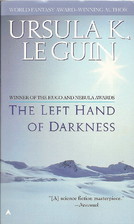
Book Review: The Left Hand of Darkness by Ursula K. Le Guin (Bottom of TBR Pile Challenge)
 Summary:
On the planet Winter, everyone is born intersex, morphing into one sex or the other during their mating cycle. The Ekumen of Known Worlds has sent a representative, Genly Ai, to make first contact. The Known Worlds have discovered that they are all related with the same ancestors who colonized the planets years ago. Genly Ai is at first horrified by the intersex nature of the Gethenians but slowly begins to adapt as he works the political situation on the planet to reach a state of belief in what this one man from his one ship is saying. A state of belief that is necessary to bring this planet into the Ekumen.
Review:
I picked this up when I saw it on sale at a local brick and mortar bookstore for two reasons. I’d never read an Ursula K. Le Guin book, which felt like sacrilege as a young feminist scifi author myself, so she was already on my radar. But why this book? Honestly, I liked the cover. It’s such a pretty cover! So many scifi/fantasy books seem to be set on a hot planet, but this is set on an icy one, and I really liked that. So when I picked it up, I had no idea that it’s considered to be a gender theory scifi. It’s presented as a book about a planet totally lacking in gender. You’ll notice that in my own summary that is not how I present it. Why not? Frankly, a gender-free society is not what I found in this book, which was a big disappointment.
The Gethenians really are not a gender free society, and Le Guin also doesn’t present them that way. It is definitely an intersex society, but it’s intersex people who predominantly present as male/masculine. Now, in case you’ve never had it explained, gender is a construct and sex is your body parts. So you could have an intersex gendered female society or an intersex gender neutral society or an intersex gender male society. The last one is what we have in this book. At first it seems that this might just be Genly Ai’s misperception (the off-world ethnologist). He mentions that he can’t help seeing the Gethenians as male, although sometimes he sees more “feminine features” in them. Perhaps. But when the narration changes from Genly’s viewpoint to a Gethenian one, we get the exact same presentation of everyone as a gendered he. There is no gender neutral pronoun used. There is no perception by the Gethenians of being free of gender. Indeed, instead of seeing themselves as gender-neutral or gender-queer, they see themselves as male until their mating cycle when some of them turn into women for a bit. (They also stay female long enough to be pregnant). Genly points out after a couple of years on this planet that he’s forgotten what it’s like to be around women. Not what it’s like to be around gender constructs. What it’s like to be around women. This is, thus, not a gender neutral society. It’s a society of male-identifying intersex persons who are free of sex-drive most of the time, and who sometimes grow vaginas/breasts for the purpose of reproduction but for nothing else. It is definitely interesting to see an exploration of this type of society, but it’s decidedly not an exploration of a gender-neutral society or really much gender theory at all. It is much more an exploration of the sex drive and a world without female-identifying persons. Now I’m not saying this isn’t a valid exploration or that it’s not well-done. I am saying that the presentation and marketing of this book gets it all wrong, which makes me wonder did Le Guin think she was exploring a gender neutral society and accidentally make an intersex male gendered one instead? Or did the publishers completely misunderstand everything about gender and sexuality and mismarket her book as something it is not? I have no idea, but the potential reader should know that they are not getting an exploration of gender and queerness from a famous scifi/fantasy author when they pick up this book.
Moving beyond the queer theory and mismarketing of it, how is the rest of the book? Well, the imagining of the world is stunning and clearly presented. The idea that planets were all settled by common ancestors and then forgotten about only to be rediscovered later (very Stargate SG1) is subtly introduced into the plot without an info-dump. The world of Winter contains multiple cultures and peoples (something often left out in scifi). The planet even has its own way to mark the passing of time and has evolved to handle the coldness of the planet without Le Guin just copying an Earth culture from a cold area, like the Inuit. No, this is all a unique way of approaching the demands of the climate. It’s also interesting to note that different skin colors are present on Winter, showing that a mixed-race group originally colonized the planet, although their bone structure and height has changed with time and evolution. The world building is so complex that I’m having difficulty explaining just how awesomely complex it is to you, so that should say something I suppose.
The plot is very political. Genly is here on Winter to get the planet as a whole to unify enough to become part of the Ekumen. Thus there is typical political intrigue across a couple of nations and various amounts of striving for power. There’s nothing incredibly unique about this element of the book but it is clearly done and is not completely predictable.
There is an interesting character development where Genly has a friendship that could take a turn for the romantic. How that line is walked could be endlessly analyzed. I will just say to keep it spoiler free that I appreciated what Le Guin did with the relationship, and it was a unique one to see in literature.
Overall, this is a richly imagined scifi world where the setting is much more the focus of the book than the more typical political intrigue/first contact plot. Do not be misled by the marketing to think that this is a book exploring a world free of gender. Rather it is a male-gendered intersex world. Thus, it is a book that will appeal to scifi lovers who prefer world-building over plot but don’t go into it expecting a scifi exploration of gender theory.
4 out of 5 stars
Source: Harvard Books

Book Review: Braided by Elora Bishop (Series)
 Summary:
A lesbian retelling of Rapunzel. Gray, a witch’s daughter, visits Zelda every day. The witch switched Gray’s fate into Zelda, so now Zelda is the one entwined with the spirit of the tree that the people worship. She must live on the platform and every day lower her hair for people to tie ribbons and prayers into. Gray feels horrible guilt over their switched fates, but she’s also falling in love with Zelda.
Review:
I’m a sucker for fairy tale retellings, although I can be fairly picky about whether or not I like them. But Rapunzel is a tale that is not redone often enough, in my opinion, and the fact that it was a lesbian version made me jump at this novella.
It’s nice that the retelling doesn’t just change the genders of the main romantic pairing and leave it at that. In the original version, a married couple steal from a witch’s garden and in payment they must give her their unborn child who she then locks up into a tower. She would let her long hair down for her witch/mother to use as a ladder to get into the tower. A prince years later hears her singing in the tower and helps her escape. In this retelling, the people worship a tree. When the tree starts to die they tie its spirit into a person. That person lives on a platform in the tree and the people pray to him/her. When the person dies, the fate to be tied to the tree randomly chooses a baby by putting a tree pattern on their chest. This fate is supposed to be Gray’s, but her mother somehow acquires another baby, Zelda, and with magic cuts the fate out and ties it to her instead. Gray knows this and at first visits Zelda out of guilt but eventually falls in love with her. This version, surprisingly, is actually a lot more fantastical and magical. There is even a quest within an alternate dimension/dream world. I enjoyed the increase in the otherworldly feel, and I liked that it lent the twist of a parent trying to protect her child rather than a mother smothering her child.
The writing has an earthy, magical quality to it. It’s definitely language that is looking to be pretty, and it mostly succeeds. The romance between Zelda and Gray is sweet and very YA. Their passion revolves entirely around kissing and holding. I like that it gives a soul and connection to the romance without ignoring the physical aspect. It’s the perfect balance for this type of story.
While I enjoyed reading the story, I must admit it wasn’t my ideal retelling of Rapunzel. I didn’t like the religious aspect that was drawn into it, and I did feel that Zelda falling for Gray was a bit fast, particularly given the fate switching aspect of the story. I was also disappointed to see that in spite of all the other changes in the story, the Rapunzel character is still blonde. I’m not sure why no one ever seems to change this when retelling Rapunzel.
Overall, this is a fun retelling of Rapunzel, particularly if you’re looking for a non-heteronormative slant or enjoy a more magical feel. Note that this is part of a series entitled Sappho’s Fables
4 out of 5 stars
Source: Amazon

 Support my work with a tip or browse my shop for curated book club guides, how to guides, cross-stitch patterns, and more!


This work by Amanda Nevius is licensed under a Creative Commons Attribution-Noncommercial-No Derivative Works 3.0 United States License.
 Opinions of a Wolf