
Archive
Book Review: How I Live Now by Meg Rosoff
 Summary:
Daisy’s stepmother has convinced her father to send her off to England to live with her aunt and cousins, and Daisy really doesn’t mind. She hates her life in NYC anyway, and life in the countryside seems like a welcome change. Her cousins are quirky and fun, and Aunt Penn is sweet and practices a relaxed parenting style. When Aunt Penn goes away for a work trip, terrorist acts occur in London effectively leaving the kids on their own. On their own to explore feelings and actions they might not otherwise have felt free to.
Review:
The big rumblings about this YA book is that there is incest in it. In the grand scheme of shocking incest though, this incest is just….not that shocking. It’s between two cousins who’ve never met until they’re teenagers. *shrug* Plus, the incestuous relationship is really not the main focus of the story at all. It holds center stage for maybe two chapters. Two very chaste chapters. Oh sure, an astute reader knows what’s going on, but there are no lengthy sexual passages. The most we get to witness is a kiss. So, this book is really just really not about incest, ok? If that was keeping you from reading it, don’t let it. If that’s why you wanted to read it, go read Flowers in the Attic
So what is the story about? Quite simply, it’s about the impact living in an age of world-wide terrorism has on young people. On their perceptions, decisions, morals, and more. As someone who was only a sophomore in highschool when 9/11 happened, I feel safe in saying that Rosoff depicts the experience of a young person growing up in this world very well. The mixture of relaxing and having fun while the adults panic around you with nights of fear are perfectly woven.
Daisy’s voice is wonderful to listen to. She’s an appealing, funny narrator with an acute wit. She is truly someone to like and root for. Similarly, her female cousin, Piper, who she becomes a pseudo-parent to, is extraordinarily interesting and appealing. In fact, I’m hard-pressed to name a character who isn’t well-rounded.
Unfortunately, all of these positives about the book come to a crashing halt at the end. All I can tell you without spoiling the ending is that Rosoff did not take her themes as far as I was hoping she would take them. In my opinion, she copped out, and I was sorely disappointed. The ending reads almost like the beginning of the Beauty and the Beast fairy tale, and I was just left feeling as if Daisy and her cousins had let me down. What could have been an extraordinary book became just average.
Thus, if you are looking for a YA take on the impact life with terrorism has had on the younger generation, but aren’t expecting anything mind-blowing, you’ll enjoy this book. If what you’re after is shocking YA, however, look elsewhere.
3.5 out of 5 stars
Source: PaperBackSwap

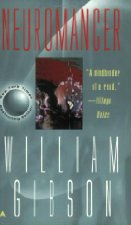
Book Review: Neuromancer by William Gibson
 Summary:
Billy Case used to be the best cowboy in the matrix–the digital world you plug yourself into. But then he pissed off the wrong boss who had his neurons fried so he can’t jack in anymore. Case has been biding his time waiting to die in Japan, until a mysterious woman named Molly shows up. She’s tricked out with blades that emerge from under her fingernails and sunglasses built into her skull. She says her boss has a job for Case and will fix his neurons, beginning the adventure of Case’s life.
Review:
This is a good example of how to effectively drop a reader into a completely unfamiliar world and explain nothing and yet have enough make sense for the reader to be invested in the outcome for the characters. Gibson doesn’t explain much to the reader, and yet what doesn’t make sense eventually clicks into place if the reader is persistent enough in the reading.
The settings vary from a creatively imagined future Japan to a Rastafarian space station to what is essentially Miami in outer space. They are all immediately engrossing and intriguing. What led the world to develop this way in Gibson’s imagination? That is never entirely clear, but that’s part of the fun. After all, when is it ever entirely clear why the world works out the way it does?
By far the most interesting character is Molly. Like a Whedon heroine, she kicks ass and takes no names. She is not just brains or brawn; she is both. Case pales abundantly in comparison to her, and he knows it. Although they do hook up, he states that Molly could never really be anyone’s woman. She is her own. Molly’s life is incredibly more interesting than Case’s, and perhaps one of the more frustrating parts of the book is that we only get to see of her what Case gets to see. The book is not about her; it is about Case’s experiences with her. Yet that is also what makes the book intriguing. She flits into and out of Case’s life and yet will linger forever in his memory as someone significant.
Of course, I would be remiss to review this classic piece of scifi without mentioning the impact its imaginings of the internet would have. Obviously there is the matrix and plugging in concepts. The idea of the internet as something that you participate in in a 3D manner. The concept of AI as a computer rather than as a robot. The list goes on and on. If you’re a scifi fan and have not read this book, you really need to. It is clear from page one what an impact Gibson has had on the genre.
The plot itself is convoluted and confusing. I’m still not entirely sure I understand exactly what happened. Yet I’m also not sure Case understands exactly what happened either. This is one of the few times I’ve finished a book and instantly wanted to re-read it, hoping to understand it a bit better the second time around. Yet such a convoluted plot is a bit distracting when there is so much else wonderful going on. It holds the book back from being superb.
Overall, this piece of classic scifi is an interesting character study and immersion in a different world. It would be interesting to anyone who enjoys that type of experience in their reading, but is also a must-read for anyone who considers themselves a scifi fanatic.
4 out of 5 stars
Source: SwapTree

Book Review: The Unit by Ninni Holmqvist
 Summary:
In the Sweden of the near future women who reach the age of 50 and men who reach the age of 60 without having successfully acquired a partner or had children are deemed “dispensable” and sent to live in “a unit.” These units appear at first glance to be like a high-class retirement home, and indeed they have all the amenities. The residents, however, are required both to participate in medical experiments and to donate various organs and body parts up until their “final donation” of their heart anywhere from a year or a few years after their arrival in the unit. Dorrit arrives at the unit depressed, but accepting of her fate as the result of her independent nature, but when she falls in love, she starts to question everything.
Review:
The entire concept of this book intrigued me as it is clearly a dystopia whose focus is on the older generations instead of teenagers and young people. The concept itself is of course frightening to any of us who have come to grips with the fact that some day we will be elderly too. This dystopia is also unique though in that it examines the possible future movement of Swedish society, which is vastly different from American society.
The writing is entirely from the perspective of Dorrit. Although it is clear she is writing from some point after the events occurred, Holmqvist eloquently allows her voice to change to reflect her changing ideas on society, her friends, her family, and her own life. When Dorrit first arrives in the unit, she attempts to defend herself saying that women used to be raised to be independent instead of with such a high focus on producing children that will add product to the GNP. It’s not as if she didn’t want a partner, she did, but it didn’t happen. So why is that her fault? Deeper issues are addressed too such as why does only a new family unit count and not siblings? What about pets? Don’t they need us? The vast implications of such a focus on interpersonal relationships found in the traditional family unit are subtly addressed. What type of people tend to be alone family-less by the age of 50 or 60? One resident in the unit’s library, for instance, points out that
“People who read books…tend to be dispensable. Extremely.” (Page 26)
Of course the setting of this dystopia also brings up other interesting issues that Holmqvist handles quite well. The dystopian setting allows the author to address the perpetual loss of friends that the elderly face as well as seeing themselves and their friends sicken mentally and physically. Placing it in a society in which this is exacerbated by science naturally gives it another level as well as a welcome distance for the elderly reader. This of course is a large part of what makes this dystopia different from the typical YA version. Instead of dramatizing the challenges young people typically face such as their world widening and new knowledge being imparted, this one shows how the world becomes smaller and acceptance that it’s too late to change the world becomes the norm.
Perhaps the most universally interesting issue this dystopia addresses is how much the individual should be willing to sacrifice for the greater good. The residents in the unit are constantly being told that their discomfort in an experiment could improve the lives of hundreds of needed people. Or that they should be perfectly fine with “donating” one of their corneas and going half-blind if it means that a nurse with three children can remain a contributing member of society. While some of the residents grow resentful of this concept, referring to the unit as a free-range organ farm, Dorrit finds leaning on this perceived value helps her with her depression in the unit.
“Otherwise I would feel powerless, which I essentially am, but I can cope with that as long as it doesn’t feel that way too.” (Page 71)
Clearly this book makes one think not just about the issues the elderly face but also about how society as a whole treats them and makes them feel. It also firmly addresses just how much individuality and choice it is justifiable to give up for the greater good. The ending completely shocked me and has left me with even more to ponder than the points given above, but I want to leave those for the future reader to discover.
I am incredibly glad this work was translated into English, and I highly recommend it to everyone, but especially to dystopia and scifi lovers, as well as those interested in sociology and psychology.
5 out of 5 stars
Source: Amazon

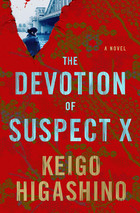
Book Review: The Devotion of Suspect X by Keigo Higashino
 Summary:
In classic noir style, Higashino tells the tale of a mathematician, Ishigami, and a physicist, Yukawa, facing off utilizing only their brilliant minds in a quest to save someone they each love from a life of tragedy. Simultaneously a story of love and betrayal amped up with academia and set against the quintessential backdrop of gritty Japanese city streets–not to mention a lunch box restaurant.
Review:
I fully admit that I put myself in to win this book purely because it’s Japanese literature, and I’m trying to expand my reading horizons to include more non-western lit. I was therefore pleasantly surprised to see so many classic noir elements present in this modern day detective mystery. Noir is one of my favorite genres and adding in the touches of Japan gave it a really fun twist.
It takes a bit for the story to get going and to get into Higashino’s writing style. The sentences lean toward shorter in length than I’m used to. Once I became used to the length difference though I really got into the different type of flow shorter sentences give to a piece of writing. Naturally, this could partly be due to it being a work in translation, but good translators try to give foreign language readers a sense of the original author’s style. I hope the translator succeeded in this regard, because this different style helped give this noir story an extra push in uniqueness.
The mystery itself is nearly impossible to completely solve before the final solution is revealed. The final solution also contains some serious betrayal and an emotional scene that reminded me a bit of some Japanese cinema I’ve seen. So intensely shocking and gritty and occurring in the very last few moments of the story. It moves the story up from a fun way to pass the time to a memorable tale.
The pacing is a bit off, however. Intensity speeds up and slows down repeatedly making it difficult to be totally sucked into the story. A few edits would probably solve this problem leaving the same basic tale but without any unnecessary diatribes. Some may not find the pacing variety as distracting as I did, however.
This Japanese noir piece is artfully pulled off and leaves the reader guessing to the very end. I recommend it to noir and Japanese literature fans alike.
4 out of 5 stars
Source: Won from EarlyReviewers via LibraryThing

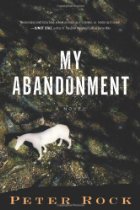
Book Review: My Abandonment by Peter Rock
 Summary:
Thirteen-year-old Caroline lives in Forest Park with her father. They have to be very quiet and careful because regular folk don’t understand why they want to live like they do. They even have to keep away from the other men that live in the park too. Caroline doesn’t mind this way of life. In fact, she prefers it. She likes being out in nature and learning everything she can from her father and from encyclopedias and library books. She even doesn’t mind fasting on Fridays. You get used to it. One day though, she makes a mistake. Will it change her and her father’s way of life forever?
Review:
What makes this book is the surprise, which I refuse to give away in my review. At first, I admit, I was a bit bored with the story. It felt like a less-interesting version of Room, only with a boy instead of a girl and the pair living set off from society willfully. When the twist came I was frankly shocked, and it set my mind reeling about the whole story. To this moment I cannot stop thinking and re-thinking about Caroline’s life. How her raising affected her and whether or not this is a bad thing.
I do think that Rock takes a bit too long to reveal the twist. I was losing patience for a solid while before it came around. Perhaps more clues should have been dropped earlier on or something to keep the reader guessing that perhaps not everything is as it seems in Caroline’s life. Additionally, the writing style in the first few chapters is an odd mix of intelligent and irritatingly simple. It is Caroline speaking, but she’s also an intelligent 13. This whole facade is dropped within a few chapters, so I see no reason to start the book out in that manner. It was a bit off-putting.
Overall, however, it does turn out to be a unique story. More importantly, it leaves the reader questioning what she thinks she knows about the world and alternative ways of living. I recommend it to fans of contemporary literature featuring a twist.
3.5 out of 5 stars
Length: 225 pages – average but on the shorter side
Source: Purchased
Buy It (Amazon or Bookshop.org)
If you found this review helpful, please consider tipping me on ko-fi, checking out my digital items available in my ko-fi shop, buying one of my publications, or using one of my referral/coupon codes. Thank you for your support!
Book Review: Hunger by Jackie Morse Kessler (Series, #1)
 Summary:
Lisabeth Lewis thought it was just a nightmare. Death coming to her when she tried to commit suicide with her mom’s antidepressants and offering to make her Famine–one of the four horsemen of the apocalypse–instead of letting her die. It’s just all way too ironic, her as Famine. After all, she’s fat. She has to watch what she eats very carefully. The Thin voice tells her all the time exactly how many calories each bit of food is and how much exercise it’ll take to burn it off. Yes. Lisabeth Lewis is fat. So why would Death assign Famine to her anyway?
Review:
When I heard the concept of this new YA series–each horseman of the apocalypse representing and dealing with a mental health issue relevant to teens–I was incredibly skeptical. Writing about mental illness in a way that teens can relate to without talking down to them as well as in a responsible manner is difficult enough without having a fantasy element present. Toss in the fantasy and I was worried this would either read like one of those old 1950s cautionary films shown in highschools or would miss dealing with the mental illness entirely. Boy was I wrong. Kessler has found such a unique, creative way to address a mental illness yet cushions it in the fantasy so that it isn’t too in your face. It’s the ideal scenario for teens reading about it, but it’s also enjoyable for adults.
The fantasy element is very tongue-in-cheek. It strongly reminds me of Buffy the Vampire Slayer in style. For instance, Death resembles a heroin-chic dead rock star, and he speaks in a mix of classic English and mocking teen speak to Lisa.
“Thou art Famine, yo,” Death said. “Time to make with the starvation.” (Location 661)
It quickly becomes apparent that Death and the Horsemen aren’t entirely what they initially seem to be. Indeed, they seem to function to get Lisa out of her own head and problems and to look at the greater world around her. She literally travels the world on her horse and sees real hunger, and it affects her. It doesn’t make her feel guilty for being anorexic, but it makes her want to be better so she will be strong enough to help others. That’s a key element of any mental illness treatment. Getting the person to see outside of themselves, and Kessler has personified it through the Four Horsemen.
She, Lisabeth Lewis, seventeen and anorexic and suicidal and uncertain of her own path–she’d done something that mattered. She’d ignored her own pain and had helped others. Maybe she wanted to live after all. (Location 2007)
Of course the non-fantastical passages dealing with Lisa’s anorexia and her friend’s bulimia are incredibly realistic. If they weren’t, the book would immediately fail as the whole thing would ring false to the teens reading it. Her anorexia is dealt with as a very real thing even as the Four Horsemen are presented as either truth or hallucinations of her starved mind. This is key. The anorexia cannot be presented as an element of fantasy.
I was concerned the ending would be too clean-cut. I won’t give any spoilers, but suffice it to say, Kessler handles the ending in a realistic, responsible manner. There are no easy solutions, but there are solutions to strive for.
Overall, Hunger takes the incredibly real problem of anorexia and presents it with a touch of fantasy to help bring the reader not only into the mind of the anorexic but also outside of herself to look at the bigger picture. It is an inspiring, fresh take on YA lit dealing with mental illness, and I highly recommend it to fans of YA lit as well as those interested in literature dealing with mental illnesses.
5 out of 5 stars
Source: Amazon

Counts For:

Book Review: Touched by an Alien by Gini Koch (Series, #1)
 Summary:
Katherine “Kitty” Katt manages to get released early from a dull day of jury duty only to find herself confronted with an angry man who sprouts wings and starts flinging knives from their tips toward everyone in the vicinity. Kitty attacks and stops him and quickly finds herself sucked into a world she was unaware existed. A world of alien refugees defending Earth and themselves from a bunch of fugly alien parasites. She soon discovers her ordinary parents are more involved in this secret world than she would ever have dreamed. On top of that, she’s increasingly finding herself falling for one of the alien hunks who announced his intentions to marry her almost immediately upon meeting her.
Review:
I received a free Kindle edition of the second book in the series, Alien Tango, last year and read it without realizing at first that it was part of a series. I immediately fell in love with the world and Kitty and decided I needed to go back and read the first entry in the series. This reverse approach definitely gave me a different perspective on the story, but it certainly didn’t make me love it any less.
What makes this series epically entertaining is well-established in this first entry. First, the paranormal element is aliens in lieu of something more widely used. Everything has the clean, secret government agency tinge to it instead of the dirty mafia feel many other paranormals elicit. The aliens are aliens, yes, but they’re also a secret government agency. Imagine Men in Black only the men in black are all aliens.
Second, Kitty Katt is a heroine who clearly epitomizes the modern woman. She can take care of herself, but that doesn’t mean she doesn’t like having a man around too. She’s smart, witty, sassy, and sexy, but she has her flaws and weak spots too. She has sex on the day she meets a man, but she’s still aware enough of social norms that she takes care to attempt to hide that fact from the majority of people around her. On the other hand, she herself doesn’t regret that act in the slightest. She so clearly reflects what it is to be a modern American woman that I can’t help but applaud Gini Koch. I hope to see more heroines like Kitty Katt in the near future.
The action itself is vastly entertaining, particularly if you enjoy scifi. The fugly parasites are imaginative, disgusting, and frightening simultaneously. The Big Bad is scary and crafty. The solution to the Big Bad is seriously entertaining. I honestly cannot say enough good things about the scifi in this book.
Overall, Gini Koch’s Kitty Katt series has not failed to leave me glued to my iPod screen yet. It’s sharp, modern, unique, and vastly entertaining. I practically throw copies at lovers of paranormal romance to read, but also highly recommend it to fans of scifi and modern heroines as well.
5 out of 5 stars
Source: Amazon

Movie Review: Red Riding Hood (2011)
 Summary:
Valerie has always lived in a small village surrounded by a dark forest haunted by a werewolf every month at the full moon. For the last ten years the wolf has kept the peace with the town by accepting a sacrifice of a beloved livestock. Now Valerie is a woman and planning on eloping with her lover, Peter, to escape an undesired marriage to the smith’s son, Henry. Just as they are about to elope, though, Valerie’s sister is found dead. The victim of the wolf. Now the town brings in a priest of questionable character in an attempt to rid them of the curse once and for all.
Review:
To me this film was truly all about atmosphere, being a feast for the eyes like the village is a feast for the wolf. Although the first few moments of the film are set in harvest time, the rest of it is during winter, complete with beautiful snowfall scenes. The village itself is simultaneously sinister and picturesque. What truly makes the atmosphere though is the costuming. Gorgeous elbow-length knitted gloves. Covetable dresses with the perfect waist-length. Sleeveless cloaks worn by all in demure shades that truly make Valerie’s red cloak pop when she receives it from her grandmother. The entire atmosphere screams fairy tale.
The story was of course re-written with red riding hood made into a young woman instead of a little girl. The character of the wolf became more complex than just the big bad wolf in the woods. However, the key creepy elements of the fairy tale remain. In all honesty, I was surprised at how good of an updated adaptation this was, and I’ve seen my fair share of fairy tale adaptations.
The one draw-back was the awkward love triangle inserted into the story. There was one scene in particular that simply screamed “This director also directed Twilight!” Ugh. I’m getting incredibly sick of love triangles existing in any story that features young adults. Plus this scene elicited laughter from the audience, which I am pretty sure was not what the director was going for.
Overall, however, this was a delightful adaptation of a beloved fairy tale. I recommend it to lovers of fairy tales and adaptations, as well as those who enjoy an exquisite atmosphere in film.
4 out of 5 stars
Source: AMC movie theater

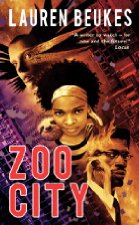
Book Review: Zoo City by Lauren Beukes
 Summary:
In the near future those who’ve committed a serious wrong for which most would feel guilty are given an animal by the spiritual world. They are known as Zoos, and the animals attempt to guide them back to the straight and narrow as well as keeping the Undertow at bay. Separation is painful and almost impossible. If the animal dies, the Zoo dies. Zinzi December of Johannesburg is one of these Zoos. Her animal is a sloth, and her magical power is finding lost things. Normally she sticks to everyday objects such as keys in the sewer, but when a music producer approaches her via his assistants for help in finding a missing teen Afropop star, she bends the rules. She just may come to regret that decision.
Review:
Beukes excels at world-building, setting a vivid example of how to use showing not telling to its best, fullest extent. I was instantly swept into this fantastical version of a nation I’ve never been to, yet somehow was able to quickly decipher which elements were pure fantasy and which based on the realities of modern South Africa. The reader comes to understand how Zoos first showed up and why they exist without even really realizing she is acquiring this information.
Similarly, the character of Zinzi was a refreshing change from the typical urban fantasy female lead. While she is clever and fairly fit, she is neither abnormally strong not incapable of making bad decisions. She is a three-dimensional character with both positive and negative qualities. She is not simply the put-upon dark heroine. Her struggles are real and current, not simply in the past. At first it appears that Beukes is going to fall into the completely redeemed heroine trope, but instead Zinzi still has demons to face. She must repeatedly fall and get back up, something that rings as far more real than one epic fall followed by heroine perfection.
The one draw-back is that the plot is a bit confusing. I had to re-read the climax to fully understand exactly what had been revealed as the big secret Zinzi was discovering. Part of that was due to a couple of elements of the plot that seemed not to mesh well with the rest of it. Some of the important fantasy parts of the plot should have, perhaps, had a bit more explanation. There is a lot going on in this novel and sometimes it can be a bit overwhelming for the reader who is new not only to the fantastical elements of the tale, but to the South African cultural elements as well. Although the plot is ultimately decipherable, it is not immediately easy to follow.
Overall this is a creative, unique piece of urban fantasy that simultaneously presents a truly flawed heroine and takes the genre into a city many modern readers are not familiar with. I recommend it to fans of urban fantasy as well as fans of African literature.
4 out of 5 stars
Source: Gift

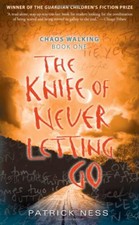
Book Review: The Knife of Never Letting Go by Patrick Ness (Series, #1)
 Summary:
Todd grew up on New World knowing only the constant Noise of other men’s thoughts all around him. He’s never known a world where a boy couldn’t hear his dog talk or where women weren’t all killed off by a horrible plague. Now, mere days before his 13th birthday when he will become a man, his world is turned upside down when his adoptive parents, Ben and Cillian, tell him to run. Run past the swamp. Run and find another settlement. A settlement he never knew existed on New World. He runs with his dog, Manchee, and on the way, they find a creature. A creature whose thoughts they cannot hear.
Review:
This book came recommended to me by three different friends, and I can see based on the summary why they would do so. It’s a dystopia on another planet with talking animals and a narrator who speaks in a mix of rural Americana and British English. The fact is though, I wound up not enjoying this book, and it probably would have been a “did not finish” if I’d had a print copy I could re-sell instead of an ebook I couldn’t. So what’s wrong with it?
Not the world-building. That was truly excellent. The wordle-like clouds of Noise that Todd can hear really bring that aspect of New World to life. Similarly, what the animals say are appropriate to their various evolutionary levels, from Manchee’s partial toddler-like sentences to the herd of elephants who simply say “here” over and over to keep the herd together. Every single scene on New World is easily imaginable in spite of it being quite a foreign location from the buildings to the presence of Noise.
The plot itself isn’t bad but also isn’t amazing. There’s a secret in Todd’s village that we discover at the end of the book that, frankly, did not live up to the build-up. However, that in and of itself doesn’t make me dislike a book. The plot was enough to keep me intrigued, which is the important part, even if in the end it is a bit disappointing.
After much thought I’ve realized that it’s the characters that kept me from enjoying the book, particularly Todd who is also the narrator. I just cannot relate to him at all. I’ve managed to relate to first person narrators ranging from lunatics to serial killers to girly girls to devout Catholics, but Todd is utterly unrelatable to me. He is just so incredibly fucking stupid. Not stupid in the mentally handicapped way. Stupid in the willfully ignorant way that makes me just want to slap him upside the head. For instance, he has this book the whole journey that Ben tells him will explain everything, yet he never sits down to read it. He takes forever to admit he struggles with reading and ask someone else to read it. This is information he needs, and yet he persists in willfully ignoring it. He reminds me of the kids in highschool who wouldn’t do their homework because it wasn’t “cool.” Similarly, I’m sorry, but he’s kind of a pussy, and that irks me. He is fighting not just for himself but for the safety of his dog and another person, but he refuses to man up. I found myself siding with the villains in this regard, and I’m sure that’s not what the author wanted. Similarly, I do not understand why it takes him so long to come around to appreciating Manchee even though he can hear his thoughts from day one and knows that Manchee loves him unconditionally. What the hell, Todd? How are you such an unfeeling idiot, eh? In the end, I simply could not enjoy the book, because although I felt appropriate loathing for the villains, I also loathed the hero and just could not bring myself to care about his plight. The only character I was rooting for at all was Manchee, and that’s not enough to carry a dystopian adventure.
I’m sure there are people out there who can either identify with Todd or empathize with him. For those people who can do so and also enjoy a dystopian adventure, I recommend this book. Anyone who thinks they’ll be even remotely irritated by Todd should stay far away though.
3 out of 5 stars
Source: Amazon

 Support my work with a tip or browse my shop for curated book club guides, how to guides, cross-stitch patterns, and more!


This work by Amanda Nevius is licensed under a Creative Commons Attribution-Noncommercial-No Derivative Works 3.0 United States License.
 Opinions of a Wolf