
Archive
Book Review: Scott Pilgrim By Bryan Lee O’Malley (Graphic Novel) (Series, #1-5)
 Summary:
Canadian Scott Pilgrim is 23 years old and has a case of what to do with myself quarter life crisis. He’s living in a studio apartment with Wallace (who is very gay), dating a 17 year old, and doesn’t have a job, but at least he’s got his band. Then he meets American Ramona Flowers and falls for her. Dating her comes with a catch, though. He’s got to defeat her 7 evil exes who really seem to enjoy jumping him when he least expects it.
Review:
Scott Pilgrim takes typical 20-something ennui and spices it up with a heavy dose of ninja fighting and videogame references, hitting its target audience dead-on. It’s the perfect mix of connection over real life issues and over generational references. It’s more than just a day in the life of Scott mixed with fighting evil exes, though. There’s a mystery to the whole situation. Why is Scott such a good fighter? Why does he fall so quickly for Ramona when nothing seems that special about her? What is up with Ramona anyway? It had me wishing that the sixth volume was out already so I could find out. (It comes out this summer).
The art is relatively average. Some of the characters and scenes are really well-drawn, but some of the minor characters blend together, particularly the women. I was left really confused about some of the women until later in the series where O’Malley put together a listing of all the characters. Even then, I thought they looked a bit too much alike. On the other hand, the art handles delicate scenes like sex and fighting really well, so it all balances out.
What really makes the series, though, is the creativity of the exes and the battles. They range from skateboarding to evil robots at concerts to races through value warehouse stores to (my absolute favorite) vegans with superpowers. Seriously, they have superpowers because they’re vegans. It’s the most awesome idea! Plus, there is a recipe for vegan shepherd’s pie given in the context of the story that I absolutely must try.
I definitely recommend this series to all 20-somethings, videogamers, and ninja-lovers. Plus, the movie version starring Michael Cera is coming out this summer, so you may as well whet your appetite for it by reading the books first.
4 out of 5 stars
Source: Borrowed
Books in Series:
Volume 1: Scott Pilgrim’s Precious Little Life
Volume 2: Scott Pilgrim vs. the World
Volume 3: Scott Pilgrim and the Infinite Sadness
Volume 4: Scott Pilgrim Gets It Together
Volume 5: Scott Pilgrim vs. the Universe
Volume 6: Scott Pilgrim’s Finest Hour (release date: July 20, 2010)

Book Review: So Long, and Thanks for All the Fish by Douglas Adams (Series, #4)
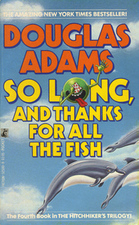 Summary:
Although the planet Earth definitely blew up, Arthur Dent has found himself back on it again, and not in the prehistoric past like before. Everything seems about the same, except that the dolphins all have disappeared and apparently there was a mass hallucination of the planet blowing up caused by a CIA experiment. You’d think this would require all of Arthur’s attention, but instead he’s rather highly focused on a woman named Fenchurch who claims the Earth really did blow up and insists something has felt off ever since.
Review:
It’s no secret that one of my favorite comedic books is The Restaurant at the End of the Universe, the second book in this series. While I felt that the third book suffered a bit, it was still pretty damn funny in my opinion. I really wish I could say the same about this.
I still enjoy Adams’ writing style. It’s tongue in cheek, snarky, and self-referencing. It is a pure pleasure to read. This still holds true here, but the problem is that it’s just not laugh out loud funny. Oh, there are bemusing moments, but mostly it’s a case of jokes falling flat. I think the reason for this is that what makes the books funny is Arthur Dent–average British dude–stuck into the bizarre situations that are the rest of the universe with only the equally bizarre Ford Prefect as a true companion. Indeed, my favorite bit of this book is when Arthur and Ford are reunited. Without that Arthur stuck in outerspace element, you wind up with a rather run-of-the-mill, “huh, something odd is going on on planet Earth” book. It’s cute, but it’s not surprising, and the element of surprise is what makes the rest of the series so funny.
I also wasn’t fond of Adams’ obvious response to the fan question, “Does Arthur ever have sex?!” with the addition of the love interest, Fenchurch. He may think it is witty to reference this and answer it, but I was disappointed. I enjoyed wondering if poor Arthur spent 8 years devoid of sex. It added a certain element of mystery to him. This whole part felt kind of like a cop-out.
I don’t want to sound like I hated the book, because I didn’t. When compared to books not written by Adams, it actually holds up quite well. It’s enjoyable and has some unique scenes. It’s just, in comparison to the rest of the series, I was left a bit disappointed. I still plan on finishing reading the series, though.
3 out of 5 stars
Source: PaperBackSwap
Previous Books in Series:
The Hitchhiker’s Guide to the Galaxy
The Restaurant at the End of the Universe
Life, the Universe, and Everything

Book Review: The Thing from the Lake By Eleanor M. Ingram
 Summary:
In the 1920s Roger Locke is a composer living in New York City. He buys a house by a lake in Connecticut as a country retreat and appoints his cousin, Phyllida, and her husband, Ethan Veer, as caretakers of the property. His first night on the property, he meets a woman–whether spirit or alive, he can’t tell–and is promptly intrigued by her. His visits quickly turn sinister, though, as a dark force based in the lake comes at night to threaten Roger away from the woman. What is the thing in the lake? Who is this woman? Can Roger defeat the dark force thereby returning himself and his cousins to their idyllic lifestyle?
Review:
I had a feeling I was going to like The Thing from the Lake when I discovered that every chapter started with a relevant quote pulled from the classics of the western canon, and I was right. Ingram weaves a complex tale, filled with surprising twists and turns. Just when you think you know what the overarching point is, or where the story is going to go next, you find out that you were wrong.
Ingram artfully goes back and forth between the daytime where the story is more period piece and the nighttime, which is all horror. It is a very New England tale, featuring small farmers, big city dreams, references to the Puritans, and quirky, drawling neighbors. While Phyllida and Ethan are believable and infinitely likeable, Roger’s immediate infatuation with the woman is a bit suspect. It seems shallow how infatuated with her hair and her scent he is, but I think he later proves himself. Sometimes people just know when they meet, so I’m willing to give Roger the benefit of the doubt.
Ingram leaves it up to the reader whether to believe the scientific or the supernatural explanation for the goings on at the lake. It reminded me of my class on the Salem Witch Trials a bit, and I’d be willing to bet that Ingram was at least partially inspired by them. It’s not easy to make both answers to a mystery equally plausible, but she pulls it off wonderfully.
The only thing holding me back from completely raving about the book is that there are parts that smack of historic misogyny. I’m not blaming Ingram. For her time period, many of her thoughts were quite progressive, and I’m sure Roger is an accurate representation of many men of that time period. However, when he speaks about how his “plain cousin” Phyllida is so much more comely when she’s doing “womanly” household chores, it makes me cringe, and not in the good horror way. Thankfully, these instances are not that frequent, so they’re easy enough to glide over.
The Thing from the Lake is a surprisingly thought-provoking book. I highly recommend it to everyone, but particularly to those who enjoy New England literature or light horror.
4 out of 5 stars
Source: Librivox recording by Roger Melin via the Audiobooks app for the iTouch

Book Review: Wolves of the Calla by Stephen King (Series, #5)
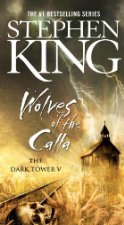 Summary:
The gunslinger’s katet have a lot more on their plate than just continuing along the path of the beam. Susannah is pregnant and has developed another personality, Mia, to deal with the pregnancy as it is most likely demonic. The Rose is in danger in then when of 1977 New York City. The man who owns the empty lot it grows in is under pressure from the mob to sell it to an unseen man. So the last thing the katet needs is to run into a town desperately in need of the help of gunslingers.
The Calla, a town made up of rice growers and ranchers who mostly give birth to twins, has been facing a plague once every generation. Creatures referred to as Wolves come and take one child out of every set of twins between the ages of about 4 and puberty. The child is later returned mentally retarded. Their local robot messenger, Andy, has warned them that the Wolves are coming in about a month, and their holy man believes gunslingers are on their way.
Unable to turn down their duty as gunslingers or give up on their quest for the Dark Tower, can the gunslingers pull it all off or is it just more than any katet, even one as strong as theirs, can handle?
Review:
Toward the beginning of the book, Roland says something like, “Being a gunslinger means weeks of planning, preparation, and hard work for 5 minutes of battle.” That’s really a good description of this book. It’s a lot of exposition, albeit very interesting exposition, followed by a rather anticlimactic battle that is really the exposition for the next leg of the katet’s journey. This could have gone really badly, but thankfully there’s a lot of information King needs to tell us, and most of it is interesting and relevant to the gunslingers’ world, so it works.
King is good at creating a culture. The Calla and its people possess a very distinctive speech pattern and colloquialisms that are simultaneously easy enough for the reader to learn and to follow. He hints that he just took the Maine accent and exaggerated it. Maybe that’s why a New England gal like myself found it so easy to follow. In any case, the town of twins, ranchers, and rice is rich with local legends, folklore, and traditions. It is enjoyable to read about, and the town also manages to provide information about the katet’s greater quest for the Dark Tower.
It is well-known that King’s Dark Tower series brings in elements and characters from his other works, as he sees all of his stories happening in the same world and being connected. To that end, the holy man of the Calla is the priest from Salem’s Lot, and a part of Wolves of the Calla is him relating his backstory to the katet. Something that irritated me about all of the tales told in the “Telling of Tales” section of Wolves of the Calla is that it would switch from the character speaking to an italicized third person narrative. I don’t know if all of the italicized portions were previously written for other books or if King felt that he needed to be an omnipotent narrator in order to properly tell everything that had happened, but I found it disjointing and jarring. It was only my unanswered questions about the Wolves and the Dark Tower that kept me reading through that section.
I enjoyed the growth in the relationship between Roland and Jake. Roland is gradually growing into a father figure/adviser, while Jake is gradually becoming a man and an equal with the other gunslingers. King handles this transition well, and it is believable. Meanwhile, Eddie and Susannah’s relationship doesn’t change per se, but Eddie does realize that he will always love Susannah more than she loves him. It is evident that both of them are uncomfortable with her multiple personalities. This is an issue that clearly has not yet been resolved.
I do have three gripes with King. The first is that he persists in calling Susannah’s multiple personalities schizophrenia, which is just wrong. Schizophrenics hear voices, at worst, they do not have multiple personalities. What Susannah has is Dissociative Identity Disorder, and it is just inexcusable that he would get this wrong.
Second, although previously in the series the reader isn’t allowed to know or see something Roland knows, the reader always gets to know what the other gunslingers know. Here, information is pointedly held back from the reader. I can only assume this was an attempt to maintain suspense about the Wolves, which I found to be a cop-out. Either come up with an idea creative enough that we’ll be surprised anyway or have the characters be surprised as well as us. Also, I already had the wolves figured out long before they are revealed anyway. The suspense came in wondering how the final battle would play out, not in wondering who the Wolves were.
Third, I don’t like the fact that Susannah’s main storyline is a pregnancy. I don’t like that one of her key roles so far as a gunslinger was to fuck the shit out of a demon so that Jake could be pulled through (The Wastelands). I also really don’t like that something as simple as her being pregnant causes her to abandon her husband and her katet in the form of another personality, Mia. It almost seems that King uses the multiple personalities just so that he can have a sweet woman around when he needs one but then can instantaneously turn her back into all of the negative images of women out there. I need to see where Susannah’s storyline winds up before I can offer a final analysis of the character and its implications, but at the moment, it reads as a very negative view of women.
The overarching storyline of the quest for the Dark Tower, however, is still going strong in this book. We learn a bunch of new, important information about the Tower, the beams, and the worlds, and new questions pop up. With each book it becomes more evident that saving the Tower is important to the well-being of all worlds. I am pleased to report that this was a marked improvement over the previous book, although not quite up to the intensity of The Waste Lands or pure readability of The Gunslinger. It still manages to suck you in and gets the story back on the path of the beam.
3 out of 5 stars
Source: Borrowed
Previous Books in Series:
The Gunslinger, review
The Drawing of the Three, review
The Waste Lands, review
Wizard and Glass, review

Book Review: Beowulf by Anonymous/Unknown
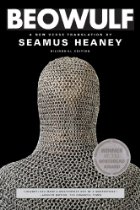 Summary:
This classic, epic poem tells the story of the life of Beowulf, a Geat warrior. In his youth, Beowulf assists the Danes who are being terrorized by a monster named Grendel. He defeats Grendel and Grendel’s mother single-handedly in hand to hand combat. When the Geatish king dies, Beowulf acts as guardian of the kingdom while the prince grows up. All is well until a dragon starts to terrorize the land.
Review:
Having read The Odyssey, The Iliad, and The Aeneid and liking them all quite well (in spite of the fact that The Aeneid is a Roman rip-off of the Greek epics) I was expecting something somewhat different from Beowulf than what I got. Although the adventures in these epics generally center around one or two characters, they are also the tales of the history of an entire people. Since Beowulf conducts pretty much all of his battles on his own, I don’t really get that vibe from Beowulf. It also is odd to me that these people seem to have a real talent for pissing off monsters buried deep in the Earth. Whereas the other epic poems are about battles between nations and the impact that has on individuals, this is really just about some guy who goes around killing monsters that people have managed to royally piss off. It’s kind of like reading a videogame in which every level consists of one monstrous boss.
Maybe this whole difference in tone is due to the fact that this pagan history is being told by a Christian narrator, whereas the other epics are told by pagan narrators. There’s definitely a vibe of “oh those silly old pagans” to Beowulf, which makes it rather hard to relate to the characters.
On the other hand, just as in the other classic, epic poems, the language is beautiful. Since I listened to this as an audiobook, I got to really listen to it. Hearing epic poetry read aloud is almost always better than reading it, as the oral tradition is where they came from. Bloody scenes manage to come across as exquisite due purely to the language being used.
If you enjoy epic poetry, you’ll definitely enjoy Beowulf. However, if you’re new to epic poems, I’d recommend you start with The Odyssey instead.
3 out of 5 stars
Length: 245 pages – average but on the shorter side
Source: Librivox recording via Audiobooks app for the iTouch
Buy It (Amazon or Bookshop.org)
If you found this review helpful, please consider tipping me on ko-fi, checking out my digital items available in my ko-fi shop, buying one of my publications, or using one of my referral/coupon codes. Thank you for your support!
Book Review: The Sweet Smell of Success and Other Stories by Ernest Lehman
 Summary:
A collection of Ernest Lehman’s noir style short fiction, including The Comedian and The Sweet Smell of Success, which was turned into a film in the 1950s. Varying in length from flash to many pages, most of the stories address the damage caused to individuals by the overly hungry theater, movie, and television industries. Some of the stories also look at individuals suffering from discontent in marriage.
Review:
My first entry in my reading challenge to read books I bought for university but never got around to reading. This was assigned for my Film Noir class in conjunction with watching The Sweet Smell of Success. I loved that class and at least enjoyed the assigned books that I read at the time. Unfortunately, I can’t say the same for these short stories.
Lehman’s writing doesn’t just evoke the past of the 1950s, it evokes an alternate, incredibly depressing universe. I have the feeling that was his point in writing these stories. The entertainment industry is evil and will slowly rob you of your soul. There’s definitely merit in that, but it can get a bit depressing and redundant to read the same theme over and over again.
I also found the dialogue jarring. The characters do things like call other men “baby,” and I can’t help but wonder if people actually talked like that back then. It made the stories ring a bit more fake to me than I think they should have.
Three of the stories revolve around press agent Sidney Falco and columnist J. J. Hunsecker. While I enjoyed these short stories it felt as if someone had ripped out three chapters from a back and handed them to me out of order. I wish Lehman had written this as a book or novella. He clearly had an affinity for these characters, as he repeatedly came back to them to explore them, so I wonder why he never just wrote a long piece about them.
The Comedian though is where Lehman hits his stride in this style and theme. He takes just the right amount of time to tell the story. He subtly lets us know the background information vital to feeling something for these characters on this crucial day, and the overarching them of the story is deeper than “the entertainment industry is evil.” Oh, it is still represented as bad, but that is not the main point of the story, which makes it stronger. I recommend reading this short story if you can get your hands on it.
Overall, if you’re in the mood for a marathon session of dark noir, you’ll enjoy this book. Otherwise, I’d recommend finding one of the short stories to get a taste of the 1950s version of the genre.
2.5 out of 5 stars
Source: University bookstore

Book Review: Woman on the Edge of Time by Marge Piercy
 Summary:
Connie, a 30-something Chicana of the 1970s who has led a rough life, enjoys the time she spends in 2137 at Mattapoisett with Luciente. She believes she is a catcher and Luciente a receiver, which allows her to time travel in her mind. Luciente tells her there are two possible futures, and they need her and all the downtrodden to fight and not give up or the utopian future of Mattapoisett will be lost. Connie’s family and friends, however, believe she is schizophrenic and in need of their help. Who is right?
Review:
I almost gave up on this in the first chapter when we discover that Connie’s daughter has been taken away from her due to child abuse. Connie blames everything bad in her life on other people–the police, social workers, white people, her brother, etc… She takes no responsibility for anything. I was concerned that Connie’s opinions were the author’s opinions as well–blame society for everything and take no individual responsibility. I was wrong about that, though, and I am very glad I didn’t stop reading.
Marge Piercy’s writing is astounding. She sets up a complex social situation and leaves it open-ended for the reader to decide who is right, what the problems really are, who is to blame, how things can be fixed. Unlike most books regarding time travel or mental illness, it is not obvious that Connie is actually time traveling or that she is schizophrenic. This fact makes this a book that actually makes you think and ponder big questions.
The future world of Mattapoisett is of course the reason this book is considered a classic of feminist literature. In this society it has been decided that all of the bad dualities of have and have not originate from the original division of male and female, so they have done everything they can to make gender a moot point. The pronouns he and she are not used, replaced with “per,” which is short for “person.” Women no longer bear children, instead they are scientifically made in a “breeder,” and then assigned three people to mother it. These people can be men or women; they are all called mother. In the future of Mattapoisett, women are allowed to be strong; men to be gentle, and that is just the tip of the iceberg of the interesting, thought-provoking elements of Mattapoisett.
At first I was concerned that this book is anti-psychiatry, but really it is just pro-compassion. The reader is forced to observe the world from multiple atypical perspectives that force a questioning of world view. More importantly though it helps the reader to put herself into another person’s perspective, which is something that it is easy to forget to do. To me the key scene in the book (which doesn’t give away any spoilers) is when two people in Mattapoisett dislike each other and are not getting along. The township gets them together and holds a council attempting to help each person see the situation from the other’s perspective, as well as to see the good in the other person.
What I’ve said barely touches the surface of the wonderful elements of this book. I absolutely loved it, and it is a book I will keep and re-read multiple times. I highly recommend it to all.
5 out of 5 stars
Source: PaperBackSwap

Book Review: The Andromeda Strain by Michael Crichton
 Summary:
The US government is searching for new biological weapons by sending satellites into the edges of the atmosphere to collect bacteria strains that may exist there but not on earth. Due to concerns of contamination on reentry, an emergency team called Wildfire is created as a contingency plan. When a satellite crashes in the Arizona desert, grotesquely killing all but two residents of a small town, the team of scientists is put to the test in a race to protect humanity.
Review:
An up-front confession: Michael Crichton is one of my favorite authors. I love how realistic his science is, and he writes suspense quite well. I was therefore excited to read his first book. Unfortunately, Andromeda Strain did not live up to these expectations.
The suspense is killed right off the bat with the narration style. The story is told as if it is a report being written up by someone after the event. This means that we not only know that some of humanity survives this impending doom, but that society is still held together enough to want a report. If I’m sure that everything is going to turn out hunky dory in the end, I’m just not going to be all that concerned throughout the book. Similarly, the characters aren’t fleshed out as well as in later books. They are basically their careers. Here’s the bacteriologist. Here’s the professor. here’s the surgeon. They don’t come across as real, rounded people, so I completely failed to care about them at all. This isn’t good for suspense, because if I don’t care about the characters, I’m not going to worry about them too much.
Crichton’s ability to set a scene shines through well in this book, however. Wildfire’s underground station is vividly imagined, as is the scene at the small town in Arizona. It was simultaneously gruesome and exciting. Similarly, his ability to weave real science into a fake scenario is carried off flawlessly here. The glimmers of the writing that would later appear in Jurassic Park and Prey is clear.
Speaking of the science, Andromeda Strain doesn’t age well. An entire page is devoted to explaining binary like it’s this huge complicated thing, which it isn’t to anyone who grew up with computers. Indeed, a lot of the book is devoted to explaining the huge computer in Wildfire’s base. Unlike biological science, in which the basics stay the same, technology changes rapidly. I don’t think it’s a wise choice to focus on in a scientific thriller, unless you are projecting plausible possibilities in technology in the future. Or super awesome possible technology the government may already have. Crichton does this really well in Prey, which is all about nanotechnology. Science horror needs to take me into a world that is a bit more awesome than my own, not lamer. Thankfully, Crichton figured this out in his later books.
If you’re a Michael Crichton fan, The Andromeda Strain is worth the read to see where he started. If you’re new to him though, I’d recommend starting with some of his later books such as Jurassic Park or Prey.
2.5 out of 5 stars
Source: Bought at Violet’s Book Exchange

Book Review: Mommie Dearest by Christina Crawford
 Summary:
In the early days of Hollywood, Joan Crawford became one of the first celebrities to adopt children. From the outside, it looked like her children had it all–presents, inherent fame, an apparently adoring mother. However, in Christina’s tell-all memoir, she reveals the truth behind the image. A mother obsessed with cleanliness and rigid rules. A mother who demanded her children worship her like her fans did in order to receive her love. A mother so desperate to cling to her days of fame that she attempted to beat down any glimmer of success in her children. A mother who Christina still desperately loved to the bitter end.
Review:
This memoir is a must read for anyone who thinks that having money and being a celebrity automatically makes for a good parent. Joan Crawford expected her four adopted children to be exactly what she wanted them to be instead of loving them for their uniqueness and human imperfections. Christina’s situation gradually worsens as she becomes older and starts to show glimmers of being her own person. The scenes of abuse in Christina’s childhood are the best written in the book. It is clear that she remembers them vividly and can still identify with the emotions that went through her as a child and young teenager.
*spoiler warning*
That said, Christina never manages to disentangle herself from her mother. In spite of everything her mother has done, Christina still attempts anything and everything to reconcile with her, apparently ignoring or forgetting the fact that she never did anything wrong to cause her mother’s behavior in the first place. Joan Crawford is a cruel, spiteful, evil person, and Christina naively continues to seek her love even in her 30s. This makes it more sad than most memoirs about abuse as it seems that Christina never truly overcame her abuser.
*end spoiler*
The writing, beyond the scenes of abuse, is sub-par. Christina has a tendency to ramble a bit in an uninteresting way. She also seems to not understand which parts of her life to skim over a bit. I mean, did we really need to know exactly when in a funeral her husband hands her a paper cup of water? No. Additionally, she obviously had a bad editor, as there are quite a few spelling and grammar mistakes, which is odd for a mass market paperback.
Overall, it’s worth a read if you’re into memoirs or the inside Hollywood scoop. All others should probably give it a pass though.
3 out of 5 stars
Source: Swaptree

Book Review: Viola in Reel Life by Adriana Trigiani
 Summary:
Viola loves her life in Brooklyn with her quirky filmmaker parents. Unfortunately, they need to go to Afghanistan to make a documentary and have dumped her in an Indiana boarding school for a year. Can Viola see past her homesickness and embrace what Prefect Academy has to offer or will she be Queen Snark for a year?
Review:
I came at this book simultaneously expecting to like it and not like it. I expected to like it, because when I was in the YA age group, I loved boarding school books, and I’ve read Trigiani’s Big Stone Gap trilogy and really liked her writing. On the other hand, reviews online stated they disliked it due to a negative portrayal of Indiana and what they felt was a lack of understanding of teenagers. Well, I liked Viola in Reel Life, and I would like to offer up rebuttals to both opinions.
First, the book is written from Viola’s perspective. She’s a fourteen year old who has spent her entire life in Brooklyn, and she didn’t want to go to boarding school. Her negative comments about Indiana are to be expected in this case. She’s a New Yorker in the country for the first time. Of course she’s going to think the fashion stinks. Of course she’s going to miss the noise of the city. Personally, I found Indiana and the folks in it to be portrayed in a positive light, because despite her anger and snark, they persist at comforting her homesickness and winning her over. She comes to like aspects of Indiana just as much as she likes aspects of Brooklyn. That is a key part of her growing up that is the main storyline. She has to learn to make home wherever she is and be independent. That point would not have come across strongly if she loved everything about Indiana from the moment she arrived.
Now to those who felt it was too young for teenagers, I think you’re starting to fall for the media’s portrayal of all teens as growing up very fast. They’re not all having sex, doing drugs, and drinking. I wasn’t that type of teen, and even teens who are can appreciate that not everyone is living a Gossip Girl life. It is a clean book, and I liked that because it left room for me to focus on Viola growing as a person. The kids are kind of innocent, and Viola acknowledges that she’s led a protected life so far. On the other hand, Viola and her friends have to deal with step-parents, new siblings, serious family illness, money problems, and more. Their problems are middle class type problems, but what’s wrong with that? Not everyone grows up abused or poor or filthy rich or debaucherous. The overall messages are excellent ones for teen girls to hear–be loyal to your friends, grow up and help your parents, don’t choose a boy over yourself, do your best and be gracious. Plus the storyline supporting these messages is fun and interesting to read.
My only complaint with the book is the minor sub-plot of a ghost. I don’t think it really fit in very well with the overall world and feel of the book. I would have much preferred that Viola find an old diary or something that made her come to understand Prefect Academy better. However, it wasn’t in the book enough to make me dislike the story.
Overall, it’s a fun read, and I recommend it if you enjoy YA lit or stories set in boarding schools.
4 out of 5 stars
Source: Won on Reading Sarah’s blog. Thanks!

 Support my work with a tip or browse my shop for curated book club guides, how to guides, cross-stitch patterns, and more!


This work by Amanda Nevius is licensed under a Creative Commons Attribution-Noncommercial-No Derivative Works 3.0 United States License.
 Opinions of a Wolf