
Archive
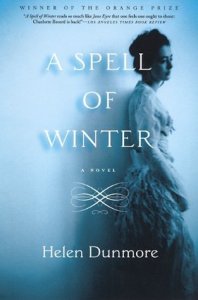
Book Review: A Spell of Winter by Helen Dunmore
 Summary:
Cathy and her brother Rob live with their emotionally distant grandfather on family land in England because her mother left, and her father died in a mental institution. Cathy and Rob seek refuge with each other against the world, but World War I won’t let them keep the world at bay forever.
Review:
I generally enjoy controversial books, and I heard that this historical fiction included the always controversial plot point of incest. The short version of my review is: it’s amazing how boring a book about incest and WWI can actually be. For the longer version, read on.
The book is told non-linearly in what appears to be an attempt to build suspense. The constant jumping with very few reveals for quite some time, though, just led to my own frustration.
I was similarly frustrated by the fact that Cathy’s childish interpretation of her father’s mental illness never progresses. She never moves from a child’s understanding to an adult’s understanding. This lack of progress gave a similar stagnant feeling to the book.
Of course, what the book is best-known for is the incest between Cathy and Rob. I found the scenes of incest neither shocking nor eliciting of any emotion. There are scenes where Cathy and Rob discuss how “unfair” it is that they cannot have children and society will judge them. But then again there are scenes that imply that Rob took advantage of Cathy. Well, which is it? It’s not that I demand no gray areas, but the existence of gray areas in such a topic would best be supported by a main character with insight. Cathy remains childlike throughout the book. Indeed, I think the characterization of Cathy is what holds the whole book back. Because the book is Cathy’s perspective, this lack in her characterization impacts the whole thing. What could be either a horrifying or a thought-provoking book instead ends up being simply meh. A lot of time is spent saying essentially nothing.
That said, I did enjoy how the author elicits the setting. I truly felt as if I was there in that cold and often starving rural England. I felt as if I could feel the cold in my bones. That beauty of setting is something that many writers struggle with.
Overall, this book read as gray and dull to me as the early 20th century English countryside it is set in. Readers with a vested interest in all varieties of WWI historic fiction and those who enjoy a main character with a childlike inability to provide insight are the most likely to enjoy this book. Those looking for a shocking, horrifying, or thought-provoking read should look elsewhere.
If you found this review helpful, please consider tipping me on ko-fi, checking out my digital items available in my ko-fi shop, buying one of my publications, or using one of my referral/coupon codes. Thank you for your support!
3 out of 5 stars
Length: 320 pages – average but on the longer side
Source: PaperBackSwap
Counts For:
Bottom of TBR Pile Challenge
Book Review: Moonlight in Odessa by Janet Skeslien Charles
 Summary:
Daria loves the city of Odessa in her home country of the Ukraine. The history of the city, the architecture, and the food. But she’s a highly educated engineer unable to find a job in her field, so she’s stuck working as a secretary for an Israeli import business, dodging the advances of both her own boss and the boss of the local mob. She takes on a second job translating for an online dating agency that matches Ukrainian women with American men. Soon she gets swept up in the idea of escaping to America, where she could actually work as an engineer and get treated like a queen by a man who won’t drink too much or keep mistresses or leave her. But will the reality of America match her dreams? And will living there ever be able to compare to her life in Odessa?
Review:
Confession. I have a thing for mail order bride / arranged marriage stories. I also have a thing for watching reality tv shows about marriages that will inevitably be trainwrecks (I’m looking at you, 90 Day Fiance). I was expecting this book to basically be the equivalent of 90 Day Fiance only on paper. Delightful, yet trashy. What I found was a book that was indeed truly delightful, but that also brought a realistic, humanizing face to modern day marriages that are not for love.
The book lingers in Odessa much longer than I was initially expecting, and I’m so glad it did. This gives a firm basis for who Daria is before she comes to America and really puts the reader in her shoes. The author clearly has a love for and strong knowledge of Odessa, Ukrainian culture, and the Russian language. Within just a few pages, it immediately becomes clear that Daria is whip-smart. Her understanding of the ins and outs of both English and Russian are amazing. She is witty, and it’s easy to see how she would have succeeded in any life circumstance. But it also quickly becomes apparent that although she loves Odessa, it doesn’t let her truly grow into who she wants to be. Every life experience she has had has taught her that Odessan/Ukrainian men will only use her and leave her, and she wants a lifetime partner and commitment. Similarly, she can’t use her engineering degree in Odessa, due to the economy, and she wants to live someplace where she can. The clear and slow unveiling of these conjoining life situations helps the reader to come to understand why she is willing to have a business-style marriage, rather than a love marriage. The American man she meets needs a wife, and she needs a life partner and a ticket to a better life.
Of course, not all is as it seems with the American man. The second half of the book dives into life in America for Daria and depicts the harsh realities of using a business-style marriage to immigrate. Even if her marriage had been perfect (which wow it isn’t), Daria still suffers culture-shock and the realization that America is definitely not perfect. There are pros and cons to living anywhere in the world.
Although her marriage is on the worse side of the arranged marriage bell curve, the author still shows the variety of marriages that can result from this type of arrangement by having Daria naturally seek out other women who came to America in similar ways. She thus meets women in both better and worse marriages than her own, and so the reader sees how, although it can possibly work out, the whole situation is ripe for abuse. For instance, if a marriage that included a K1 visa (bringing a non-US citizen into the US) is dissolved within 3 years then the spouse who was brought over on the K1 visa loses their citizenship. This means that women in these types of marriages are afraid to leave abusive situations because they believe that they will automatically be deported. There are exceptions for cases of abuse, but the women often do not know that, and the men in these situations often threaten the women with deportation. This information is all given within the book with subtlety and within the context of what will Daria do now, which lends a human face to the situation.
Given how interesting and realistic most of the book was, I must admit that I felt the end of the book went a bit soap opera, and the ending in general left me wanting. I can’t put my finger on what exactly about it left me feeling as if the story was incomplete, but it did. I don’t have any regrets about reading the book, though, because I so enjoyed seeing the world through Daria’s eyes.
Overall, anyone who enjoys contemporary fiction and is interested in either the Ukraine or the modern day “mail order bride” as done through online agencies will enjoy this book. The main character is rich and well-rounded and brings a human face to the often underrepresented immigrant side of the K1 visa story.
If you found this review helpful, please consider tipping me on ko-fi, checking out my digital items available in my ko-fi shop, buying one of my publications, or using one of my referral/coupon codes. Thank you for your support!
4 out of 5 stars
Length: 352 pages – average but on the longer side
Source: PaperBackSwap
Counts For:
Bottom of TBR Pile Challenge
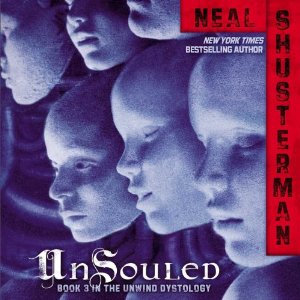
Book Review: UnSouled by Neal Shusterman (Series, #3) (Audiobook narrated by Luke Daniels)
 Summary:
Connor and Lev are on the run from the Juvenile Authority but for once they’re running to something. Or rather, someone. They’re looking for a woman Proactive Citizenry has tried to erase from history, hoping she’ll have some answers about just how the world got to be the way it is. Meanwhile, Cam, the rewound boy, is plotting to take Proactive Citizenry down in the hopes of winning the heart of Risa.
Review:
This entry in the series really fizzled for me with the far-fetched ideas and shaky execution of a complex plot finally becoming too much for me to really enjoy the story.
On the one hand, this book is more of the same. There’s multiple characters in vastly different situations who will clearly all come together at some point in a convergence that should read like fate but oftentimes just reads as too convenient. On the other hand, the action this time is interspersed with some flashbacks to the scientist who discovered unwinding, and how it went from something to be used to save lives to something to keep adolescents in line. This plot was interesting, but its reveal was awkwardly handled. The flashbacks are from the perspectives of the scientists, just as we switch around among the perspectives of the teens in the story, rather than letting them naturally discover what happened. It’s a change that could have been used to build up more tension and excitement but instead just makes the pace awkward and changes the feel of the story from one told primarily by teens to one routinely interfered with by adult perspective.
The big reveal of how unwinding came to be failed to really strike a chord with me, and I believe this is partially because it’s still a bit unclear to me as to who exactly the big bad is. I do think it’s interesting that basically unwinding came to be because big business was trying to protect their investment in health care. I appreciate the angle of how health care needs to be more than just a business. However, I question the supposed solution for unwinding offered at the end of the book. I feel it is just more big business.
Overall, this book continued the issues with the second book, only more so. Too many plots that conveniently intersect and confusion over what exactly is going on in the world. Additionally, the far-fetched elements that challenged my ability to suspend disbelief in the first two books become at the center of the big overarching plot of the series. Given both of these issues, I will not be continuing reading the series, although I am glad that I read the first book, as it is an interesting and unique dystopian YA world. It’s just one that went off the rails a bit. This entry is recommended to those readers who simply must know how unwinding came to be and how the characters plan to stop it.
If you found this review helpful, please consider tipping me on ko-fi, checking out my digital items available in my ko-fi shop, buying one of my publications, or using one of my referral/coupon codes. Thank you for your support!
3 out of 5 stars
Length: 404 pages – average but on the longer side
Source: Audible
 ,
,  ,
, Book Review: Bird Box by Josh Malerman
 Summary:
Malorie thought the hardest thing she was going to have to face was dealing with her pregnancy and impending single motherhood. She thought the warnings about seeing something that makes you go crazy and become violent was just the news blowing things out of proportion, or at least just hysteria. Her sister believed in it, but not herself.
But that was all years ago, and now Malorie is alone in a house with her two children. Children who have never been outside without blindfolds on. She only leaves the house blindfolded, tapping the ground with a stick to find the well. But now it is time for her to be brave and to take a boat on the river, just she and her two children, blindfolded, in the hopes of finding salvation.
Review:
I was drawn to this book for two reasons. First, the mere thought of a mother and two young children boating down a river blindfolded had me intrigued. Second, it’s set in Michigan, which is where my husband is from, and honestly I can’t recall the last time I saw a book set in Michigan. These two elements came together to tell me this book is probably unique. So when I saw the kindle version on sale on Amazon, I snatched it up. What I found was a chilling tale that could easily fit within the Lovecraft mythos.
The order the story is told in helps build the suspense and keeps it from being a same old apocalypse and survivors’ tale. The book opens with Malorie and her two children living alone in the house. It opens post-apocalyptic. Through flashbacks we learn various things such as who used to live in the house with Malorie, why there are certain parts of the house she doesn’t like to go to, and why neither she nor the children leave the house without blindfolds on. From here, the reader is then taken forward into Malorie’s action onto the river, going down it trying to find a safe haven of other survivors that she knows used to be there years ago. It’s a nice combination of flashback and plot progression forward that keeps the suspense interesting.
It is no spoiler to say that what caused the apocalypse is something that causes people to go stark raving mad when they see it. This is included in the official book blurb. What was interesting to me was how Malerman kept this from being purely straight-forward. Some characters believe in the mysterious creatures right away, others don’t. Some think that merely believing it will cause you to go crazy makes you go crazy. Some think that some are affected and others aren’t. Some wonder if animals are affected too, and no one knows where the creatures came from or, if you don’t believe in the creatures, how the phenomenon started. The lack of clear-cut answers reflects reality. In general, with large-scale catastrophes, it’s hard to know exactly what happened or what is going on. This lack of knowing made the situation read as real, even if the exact situation is an absurd sounding one at first.
I was also struck by how well Malerman wrote a female version of experiencing the apocalypse. Malorie is both focused on surviving for herself and her baby but also distracted from the apocalypse because she is having normal hormonal reactions to pregnancy. Similarly, while some characters embrace her as a symbol of hope, others see her as a burden. Malorie was a refreshing change from the young, virile, kick-ass heroine often seen in post-apocalyptic books. She is strong, yes, but not in a kick-ass way. She is strong in a she’s doing her best to be a good mom and still survive type way. And that’s a nice thing to see in post-apocalyptic horror fiction.
The book naturally ends up pondering “madness” a lot. The creatures drive any who see them into near-caricature depictions of madness. Sometimes the person becomes violent against others. Sometimes the person turns on themselves, killing themselves or self-injuring to the extent that they die. There are a lot of questions about what the human mind can handle. There is a lot of argument in the book for agency against all odds.
It’s better to face madness with a plan than to sit still and let it take you in pieces. (loc 4034)
On the one hand, I appreciate the argument for agency and fighting for your sanity and humanity. On the other hand, I’m not sure how I feel about a metaphor where madness happens to people who just aren’t careful enough or don’t have enough of a plan. While it’s valid that a mental illness must be fought every day and some have more natural resiliency than others, there’s a tone of blame to the theme that strikes me the wrong way.
*small spoiler*
At one point, it is postulated that perhaps the only ones immune to being driven mad by the creatures are those who are already mentally ill because they are already mad. There is no science behind this thought. There is simply a character who appears to have paranoid schizophrenia who firmly believes the creatures are not actually dangerous because he has seen them and is fine. Yet he is a character who ends up instigating an incredibly violent scene. While it is true that there are violent extremes of mental illness, there are also those that are not. The book fails to bring out the subtleties and varieties of mental illness. Imagine the power that could have been from a character who had, for instance, OCD and was able to see the creatures and interact with them without harming anyone and able to understand that others cannot see them safely. Imagine if it was simply that seeing the world differently already, being abnormal, protected one from being driven truly mad by the creatures. What an interesting direction that could have taken the story.
*end spoilers*
Thus, in general, while I appreciate the more unique and interesting things the book did, such as focusing on a pregnant woman and then a young mother as the main character and telling the plot in a non-linear way, ultimately the book did not push the boundaries or the ideas far enough to truly enrapture me. Recommended to horror, Lovecraft, and post-apocalyptic fans looking for a read with a young mother as the focus.
If you found this review helpful, please consider tipping me on ko-fi, checking out my digital items available in my ko-fi shop, buying one of my publications, or using one of my referral/coupon codes. Thank you for your support!
4 out of 5 stars
Length: 305 pages – average but on the longer side
Source: Amazon

Book Review: UnWholly by Neal Shusterman (Series, #2) (Audiobook narrated by Luke Daniels)
 Summary:
Picking up where Unwind left off, UnWholly finds Risa and Connor managing the Graveyard full of unwinds themselves with no adults in site, and Lev struggling to find a purpose now that he’s both free of clapper chemicals and under the watchful eye of the government. Into the mix comes Cam, the first ever “rewind.” He’s been assembled completely from the parts of unwinds of every race and religion. And his creator intends to meddle with the runaway unwinds too.
Review:
I picked this up right after finishing the first on audiobook, because finding a fast-paced story with a good narrator can be harder than it sounds. So once I found that with the first book in the series and I saw the rest of it had the same narrator, I figured I may as well continue along with it. While I found the first book engaging and thought-provoking, I found myself periodically bored with the plot in this one, and also found it more difficult to suspend my disbelief than before.
The basic premise is that Connor is all torn up over having the arm of his once-rival (who also just so happened to threaten to rape his girlfriend, Risa). He thus holds Risa at arm’s-length (pun intended) because he’s afraid of what his own arm will do. While I appreciate the fact that it must be truly atrocious for your boyfriend to now have your attempted rapist’s arm, I think the fact that Connor lends the arm so much agency is a symptom of one particular idea in this world-building that just doesn’t work for me. The idea that body parts have their own spark of soul or agency or thought. It’s rife in this entry in the series, and it’s just plain weird to me. I can understand a character not bonding with a transplant that was forced upon him. I can understand it being weird for loved ones. I don’t, however, find myself able to suspend my disbelief enough to believe that someone’s arm has their personality in it so much that the person who it was transplanted onto would be afraid of it. It’s an arm, not a piece of brain or even a heart. The author does provide links to sources about transplant recipients feeling connected to the person whose body part they received or having memories or what have you. I appreciate that. But for me personally this plot point just does not work. Other readers may be able to suspend their disbelief better than I was able to. I for once can’t imagine not going near my own girlfriend because I was afraid of my arm. I also just disliked how much agency Connor removes from himself for his own temper. If he hits the wall when he’s angry it’s not him hitting the wall, it’s the arm hitting the wall. The arm got mad. The arm got out of control. There’s just a ridiculous lack of agency there, and I’m not super comfortable with that level of lack of agency being in a book marketed toward teenagers, who are at the best point in life for learning agency and responsibility.
I similarly have a hard time believing, from a neurological perspective, that the rewind boy, Cam, could exist. His brain is dozens’ of peoples all wound together. I could believe replacing a brain piece here or there with transplant technology, I couldn’t believe mish-mashing many together and having them actually function. Let alone with the only issue being that Cam struggles to learn to speak in words instead of metaphors. While Cam did strike me as grotesque, he mostly just struck me as an impossibility that I was then supposed to have sympathy for because he’s a person with his own feelings…but are they really? The whole thing was just a bit too bizarre for me.
On a related note, I found the scenes where Cam wakes up and learns to talk and slowly realizes what he is to be very tedious to read. They move slowly, and there is an attempt at building of suspense, but it is clear nearly immediately that Cam is a Frankenstein’s creature like experiment, even without Cam himself knowing it right away.
The other big new character is Starkey, a boy who was storked who is brought into the Graveyard. He’s basically exactly the same as Connor (he’s even still a white boy), the only difference being that was a stork and that he has no Risa to ease down his temper. I found his characterization to be uncreative, even if the building up of strife between the storks and the rest of the unwinds was a good plot point. It would have been better if the leader of the storks was more creative. Similarly, Starkey’s two main assistants are a black girl and an Indian-American boy. Just as with the first book, non-white people exist, but only as seconds to the white people. Why couldn’t either of them have been the leader of the storks?
All of these things said, there was still a lot of plot to keep the interest. I’ve barely touched on a couple of them. The world is still engaging, even if it’s hard to suspend the disbelief for it. I doubt I’d keep reading if I was reading this in print, but the audiobook narration makes it feel like listening to a movie, and it’s the perfect match for my commutes and doing dishes and such. Plus, now I’m curious as to where else the plot will go. I’m betting it will end up going in a direction I find it even harder to suspend my disbelief for, but it’ll be a fun ride seeing where that is.
Overall, fans of the first book may be disappointed by the slightly more meandering plot in this one. The addition of two new characters to follow will be distracting to some readers while others will find it adds to the interest and suspense. Some readers may be turned off by the continued lack of diversity in such a large cast of protagonists. The plot is engaging and the world is unique, though, so fans of YA dystopian scifi will probably still enjoy it.
If you found this review helpful, please consider tipping me on ko-fi, checking out my digital items available in my ko-fi shop, buying one of my publications, or using one of my referral/coupon codes. Thank you for your support!
3 out of 5 stars
Length: 416 pages – average but on the longer side
Source: Audible
Book Review: Unwind by Neal Shusterman (Series, #1) (Audiobook narrated by Luke Daniels)
 Summary:
In the near future, the Pro-Choice and Pro-Life debate explodes into a war called the Heartland War. The only way the war could reach a peace was to come to an agreement. There would be no abortion but when children are between the ages of 13 and 17 their parents can sign an order to have them unwound. New scientific technology allows doctors to transplant all of a person’s body parts. They will then “live on” in a “divided state.” Teens whose parents choose to sign an unwind order for them are rounded up by juvie cops and brought to Harvest Camps to await their fate. Some families, particularly from fundamentalist branches of all faiths, believe in tithing 10% of their children, and will have a child simply to raise them to be a tithe. Additionally, many children end up unwanted and living in State Homes, where they are all given the last name of Ward–for ward of the state.
Connor is a light-hearted bad boy who just accidentally found his own unwind orders in his parents’ desk and immediately goes on the run. Lev is a tithe who is on his way to Harvest Camp. Risa is a ward of the state, and she is on a bus to be unwound, because she isn’t deemed exceptional enough to justify her upkeep. A series of events throws them into each other’s lives and leaves whether or not they will be unwound in question.
Review:
This was recommended to me years ago, but when I first read the description I was skeptical that the book was anything but Pro-Life propaganda. Years later I decided to check it out again, and most reviews mentioned how neutral the book was. Additionally, I read some interviews with the author where he stated he genuinely was trying to present a neutral story that analyzes some tough questions, so I thought I would give it a shot. (I also found this fun short video interview where he talks about how he came up with the idea of the dystopian world.) Ultimately, the author has succeeded at creating a future world that is fascinating to visit and that also analyzes medical ethics in a creative way. I would honestly say the book is much more about medical ethics, particularly in regards to transplants, than it really is about abortion rights.
The basic plot is that three very different teenagers are supposed to be unwound but then find themselves on the run instead of actually at Harvest Camp. The book is in the third person but from the limited perspective of one character, and that one character switches around. It is predominantly Connor, Risa, or Lev, but it is also sometimes someone like a juvie cop or a parent. Sometimes this narrative structure works really well, providing many different perspectives on the same event or issue. Other times it feels too contrived. The perspective switches at just the right moment to keep the reader in the dark, or to reveal something we wouldn’t otherwise know. Sometimes this structure builds suspense and other times it kind of ruins it. Overall, though, I enjoyed the structure and found that the multiple perspectives really added to the world and the story.
This narrative structure is enhanced by clippings from real, modern-day newspaper articles and blogs, as well as fake advertisements and news from the future the book is set in. Partially due to the Audible narrator, who did a fantastic job at the ads, I really enjoyed these snippets of media from the future. They are very tongue-in-cheek and adult, but will still appeal to teens reading the book for their over-the-topness. I found the modern day news articles to be less interesting, and mostly felt a bit like scare mongering. They read as a bit heavy-handed in pushing the “this could really happen!” angle.
I did find it a bit frustrating that all three of the main characters are white and straight. While it is acknowledged that a few people (primarily adults) could be GLBTQ, the assumed norm is straight and cis, no matter what social organization is in control. Whether it’s mainstream society, rebels, or anyone in-between. The norm is always straight cis. Similarly, while the author does include non-white people to a much greater degree than non-straight/non-cis people (there are a wide variety of ethnicities and religions represented in the society), they are all secondary characters. One thing that really stuck out to me was that at one point in the book we meet a Chinese-American girl who is being unwound because her parents wanted a son, and they just kept trying until they got one and then picked a daughter to unwind, because they couldn’t afford all the kids. She’s also got an interesting punk aesthetic to her. What an interesting main character she would have been! Can you imagine her in the role of Connor? They are both running away from being unwound, and she could easily have taken that main character role. It just bothers me when a book has three main characters who are all in a similar situation due to society-wide problems, and yet they are so non-diverse, with just a nod at gender by having one female character.
With regards to the female character, Risa, I must say I was very disappointed to have one plot point be an attempted rape of her, and her then being saved by a male character. First, we only get one female main character and then she naturally is almost raped. Then naturally she must be saved by someone else. The whole scene sickened me, especially when I thought about teen girls reading it. It was just a completely unnecessary plot point. I once read an article that talked about how often rape scenes (or attempted rape scenes) are a sign of lack of creativity. I don’t think all of them are, but this one certainly came across that way. Unnecessary and a convenient plot point without thought to how it would affect the readers.
In spite of these characterization and style complaints though, the plot is very good, and the world is fascinating. Characters in a natural manner talk about and explore the ethics of life, when life begins, and who has the right to life, as well as who has the right to end it. The plot is fast-paced, and I read as quickly as I could to find out what happened. There are also a couple of twists at the end that rocked my socks off and left me immediately downloading the next book in the series.
All of that said, I have a few questions about the world that were never addressed. First, if everyone who is unwound is between the ages of 13 and 17, how does that work out with transplantation? People have not yet finished growing at 17, especially their minds. Does this mean a 67 year old woman would have a 15 year old’s arm if she needed a transplant? If so, that sounds very grotesque to me, and I wonder how society has learned to deal with something so mis-matched. This isn’t particularly addressed, except to say that sometimes it’s weird to look at someone with two eyes that don’t match. Similarly, the world at large isn’t really talked about at all. The kids who are trying to escape being unwound don’t even consider running into another country but they never explain why. How has the world at large reacted to the United States’ new law? Is there any country that would be a safe-haven for unwinds? Are there other countries following suit? The international impact is woefully underaddressed.
In spite of these various shortcomings, the plot and the world still sucked me in. It was a quick read that left me wanting more.
Overall, fans of dystopian ya looking for another series to whet their appetite will definitely enjoy this one. It’s a completely different dystopia from most of the ones that are already big, and I am sure YA readers who are currently teens themselves will find the idea of their parents being able to sign an unwind order on them chilling. Dystopian YA fans should definitely give this one a go.
If you found this review helpful, please consider tipping me on ko-fi, checking out my digital items available in my ko-fi shop, buying one of my publications, or using one of my referral/coupon codes. Thank you for your support!
4 out of 5 stars
Length: 337 pages – average but on the longer side
Source: Audible
Book Review: Thieves’ Quarry by D.B. Jackson (Series, #2) (Audiobook narrated by Jonathan Davis)
 Summary:
It’s September 1768 in Boston, Massachusetts, and the King’s navy has sailed into Boston Harbor to start an occupation in an attempt to restore order and stop the stewing rebellion. Conjurer and thieftaker Ethan Kaille isn’t sure how he feels about the occupation but he is sure how he feels about the large spells he’s started feeling in Boston–not good. He feels even worse he finds out that all the men on board one of the British ships have been killed by a conjuring. The British navy hires him to investigate, while the mayor of Boston threatens to have all conjurers hanged in mere days if he doesn’t find the culprit.
Review:
I loved the first book in this series. Urban fantasy set in a historical time period in the city I actually live in just appealed to me so much. (I really do wish there was more historical urban fantasy. It is awesome). This book failed to capture my attention the way the first in the series did, and I’m uncertain if it was due to the tone, the plot, or the audiobook narration.
Ethan comes across as a bit more insufferable in this entry than in the first. Perhaps as an American and a Bostonian I just simply struggle to understand Loyalist leanings, but Ethan siding with the Crown over and over again, in spite of a literal military occupation just rubbed me the wrong way. It takes him far too long to be irritated by this over-reaction from the Crown, in spite of being on good terms with some of the Patriot leaders. I suppose what it comes down to is that I could take his waffling in the first book when rebellion was just beginning to brew. I thought he was closer to being on the Patriots’ side by the time period of this book, and he wasn’t. This would bother some readers less than it bothered me, I am sure.
Similarly, I had a hard time caring about the plot. I cared about Ethan solving the mystery in time to save the conjurers, but I simply didn’t care who had killed the men on the occupation ship. Everyone in the book, even the Patriots leaders, seemed to think it was this huge evil thing, and I just didn’t care much one way or the other. Part of this could be because I don’t see the difference between casting a spell and murder in other ways, whereas the characters in the book do. Part of it is that the reader never gets a chance to get to know anyone on the ship in a way that would make them sympathize. It felt for a lot of the book like Ethan was investigating a calamity of war, rather than a crime, and that just made it a bit dull to me.
All of that said, this book is a poor fit for an audiobook. I am certain I would have enjoyed it better if I was reading it myself, in retrospect. The pacing just isn’t suited to an audiobook’s speed. I wanted it to go faster, and I did speed up the narration speed, but I couldn’t speed it up too much or I’d miss important things. It was a bit frustrating, in spite of the narrator’s talents at creating unique voices for each character, which is something I always appreciate.
The ending of the book does speed up its pace, and the solution to the mystery is fascinating. This saved the book for me, although I am uncertain if I will continue along in the series. I may need to poke around and see if Ethan goes fully Patriot in the next book before I venture to pick it up.
Overall, this entry in the series fails to live up to the first, although an interesting ending will still spur the reader on to the next entry in the series. Readers who will be turned off by Loyalist leanings in a Revolutionary War book may wish to look elsewhere. But those who simply enjoy seeing urban fantasy in a historic era will not be disappointed.
If you found this review helpful, please consider tipping me on ko-fi, checking out my digital items available in my ko-fi shop, buying one of my publications, or using one of my referral/coupon codes. Thank you for your support!
3 out of 5 stars
Length: 317 pages – average but on the longer side
Source: Audible

Previous Books in Series:
Thieftaker, review
Book Review: Remember Me? by Sophie Kinsella
 Summary:
The last thing Lexi remembers she’s a 24 year old in the year 2004 with bad teeth, a bad boyfriend, and at the bottom of the totem pole in a new job where she hasn’t been working long enough to be able to get the annual bonus. When she wakes up in hospital, though, she’s told that the year is 2007, she’s 28, the boss of her department, and married to a millionaire! She’s told she was in a car accident that gave her amnesia, and now she has to piece together just how she got to this place in her life, especially when not everything is as rosy as it seems at first. Her millionaire husband is controlling, her once best friends give her the cold shoulder, and everyone at work seems to think that she’s a bitch.
Review:
True story. I spotted this sitting on top of a neighbor’s recycling bin and snatched it up as soon as I recognized the author’s name. I was a big fan of Sophie Kinsella’s in high school, and I just couldn’t bear to see a perfectly nice condition hardcover of one of her books get recycled. I wondered if I would enjoy her contemporary romance as much now as a late 20-something as I did as a teen. I’m happy to say I certainly enjoyed this one just as much, although in a slightly different way than I used to.
I wonder how much I would have appreciated this book a few years ago. As a late-20 something myself, I laughed out loud at how the 24 year old version of me would react if she was plunked into my current life. A lot really does change in 4 years in your 20s, especially with regards to your career and your love life. The plot kind of reminded me a bit of the plot of one of my favorite romcoms 13 Going On 30. Someone who is (or perceives of themselves as) much younger and less experienced than the person whose life they are now living. How that affects them and how they react to it is really interesting. Both stories show how important actually going through the growing pains really are. You can’t just suddenly handle a more adult life; you have to grow into it.
I also appreciated that, although Lexi’s husband is drop-dead gorgeous, both she and he believe she should not sleep with him until she is comfortable with him again. She may be married to him, but she doesn’t remember who he is, and she shouldn’t do anything until she’s ready. If she ever is. Her husband is definitely controlling of her when it comes to how their household is run and how they spend money, but he is very respectful of her sexually. He doesn’t touch her unless invited to, and he stops when she says to. I was really happy to see this focus on positive, enthusiastic consent portrayed in the book.
The exploration of Lexi’s career path from lower level to high-powered boss is fascinating. Lexi is torn up that now that she’s a boss those under her think she’s a bitch. There’s a nuanced exploration of how women in power are often perceived of as bitches, even if they’re just being assertive. However, there’s also a nice exploration of how to still be true to yourself when in power. You don’t necessarily have to lead in the traditional “masculine” way if you don’t want to. This combined with the exploration of aging gave a depth to the romance that kicked it up a notch for me.
It says a lot for how much the book made me like Lexi that I was able to get past one plot point that usually spoils romances for me. However, that plot point did knock the book down from 5 to 4 stars for me.
*spoilers*
It turns out that 28 year old Lexi is cheating on her husband. 24 year old Lexi is just as horrified by this as I always am by cheating. The exploration of how she wound up cheating on him didn’t make it ok to me, but I did appreciate that 24 year old Lexi took agency and addressed the situation, rather than lingering in married but cheating land. I appreciated that Lexi was able to acknowledge her mistakes, forgive herself for them, and grow and change.
*end spoilers*
Overall, fans of contemporary romance will enjoy this fun take on the amnesia plot. The plot doesn’t just cover a romance, it also covers the growing pains of being in your 20s, the challenges women face when they become the boss, and how to learn from your mistakes.
If you found this review helpful, please consider tipping me on ko-fi, checking out my digital items available in my ko-fi shop, buying one of my publications, or using one of my referral/coupon codes. Thank you for your support!
4 out of 5 stars
Length: 389 pages – average but on the longer side
Source: Rescued from a recycling bin
Buy It (Amazon or Bookshop.org)
Counts For:
Bottom of TBR Pile Challenge
Book Review: Late Eclipses by Seanan McGuire (Series, #4)
 Summary:
One of Toby’s oldest friends is in dire trouble. Lily of the Tea Gardens is slowly fading away, and no one knows what’s causing it. On top of that, one of Toby’s worst nemeses whose name is feared throughout Fae, Oleander, is back. Are the two related or is something else going on? And can Toby save the day without losing herself?
Review:
I picked this book up expecting it to be another mystery of the week entry in the series, but what I found was a surprising development in the overarching plot that kept my heart in my throat but also left me dubious about the possible directions the next book could take.
The plot starts out similarly to the previous entry in the series. Someone close to Toby is in danger. In this case, it’s Lily, and she’s sick, slowly fading out of existence. Over the course of the book, others close to Toby end up sick as well, as it soon becomes clear (this is really not a spoiler, it’s revealed early on) that someone is poisoning them. When Oleander showed up, I nearly groaned at how obvious it felt that she is the one to blame for all of this. But it’s not quite that straight-forward, and there’s also a sub-plot of Toby possibly going crazy….which changelings are known to do in this world. The book then isn’t just about Toby trying to solve the mystery, it’s also about her trying to determine if her blood has doomed her to sink into insanity. This gives the plot enough depth to keep it interesting.
Long-standing characters receive more depth of character development and new ones are added. Toby cotinues to have the wit that keeps the book upbeat even when things are grim. One quote in particular I think would work pretty well as a fitspo positive argument:
I promised myself that if I lived, I’d start working out. Better cranky and alive than cheerful and dead. (loc 1815)
As for the plot twist, I can’t talk about it much without spoilers. The spoiler free review would be that I am concerned the big overarching plot twist moves things a bit too far into one hero to save us land, which isn’t a fantasy plot I personally usually enjoy. For the spoiler version of this, see the next paragraph.
*spoilers*
It is revealed that Toby is not the type of Fae she thought, she is rather a very rare type of Fae. This type of Fae is capable of changing the make-up of their own blood. She can thus morph into more Fae, changeling, or human as she desires. It also turns out her mother is from the first born, which makes her kind of Fae royalty. My issue with this is one of the things I like so much about the series is that Toby lacks the magical powers to the extent the Fae have. She also doesn’t fit into the human world. But she fights for her right to be in the world she chooses to live in, and her value in the Fae world is due to how hard she tries and her brains, not her blood. This plot development feels like it’s making it all about her blood. Her power is due to whose daughter she is, not who she herself is. That’s just not a message I’m as fond of.
*end spoilers*
Overall, this is an action-packed entry in the series that visits another mystery with enough different sub-plots and twists to keep it interesting. Fans of the series will be surprised by the big overarching plot development toward the end of the book and will be eager to pick up the next one to see where this plot development goes.
If you found this review helpful, please consider tipping me on ko-fi, checking out my digital items available in my ko-fi shop, buying one of my publications, or using one of my referral/coupon codes. Thank you for your support!
4 out of 5 stars
Length: 372 pages – average but on the longer side
Source: Library

Previous Books in Series:
Rosemary and Rue, review
A Local Habitation, review
An Artificial Night, review
Book Review: Peyton Place by Grace Metalious
 Summary:
Peyton Place appears to be a picturesque small town in New Hampshire. But over the course of the novel, the secret passions, lies, and cruelties of its various inhabitants are revealed. From a single mother lying both about her daughter’s age and being a widow to the school janitor who drinks to dull the ache of his wife’s cheating to what exactly is buried in the sheep pen in the Cross’s yard. Small town life is anything but simple and picturesque.
Review:
This book was first recommended to me on either LibraryThing or GoodReads for being similar to The Group (review), another book written in the mid 1900s featuring an ensemble cast. I wound up ultimately picking it up because I read that it was quite scandalous when it first came out and it was the inspiration behind the first successful nighttime American soap opera of the same name (source). Additionally, I grew up in Vermont but spent a lot of time in New Hampshire, since I grew up on the Vermont border with New Hampshire. I even went to high school in New Hampshire (public school, my town in Vermont was too small for a high school so bussed us out to other ones nearby). I was curious to see if any element of the book would successfully evoke New Hampshire to me. I often find that books set in New Hampshire just don’t ring true with the New Hampshire I know. What I found was a book that almost gave me chills at how well it depicted a typical New Hampshire small town, but also was nowhere near what I would in my modern mind describe as scandalous, although I can see why it was at the time.
The story explores the intersecting lives of many town folk in the 1940s and 1950s, but primarily focuses on Constance MacKenzie, her daughter Allison, and her daughter’s friend from the wrong side of the tracks, Selena Cross. Constance is a frigid woman who has tamped down her sexuality in an attempt to raise her daughter who she conceived out of wedlock while having an affair with a married man in the right way. She has gone so far as to lie about her daughter’s age and to lie about being a widow to help her daughter seem “acceptable.” Allison grows up over the course of the novel, first having typical teenage angst, then moving away to NYC to become a writer. Selena Cross suffers from a good-for-nothing stepfather, living in a shack, and living with a mother who is not all mentally there. Through their eyes and lives we see snippets of the lives of many others in the town.
Here are the things that were considered scandalous when the book was first published: rape of a stepdaughter by a stepfather (you can probably guess who), abortion (which was illegal at the time), men locking themselves in a basement to go on a bender for weeks at a time. Things that were probably also considered scandalous but to less of a degree: teenage sex, out of wedlock sex, middle school aged boy spying on a couple having sex, murder in self-defense. I had to sit here and think for a bit to remember what was possibly deemed scandalous. It mostly just seemed like a very eventful book to me, and honestly I was just a bit surprised that nothing more scandalous happened. (Apparently, Metalious originally wrote the book with having a father rape a daughter, but the publisher made her change it because America wasn’t ready yet. Oh my how times have changed. Source). The only part of the book that really bothered me at all in the way that perhaps people were once scandalized was the depicted of Constance’s relationship with her new boyfriend. Basically she is frigid and he has to get her to open up and accept her sexuality in order to be her true self. That’s a fine plot, but the way it’s done often verges on the border of “she said no but ignore it because she really means yes.” I understand in the 1950s when this was written that it was progressive to have a woman character learning to open up and embrace her sexuality, so I shouldn’t be too harsh with modern critiques. Certainly the character herself deems what occurred between her and her boyfriend as lovemaking. But I definitely don’t think this portion aged well, and it soured my enjoyment of that particular chapter, and Constance’s plot as a whole.
I found the two abortion plots to be particularly poignant and important. Even though abortion is now legal, a lot of the arguments for and against it in the book are still heard today. I found the two abortions in the book to be an important reminder of why it’s important for abortion to be legal and also why it’s important to educate about safe sex at the same time.
What really made me enjoy the book though was its depiction of small town New Hampshire life. It just rang as so very true to me, right own to the scandals. I think too often people get this idealistic picture of small town life, and that is just not the reality for people who actually live there. People in small towns are just as human as people in cities. The real difference is that it’s hard to change your reputation in a small town. Similarly, small towns are more able to be a law in and of themselves. If the people agree on something, no outsiders can make them change their tune. That can both be a blessing and a curse. If you are interested in New Hampshire, this book certainly presents it in an unvarnished way. From the scenery to the proximity of Vermont to the mills and the problems with the mills to the way the small towns block out those who aren’t from here. If what the reader is looking for is a real representation of small town New Hampshire, they should certainly look no further.
One side-note: I find the story of the author’s life and how her book was received to be quite fascinating. For instance, how it was mostly received as chick lit, in spite of the fact that if the same story had been written by a man it would have been considered serious literature. I also find how the author found the information to inspire the story, as well as how she reacted to fame to be fascinating. If you want to read more about the former, I recommend picking up this edition of the book, as it has a great foreword talking about the history of the book from a women’s studies perspective. If you’re interested in the latter, I recommend reading this article from Vanity Fair about her life.
Overall, it is easy to see how this book was scandalous in its time, although it mostly holds no shock value today. Readers interested in small town New Hampshire life with a side of multiple overlapping juicy plots will not be disappointed.
If you found this review helpful, please consider tipping me on ko-fi, checking out my digital items available in my ko-fi shop, buying one of my publications, or using one of my referral/coupon codes. Thank you for your support!
4 out of 5 stars
Length: 384 pages – average but on the longer side
Source: PaperBackSwap

Counts For:
Bottom of TBR Pile Challenge
 Support my work with a tip or browse my shop for curated book club guides, how to guides, cross-stitch patterns, and more!


This work by Amanda Nevius is licensed under a Creative Commons Attribution-Noncommercial-No Derivative Works 3.0 United States License.
 Opinions of a Wolf