
Archive
Audiobook Review: The 5th Wave by Rick Yancey (Series, #1) (Audiobook narrated by Brandon Espinoza and Phoebe Strole)
 Summary:
When a giant spaceship showed up above Earth that wasn’t ours, Cassie and everyone else expected contact. What they didn’t expect was waves of attacks, everything from EMP to disease. Now, she’s at a refugee camp with her father and little brother wondering what the 5th wave of the attack might be. When it comes, will they even know?
Review:
I really enjoyed Rick Yancey’s other series (The Monstrumologist, series review). I must admit to being surprised that this is the series that got picked up into a movie. I didn’t find the blurb nearly as intriguing as that of The Monstrumologist. But since I liked the other series so much, I figured I’d give it a shot. While I can see why it’s taken off, I don’t find it to be as well-constructed or nearly as unique as Yancey’s other series.
The beginning of the book is very slow-paced. Cassie is off hiding in the woods on her own and through her diary where she tries to deal with what has happened the reader learns about the waves of the alien invasion. I like a diary book, but the slow pacing just really didn’t work for a book about an alien invasion.
At a certain point, this narration switches for one chapter to that of the perspective of an alien. Then it switches to the perspective of a boy from Cassie’s high school she had a crush on and his experiences with the alien invasion. Later it flips back to Cassie, only it’s now no longer her diary. Her diary just sort of gets dropped. While I can enjoy multiple narrators, I don’t think these are handled as well as they could have been. The chapter from the alien’s perspective ruins any tension or mystery that had been building around a certain event, in particular. Often switching between Cassie and Ben just feels like it’s convenient for world building and not adding very much to the plot. That said, I do like that the “star” position of this YA action is shared between a boy and a girl fairly equally.
The plot, although slow-moving, starts out strong. There is a plot twist that made me roll my eyes and that I think makes this less unique in YA literature than it started out.
Initially it appears that there will be no love triangle but there ends up being one. I can’t go into the details without some big spoilers but I will say that you make it through most of the book without a love triangle, and then there ends up being one in the last bit. It was disappointing, as I thought something more unique was being done (something akin to a crush turning into a real friendship…but that’s not what happens).
Ultimately the book ends up feeling less about aliens and more about the horrors of child soldiers and war stealing childhood. I definitely think scifi can bring a current issue such as this to people’s attention, but I also think the narration and various irritating and/or confusing plot points ultimately weakens the point. I doubt when I was a teen that such a book would have made me think about child soldiers. Instead I would have felt misled by the title and blurb and been irritated about that, distracting from the point.
All of that said, if a YA reader is looking for an apocalyptic setting featuring dual leads instead of one hero, this is a book that will fit that bill. Just be sure the reader is ok with some surprisingly slow-moving portions for a book with an action-packed blurb. However, I would suggest that a YA reader looking for something truly different check out Yancey’s other YA series: The Monstrumologist.
If you found this review helpful, please consider tipping me on ko-fi, checking out my digital items available in my ko-fi shop, buying one of my publications, or using one of my referral/coupon codes. Thank you for your support!
3 out of 5 stars
Length: 457 pages – chunkster
Source: Audible

Book Review: Toms River: A Story of Science and Salvation by Dan Fagin
 Summary:
The residents of Toms River, New Jersey didn’t mind when a CIBA chemical plant opened up in their backyard in the 1950s. It brought jobs to their small town that mostly depended upon tourism. But slowly the river started to look funny. There were plumes of funny-smelling smoke coming from the building, at first during the day, then only late at night when they were asleep. And a nurse at a hospital specializing in children’s cancer notices an awful lot of cases coming from Toms River. What follows is a multi-year public health investigation and lawsuit, only the second of its kind in the United States (the first being the Woburn, Massachusetts toxic water case).
Review:
I picked this book up for a couple of reasons. I work in an academic library that serves a Public Health program (among others), and I thought reading about a landmark case would be helpful. I also was just personally curious about how bad the pollution actually is in New Jersey. (For my non-American readers, there’s a running joke that New Jersey is the “stinky armpit” of the United States, due to the pollution).
The short version of what I got out of it is that I researched and bought the best reasonably priced water filtration pitcher for my household and will scold my husband if he drinks water directly from the sink instead of from the pitcher. The more academic version is that I learned that epidemiology is not as straight-forward as it seems, and things we can know just by looking at the situation are not easily proved. Additionally, what a woman puts into her body during pregnancy is much more important than what a young child eats or drinks.
The book is written in an investigative journalism style. If you’re comfortable reading the science section of the New York Times or something similar, you will be fine reading this book. Some of the science was new to me, but it was well-explained. On the negative end, the writing can sometimes be a bit sensationalistic. For instance, at one point the author assumes to know the reason why some people leave a meeting, jumping to the most sensational reason–that they were “repulsed” (loc 5441). (If he knows for sure why they left because he interviewed them, he does not make that clear). Most statements that are clearly factual are well-cited, however. Although the book is well-written and interesting, it simply reads as dense. I often found myself wondering if he could have maybe sped up the delivery a bit. It periodically felt like a slog, even though I was quite interested in the topic.
The book starts with introducing one of the children who was born with neuroblastoma, a particularly nasty form of childhood cancer. Then it flashes back to the arrival of CIBA in the 1950s. This clearly establishes the reader’s empathy with the children with cancer from the get-go. That’s not a bad thing, per se, but it’s not exactly unbiased.
So let’s get to what I learned. Here are the unequivocally bad things that CIBA did:
- They claimed to residents that only “the purified effluent, clear, neutral and harmless to fish life, is discharged into the Toms River” (loc 671)
- When residents complained about pollution, instead of taking pollution-minimizing measures, they just re-adjusted their schedule so that most of the discharge happened at night when residents couldn’t see it. (loc 1071)
- CIBA came to Toms River after being kicked out of Europe and the Midwest for their pollution but didn’t change their practices at all. They simply pursued the location with the least oversight. (For non-American readers, at the time, there were not the national pollution laws in place in the US that there are now. It was more overseen on a state-by-state level).
- CIBA hid the cancer rate of employees from employees
- The CIBA water fountains were too toxic for their employees to drink from–they actually stank.
- The various governmental protection agencies repeatedly found violations at CIBA, for instance, their toxic waste pits were inappropriately lined.
Here’s what I learned about cancer:
- “Cancer is not one disease but many–more than 150, by most definitions. their only common characteristic is supercharged cell division, growth run amok.” (loc 1842)
- A swollen lymph node over the left collarbone is an early warning sign of cancer. (loc 1873)
- “Between ages 5 and 69, the likelihood of getting cancer in any particular year rises with each year of life, and it does so in increasingly large intervals: from about one in nine thousand in the fifth year of life to about one in fifty-seven in the sixty-ninth year.” (loc 1882)
- “Childhood cancer incidence jumped by more than one-third between 1975 and 2005–more than twice as much as overall cancer incidence.” (loc 1889)
- The second largest cause of lung cancer in the US after cigarette smoking is radon. (loc 2343)
- Pregnant women’s consumption of polluted tap water was much more correlated with later childhood cancer than children’s consumption of it themselves (60% more likely vs 8% more likely). (loc 6757)
What I learned about Public Health epidemiology can’t be summed up easily in a bullet-pointed list. Basically, epidemiological studies are incredibly difficult, particularly when the toxic event has already passed. Study methods rely on things like patient recall of what they did day-to-day and massively complicated retroactive restructurings of how the water supply worked and which person got which well-water. The groups of people effected seem large to consumers but in the matter of actual epidemiological numbers are in fact quite small. Too small to easily prove something. As little as one extra child having cancer can be enough for the percent to appear to skyrocket but that could easily be explained as one of the normal abnormalities. A glitch, basically, that is normal when you look at a large population as a whole. Thus, even though people can look at a group and say, “Hey they seem to have a lot of cancer,” it could just be a chance cluster. Or appear like a large number but isn’t actually when you look at the charts over time. Or it could appear like a large number but actually be difficult to prove, numerically, that it is. David Ozonoff, a professor of environmental health, is quoted in the book as saying, “A good working definition of a public health catastrophe is a health effect so large even an epidemiological study can detect it.” (loc 7495) The government is reluctant to investigate these types of cases, because they take a long time, are expensive (Toms River cost over $10 million), are embarrassing, and often work out without anything being able to be proven anyway. In the United States, cancer registries may only be looked at by government agencies, due to privacy laws, so this means that if the government doesn’t look into it, no one can. The book ends on the horrifying note:
Clusters of rare cancers like the one in Toms River may actually be much more common than we can discern with the crude statistical tools of small-number epidemiology. In other words, many more pollution-induced cancer clusters may be out there, but we don’t see them and we rarely even bother to look. (loc 7535)
In the end, the book was interesting, yet a bit of a struggle to get through, as it was quite densely-written. I learned a lot about how epidemiology and public health actually work in the United States, and I was terrified of basically everything (my own tap water, weird smells in the air) the whole time I was reading it and for a few weeks afterwards. I’m still pretty freaked out by my tap water, honestly.
Overall, I would recommend this book to readers with a vested interest in better understanding epidemiology and public health, particularly in the United States, regardless of how uncomfortable knowing these facts might make them. To those who might not be up to the intensive read I would say: be vocal about environmental protection where you live, be careful what you put into your body especially if you are or will be pregnant, and seriously consider filtering your water no matter where you live or how good it tastes. Chemicals we think now are safe we may end up finding out later are not. That is certainly what the mid-20th century taught us.
If you found this review helpful, please consider tipping me on ko-fi, checking out my digital items available in my ko-fi shop, buying one of my publications, or using one of my referral/coupon codes. Thank you for your support!
4 out of 5 stars
Length: 562 pages – chunkster
Source: Netgalley
Book Review: Children of God by Mary Doria Russell (Series, #2)
 Summary:
Father Sandoz, the only person from the humanity’s first mission to Rakhat to return to Earth, has barely begun to recover from his ordeal when the Jesuits ask him to assist in preparing the second team. Reticent to assist anyone to go to Rakhat but enjoying the use of the languages again, he agrees.
Meanwhile, one survivor of the mission joins forces with the Runa and a rogue Jana’ata to bring about justice. What world will the second mission find when they return? It certainly won’t be the one previously held in a tenuous working balance between predator and prey.
Review:
The Sparrow really touched me, and I was eager to return to Rakhat, not to mention to see how Sandoz handled his recovery. What I found was a mixed bag. A creative expansion on the world of Rakhat but a message and character development that moved in directions that left me feeling very little.
The presence of humans upset the delicate balance between the Jana’ata and the Runa. The humans demonstrated to the Runa that they didn’t need the Jana’ata, and thus a revolution was born. The thing is though this culture is just so truly alien that it’s hard to root for the Runa or the Jana’ata.
The Jana’ata have a depraved world, yes, but they are also truly predators who evolved from predators. It’s hard to hate on them when they’re basically cats walking around in medieval clothes. Well, of course they’re acting barbaric. They’re cats! And the thing is, they’re not just cruel to the Runa, they’re cruel to each other as well.
The one real disjointed bit of the narrative is that this culture reads as a developing one, as if they are from the 1200s or 1300s on Earth. Yet they somehow have enough technology that they could broadcast music to Earth? It makes no sense that they would be so backwards and yet simultaneously so advanced in science.
Similarly, the Runa are a people with a culture but they also are a prey species. They reproduce like mad when they have enough food, and they act like herd animals. Yakking constantly and with no real art or science developing. It is easy to see how these two cultures came to co-exist, as well as the fact that they need each other. Put another way, everyone thinks deer are cute, and they are. But if they exist in a world with no natural predators, they soon over-run the place until they have too much population for the land to support, and they start to starve. Yes, the co-existence between the Jana’ata and the Runa could be handled better (certainly with more clarity and more maturity) but the Runa and Jana’ata need each other. They co-evolved.My perspective on the Runa and Jana’ata impacts how I feel about the rest of the book.
Russell presents the idea that it’s ok for the Runa to become the dominant culture so long as they “allow” the “good” Jana’ata (the ones who have sworn off eating Runa and struggle along eating the eggs of some other creature that can barely sustain them. Truly barely. One character has multiple problem pregnancies due to malnutrition). Positing the idea that the Jana’ata are bad because they are predators, and the Runa are good because they are herbivores (with some outliers in both groups of course) is just hard to swallow. Bad and good is much more nuanced than that. Is a shark bad because it eats a seal because it’s hungry? No. But if a shark kills a seal because it’s fun to kill a seal and then swims off without eating it? Then one could argue that’s a bad shark with a bad nature. This level of nuance is just something I felt was missing from the book and the world.
I also found Sandoz’s path back to god to be a bit irritating, as well as the repeatedly presented idea that we can all have different interpretations of the one god, but there is definitely one. A whole alien planet with two sentient species, and no one can even entertain the idea that there might be more than one god? People are allowed to think there’s not one at all, although the book does present this as a shortcoming of those people’s natures. Basically, if they were a bit more willing to open they could at least be agnostic about the idea. The ultimate “proof” of the existence of god in the book is something that made me laugh. I won’t reveal what is found but suffice to say that if you’ve heard the argument about a watch proving there’s a watchmaker, it’s very similar to that one. After the insight and the gray areas allowed in the first book with regards to faith, I was disappointed.
If my review seems a bit mixed and all over the place that’s because that’s how this book read to me. There were chapters of beauty and then others that made me sigh and still others that made me scratch my head. It’s a mixed bag of content set in a complicated world with an ending that some readers would definitely find satisfying but I do not. I still enjoyed the read overall simply because I love visiting the world of Rakhat. But would I want to visit it again? Given the direction it was going, probably not. Although I would gladly visit the future Earth that gets to meet a Jana’ata or a Runa on our own turf.
Overall, readers of the first book who enjoyed it for Rakhat will enjoy getting to know more about both the Runa and the Jana’ata culture will enjoy the sequel, whereas those who appreciated it for its nuance and exploration of gray areas and difficult topics will be less satisfied.
If you found this review helpful, please consider tipping me on ko-fi, checking out my digital items available in my ko-fi shop, buying one of my publications, or using one of my referral/coupon codes. Thank you for your support!
4 out of 5 stars
Length: 451 pages – chunkster
Source: Library
Previous Books in Series:
The Sparrow, review
Counts For:

Illness(es) featured: Autism Spectrum Disorder
Book Review: The Poisonwood Bible by Barbara Kingsolver
 Summary:
In 1959 Nathan Price took his wife and four young daughters on a mission to the Congo to spread the Evangelical Baptist message. Nathan, abusive and stubborn, refuses to listen to anyone around him–not the chief of the village he’s living in, not their Congolese maid, not the organizers of the mission, and certainly not his wife or daughters. When the Congo’s fight for independence from Belgium arrives, Nathan refuses to return to the United States with lasting consequences on all of the Prices.
Review:
I was told by several people that as a deconvert from the Evangelical Baptist faith I was raised in, I would enjoy this secularly published take on an Evangelical mission to Africa. While I did enjoy the beginning of the book for its honest look at what missions are actually like, the character development becomes increasingly more lackluster and flat throughout the book, working in direct contrast with an increasingly complex plot and souring the whole book. Additionally, although the book avoids having a Christian slanted take to missions, it certainly does not manage to tell the neutral story I was hoping for. The author’s slant is more and more apparent as the book goes on, and it ends up being quite heavy-handed by the end.
The beginning of the book is excellent. Rather than giving Nathan the voice, all of the story telling is from the point of view of one of the women in his life whom he silences–Orleanna (his wife), Rachel, Leah, Adah, and Ruth May. It is so powerful to see him through their eyes. To see him striving so hard to maintain control over everyone and simultaneously hear from their thoughts that he can never truly control them. It’s empowering and simultaneously heartbreaking.
It’s also interesting to see how Nathan’s stubbornness and know-it-all nature prevents him from ever truly connecting to or even helping the people in the village he’s working in. He thinks his way is always the best, completely missing that he and the villagers could actually trade knowledge and information and all end up better. Because they are, in his mind, backwards and unsaved, he refuses to ever listen to them. His refusal to ever bend causes the mission to break. For instance, he insists on baptism in the river, even though the villagers are afraid to go in the river because of crocodiles. He could have made a compromise, perhaps a tub of water in the church, but he continues to insist on the river, leading the villagers to believe he is out to get their children killed by crocodiles. It’s a gentle and subtle message, unlike others in the book, that could be applied to many aspects of many lives. Be willing to listen, grow, and learn.
Once the Congo rebellion starts though, the book begins a slow slide off the rails. The voices of the women change from developing toward a well-rounded presentation of their characters to flat cardboard cut-out versions of their original selves. For instance, Rachel goes from being a femme teenager frustrated with being stuck in the jungle to a cardboard cut-out racist white supremacist. While being a white supremacist is obviously wrong, Rachel isn’t well-rounded enough to let her still be human. She is instead a monster, which is a disservice to us all. It is only by seeing how those who seem monstrous are just humans gone wrong can we learn something. The same is true of the rest of the women, although they are all taken in different directions toward different stereotypes. One loses her mental health, another becomes a scholar, etc… But they all become stereotypes rather than older versions of their well-rounded younger selves.
Similarly, although the multiple different perspectives work well for a bunch of different sets of eyes seeing the same situations play out in the same village, when the daughters grow up, the multiple perspectives become instead individual perspectives of their own individual lives with some periodic judgment from one sister to another on how she’s choosing to live her life. Instead of giving a richly varied representation of one situation, the reader instead gets a slanted viewpoint of several different situations. It again renders the story flat instead of well-rounded. I found myself thinking many times that the book would have been better if it had just ended at the end of the section that takes part in the daughters’ childhoods.
The plot and character shifts both line up with a tone shift that goes from neutrally presenting what occurs in the village to having a decided political slant. It feels as if the point goes from telling a good story to convincing the reader to feel a certain way. I think it’s interesting that this slant and the weaker writing go hand-in-hand. It’s a good reminder that if you focus on telling a good story, a message may come across on its own anyway, but don’t try to force a story to fit a message you want to tell. That hurts the story.
Overall, the beginning of the book is quite strong, featuring an interesting plot and characters but about 2/3 of the way through, it loses its strength, falling into caricature and message pushing that hurt the story as a whole. Recommended to readers who are quite interested in the beginning and wouldn’t mind skimming the end.
If you found this review helpful, please consider tipping me on ko-fi, checking out my digital items available in my ko-fi shop, buying one of my publications, or using one of my referral/coupon codes. Thank you for your support!
3 out of 5 stars
Length: 546 pages – chunkster
Source: PaperBackSwap

Counts For:
Bottom of TBR Pile Challenge
Book Review: Altered Carbon by Richard K. Morgan (Series, #1) (Audiobook narrated by Todd McLaren)
 Summary:
In the future, people’s memories are backed up on sticks like external hard-drives, and when someone dies, they can just be put into a new body or resleeved. Criminals are put into the brain bank for a set period of time to serve their “prison” sentence before being resleeved. Kovacs is an ex-UN envoy but he’s also a criminal, and he wakes up one day in a new sleeve on Earth, not his home planet, before his sentence is up. A rich myth–someone who has been alive for centuries in the same body, due to their wealth–has been killed. After being resleeved, the local police told him it was suicide, but he doesn’t believe them. So he’s hired Kovacs to figure it out for him. If he solves the mystery, he’ll get sent back to his home planet and get a sleeve of his choice without serving any further sentence. If he doesn’t, he’ll serve out the rest of his sentence and get resleeved on Earth, far from home. Kovacs has no choice but to try to figure out who would waste their time killing a man who has endless sleeves to burn?
Review:
I love a good noir, and I liked the futuristic scifi sound of this one (the most famous futuristic scifi noir is Blade Runner/Do Androids Dream of Electric Sheep, in case you were wondering). Unfortunately, in spite of the very cool resleeving concept, I was left quite bored by the plot.
The setting and ideas for this future scifi world are fantastic. Earth has colonized various planets, and each planet was colonized by different mixes of cultures. Kovacs’ planet was colonized by the Japanese and Nordic cultures. When he was a UN envoy he fought on one colonized by Middle East cultures. So each planet has its own distinct culture, and, Kovacs at least, clearly feels that Earth is quite backwards. For instance, Earth has a cadre of people who believe that resleeving is unethical and sign documents saying they are ethically opposed to being resleeved. It sounds as if no other planets have that faction. Similarly, it sounds as if only Earth has people wealthy enough to become myths–people who can afford to be resleeved in new clones of their own bodies they grow and keep safe, as well as back up their brains at frequent intervals into a cloud. So Kovacs has some immediate culture shock, which is interesting to see.
Also, obviously, the idea of people’s brains being kept on usb sticks (basically) that you can just stick into the brain stem of another body and what implications that would have is just brilliant. It’s cool to read about, and it’s an interesting take on longevity. I also particularly appreciated that people *can* still die in various ways. For instance, if you shoot someone where this brain stick goes in, you ruin their stick and they therefore can’t be downloaded into a new body. This whole setting gives both a cool futuristic vibe and a complex environment for solving murders in. It’s hard to solve for murders when people can just be rebooted, basically.
There is a lot of realistic diversity in the book. The lead cop on the assignment is a Latina woman. Takeshi Kovacs is clearly intended to be biracial (white and Japanese). There is a big bad (who I won’t reveal) who is an Asian woman. The only other major characters are the myth and his wife, both of whom are white. However, the surrounding and minor characters all demonstrate a clear melting pot of race and creed. I appreciate it when futuristic scifi is realistic about the fact that all races and cultures and creeds would most likely be present.
One thing I do want to note, although I do think the book tries to address the obvious issue of what if a person gets resleeved into a race or gender different from their own, I’m not sure it was successful. Takeshi immediately notes that he is in a Caucasian sleeve, and that irritates him some. He continues to act like his own culture and exhibits a preference for the food of his home world but he doesn’t seem to be too bothered by being in someone else’s body. (Criminals get resleeved into other criminals at random. That is part of the punishment…not getting your own body back and knowing yours is out there being used by someone else). It is explained that Takeshi is able to deal with the dysphoria because he was trained for it in the UN Envoy but I do wish a bit more explanation was given to this issue. For instance, is being resleeved into a different race usually ok for the person? Or is it difficult just like every aspect of being resleeved into a new body is difficult? Does it vary person to person? This was unclear, largely because Takeshi’s Envoy training makes it a bit of a non-issue.
Similary, at one point a male character is resleeved into a female body, specifically because sleeving across genders is perceived of as an act of torture in this world (it is a bit unclear to me if this actually happened or if it’s virtual reality, but it is made very clear that virtual reality feels exactly the same as reality to the person in question, so the fact remains). I thought this was interesting and a nice send-up to trans issues. However, in the next breath, the character mentions that he can tell he’s in a woman’s body because he FEELS THINGS MORE EMOTIONALLY. *sighs* (I would provide you with a direct quote, but I don’t always manage to successfully bookmark passages in audiobooks, and this was one of those times). I get it that this passage is supposed to be a complement to women. The man in question talks at length about how women feel things so much more and isn’t that nice and what a burden it must be and men should understand it more. Yes, ok, fine, the character is being nice about it, but it’s still sexist. The character could have had the same experience and limited to just this sleeve without making it about all women, but no. He mentions that he’s been sleeved in women’s bodies before and this is how it always is.
On a related note, I just want to mention for anyone who might be triggered by such things that there is a rather graphic scene in which the same character inside a woman’s body is raped by torturers with a rod of hot iron. Just once I would like to get through a noir book without someone being raped, just saying. (If you appreciate warnings for this type of content, see my dedicated page here).
So the characters are interesting and diverse, and the scifi world is creative, but the plot is a bit ho-hum. Part of the problem is that I just honestly cannot make myself care about the rich myth and his problem. The second issue comes up though when Takeshi ends up having a problem that intertwines with the myth’s, and I just can’t care about his either, largely because it revolves around protecting someone who the reader meets for about two minutes of audiobook, so I’m imagining that’s only a few pages of the book. It’s basically big money all coming up against each other, and that’s a plot I personally struggle to really be interested in unless there’s at least one character I can really root for, and I just couldn’t root for any of these. I also think that it didn’t help that compared to how creative the world-building was, the plot is very average. So I was given high expectations with the world-building in the first few pages only to have a been there, seen that, reaction to the plot.
What lifted the book up from 3 stars to 4 for me was actually the audiobook narration. Todd McLaren does an awesome job of producing many different voices and accents for all the different characters, helping to keep complex scenes straight. He also has a great noir detective vibe to his voice when he speaks for Takeshi. I will note, though, that I did have to speed the audiobook up to 1.25x to match my listening speed. But I tend to listen fast, so other readers would probably prefer the slower speed.
Overall, scifi readers who also enjoy noir will most likely still enjoy the read, in spite of a seen it before plot, because the world-building is unique and creative. I would recommend that readers who enjoy both print and audiobook check out the audiobook, as I feel it elevates the story.
If you found this review helpful, please consider tipping me on ko-fi, checking out my digital items available in my ko-fi shop, buying one of my publications, or using one of my referral/coupon codes. Thank you for your support!
4 out of 5 stars
Length: 526 pages – chunkster
Source: Audible

Book Review: The Years of Rice and Salt by Kim Stanley Robinson
 Summary:
Imagine a world where the Black Death of the 14th century wiped out the majority of the European population, rather than one-third of it. This is the world Robinson imagines, one where Buddhism and Islam rise as the two major religions of the world (with no religion a close third). See the history of the world through the eyes of two souls who keep reincarnating in different cultures, struggling to better both themselves and their world that could easily have been ours.
Review:
I originally picked this book up because I have long held a fascination with the various religions of the world (I was actually a Religious Studies minor in undergrad). The “what if” at the center of the book seemed like a great starting place to me. Indeed, what if most of the followers of currently largest faith (Christianity, source) had died off? What things would change and what would have stayed the same? Robinson chooses to tell this tale through reincarnating souls, which sometimes gives us a lot of access to these changes but other times leaves the reader feeling like they got just a passing breath of a culture and a century.
I didn’t realize going into this that Robinson had chosen to tell this story through the eyes of the same souls reincarnating over and over again. It’s an interesting choice that I am uncertain about as it lends a sort of “this much we know” to the spiritual side of the story. We, the readers, know that the souls of people in this world definitely exist, they go to the bardo to await judgment and reincarnation. The bardo they go to appears to reflect whatever faith they had (Muslims have their own, Buddhists have their own, etc…) The idea is also put out there that each of the faiths is a different path to the same end (enlightenment). Much as I may personally believe this idea, I’m not sure how I feel about this particular story being so mythology heavy. The History BA in me very much wanted to see a more analytical power-structure play-out, which we do get some of, but not as much as we get of the how to better our souls question. I suppose what I am trying to say is that, although I was anticipating a book that was scholarly with a dash of spiritual, what I got instead was the reverse. That’s not a bad thing, and I still enjoyed it, but it definitely wasn’t what I was expecting, and I do wonder how the story may have played out differently if Robinson wasn’t so tied to the same souls over and over again.
One aspect of the same souls reincarnating that niggled at me a bit was that throughout history, no matter where they were born (or what gender or species), their names always started with the same letters. So a character whose first name in the first incarnation started with the letter K always had a name that started with the letter K. It got so I could predict who was who and, to a certain extent, how they would act in each incarnation. On the one hand, it was a cool idea, although highly unlikely someone’s name would start with the same letter throughout time and cultures and languages. On the other hand, it distracted me from the more interesting story of the different world developing with the rise of different cultures than actually appeared in our own history.
Similarly, I think there is far too much story and richness in this idea and timeline to limit it to one book. There were multiple incarnations that I really wanted to know more of. I wanted to know the whole story of these lives and this place. Instead, the reader gets a quick glimpse into one time in their lives, and then we are left jumping ahead to the bardo to find out how they died and oh here comes the next incarnation. Perhaps the point was to make the reader feel as if each life is only a blink, but the scholar in me was left wanting to know so much more about every area and life the book briefly visited. It was like getting only a small morsel of each chocolate in a box of delicious chocolates, instead of getting to savor them all over a long period of time.
All of this said, let me now discuss the parts of the book I really enjoyed (and would have liked to have seen more of). My favorite is how Robinson reimagined the Americas. The same essential problem of real history still exists for the Native Americans even with the change of the Christians mostly dying off. Mainly, they lacked easily sourced heavy metals to make higher-tech weapons and they were susceptible to all of the germs European explorers brought with them. (I learned about this in my classes in US History for my BA, but my professors told me this whole idea is also presented in the book Guns, Germs, and Steel
Robinson does a much better job painting Islam and Buddhism with a nuanced brush. Since their cultures dominate the book, this means most of the book is much more gray area, rather than presenting everything as black and white. One element that demonstrates this, is how Robinson handles Islam and women. All sides of the arguments about Islam and women are presented here. There are incarnations of the souls that are Muslim women who argue strongly that the men are misinterpreting the Quran, what Mohammed said, etc… There are of course other incarnations that say no, the extreme fundamentalism is the right interpretation. Through showing Islam through many different lenses in a world that is different from our own, Robinson demonstrates how religion is so incredibly open to interpretation, and good and bad people can shape it to their own agendas. One passage that I think demonstrates how well Robinson walks this line is a conversation some characters have about the women wearing the veil or not:
The veil has a kind of power, in certain situations. All such signs stand for other things; they are sentences spoken in matter. The hijab can say to strangers, ‘I am Islamic and in solidarity with my men, against you and all the world.’ To Islamic men it can say, ‘I will play this foolish game, this fantasy of yours, but only if in return you do everything I tell you to.’ For some men this trade, this capitulation to love, is a kind of release from the craziness of being a man. So the veil can be like putting on a magician queen’s cape…. Or it can be like putting on a slave’s collar, certainly. (page 592)
If this passage appeals to you in how it presents the various nuances and gray areas of religion and culture, then a lot of this book will appeal to you.
One final issue with the book I will note that may turn off some readers is that out of all the many incarnations, only two are in Native American bodies (and then, they are both Native Americans in North America. South America is completely left out for incarnations, although incarnations visit there). Similarly, there are no incarnations to Australia, New Zealand, Central America, or any island nation anywhere (Caribbean, Pacific Islands, United Kingdom, Iceland). There is only one incarnation where one of the souls is in an African, and that African is a slave on a Chinese slave ship who then goes to China (we thus spend very little time in Africa, just at the beginning on the slave ship). One character in an incarnation mentions that in the past she went to Africa but the reader does not see her time there. I definitely think that it’s a weakness that so many areas of the world are left out. For instance, I have zero idea what happened in Australia now that it clearly was never a penal colony of the UK (since the UK never existed). Similarly, it seems Africa would be very different with all the changes in global power, and yet the only passing mention we get of modern Africa in the later incarnations is that one of the characters visits there to fight against Female Genital Mutliation (FGM). If so much else changed, why not in Africa?
I know it may seem like I listed out a lot of issues, but it is a very long book that tackles a huge task. My review is almost as if I was reviewing an entire series in one fell swoop. Each individual part had issues, as did some of the overarching ideas, but I mostly really did enjoy reading it. It’s a fascinating thought experiment that wasn’t as well executed as it could have been, but parts of it were brilliant. I also enjoyed the feminist themes throughout. Men and women are both just souls, reincarnating into a woman is not a punishment. In fact, neither gender nor race is a punishment for previous incarnations, just species. Similarly, the more a society advances the more equal their genders and races are. There is a lot of thought given to what it means to be a woman in various areas of the world, which could easily have been passed over or not handled well.
Overall, this is a book that tackles a huge philosophical question in a fantastical way. It is a large task that probably would have been better suited to a series to fully flesh-out the world, the lives, and the nuances in both. Readers interested in spiritual questions with a tendency to view all religions as different paths to the same enlightenment and a curiosity about how the world might be different with different religions in the lead will be most suited to the book. Readers interested in a more thorough exploration of an alternate history will most likely be disappointed by the reincarnation aspect and the brief time spent in each time period and culture.
If you found this review helpful, please consider tipping me on ko-fi, checking out my digital items available in my ko-fi shop, buying one of my publications, or using one of my referral/coupon codes. Thank you for your support!
4 out of 5 stars
Length: 763 pages – chunkster
Source: PaperBackSwap

Counts For:
Bottom of TBR Pile Challenge
and

Book Review: Liar, Temptress, Soldier, Spy: Women Undercover in the Civil War by Karen Abbott
 Summary:
Abbott looks at the little discussed role of women in the Civil War by highlighting the lives of four different women spies, two with loyalties to the South and two to the North. By following their lives through the Civil War, Abbott demonstrates the critical role women played in the Civil War that is too often silenced.
Review:
Doing Dewey’s review of this book landed it on my wishlist, and I was really pleased to receive it for Christmas. It was everything I’d expected it to be. A look at the Civil War through a women’s history perspective and told in an easy to follow style with lots of respect for the historical source material.
Abbott notes at the beginning of the book that she only uses quotation marks around information she is directly quoting from source material. I knew from that second forward I was going to enjoy this work of nonfiction, because too often authors stray either too far toward hearsay and imagining how people felt or too far toward distancing themselves from anything other than the driest facts. Abbott beautifully switches among the four different women, following the timeline of the Civil War and telling their stories simultaneously. This lends a clearer perspective on the Civil War than I had before. It puts a humanizing eye on real events.
So who are the four women highlighted in this book? On the side of the North, there’s Emma Edmonds, who had already been living as a man to escape a marriage being forced upon her by her family. Emma enlisted as a Union soldier and soon wound up spying for them — pretending to be a man pretending to be a woman to cross the lines. There’s also Elizabeth Van Lew and her freed slave Mary Bowser in Richmond who worked together to spy on the Confederate president. On the side of the South there’s Rose O’Neale Greenhow, a socialite in DC who used her affairs with Northern politicians to spy. There is also Belle Boyd, a boisterous woman at first more interested in notoriety than in helping any cause but whose loyalty to the South became ever more strong.
This book makes it clear that women made ideal spies thanks to sexism. The men of the North and South both viewed women as the “delicate sex” that would never actually participate in anything so soiled as war, so when they attempted to cross the lines, they would be let through without being searched. The more high class a woman, the more protection she was afforded, so even though women were under suspicion, they were always treated better than men under the same suspicion. For instance, Belle Boyd was caught red-handed as a spy once. The penalty for a man would be death, but she was sent to prison and then later paroled and sent back to the South, basically with a slap on the wrist and demand she not do that again. Another example, in the case of Elizabeth Van Lew,
For now, at least, her social position and gender served as her most convincing disguise. No one would believe that a frail, pampered spinster was capable of plotting treasonous acts, let alone carrying them out right under the government’s nose. (page 47)
Abbott does a good job of presenting the reality of these women’s lives and their politics matter-of-factly with little judgment from the future. The women are allowed to basically speak for themselves, and the reader can ultimately decide how they feel about them. Abbott maintains the historic feel by referring to African-Americans as “Negroes.” This may bother some readers, and they should be aware to expect it.
The only element of the book that disappointed me was how the author handled Mary Bowser. First, this woman is not one of the four featured in the book description or the title, and yet she served as a spy inside the Confederacy presidential household. Mary Bowser was freed from slavery at a young age by Van Lew’s family. The Van Lew’s sent her North to be educated and kept her on in the household as a free servant. When Elizabeth heard that Confederate President Davis’s household needed more servants, she talked to Mary about her serving there. This educated and highly intelligent woman (she was rumored to have a photographic memory) proceeded to pretend to be the stupid, subservient person the Davises were expecting through their racism, and thus was able to do things like dust President Davis’s desk and memorize upcoming troop movements to report later. It was thanks to her work in conjunction with Elizabeth, who organized how to get the information out of the South to the North, that the Union was able to know so many of the Confederacy moves ahead of time. Yet, she is not featured as one of the four main women in the book. She is not listed as one of the women spies. The end of her life after the Civil War is not mentioned, not even to say whether or not Abbott was able to find any information about her. For a book highlighting the lives of those often erased from history, writing Mary as Elizabeth’s sidekick was quite disappointing.
The book ends by telling the reader what ultimately happened in these women’s lives after the Civil War. It’s a bit of a sad note, particularly for the Union women who fought for freedom and yet wound up with little of it themselves.
At last Elizabeth retreated, withdrawing entirely from public life. She had no target for her ferocious will. Her one political act was to attach a note of “solemn protest” to her annual tax payment, declaring it unjust to tax someone who was denied the vote. (page 426)
Overall, this book covers the history of the Civil War from the unique women’s history perspective of women spies. Those looking for an engaging alternate way to learn about Civil War history will enjoy this book and learning about the women who had an impact on history.
If you found this review helpful, please consider tipping me on ko-fi, checking out my digital items available in my ko-fi shop, buying one of my publications, or using one of my referral/coupon codes. Thank you for your support!
4 out of 5 stars
Length: 533 pages – chunkster
Source: Gift

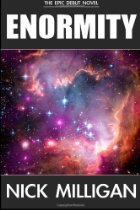
Book Review: Enormity by Nick Milligan
 Summary:
When Australian astronaut, Jack, crashlands on a planet during a mission and is the only survivor, he fears the worst. What he finds is a planet surprisingly similar to Earth–even speaking English–only with a culture of peace and non-violence. Seeking to survive as a homeless person, he starts busking with a guitar he finds, playing Earth songs. Before he knows it, he’s discovered and becomes a rock star, introducing the planet to Earth’s greatest rock songs, while claiming to have written them himself. But rock star is an awfully high profile for someone who is technically an alien.
Review:
This was my final accepted ARC from 2014, and I think it’s a fitting review for the last day of 2014 here on Opinions of a Wolf. This was an interesting read that kept me moderately entertained, although it wasn’t the rollicking good time I was initially expecting.
The book jumps right in to Jack as already a rock star on Heaven (the alien planet) and tells of his arrival and how he became famous through a series of flashbacks. This nonlinear storytelling works well with the plot. Starting with semi-familiar rock star territory, the book slowly reveals what is different about this planet, as well as about Jack.
It is evident that this was originally a three part series, as the plot consists of three distinct parts that, while connected, keep the book from having an overarching gradual build-up of suspense. Jack has three distinct episodes of action, and that lends the book and up and down quality that feels a bit odd in one novel. I actually think I might have enjoyed the book more if it was kept as a trilogy with each part’s plot fleshed out a bit and the overarching conflict made more evident. An overarching conflict does exist, but it is so subtle that the opportunity to build suspense is mostly missed.
Personally, Jack didn’t work for me as a main character. While I don’t mind viewing the world through a bad guy’s eyes, I usually enjoy that most when I get a lot of depth and insight into who that person is. Jack holds everyone, including the reader, at arm’s length, so I both saw the world through his objectifying eyes and couldn’t really get to know him at all. That said, I can definitely see some readers enjoying Jack and his viewpoint. He lends the unique ability to let people see the world both through a rock star’s eyes and through an astronaut’s. A reader who is into both famous people’s biographies/autobiographies and scifi would probably really enjoy him.
Similarly, the humor in the book just didn’t strike my funny bone. I could recognize when it’s supposed to be humorous, but I wasn’t actually amused. I know other people would find it funny, though. Readers expecting a Douglas Adams style humor would be disappointed. Those who enjoy something like Knocked Up would most likely appreciate and enjoy the humor.
There are certain passages that sometimes struck me as a sour note among the rest of the writing. Perhaps these are passages that would be humorous to other readers, but to me just felt odd and out of place in the rest of the writing. Most of the writing at the sentence level worked for me. It was just the right tone for the story it was telling. But periodically there are passages such as the one below that made me gnash my teeth:
Natalie is a rare beauty. A creature of potent sexuality. Someone you would step over your dying mother to penetrate. (loc 8803)
I take a seat in McCarthy’s desk chair. It’s comfortable. Luxurious in the way a set of stainless steel steak knives might feel to a psychopath. It’s beautiful and firm and smells nice, but in the wrong hands this chair could be used for evil. (loc 6821)
Again, perhaps this is humor that just didn’t work for me. I’m not certain. If you like the concept of the rest of the book, there are only a few of these passages that are easy to pass over. If you enjoy them and find them humorous, then you will most likely enjoy the book as a whole as well.
Overall, this is a piece of scifi with the interesting idea of turning an Earth astronaut into a rock star on another parallel planet. Potential readers should be aware that the book was originally told in three parts, and that is evident in the book. They should also be aware that the main character is both a self-centered rock star and a self-centered astronaut, while this viewpoint may work for some, it will not work for others. Recommended to those who enjoy both celebrity autobiographies/biographies and scifi who can overlook some bizarro coincidences.
If you found this review helpful, please consider tipping me on ko-fi, checking out my digital items available in my ko-fi shop, buying one of my publications, or using one of my referral/coupon codes. Thank you for your support!
3 out of 5 stars
Length: 470 pages – chunkster
Source: Kindle copy from author in exchange for my honest review

Book Review: From a Buick 8 by Stephen King (Bottom of TBR Pile Challenge)
 Summary:
When Pennsylvania state troopers are called in for an abandoned car, they expect it to be a simple report and transfer to impound. But instead they find a car that is slightly off. It looks like a Buick 8 but isn’t quite one. Plus its engine by all laws of mechanics should not work. The troopers agree to make the Buick their responsibility, putting it in a shed and keeping an eye on it. Because it’s not just a car. It might not be a car at all.
Review:
I was told before I read this by other Stephen King fans that it’s not one of King’s better books, but I would like to read everything he has written, so I picked it up anyway. This is a book that builds thrills slowly and gently to a conclusion that may not seem satisfying to many readers.
The biggest thing that I think took the thrills out of the book for me is that I am not a car person. When the narrator was describing the Buick 8, I had no idea any of it was off at all, so it didn’t give me the creeps. When they first describe the engine, for instance, I was surprised they were freaked out by it because it just seemed like a mysterious engine to me….like all engines. I definitely think there are more thrills to be found here if the reader is a car person. A car person will get caught up in what’s awry with the Buick, and see it as the mystery that the state troopers recognize it to be immediately.
What this book excels at is what King always excels at. The book establishes the place and feeling of rural Pennsylvania beautifully. The characters all speak in accurate and easily readable dialogue. There is a large assortment of characters, and they are easy to tell apart. The timeline of the book is carefully selected for just the right tempo for the book. These are all wonderful things that kept me reading and made me engaged with characters I might not normally identify with.
Some readers might find that the plot and thrills move too slowly for them. The Buick has issues gradually over time, and the conclusion they build to might not feel like a satisfying conclusion for all readers. Personally, I enjoy slower moving thrillers, so this worked for me, but it might not work for all. Similarly, I believe the ending will be more satisfying to those who have read the entire Dark Tower series than to those who have not. What is going on with the Buick is more understandable and a bigger deal if the reader is aware of all of the context provided by the Dark Tower.
Overall, if you are a car person who will appreciate a car that is slightly off and also enjoys slowly moving thrillers enhanced by a strong sense of place, this will be a great read for you. Similarly, those who have read the Dark Tower may be interested in this book due to some possible connections to that series. If neither of those descriptions fit you, you may want to pick up a different Stephen King book for your thrills. He certainly has plenty to choose from.
If you found this review helpful, please consider tipping me on ko-fi, checking out my digital items available in my ko-fi shop, buying one of my publications, or using one of my referral/coupon codes. Thank you for your support!
3 out of 5 stars
Length: 467 pages – chunkster
Source: Harvard Books

Counts For:

Book Review: Nexus by Ramez Naam (Series, #1)
 Summary:
Science is moving forward to and through transhumanism to posthumanism, and no society seems to quite know how to handle it. China is using the tech in their armies, Thailand is interested in its use to enhance meditation and zen, and the US government banned many of the different treatments and drugs after they were used by cults to make cloned children into killing machines. Kaden Lane knows about the potential dangers, but he and his lab partners are still invested in making their brain nanotechnology drug, Nexus, work. It makes minds meld together, able to feel others’ suffering, and they think it will lead to world peace. Samantha Cataranes was a victim of a transhumanist mind control cult as a child, now she fights on the side of the FBI putting a stop to any science deemed too dangerous. When Samantha and Kaden meet, their worlds and worldviews start colliding.
Review:
I had honestly kind of forgotten what this book was about, beyond it being scifi, by the time I picked it up to read it. I thus was able to experience most of it as a surprise. It’s a book that’s a modern twist on cyberpunk with plenty of action to boot.
Jumping far enough ahead that some transhumanist elements already exist is a smart move. It lets the book think forward further than the initial transhumanist elements that it’s generally easy to see the advantages of, like fully functional robotic hands, into the grayer areas with things like cloning and mind control and making soldiers who are super-soldiers. This is a more interesting ethical dilemma, and the book doesn’t take very long to set up the world and get into it.
Nexus itself is a fascinating drug that combines nanotech and drugs. It’s easy to see that the author knows his science and has extrapolated into a possible future with a lot of logic based on current science. That’s part of what makes reading the book so fascinating and slightly frightening. It feels like an actual possibility.
The world building is done smoothly, incorporating both in-plot mentions and newspaper clippings and internal briefings to establish what is going on in the greater world around Kaden and Samantha.
The characterizations are fairly strong. Even if some of the secondary characters can seem two-dimensional, the primary characters definitely are not. Seeing a woman as the world-wise, transhuman strong fighter, and the man as the physically weaker brains was a nice change of pace. Additionally, the book embraces the existence of gray areas. “Bad guy” characters aren’t necessarily bad, and “good guys” aren’t necessarily good. This characterization helps tell the nuanced gray area story of the overarching plot.
The beginning of the book was weaker than the middle and the end. The first chapter that has a character testing out Nexus by using it to land sex with a hot woman almost made me stop reading the book entirely. It felt like some pick-up artist douchebro was imagining a future where tech would make him irresistible to women. Frankly, that whole first chapter still feels extremely out of place to me now. It doesn’t fit into the rest of the presentation of the character throughout the book. It feels like an entirely separate story altogether. I would encourage potential readers to skim it, since it barely belongs, then get to the rest of the book.
After the first chapter, the next few chapters feel a bit overly rose-colored lenses at first. Almost as if the author sees no gray areas and only the potential good in humans. Thankfully, this is mostly the rose-colored lenses of a main character that quickly fall away for the more nuanced storytelling of the rest of the book. But it did induce a few eye-rolls before I got further along.
The middle and end of the book look at human potential for both good and evil within the context of both science and Buddhism. It’s fascinating stuff, and makes a lot of sense since quite a bit of modern psychiatry is working hand-in-hand with ideas from Buddhism, particularly about meditation. This is where the more interesting insights occurred, and also where I felt I could embrace the book a bit more.
Each of us must walk our own ethical path. And together, men and women of ethics can curb the damage of those without. But for you…if you keep vital knowledge from others, then you are robbing them of their freedom, of their potential. If you keep knowledge to yourself, then the fault is not theirs, but yours. (loc 5597)
Overall, this cyberpunk scifi that mixes transhumanism and posthumanism with nanotechnology, fighting big governments, and Buddhism tells a fascinating tale full of gray areas that will appeal to scifi fans. Some may be turned off by the first few chapters that lack the nuance and likeable and strong characterization of the rest of the book, but it’s worth it to skim through the first few chapters to get to the juicier middle and end.
If you found this review helpful, please consider tipping me on ko-fi, checking out my digital items available in my ko-fi shop, buying one of my publications, or using one of my referral/coupon codes. Thank you for your support!
4 out of 5 stars
Length: 460 pages – average but on the longer side
Source: Netgalley

 Support my work with a tip or browse my shop for curated book club guides, how to guides, cross-stitch patterns, and more!


This work by Amanda Nevius is licensed under a Creative Commons Attribution-Noncommercial-No Derivative Works 3.0 United States License.
 Opinions of a Wolf