
Archive
Book Review: Bear by Marian Engel

Summary:
A librarian named Lou is called to a remote Canadian island to inventory the estate of a secretive Colonel whose most surprising secret is a bear who keeps her company–shocking company.
Review:
I don’t recall anymore how I heard about this book, but this is what I heard about it:
There’s this book that’s considered a Canadian classic where a librarian has sex with a bear.
Ok. I was left with questions. First, this sounds like erotica – how is it a classic? Second, as a trained librarian I immediately wondered if the librarian part was essential to the story. Third, does she really have sex with a bear? Then I became even more intrigued when I discovered I couldn’t get this book digitally but only in print AND it’s out of print in the US so it’s far cheaper to purchase it abroad and have it sent here. So, now that I got this book from the UK and read it (in one weekend), let me answer these questions for you.
First, I wouldn’t call this erotica. The point, in spite of the murmurings about it, is absolutely not about sex with a bear, whereas in erotica, the point is the sex. I in all honesty would say this is a book about burnout. Lou is an archivist who is in a rut. When the nameless Institute she works for sends her to this estate that has been left to them to inventory their materials, her time in nature and her experiences with the locals (yes, including Bear), reveals her massive burnout to her.
She wondered by what right she was there, and why she did what she did for a living. And who she was.
(pg 93)
Second, I would definitely say the librarian part is essential to the story. Librarianship is a feminized profession. This book was first published in 1976. It is an exploration of what it means to be a working woman and how the world views working women, even when our work is performed outside of the public’s eye (perhaps especially when our work is performed outside of the public’s eye). I also thought this book does an excellent job of showing how even though librarianship is a feminized profession, those in the positions of greatest power within libraries and archives are men. Lou’s boss is a man, and this is relevant to her negative work experience.
Third, does she actually have sex with a bear? Ok, slight spoiler warning here. There is no penetration. She tricks the bear to go down on her. That’s it. I didn’t find it particularly shocking, but I’m a millennial from the internet generation that grew up with the internet urban legend about the woman with the dog and the peanut butter so. I viewed the transgressive act with Bear as serving two purposes. First, Lou has a tendency toward self-sabotage, self-loathing, and self-punishment. I think transgressing in this way makes her see how she’s transgressing against herself and her own soul in other ways and makes her refind her own sense of self. Second, I think it’s important to note that at the beginning of the book an Indigenous woman named Lucy kind of hands off the caretaking of Bear to Lou. At the end of the book, she hands the caretaking back to Lucy. I view this as an acknowledgement that just because you can do something doesn’t mean you should. It doesn’t mean it’s your life calling. There are other interesting takes on this as a commentary on colonialism, which I also think are valid.
So do I see why this is a Canadian classic? Yes, absolutely. The whole story oozes Canada from the juxtaposition of the wilderness with the city to the entwining of European and local history to the acknowledgment of the realness and relevance of local Indigenous peoples. (These peoples are not of the past but are of the present, something I think Canadian literature often does a better job with than US literature).
I thought I was going to read this book and laugh at it, kind of like how folks on book-tok are laughing about the ice planet barbarians right now. Instead, I found a unique story about a woman’s time in the semi-wilderness and how it makes her confront her burnout and how her career is a poor fit for her. How her life setup is causing her to transgress and how that needs to change. A shocking way to get the point across? Perhaps. But an important point nonetheless.
4 out of 5 stars
Length: 167 pages – average but on the shorter side
Source: Purchased
Buy It (Amazon or Bookshop.org)
Get the Reading Group / Book Club Discussion Guide
A beautifully graphic designed 2 page PDF that contains: 1 icebreaker, 9 discussion questions arranged from least to most challenging, 1 wrap-up question, 3 read-a-like book suggestions
View a list of all my Discussion Guides.
If you found this review helpful, please consider tipping me on ko-fi, checking out my digital items available in my ko-fi shop, buying one of my publications, or using one of my referral/coupon codes. Thank you for your support!
Book Review: One Last Stop by Casey McQuiston (Plus Reading Group / Book Club Discussion Guide)

Summary:
Twenty-four-year-old August has struggled to find her place in life. She’s now transferred to her third college, this time in Brooklyn, and she hopes it’ll stick. She finds a room in an apartment that comes with a delightful mix of found friends all also a part of the queer community, and they set her up with a job at the local diner. August thinks maybe it’s finally time to fit in and start to feel like she’s living a normal life, but then she meets a stunningly cute Chinese-American girl on the Q train. And meets here again. And again. Slowly she discovers that this girl might not be quite what she seems to be – in fact she’s a punk rock lesbian from the 1970s displaced out of time. Can August solve the case of how she got displaced and not lose her heart in the process?
Review:
I heard this described somewhere as a queer romance similar to the movie Kate & Leopold. That’s one of my favorite romantic comedies, so I was sold. I can definitely understand the comparison. They’re both set in New York and feature a love interest displaced out of their own time. While I love Kate & Leopold though, I have to admit I didn’t quite love this book.
Let’s start with what I liked. The main character, August, is bisexual and says it (more than once) with confidence. There is no biphobia expressed in this book by any of the characters she cares about. I also really appreciated seeing a bisexual main character who is a virgin and yet still declares this. An important moment of representation that one does not need to sleep with people to know one’s sexuality
August’s roommates and new friends are eclectic and fun while still feeling real. There is representation of gay and trans* folks especially. One of the roommates is Black (with Chinese adoptive parents), one is Greek-American, and one is Jewish. There’s a lot of diversity here. Part of what made them all feel real is that all of them had their own different families and issues. It wasn’t one queer story but many. I also really liked how real the local drag club felt, and I appreciated the representation of someone in recovery (the chef at the pancake restaurant).
I thought there was a lot of sizzle between August and the girl on the train – Biyu. Now at first she goes by Jane but over the course of the book she comes to ask to go by her birth name, Biyu, rather than her Americanized nickname. I want to be respectful of that. I also enjoyed the mystery of how she came to be on the train, and how August goes about solving it.
I felt pretty neutrally about the sex scenes. They were steamy without being explicit, but they weren’t anything particularly memorable for me. Some readers, I know, were turned off by the fact some of the sex happens on the train. That didn’t bother me because it makes sense for the characters. But be forewarned!
Now what I liked less. I don’t think the book handled racism and homophobia as directly or clearly as it should have. Biyu is from the 1970s and is a Chinese-American who is visibly lesbian. She literally had run-ins with the cops over wearing men’s clothes in her time period. But being jetted forward 40 years doesn’t solve the problems of homophobia and racism. I think the book acknowledges this by having Biyu have a run-in with someone who says something both racist and homophobic to her (the words are not said in the book and the incident appears off-screen). Yet August responds by saying, “most people aren’t like that anymore” (I can’t give an exact page number as this was a review copy but it occurs in Chapter 12). This does lead into a large fight between Biyu and August, which I think implies that August was wrong in what she said. However, I think August needed a bigger I was wrong moment, where she acknowledges that she did a very poor job of both being there for Biyu in that moment and of describing the complexity of how racism and homophobia are simultaneously different and yet not in modern times. I think readers also would have benefited from a nuanced discussion of how, for example, same-sex marriage is now legal and yet hate crimes against Asian-Americans and Pacific Islanders have increased dramatically in the last year, especially against Chinese-Americans (source). I think this book wanted to say something big and interesting about sexuality and queerness especially in the 1970s versus now, but in my opinion it falls short of accomplishing this.
Additionally, I know I was supposed to find the ending satisfying but it left me dissatisfied. I think for similar reasons – it’s a complex situation and the book doesn’t dig deep enough or hard enough into these complexities. Things are kept at the surface level. While it is a book in the spirit of a romcom, romcoms can say big and difficult things while not losing the romcom feel. Confessions of a Shopaholic springs to mind – it deals with the very serious issue of shopping addiction while still feeling like a very fun romcom.
Overall, this book is fun and lighthearted. It features a realistic bisexual lead and steamy, yet not explicit, f/f scenes. The queer found family is delightful. But it could have stood to have dug a bit deeper into the serious issues it brought up. They are important conversations to have that wouldn’t have messed up the lightheartedness of the romcom vibe.
4 out of 5 stars
Length: 422 pages – average but on the longer side
Source: NetGalley
Buy It (Amazon or Bookshop.org)
Get the Reading Group / Book Club Discussion Guide
A beautifully graphic designed 2 page PDF that contains: 1 icebreaker, 9 discussion questions arranged from least to most challenging, 1 wrap-up question, 3 read-a-like book suggestions
View a list of all my Discussion Guides.
If you found this review helpful, please consider tipping me on ko-fi, checking out my digital items available in my ko-fi shop, buying one of my publications, or using one of my referral/coupon codes. Thank you for your support!
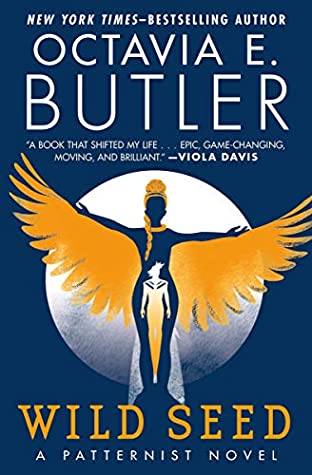
Book Review: Wild Seed by Octavia Butler (Series, #1)
Summary:
Anyanwu is a shapeshifter who is immortal who has so far largely passed without notice. But when Doro, a being who maintains his immortality by stealing others’ bodies, discovers her, everything changes. He considers her to be wild seed for his project of gathering together all humans with special powers to breed them to try to create those who can match him. But is Anyanwu already a match for him? And can they ever produce children who are like them?
Review:
The simplest word to describe this book is unexpected. That’s something that’s difficult to achieve in fantasy about immortality, so I was pleasantly surprised.
This book immediately asks the reader to identify with and understand Anyanwu at least a little bit. Unlike in some other fantasies about immortality, she is already immortal when she meets Doro. So the challenge isn’t does she want to be immortal but rather what is it like to be truly seen by someone else? Doro is somehow more frightening than Anyanwu. The reader thus sides with Anyanwu, even though she is also a little bit scary. Anyanwu also says she goes with him to protect her children from him, an emotion it is easy to understand. Thus, the reader develops an ability to see Anyanwu’s viewpoint. When Anyanwu later does certain things that would have seemed shocking, this ability to see her perspective remains.
It is also interesting to see Doro and Anyanwu’s lives placed against a backdrop of slavery. Anyanwu is African. Doro can take the body of anyone he chooses, but he does state his original human body was in Africa. They are aware of slavery and even pull some seed away from being slaves to live in Doro’s villages instead. Doro breeds people regardless of their race. What he is interested in is their abilities. However, slowly the book comes to ask if this is in a way another form of slavery? Doro says the people view him as a god and that is their relationship, but Anyanwu feels differently. That sets up the reader to ask how free are these people in these villages really?
I was also pleasantly surprised by an appearance of queerness in the later half of the book. Anyanwu makes some interesting discoveries about her shapeshifting that leads to some pregnancies and relationships that are decidedly queer in nature. I was glad the book went there but surprised because so often books about shapeshifting and body inhabiting never do cross the line of gender.
Although this is the first book in a series, I felt it stood strongly on its own yet, simultaneously, propelled me to read more. The immortality angle is what makes it work this way. This is a solid chapter in the lives of Anyanwu and Doro. Yet clearly their story isn’t over, and there are new people who are going to encounter and challenge them. It was fantasy that felt possible and challenging simultaneously. Recommended to fantasy readers looking for a fresh take on immortality.
4 out of 5 stars
Length: 320 pages – average but on the longer side
Source: Library
Buy It (Amazon or Bookshop.org)
Get the Reading Group / Book Club Discussion Guide
A beautifully graphic designed 2 page PDF that contains: 1 icebreaker, 9 discussion questions arranged from least to most challenging, 1 wrap-up question, and 3 read-a-like book suggestions
View a list of all my Discussion Guides.
If you found this review helpful, please consider tipping me on ko-fi, checking out my digital items available in my ko-fi shop, buying one of my publications, or using one of my referral/coupon codes. Thank you for your support!
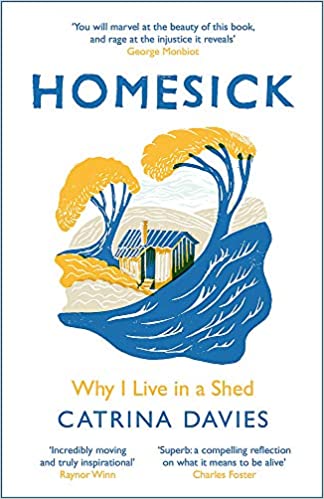
Book Review: Homesick: Why I Live in a Shed by Catrina Davies
Summary:
Catrina was 31 and very tired of never quite being sure if she could even make the rent on her box-room in a home she shared with four adult roommates (plus one child). With the cost of housing in the UK, she knew the odds were stacked against her to both be able to afford better housing and to have time for her artistic pursuits. So she decided to opt out by taking up residence in her father’s abandoned shed in Cornwall. She doesn’t have a toilet but she does have time to surf, write, and make music. This memoir both chronicles her decision and beginnings in the shed, as well as gives deep consideration to the housing crisis, consumerism, and finding the time to truly live.
Review:
I was immediately intrigued by the name of this book. It’s not why I live in a tiny house. It very explicitly calls it a shed. When I saw this was set in the UK, I was even more intrigued. As an American, my pre-existing understanding was that the UK has a robust system for caring for the poor, thinking specifically of the dole and council housing. It seemed to me that this must have been a choice to live in a shed, and I wanted to know more about this counter-cultural choice. This is indeed a beautiful counter-cultural memoir that surprised me by illuminating how much I didn’t know about the realities of the UK’s housing situation currently.
Catrina artfully weaves in both facts about housing in the UK and her own thoughts on modern culture within the story of her moving to and setting up the shed. (I would call it her first year in the shed, but the author’s note is that she actually condensed several years into one to make it more of a story). For example, while she asks her father for permission to live in his old small business’s shed, we find out that the shed is not zoned for housing, so, while she has the owner’s permission, what she is doing is still technically illegal. I also learned a lot about lords and how much of her area of Cornwall is actually owned by a lord with a castle on an island who will randomly make decisions like to charge for parking when previously people just parked for free to enjoy the ocean. Obviously a lord has no need for this money. I am still jarred by the idea of an actual lord running most of the show in a town. This is just one of the many examples of the inequities that remain in the UK that I had not previously known about.
When not discussing housing, Catrina explores gardening, surfing, making music, and writing. She discusses how living in the shed rent-free enables her to take low-paying jobs that leave her with enough time and energy to enjoy these pursuits. Living in the shed puts her closer to nature, and she becomes a bit obsessed with Walden (as a New Englander, I really wanted to enlighten her about how Walden Pond isn’t all it’s cracked up to be and how many moneyed connections, including in his own family, Thoreau actually had, partially thanks to having graduated from Harvard). While this may seem like a digression, it actually leads me quite smoothly into my main critique of the book, which is that I do wish the author demonstrated a bit more insight into her own privilege. She only can live in the shed because her father bought and paid for it. There is intergenerational assistance and provision here, even if she doesn’t recognize it as such. I’m not saying that it’s the same thing as having a trust fund handed to you, but it’s also not the same thing as her friends who squat in sheds of their own making on public land. Similarly, she, for example, showers at the homes of the people who she gardens for (often with their permission, but not always). She couldn’t take these moments of comfort she loves so much if those people hadn’t bought into the housing game. She may feel she’s opted out of society, but has she really?
Those who enjoy memoir as a way to gain insight into a different type of life than their own will not be disappointed by this book. This book made me think about what I am doing in my life because I want to versus what I am doing just because my culture pointed me here, and I appreciate that. I also enjoyed getting to vicariously surf in Cornwall.
4 out of 5 stars
Length: 256 pages – average but on the shorter side
Source: Purchased
Buy It (Amazon, this book is not available on Bookshop.org)
Get the Reading Group / Book Club Discussion Guide
A beautifully graphic designed 2 page PDF that contains: 1 icebreaker, 9 discussion questions arranged from least to most challenging, 1 wrap-up question, 3 read-a-like book suggestions
View a list of all my Discussion Guides.
If you found this review helpful, please consider tipping me on ko-fi, checking out my digital items available in my ko-fi shop, buying one of my publications, or using one of my referral/coupon codes. Thank you for your support!
 Support my work with a tip or browse my shop for curated book club guides, how to guides, cross-stitch patterns, and more!


This work by Amanda Nevius is licensed under a Creative Commons Attribution-Noncommercial-No Derivative Works 3.0 United States License.
 Opinions of a Wolf