
Archive
Book Review: Doctor Sleep by Stephen King (Series, #2) (Audiobook narrated by Will Patton)
 Summary:
Danny Torrance didn’t die in the Overlook Hotel but what happened there haunts him to this day. Not as much as the shining does though. His special mental powers that allow him to see the supernatural and read thoughts lead to him seeing some pretty nasty things, even after escaping the Overlook. He soon turns to drinking to escape the terror. But drinking solves nothing and just makes things worse. When he sees his childhood imaginary friend, Tony, in a small New Hampshire town, he turns to AA to try to turn his life around and learn to live with the shining.
Abra is a middle school girl nearby in New Hampshire with a powerful shine. She sees the murder of a little boy by a band of folks calling themselves the True Knot. They travel in campers and mobile homes, seeking out those who have the shine to kill them for it and inhale it. They call it steam. They’re not human. And they’re coming after Abra. Abra calls out to the only person she knows with a shine too, the man she’s talked to before by writing on his blackboard. Dan.
Review:
A sequel that takes the original entry’s theme on overcoming your family origin and ramps it up a notch, Doctor Sleep
The book begins with a brief visit to Danny as a kid who learns that the supernatural creatures exist in places other than the Overlook, and they are attracted to the shine. This lets the reader first get reacquainted with Danny as a child and also establishes that the supernatural are a potential problem everywhere. The book then jumps aggressively forward to Danny as a 20-something with a bad drinking problem. It’s an incredibly gritty series of scenes, and it works perfectly to make Dan a well-rounded character, instead of a perfect hero of the shine. It also reestablishes the theme from The Shining
The way Dan overcomes both his drinking and his temper, as well as how he learns to deal with his shine, is he joins Alcoholics Anonymous (AA). In contrast to his father who tried to quit drinking on his own, Dan attempts it in a group with accountability. This then shows how much easier it is to overcome a mental illness with community support. I appreciated seeing this. I will say, however, that some of the AA talk in the book can get a bit heavy-handed. Some chapter beginnings include quotes from the book of AA, and Dan can sometimes seem a bit obsessed with it when he relates almost everything to something he learned or heard there. AA definitely plays a vital role in many people’s recovery from addiction, and it’s wonderful to see that in a work of fiction. However, it would have been better for the reader to see the role of AA more than to hear quotes from AA so often.
The big bad in this book is a band of supernatural creatures who were once human and still look human. But they change somehow by taking steam and go on to live almost indefinitely. They can die from stupid accidents and sometimes randomly drop dead. The steam is acquired by torturing children who have the shine. The shine comes out of their bodies as steam when they are in pain. They call themselves The True Knot. This troop is a cartoonish group of evil people who try to look like a troop of retirees and some of their family traveling in a camper caravan. The leader of this group is Rose the Hat–a redheaded woman who wears a top hat at an impossibly jaunty angle. I was pleased to see Rose written quite clearly as a bisexual. Her sexuality is just an aspect of who she is, just like her red hair. Seeing a bi person as the big bad was a delight. Her bisexuality isn’t demonized. Her actions as a child killer and eater of steam are. She is a monster because of her choices, not because of who she is. I alternated between finding The True Knot frightening and too ridiculously cartoonish to be scary. I do think that was partially the point, though. You can’t discredit people who seem ridiculous as being harmless.
How Abra is found by The True Knot, and how she in turn finds Dan, makes sense within the world King has created. It doesn’t come until later in the book, though. There is quite a bit of backstory and build-up to get through first. The buildup is honestly so entertaining that it really didn’t hit me until after I finished the book how long it actually took to get to the main conflict. So it definitely works. Abra is a well-written middle school girl. King clearly did his research into what it’s like to be a middle schooler in today’s world. Additionally, the fact that Abra is so much older than Danny was in The Shining
There is one reveal later in the book in relation to Abra that made me cringe a bit, since it felt a bit cliche. It takes a bit of a leap of faith to believe, and I must admit it made me roll my eyes a bit. However, it is minor enough in the context of the overall story that it didn’t ruin my experience with the book. I just wish a less cliche choice had been made.
The audiobook narrator, Will Patton, does a phenomenal job. It was truly the best audiobook narration I’ve heard yet. Every single character in a very large cast has a completely different voice and style. I never once got lost in who was speaking or what was going on. More importantly to me, as a New England girl born and raised, is that he perfectly executes the wide range of New England accents present in the book. Particularly when he narrates the character, Billy, I thought I was hearing one of my older neighbors speak. I could listen to Will Patton read a grocery list and be entertained. Absolutely get the audiobook if you can.
Overall, this sequel to The Shining
4 out of 5 stars
Source: Audible

Previous Books in Series:
The Shining
Counts For:

Book Review: Something Spectacular: The True Story of One Rockette’s Battle with Bulimia by Greta Gleissner (Audiobook narrated by Dina Pearlman)
 Summary:
Greta Gleissner finally achieved her lifelong dream of making a living just from her professional dancing. She landed the prestigious job of being a Rockette in the New York City show. She hoped that this newfound stability and prestige would cure her of her bulimia. What was there to binge and purge about when she was living her dream? But her eating disorder she’d had since a young age won’t just disappear because of her newfound success. Soon, her bulimia is putting her job–and her life–at risk.
Review:
I was immediately intrigued by the elements of this eating disorder memoir that make it different from the, sadly, so many others that exist. Greta’s eating disorder peaks in her 20s, not her teens. She was a Rockette, and she’s a lesbian. An eating disorder memoir about someone in their 20s in the dance industry who is also queer was very appealing to me. What I found was a memoir that gives insight to having an eating disorder, the impact of homophobia, and an inside look at the professional dance world told in a non-linear, honest, and engaging manner.
Greta tells her memoir in the framework of a play. There are scenes, acts, overtures, etc… This lets her address the story in a non-linear way that still makes sense. The overture, for instance, shows a dramatic moment when her eating disorder was at full tilt and destroying her life. Then she backs up to the few months before she became a Rockette. The time of auditioning then being a Rockette is interspersed with flashbacks to help us better understand her life. Finally, she enters an inpatient clinic, where we get flashbacks in the context of her therapy. It’s a creative storytelling technique that brings a freshness to her memoir.
Honesty without cruelty to herself or others is a key part of her narrative voice. Greta is straightforward, sometimes grotesquely so, about her bulimia and what it does to her. The eating disorder is not glamorized. Greta takes us down into the nitty-gritty of the illness. In fact, it’s the first bulimia memoir I’ve read that was so vivid and straightforward in its depictions of what the illness is and what it does. In some ways, it made me see bulimia as a bit of a mix between an addiction and body image issues. Greta was able to show both how something that was helping you cope can spiral out of control, as well as how poor self-esteem and body image led her to purging her food.
Greta also is unafraid to tell us about what goes on inside her own mind, and where she sees herself as having mistreated people in the past. I never doubted her honesty. Similarly, although Greta’s parents definitely did some things wrong in how they raised her, Greta strives to both acknowledge the wounds and accept her parents as flawed and wounded in their own ways. You can hear her recovery in how she talks about both them and her childhood. She has clearly done the work to heal past wounds.
The memoir honestly made me grateful the dancing I did as a child never went the professional route. It’s disturbing how pervasive body policing and addictions in general are in the dance world, at least as depicted by Greta. Similarly, it eloquently demonstrates how parents’ issues get passed down to the children, and sometimes even exacerbated. Greta’s mother was a non-professional dancer who was constantly dieting. Greta also loved dancing but her mother’s body image issues got passed down to her as well. Food was never just food in her household.
One shortcoming of the memoir is that Greta never fully addresses her internalized homophobia or how she ultimately overcomes it and marries her wife. The book stops rather abruptly when Greta is leaving the halfway house she lived in right after her time in the inpatient clinic. There is an epilogue where she briefly touches on the time after the halfway house, mentions relapse, and states that she ultimately overcame her internalized homophobia and met her now wife. However, for the duration of her time in the clinic and the halfway house, she herself admits she wasn’t yet ready to address her sexuality or deal with her internalized homophobia. It was clear to me reading the book that at least part of her self-hatred that led to her bulimia was due to her issues with her sexuality. Leaving out how she dealt with that and healed felt like leaving out a huge chunk of the story I was very interested in. Perhaps it’s just too painful of a topic for her to discuss, but it did feel as if the memoir gave glimpses and teasers of it, discussing how she would only make out with women when very drunk for instance, but then the issue is never fully addressed in the memoir.
Similarly, leaving out the time after the halfway house was disappointing. I wanted to see her finish overcoming and succeeding. I wanted to hear the honesty of her relapses that she admits she had and how she overcome that. I wanted to hear about her dating and meeting her wife and embracing her sexuality. Hearing about the growth and strength past the initial part in the clinic and halfway house is just as interesting and engaging as and more inspiring than her darker times. I wish she had told that part of the story too.
The audiobook narrator, Dina Pearlman, was a great choice for the memoir. Her voice reads as gritty feminine, which is perfect for the story. She also handles some of the asides and internal diatribes present in mental illness memoirs with great finesse.
Overall, this is a unique entry in the eating disorder memoir canon. It gives the nitty gritty details of bulimia from the perspective of a lesbian suffering from homophobia within the framework of the dance world. Those who might be triggered should be aware that specific height and weight numbers are given, as well as details on binge foods and purging episodes. It also, unfortunately, doesn’t fully address how the author healed from the wounds of homophobia. However, her voice as a queer person is definitely present in the memoir. Recommended to those with an interest in bulimia in adults, in the dance world, or among GLBTQ people.
4 out of 5 stars
Source: Audible

Counts For:
Book Review: A Queer and Pleasant Danger: The True Story of a Nice Jewish Boy Who Joins the Church of Scientology and Leaves Twelve Years Later to Become the Lovely Lady She is Today by Kate Bornstein (Audiobook narrated by Alice Rosengard)
 Summary:
Kate Bornstein is a playwright, gender theorist, and queer activist. She chose to write a memoir as a way to reach out to her daughter, Jessica, who is still in the Church of Scientology, and thus, must not speak to her. Her memoir talks about growing up Jewish in the 1950s, feeling like a girl inside a boy’s body. It then talks about why and how she joined Scientology (still identifying as a man, Al), climbing Scientology’s ladder, marrying, fathering Jessica, and finally getting kicked out of Scientology and becoming disillusioned. From there the memoir explains to Jessica how and why Al decided to become Kate and talks about the person behind the queer theory, trying to explain who the incredibly unique parent she has truly is.
Review:
I was feeling bad about how far behind I’ve fallen in writing up reviews for the books I’ve finished reading, but with the historic DOMA ruling in the US yesterday (giving official federal support to marriage equality), I’m really glad I had a LGBTQIA+ book in the queue ready to be reviewed. And not just any LGBTQIA+ book. An amazing one! You can’t read that title and not be intrigued. It’s impossible. I spotted it on tumblr and instantly knew I had to read it. A memoir about a transwoman who was a member of Scientology?! It’s the intersection of three topics I find fascinating.
Kate is unabashedly honest about the fact that this book exists as a letter to her daughter, Jessica. The prologue explains that this memoir came about as a way for Kate to reach out to Jessica and her children, even after Kate has passed away. This lends a tone to the book of an elderly neighbor sitting down to tell you their life story, and you finding out gradually that your elderly neighbor is, in fact, a bad ass, and age has nothing to do with how cool a person still is to this day. And Kate doesn’t hold back because of this perspective. If anything, she is more brutally honest than she might otherwise be. She wants Jessica to have a whole, clear picture of who she is. Flaws and all. One technique that I thought was brilliant for a memoir and helped establish trust in truth between the reader and the author was the fact that Kate would tell a family story she heard growing up and then say, well, that was a lie. I thought it was true, but it turns out what people told me was a lie. Given that, how can we ever know what really is true? Just because we think something is true doesn’t mean it is. It’s an excellent grain of salt to be given in a memoir.
After the prologue, Kate tells her story chronologically. Her story can be roughly summarized as the following sections: growing up a gender queer person, joining Scientology, break-down after getting kicked out of Scientology and coming to terms with her queerness, transitioning, life as a lesbian trans activist, finding BDSM, and overcoming depression and suicidal thoughts. It’s an emotional rollercoaster ride, and one cannot help but feel empathy for this person just struggling to find a place in the world. Personally, I think Kate’s life story is an excellent argument for breaking down the binary gender divide. A lot of Kate’s struggles come from the rigid gender norms and expectations placed upon her by others. It would have been much simpler for people to have let her be gender fluid, and indeed, Kate in more recent years has come to be an activist for gender fluidity and queerness (as is evidenced by her book Gender Outlaw: On Men, Women and the Rest of Us
The Scientology section was surprisingly mundane compared to what I thought actually happens in Scientology. Yes, there was abuse and lies and many other things going on that demonstrate the fallacies of L. Ron Hubbard, but honestly none of it was that much worse than religious extremists of any religion. Scientology expects its followers to cut themselves off from people deemed poisonous and to proselytize non-stop. It takes over the lives of the people in the upper-echelons, controlling every aspect of their lives. We can see all of this in Kate’s years in Scientology, and while it was interesting, none of it is shocking to anyone moderately informed on Scientology. I actually was more interested in how Kate wound up joining Scientology. Scientology teaches the the soul is genderless, and you also reincarnate. Everyone has been in both male and female bodies. Kate (then Al) found this incredibly comforting. It’s possible that his soul was just more frequently in female bodies, and so that’s why he felt like a girl inside. What an appealing concept to a confused, unsupported trans or gender queer young adult. I think this part of the book demonstrates clearly why it’s important for families and loved ones to be supportive of their LGBTQIA+ teens and young people. You don’t want a harmful group of people snapping them up with promises of understanding and caring and information that sounds more supportive than the people they live with.
Interestingly, the much more shocking section was the one in which Kate discusses discovering BDSM and getting pleasure from pain. Kate was part of a BDSM triad for quite some time, and this is addressed. It does, however, come with a warning for Jessica and readers who might not want to hear the details so they can easily skip over it and still get the most important information without getting all the details. I thought that was a nice touch from Kate, showing her maturity and openness. Of course, I read that section, and I will say that Kate had a more intense BDSM relationship than you tend to see in literature, and it was interesting to read about.
It’s also interesting to note that from the prologue Kate is honest with the reader about being diagnosed with Borderline Personality Disorder years ago. This is not something I knew coming into the book, and I don’t think Kate’s mental illness played very much into the book. I certainly think she would have had a better time coping with her mental health issues if she had had a supportive environment for her queerness. Even within the LGBTQIA+ community, she was ostracized for some of her less mainstream beliefs within that community. It’s sad that even a community of people ostracized by the larger society, people can still be unaccepting and unloving. In spite of the fact that the book talks a lot about depression, self-injury, and other mental health issues, I am hesitant to label it as counting for my Mental Illness Advocacy Reading Challenge. I don’t want the casual reader to think that I’m equating being queer with having a mental illness. However, the fact remains that Kate herself states she was diagnosed with BPD, and trans and queer people certainly can have mental illnesses. One does not cause the other, although certainly I think lack of acceptance and loving increases symptoms of mental illnesses. In any case, for this reason, I am counting this read for the challenge, but I want to be crystal clear that this is due to Kate’s BPD and NOT her queer/trans orientation.
The narration of the audiobook was perfect. Thankfully, they chose to use a female narrator throughout, which fits perfectly with the image of an older Kate Bornstein telling her life story to her daughter. Alice Rosengard was a perfect narrator. She became Kate in my mind, and there’s not a better complement you can pay a narrator than that.
I feel like I’ve rambled a lot about this book. It’s hard to succinctly discuss a memoir as unique as this one, let alone a book you love as much as I loved this one. It’s amazing. It’s unique. It does exactly what a memoir should do. It tells a unique life story in an engaging way that forces the reader to put herself into someone else’s shoes and feel empathy and maybe even come out of it with a changed worldview, however slightly. I strongly recommend this book to everyone, really, but especially anyone with an interest in LGBTQIA+ history/theory/studies or an interest in the first few decades of Scientology. I will definitely be reading more of Kate’s works, myself, and want to thank her for being a pioneer, in spite of everything.
5 out of 5 stars
Source: Audible

Counts For:

Book Review: Superior Women by Alice Adams (Bottom of TBR Pile Challenge)
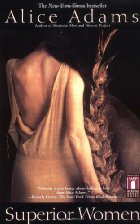 Summary:
When Californian Megan Greene runs has a steamy affair in the summer of 1943 with a Harvard student visiting the west coast for the summer, she decides to follow him back to the east coast and attend Radcliffe. There she meets four other women, three of whom it might be more accurate to call frenemies than friends. Their lives and destinies repeatedly intertwine throughout the tumultuous changes of mid-20th century America.
Review:
I kept my eye out for this book when it was named as a read-a-like to my 2011 5 star read The Group
The book covers 1940s to 1980s America, yet as the decades move on, less and less is said. The 1940s are expressed clearly with exquisite detail, and I was excited to see what would happen with the 1950s and the 1960s. But the 1950s slowed down, the 1960s were barely touched upon, the 1970s were jumped over almost entirely, and the 1980s were the final chapter of the book. The pacing was all off. I wanted to know these women in as much detail in the latter decades as in the first. Instead of feeling like I knew them more and more intimately, they increasingly became strangers to me.
One thing that I think really works against the book is it is neither an ensemble nor a one character piece. Most of the book is told about Megan, but not all of it. We get snippets of the other characters, meaning perspectives that Megan is not privy to, but not enough to ever truly know them. Since most of the book is about Megan, these bits away from her feel sort of like the story is robbing us of more time with the main character we are interested in. Similarly, reading the blurb and the title, I thought this was going to be an ensemble book, which is not what we get either. I wanted to know much more about two of the characters in particular, Peg, who comes out as a lesbian at some point in the 1960s, and Cathy, who has an affair with a priest. These two stories are wonderfully intriguing, particularly Peg’s since her love of her life is met on a mission to register black voters in the American south, and her love interest is a Latina woman. There is so much meat to that storyline, and yet it is barely touched upon while we instead listen to Megan hem and haw about her job, and Lavinia try to figure out how best to cheat on her husband. The balance of telling this ensemble piece was just entirely off.
Similarly, while big issues and events of mid-20th century America were briefly touched upon, the book never really presented a truly personal look at any of them. For instance, Megan has a friend who is bashed in a drive-by gay bashing but we never get to see Megan emotionally deal with this stark reality. She hears about it, calls him, and moves on. Similarly, as previously mentioned, Peg comes out as a lesbian, and we see a snippet of her depression caused by living the lie of being straight, but we never get to understand the emotions or impetus behind her bravely coming out and living in a visible, inter-racial lesbian relationship in the south. It is disappointing because we get a taste of really encountering these historical issues, but we never actually get to.
In spite of all these problems, I still enjoyed reading the book well enough. The plot, while frustrating, does progress forward in an interesting fashion. The characters, although frequently two-dimensional, are bright and vivid. I came away with the perspective I always have with historical fiction about women’s history. That I am grateful I was born in a different time, because we women have much more opportunities available to us now. So I appreciated my visit to that time period but it was a bit disappointing.
Overall, if you are a huge fan of historical fiction about women’s issues, this is an interesting book to add to your repertoire. It is a good comparison to others that did it differently or better, and it is still fun to visit those time periods. If this type of literature is not generally your cup of tea, though, I would suggest you instead read stronger competitors in that genre, such as The Group
3.5 out of 5 stars

Book Review: Braided by Elora Bishop (Series)
 Summary:
A lesbian retelling of Rapunzel. Gray, a witch’s daughter, visits Zelda every day. The witch switched Gray’s fate into Zelda, so now Zelda is the one entwined with the spirit of the tree that the people worship. She must live on the platform and every day lower her hair for people to tie ribbons and prayers into. Gray feels horrible guilt over their switched fates, but she’s also falling in love with Zelda.
Review:
I’m a sucker for fairy tale retellings, although I can be fairly picky about whether or not I like them. But Rapunzel is a tale that is not redone often enough, in my opinion, and the fact that it was a lesbian version made me jump at this novella.
It’s nice that the retelling doesn’t just change the genders of the main romantic pairing and leave it at that. In the original version, a married couple steal from a witch’s garden and in payment they must give her their unborn child who she then locks up into a tower. She would let her long hair down for her witch/mother to use as a ladder to get into the tower. A prince years later hears her singing in the tower and helps her escape. In this retelling, the people worship a tree. When the tree starts to die they tie its spirit into a person. That person lives on a platform in the tree and the people pray to him/her. When the person dies, the fate to be tied to the tree randomly chooses a baby by putting a tree pattern on their chest. This fate is supposed to be Gray’s, but her mother somehow acquires another baby, Zelda, and with magic cuts the fate out and ties it to her instead. Gray knows this and at first visits Zelda out of guilt but eventually falls in love with her. This version, surprisingly, is actually a lot more fantastical and magical. There is even a quest within an alternate dimension/dream world. I enjoyed the increase in the otherworldly feel, and I liked that it lent the twist of a parent trying to protect her child rather than a mother smothering her child.
The writing has an earthy, magical quality to it. It’s definitely language that is looking to be pretty, and it mostly succeeds. The romance between Zelda and Gray is sweet and very YA. Their passion revolves entirely around kissing and holding. I like that it gives a soul and connection to the romance without ignoring the physical aspect. It’s the perfect balance for this type of story.
While I enjoyed reading the story, I must admit it wasn’t my ideal retelling of Rapunzel. I didn’t like the religious aspect that was drawn into it, and I did feel that Zelda falling for Gray was a bit fast, particularly given the fate switching aspect of the story. I was also disappointed to see that in spite of all the other changes in the story, the Rapunzel character is still blonde. I’m not sure why no one ever seems to change this when retelling Rapunzel.
Overall, this is a fun retelling of Rapunzel, particularly if you’re looking for a non-heteronormative slant or enjoy a more magical feel. Note that this is part of a series entitled Sappho’s Fables
4 out of 5 stars
Source: Amazon

Book Review: Oranges Are Not the Only Fruit by Jeanette Winterson
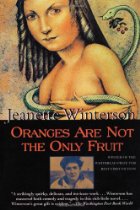 Summary:
Jeanette has the dubious distinction of being raised by one of the most vocal women in the fire-brand style Evangelical church in a small British town. Although she at first is different among her school chums for her beliefs, soon she becomes marked as different in her church for her homosexuality. Her journey from differently religious to outcast young adult is chronicled here.
Review:
I picked this up when I heard that it’s a lesbian classic that simultaneously addresses being raised fundy. Having been raised fundy myself (and left), I tend to find these leaving the faith stories highly relatable, and I knew the added queer element would just make it all the more interesting of a read for me.
One interesting thing to note about this book is that no one can quite agree if it’s a novel or a memoir. Winterson herself says that while this was inspired by her own childhood, it is the lite version. Hers was much worse. Given this statement, I choose to respect the author and view this as a novel, but potential readers may want to be aware of this element of the book.
Jeanette (the character) is immediately immensely likeable. Whereas her mother is overbearing and negative, Jeanette is highly intelligent and witty. Her observations on the Bible and religion in the early parts of the book before she realizes she is gay are hilarious, particularly to anyone raised in a fundamentalist faith.
I didn’t know quite what fornicating was, but I had read about it in Deuteronomy, and I knew it was a sin. But why was it so noisy? Most sins you did quietly so as not to get caught. (location 533)
As the book moves from Jeanette’s early life to her adolescence the writing style changes a bit. Winterson inserts various fantastical fancies of Jeanette’s that are clearly her way of trying to discover who she is and explore her options. Some readers might be thrown by these, but I found them delightful. It’s a coping mechanism that I think many people use but few authors put down on paper.
Through these periodic fantastical tales combined with the more traditional narrative, we slowly see Jeanette fall in love with another girl at her church. We then see the fall-out. The two girls torn apart. The attempts at exorcisms. Jeanette is left bereft and confused because, unlike myself, she still wanted her faith. She wanted to believe in God the way she was raised to and to be allowed to love women. She can’t figure out why she can’t have both and thus is left wandering lost and confused.
The novel never makes it clear if Jeanette comes to terms with her lesbianism by letting go of her religion or by finding a more accepting one. It kind of ends on an uncertain, agnostic if you will, note. But that’s really irrelevant. What matters is how beautifully the novel shows the pain that adolescents are needlessly put through when those around them won’t love them for who they are.
At last she put on her gloves and beret and very lightly kissed me goodbye. I felt nothing. But when she’d gone, I pulled up my knees under my chin, and begged the Lord to set me free. (location 1180)
It’s not a book with a clear ending or easy answers, but neither is life really, is it? What it does possess though is a great ability to show a reader the life of a child raised Evangelical who later just cannot fit the mold demanded of her. And that’s a powerful story that needs to be told over and over again until people get it that we can’t do that to children.
Recommended to those with an interest in unique story-telling techniques and coming out stories.
4 out of 5 stars
Source: Amazon

Book Review: Finding Bluefield by Elan Barnehama
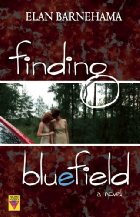 Summary:
It’s the 1960s, and Barbara thinks she has enough on her hands handling medical residency as a woman. She doesn’t need the complications of dating women on top of that…or the risk to her profession of rumors that she’s a lesbian. But when she meets local cook, Nicky, all these cautions go out the window. Soon they’re a couple, and Nicky is determined to have a baby for them to raise together.
Review:
I read this book because my previous read from this indie publisher (Bold Strokes Books) was such a unique, well-written piece of LGBTQIA+ lit, and I was excited to get more. Unfortunately, the quality of this book does not come close to that of Lemon Reef
The plot is moderately common in lesbian fiction. Girl meets girl. Couple wants a baby. Girl gets pregnant. Can they raise the baby and keep the relationship going. With the added backdrop of prejudice and changing rights from the 1960s through the 1980s, it had the potential to be more unique and add an interesting twist, particularly since Nicky is supposed to be involved in the Civil Rights movement. Unfortunately, none of this really pans out. There are tantalizing teases of something more or something unique such as when Nicky gives a ride to a black man trying to escape from mob “justice” in the small town or when Barbara cheats on Nicky in New York City, but none of these ideas are brought to fruition. In fact, the whole book feels more like a moderately fleshed-out plot outline for a future book. Like, here are the key points, and I’ll flesh them out later. Only this is the finished book. There will be no more fleshing out of the plot. It’s frustrating to read because just when you think something is about to happen, the idea gets dropped and you skip ahead a few years.
Similarly, the characters are never fully realized. They are extremely two-dimensional, even the two main characters. I actually found myself mixing Barbara and Nicky up repeatedly, which is intensely problematic. They are two separate people, and their relationship is the focus of the novel, yet even after the entire book they are mostly unclear to me, except that Nicky has green eyes. They simply don’t feel like real people to the reader at all, which is a problem in general but even more so when the book is trying to both be character-driven and address rights issues.
A book needs at least a compelling plot or engaging characters to be readable and both to be great. This book has neither. I can see potential in the plot and sentence structures for good writing, but the author needs to work on both expanding into greater plot detail as well as on improving characterization.
2 out of 5 stars
Source: Netgalley

Book Review: Lemon Reef by Robin Silverman
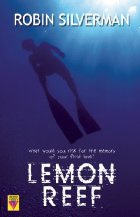 Summary:
Jenna is a high-powered, newly appointed commissioner in San Francisco where she lives with her wife and their dog. Life is good, and Jenna tries not to think too much about her rough childhood and teen years growing up in Florida. But a phone call comes in. Her first love, Del, has died diving at lemon reef at the young age of 30. The mutual friend invites Jenna to the funeral, but when she arrives in Florida, she discovers that there’s more to it than that. Del’s mother, Pascale, wants her help in getting custody of Del’s daughter, Khila, instead of her father, Talon, who Pascale insists must have murdered Del.
Review:
This book was a bit of an emotional roller-coaster to read, which of course is a sign of a good book.
The plot structure is incredibly complex and engaging without ever being confusing. There is the mystery of Del’s death, but also (for the reader) the mystery of why and how Del and Jenna’s romance ended tragically, as it is evident it did. In addition there is the powerful emotions of a first love and first romance for a pair of teens who must grow up too fast thanks to the rough circumstances they find themselves in. Silverman handles the past reminisces intermingled with the current mystery and discoveries quite eloquently. I found myself admiring her talent in plot structuring throughout.
There are no easy answers in this book, and no one is easily demonized, including Talon. Every single character has flaws and good qualities. Del stands up for her siblings but won’t stand up for her love of Jenna. Jenna loves people but can sometimes get too caught up in her own world and her own needs. Pascale was an alcoholic when Del was in highschool but successfully quits in order to be able to spend time with her granddaughter. Del’s sister Nicole breaks a lot of laws (including breaking and entering and prostitution), but she is fiercely loyal and stands up for those she loves. The complexity of the characters and the situation is part of what makes it such an emotional read. There’s no one to easily blame for the problems these women find themselves in. I think this complexity points to Silverman’s experience both as a counselor and a lawyer. She clearly understands human psychology and how problems are not always black and white but can be very gray.
The writing is lovely and fills in the framing of the plot and the characters. There are lines that just totally grab you.
Because minds do blow and hearts do break. Those are not just sayings. And wolves and roaches are not the only creatures that chew off their legs to get out of traps—human beings do that, too. (location 3058)
I also really enjoyed that while Jenna’s coming out story (told in flash-backs and reminiscing) is rather typical, Del’s is much more complex. She is bi but is uncomfortable with the fact that she likes women too. She doesn’t want people to know, doesn’t say a thing about it to her sisters, denies it even. But we find out later that there were other ways in which it was clear she did identify as bi and part of the community. I won’t say how, because I don’t want to spoil the surprise. But I found this complexity interesting. It shows how for Jenna she had to push and come out because there was no other option. Del could sometimes pass but not always and clearly it was a struggle for her throughout her whole life. This shows an understanding of what it is to be bi that I honestly was not expecting, as it is hard to find that in novels.
There were, unfortunately, a couple of things that didn’t quite live up to the rest of the book. There were a few passages that weren’t as well-written or well-edited that detracted from the overall beauty of the book. For instance, there is a scene in which a character points a flashlight at a floor but the narrator calls it the ground. Things like that that are periodically clunky. I’m sure this will improve with time, though, as this is Silverman’s first work of fiction.
I also was disappointed that we didn’t get to see very much at all in regards to how this whole drama of the first love’s mysterious death impacted Jenna’s relationship with her wife. I was hoping this would be at least touched upon in the last chapter, but instead we just see Madison show up with Jenna for the funeral. Since I had come to care for Jenna, I wanted to know how such a dramatic, emotional event would affect her new life and marriage with Madison. It seems obvious to me that such an incident would at least lead to a few discussions and maybe difficult moments between a married couple. I wanted to see that and not seeing it made Madison and Jenna’s marriage to her feel more like a prop than an actual element of Jenna’s life.
Overall, though, this is a unique work of GLBTQ lit. Its themes of reconciling with your past, coming out, being queer, and first love are all beautifully told within a plot that keeps the reader invested and interested. I highly recommend it to GLBTQ readers, but also to anyone with an interest in stories addressing the complexity of human relationships and the long-reaching impact of first loves.
4 out of 5 stars
Source: Netgalley
 Support my work with a tip or browse my shop for curated book club guides, how to guides, cross-stitch patterns, and more!


This work by Amanda Nevius is licensed under a Creative Commons Attribution-Noncommercial-No Derivative Works 3.0 United States License.
 Opinions of a Wolf