
Archive
Book Review: The Exorcist by William Peter Blatty

The book that came before the classic horror movie featuring a little girl who may or may not be possessed by a demon and the priest struggling with his faith called upon to help her.
Summary:
Actress and divorced mother Chris MacNeil starts to experience ‘difficulties’ with her usually sweet-natured eleven-year-old daughter Regan. The child becomes afflicted by spasms, convulsions and unsettling amnesiac episodes; these abruptly worsen into violent fits of appalling foul-mouthed curses, accompanied by physical mutation. Medical science is baffled by Regan’s plight and, in her increasing despair, Chris turns to troubled priest and psychiatrist Damien Karras, who immediately recognises something profoundly malevolent in Regan’s distorted fetures and speech. On Karras’s recommendation, the Church summons Father Merrin, a specialist in the exorcism of demons . . .
Review:
I’d seen the classic horror movie and, while I thought certain shots were gorgeous and the soundtrack was beautiful, I felt rather ho-hum about the story overall. Imagine my surprise when I found the book version simultaneously thrilling and intellectually engaging. A difference even more interesting since Blatty wrote both. (It’s more common for a different author to write the screenplay adaptation of a book.)
From the beginning of the book, there are three story threads. First there’s Chris, the divorced, wealthy, actress mother who is an atheist and her daughter who starts acting funny. Second, there’s Father Karras, a psychiatrist and a priest who is having a crisis of faith. Third, there are recent desecrations in a local church that a detective is investigating. These three threads merge by the end of the book. But their separate developments kept me simultaneously intellectually engaged and thrilled.
While there absolutely is the thrilling aspect of what is wrong with Regan and can she be healed/saved from it, I was drawn in by the exploration of faith. How it presents in different people, even those we assume must have a very strong faith or none at all. What it means to have faith. How having faith impacts people. How evil forces can use someone’s doubts and misunderstandings against them. (This part of the book reminded me of a more subtle version of The Screwtape Letters.)
I really felt both for Father Karras and for Regan. For the former, I understood how adult life had slowly worn down his youthful faith. How it was easier for him to believe in things when he was young than it was now in middle-age. And I also felt for Regan, whose mother left her completely unequipped to protect herself against forces of darkness. The fact that her mother forbid the nanny to mention God to her but also simultaneously allowed her to play with a Ouija board. If she’s so atheist as to not want a child to even know the concept of God, shouldn’t she also ban all religious items, including ones used for witchcraft, from her home? I don’t view this as a writing flaw but rather an accurate assessment of how often atheism attacks the concept of God but not of other supernatural forces. Indeed, I think demonstrating this was probably a part of the point.
The book does a good job of leaving it up to the reader to decide if Regan was actually possessed by a demon or having a psychosomatic experience in response to the trauma from her parents’ divorce. I’m sure you can tell from my review that I fall on the she was possessed side. You can see from the book how much more traumatic the 1970s viewed divorce for children than we do now. The 1970s brought no-fault divorce, and so the divorce rate went up, but there was still social stigma. So even though for the modern reader a simple, relatively amicable divorce with a bit of an absent father is nowhere near enough trauma for a child to have a psychotic break, for the audience in the 1970s with the stigma still fresh, it was. And the scientific side of why they think this might be is well-explained. It’s just to me it’s very clear this is a demon.
My experience of the book being about faith matches what Blatty said in interviews in his life. It’s interesting how that has been overshadowed by the cultural experience of the movie as a horror classic. Perhaps the book can be both. Indeed, theological horror is a genre.
The reason it’s not a full five stars for me is I felt like the last third of the book wasn’t as strong as the first two-thirds.
Let me leave you with my favorite quote from the book.
I think the demon’s target is not the possessed; it is us … the observers … every person in this house. And I think—I think the point is to make us despair; to reject our own humanity, Damien: to see ourselves as ultimately bestial, vile and putrescent; without dignity; ugly; unworthy. And there lies the heart of it, perhaps: in unworthiness. For I think belief in God is not a matter of reason at all; I think it finally is a matter of love: of accepting the possibility that God could ever love us.
page 345
Overall, this is a complex book of theological horror. It keeps the plot moving forward with multiple threads and compelling scenes while also taking the time to contemplate big questions about faith. Well worth the read, even if you have seen the movie, as it is a different experience altogether.
If you found this review helpful, please consider tipping me on ko-fi, checking out my digital items available in my ko-fi shop, buying one of my publications, using one of my referral/coupon codes, or signing up for my free microfiction monthly newsletter. Thank you for your support!
4 out of 5 stars
Length: 403 pages – average but on the longer side
Source: Library
Buy It (Amazon or Bookshop.org)
Get the Book Club Discussion Guide
A beautifully graphic designed 2 page PDF that contains: 1 icebreaker, 9 discussion questions arranged from least to most challenging, 1 wrap-up question, and 3 read-a-like book suggestions
View a list of all my Book Club Guides.
Book Review: The Sentence by Louise Erdrich
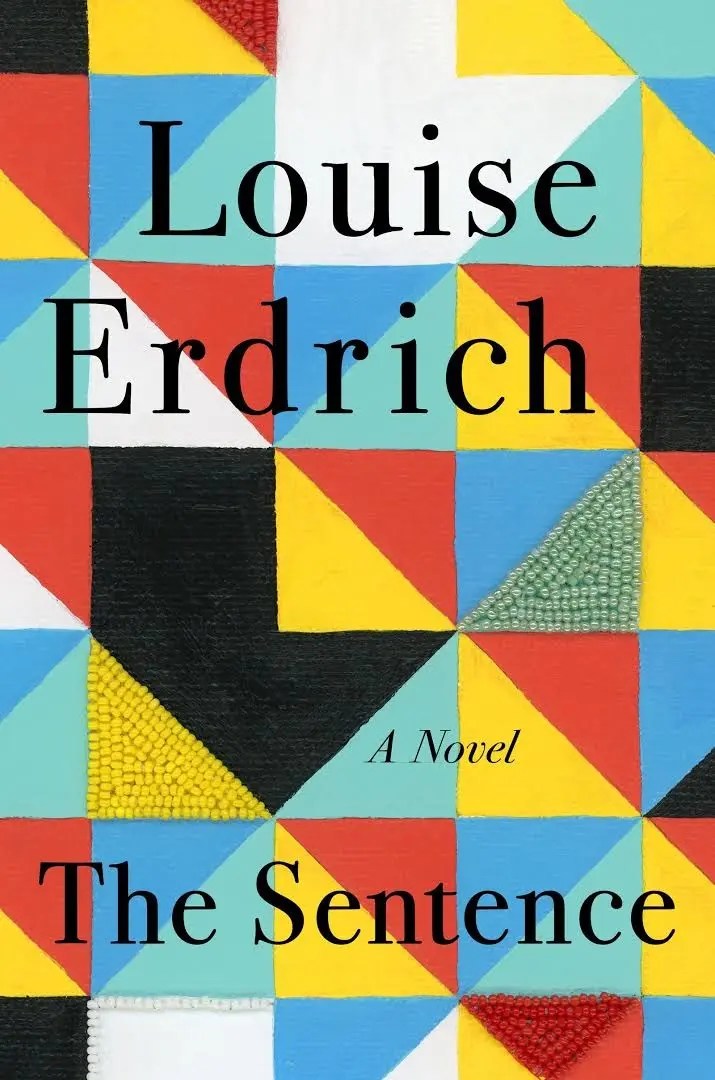
A previously incarcerated Indigenous woman loves her job at an independent bookstore focused on Indigenous literature right up until the store’s most annoying customer dies and begins haunting it.
Summary:
A small independent bookstore in Minneapolis is haunted from November 2019 to November 2020 by the store’s most annoying customer. Flora dies on All Souls’ Day, but she simply won’t leave the store. Tookie, who has landed a job selling books after years of incarceration that she survived by reading with murderous attention, must solve the mystery of this haunting while at the same time trying to understand all that occurs in Minneapolis during a year of grief, astonishment, isolation, and furious reckoning.
Review:
It’s a good thing I didn’t see that this book is magical realism or I wouldn’t have picked it up. You see, I had a serious misunderstanding of what magical realism is and thought I didn’t like it. In fact, I like it very much. I only wish I had first been introduced to it by the excellent explanation from Master Class originally. I’m excited that this book has helped me see past the magical realism label.
The thing that I love structurally about this book is how the title has so many different meanings. There’s the sentence that Tookie serves for her crime. There’s the sentence found within the book that Flora is reading when she dies. And there’s many other sentences throughout the book. I love when one title has many meanings.
The book starts with Tookie thinking back briefly on her incarceration and what landed her there. Part of what made the beginning so readable was how Tookie told this story. It was like speaking with a friend about a piece of their past. Raw and real but quick and to the point. It got me invested in the book right away. Then we jump to Tookie’s present, working in the bookstore, and the haunting, and this is utterly engaging right away as well. Tookie is flawed but so relatable. I think most readers will find her to be this way because she’s such a huge reader herself.
I also found her relatable because she’s in long-term recovery. I like how she sometimes thinks about how she was but it’s not like any single bad day gives her an urge she has to fight. A lot of times in literature and movies only early sobriety is shown, and the fact is, the experience in long-term recovery is different. I was so glad to see that in Tookie, and to see her breaking the multi-generational disease. But I also appreciated the very realistic depiction of her being concerned about talking about the haunting with her husband, Pollux, for fear he would think she had relapsed. I also should mention that both Tookie and her niece are bisexual. Their sexual fluidity is never judged or questioned. It’s just a part of who they are, which I really appreciated.
The book centers around a difficult question that it doesn’t provide answers for. Flora is a “wannabe Indian.” She’s a white woman who claims Indigenous heritage based on one photo she says is of a great-grandparent. The Indigenous community is dubious but doesn’t want to tell her she can’t belong. She spends much of her life working for the betterment of Indigenous people, including even taking in an unhoused teenager and caring for her so much that when she’s grown she refers to her as mother. So everyone has complex feelings about her. There are also some scenes that show white people behaving in offensive ways and smoothly depict how hard it is for Indigenous people to deal with these aggressions on a regular basis. One that really stuck in my mind was the white woman who shows up at the Indigenous bookstore and talks about her grandmother reassembling Indigenous bones she found on her land and winning a blue ribbon for it. She doesn’t understand why this is offensive to the Indigenous people she’s speaking with. To me the examples like this throughout the book demonstrate two types of white people who are hurtful to Indigenous people. The book is never preachy with these scenes. They come across as very realistic depictions of, unfortunately, regular interactions between Indigenous people and white people. If you yourself aren’t sure why these two types of interactions are hurtful, then I think this book would show you.
I wasn’t sure how I would feel reading a fictional book set during the first year of the pandemic. Overall, even though Tookie’s experiences and mine were different from each other (she was much older than me and had an essential worker, public facing job), I still found it realistic and relatable. The book never dwelled too much on any individual aspect of the pandemic but had scenes that were necessary reminders of how things were in the early days, like when Tookie goes to the grocery store to stock up just in case and ends up buying the best she can from what’s left, such as a tube of cookie dough. Similarly, Minneapolis was where George Floyd was killed and followed by the protests that spread throughout the country in 2020, and so this had to be a part of the book. At the start of the book it’s established that Tookie’s husband, Pollux, is who actually arrested her. By the time she was out of prison, he had left the tribal police force. But her household still must deal with the complex situation of having a previously incarcerated person and an ex-cop in the same household during this tumultuous time. There’s also the nice addition of Pollux’s niece, Hetta, living with them and, as a young person, being more involved in the protests. This thoughtful characterization allowed for multiple perspectives on the protests. For example, while there is support, there is also sadness and concern about the small businesses being impacted.
In spite of all that comes in the middle, the last part of the book deals mainly with Tookie’s relationship with Pollux and Tookie dealing with Flora’s ghost. This provides closure even while the reader knows the difficulties didn’t end in November 2020. In many ways I found this to be a story about relationships and reconciliation.
Overall, this is a strong piece of contemporary magical realism. If you’re ready to read a book featuring the pandemic while not being about the pandemic itself, this is a great place to begin.
If you found this review helpful, please consider tipping me on ko-fi, checking out my digital items available in my ko-fi shop, buying one of my publications, or using one of my referral/coupon codes. Thank you for your support!
4 out of 5 stars
Length: 387 pages – average but on the longer side
Source: Library
Buy It (Amazon or Bookshop.org)
Get the Reading Group / Book Club Discussion Guide
A beautifully graphic designed 2 page PDF that contains: 1 icebreaker, 9 discussion questions arranged from least to most challenging, 1 wrap-up question, and 3 read-a-like book suggestions
View a list of all my Discussion Guides.
 Support my work with a tip or browse my shop for curated book club guides, how to guides, cross-stitch patterns, and more!


This work by Amanda Nevius is licensed under a Creative Commons Attribution-Noncommercial-No Derivative Works 3.0 United States License.
 Opinions of a Wolf