
Archive
Book Review: Emotional Geology by Linda Gillard
 Summary:
Rose is a textile artist with bipolar disorder who for years found her medication dulled her ability to work. After a stunning betrayal that landed her in a mental hospital, she has moved to a quiet, extraordinarily rural island in Scotland in an attempt to control her illness with as little medication as possible so she may still create her art. Her life isn’t quite as quiet as she imagined it would be, though, with a warm neighbor, Shona, who introduces her to her brother, a teacher and poet.
Review:
A rural island setting combined with art, romance, and mental illness–I knew this book and I would be fast friends before I even started reading it. What I discovered was a book that addresses multiple universal issues–grief, betrayal, loss, family ties–in a glorious setting that left me dying to visit Scotland, if only to discover what peat smoke smells like.
The style of this book is unique. Gillard easily transitions between perspectives, points in the time-line of Rose’s life, and even poetry versus prose. I was astounded to discover that I enjoyed the poetry portions creeping up in the book. They tend to happen at points of high emotion and exquisitely express the high highs and low lows someone with bipolar disorder goes through. The changing of perspectives and time-lines could sometimes feel a bit jarring; that could have been smoother done, but I appreciate the style and vibe Gillard is going for. It almost mimics the jarring highs and lows of bipolar disorder.
More importantly, though, the book exquisitely, gently shows that people with mental illness are just people like everyone else. They may feel things slightly more strongly or need to work harder to stay balanced, but the mentally healthy have emotions too. The mentally healthy can be thrown just as badly by life’s experiences. If I could sum up the book’s point, it would be that we all have scars.
So you see, Rose, if you would just step outside your own fucking head for a few moments, you’d see you’re not the only one with scars. In any case the worst ones, the most disfiguring are never visible to the naked eye.” He zips up his fly. “I can probably live with yours. Can you live with mine?” (location 3816)
This is an emotional, challenging, touching book to read. I recommend it to fans of contemporary fiction with a heart.
4 out of 5 stars
Source: Kindle copy from author in exchange for my honest review

Counts For:
Book Review: The Burning Sky by Joseph Robert Lewis (Series, #1)
 Summary:
In an alternate vision of history, the Ice Age has lingered in Europe, slowing down Europeans’ rate of civilization and allowing Ifrica (Africa) to take the lead. Add to this a disease in the New World that strikes down the invaders instead of vice versa, and suddenly global politics are entirely different. In this world, steam power has risen as the power of choice, and women are more likely to be the breadwinners. Taziri is an airship co-pilot whose airfield is attacked in an act of terrorism. She suddenly finds herself flying investigating marshals and a foreign doctor summoned by the queen herself all over the country. Soon the societal unrest allowing for a plot against the queen becomes abundantly clear.
Review:
Can I just say, finally someone wrote a steampunk book I actually like, and it’s a fellow indie kindle author to boot! All of the possibilities innate in steampunk that no other book I’ve read has taken advantage of are used to their fullest possibilities by Lewis.
I love that Lewis used uncontrollable environmental factors to change the political dynamics of the world. Anybody who has studied History for any length of time is aware how much of conquering and advancement is based on dumb luck. (The guns, germs, and steel theory). Lewis eloquently demonstrates how culture is created both by the people and their surroundings and opportunities. For instance, whereas in reality the Native Americans had to rely on dogs for assistance and transportation against invaders on horseback, Lewis has given the Incans giant cats and eagles that they tame to fight invaders. Similarly, in Europe the Europeans are constantly fighting a dangerous, cold environment and have dealt with this harsh landscape by becoming highly superstitious, religious people. This alternate setting allows for Lewis to play with questions of colonization, race, and technology versus tradition in thought-provoking ways.
Women are in positions of power in this world, but instead of making them either perfect or horrible as is often the short-coming of imagined matriarchies, there are good and bad women. Some of the women in power are brilliant and kind, while others are cruel. This is as it should be because women are people just like men. We’re not innately better or worse. Of course, I couldn’t help but enjoy a story where a soldier is mentioned then a character addresses her as ma’am, without anyone feeling the need to point out that this is a woman soldier. Her gender is just assumed. That was fun.
Although Taziri does seem to be the main focus of this book, the story is told by switching around among a few main characters who find themselves swept together in the finale for the ultimate battle to save or assassinate the queen. This strategy reminded me a bit of Michael Crichton’s Next where seemingly unrelated characters suddenly find how their destinies are all connected together. Lewis does a good job with this, although personally I found the beginning a bit slow-moving. It all comes together well in the end, though, with everything resulting in a surprising, yet logical, ending.
What kept me from completely loving the book is that I feel it needs to be slightly more tightly edited and paced. Some sections were longer than they needed to be, which I can certainly understand, because Lewis has made a fun world to play around in, but as a reader reading what amounts to a thriller, I wanted things to move faster.
That said, I thoroughly enjoyed exploring the steampunk world Lewis has created after a couple of years of loving the fashions and possibilities but finding no steampunk books I liked. If someone were to ask me where to start with steampunk, I would point them here since it demonstrates the possibilities for exploring race, colonization, and gender, showing that steampunk is more than just an extended Victorian era.
Overall this is a wonderful book, far better than the traditionally published steampunk I’ve read. I highly recommend it to fans of alternate history, political intrigue, and steampunk alike. Plus it’s only 99 cents on the kindle. You can’t beat prices like that.
4 out of 5 stars
Source: Won on LibraryThing from the author in exchange for my honest review

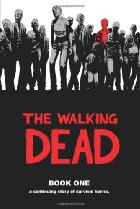
Book Review: The Walking Dead, Book 1 by Robert Kirkman (Series, #1) (Graphic Novel)
 Summary:
When cop Rick wakes up from a coma brought on by a gun shot wound, he discovers a post-apocalyptic mess and zombies everywhere. He sets off for Atlanta in search of his wife, Lori, and son, Carl, and soon teams up with a rag-tag group of survivors camped just outside of Atlanta.
Review:
I just want to point out that this review is purely focused on the graphic novel, not the tv series. I haven’t even seen more than 10 minutes of the tv show, so remember this is about the books not the show. Thanks! Moving along….
I almost gave up on this within the first few pages, because COME ON. Can we PLEASE get over the whole oh I had a coma and then woke up to a zombie apocalypse trope, please? First, it is so highly statistically unlikely that it was laughable the first few times it was used in my beloved dystopian novels, but at this point it just looks lazy. Come up with some other way to start the apocalypse, ok? I don’t care if your main character is out of touch with reality for a few days because he’s on a drug-fueled sex streak. At least it would be different! Also, a cop, really? You want me to root for a cop? And everyone trusts him because he’s a cop? A cop is the last person I would put in charge if I was a member of a rag-tag bunch of survivors; I’m just saying.
Once we move on beyond the initial set-up though to the group of survivors caravaning their way across America, the story vastly improves. The people are real. They’re scared. They’re angry. The snap easily. They hook up with whoever is convenient (and not necessarily young and hot). They teach the kids to use guns. It’s everything we know and love about post-apocalypse stories.
The artwork is good. Scenes are easy to interpret; characters are easy to tell apart. The zombies are deliciously grotesque, although I did find myself giggling at them saying “guk.” Guk? Really? Ok….
The best part, though, is the people that in your everyday life you are just like, come on, god, bolt of lighting, right here? They’re the ones who get eaten by zombies! It is excellent. So that really annoying chick in camp? Totally gets her head bit by a zombie. It’s cathartic and awesome.
The cast is diverse, and no, the black guy is not the first to be eaten (or the red shirt guy for that matter). It wouldn’t kill Kirkman to be a little less heteronormative, but he’s still got time and more survivors to add.
Overall, this is a good first entry in a zombie apocalypse series. Kirkman needs to be more careful to stay away from expected tropes in the genre and bring more of the creativity it is apparent he is capable of. I recommend it to fans of zombies, obviously. ;-)
4 out of 5 stars
Source: Public Library

If you found this review helpful, please consider tipping me on ko-fi, checking out my digital items available in my ko-fi shop, buying one of my publications, or using one of my referral/coupon codes. Thank you for your support!
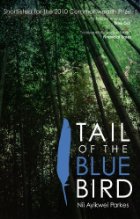
Book Review: Tail of the Blue Bird by Nii Ayikwei Parkes (Ghanaian Lit Week)
 Summary:
When the girlfriend of the minister for roads and highways spots a disgusting red lump of flesh in a hut in the village Sonokrom, what normally would have been ignored and left to the villagers suddenly becomes a matter of national importance. Inspector Donkor wants a promotion, and he believes that one of the only forensics specialists in Ghana–Kayo–can get it for him.
What Kayo finds in the village is a people still steeped in the culture of the countryside, in touch with Onyame and the ancestors, drinkers of palm wine mixed with aphrodisiacs. Although he arrives with the mind of a scientist, soon his perceptions begin to change.
Review:
Kinna is one of the international bloggers I discovered through Amy, and she is awesome! She lives and works in Ghana and is interested in spreading literacy and love of reading in her own country, as well as interest in African lit everywhere. So when she announced that she was hosting a week in hour of Ghanaian lit, I knew I wanted to participate. Using the wonderful resource of tags in LibraryThing, I hunted down a book that LibraryThing was “mostly sure” I would like and ordered it from my library. Yet again, the book blogging world has brought me to a book I never would have read otherwise, but am glad I did.
This book reminds me a lot of The Summoner, only with the distinct bonus that it is a crime mystery set in Africa written by an African instead of a westerner who has visited. This means our detective hero is distinctly Ghanaian. Like all detectives, he drinks, but his drink of choice is palm wine enhanced by the village medicine man. Just typing out that sentence gave me the shivers of delight I got when I was reading the scenes of drinking and eating in the hut, which is the village pub managed by a woman and her adult daughter. It felt simultaneously familiar and new, which is one of the thrills of reading literature not written by one of your own countrymen.
Unlike western detective stories though, Parkes does not seem to feel a need to give a scientific explanation for every mysterious event that occurs. In fact, it is actually easier to believe the magical explanation than to wonder about the scientific explanation. For that reason I would definitely categorize this as “magical realism.” It is almost as if Sonokrom is a world unto itself, existing in some sort of parallel universe where magic is just an ordinary part of life.
The characters are all richly drawn and well-rounded. I had no trouble telling them apart in my mind. The method of switching perspectives from Kayo to the old man in the village works well. It allows the reader to see both the scientific and traditional perspectives and make up her own mind.
Some people may be bothered by the ambiguous/open-ended ending, but personally I feel that this is what the story needs. It leaves the reader to ponder upon the values of both tradition and modernity. Perhaps that is the point of the whole story.
Now, the book does throw in some Twi words here and there, but those are easily decipherable by context. The more difficult aspect as a non-African reader is the presence of Pidgin. Since whole sentences are written in Pidgin they were much more challenging for me. I must admit this small book took me quite a while to finish, compared to my usual reading rate. The Pidgin is not impossible, though, particularly if you have read widely among the various American dialects. An English dialect is an English dialect, after all.
Overall, I recommend this to those who enjoy both mystery and magical realism and don’t mind exploring a new dialect.
4 out of 5 stars
Length: 200 pages – average but on the shorter side
Source: Public Library
Buy It (Amazon or Bookshop.org)
If you found this review helpful, please consider tipping me on ko-fi, checking out my digital items available in my ko-fi shop, buying one of my publications, or using one of my referral/coupon codes. Thank you for your support!
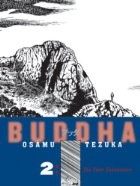
Book Review: Buddha Volume Two The Four Encounters by Osamu Tezuka (Series, #2) (Graphic Novel)
 Summary:
The second entry in the novelization of the Buddha’s life takes us through Siddhartha’s youth spent as a prince. He meets a mysterious Brahmin who tells him he is destined to help the whole world, not rule a single kingdom. Siddhartha is weak, frequently sleeps, and has visions. He is discontent as a prince yet reluctant to abandon his people. On an adventure outside the castle walls he meets a grown-up Tatta and falls for a slave woman, Migaila. Conflict between what he believes and his duties as a prince seem central to the plot, yet in fact it is Siddhartha’s reluctance to follow his calling and leave the castle to be a monk that is at the core of the conflict.
Review:
I was pleased to see this entry in the series jump right into Siddhartha’s life instead of those on the periphery, yet Tezuka also brings in the major characters from the first book as minor characters in this one. It works well, definitely better than the first book. However, I am left wondering if the love between Siddhartha and a slave woman was based at all on fact or hearsay or purely came out of Tezuka’s mind. It would definitely give a new perspective on Siddhartha to know he once had an ill-fated love affair.
Although it’s important to know where the Buddha came from, it is difficult and not particularly enjoyable to read about the time in his life when he was a spoiled brat. Siddhartha does not treat his wife or his father well. Although he has natural talents with meditation and visions, he surprisingly lacks compassion for others. One of the things I like, of course, about the Buddha is that he did start out this way. He’s not perfect; he just learned and worked toward Nirvana. So it’s important to see this part of his life, even if it is uncomfortable to read.
I again felt distracted by the characters Tezuka made up though. I wish he had stuck to a straight-forward graphic novelization of Siddhartha or the legends of the Buddha at least. The weakest points of the book are the parts including characters Tezuka made up purely on his own.
The art is again enjoyable but not amazing. The pictures show the story but do not suck you in. They give the feeling of being there to do a job, not necessarily to provide a memorable visual experience to the reader.
Overall, it’s an interesting new way to explore the life of the Buddha, but I would not recommend it to someone completely new to Siddhartha. It is an improvement over the first entry, and hopefully they will continue to improve, but an idea that could have been great is simply average. That’s disappointing.
3.5 out of 5 stars
Source: Public Library

Previous Books in Series:
Buddha, Volume 1: Kapilavastu
Book Review: Hetalia: Axis Powers Volume 2 by Hidekaz Himaruya (Series, #2) (Manga)
 Summary:
The manga featuring the countries from WWII as characters is back this time focusing more on the future of the nations after WWII instead of the history before WWII. Russia’s dilemmas with his sisters the Ukraine and Belarus are explored. Canada’s persistent ability to somehow be invisible to most of the rest of the G8 nations (and also to be mistaken for America). The various vignettes are punctuated with Japan-kun and America-kun visiting each other’s homes and attempting to reach a cultural understanding.
Review:
Himaruya’s tongue in cheek representation of global politics and national cultures is just as strong here as in the first entry into the series. I appreciate that he addressed before and after WWII first. It puts everything into an interesting historic perspective.
The art is still gorgeous. The countries who are “relatives” of each other are similar looking but still decipherable from each other (although Canada probably wishes he looked a bit less like America). There is a lot to feast your eyes upon on every page.
I again found myself laughing uproariously at the wit within the pages. Every country is teased by the author, including his own. He points out shortcomings without judging them too harshly. It is what it is, and the more I read nations as characters, the easier it is to see the world as one big loopy extended family.
I particularly appreciate how Himaruya explains the former Soviet Union nations’ problems so clearly. It’s something that I must admit as an American we didn’t ever really address in school, so this was all new to me and yet I came away knowing the facts from a manga.
That’s what makes this series awesome. It’s factual without being judgmental. It sees the humor in local customs and quirks. And somehow it teaches you something in the meantime. Highly recommended to all. Just remember to start reading it at the back. ;-)
5 out of 5 stars
Source: Public Library

Previous Books in Series:
Hetalia: Axis Powers, Vol. 1
Book Review: The Mummy by Anne Rice (series #1)
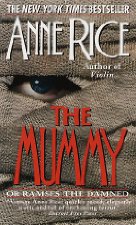 Summary:
Julie Stratford’s father is a retired shipping mogul who now spends his time as an archaeologist in Egypt. He uncovers a tomb that claims to be that of Ramses the Damned, even though his tomb was already found. Everything in the tomb is written in hieroglyphs, Latin, and Greek, and the mummy is accompanied by scrolls claiming that Ramses is immortal, was a lover of Cleopatra, and can and will rise again.
Review:
I’m a fan of Anne Rice. Her Vampire Chronicles are a lovely mix of social commentary, lyrical writing, and all the best tropes of genre fiction, so I was excited to stumble upon a cheap copy of The Mummy in the second-hand section of the bookstore. I wanted to love it. I really did. But whereas the Vampire Chronicles contain valid social commentary, this is so stereotypical of mainstream romance a la The Titanic that I was sorely disappointed.
Again, the language is lyrical and gorgeous. Rice without a doubt is incredibly talented at putting together sentences that read like a rich tapestry of old. There is no rushing to get the story out as is so often found in more modern writing. It’s fun to indulge the senses and oneself in the scene.
The plot, though, ohhhh the plot. It’s so mainstream romance it hurts. And yes, I know I read and enjoy (and write) paranormal romance, but the difference is that PNR is oftentimes tongue in cheek. It knows it’s ridiculous and over the top and doesn’t take itself too seriously. It’s meant to be fun and ridiculous. Rice is being serious here, however, and that’s why the plot bugs me. Let’s look at it for a second, shall we?
Girl is engaged to the perfect guy but she mysteriously does not think she loves him. Girl meets immortal man who is so hot he would be voted hottest man alive every year forever. Girl immediately “falls in love” with immortal guy. Girl ditches perfect guy for immortal guy. Girl and immortal guy have lots of the hot hot sex. Immortal guy causes a series of unfortunate events in pursuit of his ex-lover. Girl insists she still loves guy but cannot forgive him. Girl decides life is pointless without immortal guy. Girl attempts to kill herself. Immortal guy saves her. Girl forgives immortal guy. Girl agrees to become immortal too. Yay happily ever after.
Like….just……there are SO MANY parts of that that piss me the fuck off. So. Many. The main female character (Julie) is a shallow douchebag in spite of claiming to be a modern, progressive woman. She does not “fall in love” with Ramses. She falls in lust with him. He gives her tinglies in all the right places. He ditches her to pursue his ex-lover (Cleopatra). She, at first, rightfully tells him she can’t forgive him for that. But then she TRIES TO OFF HERSELF. OVER A GUY. And the only reason she doesn’t succeed is douchebag saves her. I just….wow. Not a plot I can respect. Not a plot that gives us anything different from the patriarchal rigamarole so often forced upon us. Anne Rice. I am disappointed.
Then there’s the odd eurocentrism at work in the narration. Even though Julie’s father loves Egypt and Ramses is, um, Egyptian, for some reason everything modern and European is what is impressive to everyone. I suppose I could maybe (maybe) forgive that, but then there’s the fact that the elixir that makes people immortal also for some mysterious reason turns their brown eyes blue. So nobody immortal has brown eyes. I don’t think I need to unpack why that’s offensive for you all. I trust you can figure that out for yourselves. Unlike Rice.
So, essentially, The Mummy is a beautifully written book that is destroyed by a kind of offensive, all-too-common plot and Eurocentrism. Even beautiful writing can’t overcome that.
3 out of 5 stars
Source: Harvard Books

Book Review: Lean, Long & Strong The 6-week Strength-training, Fat-burning Program for Women by Wini Linguvic
 Summary:
In this book Linguvic seeks to lay out multiple strength training routines for women that can be done within your own home with minimal equipment. The routines are divided into core, lower body, and upper body. Each of these have beginner, intermediate, and advanced options. The routines are designed to be combined in various ways to either fat-blast or target core, lower body, or upper body. The book includes a nutrition guide.
Review:
This is one of those times where I really wish I hadn’t trusted the reviews on Amazon and instead borrowed the book from the library. Granted, I got it for only $3 from Better World Books, but it proved to be utterly useless for me.
Linguvic is definitely a strong woman in all of her pictures, but there is NO WAY she got that strong doing these wimpy routines. I’d been strength training for nine months prior to getting this book hoping to expand my routine, and they were all simply way too easy for me. There is nothing intermediate or advanced about this book. It is beginner all the way.
Almost all of the moves include using an exercise ball and a towel and maybe a set of hand-weights. Personally I find exercise balls to be more trouble than they’re worth you can just bench press or use a Roman chair. They’re rolly and annoying. However, I suppose if you’re the timid type wanting to start to work out and not join a gym just yet, it could work for you.
That said, a solid half of the moves are stretches. Stretching is not going to give you muscles, so I have no idea why she dedicates so much space to them.
The nutrition section is disappointing, but that’s not surprising given that I’m veg, and she’s an omnivore. It gives good basic tips, but they’re ones you could get on the internet for free, (such as eat breakfast, don’t eat processed food, etc…)
I think this book suffers a bit from false marketing. It is not a book that will work for any woman at any strength training level. It is clearly a book designed for women who are going from doing nothing physical to attempting to begin building some muscle. It is a beginner’s book. Even as a beginner’s book, though, it is lacking in variety and truly challenging moves.
Overall, there is some value in this book in that it consists of non-threatening, quick routines that women who have never exercised before may find simple enough to stick with. If it will get them off the couch, then it has done something. If you have any experience with strength training at all, though, don’t waste your time with it.
2 out of 5 stars
Source: Better World Books

Book Review: Dark Harvest by Norman Partridge
 Summary:
Every year the people of the town lock their boys aged sixteen to nineteen in their bedrooms for five days without food then let them loose on the night of Halloween for the Run. The October Boy, a living, breathing scarecrow stuffed with candy and topped by a jack-o-lantern head, will try to make it to the church by midnight. Whatever teenage boy stops him is the winner and is allowed past the Line to escape from town. Pete is determined to win this year, but not everything about the Run is as it at first appears.
Review:
This short book reads like a campfire story. I kept finding myself wishing I was huddled up around a campfire reading it out loud to my friends. The narration style is decidedly written that style. The style of a whispered urban legend or a campfire ghost story.
I don’t know what possessed Partridge to name this book Dark Harvest, when while I was reading it I definitely thought of it as The October Boy. Plus, Dark Harvest is a common name whereas The October Boy is not. The title is definitely one of the weakest points of the book.
Basically this story is an allegory for every teenager who ever felt trapped in a small town.
You remember how it feels, don’t you? All that desire scorching you straight through. Feeling like you’re penned up in a small-town cage, jailed by cornstalk bars. Knowing, just knowing, that you’ll be stuck in that quiet little town forever if you don’t take a chance. (page 41)
That desire and drive as a teenager to get the heck out of dodge is palpable in the book. Similarly, the disillusionment as you realize as a teenager that adults are not perfect and do not know it all and maybe even lied to you. It’s a nice allegory for both of those emotions, but it is not a perfect one.
I felt too many questions were left unanswered at the end of the book. Perhaps that wouldn’t bother some readers, but it bothered me. There’s this huge mystery of The October Boy, but while we get some answers, we are left with some questions hanging. I was hoping for more from this book.
Overall, this is a fun, quick horror story told in an intimate, urban legend style. Due to its themes, it will work best for teenagers, but adults who vividly remember those emotions will probably enjoy it as well.
3 out of 5 stars
Source: Better World Books
Buy It

Counts For:

Book Review: Symphony of Blood by Adam Pepper
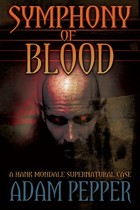 Summary:
Hank Mondale wanted to be a cop but his gambling, alcohol, and drug addictions ruined his record. Instead, he is now a private detective barely scraping by, so when a wealthy and famous man named Blake hires him to figure out where the monster pursuing his daughter is hiding out, he takes the case in spite of the odd sound of it. Particularly since Blake and his daughter insist that this is a literal, shape-changing, lizard-like monster after her.
Review:
This is a book that suffers from bad structure, a plethora of unlikable characters, and a serious lack of editing.
I don’t need to go into too much detail about the lack of editing. Suffice to say it’s a combination of grammar, spelling, and punctuation errors. For instance, Jaeger is spelled “Yager” at one point (when being spoken about by an alcoholic character, no less). Also, although most of the book is told in past tense, periodically present tense shows up. Similarly, other errors show up that simply jar the reader, such as calling a character “rippled,” when the author meant “ripped.”
These are all editing problems, though, so I always try to look beyond them to see if they were fixed, would the story be a quality one? Alas, the case in this instance is simply no. The first half of the book is told entirely from the detective’s point of view, only to abruptly switch and have the next 25% or so back-track and tell what occurred from the monster’s perspective. Then the last bit of the book reverts back to the detective’s perspective. This gives the book an incredibly odd structure and simultaneously removes most of the mystery and suspense. Where before the creature was an enigma, we now understand it intimately. Similarly, whereas the section told from the creature’s point of view could be an interesting story in its own right, it is instead smushed between two ho-hum detective sections. Either choose to be investigating the monster or be the monster or alternate more quickly between the two to maintain some mystery. This structure simply feels like two different books willy-nilly slammed together.
There’s also the problem of the characters. The only sympathetic one is the monster, which would work if the story was told entirely from the monster’s perspective, yet it is not. Plus the monster itself just doesn’t make much sense. It’s hard to picture or imagine how it operates. It seems the author used the excuse of it being a monster to let it bend all rules whenever it was convenient to the storyline. Beyond the monster, the detective, his friends, Blake, and the daughter are all completely unsympathetic. They are the kind of people you’d move away from on the subway or roll your eyes at behind their backs. Readers, particularly in a mystery, need at least one character they can relate to.
All that said, Pepper does have some writing abilities. He clearly has a creative mind and is capable of telling a story one can follow. This would be a good draft, but not a final published work. He needs to decide if he wants to tell the monster’s story or the detective’s, then rewrite entirely from that point of view and also invest in an editor. If these steps are followed, Pepper could have a solid book here. As it stands now, though, I can’t in good faith recommend it to anyone, even staunch horror fans.
2 out of 5 stars
Source: Copy from the author in exchange for my honest review

Counts For:
 Support my work with a tip or browse my shop for curated book club guides, how to guides, cross-stitch patterns, and more!


This work by Amanda Nevius is licensed under a Creative Commons Attribution-Noncommercial-No Derivative Works 3.0 United States License.
 Opinions of a Wolf