
Archive
Book Review: Hungry For You by A. M. Harte

Summary:
A collection of zombie-themed short stories and poetry with the twist that they all have to do with romantic relationships in some way, shape, or form.
Review:
This is a solid collection of short stories and poetry that can be enjoyed one at a time or inhaled in one sitting. I went for the one sitting option.
In some stories Harte sticks to zombie tropes but in not all. The ones where she varies or surprises the reader in some way are definitely the stronger ones. She has an ability to imagine multiple different possible zombie apocalypses that are all, if not equally believable, still believable. Her dialogue is a definite strength, reading as incredibly realistic in the midst of fantastical happenings.
Where she excels though, and where I would encourage her to focus future horror writings, is when she uses the zombies and zombie apocalypse as a metaphor or an instigator for something in a relationship from women’s perspective. My three favorite stories from the collection–“Dead Man’s Rose,” “Seven Birds,” and “Alive”–all feature this element. In “Dead Man’s Rose,” the zombie is a metaphor for an abusive lover who refuses to grant the woman her freedom. In “Seven Birds” the surprise of the zombie apocalypse coincides nicely with an unexpected break-up (I particularly enjoyed that female character’s reaction to both). In “Alive” the female character must deal both with the zombie apocalypse and the emotional fall-out after a one-night stand with a co-worker. These are all three things modern women face in relationships and getting to see them take place in a world infested with zombies (one of my favorite kinds) was such a welcome change! Too often, especially in zombie movies, we see the apocalypse from a man’s perspective and not from a woman’s. I found myself saying to Harte in my head, “Ignore the male perspective and switch to just writing from the female perspective, because you do it so well!” For instance, it’s not every day in a female zombie fiction fan’s life that you come across a resonant passage like this:
When I am lonely for boys what I miss is their bodies. The smell of their skin, its saltiness. The rough whisper of stubble against my cheek. The strong firm hands, the way they rest on the curve of my back. (location 1206)
Never have I come across a passage in zombie fiction that so struck at the heart of what it is to be a modern straight woman, and to have that followed up by oh no zombies was just awesome.
There are a few shortcomings though. A couple of the stories simply felt too short, and a couple of them–“A Prayer to Garlic” and “Arkady, Kain, & Zombies”–just didn’t make much sense to me. I think the former would have benefited from being a bit longer with more explanation, whereas the latter actually felt too long and had a couple of plot holes that I couldn’t wrap my mind around. This collection is periodically more British than at other times. One short story revolves around tea to an extent that I’m afraid a Boston gal like myself just couldn’t quite relate to. I know that those more British stories will definitely appeal to the type who love Doctor Who for instance, though. I also really wish it included a table of contents. That would be super-helpful in revisiting those stories readers would like to revisit.
Overall this book is definitely worth the add to any zombie fan’s collection, but particularly to female zombie fans. It’s different and fun simultaneously.
If you found this review helpful, please consider tipping me on ko-fi, checking out my digital items available in my ko-fi shop, buying one of my publications, or using one of my referral/coupon codes. Thank you for your support!
4 out of 5 stars
Length: 122 pages – novella
Source: Smashwords copy from the author in exchange for my honest review
Buy It (Amazon. Not available on Bookshop.org)
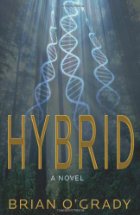
Book Review: Hybrid by Brian O’Grady
 Summary:
Amanda Flynn’s life changed forever when her Red Cross relief team was exposed to a deadly virus in the Honduras, leaving her the sole survivor. Seven years later, when she thinks most of the horror is over, the virus resurfaces in Colorado Springs, Colorado, and she finds herself forced to team up with various government officials, a priest, and a coroner, in a fight against a deadly terrorist plot.
Review:
I admit that I bought this book in a haze that I call “Kindle Sale Fever.” Periodically Amazon has sales of Kindle books where they suddenly cost 99 cents to $2.99, and I tend to impulse buy. Oops. (I mean, if you’d told 7 year old me such a thing would even be possible one day, I probably would have curled up and died in pure bliss). In any case, the Amazon blurb led me to think this was more in the transhumanist/zombie genre than evil terrorist plot thriller, which I tend to avoid. It’s nothing against the genre; I just don’t do politics in my happy fun reading time. So, this book was already facing a challenge to satisfy someone who doesn’t tend to like that kind of story.
At first, it definitely was working for me. The plot of Amanda Flynn mysteriously surviving the illness and escaping the CDC to avoid being treated like a guinea pig was engrossing for the sheer humanity of it. The initial break-out in Colorado Springs was also intriguing with the virus killing some people but healing others from serious illnesses like childhood leukemia. At a certain point though it started to feel like O’Grady was trying to do too much. The book was trying to straddle multiple genres and plot-lines that didn’t quite mesh. Among the things going on: new general trying to prove himself, survivors who turn psychic, Amanda dealing with her guilt, new African-American head detective dealing with being head detective in a largely white city, priest having crisis of faith, little girl miraculously healed of leukemia, coroner who might be a sociopath, definitely evil dude who hallucinates (or might not be hallucinating) some random Russian guy, head of the CDC trying to figure out the spy in his office, and Arab dude who may or may not be defecting from the terrorists to the Americans. See what I mean? This would be totally fine if they all somehow tied up in the end, but the main issue in the book of these survivors with psychic powers is just kind of dropped. We get far more information on the foiled terrorist plot than on the effects of the virus on the survivors, and that is by far the more interesting part of the story.
It’s also bothersome that the main character, Amanda Flynn, is the least well-rounded and likeable. The priest and the coroner are far more interesting and well-rounded, showing that O’Grady can write characters well, but Amanda simply rings false. Perhaps part of this is that we see the priest and the coroner before they become infected and are still entirely human. The story of Amanda and her survival in the Honduras is simply never fully told, and I think that would have helped a lot, even if addressed only in a flashback.
Overall, although the story itself is not for me, it does suffer from some characterization/plotting issues. Thus, I would recommend it to huge fans of terrorist thrillers, who would probably still enjoy it.
2.5 out of 5 stars
Source: Amazon

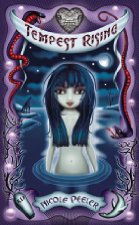
Book Review: Tempest Rising by Nicole Peeler (series, #1)
 Summary:
Jane True lives in a small coastal town in Maine and cares for her father, a stubborn fisherman who refuses to leave his hometown. This means Jane is stuck in a town where everyone pretty much thinks she’s crazy. Everyone except the lesbian couple who run the local bookstore where she works. Even Jane thinks there’s something off about herself what with swimming near the deadly whirlpool The Sow in the ocean in the middle of the night in the winter on a regular basis. But then a neighbor winds up dead, mysterious people show up, and Jane finds out she’s half-selkie, and nowhere near as crazy as she once thought.
Review:
First things first. I absolutely, completely, 100% love the character of Jane True. If she lived in my neighborhood, we’d definitely be the best of friends. She’s smart and loyal with a biting, classic yankee sense of humor. At the same time though, she’s human, flawed, and makes mistakes but not the sort of mistakes that would make you hate her. I also really related to her relationship with her father, as mine has the same debilitating heart disease that her father has. Seeing her see in him the same, strong, blue collar daddy who raised her and who now is struggling with an illness was really refreshing to see in a paranormal romance. It seems like dads tend to be absent in the genre in general, when let’s face it, a lot of women’s dads remain an integral part of their life, even when grown-up.
The storyline itself is fairly complex, and it was a delight to see modern rural New England in literature. The characters also take a random jaunt up to Quebec, which honestly we definitely do periodically. I’ve been to Canada more times than I’ve been to the American south for instance. The settings were fabulous and well-envisioned. Normally I would complain about Jane’s love interest, but it’s obvious to me that she’s going to outgrow him with time.
The one thing I actually didn’t like about the book was the sex scenes, which is kind of problematic for a paranormal romance since that’s kind of half the point. Jane insists her man uses a condom. Ok, fine, write that in there once and then we’ll assume that they have safe sex for the other encounters. The thing is though, Mr. Man Candy complains about having to use a condom every single time, and every single time asks her if they really have to….by dangling the wrapped condom in her face. This is not sexy behavior! This is reason to ditch a guy behavior. She said use it, that means use one until she says otherwise quit being a baby. And frankly, quit ruining my sexy reading by turning into an asshole right before the sexy times. The whole entire sex scene situation is problematic throughout the book, and just gets worse each time they do it. There’s one scene in particular when Jane is down on her hands and knees, and the dude is behind her, and he dangles the condom in her face. Like randomly he’s behind her, she’s getting excited, he’s touching happy places, then bam there’s a condom in her face. WTF. This is not how paranormal romance should work. I get it that we’re not supposed to 100% like the guy, and this is part of the way of showing us he’s an asshole, but still. I hope the whole sex scene situation improves in the next book.
Overall, the character is a rich, engaging, Mainiac with a biting sense of humor, and the world Peeler has created is diverse and engaging. Hopefully the boyfriend situation improves in the later books. Given how much I like the main character (which is rare in paranormal romance), I’ll definitely be reading the next entry. If she sounds engaging to you as well, and you like paranormal romance, you’ll most likely enjoy this book.
3.5 out of 5 stars
Source: Amazon


Book Review: Heinrich Himmler: The Sinister Life of the Head of the S.S. and Gestapo by Roger Manvell and Heinrich Fraenkel
 Summary:
Manvell and Fraenkel conducted years of meticulous research both with primary documents and those who actually knew Himmler to bring about a biography of the man infamous for being in charge of the S.S., Gestapo, and concentration camps that made the terror of Hitler’s reign possible. They seek to provide a well-rounded look at Himmler’s entire life for those with some familiarity with the events of World War II.
Review:
This was a fascinating and difficult book to read, not because of the writing style or the atrocities recounted, but because the authors succeeded in putting a human face on Heinrich Himmler. In the intro to the book, the authors state:
The Nazi leaders cannot be voided from human society simply because it is pleasanter or more convenient to regard them now as outside the pale of humanity. (location 31)
In other words, the easy thing to do is pretend the Nazi leaders or anyone who commits atrocities is something other than human. That they are monsters. When in fact, they really are still people like you and me, and that should frighten us far more than any monster story. What leads people to do horrible things to other people? What makes them bury their conscience and humanity and commit acts of evil? This biography thus does not say “here is a monster,” but instead says, “Here is this young boy who became a man who committed himself to a cause and proceeded to order acts of evil upon others. What forces came together to mold him into someone who would do these things?”
One of the more fascinating things brought to light in this book is that Himmler was never actually fit into the ideal of a top-notch Aryan male he himself advocated. In fact throughout his life he was sickly, pale, and scholarly. He tried in school to fit in with the athletic boys but never succeeded in anything for any length of time except fencing. Instead of accepting who he was, he continually pushed his sickly body past its limits throughout his life, trying to force it to fit into his ideals of what it should be. He actually enlisted his own personal healer, a masseuse trained by a talented Chinese doctor, throughout the war. This masseuse, Kersten, was working as a spy for the Allies and was instrumental in convincing Himmler to release various people from concentration camps throughout the war. His sickly body then not only opened him up to the Allies for a convenient spy, but also was key in how he related to the world. He projected his own insecurities about the ideal body onto everyone else.
Himmler’s anxiety to destroy the Jews and Slavs and place himself at the head of a Nordic Europe brash with health was a compensation for the weakly body, the sloping shoulders, the poor sight and the knock-knees to which he was tied. (location 2189)
This physical weakness and obsession does not mean he was a weak man, however. He was profoundly intelligent and detail-oriented. He easily became obsessed with ideas he came up with and would search for proof of them excluding any and all evidence to the contrary. Those of us who went to liberal, private colleges where we were taught to adjust our worldview for new, challenging ideas may be surprised to learn that Himmler read obsessively. The fact though is that Himmler sought out in his reading sources that would simply support his previously established, prejudicial worldview.
Like Hitler, he [Himmler] used books only to confirm and develop his particular prejudices. Reading was for him a narrowing, not a widening experience. (location 2547)
Thus we cannot depend on reading alone to prevent close-mindedness.
As the Nazi regime continued on, Himmler grew more and more committed to his obsessions. Those who knew him well described the frenzy and meticulousness with which he worked over every detail toward his final goal of the “Aryan race” being in control of Europe.
Himmler’s need to rid himself of the Jews became an obsession. The ghosts of those still living haunted him more than the ghosts of those now dead; there were Jews everywhere around him, in the north, in the west, in the south, in the areas where his power to reach them was at its weakest. (location 2074)
The information on Himmler at this time period certainly sound like a man suffering from intense paranoia. Think of John Nash in A Beautiful Mind and how he firmly believed government agents were all around him persecuting him. The difference is that this physically weak, close-minded, paranoid man was given immense power over the lives of millions instead of simply being a professor. It is easy after reading this book to see how Himmler could easily have been that crazy neighbor worried that the people across the street were watching him all the time instead of the engineer behind genocide. All it took was placing near total power and trust in his hands to turn him into the organizer of a genocide.
There will always exist human beings who, once they are given a similar power over others and have similar convictions of superiority, may be tempted to act as he [Himmler] did. (location 592)
The lesson the authors send home repeatedly then is that Himmler was just a man overcompensating for a physically weak body who grasped onto the idea that he was actually superior to others simply because of his ancestors with a tendency toward paranoia who was given a dangerous amount of power. It is easy to imagine how the entire situation could have worked out differently if some sort of intervention had happened earlier in his life. If he was taught that everyone was valuable for different reasons that have nothing to do with their physical abilities or ancestry. If he had initially read books that weren’t racist and xenophobic. If he was never swept into the Nazi Party mania in the 1930s. If he had been maintained as an office worker in the Nazi party instead of being given so much power. It’s a lot of if’s, I know, but it’s important to think about all the ways to prevent something like this from ever happening again. Although the authors’ primary point is “be careful who you allow to have power,” I would also add “intervene when they are young to prevent the development of a xenophobic, paranoid personality to start with.” With both precautions in place, perhaps we humans as a group can avoid such atrocities in the future.
Readers should note that this book is written by Europeans and not “translated” into American English. Additionally, periodically the authors sway from the strict chronological method of a biography to follow one thought or event through to its conclusion then back-track. This was a bit distracting, but absolutely did not prevent me from learning much about Himmler, WWII, and the Holocaust that I did not previously know.
Overall, I highly recommend this to those with an interest in WWII in particular, but also to anyone interested in the prevention of future genocides. It offers great insight into how these atrocities came to be.
4 out of 5 stars
Source: Amazon

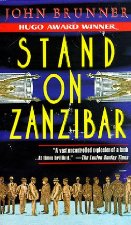
Book Review: Stand on Zanzibar by John Brunner
 Summary:
In the near-future humanity is increasingly facing over-population and all its consequences. In reaction to this, most world governments have established population laws and eugenics boards. In this overly crowded, information overloaded, perpetually on the brink of war society exist Donald and Norman, healthy bachelors who must live as roommates due to the housing crisis. Donald is a dilettante, an information specialist on reserve to be activated as a spy when needed for the US government. Norman is a Muslim African-American working his way up the corporate ladder of the most important technology firm in the world–GT. GT houses the world’s most brilliant computer named Shalmaneser. The intertwining lives of these two oddly well-suited roommates gradually unfold amid digressions into the lives of those they come into contact with and information from the modern-day philosophies and advertizing.
Review:
What is most memorable and striking about this book is not so much the story, although that is fairly unique, but the way in which it is told. Brunner does not simply tell the main storyline, he also immerses the reader into the world the characters live within. To that end, the main storyline (continuity) is interspersed with chapters focusing in on minor characters (tracking with close-ups, essentially short stories), plunging the reader into the middle of the advertizing of the time (the happening world), and works of importance to the world (context). The result is that, although it takes a bit of work to get into the book, in the end the world these characters exist in is much more vivid and clear in the reader’s mind, thus allowing her to more fully understand the characters.
Sometimes this method of writing is a bit difficult to read, of course. For instance, one chapter takes place at a party, and Brunner simply streams all of the conversation together as you would hear it if you were at the party yourself. You catch snippets of bits of different conversations taking place, but never an entire one all at once. It’s the most immersive party scene I’ve ever read, but also took me an inordinate amount of time to get through.
It was also refreshing to have one of the main characters in a futuristic scifi book be a minority. This in and of itself made Stand on Zanzibar a unique, interesting read, and I believe Brunner did a good job portraying both Norman’s struggles with still prevalent racism and presenting him as a well-rounded character.
The major themes of the book, beyond the incredibly meta presentation style, are the very real threat of the loss of privacy and the dehumanization of dependence upon artificial intelligence.
The dehumanizing affect of overpopulation is evident in the language employed by the characters early on in the book.
Not cities in the old sense of grouped buildings occupied by families, but swarming antheaps collapsing into ruin beneath the sledgehammer blows of riot, armed robbery and pure directionless vandalism. (page 52)
These are no longer human cities. They are crawling ant-piles. The vision of piles of swarming ants is simply not a pleasant one. This concept of humanity as a pest is carried even further in a poem from one of the context chapters entitled “Citizen Bacillus,” which begins:
Take stock, citizen bacillus,
Now that there are so many billions of you,
Bleeding through your opened veins,
Into your bathtub, or into the Pacific
Of that by which they may remember you. (page 115)
Not only is this poem taking into account the increasingly suicidal tendencies of the human population in this future society (something that is seen in the animal kingdom when a population becomes overcrowded), but it also is blatantly calling humans a bacteria (bacillus).
The book repeatedly addresses through vignettes, samples of books of the time period, and the lives of the main characters that overpopulation leaves people without enough room to think and figure themselves out in.
True, you’re not a slave. You’re worse off than that by a long, long way. You’re a predatory beast shut up in a cage of which the bars aren’t fixed, solid objects you can gnaw at or in despair batter against with your head until you get punch-drunk and stop worrying. No, those bars are the competing members of your own species, at least as cunning as you on average, forever shifting around so you can’t pin them down, liable to get in your way without the least warning, disorienting your personal environment until you want to grab a gun or an axe and turn mucker. (page 77-8)
In the book “turning mucker” is when a person inexplicably loses their mind and attacks strangers near them. This happens increasingly throughout the book. Thus Brunner’s main point that humans are our own worst enemy is repeated throughout the book.
Added on top of this is the fact that artificial intelligence is outpacing humans. The characters literally cannot keep up with the information overload. They have nightmares about it. They simultaneously depend on the computers and dread them. When one goes awry, they hardly know how to continue on, but simply flounder around. Chad Mulligan (one of my new favorite literary characters) sums it up eloquently:
What in God’s name is it worth to be human, if we have to be saved from ourselves by a machine? (page 645)
Thus, Stand on Zanzibar through postulating an overpopulated future that is overly dependent on technology demonstrates the very real dangers humans pose to ourselves if we outpace either our own minds or our environment’s ability to house us. It is a brilliant read for the meta-literature aspect alone, but the content is also challenging and thought-provoking. I highly recommend it to scifi fans.
4 out of 5 stars
Source: PaperBackSwap

Book Review: I Kill Giants by Joe Kelly (Graphic Novel)
 Summary:
Barbara is a middle school student with one intense focus–she must learn how to kill giants before it is too late. She doesn’t fit in much at school or have many friends, but she doesn’t really care, because she needs to be ready for the giant. The giant is connected to a secret at home, you see, and this secret takes over her life too much to care about all those silly things the other girls talk about.
Review:
I picked up this graphic novel because it was getting tons of buzz as being an excellent graphic novel. I also wanted to know what this big secret was in Barbara’s life. Does the graphic novel address something that isn’t discussed much in polite society but is still an issue for many middle schoolers out there? I was dying to know! Unfortunately, I found myself incredibly disappointed with this graphic novel. I can’t discuss why without spoiling what the giant is, so if you don’t want to be spoiled, skip this review.
I was expecting the giant Barbara is facing at home to be something like abuse or incest. Instead, it turns out Barbara’s mother is dying of cancer. Um. Ok. I’m sorry, a big scary giant doesn’t seem to be quite the right metaphor for a dying parent. What makes this little girl think she can fight death? I guess I just don’t get it.
Additionally, I just really didn’t like Barbara. I honestly get tired of graphic novel writers always making the main character a geek. This little girl–shocker–plays D&D. She is cruel to her classmates. She judges them. She’s even mean to the one girl who for some unearthly reason shows an interest in Barbara and what she likes to do. She, quite frankly, rubs me the wrong way, and I don’t think she’s supposed to.
Then there’s the art. I also didn’t like that, especially how he drew Barbara. Why does she have bunny ears? What’s up with that? The drawing style never feels artistic. Not once did I find myself sucked into the pictures to get further into Barbara’s world. They felt more like badly-done newspaper comic strips than a graphic novel.
Overall, I’m disappointed that I even bothered with this book. It’s one of those few instances when if I’d known the spoiler ahead of time, I’d have saved myself some time. I can’t even imagine handing this over to a middle schooler dealing with a terminally ill relative, because I don’t think it particularly presents healthy coping mechanisms or solutions to unhealthy ones. Why this book is so popular remains a mystery to me.
2 out of 5 stars
Source: Amazon
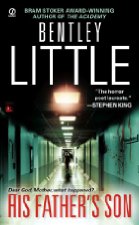
Book Review: His Father’s Son by Bentley Little
 Summary:
Steven’s life in California is so typical it borders on boring. He writes for AlumniMedia. He’s engaged to a librarian named Sherry. He goes out for happy hour every Friday night with his three buddies. Then one day his mother calls him and informs him his father tried to kill her. His father has had strokes and dementia, but in a moment of absolute clarity in the VA hospital, his father whispers to Steven, “I killed her.” Thus begins Steven’s tailspin into a world of darkness and ever-changing morality.
Review:
I believe this book succeeds in serving its purpose–it’s a page-turner with chills. If someone asked me for a simple thriller for the beach, I’d have no qualms handing this over. I cannot rid myself of the vibe though that the idea of this book could have led to a thriller of excellent quality instead of beach read quality, and that is a bit disappointing.
The set-up is excellent. Here we have an ordinary guy with some issues with his parents, but he still tries to live up to his family obligations. Then his father has an episode that makes mortality something Steve is no longer able to ignore. Steve then starts this quest that could easily be read as a metaphor for adults dealing with the increased fragility of their parents. However, about two-thirds of the way through, the plot takes an unexpected twist that then essentially nose-dives off a cliff into a scenario that is jarring and rather insulting to the reader. The book is not at all about what it at first appeared to be, and honestly, the original concept was much more intriguing than the final answer. The resolution is cliche, whereas the original set-up was not.
Other than the plot, Little sets scenes fairly well. It is easy to envision both the simpler scenes as well as the more complex scenes of violence. His writing style is not particularly memorable though. I didn’t once feel the need to write down a quote or dog-ear a page.
One of the more interesting elements of the book is that Steven is a writer, and his short stories pepper the book to give you an idea of his mental state at the time. I honestly enjoyed the short stories more than the actual book itself. I could easily see myself reading a collection of Little short stories in the future.
Overall, this is an enjoyable, if forgettable, thriller ideally suited to summer beach reading. I recommend it to fans of thrillers looking for an easy read.
3.5 out of 5 stars
Source: PaperBackSwap

Book Review: Rage by Jackie Morse Kessler (Series, #2)
 Summary:
Melissa Miller is your typical 16 year old–mom, dad, annoying sister, a jerk of an ex-boyfriend–with one small difference. She deals with her emotions by cutting herself. She keeps a razor in a locked box in her closet and pulls it out when she gets overwhelmed. One night she accidentally cuts too deep, and Death shows up with an option. Either die now or become one of the Horsemen of the Apocalypse–War. Missy chooses the latter option, and as she gets to know the other Horsemen and her job as War, she starts to realize she needs to face the rage inside her.
Review:
Speaking as someone who knows a lot about mental illness, self-injury is one of the illnesses that people who don’t have it have the most difficulty understanding. It seems bizarre to those who don’t self-injure, even as for the self-injurer those moments of cutting or burning or whatever chosen method are the best coping mechanism they can come up with. It’s not easy for those who don’t self-injure to understand, which is why I am so impressed at how well Morse Kessler has grasped the inner workings of the self-injurer in order to write such a well-rounded, sympathetic character as Missy.
Missy is simultaneously relatable as a typical teenager, for instance she gets horribly embarrassed at a party one night, but she also has this deep, dark, misunderstood secret. Gradually other teens find out and are either concerned or lash out at her due to their fear and lack of understanding, but Missy feels that she can’t confide in even the sympathetic ones. In perhaps one of the most powerful passages, the reader gets to see exactly why Missy cuts, while she simultaneously explains why she can’t explain it to her sister.
She could tell her that she turned to the blade because she wanted to live and sometimes pain was the only thing that kept her alive. She could tell her that she was terrified of things she couldn’t even begin to name, that friends could be fickle and lovers could be false. She could try to explain all of that and more, and maybe her sister would understand. But trust was as fragile and cutting as a crystal sword. (page 100)
That is perhaps the most clear, succinct explanation of self-injury I’ve seen outside of nonfiction clinical books. Missy’s reasons for cutting are clear, even as it becomes more and more evident to the reader that this coping mechanism is not truly addressing Missy’s real problems.
Of course, the fantasy element comes to play here again, and it works perhaps even better this time around. Giving the fantasy personas for Missy to talk to and express herself to gives her a safe space to think out her emotions instead of cutting them out. There are also a few cameos from Famine, which is fun to see after reading the first book. The fantasy also works here because it helps give the book a distance that makes it less triggering. There are intense emotional moments, but then Death shows up with a humorous quip to lighten the situation. It addresses the real problems without getting bogged down in over-emotionality.
This book will give self-injuring teens a way to see themselves reflected in literature and accepted and loved for who they are. It will give them a chance to maybe address their own emotions and issues. Similarly, non-self-injuring teens will hopefully become more empathetic to their peers who struggle with it. It’s a book that is simultaneously enlightening but not preachy. I highly recommend it to teens and those who work in mental health or with teenagers.
5 out of 5 stars
Source: Amazon

Previous Books in Series:
Hunger, review
Counts For:

Book Review: Undead and Unemployed by MaryJanice Davidson (Series, #2)
 Summary:
Betsy may have dealt with the fact that she’s an undead blood-sucker, but she certainly is not ready to deal with the idea of being queen of the vampires for 1,000 years. Or mated to the horribly tricky Sinclair. The sexy, tricky Sinclair. She is focused on more important things, like her new job selling designers shoes at Macy’s. But when vamps start popping up dead a second time, her duty calls whether she wants to listen or not.
Review:
If somebody asked me to hand them the quintessential chick lit summer beach read, I’d toss the Queen Betsy series at them. Light, short, set in a cool climate, and one guaranteed hot sex scene per book. Great literature it ain’t, but I’ve definitely read far worse paranormal romance in my time, plus Davidson always manages to get at least a few chuckles out of me.
The one thing that baffles me is that I truly hate Queen Betsy. She is everything I loathe in *coughs* certain women: shallow, conceited, wears too much make-up, obsessed with shoes, self-centered. Yet for some reason I can’t help rooting for her. Maybe it’s that she didn’t ask to be queen of the vampires and yet still manages to rise to the occasion when needed that makes her bearable. This is a long series, and I do hope that Davidson will see fit to give us a good character arc for Betsy. Going from a shallow 20-something to a fully grown-up queen. I could dig that.
In the meantime, the storyline here in the second book was actually a bit more interesting than the first, although the mystery was quite easy to solve. Unfortunately, the laughs weren’t quite as frequent, which is what made the first book so enjoyable, but they are still present. Who reads paranormal chick lit for more than a few hours of giggles and horribly unrealistic vampire sex that knocks chunks of plaster out of the ceiling? If that’s what you’re looking for, you won’t go wrong with the Queen Betsy series.
3.5 out of 5 stars
Source: PaperBackSwap

Previous Books in Series:
Undead and Unwed, review
Book Review: I Am Legend by Richard Matheson
 Summary:
A worldwide virus pandemic has turned most of the world’s population into vampires–both alive and undead. Robert Neville might, quite possibly, be the only uninfected left. Every day he goes out on his quest to simply kill the vampires while they sleep. Every night he curls up in sound-proofed home drinking whiskey and listening to records. Will anything ever save him from this monotonous existence?
Review:
It’s difficult to read a highly influential scifi book that inspired both the trend of writing of a worldwide pandemic and the original Night of the Living Dead and find that you actually are a bit unimpressed by it. I was simply expecting more from such an influential book.
Claustrophobic. That is the best word to describe the book, and it is also what Matheson excels at. Depicting the effects of painful ostracism and loneliness on a person’s psyche. For Robert isn’t alone per se. He is surrounded by those infected with the virus. Yet he can’t hang out with them or converse logically with them. They are entirely at odds, and whereas the infected have each other, Neville has no one. What this book depicts is what happens when the world moves on, and someone is left behind. This is truly well done and what makes the book periodically powerful.
Yet it struggles with things, particularly the most simple story-telling and pacing. The order of events is disjointed and difficult to make sense of. Neville is a rather unsympathetic character because we only get rare glimpses into his past life before the apocalypse. His relationship with Ben Cortman, an infected neighbor, is built up to be important and influential, yet it is dropped at the last minute. One plot point in particular toward the end of the book truly makes very little sense. The actions of the infected seem to be ludicrous at best. At the base of it, we see Neville’s insanity much more clearly than we see his previous sanity, which makes his gradual changes due to loneliness less powerful. Thus, both the characterization and the plot suffer from a certain ever-present disjointedness.
This reads as a great idea that was a bit poorly executed. Perhaps this is why it has inspired so much other creativity. The germ of the idea is excellent and easy to ponder upon in spite of a far less sophisticated story-telling. I thus mostly recommend this to fans of the worldwide pandemic or Night of the Living Dead franchise to see where it all started. Those who are intrigued by the look at ostracism may enjoy it as well, but others probably should steer clear.
3 out of 5 stars
Source: Borrowed

 Support my work with a tip or browse my shop for curated book club guides, how to guides, cross-stitch patterns, and more!


This work by Amanda Nevius is licensed under a Creative Commons Attribution-Noncommercial-No Derivative Works 3.0 United States License.
 Opinions of a Wolf