
Archive
Book Review: Out of the House of Bondage: The Transformation of the Plantation Household by Thavolia Glymph (The Real Help Reading Project)
 Summary:
Thavolia Glymph analyzes the power relations between black and white southern women within the plantation household in the antebellum, Civil War, and immediately post-Civil War American South utilizing primarily slave narratives/interviews and the diaries and letters of white mistresses.
Review:
I am chagrined to admit that not only is this the first time I was late on the schedule of The Real Help Reading Project I am co-hosting with Amy, but I was exactly a week late! The lesson I have learned? Never schedule a timely thing for a holiday weekend. I apologize to Amy and everyone following along for making you wait, but at least it was Amy’s turn to host! Moving right along….
Whereas Labor of Love, Labor of Sorrow was extraordinarily all-encompassing, here Glymph narrows her focus severely to only relationships between black and white women in traditional plantation households in the American South. She, alas, stops her analysis around the turn of the 20th century, only venturing into the unique relations within the domestic work realm depicted in The Help in the epilogue. However, this book is quite valuable in that it analyzes the relationships that led up to that odd dynamic of the 1950s and 1960s.
This book covers a lot of information, but what sticks out the most to me in retrospect was how much work and effort it took to maintain a racist, unequal society. The white mistresses had this odd, completely illogical dichotomy of viewing black women both as inferior and needing their guidance and as naturally suited to hard labor. My eyes practically bugged out of my head when reading of white women teaching black women to do chores that supposedly white women were too weak to do….and yet they were perfectly capable of doing them well enough to show the black women what they wanted done. Um….what? That is the sort of illogical situation that only someone entirely committed to a belief system, no matter how wrong, will be able to come to terms with.
Similarly, the former mistresses predicted the imminent downfall of their former house slaves only to find themselves hired by these same freedwomen to sew fine dresses for them with the money they earned by working the plantation. Yet, the former mistresses persisted in believing in the racial inferiority of the freedwomen. Perhaps the most mind-boggling to me was the story of one former mistress who wound up teaching at a freed black school, yet even though she was with these children daily, she still believed in white supremacy. Why this persistent need to believe you’re better than someone else? Personally, it seems to me that the white men were so constantly judgmental of the white women that they reacted by taking it out on those society deemed inferior to them. If black free women rose to their same status, then who would they take their frustrations out on? This logic doesn’t free the white women of the guilt that they definitely deserve, but it does help to make sense of their ability to take on completely illogical stances.
I feel that I am repeating myself a bit with this project, but the books repeatedly demonstrate how inequality on any level acts as a poison to the whole society. I hope that is something that we modern readers will bare in mind in our own daily lives.
3 out of 5 stars
Length: 296 pages – average but on the shorter side
Source: BookU
Buy It (Amazon or Bookshop.org)
Please head over to Amy’s post to discuss this book!
If you found this review helpful, please consider tipping me on ko-fi, checking out my digital items available in my ko-fi shop, buying one of my publications, or using one of my referral/coupon codes. Thank you for your support!
Book Review: Y: The Last Man: Cycles by Brian K. Vaughan (Series, #2) (Graphic Novel)
 Summary:
Yorick and his monkey, Ampersand, (the last males on Earth) continue their reluctant quest to help the government find a way to fix the disease that killed all the other men or at least to clone new men. Their train trip from Boston to California is caught up in Ohio, though, where they stumble upon an oddly utopian town of women. Meanwhile, Yorick’s sister, Hero, and the Amazons continue their quest to rid the Earth of the last man. Plus there’s a mysterious Russian woman who keeps insisting a spaceship with men on it is going to land.
Review:
Now that the premise of the post-apocalyptic world is set up, Vaughan’s story really picks up speed. There is much less explaining and far more action this time around. There are now multiple plot lines and mysteries beyond Yorick’s main one going as well, which helped, because let’s be honest, Yorick isn’t that likeable.
About 1/3 of this entry is set in Boston, primarily around Fenway and the train station. I think having the Amazons duke it out in front of Fenway Park was a pretty nice touch too.
I don’t recall laughing with the first entry, but this one had me laughing out loud on the bus then having to explain to my companions around me what was so funny. The line?
Killing’s easy. Like….like doing laundry!
It is a random, quirky sense of humor that I really enjoy, although I do expect that it might not strike some people as humorous.
The artwork continues to be bright and easy to follow. I really appreciated the preliminary sketches featured in the back of the book. It was most surprising to see that agent 355 originally was white and gradually was changed to black. I’m glad Vaughan made the move, but I do wonder what brought it on!
Overall, if you like a post-apocalyptic graphic world with biting wit and gender commentary, you’re going to enjoy this book.
5 out of 5 stars
Source: Public Library

Previous Books in Series:
Y: The Last Man: Unmanned
Book Review: Emotional Geology by Linda Gillard
 Summary:
Rose is a textile artist with bipolar disorder who for years found her medication dulled her ability to work. After a stunning betrayal that landed her in a mental hospital, she has moved to a quiet, extraordinarily rural island in Scotland in an attempt to control her illness with as little medication as possible so she may still create her art. Her life isn’t quite as quiet as she imagined it would be, though, with a warm neighbor, Shona, who introduces her to her brother, a teacher and poet.
Review:
A rural island setting combined with art, romance, and mental illness–I knew this book and I would be fast friends before I even started reading it. What I discovered was a book that addresses multiple universal issues–grief, betrayal, loss, family ties–in a glorious setting that left me dying to visit Scotland, if only to discover what peat smoke smells like.
The style of this book is unique. Gillard easily transitions between perspectives, points in the time-line of Rose’s life, and even poetry versus prose. I was astounded to discover that I enjoyed the poetry portions creeping up in the book. They tend to happen at points of high emotion and exquisitely express the high highs and low lows someone with bipolar disorder goes through. The changing of perspectives and time-lines could sometimes feel a bit jarring; that could have been smoother done, but I appreciate the style and vibe Gillard is going for. It almost mimics the jarring highs and lows of bipolar disorder.
More importantly, though, the book exquisitely, gently shows that people with mental illness are just people like everyone else. They may feel things slightly more strongly or need to work harder to stay balanced, but the mentally healthy have emotions too. The mentally healthy can be thrown just as badly by life’s experiences. If I could sum up the book’s point, it would be that we all have scars.
So you see, Rose, if you would just step outside your own fucking head for a few moments, you’d see you’re not the only one with scars. In any case the worst ones, the most disfiguring are never visible to the naked eye.” He zips up his fly. “I can probably live with yours. Can you live with mine?” (location 3816)
This is an emotional, challenging, touching book to read. I recommend it to fans of contemporary fiction with a heart.
4 out of 5 stars
Source: Kindle copy from author in exchange for my honest review

Counts For:
Book Review: The Sum of My Parts: A Survivor’s Story of Dissociative Identity Disorder by Olga Trujillo, JD
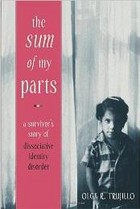 Summary:
Olga was a young, successful lawyer in DC when she suddenly started having inexplicable panic attacks and episodes of blank stares or rapidly moving eyes. She sees a psychiatrist and is diagnosed with a moderate case on DID. On the spectrum, she has multiple parts but not exclusive personalities and still has a central core. These parts have kept the memories of her extraordinarily violent, abusive childhood from her consciousness thereby allowing her to function, but just barely. In her memoir, Olga tells what she has now remembered of her childhood and how she has now discovered she managed to function and be surprisingly resilient. She then delves into her long-term therapy and how she has come together into mostly one part and usually no longer dissociates.
Review:
I always find memoirs by those with DID or dissociation completely fascinating. Even just the ability to write the book and explain the disorder from the insider’s perspective is a remarkable achievement. I previously read When Rabbit Howls
Olga offers up a very precise trigger warning of which chapters could be dangerous for fellow trauma survivors. That said, I found her reporting of what occurred to her to be respectful of herself as a person. She never shirks from what happened to her, but is sure to couch it in concise, clinical language. I respect this decision on her part, and again believe it will make her book more accessible to a wider audience. People can see the results of the trauma without finding themselves witnesses to the trauma itself.
The book right up through about halfway through her therapy is clear and detailed, but then starts to feel rushed and more vague. Perhaps this is out of respect for the people currently in her life, but personally I wanted to know more. For instance, how was she able to make a drastic move from DC to the middle of the country without upsetting her healing process? How do the phone sessions with her therapist work? I think many advocates of those with mental illness would appreciate more detail on how she is able to have a healthy, happy relationship now, especially since we witness the dissolution of her first marriage. Similarly, I wanted to know more about her coming out process. She states that she knew at 12 she was a lesbian, but pretty much leaves it at that. I’m sure it was easier to embrace her sexuality the more integrated her parts became, but I am still interested in the process. She was so brave recounting her early life that I wonder at the exclusion of these details.
Overall this is a well-written memoir of both childhood abuse, therapy for DID, and living with DID. Olga is an inspirational person, overcoming so much to achieve both acclaim in her career and a happy home life. I recommend it to a wide range of people from those interested in the immigrant experience to those interested in living with a mental illness.
4 out of 5 stars
Length: 258 pages – average but on the shorter side
Source: NetGalley
Buy It (Amazon or Bookshop.org)
If you found this review helpful, please consider tipping me on ko-fi, checking out my digital items available in my ko-fi shop, buying one of my publications, or using one of my referral/coupon codes. Thank you for your support!
Book Review: The Burning Sky by Joseph Robert Lewis (Series, #1)
 Summary:
In an alternate vision of history, the Ice Age has lingered in Europe, slowing down Europeans’ rate of civilization and allowing Ifrica (Africa) to take the lead. Add to this a disease in the New World that strikes down the invaders instead of vice versa, and suddenly global politics are entirely different. In this world, steam power has risen as the power of choice, and women are more likely to be the breadwinners. Taziri is an airship co-pilot whose airfield is attacked in an act of terrorism. She suddenly finds herself flying investigating marshals and a foreign doctor summoned by the queen herself all over the country. Soon the societal unrest allowing for a plot against the queen becomes abundantly clear.
Review:
Can I just say, finally someone wrote a steampunk book I actually like, and it’s a fellow indie kindle author to boot! All of the possibilities innate in steampunk that no other book I’ve read has taken advantage of are used to their fullest possibilities by Lewis.
I love that Lewis used uncontrollable environmental factors to change the political dynamics of the world. Anybody who has studied History for any length of time is aware how much of conquering and advancement is based on dumb luck. (The guns, germs, and steel theory). Lewis eloquently demonstrates how culture is created both by the people and their surroundings and opportunities. For instance, whereas in reality the Native Americans had to rely on dogs for assistance and transportation against invaders on horseback, Lewis has given the Incans giant cats and eagles that they tame to fight invaders. Similarly, in Europe the Europeans are constantly fighting a dangerous, cold environment and have dealt with this harsh landscape by becoming highly superstitious, religious people. This alternate setting allows for Lewis to play with questions of colonization, race, and technology versus tradition in thought-provoking ways.
Women are in positions of power in this world, but instead of making them either perfect or horrible as is often the short-coming of imagined matriarchies, there are good and bad women. Some of the women in power are brilliant and kind, while others are cruel. This is as it should be because women are people just like men. We’re not innately better or worse. Of course, I couldn’t help but enjoy a story where a soldier is mentioned then a character addresses her as ma’am, without anyone feeling the need to point out that this is a woman soldier. Her gender is just assumed. That was fun.
Although Taziri does seem to be the main focus of this book, the story is told by switching around among a few main characters who find themselves swept together in the finale for the ultimate battle to save or assassinate the queen. This strategy reminded me a bit of Michael Crichton’s Next where seemingly unrelated characters suddenly find how their destinies are all connected together. Lewis does a good job with this, although personally I found the beginning a bit slow-moving. It all comes together well in the end, though, with everything resulting in a surprising, yet logical, ending.
What kept me from completely loving the book is that I feel it needs to be slightly more tightly edited and paced. Some sections were longer than they needed to be, which I can certainly understand, because Lewis has made a fun world to play around in, but as a reader reading what amounts to a thriller, I wanted things to move faster.
That said, I thoroughly enjoyed exploring the steampunk world Lewis has created after a couple of years of loving the fashions and possibilities but finding no steampunk books I liked. If someone were to ask me where to start with steampunk, I would point them here since it demonstrates the possibilities for exploring race, colonization, and gender, showing that steampunk is more than just an extended Victorian era.
Overall this is a wonderful book, far better than the traditionally published steampunk I’ve read. I highly recommend it to fans of alternate history, political intrigue, and steampunk alike. Plus it’s only 99 cents on the kindle. You can’t beat prices like that.
4 out of 5 stars
Source: Won on LibraryThing from the author in exchange for my honest review

Book Review: The Walking Dead, Book 1 by Robert Kirkman (Series, #1) (Graphic Novel)
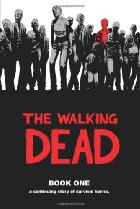 Summary:
When cop Rick wakes up from a coma brought on by a gun shot wound, he discovers a post-apocalyptic mess and zombies everywhere. He sets off for Atlanta in search of his wife, Lori, and son, Carl, and soon teams up with a rag-tag group of survivors camped just outside of Atlanta.
Review:
I just want to point out that this review is purely focused on the graphic novel, not the tv series. I haven’t even seen more than 10 minutes of the tv show, so remember this is about the books not the show. Thanks! Moving along….
I almost gave up on this within the first few pages, because COME ON. Can we PLEASE get over the whole oh I had a coma and then woke up to a zombie apocalypse trope, please? First, it is so highly statistically unlikely that it was laughable the first few times it was used in my beloved dystopian novels, but at this point it just looks lazy. Come up with some other way to start the apocalypse, ok? I don’t care if your main character is out of touch with reality for a few days because he’s on a drug-fueled sex streak. At least it would be different! Also, a cop, really? You want me to root for a cop? And everyone trusts him because he’s a cop? A cop is the last person I would put in charge if I was a member of a rag-tag bunch of survivors; I’m just saying.
Once we move on beyond the initial set-up though to the group of survivors caravaning their way across America, the story vastly improves. The people are real. They’re scared. They’re angry. The snap easily. They hook up with whoever is convenient (and not necessarily young and hot). They teach the kids to use guns. It’s everything we know and love about post-apocalypse stories.
The artwork is good. Scenes are easy to interpret; characters are easy to tell apart. The zombies are deliciously grotesque, although I did find myself giggling at them saying “guk.” Guk? Really? Ok….
The best part, though, is the people that in your everyday life you are just like, come on, god, bolt of lighting, right here? They’re the ones who get eaten by zombies! It is excellent. So that really annoying chick in camp? Totally gets her head bit by a zombie. It’s cathartic and awesome.
The cast is diverse, and no, the black guy is not the first to be eaten (or the red shirt guy for that matter). It wouldn’t kill Kirkman to be a little less heteronormative, but he’s still got time and more survivors to add.
Overall, this is a good first entry in a zombie apocalypse series. Kirkman needs to be more careful to stay away from expected tropes in the genre and bring more of the creativity it is apparent he is capable of. I recommend it to fans of zombies, obviously. ;-)
4 out of 5 stars
Source: Public Library

If you found this review helpful, please consider tipping me on ko-fi, checking out my digital items available in my ko-fi shop, buying one of my publications, or using one of my referral/coupon codes. Thank you for your support!
Book Review: Tail of the Blue Bird by Nii Ayikwei Parkes (Ghanaian Lit Week)
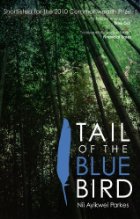 Summary:
When the girlfriend of the minister for roads and highways spots a disgusting red lump of flesh in a hut in the village Sonokrom, what normally would have been ignored and left to the villagers suddenly becomes a matter of national importance. Inspector Donkor wants a promotion, and he believes that one of the only forensics specialists in Ghana–Kayo–can get it for him.
What Kayo finds in the village is a people still steeped in the culture of the countryside, in touch with Onyame and the ancestors, drinkers of palm wine mixed with aphrodisiacs. Although he arrives with the mind of a scientist, soon his perceptions begin to change.
Review:
Kinna is one of the international bloggers I discovered through Amy, and she is awesome! She lives and works in Ghana and is interested in spreading literacy and love of reading in her own country, as well as interest in African lit everywhere. So when she announced that she was hosting a week in hour of Ghanaian lit, I knew I wanted to participate. Using the wonderful resource of tags in LibraryThing, I hunted down a book that LibraryThing was “mostly sure” I would like and ordered it from my library. Yet again, the book blogging world has brought me to a book I never would have read otherwise, but am glad I did.
This book reminds me a lot of The Summoner, only with the distinct bonus that it is a crime mystery set in Africa written by an African instead of a westerner who has visited. This means our detective hero is distinctly Ghanaian. Like all detectives, he drinks, but his drink of choice is palm wine enhanced by the village medicine man. Just typing out that sentence gave me the shivers of delight I got when I was reading the scenes of drinking and eating in the hut, which is the village pub managed by a woman and her adult daughter. It felt simultaneously familiar and new, which is one of the thrills of reading literature not written by one of your own countrymen.
Unlike western detective stories though, Parkes does not seem to feel a need to give a scientific explanation for every mysterious event that occurs. In fact, it is actually easier to believe the magical explanation than to wonder about the scientific explanation. For that reason I would definitely categorize this as “magical realism.” It is almost as if Sonokrom is a world unto itself, existing in some sort of parallel universe where magic is just an ordinary part of life.
The characters are all richly drawn and well-rounded. I had no trouble telling them apart in my mind. The method of switching perspectives from Kayo to the old man in the village works well. It allows the reader to see both the scientific and traditional perspectives and make up her own mind.
Some people may be bothered by the ambiguous/open-ended ending, but personally I feel that this is what the story needs. It leaves the reader to ponder upon the values of both tradition and modernity. Perhaps that is the point of the whole story.
Now, the book does throw in some Twi words here and there, but those are easily decipherable by context. The more difficult aspect as a non-African reader is the presence of Pidgin. Since whole sentences are written in Pidgin they were much more challenging for me. I must admit this small book took me quite a while to finish, compared to my usual reading rate. The Pidgin is not impossible, though, particularly if you have read widely among the various American dialects. An English dialect is an English dialect, after all.
Overall, I recommend this to those who enjoy both mystery and magical realism and don’t mind exploring a new dialect.
4 out of 5 stars
Length: 200 pages – average but on the shorter side
Source: Public Library
Buy It (Amazon or Bookshop.org)
If you found this review helpful, please consider tipping me on ko-fi, checking out my digital items available in my ko-fi shop, buying one of my publications, or using one of my referral/coupon codes. Thank you for your support!
Book Review: Buddha Volume Two The Four Encounters by Osamu Tezuka (Series, #2) (Graphic Novel)
 Summary:
The second entry in the novelization of the Buddha’s life takes us through Siddhartha’s youth spent as a prince. He meets a mysterious Brahmin who tells him he is destined to help the whole world, not rule a single kingdom. Siddhartha is weak, frequently sleeps, and has visions. He is discontent as a prince yet reluctant to abandon his people. On an adventure outside the castle walls he meets a grown-up Tatta and falls for a slave woman, Migaila. Conflict between what he believes and his duties as a prince seem central to the plot, yet in fact it is Siddhartha’s reluctance to follow his calling and leave the castle to be a monk that is at the core of the conflict.
Review:
I was pleased to see this entry in the series jump right into Siddhartha’s life instead of those on the periphery, yet Tezuka also brings in the major characters from the first book as minor characters in this one. It works well, definitely better than the first book. However, I am left wondering if the love between Siddhartha and a slave woman was based at all on fact or hearsay or purely came out of Tezuka’s mind. It would definitely give a new perspective on Siddhartha to know he once had an ill-fated love affair.
Although it’s important to know where the Buddha came from, it is difficult and not particularly enjoyable to read about the time in his life when he was a spoiled brat. Siddhartha does not treat his wife or his father well. Although he has natural talents with meditation and visions, he surprisingly lacks compassion for others. One of the things I like, of course, about the Buddha is that he did start out this way. He’s not perfect; he just learned and worked toward Nirvana. So it’s important to see this part of his life, even if it is uncomfortable to read.
I again felt distracted by the characters Tezuka made up though. I wish he had stuck to a straight-forward graphic novelization of Siddhartha or the legends of the Buddha at least. The weakest points of the book are the parts including characters Tezuka made up purely on his own.
The art is again enjoyable but not amazing. The pictures show the story but do not suck you in. They give the feeling of being there to do a job, not necessarily to provide a memorable visual experience to the reader.
Overall, it’s an interesting new way to explore the life of the Buddha, but I would not recommend it to someone completely new to Siddhartha. It is an improvement over the first entry, and hopefully they will continue to improve, but an idea that could have been great is simply average. That’s disappointing.
3.5 out of 5 stars
Source: Public Library

Previous Books in Series:
Buddha, Volume 1: Kapilavastu
Book Review: Hetalia: Axis Powers Volume 2 by Hidekaz Himaruya (Series, #2) (Manga)
 Summary:
The manga featuring the countries from WWII as characters is back this time focusing more on the future of the nations after WWII instead of the history before WWII. Russia’s dilemmas with his sisters the Ukraine and Belarus are explored. Canada’s persistent ability to somehow be invisible to most of the rest of the G8 nations (and also to be mistaken for America). The various vignettes are punctuated with Japan-kun and America-kun visiting each other’s homes and attempting to reach a cultural understanding.
Review:
Himaruya’s tongue in cheek representation of global politics and national cultures is just as strong here as in the first entry into the series. I appreciate that he addressed before and after WWII first. It puts everything into an interesting historic perspective.
The art is still gorgeous. The countries who are “relatives” of each other are similar looking but still decipherable from each other (although Canada probably wishes he looked a bit less like America). There is a lot to feast your eyes upon on every page.
I again found myself laughing uproariously at the wit within the pages. Every country is teased by the author, including his own. He points out shortcomings without judging them too harshly. It is what it is, and the more I read nations as characters, the easier it is to see the world as one big loopy extended family.
I particularly appreciate how Himaruya explains the former Soviet Union nations’ problems so clearly. It’s something that I must admit as an American we didn’t ever really address in school, so this was all new to me and yet I came away knowing the facts from a manga.
That’s what makes this series awesome. It’s factual without being judgmental. It sees the humor in local customs and quirks. And somehow it teaches you something in the meantime. Highly recommended to all. Just remember to start reading it at the back. ;-)
5 out of 5 stars
Source: Public Library

Previous Books in Series:
Hetalia: Axis Powers, Vol. 1
Book Review: From This Moment On by Shania Twain
 Summary:
Shania Twain shot to fame on the country music charts in 1995 with her second album The Woman in Me. Her music was part of the new generation of 90s country, featuring such artists as Toby Keith, Tim McGraw, Faith Hill, etc…, that would blend country and pop for a new sound. In her memoir Shani recounts her life from her childhood in the northern part of Ontario, Canada to her sudden fame to the heartbreaking realization that her husband was cheating on her with her best friend to her recovery and new life.
Review:
While other girls of the 90s were obsessed with The Spice Girls and Britney Spears, I fan girled out over Shania Twain. My family was a country music household to begin with, so getting my parents to be cool with me listening to pop was always a creative act. (I remember I got away with listening to Britney Spears by getting my mother to listen to Hit Me Baby One More Time and like it and then revealed that it was Britney Spears. I’ve always been a wily lady.) In any case, I needed to employ none of this trickery to listen to Shania. As country music she had the stamp of approval, plus my big brother had bought her cd. I was 8 years old when The Woman in Me came out, and I remember being completely blown away by “Any Man of Mine.” (Go watch the video. I can wait.) I was blown out of the water. Whereas most country I’d heard prior was all about love and heartbreak and cheating husbands, here was a woman saying loud and proud that she deserves to be treated right, dammit! Let’s just say it really appealed to the feminist inside me. When I found out she was from “the bush” of Canada and a poor family closely tied to Native culture, well, I was insanely curious, but Shania has always kept her private life private, so I was left to wonder. Needless to say, when I heard at the beginning of this year that Shania would be publishing a memoir, I pre-ordered it. I had to know more about this woman whose music so spoke to lonely little rural girl of the 90s.
Shania’s memoir is very different from any others I have read. She does not involve many storytelling tropes. She only quotes people twice in the entire book. She reflects a lot, similar to, perhaps, if you’ve ever had the chance to listen to an older relative think out loud about her life. It does not read like a story, but it does feel as if you were granted a couple hours of private access to one of the more private country stars.
The strongest part of the book is without a doubt when she is reflecting on her family and upbringing in Canada. It becomes abundantly clear that perhaps Shania’s reclusiveness has more to do with the fact that while she loved music she had no dreams of being a star. Her mother decided her daughter would be a star and pushed her into it.
Imagine what a burden that is for a young girl. I just wanted music, not necessarily a music career. But because I felt obligated by her dedication to me her singer, I never had the heart to consider anything else in life, even though I’d dreamed of maybe becoming a veterinarian. I also developed a passion for design and architecture that continues to this day. In fact, that’s probably what I would have pursued had my mother not been so forceful about music. (location 1634)
I find it fascinating how often famous people were pushed into that career path as a child. What makes parents do this? I remember when I was a kid I wanted to “be a star,” and my father sat me down and told me to think really hard about it, because I’d lose all privacy and normalcy. I gave up on the idea and decided to be a reclusive writer instead. So what makes other parents push their kids into it?
Well, it’s obvious Shania’s mother had an incredibly rough life. Her family was below the poverty line with young mouths to feed. Her mother’s relationship was abusive, and she struggled with depression.
The perpetual undertow of financial instability took its tool in other ways, as it usually does, compromising my parents’ love for each other at times and no doubt feeding my mother’s recurrent bouts of depression. (location 189)
Ah. I can only guess that Shania’s mother saw a chance for financial stability for her daughter’s future in her talent, pinpointing most of her life’s troubles on a lack of money. Funny how Shania then succeeded and went on to have similar problems simply on the opposite end of the financial spectrum.
The section of the book dealing with fame, recording, making music videos, etc… is frankly disappointing. Shania barely brushes the surface of what actually went on behind the scenes, instead focusing in on how drained and dissatisfied her newfound fame made her feel. Passages largely read like this:
I was starting to feel as if I’d lost my chops at life’s fundamentals—and I’d been someone who could survive on my own in a cabin in the woods with no running water or electricity in subzero temperatures and snow up to my butt. Now, with a skilled full-time staff at home to handle every domestic and personal chore for me, I felt…useless and inept. (location 4905)
An interesting reflection, no doubt, but I really wanted to know what happened during the, at the time controversial, “The Woman in Me” video shoot in Egypt, for example. Details like this combined with the reflections on the dissatisfaction of fame would have made for a more powerful book, in my opinion.
The last section of the book addresses Shania’s time off from music, the birth of her son Eja, and the dissolution of her marriage to music producer Mutt Lange. This part is hard to read, because it is so abundantly clear that those around her have used and abused Shania (her husband cheated on her with her best friend in Switzerland). This is a woman for whom for her whole life family and being in touch with nature have mattered to her far more than anything else, and yet these things seem to be denied her. It saddens me that the woman who sang such strong music has in fact spent most of her life trying to make other people happy. This memoir was written as a way to deal with the end of her marriage, and I hope that through it Shania has found some peace and starts listening to her heart about what she really values and needs. It is so evident in the last third of the book that she is trying to buy happiness with more and more property and perfectly built homes. If only there was some way for the peace and quiet loving singer/songwriters of the world to get their music to others without suffering from the entrapment of fame. Maybe the internet will help with that.
Overall, I found this to be a moving memoir, if a bit flawed. It meanders sometimes and skips over some things that fans would definitely want to know about, but it is an interesting insight into the mind and life of a famous country singer and gives an interesting look at the negative effects of fame, even if they aren’t as huge as drug overdoses.
4 out of 5 stars
Source: Amazon

 Support my work with a tip or browse my shop for curated book club guides, how to guides, cross-stitch patterns, and more!


This work by Amanda Nevius is licensed under a Creative Commons Attribution-Noncommercial-No Derivative Works 3.0 United States License.
 Opinions of a Wolf