
Archive
Book Review: A Bánh Mì for Two by Trinity Nguyen
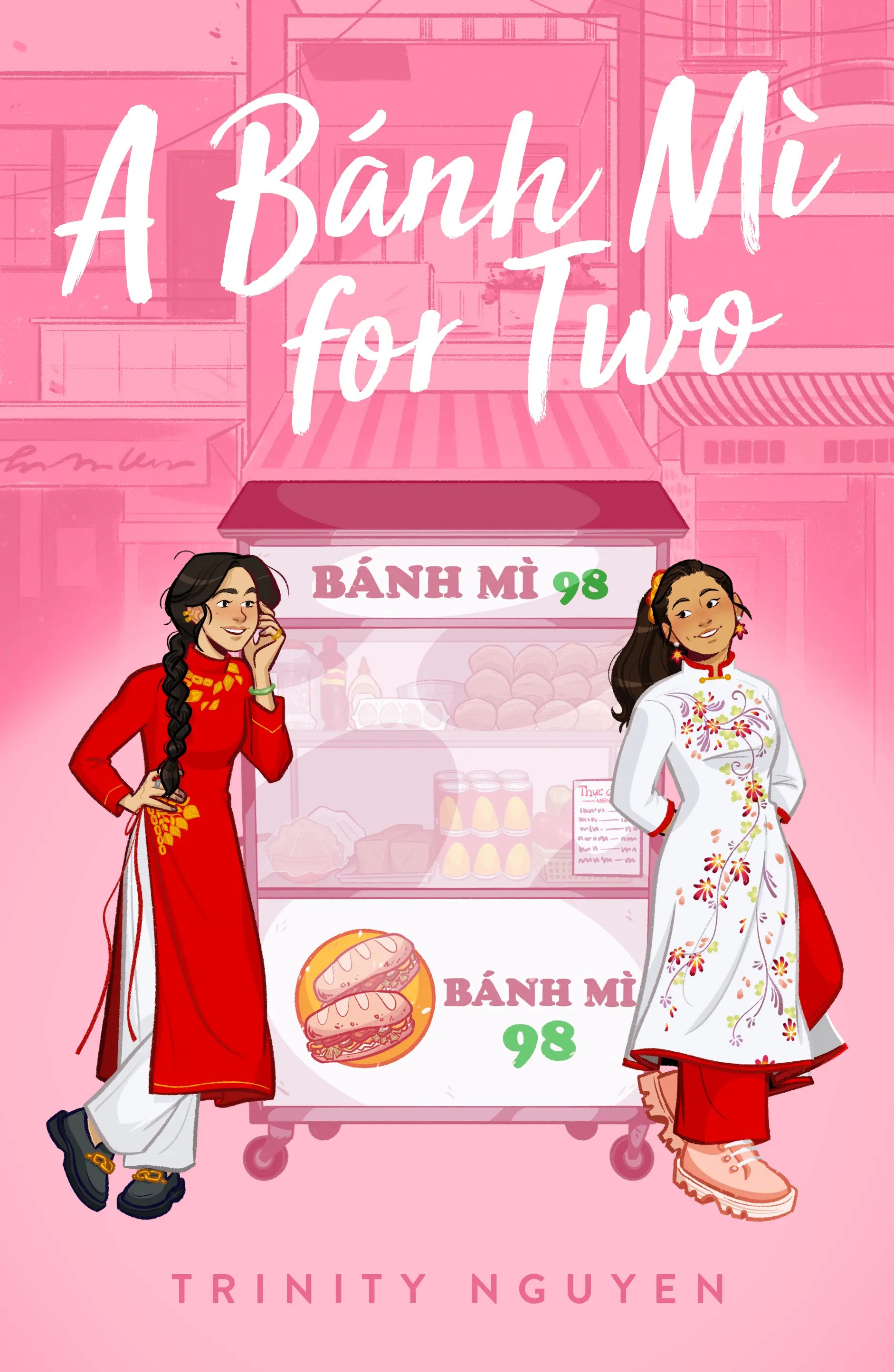
A sweet, closed-door sapphic romance set in Sài Gòn, where two foodie 18-year-olds fall for each other while uncovering family secrets and rekindling a love of food writing.
Summary:
In Sài Gòn, Lan is always trying to be the perfect daughter, dependable and willing to care for her widowed mother and their bánh mì stall. Her secret passion, however, is A Bánh Mì for Two, the food blog she started with her father but has stopped updating since his passing.
Meanwhile, Vietnamese American Vivi Huynh, has never been to Việt Nam. Her parents rarely talk about the homeland that clearly haunts them. So Vivi secretly goes to Vietnam for a study abroad program her freshman year of college. She’s determined to figure out why her parents left, and to try everything she’s seen on her favorite food blog, A Bánh Mì for Two.
When Vivi and Lan meet in Sài Gòn, they strike a deal. Lan will show Vivi around the city, helping her piece together her mother’s story through crumbling photographs and old memories. Vivi will help Lan start writing again so she can enter a food blogging contest. And slowly, as they explore the city and their pasts, Vivi and Lan fall in love.
Review:
I love a sweet, closed-door sapphic romance (see my review of Hani and Ishu’s Guide to Fake Dating), so when I heard about A Bánh Mì for Two, it was an easy add to my wishlist. The focus on food blogging and Vietnamese street food—both eating it and running a street food cart—was just the icing on the cake. This story strikes a delicate yet exquisite balance between lighthearted sweetness and the very real multigenerational trauma caused by the Vietnam War (referred to in Vietnam as The War Against the Americans to Save the Nation).
Told in alternating first-person perspectives between Lan and Vivi, the book avoids the common pitfall of muddled voices. While both characters are kind and thoughtful, they each have distinct ways of seeing the world, which keeps their narration clear and engaging. The romance is a sweet, slow burn, beginning with Vivi’s admiration of Lan’s food blog and blossoming into real-world chemistry after a chance encounter in Sài Gòn.
I especially appreciated the queer representation. There’s no on-page angst about being queer. Vivi does talk briefly with her friend Cindy (a Mexican American character) about how coming out can be complicated with conservative parents, but by the time the story begins, both girls’ families are accepting. It was also refreshing to see Vivi clearly identify as bisexual—representation that could’ve been easily overlooked since her only relationship in the book is with Lan. It’s affirming and intentional, which I loved.
The food descriptions are vivid but never overdone. They strike just the right balance between informing the reader (especially for dishes that might be unfamiliar) and keeping the flow natural. (I’ve eaten many a bánh mì in my life, and still found the food writing delightful!) I also really appreciated that this is a story about two 18-year-olds, and college isn’t presented as the only post–high school option. Lan’s mom encourages her to pursue school if she wants to, but also supports her jumping right into a career—a rare and welcome take in YA-adjacent fiction.
Vivi’s experience as a Vietnamese American studying abroad in Vietnam adds a beautiful emotional layer. She’s not a tourist—she’s searching for a kind of homecoming. She’s exploring why her mother kept so many details about Vietnam and their family a secret. This process is a powerful lens for the reader to learn about the war’s impact on Vietnamese families without the book ever feeling preachy. The historical context emerges naturally—through conversations, shared meals, and street encounters. It’s excellent writing.
The romantic progression between Lan and Vivi is tender and believable. One of my favorite parts was the motorbike rides around Sài Gòn—evocative, cinematic, and intimate. Even the third-act conflict felt justified. It wasn’t a contrived misunderstanding but a believable clash of cultural differences and personal pain. No one is villainized, and the resolution feels earned.
That said, a few elements pulled me out of the story. For example, Vivi’s study abroad program is mentioned as her reason for being in Vietnam, but we never actually see her attend class or study. This absence feels like a missed opportunity—readers might expect the study abroad setting to include some academic context. Similarly, while the book opens with several references to Vivi lying to her mom about her location—including photoshopping photos—the tension fades away later in the book. I found it a bit hard to believe that her mom wouldn’t catch on sooner.
The book is richly diverse, featuring Vietnamese and Vietnamese American characters, a Mexican American side character, and a sapphic romance at the center. Lan’s mother has a chronic illness, and her father passed away young from a stroke. The book also explores difficult family dynamics, grief, and healing across generations.
Overall, this is a fun, sweet sapphic romance featuring the beloved tropes of slow burn and study abroad, while offering thoughtful reflections on Vietnamese culture, family history, and the legacy of war. It’s beautifully steeped in food, healing, and love. Recommended for anyone looking for a sweet, queer romance with emotional depth, cross-cultural exploration, and heartwarming food moments.
If you found this review helpful, please consider tipping me on ko-fi, checking out my digital items in my ko-fi shop, buying one of my publications, using one of my referral or coupon codes, signing up for my free microfiction monthly newsletter, or tuning into my podcast. Thank you for your support!
4 out of 5 stars
Length: 224 pages – average but on the shorter side
Source: Library
Buy It (Amazon or Bookshop.org)
Book Review: Garlic, an Edible Biography: The History, Politics, and Mythology Behind the World’s Most Pungent Food — With Over 100 Recipes by Robin Cherry
 Summary:
A history of the world and medicine as seen through the eyes of garlic, plus a lesson on the many varieties of garlic, how to grow it, and where to find other garlic lovers. Topped off with a collection of over 100 recipes from all over the world featuring garlic, both historic and new.
Review:
When I saw this book on NetGalley, I knew I needed a review copy. I’m a passionate home chef with a love of garlic and a never-ending interest on the history of food. This book’s title indicated it would hit all three of those interests, and its content did not let me down.
The book is divided into two parts. Part One focuses on everything but the recipes. Part Two is the recipes. Part One’s chapters cover the history of using garlic for health and for food, garlic in legends and lore, and how to grow your own. This is the section that most entertained my friends and fiancé, as they found themselves the recipients of random facts about garlic. One friend received an email of all of the types of garlic that originated in the country of Georgia; another a tip that growing some near her fruit tree might be beneficial for the tree. Here are a few of my favorite facts that I learned in Part One:
- The world’s first-known medical text also mentions medical uses of garlic (loc 129)
- Garlic is designated as a drug in Japan (loc 222)
- Spanish immigrants were the most likely to survive during the colonization of the Western hemisphere, thanks to their consumption of garlic. Carrying the cloves protected them from disease-carrying mosquitoes. (loc 309-313)
- Garlic vodka is used as an antiflu remedy in Russia (Bonus: the book has the recipe for making this for yourself). (loc 392)
- “In addition to preventing colds, garlic is effective in killing viral meningitis, viral pneumonia, influenza, and herpes.” (loc 423)
- “Garlic also kills bacteria directly, by invading its cells and causing them to explode, thus bacteria has not opportunity to develop a resistance to it.” (loc 427)
- “Green-colored garlic is stronger than white garlic because it contains more of the aromatic sulfuric compounds.” (loc 922)
- The earliest bridal bouquets incorporated garlic to ward off the evil spirits. (loc 1067)
- There are over 200 varieties of garlic. (loc 1203)
Part One ends with tips on how to cultivate garlic and a selection of the various types of garlic, including notes on where they grow best, how they look, and how they taste. Garlic may be broadly divided into hardnecks and softnecks, but there are subvarieties within these two main ones. (Softnecks are the ones that you can braid). My one criticism of Part One is that I wish it had gone more in-depth into the history of garlic all over the world. It left me wanting more. Perhaps there isn’t more, but I certainly wish there was. I would additionally note that, although I personally enjoyed reading about the many varieties of garlic and took copious notes, some readers might find the listing of the types a bit tedious to read and may not be expecting it in a book of this nature.
Part Two is the recipes. It starts with notes on how to handle and prepare garlic. The recipes are then divided into: dips, sauces, and condiments; bread, pizza, and pasta; soups; salads and salad dressings; appetizers; poultry; lamb; beef; seafood; vegetarian; side dishes; dessert; and historical recipes. I marked off a total of 19 recipes that I definitely want to try, which is quite a lot for me. Often I’ll read a cookbook and only be interested in one or two of the recipes. The recipes cover a nice variety of cuisines, and the historic recipes are fascinating, although most readers will probably not try them as they require things such as fresh blood. Besides the historic recipes, the dessert ones are probably the most surprising. I actually did mark one off as one I’d like to try–Roasted Garlic Creme Brulee.
I have managed to make one of the recipes so far: Garlic Scape Pesto (loc 1649). For those who don’t know, garlic scapes are the green stalks that grow out of the bulbs. They must be trimmed (on most varieties). They taste a bit like a cross between garlic and leeks. Our local produce box happened to give us a bunch of them right around when I read the book, and I’m a big pesto fan, so I decided to try the recipe.
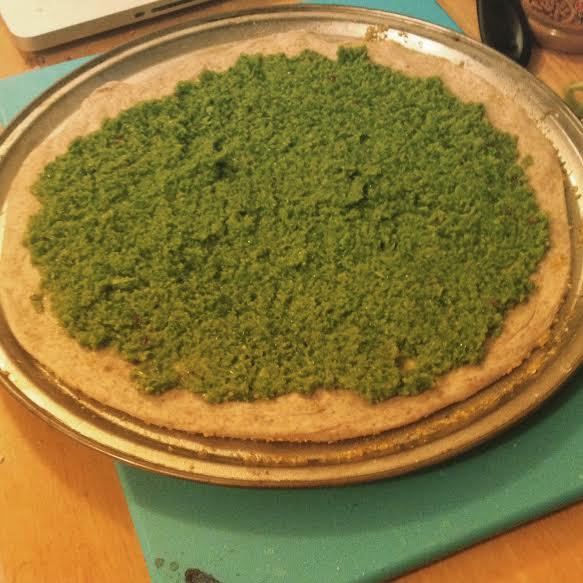
Garlic Scape Pesto on top of my pizza crust, before the rest of the toppings were added.
The recipe is supposed to make 2 cups. I halved it, and somehow still wound up with 2 cups of pesto. The recipe suggests storing the leftovers under a layer of olive oil. I found that unnecessary. My extra kept in the fridge in a tupperware container for a week without adding a layer of protective oil. The pesto was truly delicious though. I partially chose it since I have made garlic scape pesto before, and I must say I found this one much more delicious than the other recipe that I tried. I am looking forward to trying the others I am interested in, although I will probably continue to halve the recipes, as I am only cooking for two.
Overall, foodies with a love of garlic will find this book both fascinating and a source of new recipes to try. Some readers may wish for more information, while others may find themselves a bit more informed on the varieties of garlic than they were really looking for. All will find themselves chock full of new information and eager to try new ways to use garlic…and perhaps even to start growing some heirloom varieties for themselves.
If you found this review helpful, please consider tipping me on ko-fi, checking out my digital items available in my ko-fi shop, buying one of my publications, or using one of my referral/coupon codes. Thank you for your support!
4 out of 5 stars
Length: 240 pages – average but on the shorter side
Source: NetGalley

Book Review: Lunch in Paris: A Love Story, With Recipes by Elizabeth Bard
 Summary:
Elizabeth has always been drawn to museums and the Old World, so when she’s doing her graduate work in London and meets Gwendal, a Frenchman, she jumps right into dating him. Gradually she falls for not just Gwendal, but Paris in general, especially the food. This memoir tells about her falling in love and the process of becoming an expat in France through the lens of food.
Review:
This memoir starts out strong. Who doesn’t enjoy a good real life love story? Paris sounds incredibly romantic and appealing to anyone who enjoys open food markets, museums, and the big city charm of small spaces. Two things held me back from really enjoying the book though.
First, as a vegetarian, I really didn’t appreciate the incredibly long and frequent sections describing eating meat, cooking meat, how awesome meat is, etc… Where Elizabeth describes her future husband, Gwendal, telling her “I love you” for the first time over a piece of bloody meat, I was thoroughly distracted by the poor, dead, bleeding animal. I could not identify with Elizabeth at all in these frequent sections. How can she claim to be a romantic at heart yet have so much of her life revolve around eating innocent creatures? I wound up skimming a lot.
Granted, I know readers who enjoy eating meat themselves won’t be bothered by these passages, but I am fairly certain they’ll be irritated by the change of tone of voice partway through the narrative. From telling us about how lucky she is to be living this life in Paris, Elizabeth suddenly changes into a bit of a pity party. Poor Elizabeth, living in Paris with a man who loves her, cooking food for him every day, giving tours of the Louvre. This isn’t how she imagined her life would work out. Um….ok. I’d suggest Elizabeth try reading some memoirs of true struggles such as The Glass Castle and get back to us.
Overall, the scenes of real Paris life are interesting and enjoyable, but the frequent scenes featuring bloody meat and Elizabeth’s pity party really detract from the book. If you are a meat eater yourself and a foodie, you’ll probably enjoy this memoir anyway. I’d advise others to stay away.
3 out of 5 stars
Source: Amazon

 Support my work with a tip or browse my shop for curated book club guides, how to guides, cross-stitch patterns, and more!


This work by Amanda Nevius is licensed under a Creative Commons Attribution-Noncommercial-No Derivative Works 3.0 United States License.
 Opinions of a Wolf