
Archive
Book Review: Trespasses: A Memoir by Lacy M. Johnson
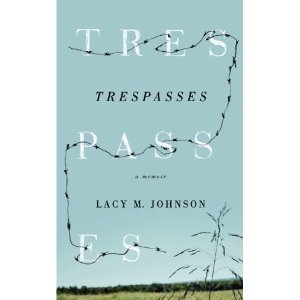 Summary:
Lacy grew up in Missouri to a traditional, poor farming family that never bothered to keep track of its European roots. Through interviews with her family members and a series of personal vignettes, Lacy explores what it is to be white and poor in America, the farming community, and the odd in-between Missouri inhabits as not quite southern and not quite midwestern.
Review:
The concept behind this book is excellent. The execution is discombobulated with a few gems at best, off-putting to the reader at worst.
I think what is most difficult about this book as a reader is that we jump around through time and situations with no guidance. Who is Judith? How is she related to Archie? For that matter, how is she related to the author? We have no real idea. I’m not against the jumps around the family time-line as a method in contrast to the more traditional linear timeline, but the reader needs to know who we are reading about. I honestly think an intro with a simple, straight-forward family tree would have helped immensely. Instead we have to wait until later in the book to determine who these women are that the author is speaking about. It leaves things confused.
Then there’s the narration style. It jumps from “you are so and so” to third person to first person past to first person present without any real rhyme or reason. I can appreciate the style of the individual vignettes. Individually, they are well-written. But assembled together into one single book where they are all supposed to tell a cohesive story, they are puzzling and off-putting.
The absolute strength of the work is when Lacy puts down her story-telling mantel and simply talks about the history of the terms “white trash, cracker,” what it is to grow up white trash, what it is to change class setting from poor to academic. These were interesting and relatable. I believe this is the author’s strong point and would encourage her to pursue this in future works. It is certainly an experience that she is not alone in having in her lifetime.
Overall although the concept of this memoir is strong and unique, the method of time-jumping vignettes and constantly changing narration styles make for a confusing read. I would recommend you browse a copy in a library or a bookstore if you are interested in the author’s writing style or one or two particular vignettes, but not venture beyond that.
2 out of 5 stars
Source: NetGalley

Book Review: The Book of Lost Fragrances by M. J. Rose (Series, #4)
 Summary:
Jac ran away from her family’s traditional perfumerie in Paris to pursue a career in mythology in her mother’s homeland of the USA. This move was spurred on by her mother’s suicide, and Jac’s own subsequent loss of touch with reality. Years of therapy later, all is well, but when Jac’s brother and current manager of the perfumerie goes missing, Jac must face up to her demons at home, as well as scenes in her own mind. Are they delusions or past life memories?
Review:
I requested this on NetGalley without realizing it was part of a series, but it is evident each entry in the series is about different people whose lives intertwine in a minor way. Thus, I was able to read this book without feeling that sense of disorientation that happens when you jump into the middle of a series. I’m glad too, because I found the story an intriguingly different plot-line for a thriller.
Essentially, there are some pottery pieces that Robbie discovers in his home that may or may not have once held a scent that allows whoever smells it to remember their past lives. A past life therapist wants these pottery pieces, Robbie wants to give them to the Dalia Lama, and the Chinese government wants to keep them out of the Dalai Lama’s hand in their on-going quest against Tibet. It’s a good big world plot, but the overall focus is mostly on Jac, which is how I tend to prefer thrillers. And Jac is a great character. She is strong, intelligent, a caring sister. She had a rough childhood, but still has her head on straight. Her struggle with whether or not she had past lives ends up not being as important as the reader might at first think, which I also appreciated. Jac’s character development is about accepting herself for who she is and not making selfish choices. It is not at all the romance I thought at first it was going to be, and that is a good thing.
Rose evokes the settings of Paris and NYC with equal aptitude. I must say I found myself craving an afternoon at the museum and some creperies when I was done with the book. The perfumerie business and house are equally beautiful and easy to picture, but also the tunnels underneath Paris are evoked well. Setting and characterization are strong points of Rose’s.
I did periodically feel the book moved too slow in the beginning. Also, I was disappointed that people who were evil now were evil in past lives and the good were always good. Similarly, only one person had a past life as a different gender. I get it that Rose’s point is that one needs to know one’s past lives in order to fix your mistakes that you make over and over, but I think it’s a bit short-sighted to think that if reincarnation did exist it would be that simplistic. Also, personally, I just don’t believe in soul mates, so having that as a strong theme in the book was rather eye-roll inducing.
Overall, this is a fun worldwide thriller with educated people at the center of it that includes thought-provoking themes like self-improvement and self-acceptance. Fans of the modern, globe-spanning thriller will enjoy it, as well as anyone who has a love of Paris.
4 out of 5 stars
Source: NetGalley

Previous Books In Series:
The Reincarnationist
The Memorist
The Hypnotist


Book Review: The Walking Dead: Rise of the Governor by Robert Kirkman and Jay Bonansinga (Series, #1)
 Summary:
The first in a prequel trilogy that relates how the baddest villain of The Walking Dead’s zombie apocalypse came to be–not just how he came to rule Woodbury, but how he became an evil sociopath.
Review:
Wow. Just wow. If I could be a good book blogger and just say that I would, but I can’t so I suppose I must attempt to put my love for this book into words.
First of all, it’s important to know that this is sort of a prequel to The Walking Dead graphic novels. It’s the origin story of The Governor (aka one of the most evil comic book villains ever). Only instead of sticking to his graphic novel format, Kirkman, with the assistance of Bonansinga, went with the written word. Now, I was offered this book as an audiobook, and I have to say this really affected my reading of it. The reader, Fred Berman, does an absolutely amazing job. He has a natural standard American accent, but seamlessly slips into a Southern drawl when the characters speak. Beyond this though he is able to bring the anguish and tensity to the survival scenes that is necessary without seeming melodramatic. It reminded me of being read to by my own father when I was a little girl. I found myself choosing to curl up with the audiobook over many other activities. So. I’m not sure if the experience is the same reading it yourself. I do know that listening to the audiobook is a remarkable experience.
Now, this is a zombie apocalypse horror novel about an evil man. It gets uncomfortable. Kirkman and Bonansinga bring us inside the minds of men warped by situations and psychiatric problems alike. It’s not pretty. It makes you squirm. But it’s supposed to. Some reviewers have accused this book of being misogynistic because bad things seem to happen an awful lot to the female characters. I have a couple of things to say about that. First of all, hello, do you live in this world? Because women have to survive a lot of bad shit. Second, this is an apocalypse. Think of it as a war zone. Do women get molested, raped, murdered, treated as less strong and unequal? Absolutely. The book isn’t misogynistic. It’s realistic about how a south torn apart by zombies would treat women. The way to determine if a book in this sort of situation is misogynistic is to look at how the author treats the women. Does he present them as hysterical, over-reacting? Do they refuse to stand up for themselves? I can unequivocally say that although horrible things happen to the women in this book, they fight for themselves. It is therefore not misogynistic, but realistic.
Now one thing that probably a lot of people wonder is is the story predictable? We already know who The Governor is and that he keeps his zombie daughter as a pet. That would seem to remove the ability for the authors to surprise us at all. I am happy to say that in spite of knowing the end result, this story kept me on the edge of my seat. Some readers didn’t like all of the surprises and twists. Personally, I feel that they brought the novel up a notch in both talent and enjoyability.
Overall, this is a wonderful addition to The Walking Dead canon. Fans of the graphic novel series will not be disappointed, although fans of the tv show seem to be taken aback by it. All I can say is that the books don’t pull any punches and are not for the squeamish. If you don’t want to be challenged, stick to tv. Everyone else should scoop this up as soon as possible.
5 out of 5 stars
Source: Copy from the publisher in exchange for my honest review and a giveaway

Book Review: Natural Brilliance: A Buddhist System for Uncovering Your Strengths and Letting Them Shine by Irini Rockwell
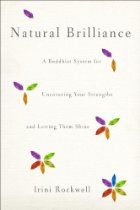 Summary:
Utilizing the traditional Buddhist five wisdoms–presence, clarity, richness, passion, and action, Rockwell seeks to show readers their own personal strengths and possible weaknesses. Rockwell then seeks to demonstrate how to bring out the other three to four wisdoms within your personality to achieve more balance.
Review:
Before I had a book blog, I read quite a bit of Buddhist literature. My minor was Religious Studies, and I also had an interest in it from a psychiatric and personal perspective. Certain aspects of Buddhism are used in modern psychiatric treatments, for instance. In any case, this is not my first Buddhist read. I am familiar with a lot of the terminology and ideas. This book though was nearly impossible to follow. Quite possibly the worst book on Buddhism I’ve ever come across.
First, there’s how Rockwell talks about the five wisdoms. Instead of consistently calling them by either their English name, Sanskrit name, or a hyphenated version of the two like most Buddhist works do, Rockwell bafflingly switches back and forth between English and Sanskrit without any rhyme or reason. Particularly in an ebook where it’s difficult to flip back to the earlier pages where the wisdoms were introduced, this makes it really hard to follow the author’s thought-process.
Similarly, random information is inserted but then not fully explained. I wonder if in the print version these are set apart in boxes? Not sure. For instance, the section introducing the five wisdoms has a completely random blip about the colors Tibetan Buddhism associates with them inserted in the text between the fourth and fifth wisdoms. It’s just jarring and odd.
Finally, I didn’t really learn anything of value from the book. Rockwell talks at length about what a person who is mostly possessing the wisdom of passion might look, behave, and even dress like, but not much is discussed about how to put this knowledge to good use. It’s almost as if Rockwell got so caught up in describing the wisdoms that he forgot to talk to us about how to put this knowledge to much use. Besides, does it really help to know to label the person who is passionate as exhibiting the passion wisdom? We already know instinctively what they are like and how to deal with them. Labeling it doesn’t really help, does it?
Overall, I found this book to offer very little in a way of self-improvement or aid in dealing with people. It is confusingly organized without much valuable information within it. Although it is a readable book that is not at all offensive, it just doesn’t seem like reading it is worth the time.
2 out of 5 stars
Source: NetGalley

Book Review: Dead Harvest by Chris F. Holm (Series, #1)
 Summary:
Sam sold his soul to the devil in the 1940s and ever since then he’s been hopping from body to body, possessing and utilizing them to perform his task–collect the souls of the dammed. Although he can possess anyone, he prefers the recently dead. His new assignment stops him dead in his tracks though when he touches the 17 year old girl’s soul, a girl who supposedly killed her mother, father, and brother in cold blood, and finds it untainted. His refusal to collect her sends both angels and demons after him, eager to restore the balance, but Sam insists that collecting her soul will only bring about the Apocalypse.
Review:
I’m not sure why, but somewhere between my email from Angry Robot about this then upcoming book and actually reading it, I forgot what it was about and assumed from the title that it’s about zombies. Um, not so much? Haha. Actually, it is an urban fantasy film noir. Instead of a detective we have a collector, who, a friend pointed out to me, is basically the same as Sam the Reaper on the tv show Reaper. Our femme fatale is Lilith (you know, the first woman god made but she refused to be subservient to man so she got kicked out of the garden and went and hung out with demons. I always liked her). It all sounds super-cool, but I was left feeling very luke-warm about the whole thing.
First, there’s how Sam talks, which I get is supposed to come across as witty banter, but I myself didn’t find that amusing. Perhaps I’m way too familiar with the classic works of film noir and to me this just didn’t measure up. Perhaps I’m just a mismatch for it. I feel like people with a slightly different sense of humor would enjoy it more, though. Personally it just read as Sam trying too hard to sound suave, which I always find annoying.
My other big issue with the story is a couple of really unbelievable action sequences. Ok, I get it that this is urban fantasy, but even within that we still need believability. What do I mean by this? Well, if something huge happens that affects the mortals, there should be discussion of how the immortals cover it up or deal with the fall-out. This doesn’t really happen in this book. One sequence in particular that bugged me involved Sam and the 17 year old hijacking a helicopter, flying it all over NYC, then crashing it in a park AND THEY GET AWAY. Does anyone believe this could actually happen in a post 9/11 world unless some sort of otherworldly shielding was going on? I don’t think so. It was at this point that I knew the book was just not gonna work for me.
Does this mean that I think it’s a badly written book? No. It’s an interesting twist on urban fantasy and film noir simultaneously. The characters are interesting, and the plot wraps-up fairly well. I personally found it difficult to get into and found some sequences simply too ridiculous to believe. However, I do think other people might enjoy it more, perhaps someone who has an intense love for urban fantasy and doesn’t mind ridiculous situations.
3 out of 5 stars
Source: Kindle copy from publisher in exchange for my honest review

Book Review: The Child Who by Simon Lelic
 Summary:
A gruesome murder has thrown a British county up-in-arms, and Leo Curtice finds himself the attorney randomly assigned to defend the murderer–a 12 year old boy who killed and sexually assaulted an 11 year old girl. He finds himself seeking to understand what would make a 12 year old kill and finding more empathy for the boy than those around him think is allowable. Meanwhile, threats start coming in against his own family, including his 15 year old daughter.
Review:
This is a ripped from the headlines style novel that falls far short of others in its genre. Apparently, Britain has a real problem with child murderers. The thing is, though, when you’re writing a ripped from the headlines type story, your fictional version needs to bring something to the table that the real life stories and newspaper articles can’t or don’t. 
It’s also problematic when you google about child murderers in Britain and the stories that come up are far more fascinating than the novel you just read. Stories like Robert Thompson and Jon Venables, two ten year olds who tortured and murdered a two year old. Or Mary Bell an eleven year old who killed and tortured other children without remorse. In contrast our story here is about a twelve year old boy who hits on an eleven year old, is rebuffed, and proceeds to knock her down, bludgeon her, and assault her with a stick. Horrible? Yes. But with far more motive than two ten year olds abducting and killing a two year old. See the difference? The true to life stories push us to question and understand human development and behavior. The fake one seems rather easily written off as a vicious twelve year old who can’t handle the word no from a girl he likes. It’s as if the author was trying to play off of a phenomenon in Britain but missed the crux of what makes it so fascinating. Twelve is hardly a youth in the way that ten is.
Then there is the whole side-plot about Curtice’s daughter. From the beginning of the book you think she was murdered eventually somehow in some connection with the case. Wanting to find out how this occurred is what keeps the reader interested and the plot moving in spite of the problems addressed earlier. This, though, is ultimately a red herring of a plot point. The daughter was a runaway. Yes, the father didn’t know it at first, but she just ran away because of all the stress from the case. That’s it. As a reader, it felt like Lelic played a dirty trick on me, and I really didn’t like that.
Ultimately, Lelic tried to write a ripped from the headlines style story akin to Room
2 out of 5 stars
Source: Netgalley

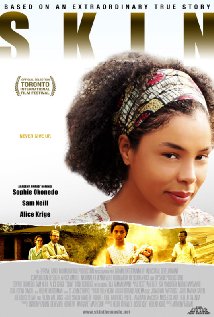
Movie Review: Skin (2008) South Africa
 Summary:
Based on a true story, Sandra Laing was born black to two white parents. Something that is an interesting anomaly of unacknowledged or unknown ancestors, but unfortunately for Sandra it was oh so much more than that. Sandra was born in South Africa during Apartheid, and her white Afrikaner parents were members of the National Party. This film chronicles her fascinating life from a young girl hidden from the sun in the hopes that her skin would lighten as she grew older to a young runaway marriage to striking out on her own with her children.
Review:
I know movie reviews have been scarce around here. That’s mostly because since I joined the gym my evening free time is spent either there or reading. This weekend though I had a cold and a bit of a fuzzy head from a fever so I randomly chose an interesting looking movie from my Netflix recommendations. I had no idea when I chose it that Sandra Laing’s story is a true one. I didn’t realize this bit of information until the end credits. I thought it was one of those “what if” scenarios and knowing that this actually happened makes the whole thing incredibly painful.
We know that innate parental unconditional love is a myth. And if there was ever a true story that should unequivocally dispel this myth once and for all, it’s Sandra’s. Is there anything more abusive, more unloving than raising your child in a culture that hates her and doing, really, nothing about it? Although her parents did fight to have her classified as white and not colored (so they could keep custody of her, because apparently children had to be raised by parents of the same race during Apartheid), they did little else to protect her. Indeed, by her teen years her father was pressuring her to behave for white boys who were being verbally cruel at best or attempting to rape her at worst on dates. It’s little wonder Sandra ran off to be with a black man she met. Your role as a parent should be to protect your child and prepare her to take care of herself in the real world and advocate for herself. But Sandra’s parents’ racism clouded everything so much that the most they did was attempt to hide her.
Of course, the problem then became that Sandra was raised in a privileged background, and that’s all some of the black South Africans could see when they looked at her, including her own husband. He says to her at one point, “You still think of yourself as white.” I find it fascinating how people can become so wrapped up in their own problems resulting from inequality that they fail to see the pain inflicted by it on others, even others that they love.
The actress who plays the older Sandra does a great job showing her progression from a hopeful teen to a downtrodden factory worker at the end of Apartheid. The trauma from a life where everyone judged her either on her own skin tone or that of her parents is abundantly evident on the actresses’ face.
That said, while the topic is incredibly important and the true life events heart-breaking, I don’t think the movie itself does the real story true justice. The actors and actresses did a fine job with what they were given, but even basic googling shows that the story was cleaned up for a mainstream audience, which I think was a very poor decision on the part of the filmmakers. Sandra’s life was actually more difficult than they even give her credit for. For instance, she left home at only 15 (she seems much older in the film), her first husband already had a first wife, she actually had six children not two, etc…. (Essence, The Guardian, Women and Hollywood)
Personally, I view this movie as a gateway to the far more fascinating nitty gritty true story. I’m adding the book by the journalist Judith Stone about her work with Sandra to attempt to figure out her past called When She Was White
4 out of 5 stars
Source: Netflix Instant

Book Review: Hellsbane by Paige Cuccaro (Series, #1)
 Summary:
Emma Jane Hellsbane has always had the ability to sense other people’s emotions, and she turned that into a comfortable career as a “psychic.” All that changes when the cute jock from highschool who mysteriously disappeared halfway through senior year lands on her doorstep with a clawed stomach. She swiftly finds out that he’s a nephilim–half human, half fallen angel–and so is she. Without intending to, Emma Jane finds herself swept into the war between the angels and the fallen, as well as attempting to pay off the debt for her father’s sin.
Review:
This was a classic case of not a bad book but I’m not the right audience for it. I definitely don’t think the summary of the book that I read was quite as clear about the book’s Christian leanings as the one I just wrote for ya’ll. If it was, I wouldn’t have picked it up.
What we have here is what I’m thinking is probably a new category of Christian fiction I was completely unaware of –Christian paranormal clean romance. Now, I know at least two of my followers who would absolutely LOVE this book for exactly those reasons. Alas, that’s exactly why I didn’t like it.
The Christian mores and doctrines have a strong presence. We even go so far as to have Emma Jane come from a Catholic family but be an agnostic herself until hell and heaven literally show up on her doorstep. As an agnostic myself, I found it rather patronizing to have an agnostic character proven wrong by flesh and blood angels and demons. Y’know, like that would ever actually happen in real life? The whole scene just felt smug. On the other hand, I could totally see as a Christian enjoying seeing someone convert from agnostic back to Catholic. And yes, this book is heavily Catholic. There is a lot of talk of saints and levels of sin and etc… This of course means that there are things that I just don’t agree with (like the whole Emma Jane being held responsible for her father’s sin), but that’s only natural considering that this book is geared toward people who believe in those sorts of things. Kind of like how I can’t stand The Chronicles of Narnia for similar reasons.
The fact that this is a Christian romance also means that there is ZERO SEX. There is one pretty tame kiss. If you want clean romance, this is your book, but if you’re like me it, um, is not.
The only thing that bothered me that I can’t chalk up to not being the target audience is the surprising lack of racial diversity in a book set in Pittsburgh. Seriously, woman, I know there are black people in Pittsburgh! And we’re not just talking oh the characters are white. They all seem to be blonde-haired, blue-eyed white people. This would make sense maybe in um….Wisconsin perhaps. Not Pittsburgh. Cuccaro really should focus on more diversity in her future books.
These things said, Cuccaro is generally a good writer. The plot is complex, the characters well-rounded, and the sentences are well-written.
Overall, this book is well-written for its target audience–Christian, probably Catholic readers looking for some clean paranormal romance. If this sounds like you, you should check it out.
3 out of 5 stars
Source: Netgalley

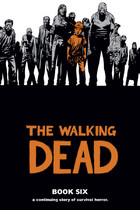
Book Review: The Walking Dead, Book Six by Robert Kirkman (Series, #6) (Graphic Novel)
 Summary:
The group continues to slowly lose their collective minds, although it is quickly made evident that they haven’t gone as crazy as some groups when they find themselves stalked by living cannibals. Toss in a preacher who failed to protect his flock and what turned out to be a pack of lies from the scientist, and it’s no wonder the group is suspicious when a couple of men approach and offer them refuge in an idyllic community just outside of DC. They in their state of PTSD can’t stop seeing danger around every corner and don’t even realize the dangerous ones just might be themselves.
Review:
You know how they say you can always find someone in the world worse off than you? Well, the first part of book 6 seems to be all about proving that’s true, perhaps in a way to humanize the group prior to how abundantly evident their loss of humanity is in contrast to the DC compound. That isn’t to say I particularly enjoyed the cannibalism plot-line. I can see its value, yes, but I also feel like we’d already seen how bad humanity can go in Woodbury, and if people are going to be eating people, that’s what you have zombies for. So the first half of the book is kind of meh to me.
On the other hand, seeing our group in the DC compound is delicious. I think one of the pieces of artwork in the appendix at the back explores the contrast eloquently. Michonne is dressed up talking to a group of women at a party, but she’s hiding a sword behind her back. The group has become so used to constantly being turned on and at war with the zombies and other survivors that they cannot relax. Classic PTSD. It’s fascinating to see how even Carl can recognize that they are no longer like these people who’ve been able to have downtime in the zombie war. Anybody who understands war and trauma at all would know that these people need special care. Even just the way they clump up and sleep all together in spite of being offered separate quarters is a symptom of PTSD, and yet the DC group makes Rick a cop. Um….ok. A seriously questionable choice there, but then again, the mayor of DC did used to be in politics. And we all know how smart those types can be. *eye-roll*
In any case, it’s obvious that this book is setting things up for a show-down between our traumatized group and the DC folks. I’m enjoying seeing our main guys turn slowly evil, and I’m curious to see how far Kirkman is willing to take it. That said, the first half of the book with the cannibals seemed kind of unnecessary to me. I’d rather have seen more zombies. Overall, it moves the plot forward, but that plot momentum is left mostly to the second half of the book. Worthy of the series and hopefully book 7 will live up to the build-up.
4 out of 5 stars
Source: Public Library

Previous Books in Series:
The Walking Dead, Book One
The Walking Dead, Book Two
The Walking Dead, Book Three
The Walking Dead, Book Four
The Walking Dead, Book Five
Book Review: Succubus Blues by Richelle Mead (Series, #1) (Bottom of TBR Pile Challenge)
 Summary:
Georgina Kincaid is a succubus. Has been for hundreds of years. She’s currently assigned to the demon district of Seattle, but she’s not really feeling being a succubus anymore. Oh, sure, she still needs to eat sexual energy from men, but she tries to keep it to the low-lifes, like cheaters, and avoid the good guys. Thankfully her demon boss lets her lack of stealing souls for the bad side slide. All in all, life is pretty good for Georgina. Her favorite author is even coming to do a reading at the bookstore she works at! But one night a vampire is killed and threats start coming in against all the baddies in Seattle–including Georgina.
Review:
Sometimes the books I’ve read for the Bottom of TBR Pile Challenge make me wonder what the hell past Amanda was thinking, and other times they make me realize that past Amanda was still me…..and I really do love to love the bad guys. And hoo boy is this book ever about the bad guys! Also, sex. Lots of sex. I mean, a succubus has gotta eat.
Getting an urban fantasy that isn’t all about a demon slayer but instead is about the demons is just awesome. It is really fun to be rooting for the succubus, demons, and vampires, but not in a Sookie Stackhouse sort of way. These guys are the other side of the war, and are they ever fun. It’s obvious that Mead is aware that she’s flipping the typical story on its head from a delicious tongue-in-cheek scene in which an angel’s helper shows up completely covered up and mocking Georgina’s sexy succubus outfit and blushing at all the swear words the bad crowd tosses around. And it’s so true! The good guys wouldn’t be *fun*. The good guys would be boring, and they sure as hell wouldn’t say fuck.
Also, it’s nice that for once we pop into the middle of the main character’s life instead of meeting her right when she gets her powers. It lends more depth to the character, adds mystery, and lets us just get on with the supernatural. This makes for a much faster moving plot as well, which is definitely appreciate. Plus, there’s the historical aspect to Georgina’s flashbacks, and that’s always fun.
The sex scenes are well-written. Um, really well-written. *coughs* The love interest is realistically attractive and intelligent, which is pure win. For once we aren’t stuck with a gorgeous, perfect man. We have an imperfect one who is still totally loveable.
So what’s keeping it from five stars for me? I’m not a fan that Georgina has somehow turned into a reluctant succubus. I want my succubus to steal men’s life energy and LIKE IT. But I get it that this makes Georgina more lovable to probably just about everyone else. I am still hoping that this reluctance will change in the next book. Haha.
Overall, this is a delicious urban fantasy that I highly recommend to fans of the genre who enjoy steamy sex and rooting for the bad guys.
4 out of 5 stars
Source: PaperBackSwap

 Support my work with a tip or browse my shop for curated book club guides, how to guides, cross-stitch patterns, and more!


This work by Amanda Nevius is licensed under a Creative Commons Attribution-Noncommercial-No Derivative Works 3.0 United States License.
 Opinions of a Wolf