
Archive
Book Review: Buddha Volume Three Devadatta by Osamu Tezuka (Series, #3) (Graphic Novel)
 Summary:
Siddhartha is now a young monk pursuing knowledge and education. He runs into a one-eyed monk who attempts to educate him on the concept of ordeals–essentially punishments for the body designed to help attain enlightenment. The childhood of Devadatta is also depicted. He is bullied and becomes a killer at a young age, thrown out to the wolves who then raise him. Thus his hatred of humanity is explored.
Review:
I am consistently finding this series to be decidedly meh, yet I persist in reading it. I think the art is a large piece of why. It’s almost immediately relaxing to look at, so much so that it doesn’t really matter too much to me what the story is that’s going along with it.
I was intrigued to see a “raised by wolves” myth in another culture. It’s interesting that instead of turning Devadatta into a great warrior, though, it makes him hate humans. A great section is where the wolf mother tells Devadatta that humans are the only animals who kill when they are not hungry. The kindness of and lessons to be learned from the animal world is a persistent theme throughout the series that I enjoy.
Siddhartha’s journey here though does not read at all the way I read it in Siddhartha in college. I appreciate that we’re seeing how no one seems to have answers that ring true for him. For instance, he does not agree with choosing physical punishment purely to suffer an ordeal for no apparent reason. It’s interesting to see his nature depicted as one that just happens to be able to sniff out falseness. It’s a different perspective on the Buddha that I value seeing.
It is odd though for a graphic novel series on an important topic like the Buddha’s life to feel as if it is best read by those already educated on the Buddha. I assumed it would read like an easy introduction, but instead it is so subtle and leaves out so many key details that it is actually best read by those already well educated on Buddhism and the Buddha’s life.
3 out of 5 stars
Source: Public Library

Previous Books in Series:
Buddha, Volume 1: Kapilavastu
Buddha, Volume 2: The Four Encounters
Book Review: The Burning Sky by Joseph Robert Lewis (Series, #1)
 Summary:
In an alternate vision of history, the Ice Age has lingered in Europe, slowing down Europeans’ rate of civilization and allowing Ifrica (Africa) to take the lead. Add to this a disease in the New World that strikes down the invaders instead of vice versa, and suddenly global politics are entirely different. In this world, steam power has risen as the power of choice, and women are more likely to be the breadwinners. Taziri is an airship co-pilot whose airfield is attacked in an act of terrorism. She suddenly finds herself flying investigating marshals and a foreign doctor summoned by the queen herself all over the country. Soon the societal unrest allowing for a plot against the queen becomes abundantly clear.
Review:
Can I just say, finally someone wrote a steampunk book I actually like, and it’s a fellow indie kindle author to boot! All of the possibilities innate in steampunk that no other book I’ve read has taken advantage of are used to their fullest possibilities by Lewis.
I love that Lewis used uncontrollable environmental factors to change the political dynamics of the world. Anybody who has studied History for any length of time is aware how much of conquering and advancement is based on dumb luck. (The guns, germs, and steel theory). Lewis eloquently demonstrates how culture is created both by the people and their surroundings and opportunities. For instance, whereas in reality the Native Americans had to rely on dogs for assistance and transportation against invaders on horseback, Lewis has given the Incans giant cats and eagles that they tame to fight invaders. Similarly, in Europe the Europeans are constantly fighting a dangerous, cold environment and have dealt with this harsh landscape by becoming highly superstitious, religious people. This alternate setting allows for Lewis to play with questions of colonization, race, and technology versus tradition in thought-provoking ways.
Women are in positions of power in this world, but instead of making them either perfect or horrible as is often the short-coming of imagined matriarchies, there are good and bad women. Some of the women in power are brilliant and kind, while others are cruel. This is as it should be because women are people just like men. We’re not innately better or worse. Of course, I couldn’t help but enjoy a story where a soldier is mentioned then a character addresses her as ma’am, without anyone feeling the need to point out that this is a woman soldier. Her gender is just assumed. That was fun.
Although Taziri does seem to be the main focus of this book, the story is told by switching around among a few main characters who find themselves swept together in the finale for the ultimate battle to save or assassinate the queen. This strategy reminded me a bit of Michael Crichton’s Next where seemingly unrelated characters suddenly find how their destinies are all connected together. Lewis does a good job with this, although personally I found the beginning a bit slow-moving. It all comes together well in the end, though, with everything resulting in a surprising, yet logical, ending.
What kept me from completely loving the book is that I feel it needs to be slightly more tightly edited and paced. Some sections were longer than they needed to be, which I can certainly understand, because Lewis has made a fun world to play around in, but as a reader reading what amounts to a thriller, I wanted things to move faster.
That said, I thoroughly enjoyed exploring the steampunk world Lewis has created after a couple of years of loving the fashions and possibilities but finding no steampunk books I liked. If someone were to ask me where to start with steampunk, I would point them here since it demonstrates the possibilities for exploring race, colonization, and gender, showing that steampunk is more than just an extended Victorian era.
Overall this is a wonderful book, far better than the traditionally published steampunk I’ve read. I highly recommend it to fans of alternate history, political intrigue, and steampunk alike. Plus it’s only 99 cents on the kindle. You can’t beat prices like that.
4 out of 5 stars
Source: Won on LibraryThing from the author in exchange for my honest review

Book Review: The Walking Dead, Book 1 by Robert Kirkman (Series, #1) (Graphic Novel)
 Summary:
When cop Rick wakes up from a coma brought on by a gun shot wound, he discovers a post-apocalyptic mess and zombies everywhere. He sets off for Atlanta in search of his wife, Lori, and son, Carl, and soon teams up with a rag-tag group of survivors camped just outside of Atlanta.
Review:
I just want to point out that this review is purely focused on the graphic novel, not the tv series. I haven’t even seen more than 10 minutes of the tv show, so remember this is about the books not the show. Thanks! Moving along….
I almost gave up on this within the first few pages, because COME ON. Can we PLEASE get over the whole oh I had a coma and then woke up to a zombie apocalypse trope, please? First, it is so highly statistically unlikely that it was laughable the first few times it was used in my beloved dystopian novels, but at this point it just looks lazy. Come up with some other way to start the apocalypse, ok? I don’t care if your main character is out of touch with reality for a few days because he’s on a drug-fueled sex streak. At least it would be different! Also, a cop, really? You want me to root for a cop? And everyone trusts him because he’s a cop? A cop is the last person I would put in charge if I was a member of a rag-tag bunch of survivors; I’m just saying.
Once we move on beyond the initial set-up though to the group of survivors caravaning their way across America, the story vastly improves. The people are real. They’re scared. They’re angry. The snap easily. They hook up with whoever is convenient (and not necessarily young and hot). They teach the kids to use guns. It’s everything we know and love about post-apocalypse stories.
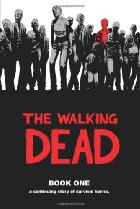
The artwork is good. Scenes are easy to interpret; characters are easy to tell apart. The zombies are deliciously grotesque, although I did find myself giggling at them saying “guk.” Guk? Really? Ok….
The best part, though, is the people that in your everyday life you are just like, come on, god, bolt of lighting, right here? They’re the ones who get eaten by zombies! It is excellent. So that really annoying chick in camp? Totally gets her head bit by a zombie. It’s cathartic and awesome.
The cast is diverse, and no, the black guy is not the first to be eaten (or the red shirt guy for that matter). It wouldn’t kill Kirkman to be a little less heteronormative, but he’s still got time and more survivors to add.
Overall, this is a good first entry in a zombie apocalypse series. Kirkman needs to be more careful to stay away from expected tropes in the genre and bring more of the creativity it is apparent he is capable of. I recommend it to fans of zombies, obviously. ;-)
4 out of 5 stars
Source: Public Library

If you found this review helpful, please consider tipping me on ko-fi, checking out my digital items available in my ko-fi shop, buying one of my publications, or using one of my referral/coupon codes. Thank you for your support!
Book Review: Tail of the Blue Bird by Nii Ayikwei Parkes (Ghanaian Lit Week)
 Summary:
When the girlfriend of the minister for roads and highways spots a disgusting red lump of flesh in a hut in the village Sonokrom, what normally would have been ignored and left to the villagers suddenly becomes a matter of national importance. Inspector Donkor wants a promotion, and he believes that one of the only forensics specialists in Ghana–Kayo–can get it for him.
What Kayo finds in the village is a people still steeped in the culture of the countryside, in touch with Onyame and the ancestors, drinkers of palm wine mixed with aphrodisiacs. Although he arrives with the mind of a scientist, soon his perceptions begin to change.
Review:
Kinna is one of the international bloggers I discovered through Amy, and she is awesome! She lives and works in Ghana and is interested in spreading literacy and love of reading in her own country, as well as interest in African lit everywhere. So when she announced that she was hosting a week in hour of Ghanaian lit, I knew I wanted to participate. Using the wonderful resource of tags in LibraryThing, I hunted down a book that LibraryThing was “mostly sure” I would like and ordered it from my library. Yet again, the book blogging world has brought me to a book I never would have read otherwise, but am glad I did.
This book reminds me a lot of The Summoner, only with the distinct bonus that it is a crime mystery set in Africa written by an African instead of a westerner who has visited. This means our detective hero is distinctly Ghanaian. Like all detectives, he drinks, but his drink of choice is palm wine enhanced by the village medicine man. Just typing out that sentence gave me the shivers of delight I got when I was reading the scenes of drinking and eating in the hut, which is the village pub managed by a woman and her adult daughter. It felt simultaneously familiar and new, which is one of the thrills of reading literature not written by one of your own countrymen.
Unlike western detective stories though, Parkes does not seem to feel a need to give a scientific explanation for every mysterious event that occurs. In fact, it is actually easier to believe the magical explanation than to wonder about the scientific explanation. For that reason I would definitely categorize this as “magical realism.” It is almost as if Sonokrom is a world unto itself, existing in some sort of parallel universe where magic is just an ordinary part of life.
The characters are all richly drawn and well-rounded. I had no trouble telling them apart in my mind. The method of switching perspectives from Kayo to the old man in the village works well. It allows the reader to see both the scientific and traditional perspectives and make up her own mind.
Some people may be bothered by the ambiguous/open-ended ending, but personally I feel that this is what the story needs. It leaves the reader to ponder upon the values of both tradition and modernity. Perhaps that is the point of the whole story.
Now, the book does throw in some Twi words here and there, but those are easily decipherable by context. The more difficult aspect as a non-African reader is the presence of Pidgin. Since whole sentences are written in Pidgin they were much more challenging for me. I must admit this small book took me quite a while to finish, compared to my usual reading rate. The Pidgin is not impossible, though, particularly if you have read widely among the various American dialects. An English dialect is an English dialect, after all.
Overall, I recommend this to those who enjoy both mystery and magical realism and don’t mind exploring a new dialect.
4 out of 5 stars
Length: 200 pages – average but on the shorter side
Source: Public Library
Buy It (Amazon or Bookshop.org)
If you found this review helpful, please consider tipping me on ko-fi, checking out my digital items available in my ko-fi shop, buying one of my publications, or using one of my referral/coupon codes. Thank you for your support!
Book Review: Buddha Volume Two The Four Encounters by Osamu Tezuka (Series, #2) (Graphic Novel)
 Summary:
The second entry in the novelization of the Buddha’s life takes us through Siddhartha’s youth spent as a prince. He meets a mysterious Brahmin who tells him he is destined to help the whole world, not rule a single kingdom. Siddhartha is weak, frequently sleeps, and has visions. He is discontent as a prince yet reluctant to abandon his people. On an adventure outside the castle walls he meets a grown-up Tatta and falls for a slave woman, Migaila. Conflict between what he believes and his duties as a prince seem central to the plot, yet in fact it is Siddhartha’s reluctance to follow his calling and leave the castle to be a monk that is at the core of the conflict.
Review:
I was pleased to see this entry in the series jump right into Siddhartha’s life instead of those on the periphery, yet Tezuka also brings in the major characters from the first book as minor characters in this one. It works well, definitely better than the first book. However, I am left wondering if the love between Siddhartha and a slave woman was based at all on fact or hearsay or purely came out of Tezuka’s mind. It would definitely give a new perspective on Siddhartha to know he once had an ill-fated love affair.
Although it’s important to know where the Buddha came from, it is difficult and not particularly enjoyable to read about the time in his life when he was a spoiled brat. Siddhartha does not treat his wife or his father well. Although he has natural talents with meditation and visions, he surprisingly lacks compassion for others. One of the things I like, of course, about the Buddha is that he did start out this way. He’s not perfect; he just learned and worked toward Nirvana. So it’s important to see this part of his life, even if it is uncomfortable to read.
I again felt distracted by the characters Tezuka made up though. I wish he had stuck to a straight-forward graphic novelization of Siddhartha or the legends of the Buddha at least. The weakest points of the book are the parts including characters Tezuka made up purely on his own.
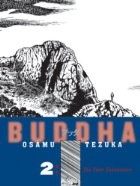
The art is again enjoyable but not amazing. The pictures show the story but do not suck you in. They give the feeling of being there to do a job, not necessarily to provide a memorable visual experience to the reader.
Overall, it’s an interesting new way to explore the life of the Buddha, but I would not recommend it to someone completely new to Siddhartha. It is an improvement over the first entry, and hopefully they will continue to improve, but an idea that could have been great is simply average. That’s disappointing.
3.5 out of 5 stars
Source: Public Library

Previous Books in Series:
Buddha, Volume 1: Kapilavastu
Book Review: From This Moment On by Shania Twain
 Summary:
Shania Twain shot to fame on the country music charts in 1995 with her second album The Woman in Me. Her music was part of the new generation of 90s country, featuring such artists as Toby Keith, Tim McGraw, Faith Hill, etc…, that would blend country and pop for a new sound. In her memoir Shani recounts her life from her childhood in the northern part of Ontario, Canada to her sudden fame to the heartbreaking realization that her husband was cheating on her with her best friend to her recovery and new life.
Review:
While other girls of the 90s were obsessed with The Spice Girls and Britney Spears, I fan girled out over Shania Twain. My family was a country music household to begin with, so getting my parents to be cool with me listening to pop was always a creative act. (I remember I got away with listening to Britney Spears by getting my mother to listen to Hit Me Baby One More Time and like it and then revealed that it was Britney Spears. I’ve always been a wily lady.) In any case, I needed to employ none of this trickery to listen to Shania. As country music she had the stamp of approval, plus my big brother had bought her cd. I was 8 years old when The Woman in Me came out, and I remember being completely blown away by “Any Man of Mine.” (Go watch the video. I can wait.) I was blown out of the water. Whereas most country I’d heard prior was all about love and heartbreak and cheating husbands, here was a woman saying loud and proud that she deserves to be treated right, dammit! Let’s just say it really appealed to the feminist inside me. When I found out she was from “the bush” of Canada and a poor family closely tied to Native culture, well, I was insanely curious, but Shania has always kept her private life private, so I was left to wonder. Needless to say, when I heard at the beginning of this year that Shania would be publishing a memoir, I pre-ordered it. I had to know more about this woman whose music so spoke to lonely little rural girl of the 90s.
Shania’s memoir is very different from any others I have read. She does not involve many storytelling tropes. She only quotes people twice in the entire book. She reflects a lot, similar to, perhaps, if you’ve ever had the chance to listen to an older relative think out loud about her life. It does not read like a story, but it does feel as if you were granted a couple hours of private access to one of the more private country stars.
The strongest part of the book is without a doubt when she is reflecting on her family and upbringing in Canada. It becomes abundantly clear that perhaps Shania’s reclusiveness has more to do with the fact that while she loved music she had no dreams of being a star. Her mother decided her daughter would be a star and pushed her into it.
Imagine what a burden that is for a young girl. I just wanted music, not necessarily a music career. But because I felt obligated by her dedication to me her singer, I never had the heart to consider anything else in life, even though I’d dreamed of maybe becoming a veterinarian. I also developed a passion for design and architecture that continues to this day. In fact, that’s probably what I would have pursued had my mother not been so forceful about music. (location 1634)
I find it fascinating how often famous people were pushed into that career path as a child. What makes parents do this? I remember when I was a kid I wanted to “be a star,” and my father sat me down and told me to think really hard about it, because I’d lose all privacy and normalcy. I gave up on the idea and decided to be a reclusive writer instead. So what makes other parents push their kids into it?
Well, it’s obvious Shania’s mother had an incredibly rough life. Her family was below the poverty line with young mouths to feed. Her mother’s relationship was abusive, and she struggled with depression.
The perpetual undertow of financial instability took its tool in other ways, as it usually does, compromising my parents’ love for each other at times and no doubt feeding my mother’s recurrent bouts of depression. (location 189)
Ah. I can only guess that Shania’s mother saw a chance for financial stability for her daughter’s future in her talent, pinpointing most of her life’s troubles on a lack of money. Funny how Shania then succeeded and went on to have similar problems simply on the opposite end of the financial spectrum.
The section of the book dealing with fame, recording, making music videos, etc… is frankly disappointing. Shania barely brushes the surface of what actually went on behind the scenes, instead focusing in on how drained and dissatisfied her newfound fame made her feel. Passages largely read like this:
I was starting to feel as if I’d lost my chops at life’s fundamentals—and I’d been someone who could survive on my own in a cabin in the woods with no running water or electricity in subzero temperatures and snow up to my butt. Now, with a skilled full-time staff at home to handle every domestic and personal chore for me, I felt…useless and inept. (location 4905)
An interesting reflection, no doubt, but I really wanted to know what happened during the, at the time controversial, “The Woman in Me” video shoot in Egypt, for example. Details like this combined with the reflections on the dissatisfaction of fame would have made for a more powerful book, in my opinion.
The last section of the book addresses Shania’s time off from music, the birth of her son Eja, and the dissolution of her marriage to music producer Mutt Lange. This part is hard to read, because it is so abundantly clear that those around her have used and abused Shania (her husband cheated on her with her best friend in Switzerland). This is a woman for whom for her whole life family and being in touch with nature have mattered to her far more than anything else, and yet these things seem to be denied her. It saddens me that the woman who sang such strong music has in fact spent most of her life trying to make other people happy. This memoir was written as a way to deal with the end of her marriage, and I hope that through it Shania has found some peace and starts listening to her heart about what she really values and needs. It is so evident in the last third of the book that she is trying to buy happiness with more and more property and perfectly built homes. If only there was some way for the peace and quiet loving singer/songwriters of the world to get their music to others without suffering from the entrapment of fame. Maybe the internet will help with that.
Overall, I found this to be a moving memoir, if a bit flawed. It meanders sometimes and skips over some things that fans would definitely want to know about, but it is an interesting insight into the mind and life of a famous country singer and gives an interesting look at the negative effects of fame, even if they aren’t as huge as drug overdoses.
4 out of 5 stars
Source: Amazon

Book Review: Like One of the Family by Alice Childress (The Real Help Reading Project)
 Summary:
Originally published as a serial in African-American papers in the 1950s this series of monologue-style short stories are all in the voice of Mildred–a daytime maid for white families in New York City. The monologues are all addressed to her best friend and downstairs neighbor, Marge, who is also a maid. The stories range from encounters with southern relatives of moderately minded employers to picnics threatened by the Ku Klux Klan to more everyday occurrences such as a dance that went bad and missing your boyfriend. Mildred’s spitfire personality comes through clearly throughout each entry.
Review:
With completion of this book, Amy and I are officially halfway through our The Real Help Reading Project! This book is our first piece of fiction to directly foray into the time era and relationships depicted in The Help, whereas the rest have shown the slave culture and racial issues leading up to that time period. I’m glad we got the historical context from our previous reads before tackling this one written during the Civil Rights era by an author who periodically worked as a maid herself.
The introduction by Trudier Harris is not to be missed. She provides excellent biographical details of Alice Childress, who was not only a black writer of fiction, but also wrote and performed in plays. I am very glad I took the time to read the introduction and get some context to the author. Harris points out that in real life some of the things the character Mildred says to her employers would at the very least have gotten her fired, so to a certain extent the situations are a bit of fantasy relief for black domestic workers. Mildred says what they wish they could say. Since we know Childress was a domestic worker herself, this certainly makes sense. I would hazard a guess that at least a few of the stories were real life situations that happened to her reworked so she got to actually say her mind without risking her livelihood. I love the concept of this for the basis of a series of short stories.
More than any other work we’ve read, Like One of the Family demonstrates the complexities of living in a forcibly segregated society. Mildred on the one hand works in close contact with white people and subway signs encourage everyone in New York City to respect everyone else, and yet her personal life is segregated. Mildred frequently points out how she can come into someone else’s home to work, but it wouldn’t be acceptable in society for that person to visit her as a friend or vice versa.
Another issue that Childress demonstrates with skill is how a segregated, racist society causes both black and white people to regard each other with undue suspicion. In one story Mildred’s employer asks her if it’s too hot for a dress Mildred already ironed for her and ponders another one. Mildred assumes that if she agrees with her employer that it’s too hot for the first dress, she’ll have to stay late to iron. Her employer instead of getting angry realizes that Mildred has been mistreated this way before and takes it upon herself to reassure Mildred that she herself is perfectly capable of ironing her own dresses and will not keep Mildred longer than their agreed upon quitting time. Of course, Mildred sometimes is the one who must hold her temper and calm irrational fears. In one particularly moving section she encounters a white maid in their respective employers’ shared washroom. The woman is afraid to touch Mildred, and it takes Mildred holding her temper and carefully explaining that they are more similar than different before the woman realizes how much more she has in common with Mildred than with her white employer. These types of scenes show that the Civil Rights movement required bravery in close, one-on-one settings in addition to the more obvious street demonstrations and sit-ins.
Of course the stories also highlight the active attempts at exploitation domestics often encountered. Mildred herself won’t put up for it, but Childress manages to also make it evident that some people might have to simply to get by. An example of this sort of exploitation is the woman who upon interviewing Mildred informs her that she will pay her the second and fourth week of every month for two weeks, regardless of whether that month had five weeks in it or not. What hits home reading these serials all at once that perhaps wouldn’t otherwise is how frequent such a slight was in a domestic’s life during this time period. Mildred does not just have one story like this. She has many.
Of course sometimes reading Mildred’s life all at once instead of periodically as it was intended was a bit desensitizing. Although Mildred had every right to be upset in each situation related, I found myself noticing more and more that Mildred was simply a character for Childress to espouse her views upon the world with. I quickly checked myself from getting bugged by that, though. Of course Childress had every right to be upset and did not originally intend this to be a book of Mildred’s life. Mildred was a vehicle through which to discuss current issues highly relevant to the readers of the paper. It is important in reading historic work to always keep context in mind.
Taking the stories as a whole, I believe they show what must have been one of the prime frustrations for those who cared about Civil Rights during that era, whether black or white. Mildred puts it perfectly:
I’m not upset about what anybody said or did but I’m hoppin’ mad about what they didn’t say or do either! (page 167)
Passivity in changing the system is nearly as bad as actively working to keep the system, and Mildred sees that. Of course what Mildred highlights is a key conundrum for the black domestic worker of the time–speak up and risk your job or stay silent at a cost to the overall condition of those stuck in the system? A very tough situation, and I, for one, am glad that many strong men and women of all races took the risk to stand up and change it.
Source: Copies graciously provided to both Amy and myself by the publisher in support of the project (Be sure to sign up for the giveaway. US only and International).

Discussion Questions:
- How do you think domestics decided where to draw the line in what they would and would not put up with in employment in white people’s homes?
- Some of Mildred’s employers seem to be sensitive to the racial and inequality issues and are very kind to Mildred. Be that as it may, do you think it is/was possible to hire a maid for your home and not have a racist mind-set?
- Do you think the employers Childress depicts attempting to exploit Mildred were doing so out of racism, a power-trip, or greediness or some combination or all three?
- Mildred points out multiple times that she feels that the public ads encouraging people to accept each other “in spite of” their differences are still racist. Do you think this is true?
Book Review: Buddha Volume 1 Kapilavastu by Osamu Tezuka (Graphic Novel) (series, #1)
 Summary:
The tale of the Buddha’s life is told peripherally to those of fictional, central characters. There is Tatta, an untouchable who can inhabit the bodies of animals. He is joined by Chapra, a slave who wants to become a warrior. Also there is Chapra’s mother and a young monk. Their lives are impacted by the birth of the Buddha.
Review:
I picked this up randomly from the shelf in the library, and I must say I was expecting a bit more focus on the Buddha than is present in the story. Instead this is one of those tales about fictional people living in the shadow of a world-changing person. I honestly was really excited about the idea of the story of the Buddha told in the graphic novel style, so that was a bit of a disappointment to me.
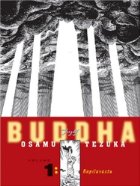
The art style is interesting. Somewhere between manga and more western-style animation. The characters are really easy to tell apart, though, which was a nice change from some manga.
Although the Buddha is mostly gestating and being born during the course of the book, Buddhist ideas are still present periodically in the storyline. One of my favorites is when a saint chastises the monk for how he orders Tatta to use his talents:
To save just one human, you mindlessly harnessed numerous beasts to an impossible task…and killed them one by one! The beasts you bent to your purpose all suffered greatly and died cruelly! You believe that human lives are sacrosanct while animal lives are worthless?!?! You saved [the human], but the beasts that you sacrificed for his sake are now beyond saving. Life is sacred whether or not it is human! (page 350-1)
It was fun to see these sorts of ideals in the context of a story, and I do always enjoy reading a graphic novel. The main story itself fell flat for me though. It mostly focuses in on Chapra attempting to become a great warrior and save his mother from being a slave, which I fail to see how that relates to the Buddha. As I said, though, this book was not what I was expecting, and I don’t tend to really go for warrior/mother tales. Except Oedipus.
Overall, the art is an interesting style and some of the ideas contained within the book are fun to see in fiction, but the main storyline separate from Buddha’s life simply did not resonate with me. Perhaps it will with you.
3 out of 5 stars
Source: Public Library
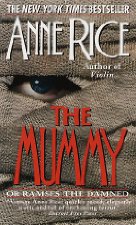
Book Review: The Mummy by Anne Rice (series #1)
 Summary:
Julie Stratford’s father is a retired shipping mogul who now spends his time as an archaeologist in Egypt. He uncovers a tomb that claims to be that of Ramses the Damned, even though his tomb was already found. Everything in the tomb is written in hieroglyphs, Latin, and Greek, and the mummy is accompanied by scrolls claiming that Ramses is immortal, was a lover of Cleopatra, and can and will rise again.
Review:
I’m a fan of Anne Rice. Her Vampire Chronicles are a lovely mix of social commentary, lyrical writing, and all the best tropes of genre fiction, so I was excited to stumble upon a cheap copy of The Mummy in the second-hand section of the bookstore. I wanted to love it. I really did. But whereas the Vampire Chronicles contain valid social commentary, this is so stereotypical of mainstream romance a la The Titanic that I was sorely disappointed.
Again, the language is lyrical and gorgeous. Rice without a doubt is incredibly talented at putting together sentences that read like a rich tapestry of old. There is no rushing to get the story out as is so often found in more modern writing. It’s fun to indulge the senses and oneself in the scene.
The plot, though, ohhhh the plot. It’s so mainstream romance it hurts. And yes, I know I read and enjoy (and write) paranormal romance, but the difference is that PNR is oftentimes tongue in cheek. It knows it’s ridiculous and over the top and doesn’t take itself too seriously. It’s meant to be fun and ridiculous. Rice is being serious here, however, and that’s why the plot bugs me. Let’s look at it for a second, shall we?
Girl is engaged to the perfect guy but she mysteriously does not think she loves him. Girl meets immortal man who is so hot he would be voted hottest man alive every year forever. Girl immediately “falls in love” with immortal guy. Girl ditches perfect guy for immortal guy. Girl and immortal guy have lots of the hot hot sex. Immortal guy causes a series of unfortunate events in pursuit of his ex-lover. Girl insists she still loves guy but cannot forgive him. Girl decides life is pointless without immortal guy. Girl attempts to kill herself. Immortal guy saves her. Girl forgives immortal guy. Girl agrees to become immortal too. Yay happily ever after.
Like….just……there are SO MANY parts of that that piss me the fuck off. So. Many. The main female character (Julie) is a shallow douchebag in spite of claiming to be a modern, progressive woman. She does not “fall in love” with Ramses. She falls in lust with him. He gives her tinglies in all the right places. He ditches her to pursue his ex-lover (Cleopatra). She, at first, rightfully tells him she can’t forgive him for that. But then she TRIES TO OFF HERSELF. OVER A GUY. And the only reason she doesn’t succeed is douchebag saves her. I just….wow. Not a plot I can respect. Not a plot that gives us anything different from the patriarchal rigamarole so often forced upon us. Anne Rice. I am disappointed.
Then there’s the odd eurocentrism at work in the narration. Even though Julie’s father loves Egypt and Ramses is, um, Egyptian, for some reason everything modern and European is what is impressive to everyone. I suppose I could maybe (maybe) forgive that, but then there’s the fact that the elixir that makes people immortal also for some mysterious reason turns their brown eyes blue. So nobody immortal has brown eyes. I don’t think I need to unpack why that’s offensive for you all. I trust you can figure that out for yourselves. Unlike Rice.
So, essentially, The Mummy is a beautifully written book that is destroyed by a kind of offensive, all-too-common plot and Eurocentrism. Even beautiful writing can’t overcome that.
3 out of 5 stars
Source: Harvard Books

Book Review: Dark Harvest by Norman Partridge
 Summary:
Every year the people of the town lock their boys aged sixteen to nineteen in their bedrooms for five days without food then let them loose on the night of Halloween for the Run. The October Boy, a living, breathing scarecrow stuffed with candy and topped by a jack-o-lantern head, will try to make it to the church by midnight. Whatever teenage boy stops him is the winner and is allowed past the Line to escape from town. Pete is determined to win this year, but not everything about the Run is as it at first appears.
Review:
This short book reads like a campfire story. I kept finding myself wishing I was huddled up around a campfire reading it out loud to my friends. The narration style is decidedly written that style. The style of a whispered urban legend or a campfire ghost story.
I don’t know what possessed Partridge to name this book Dark Harvest, when while I was reading it I definitely thought of it as The October Boy. Plus, Dark Harvest is a common name whereas The October Boy is not. The title is definitely one of the weakest points of the book.
Basically this story is an allegory for every teenager who ever felt trapped in a small town.
You remember how it feels, don’t you? All that desire scorching you straight through. Feeling like you’re penned up in a small-town cage, jailed by cornstalk bars. Knowing, just knowing, that you’ll be stuck in that quiet little town forever if you don’t take a chance. (page 41)
That desire and drive as a teenager to get the heck out of dodge is palpable in the book. Similarly, the disillusionment as you realize as a teenager that adults are not perfect and do not know it all and maybe even lied to you. It’s a nice allegory for both of those emotions, but it is not a perfect one.
I felt too many questions were left unanswered at the end of the book. Perhaps that wouldn’t bother some readers, but it bothered me. There’s this huge mystery of The October Boy, but while we get some answers, we are left with some questions hanging. I was hoping for more from this book.
Overall, this is a fun, quick horror story told in an intimate, urban legend style. Due to its themes, it will work best for teenagers, but adults who vividly remember those emotions will probably enjoy it as well.
3 out of 5 stars
Source: Better World Books
Buy It

Counts For:

 Support my work with a tip or browse my shop for curated book club guides, how to guides, cross-stitch patterns, and more!


This work by Amanda Nevius is licensed under a Creative Commons Attribution-Noncommercial-No Derivative Works 3.0 United States License.
 Opinions of a Wolf