
Archive
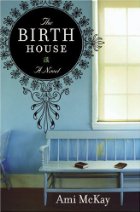
Book Review: The Birth House by Ami McKay
 Summary:
Dora Rare is rare indeed. She is the first female born to the Rare family Scots Bay, Canada in generations. Her dark hair and brownish skin reflecting the family’s Micmac heritage make her stick out like a sore thumb in the area. However, Scots Bay’s midwife, Miss B., has always taken a shining to Dorrie, and she trains her in the ways of midwifery. The early 1900s are a tough time for midwives and women, though. Soon the area is threatened by World War I and male obstetricians, not to mention all the obstacles rural women have always had to face from violent, drunk husbands to too many children.
Review:
This book was quite honestly painful to read, for it lays out so clearly what it is that makes being a woman difficult in society. Although some things in modern day have improved, for instance we western women have the right to birth control, in other ways things have remained painfully the same. There are still areas of the world where men have more control over women’s bodies than they do. It is often still expected for women to be pure when men are not. Women often feel that they must put up with the wrongdoings of their husband simply to keep the home and family life that they so desperately desire, and on and on.
The book itself is told as a mix of third person narrative and Dora’s journal with clippings from the various newspapers. This style suits the story well, as we are allowed to see Dora from both outside and inside her own head. The characters are fairly well-rounded, although the motivations of those who are not Dora are not always the clearest or the most sympathetic, but as most things are from her perspective, that is understandable.
Of particular interest to me, especially with my knowledge of psychology, was the portions of the book dealing with how women are often accused of being insane simply for reacting to the injustices foisted upon them. I discussed this topic at length in multiple women’s studies and feminism classes. The idea that the just rage of the trodden upon is often depicted by the rulers as insanity. This is beautifully depicted in this book for Dora, struggling against many injustices and feeling rightfully irritated and angry, is informed by a male doctor that she is suffering from hysteria–a peculiarly female ailment resulting from female organs. Her anger and fighting back is thus tagged with a name that let’s others dismiss it as an illness, rather than a just reaction. McKay eloquently depicts this entire issue without being too heavy-handed.
I was also surprised and delighted to see a portion of the story take place in Boston during the women’s suffrage movement in the United States. I’m assuming McKay must have visited my city, for she perfectly describes the North End from the buildings to the atmosphere of walking those streets. This accuracy allowed me to travel back in time to a period of injustices in my own city, not to mention the molasses flood. It was indeed a delight to read of Boston from a women’s rights perspective for once instead of always reading of the Irish mafia.
The main point of the book comes across throughout it in a gentle way. The idea that we must continue to struggle and give but not give up or the oppressors will win.
Never let someone take what’s rightfully yours. You can give all you want in life, but don’t give up. (page 337)
It is simultaneously encouraging, uplifting, and depressing to realize that women throughout time have struggled with similar issues. Yet things are gradually improving, and thus we must not give up for the sake of future generations of women.
This book beautifully depicts the history of women’s rights in the early 1900s. It is a painfully beautiful read that I recommend all women, as well as men sympathetic to the cause, read.
4 out of 5 stars
Source: PaperBackSwap


Book Review: I Kill Giants by Joe Kelly (Graphic Novel)
 Summary:
Barbara is a middle school student with one intense focus–she must learn how to kill giants before it is too late. She doesn’t fit in much at school or have many friends, but she doesn’t really care, because she needs to be ready for the giant. The giant is connected to a secret at home, you see, and this secret takes over her life too much to care about all those silly things the other girls talk about.
Review:
I picked up this graphic novel because it was getting tons of buzz as being an excellent graphic novel. I also wanted to know what this big secret was in Barbara’s life. Does the graphic novel address something that isn’t discussed much in polite society but is still an issue for many middle schoolers out there? I was dying to know! Unfortunately, I found myself incredibly disappointed with this graphic novel. I can’t discuss why without spoiling what the giant is, so if you don’t want to be spoiled, skip this review.
I was expecting the giant Barbara is facing at home to be something like abuse or incest. Instead, it turns out Barbara’s mother is dying of cancer. Um. Ok. I’m sorry, a big scary giant doesn’t seem to be quite the right metaphor for a dying parent. What makes this little girl think she can fight death? I guess I just don’t get it.
Additionally, I just really didn’t like Barbara. I honestly get tired of graphic novel writers always making the main character a geek. This little girl–shocker–plays D&D. She is cruel to her classmates. She judges them. She’s even mean to the one girl who for some unearthly reason shows an interest in Barbara and what she likes to do. She, quite frankly, rubs me the wrong way, and I don’t think she’s supposed to.
Then there’s the art. I also didn’t like that, especially how he drew Barbara. Why does she have bunny ears? What’s up with that? The drawing style never feels artistic. Not once did I find myself sucked into the pictures to get further into Barbara’s world. They felt more like badly-done newspaper comic strips than a graphic novel.
Overall, I’m disappointed that I even bothered with this book. It’s one of those few instances when if I’d known the spoiler ahead of time, I’d have saved myself some time. I can’t even imagine handing this over to a middle schooler dealing with a terminally ill relative, because I don’t think it particularly presents healthy coping mechanisms or solutions to unhealthy ones. Why this book is so popular remains a mystery to me.
2 out of 5 stars
Source: Amazon
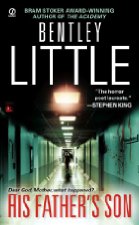
Book Review: His Father’s Son by Bentley Little
 Summary:
Steven’s life in California is so typical it borders on boring. He writes for AlumniMedia. He’s engaged to a librarian named Sherry. He goes out for happy hour every Friday night with his three buddies. Then one day his mother calls him and informs him his father tried to kill her. His father has had strokes and dementia, but in a moment of absolute clarity in the VA hospital, his father whispers to Steven, “I killed her.” Thus begins Steven’s tailspin into a world of darkness and ever-changing morality.
Review:
I believe this book succeeds in serving its purpose–it’s a page-turner with chills. If someone asked me for a simple thriller for the beach, I’d have no qualms handing this over. I cannot rid myself of the vibe though that the idea of this book could have led to a thriller of excellent quality instead of beach read quality, and that is a bit disappointing.
The set-up is excellent. Here we have an ordinary guy with some issues with his parents, but he still tries to live up to his family obligations. Then his father has an episode that makes mortality something Steve is no longer able to ignore. Steve then starts this quest that could easily be read as a metaphor for adults dealing with the increased fragility of their parents. However, about two-thirds of the way through, the plot takes an unexpected twist that then essentially nose-dives off a cliff into a scenario that is jarring and rather insulting to the reader. The book is not at all about what it at first appeared to be, and honestly, the original concept was much more intriguing than the final answer. The resolution is cliche, whereas the original set-up was not.
Other than the plot, Little sets scenes fairly well. It is easy to envision both the simpler scenes as well as the more complex scenes of violence. His writing style is not particularly memorable though. I didn’t once feel the need to write down a quote or dog-ear a page.
One of the more interesting elements of the book is that Steven is a writer, and his short stories pepper the book to give you an idea of his mental state at the time. I honestly enjoyed the short stories more than the actual book itself. I could easily see myself reading a collection of Little short stories in the future.
Overall, this is an enjoyable, if forgettable, thriller ideally suited to summer beach reading. I recommend it to fans of thrillers looking for an easy read.
3.5 out of 5 stars
Source: PaperBackSwap

Book Review: Rage by Jackie Morse Kessler (Series, #2)
 Summary:
Melissa Miller is your typical 16 year old–mom, dad, annoying sister, a jerk of an ex-boyfriend–with one small difference. She deals with her emotions by cutting herself. She keeps a razor in a locked box in her closet and pulls it out when she gets overwhelmed. One night she accidentally cuts too deep, and Death shows up with an option. Either die now or become one of the Horsemen of the Apocalypse–War. Missy chooses the latter option, and as she gets to know the other Horsemen and her job as War, she starts to realize she needs to face the rage inside her.
Review:
Speaking as someone who knows a lot about mental illness, self-injury is one of the illnesses that people who don’t have it have the most difficulty understanding. It seems bizarre to those who don’t self-injure, even as for the self-injurer those moments of cutting or burning or whatever chosen method are the best coping mechanism they can come up with. It’s not easy for those who don’t self-injure to understand, which is why I am so impressed at how well Morse Kessler has grasped the inner workings of the self-injurer in order to write such a well-rounded, sympathetic character as Missy.
Missy is simultaneously relatable as a typical teenager, for instance she gets horribly embarrassed at a party one night, but she also has this deep, dark, misunderstood secret. Gradually other teens find out and are either concerned or lash out at her due to their fear and lack of understanding, but Missy feels that she can’t confide in even the sympathetic ones. In perhaps one of the most powerful passages, the reader gets to see exactly why Missy cuts, while she simultaneously explains why she can’t explain it to her sister.
She could tell her that she turned to the blade because she wanted to live and sometimes pain was the only thing that kept her alive. She could tell her that she was terrified of things she couldn’t even begin to name, that friends could be fickle and lovers could be false. She could try to explain all of that and more, and maybe her sister would understand. But trust was as fragile and cutting as a crystal sword. (page 100)
That is perhaps the most clear, succinct explanation of self-injury I’ve seen outside of nonfiction clinical books. Missy’s reasons for cutting are clear, even as it becomes more and more evident to the reader that this coping mechanism is not truly addressing Missy’s real problems.
Of course, the fantasy element comes to play here again, and it works perhaps even better this time around. Giving the fantasy personas for Missy to talk to and express herself to gives her a safe space to think out her emotions instead of cutting them out. There are also a few cameos from Famine, which is fun to see after reading the first book. The fantasy also works here because it helps give the book a distance that makes it less triggering. There are intense emotional moments, but then Death shows up with a humorous quip to lighten the situation. It addresses the real problems without getting bogged down in over-emotionality.
This book will give self-injuring teens a way to see themselves reflected in literature and accepted and loved for who they are. It will give them a chance to maybe address their own emotions and issues. Similarly, non-self-injuring teens will hopefully become more empathetic to their peers who struggle with it. It’s a book that is simultaneously enlightening but not preachy. I highly recommend it to teens and those who work in mental health or with teenagers.
5 out of 5 stars
Source: Amazon

Previous Books in Series:
Hunger, review
Counts For:

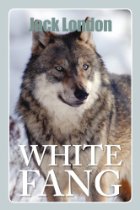
Book Review: White Fang by Jack London
 Summary:
White Fang is born in the wild 1/4 dog and 3/4 wolf. He soon finds himself back in the realm of man when his mother returns to the Indian camp she had left. Thus begins the struggle between White Fang’s desire for the companionship of the human gods and the call of the wild inside him.
Review:
This companion novel to The Call of the Wild flips the original story on its head. Instead of it being a dog feeling the call of the wild, we have a wolf feeling the call of the companionship of man, in spite of mistreatment. The story doesn’t quite work as well when reversed in that way, though.
Both White Fang and Buck suffer mistreatment at the hands of men that is incredibly painful for an animal lover to read about. Whereas this served to make it understandable why Buck leaves for the wild, though, it makes it difficult to understand why White Fang doesn’t do the same. Yes, eventually he meets a master who loves him and cares for him, but for years prior that is not the case. Perhaps London is attempting to demonstrate the intense loyalty of dogs to their masters whether or not they deserve it. It is true that animal rights workers see this sort of situation over and over again, yet White Fang is mostly wolf. It is difficult to believe his wild nature would not take over at some point, particularly when being mistreated. If this story was told of a dog and not a wolf, it would make more sense.
That said, London’s strength at delving into the animal world without personifying them to be more human than they are is still incredibly strong here. The animals are not personified but they are humanized. By that I mean, their personalities and instincts are clear and understandable. It is difficult to imagine anyone reading this book then proceeding to abuse an animal. They are truly remarkable creatures, London excels at demonstrating this.
Overall, this book is not as amazing as The Call of the Wild but it is well-worth the read for more time spent seeing animals through Jack London’s eyes. Recommended.
4 out of 5 stars
Length: 208 pages – average but on the shorter side
Source: Purchased

Buy It (Amazon or Bookshop.org)
Companion Book:
The Call of the Wild, review
If you found this review helpful, please consider tipping me on ko-fi, checking out my digital items available in my ko-fi shop, buying one of my publications, or using one of my referral/coupon codes. Thank you for your support!
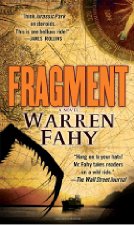
Book Review: Fragment by Warren Fahy (Series, #1)
 Summary:
When the floating reality tv show SeaLife receives a distress beacon coming from a remote island, it looks like their ratings are going to improve. Henders Island has not been visited since the 1700s, and the scientists aboard the Trident are excited at the possible new species they could find. Unfortunately, the species aren’t as benign as they thought.
Review:
This was recommended to me by a couple of friends who know I’m a huge Michael Crichton fan as a Crichton-esque reading experience. I can definitely say that this falls solidly in the hard, plausible scifi genre that has been so empty since Crichton’s passing.
Fahy takes the concept of an island splitting off from the rest of civilization and evolving separately and runs with it. The creatures he comes up with are fantastic and frightening yet simultaneously plausible, which is part of what makes the thrills so thrilling. Similar to Crichton, there are long passages of science explained at a level easily understandable by anyone with a high school diploma. Also, there are passages that at first seem unimportant but later are revealed to be connected and important.
The characterization is strong enough for a thriller of this sort, although that of the main characters could be a bit stronger. Everyone is easy to tell apart, however, and their motivations are clear, something that can be difficult to pull off at the fast pace of a thriller. In future writings, I do hope that Fahy’s main characters will be a bit more well-rounded, however.
The pacing is a bit bumpy with some passages that remove the previously built-up suspense. Although this was necessary to explain the science, it does seem that it could have been worked in more smoothly. The last quarter of the book, however, is paced perfectly with no interruptions and just the right amount of suspense.
One of the highlights of the book is definitely the inclusion of the reality tv show. It lends it a current real vibe. Things are recorded as they happen. The world sort of knows what’s going on, but not quite. The military has to get involved. Everything reads as very plausible and realistically connected to how the modern world actually works. Plus the scenes involving the reality tv producers are just good comic relief.
I absolutely plan on reading Fahy’s future works, and definitely recommend this to fans of Crichton style scifi.
4 out of 5 stars
Source: PaperBackSwap


Book Review: The Land of Painted Caves by Jean M. Auel (Series, #6)

Summary:
All of Ayla’s unique life situations–from being adopted by the Clan to living in a valley by herself to her long Journey with Jondalar–have been combining to make her into a great, powerful woman. In this final entry in the Earth’s Children series we witness her transformation from Ayla to Zelandoni shaman of the Zelandonii.
Review:
As a fan of the Earth’s Children series since the age of 15, there is just no way I can review this epically disappointing, long-awaited finale to the series without spoilers. So, be warned, this whole post is going to contain spoilers, because there is just no way I can possibly not talk about everything that went horribly awry here.
First there is the incredibly huge issue of plot. The book is divided into three sections. The first section is entirely Ayla wandering around looking at caves with Zelandoni. Which would be fine. If the caves had anything particularly unique about them or anything exciting happened in the caves or if we weren’t told repeatedly “here’s a horse painting, here’s a cave lion painting, here are dots that mean something to the Zelandoni but I won’t ever tell you what they mean because where would the fun in that be?” Oh sure, there are hints that something more exciting might happen, but nothing ever does. It’s like Auel thought about putting action in, but then decided it’d be way easier to talk more about the badly painted and scratched in horses in these caves that for some reason the Zelandonii think are so incredibly sacred. Oh yeah. I remember why. Because they’re supposedly the vagina of the Earth Mother. Think about that for a second. These people are worshiping in sacred vaginas.
Then we have the second section which mysteriously jumps forward four years in Ayla’s acolyte training because for some reason we couldn’t possibly be interested in that, oh no, there’s nothing interesting about ceremonies or studies. Instead, we get to jump ahead four years and go on Ayla’s Donier tour. Do you know what Ayla’s Donier tour is? Going around Zelandonii territory to look at MORE CAVES. This traveling could possibly be interesting. We have foreshadowing multiple times that something bad is going to happen to Ayla, particularly that a band of evil bad rapist men are going to kidnap her and drag her off. But no. They grab her and Jondalar somehow miraculously goes from in front of the evil band of rapist men to behind them, breaks the leather-thong assisted choke-hold the dude has on Ayla, and saves her from them. Then the Zelandoni beat them to death in an instance of mob justice. Well. At least something sort of happened?
The third section jumps ahead two more years (skipping almost all the rest of Ayla’s acolyte training) to yet another summer meeting, which Ayla has to come to part-way through because she had to stay back to complete her final assignment of training. Ayla has a vision in a cave (oh, we’ll get to that in a minute) and then goes to the summer meeting where she walks in on Jondalar getting naked sexy head from the one woman in the Ninth Cave of the Zelandonii immune to liking Ayla. No, I am not joking. Jondalar, the oh I am Ayla’s soulmate and we will be together forever and I love her so much has totally been cheating on her for almost the entire last two years of her acolyte training. Because she was busy. Because a man has needs. Because the ho offered herself to him and why on earth would Jondalar say no? I am not joking, that is the tone of the book in the whole revelation of cheating thing. PLUS, the whole cave knew about it and hid it from Ayla to protect her feelings. Ayla, naturally, knows jealousy is taboo in Zelandonii society, so instead of confronting the cheating bastard she first has sex at a Mother Ceremony (ahem, orgy) with the dude Jondalar hates most in the Ninth Cave, and then she decides life isn’t worth living and tries to kill herself with the Clan root. This from a woman who has three horses, a wolf, and a freaking 6 year old daughter to look after. The only thing that saves her, naturally, is Jondalar’s undying love. It took all of my self-control not to throw my kindle across the room. Well, and also my intense love for my kindle.
So for two-thirds of the book nothing really happens, and then in the last third our two heroes both turn into loathsome people. Good. Times.
Ok, so, the plot takes a complete nose-dive off Niagara Falls without a barrel while holding your beloved kitten. What about the supposedly key element of the book and series? What world-changing thing does this special woman, this powerful shaman, bring about? Allow me to quote the new verse of the Earth Mother’s Song that is revealed to Ayla at the climax:
Her last Gift, the Knowledge that man has his part.
His need must be spent before new life can start.
It honors the Mother when the couple is paired,
Because woman conceives when Pleasures are shared.
Earth’s Children were blessed.
The Mother could rest. (page 540)
Yes. That is right, people. The reason for this woman existing is to reveal to these dim-wits that sex, not the Earth Mother mixing spirits, causes babies. Allow me to repeat that. Ayla’s big contribution to pre-historic society is to teach these people the birds and the bees.
I wish I could say it gets better from there, but it doesn’t. First Ayla has to convince the other shamans (Zelandoni) that this is true. They, naturally, don’t want to believe it. The lead Zelandoni convinces them that they must tell the people in a huge ceremony, because this will be life-changing. Then we have, quite possibly, the most eyeball-widening, face-palming, head:desk inducing passage I have ever read. The ceremony, meetings, and Mother’s Celebration that go along with it. I won’t put you through the pain of all of it, but allow me to show you a good sample. The passage in which the lead Zelandoni explains what to call the men who are also parents:
He is a far-mother, a fa-ther. It was also chosen to indicate that while women are the Blessed of Doni, men may now think of themselves as the Favored of Doni. It is similar to ‘mother,’ but the fa sound was chosen to make it clear that it is a name for a man, just as ‘fa’lodge’ is the name for the men’s place. (page 676-7)
I just…..there are no words for the inanity of it all.
Then, of course, all the men overnight turn into possessive, abusive, over-aggressive douchebags since now they know that their sperm has magical powers. The book ends with the very heavy-handed suggestion that this revelation is what caused the move from matriarchy to patriarchy.
Oh, but it gets better. To put one final touch of absurdity on the whole thing, we also finally get to find out what happened to the Neanderthals (Clan). Ayla still has the black stone that contains a piece of every Clan member’s spirit in it from when she was a medicine woman for them. A vision reveals to her that when Broud cast her out with the death curse, she forgot to leave the stone behind and thus caused the death of the entire Clan. Yeah. Really. That’s what happens. All of this build-up, and we find out that Ayla reveals the birds and the bees, kills matriarchy, and kills the Neanderthals. What. The. Fuck.
As if the meandering plot and completely inane and horrifying huge reveals weren’t bad enough, something happened to Auel’s writing style. I like to call it “let me give everything really long names and repeat myself a lot” Just one example of the plethora of overly long names is “Zelandoni Who Was First Among Those Who Served The Great Earth Mother.” That would be less painful, maybe, if Auel didn’t also repeat herself all the time. Almost every time the lead Zelandoni shows up, we are reminded that she is a very large woman. Almost every time Ayla speaks, someone notices her foreign accent. Almost every time someone sees Jonayla (kill me now with that name), someone notices that she has Jondalar’s eyes. Enough already! We know! Stop telling us!
Between the meandering plot, completely what the fuck ending, and simply bad writing, I can’t recommend this book to anyone. My best advice to fans of the series, or those interested in it, is to pretend that it ends with The Mammoth Hunters and Jondalar riding off into the sunset with Ayla. Just pretend it stops there. Ignore his people. Ignore Ayla’s calling. Ignore the Journey. Just ignore the whole thing. Take the characters and world back from Auel who completely mistreated them and let them exist in your mind the way they were at the end of The Mammoth Hunters. Do not waste your time or hurt your brain reading this book. Just…..don’t.
1 out of 5 stars
Source: Amazon

Previous Books in Series:
The Clan of the Cave Bear
The Valley of the Horses
The Mammoth Hunters
The Plains of Passage
The Shelters of Stone
If you found this review helpful, please consider tipping me on ko-fi, checking out my digital items available in my ko-fi shop, buying one of my publications, or using one of my referral/coupon codes. Thank you for your support!
Book Review: Undead and Unemployed by MaryJanice Davidson (Series, #2)
 Summary:
Betsy may have dealt with the fact that she’s an undead blood-sucker, but she certainly is not ready to deal with the idea of being queen of the vampires for 1,000 years. Or mated to the horribly tricky Sinclair. The sexy, tricky Sinclair. She is focused on more important things, like her new job selling designers shoes at Macy’s. But when vamps start popping up dead a second time, her duty calls whether she wants to listen or not.
Review:
If somebody asked me to hand them the quintessential chick lit summer beach read, I’d toss the Queen Betsy series at them. Light, short, set in a cool climate, and one guaranteed hot sex scene per book. Great literature it ain’t, but I’ve definitely read far worse paranormal romance in my time, plus Davidson always manages to get at least a few chuckles out of me.
The one thing that baffles me is that I truly hate Queen Betsy. She is everything I loathe in *coughs* certain women: shallow, conceited, wears too much make-up, obsessed with shoes, self-centered. Yet for some reason I can’t help rooting for her. Maybe it’s that she didn’t ask to be queen of the vampires and yet still manages to rise to the occasion when needed that makes her bearable. This is a long series, and I do hope that Davidson will see fit to give us a good character arc for Betsy. Going from a shallow 20-something to a fully grown-up queen. I could dig that.
In the meantime, the storyline here in the second book was actually a bit more interesting than the first, although the mystery was quite easy to solve. Unfortunately, the laughs weren’t quite as frequent, which is what made the first book so enjoyable, but they are still present. Who reads paranormal chick lit for more than a few hours of giggles and horribly unrealistic vampire sex that knocks chunks of plaster out of the ceiling? If that’s what you’re looking for, you won’t go wrong with the Queen Betsy series.
3.5 out of 5 stars
Source: PaperBackSwap

Previous Books in Series:
Undead and Unwed, review
Book Review: Thinner by Stephen King
 Summary:
Billy Halleck is an overweight, high-powered lawyer in a wealthy Connecticut town. He’s getting a bit irritated at his wife and a bit frustrated with his weight, but he loves his teenage daughter. One day, a band of gypsies come to town, and Billy accidentally runs one of them down with his car, killing her. His law firm and the cops, naturally, get him out of the manslaughter charge, but nobody can protect him from the lead gypsy’s curse, uttered while stroking one finger down his cheek, “Thinner.” Now he’s dropping weight no matter how much he eats, and he must race against the clock in an attempt to save himself.
Review:
A book about gypsy curses could easily slide into racist territory, but in fact Thinner actually criticizes the treatment the gypsies have received in the United States over the years, in spite of them not always being the most sympathetic characters in the book. They may be a bit non-mainstream and overly quick to exact their own vengeance, but Billy Halleck and his cronies are a much more frightening type of bad. They’re the bad that comes from too much money and power. The bad that comes from being so self-centered and over-indulgent that you’ve stopped noticing the rest of the world exists.
So, the social commentary is good and not offensive, what about the horror and thrills? That is, after all, what one reads a King novel for. The grotesqueness definitely builds gradually over time, making this much more of a thriller than a horror. At first Billy’s weight loss is welcomed. He was, after all, overweight before. Gradually, though he starts to freak out about how much weight he’s consistently losing in spite of eating as much as he possibly can. He starts to investigate and discovers two others with their own unique and, frankly, much more frightening curses. Although the beginning may feel a bit slow, that is exactly as it should be. Billy goes from normal life to life under a curse to racing against the clock to save his own life. The horror builds perfectly.
That said, this still doesn’t quite read as sophisticated as some of King’s later work. It does almost seem like a bit too obvious an allegory. A bit too obvious a statement being made. In spite of the story providing chills, it’s not quite terrifying or mind-blowing. It’s a fun read, but it’s no Dark Tower.
Overall this thriller provides chills, horror, and a good social commentary. I recommend it to fans of horror and thrillers alike, although slightly more to fans of thrillers.
4 out of 5 stars
Source: Harvard Book Store

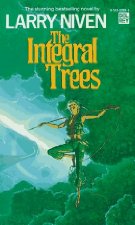
Book Review: The Integral Trees by Larry Niven (Series, #1)
 Summary:
Humans settled on a planet far from Earth after mutinying from their spaceship. Generations later, their descendants have formed various tribes and cities ranging in civilization from tribal to bronze age level of technology. What makes the planet unique is its lack of gravity. Most people live in “integral trees” or in “jungle clouds” with varying amounts of pull (gravity) due to the presence of the tree. In this peek at their existence, we follow a bunch of intrepid people who survive when their tree dies only to find themselves marooned in the sky, along with the flying animals, pools of water, flying fish, and more.
Review:
This book is the definition of classic hard scifi. The world is complex, alien, and unique. It manages to simultaneously be barbaric and technologically advanced in some ways. Everything is as alien from our own lives as we could possibly imagine, from what the people eat to how their cultures are to how people interact.
It takes a bit to get into the book. At first the concept of the planet and how people live on it is overwhelming. But Niven introduces things slowly, so by the time you’re reading about a jungle cloud with people with prehensile toes, it’s easy to imagine and doesn’t slow you down at all in the story. Yet simultaneously it is obvious from looking back to the beginning of the book that Niven always has a clear understanding of how his world works, even if it’s not entirely clear to the reader yet. This is the definition of good writing, and especially good scifi.
The characters have a tendency to be a bit one-dimensional and flat. This is possibly due to all of the attention being paid to the world the story is set in. However, the story still would be improved with more three-dimensional characters. One character in particular goes from a female warrior to a married woman to a concubine and seems to take it all a bit too much in stride for someone who started out as a woman warrior. It felt a bit as if Niven was changing the characters to fit the situation rather than seeing how the characters he had already developed actually would react.
There is definitely a bit of a tinge of male fantasy to the whole story. Even the jungle cloud women who participate equally in their society end up being sister wives to one guy. Personally, I thought given the way women were treated in the story that it must have come out in the 1950s or 1960s, but a quick check shows it came out in 1984. That’s a bit….disturbing. While it’s certainly logical that some cultural things will not be ideal on a foreign planet such as this, the status of women in the novel reads less as a commentary and more as something the author would very much like the world to look like.
Overall, this is an enjoyable hard scifi novel with a rich setting, weak characters, and questionable mores. I recommend it to lovers of hard scifi, but most others probably would not enjoy it.
3 out of 5 stars
Source: PaperBackSwap

 Support my work with a tip or browse my shop for curated book club guides, how to guides, cross-stitch patterns, and more!


This work by Amanda Nevius is licensed under a Creative Commons Attribution-Noncommercial-No Derivative Works 3.0 United States License.
 Opinions of a Wolf