
Archive
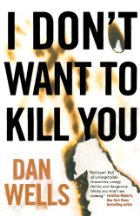
Book Review: I Don’t Want to Kill You by Dan Wells (Audiobook narrated by Kirby Heyborne) (Series, #3)
 Summary:
Teenaged John Cleaver had his sociopathy under control but when his town was plagued with two different demons, he had to let it loose a bit to fight them. He invited the demon Nobody to come face off with him, but he and those around him are left wondering if Nobody is real or if John’s sociopathy has just gone out of control. Meanwhile the teenage girls of the town are committing suicide left and right, and John can’t help but wonder why he’s ever tried to save anybody.
Review:
This is one of only a few YA series that I’ve enjoyed reading. The paranormal/youth aspect are almost like a Dexter lite, which is enjoyable. I must say, though, that I was disappointed by the ultimate ending to the series. However, since I write up series review posts every time I finish a series, I’ll leave my analysis of the series as a whole to that post, which will be coming up next. For right now, let’s look at the final book on its own merit.
The plot this time around was disappointingly full of obvious red herrings. I knew within the first chapter where Nobody was hiding, and it was kind of ridiculous that talented, intelligent John was missing it. Similarly, I found the serial killer who John identified as who he could end up being if he made the wrong choices to be a bit heavy-handed. John was already well aware of the risks of his sociopathy from the very first book. It felt a bit unnecessary to make this such a strong plot point. It came across as preachy, which is something that this series had avoided so far. Similarly, John goes to see a priest at one point in his investigations, and his conversations with him felt a bit too heavy-handed, almost like the (known religious) Wells was preaching at the readers through the priest. Authors are allowed their opinions and perspectives, but preachiness is never good writing. Perspective and opinion should be shown eloquently through the plot and characters.
Speaking of characterization, John was still strongly written, but his mother and sister were another story. They felt less like they were doing what was logical and more like they were doing what needed to be done to move the plot forward. On the other hand, I really enjoyed John’s new girlfriend. She was well-rounded and realistic. Plus she was fit while being curvy, which I think is a great thing to see in a book.
In spite of the slightly obvious plot, I still was engaged to get to the end. Even though I knew whether or not there was a demon and who the killer was, I still deeply wanted to see how John would handle it. The audiobook narrator, Kirby Heyborne, helped with this momentum. His narration was just the right amount of tension while still remaining in a teenager’s voice. Be warned, though, that there is some yelling in the book, so the volume does spike considerably at a few points in the narration. You may want to keep the volume a bit lower than usual to accommodate this.
Unfortunately, where the plot ultimately ended up was deeply disappointing to me. It was not at all a satisfying ending, and from a mental illness advocacy perspective, I actually found it distressing. Whereas John’s sociopathy previously was handled with a lot of scientific understanding, I found the ending of this book to be completely out of touch with real sociopathy. While it wasn’t offensive per se, it drastically oversimplifies sociopathy, both its treatment and its causes, which is just as bad as demonizing it. I will address this issue more fully in the series review, but suffice to say that I found the ending to this book’s individual mystery and the series as a whole to be disappointing, particularly given the potential of the book.
Overall, then, this is an average book that wraps up an above average series. If you are someone who is fine with stopping things partway through, I’d recommend just stopping with the previous book in the series, Mr. Monster. But if you are interested in the overall perspective, this book is still an engaging read that doesn’t drag. It just might disappoint you.
3.5 out of 5 stars
Source: Audible

Previous Books in Series
I Am Not A Serial Killer
Mr. Monster
Counts For:

Book Review: Half of a Yellow Sun by Chimamanda Ngozi Adichie (Audiobook narrated by Robin Miles)
 Summary:
The Nigerian-Biafran War (or the Nigerian Civil War, as it is also known) is seen through the intertwining lives of four different people. The daughter of a wealthy Igbo couple, Kainene, with a fierce business sense. Her fraternal twin sister, who is also the beautiful one, Olanna, an academic in love with a revolutionary-minded man named Odenigbo. Kainene’s boyfriend then fiancee, the white English writer Richard. And Ugwu. Olanna’s houseboy who came to them from a rural village. Their lives are irreparably impacted, and in some cases destroyed, by the war for a cause they all believe in, but that the world largely ignores.
Review:
I originally intended this Nigerian book to be my final read for the Africa Reading Challenge 2012, but even though I started it in November, the audiobook took over three months to get through, so it ultimately missed counting for the challenge. I thought it was much longer than my usual audiobook fare, but a quick check of the listen length shows that it is 18 hours and 56 minutes long, which is only about 7 hours longer than my norm. So why did it take me so long to finish? Well, I just didn’t enjoy it that much.
I believe I was expecting something else from Adichie, since I had previously read her book Purple Hibiscus
As far as the plot goes, it was interesting but it was a bit confusing. Part of my confusion could have been because I listened to it, but from my understanding when I was listening, first there was an affair, then we jumped back to before the affair, then we jumped forward, then we jumped back to a different affair that came before the first affair. It was profoundly confusing. Particularly with a child referred to only as Baby (with no explanation about this for quite some time) who also randomly shows up and disappears. There was already so much going on with four different main characters and the war that this non-linear plot felt unnecessarily extraneous and confusing. However, it is possible that this plot is more clear when reading the print version, as opposed to the audio version.
The language of the writing itself is pretty, and I found periodic astute insights that I’ve come to expect and enjoy from Adichie. For instance,
Why do I love him? I don’t think love has a reason. I think love comes first, and the reasons come later.
Passages like these are what helped me enjoy the book to the extent that I did.
There is one plot point in the book that truly distressed me, so I feel I must discuss it. It is a spoiler though, so consider yourself spoiler warned for this paragraph. Throughout the book, the narration style is third person limited, which means that it is told in third person, but the reader knows what is going on in the main character’s head and is generally limited to that character’s perspective. The point of view is switched around among the four main characters, one of whom is Ugwu, the houseboy. We thus get to know him as the houseboy, he gradually grows up, and then later he is conscripted into the Biafran army. At this point, he participates in a gang rape on a waitress in a bar. I read a lot of gritty things. I routinely read books offering up the point of view of sociopaths or serial killers. I’m not averse to seeing the world through a bad person’s eyes, or through the eyes of a person who does bad things. But it has to be handled in the appropriate manner. I felt that there was entirely too much empathy toward Ugwu in the case of the gang rape. Adichie sets it up so that he walks in on his fellow soldiers gang raping this woman, and he says he doesn’t want to participate, they question his manhood, he admits in his head that he is turned on by the view of her pinned to the ground crying with her legs held apart having just been raped by a different soldier, and he participates. I think what disturbed me the most about this passage was how the narration makes it seem so ordinary. Like it’s something any man would do in that situation. Like it’s only natural he’d be turned on and get a hard-on from seeing a woman forcibly pinned to the ground so she can be gang raped by a bunch of men including himself. I think it’s awful to treat men like that. To act like they clearly are incapable of standing up for what’s right or that they’ll get a hard-on any time they see an orifice they can physically bang. Men are human beings and are entirely capable of thinking with more than their penis. Now, obviously there are men who rape, but there has got to be more going on there then I have a hard on and there’s a woman who I can stick it into. To treat rape that simply is a disservice to men and women’s humanity alike. Part of the reason why this reads this way is that we don’t know Ugwu well but we know him well enough to think that he’s an at least moderately decent young man. We don’t see a gradual downfall. No one holds a gun to his head or even implicitly threatens him with death if he doesn’t participate. It makes it seem like war makes men, even moderately good men, rape, as opposed to war simply providing more opportunities for rapists to rape. That is a perspective that I do not endorse, that I do not enjoy having sprung upon me in my literature, and that I found triggering as well. I was shocked to see it in a book by Adichie. Shocked and disappointed. It left me wishing I could scrub my brain of the book. Wishing for those hours of my life that I spent listening to it back.
Now, let me take a moment to speak about the narrator, Robin Miles. Miles is an astounding narrator. Her audiobook narration is truly voice acting. She is capable of a broad spectrum of accents, including Nigerian, British, and American, and slips in and out of them seamlessly. She easily creates a different voice for many different characters. I absolutely adored listening to her, in spite of not enjoying the book itself. Her performance of this book is easily a 5 star one.
Overall, though, the high quality narration simply could not make up for a story that failed to hit the mark with me on so many levels. It covers an important time period in Nigeria, and the highly important human rights issue of the genocide of the Igbo, but the style in which it does simply misses the mark for me. If this was all, I would still recommend the book to others who are more fond of a more impersonal, sweeping narration style. However, I also found the treatment of rape in the book to be simultaneously offensive and triggering. For this reason, I cannot recommend this book, although I do recommend the audiobook narrator, Robin Miles.
2 out of 5 stars
Source: Audible

Book Review: The Long Quiche Goodbye by Avery Aames (Series, #1) (Bottom of TBR Pile Challenge)
 Summary:
Charlotte Bessette is ecstatic that her slightly eccentric French grandfather and grandmother have handed over the running of their small town cheese shop to her and her cousin, Matt. She and Matt have redecorated the place for the 21st century and have added a wine annex. Everyone is excited for the grand re-opening but when their landlord turns up dead on their doorstep stabbed with one of their cheese knives and Charlotte’s grandmother standing over him, both the shop and the family are at risk.
Review:
Cozies are, by their very nature, absolutely ridiculous and difficult to explain. I generally default to an explanation like, “It’s murder! With arts and crafts and cooking! But not too much blood and no sex! And the titles are puns!” At this point the person I’m talking to generally looks at me like I’m nuts and wanders off. But even though the cozy genre is ridiculous and tough to explain, there are things that work for it and things that don’t. This book is definitely a cozy but it combines the cozy elements oddly, making it fall short of awesome into the decidedly meh category.
Most cozies have a moderately ridiculous plot involving a dead body being found and a woman ultimately amateur investigating the crime. The crime in this one was odd. A landlord who nobody likes is stabbed directly in front of the cheese shop on grand reopening night. Oh, and he’s stabbed with a cheese knife. Sometimes I think authors just don’t research and realize how hard it actually is to stab someone in the chest. A cheese knife wouldn’t cut it. (See what I did there?) So that had me rolling my eyes from the start. The ultimate whodunit was also a bit bizarre and had me scratching my head. It made some sense but it also sort of felt a bit like the author just chose whoever would be the most surprising as the killer, instead of really thinking through the logic and motivation. It’s also a bit problematic to have the murder victim be some sleaze everybody in town hates. This felt like a choice to give the mystery more easy suspects rather than, again, based on thinking through logic, motivation, and real crimes.
Then there’s the issue of the main character, Charlotte, who ultimately investigates. She doesn’t really have the get up and go gumption necessary for someone to start investigating something on her own. She’s….kind of snooty and prissy. A good cozy main character should be into her arts and crafts but also possess a lot of independent spirit and gumption. Charlotte is surrounded by people like that–her grandmother, her shop employee–but she herself isn’t like that at all. Yes, her grandmother is accused of a crime she didn’t commit and that’s a big impetus to do something, but it just feels out of character for Charlotte to do investigation. Similarly, Charlotte’s romantic interest felt forced and fake, which was awkward. In a genre where we get no sex scenes, the romance should be very well done, which it was there, but it wasn’t truly engaging.
The quirky characters in the town, besides Charlotte and her love interest, were interesting and just the right blend of quirks and reality to suit a cozy. Similarly, I was glad to see some cheese-heavy recipes in the back. I also thought the pun title was great and played in well to the mystery without giving too much away.
Personally, I think there are better, more engaging and funny cozy series out there to invest my time in. However, if you are a huge cozy fan and don’t mind the oddly snooty, timid main character and a slightly silly mystery plot, then you should give it a go. The cheese angle is certainly unique.
3 out of 5 stars
Source: PaperBackSwap

Book Review: Captain America: Winter Soldier Ultimate Collection (Series, #1-9 and 11-14) (Graphic Novel)
 Summary:
Captain America has been increasingly violent and melancholy lately, and SHIELD is worried about him. When his arch-nemesis, the Red Skull, turns up as a corpse, things go from troubled to worse for Captain America. Ghosts of his past increasingly haunt him as the desire for the Cosmic Cube wreaks havoc once again.
Review:
I admit that I am new to the traditional comic book characters. I found my way into graphic novels via manga followed by more literary graphic novels followed by The Walking Dead, none of which are really comic book characters, per se. But I, just like most of the world, watched the new movies featuring Iron Man and Thor and loved them. So I decided to try to start reading the comic books, a daunting task for a newbie. I did my best to find a good introductory book, but I admit I probably should have actually watched Captain America before deciding to start with him.
Captain America is my least favorite of the Avengers. He, to me, is so incredibly lame. Whiny and lame. And traditional. I really should have started this comic book adventure with Iron Man.
Anyway, point being, take my review with the grain of salt that 1) I am new to traditional comic book characters 2) I don’t like Captain America.
The story itself is bright and action-packed. Once I understood who the Red Skull and Bucky were, I started to get the feel for the tension in the story. The pages are well-drawn and easy to follow with lots to suck the reader in. Fans of Captain America will probably appreciate the chance to get to know more of his backstory, particularly concerning Bucky, his side-kick, and what happened to him. The Cosmic Cube was amusing as ever to watch corrupt people, and I definitely was surprised by the plot twist at the end. In spite of my distaste for the character, I was a bit tempted to read more.
Overall, then, this is an action-packed entry in the Captain America canon that simultaneously provides character development and backstory. Recommended to fans of Captain America.
3 out of 5 stars
Source: Amazon

2012 Reading Stats!
To celebrate the new year here on the blog, it’s time to take a look back at my reading stats for 2012. It’s always fun to compile them and see how my reading changes and simultaneously stays the same over the years.
Last year, I read a grand total of 107 books. In 2010 that number was 70, and the year before that it was 52. This year I didn’t make it to my goal of 150, but I think I did pretty damn good anyway. :-)
Total books read: 118
Average books read per month: 9.8
Month most read: January with 20 (I’d chalk this up to New Year Resolution momentum!)
Month least read: Tie between September and December with 4 each. (September was part of a very busy month at work with Orientations for the students. December was the holidays plus a wedding I was in, so…..kind of understandable reading got left behind a bit!)
Longest book read: David Goodis: Five Noir Novels of the 1940s and 50s by David Goodis with 848 pages
Fiction: 86 (73%)
Nonfiction: 32 (27%) This was an 11% increase from last year.
Series: 48 (41%)
Standalone: 70 (59%) I think this is a nice balance between series and standalone books.
Formats:
–traditional print: 34 (29%)
–ebook: 59 (50%)
–graphic novel: 11 (9%)
–audiobook: 14 (12%) (This more than doubled. I thank Audible for that!)
Genres:
–scifi: 19 (Winner for the fourth year running! It’s clear what my favorite genre is.)
–indie lit: 16
–GLBTQ: 15 (This came out of nowhere, but I’m glad I found a new genre I enjoy.)
–historic fiction: 15
–fantasy: 14 (I have found a few fantasy books I enjoy, so I will definitely keep reading, although a bit more selectively.)
–post-apocalyptic: 12
–urban fantasy: 10
–contemporary fiction: 9
–horror: 9
–mental illness: 9
–nonfiction cookbook: 8 (I had hoped to try one new cookbook a month, but I do think 8 is pretty good.)
–African lit: 7 (Thanks to the African Lit reading challenge I participated in.)
–nonfiction memoir: 7
–mystery: 6
–black lit: 5
–nonfiction environmentalism: 5
–nonfiction history: 5
–thriller: 5
–YA: 5 (Realizing I dislike this genre led to it mostly leaving my reading, except for older acquired books on the tbr shelf.)
–alternate history: 4
–dystopian: 4 (Shockingly low compared to previous years.)
–nonfiction lifestyle: 4
–nonfiction science: 4
–erotica: 3
–nonfiction diet: 3
–romance: 3
–steampunk: 3
–military: 2
–noir: 2
–nonfiction Buddhism: 2
–nonfiction relationships: 2
–transhumanism: 2
–American classics: 1
–nonfiction feminism: 1
–cozy: 1 (Given how much I enjoy cozies, I should really read more of them!)
–Cthulhu mythos: 1
–European classics: 1
–fashionpunk: 1
–humorous: 1
–Irish lit: 1
–Japanese lit: 1
–magical realism: 1
–nonfiction fitness: 1
–nonfiction reference: 1
–nonfiction social justice: 1
–paranormal romance: 1 (It seems I am truly over my paranormal romance phase.)
–poetry: 1
–short story collection: 1
–time-travel: 1
Vampires vs. Zombies vs. Aliens vs. Demons:
–zombies: 9
–vampires: 8
–aliens: 4 (I think aliens should get more attention next year.)
–demons: 3
Number of stars:
–5 star reads: 16 (14%)
–4 star reads: 50 (42%)
–3 star reads: 33 (28%)
–2 star reads: 17 (14%)
–1 star reads: 2 (2%)
Looking at my stats, I can see one thing rather clearly. My number of highly rated reads went down, and simultaneously some genres I enjoy went down while genres I don’t enjoy (generally) went up. I think it’s important for me in 2013 to focus in more on reads I am fairly certain I will enjoy, rather than books I think I should read. I also would like to read more in the genres that as a writer I am currently (or intend to) write in.
On the other hand, I have definitely enjoyed adding diversity to my reading. I’m very happy to see how much more diverse my reading is now than it used to be when it comes to areas of the world and representations of various perspectives. This is something I would like to hold on to.
I also would like to even out the number of books read per month to a more consistent number. The difference between 20 and 4 is huge, and I would like to see my reading not fall by the wayside if possible. Granted, some of that numerical difference was due to reading chunksters versus graphic novels, so I suppose it’s important to keep in mind that a number is just a number. :-)
Overall, this was a great reading year. It was incredibly varied, and I think I learned more about myself and what I enjoy reading (not to mention writing). For 2013, I hope to read 120 books, an average of 10 books a month. I also will be doing the Mental Illness Advocacy Reading Challenge again, as well as the Finishing the Series Reading Challenge. Beyond that, I will continue tackling my tbr pile. Hopefully, my 2013 will see me finding a few more gems than I found this year.
Happy 2013 everyone! Any suggestions for my 2013 reading goals?
Book Review: Roadside Picnic by Arkady and Boris Strugatsky
 Summary:
When the aliens landed, they ignored humanity. Stopping briefly on their way somewhere else. Leaving behind mysterious random detritus, much like the remains left behind a roadside picnic. Redrick happened to live in one of the towns visited, and as a result has become a stalker. He sneaks into the Zone to gather alien artifacts to sell on the black market. Soon his whole life–and those of everyone in the town–becomes dominated by the Zone.
Review:
When I saw that this was Russian scifi from the Soviet era, I knew that I needed to pick it up, if for no other reason than that I’d never seen any before. This new print has been returned to the authors’ original vision, with the heavy edits (really, censorship) removed. It also starts with an introduction by Ursula K. LeGuin. I want to highlight one thing she says about scifi that I think truly illuminates its power.
Soviet writers had been using science fiction for years to write with at least relative freedom from Party ideology about politics, society, and the future of mankind. (location 22)
Scifi provides an opportunity for writers and readers to remove the shackles of whatever society they are currently living in and imagine the other. I think that’s a very powerful tool, and I commend the Strugatsky brothers for utilizing it in such a way from behind the Iron Curtain. They had to fight for years to get some version of this book published, in spite of being well-known and respected authors. That is a commitment to their art that is truly admirable. Now, on to the review of the actual book.
The germ of the idea is truly brilliant and is immediately clear. This idea of an alien race stopping by for a picnic, essentially, and ignoring humanity like so many ants. It’s so different from the more egotistical interpretation of alien visitations that we usually see. The book was worth the read for that alone. The early scenes are vivid and clearly establish this post-visitation situation where the Zone the aliens landed in is uninhabitable, and the government and scientists are trying to study it while stalkers sneak in (at great risk to their lives) to extract artifacts for the black market. Similarly, the artifacts that the stalkers (and government) find and bring out of the Zone are wonderfully imagined. It is easy to see that the authors probably knew exactly what the aliens used the items for whereas the characters in the book are clueless. Trying to find any use they can for them.
The book though is truly about Redrick. It uses the scifi setting to explore this man who really just wants to escape the rat race and have a comfortable life with his family. He chooses to attempt to be his own boss by being a stalker in the Zone and is repeatedly thrown in prison for it. We never really see him as a whole man, since we only saw him after the Zone. It is as if the presence of the Zone gave him hope, and the repeated failures slowly rob him of his life energy.
My whole life I’ve been dragged by the nose, I kept bragging like an idiot that I do as I like, and you bastards would just nod, then you’d wink at each other and lead me by the nose, dragging me, hauling, me, through shit, through jails, through bars…Enough! (location 2295)
In spite of this excellent set-up and interesting character arc, the book didn’t fully satisfy me. I found Redrick difficult to sympathize with. He thinks he is a slave to the system, but really he is choosing to be a slave to money. He could have left the town and the Zone behind multiple times to go live a life with his family, but he doesn’t. I understand others might interpret his freedom of movement differently from me, but that is how I saw his situation. It seems most of his problems come from a love of not just money but a love of wealth. So although I periodically sympathized with what he was saying, I didn’t ultimately sympathize with him.
What I truly found disappointing though was the ending. Without giving too much away, suffice to say that while the rest of the book was realistic scifi, couched in darkness and despair, the ending was surprisingly positive in a deus ex machina manner. It felt like a real cop-out, particularly compared to the rest of the book. Whereas most everything else was innovative, this was generic, ho-hum, and disappointing. While I was still glad to have experienced Redrick’s world, the ending kept the book from truly grasping me or blowing my mind.
Overall, then, this book is an important piece of both Russian and scifi literature. It has enough uniqueness of setting to it to keep the well-versed reader of both genres interested but beware that the main character might not be entirely sympathetic, and the ending is a bit disappointing. Recommended to fans of Russian or scifi literature.
3.5 out of 5 stars
Source: Netgalley

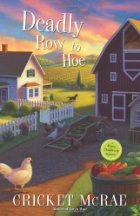
Book Review: Deadly Row to Hoe by Cricket McRae (Series, #6)
 Summary:
Sophie Mae and her best friend decided to join a CSA (Community Supported Agriculture) as soon as the opportunity popped up in their small town. One day when they’re volunteering at the farm, a dead body is found in the compost heap. Sophie Mae is determined not to get involved this time, after all, she’s got enough on her plate with her soap making business and trying to make a baby with her husband, Detective Barr. But Barr’s boss asks her to help identify the body by talking to the folks in the community , and she just can’t say no.
Review:
Cozy mysteries consist of a mystery (that’s not too explicit or bloody) paired with an unlikely investigator, some sort of crafting, a good dose of humor, and a punny title. In other words, they were basically made for me. (Some even come with recipes!) So when this one popped up on NetGalley, I snatched it up, and I’m so glad I did! McRae successfully pulls together everything that makes a cozy great.
The plot is excellent. The murder mystery isn’t too gory, but is also realistic. The body is found in a compost heap, yes, but it’s just a dead body. There aren’t slashed off heads hanging out in tea kettles or something. Everyone is appropriately disturbed by the finding. There’s no ho-hum just another day element at play. Although I admit I had figured out whodunit before the end, the why and when were still a mystery. Plus I never felt that Sophie Mae was being stupid and just missing something. Why it was taking her a bit to see whodunit made total sense. I also really appreciate that GLBTQ people are included in the plot without a big deal being made out of it. They are just another character, which is just how I like my diversity in genre literature.
The characters are fairly three-dimensional for a cozy. Everyone had something I liked and didn’t like about their personality, even the heroine, which is key to characters seeming realistic. There were also a wide variety of people present from Sophie Mae’s best friend’s daughter to an elderly friend of the family. This range is something that is often missing in literature, and I liked seeing it here.
What I really come to cozies for, though, I admit, is the integration of crafting. In this case the theme is participating in a CSA, so parts of the book are devoted to how a CSA works from acquiring your weekly allotment to figuring out how to use it to cooking with it. I really appreciated the quips about having so much of a certain produce that they’re coming out your ears. I also really enjoyed the scenes that discussed taking real time out to cook dinner and what that feels like, such as talking about how garlic smells when you first throw it into a hot pan. I know not all readers enjoy this, but honestly that’s part of the point of a cozy. Taking the time to linger on crafts and talents that take time to cultivate but are well worth it, and McRae incorporated this element very smoothly into the book. I do wish some recipes or CSA tips had been included, but it’s possible I just didn’t see them since I had an advanced copy.
Overall this book has a dash of everything enjoyable about a cozy mystery. Recommended to cozy fans, particularly those in or considering a CSA.
4 out of 5 stars
Source: NetGalley

Previous Books in Series:
Lye in Wait
Heaven Preserve Us
Spin a Wicked Web
Something Borrowed, Something Bleu
Wined and Died


Book Review: The Preying Mantis by Andreas Louw
 Summary:
FBI agent Betty Roy has been pursuing one serial killer for years. He murders one young female teacher who plays a musical instrument per season. Suddenly, though, he contacts Betty herself and starts ratcheting up the rate of the killings. He seems to have some sort of personal interest in her.
Review:
I picked this up during the Smashwords Summer/Winter sale for two reasons. The plot sounded intriguing, and honestly the cover amused me. What I found inside was a plot that was mostly strong (although it fell apart at the end) that was unfortunately supported by some truly bad writing.
Let’s start with the good. The plot is genuinely creepy. Although the Preying Mantis (as he calls himself) is fairly typical for a serial killer thriller, he’s got enough unique qualities that the reader is left intrigued and guessing. The murder scenes are brutal and frightening. I was engaged enough that I kept reading in spite of the bad writing quality, purely because I wanted to know what happened at the end.
Unfortunately, the plot at the end takes a bit of a nonsensical nose-dive. I have an incredibly difficult time believing that the FBI would let an agent recently removed from a serial killer case who they know is currently being pursued by him run off into the middle of the woods without backup. Or some sort of catch the criminal plan she is in on. Similarly, I have major issues believing this same FBI agent would be stupid enough to go to the woods at this point in time, let alone go there without her big guard dog that she instead leaves at a friend’s house. It’s a lot of characters acting stupid just to get them to where the author needs them to be. Thankfully, that only shows up at the end.
As for the writing itself, there are three separate issues at hand.
First up, we have an omniscient third person narrator telling a story that takes place almost entirely in New York City with American characters, and yet the narrator repeatedly speaks British English. This is bizarre, confusing, and jolts the reader out of the story. I actually had to check a couple of times and make sure the story was indeed happening in NYC. Here are a few examples:
She had met the old man before and knew his heart was a bit dodgy. (location 1095)
He thought it best not to point out at this stage that if he had been shagging Wells’ wife, he might not have been gay. (location 2306)
Betty came out of the shower, refreshed, and took out a pack of crisps and a soft drink. (location 3553)
In case it’s unclear, Americans don’t say dodgy, shagging, or crisps. We say sketchy, banging, and chips. I suppose it’s possible that Louw could want the narrator of this event taking place in America to be British, but if so, it should be for a reason. For instance, it would make sense if the story was being told by a British person researching the killer at a later date. That is not the case, though. As previously pointed out, this is an omniscient third person narrator telling a story set in America. They should speak American English. The British English also drifts into the American characters’ dialogue, but there are far larger problems with the dialogue, so I won’t bother citing those. Suffice to say though that if it’s a problem for the narrator to speak British English it’s an even larger one for the American characters to do so.
Speaking of dialogue (see what I did there), let’s get to that. The main problem with the dialogue is that it doesn’t sound realistic. At all. Also every single character sounds exactly the same. The Latino-American cop sounds exactly like the white American FBI Agent who sounds exactly like the serial killer who sounds exactly like the head of the FBI’s investigation. And none of them sound realistic. Rather than try to explain it, let me show you.
I shall go mad if I don’t have anything to do for the next two weeks. (location 310)
Would you like to order out? I am quite hungry and can do with some sustenance. (location 1213)
After about fifteen minutes he emerged form his office and said, “Let us go.” (location 2868)
How come you being here all by yourself in the middle of nowhere, dear? (location 3617)
The only way dialogue like this would work would be if, say, one character was OCD about never saying a contraction or had Asperger’s Syndrome or something. But none of the characters are like that and also they all speak exactly the same way. It’s a real problem for dialogue to sound so incredibly unrealistic. It drags the reader out of the story, plus it’s bad characterization. Each character should have an individual sound.
Finally, there are the general grammar/spelling issues. The most annoying being the author’s tendency to switch back and forth between present and past tense, frequently within the same sentence. For example:
She had been hunting him for the last two years and it reached the point where he has invaded every aspect of her life. (location 123)
Lemke had played this kind of game before and he is definitely not going to let someone like Newmark get under his skin. (location 669)
Shudders up and down my spine, y’all. And not the kind you’re supposed to get from reading about a serial killer.
Overall, the book has a relatively unique plot that is overshadowed by a first draft quality level of writing. I encourage Louw to get either a co-author or an editor for future endeavors, as well as a wider variety of beta readers. Sound editing and checks by beta readers could have cleared up many of these issues.
2 out of 5 stars
Source: Smashwords
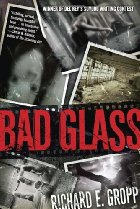
Book Review: Bad Glass by Richard E. Gropp
 Summary:
Something strange is happening in Spokane, and the US military has taken control of the city, closing it and its happenings to the press. Dean sees this as the perfect opportunity to break into photography before he graduates from college and is forced into giving up on his artistic dreams to work a regular 9 to 5 job. So he sneaks into Spokane, where he meets an intriguing young woman and her rag-tag household of survivors, and quickly starts to see the inexplicable things that are going on inside the city.
Review:
Dark fantasy is one of my favored genres, but unfortunately not a ton comes out in it in any given year. So when I saw this title available on NetGalley, I just had to snatch it up. I’m glad I did, because it’s a truly enjoyable read.
The basic plot uses a trope of dark fantasy–a creative outsider comes to a town where bizarre things supposedly happen then starts to document them happening. The twist here is that the creative type is a photographer, so the art form being used is photography. This was an incredibly refreshing way to approach the topic. Each chapter opens with a description of a shot that Dean will get at some point in that chapter. It’s fascinating foreshadowing, and also Gropp shows real talent in describing photographs of both the fantastical and more ordinary varieties. The descriptions also talk about more technical aspects of photography, and these show up within the story too (such as lighting and shutter speed). Describing instead of showing the photographs was a choice that I at first was not certain of but I ultimately appreciated. By not reproducing the photographs, Gropp leaves quite a bit of the mystery up to the reader and doesn’t spoil whatever images the reader has already established within her own mind. But the descriptions are also so well-done that the impact of seeing one brief moment in this surreal world is still rendered. It’s a unique and well-done choice, and I’d recommend this read to people based on that creative storytelling aspect alone.
It’s also great to see a story centering primarily around 20-somethings. Often literature tends to stick to YA (teens) or jump right over those of us who are in that truly young adult phase of our lives and into 30-somethings. Although the primary focus of the story is what precisely is happening in Spokane, conflicts frequently faced by 20-somethings come up within this framework–what to do for a career, do you give up on your dreams and settle down into a cubicle or not, when and with whom should you settle down, should you settle down at all, when should you respect your parents and their experience and when should you stand up to them, etc… Long-time followers know that one reason I enjoy genre literature is it addresses these real life issues within the context of the fantastic, and the good ones do it integrated and in a thought-provoking manner. This book achieves that.
The main character also is bisexual, while being primarily interested in a woman. It was so awesome to get to see a bi male main character and have it be presented as just a part of who he is and not a big deal at all. Although there is certainly a need and a place for the coming out tales and stories where the character’s sexuality is a central issue, it is also nice to see queer characters where that is just one aspect of who they are and is not dwelled upon much. It is just a part of who Dean is.
As for the central plot–what is happening in Spokane–I admit that I hoped for slightly more answers than we ultimately get. Readers looking for nicely tied up endings or even a hint at an answer will be left wanting. I enjoy an ambiguous ending, but I also felt that perhaps the plot could have been a bit clearer. In particular, without giving anything away, I felt that the scenes revolving around the hospital while powerful left me feeling a bit like perhaps even the author doesn’t really know what’s going on in Spokane. Perhaps that is the point, but it did leave me feeling that the plot was not as up to par as the world building and characterization.
Overall, this is a wonderful addition to the dark fantasy genre. Gropp gives us a unique main character and also utilizes writing about photography in a creative manner. I highly recommend it to fans of dark fantasy, particularly 20-somethings and those with an interest in photography.
4 out of 5 stars
Source: NetGalley

Friday Fun! (Blogger and Writer News, Ahoy!)
Hello my lovely readers!
Just a couple of quick blogger and writer related updates for you all this week.
First off in very exciting blogger news, you all may remember me telling you about the new initiative called Bookstore Book Blogger Connection, which is all about connecting online reviewers and reviews with brick and mortar bookstores. Welp. I popped on over there to check in on how things are going and lo and behold there were some photos from a bookstore showing off their new displays with book blogger quotes, and my recommendation for Stand on Zanzibar
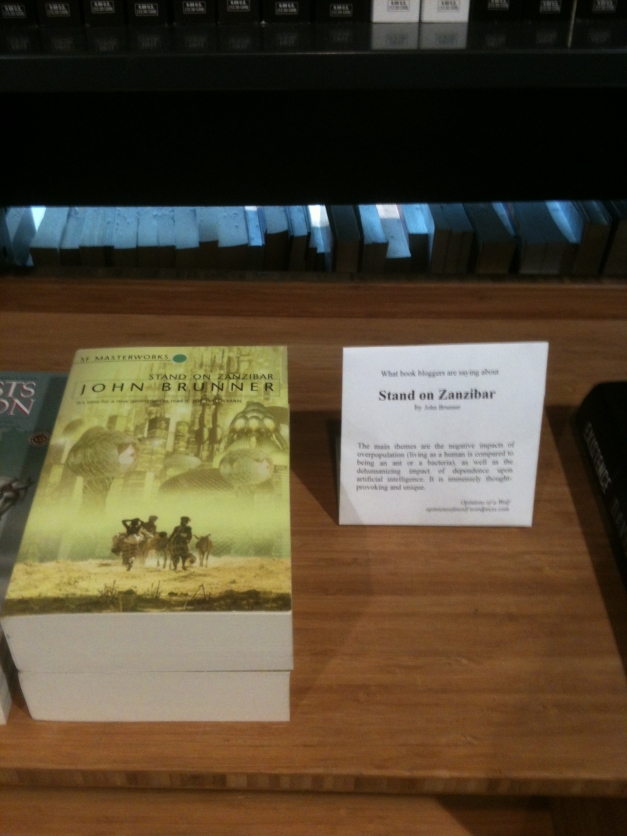
Not that this isn’t cool enough already, but what moved it up a level in the squee factor is that this is from a bookstore in the Netherlands! The American Book Center to be exact. And they look pretty damn cool. There’s something that’s just extra-exciting about being part of a bookstore that isn’t even in my country. So thanks, guys, for sending the shots to the Bookstore Book Blogger Connection website. You gave this blogger warm glowy feelings, and I do hope the display helped introduce more readers to the awesomeness that is John Brunner’s writing.
In writerly news, I got to participate in Ang’s blogoversary over on Eastern Sunset Reads. She gave Waiting For Daybreak
I also was able to contribute a guest post to her blogoversary where I talked about her theme for the month on where a love of reading came from for me. My guest post is quite personal, and I really enjoyed writing it. Big thanks to Ang for inviting me to be part of her special month!
Although my blog tour is not still going on, book bloggers are always welcome to request review copies of both my novel and my novella. I appreciate any and all signal boosts. :-)
That’s it for the news for this week! I hope you all have completely awesome weekends. *waves*
 Support my work with a tip or browse my shop for curated book club guides, how to guides, cross-stitch patterns, and more!


This work by Amanda Nevius is licensed under a Creative Commons Attribution-Noncommercial-No Derivative Works 3.0 United States License.
 Opinions of a Wolf