
Archive
Book Review: Soul Surfer: A True Story of Faith, Family, and Fighting to Get Back on the Board by Bethany Hamilton

A powerful disability memoir about faith, resilience, and healing after a shark attack.
Summary:
They say Bethany Hamilton has saltwater in her veins. How else could one explain the passion that drives her to surf? How else could one explain that nothing—not even the loss of her arm—could come between her and the waves? That Halloween morning in Kauai, Hawaii, Bethany responded to the shark’s stealth attack with the calm of a girl with God on her side. Pushing pain and panic aside, she began to paddle with one arm, focusing on a single thought: “Get to the beach….” And when the first thing Bethany wanted to know after surgery was “When can I surf again?” it became clear that her spirit and determination were part of a greater story—a tale of courage and faith that this soft-spoken girl would come to share with the world.
Soul Surfer is a moving account of Bethany’s life as a young surfer, her recovery after the attack, the adjustments she’s made to her unique surfing style, her unprecedented bid for a top showing in the World Surfing Championships, and, most fundamentally, her belief in God. It is a story of girl power and spiritual grit that shows the body is no more essential to surfing—perhaps even less so—than the soul.
Review:
In many of the circles I’m in, “recovery” means recovery from addiction. But it can also mean recovery from trauma—and for many of us (studies suggest around 75%), those things are intertwined. That’s part of why memoirs about recovering from trauma resonate so deeply with me. I’m especially drawn to the ones that focus not on the traumatic event itself, but on the response to it—the healing, the resilience, the rebuilding. This is that kind of memoir.
I remember when the news broke in 2003: a teenage surfer in Hawaii had lost her arm to a shark attack. I was in high school myself, and even though I lived in Vermont (far from any waves), I immediately felt heartbroken for her, losing not just a limb, but the ability to pursue something she loved. Years later, when I learned Bethany was not only surfing again but competing professionally, I was stunned—and moved.
Bethany knows that readers will come to her story expecting to read about the shark attack, and she doesn’t shy away from it. But she also doesn’t sensationalize it. It’s described early in the book with striking clarity and calm. There’s no melodrama—just presence, perspective, and truth. It’s a credit to both her and her editorial team that this tone is preserved. Her calm focus in the water (“Get to the beach…”) is echoed in how she writes.
What carries Bethany through, more than anything, is her deep faith. She was a girl of faith before the attack, during recovery, and continues to lean on her faith throughout her life. Her story isn’t preachy, but it is grounded in that spiritual strength. Her family, too—supportive parents and brothers—play a major role, along with a strong friend group that surrounds her in the aftermath.
One of my favorite moments in the book is her description of working with a blind therapist during her recovery. That peer connection—being guided by someone who also lives with a disability—felt powerful and familiar. Coming from the world of recovery, I saw that moment as a type of peer support. Rather than being told how to heal by someone without shared experience, Bethany was supported by someone who understood. It’s a powerful reminder of why peer-based healing matters.
Bethany also takes care to honor Hawaiian culture. As a white surfer growing up in Hawaii, she shares what she’s learned about the Indigenous roots of surfing, respectfully credits Hawaiian words and traditions, and speaks with admiration about her Hawaiian coach. This kind of cultural awareness—especially in faith-based memoirs—is both rare and welcome.
Later in the memoir, she explores what it was like to become famous almost overnight. From media appearances to a Hollywood movie adaptation, Bethany shares the highs and lows with honesty—including awkward encounters with strangers and challenging public questions.
I listened to the audiobook, which includes a charming guitar riff at the end of each chapter—a small touch that added to the overall tone and kept me engaged.
Overall, this is an uplifting, engaging memoir of trauma, recovery, and spiritual grit. It doesn’t just tell the story of a shark attack. It tells how we can recover. If you’re interested in memoirs, faith-based stories of resilience, or narratives about disability and healing, this one’s worth the read.
If you found this review helpful, please consider tipping me on ko-fi, checking out my digital items in my ko-fi shop, buying one of my publications, using one of my referral or coupon codes, signing up for my free microfiction monthly newsletter, or tuning into my podcast. Thank you for your support!
4 out of 5 stars
Length: 222 pages – average but on the shorter side
Source: Library
Buy It (Amazon or Bookshop.org)
Stories That Heal: 5 Books for Mental Health Awareness Month
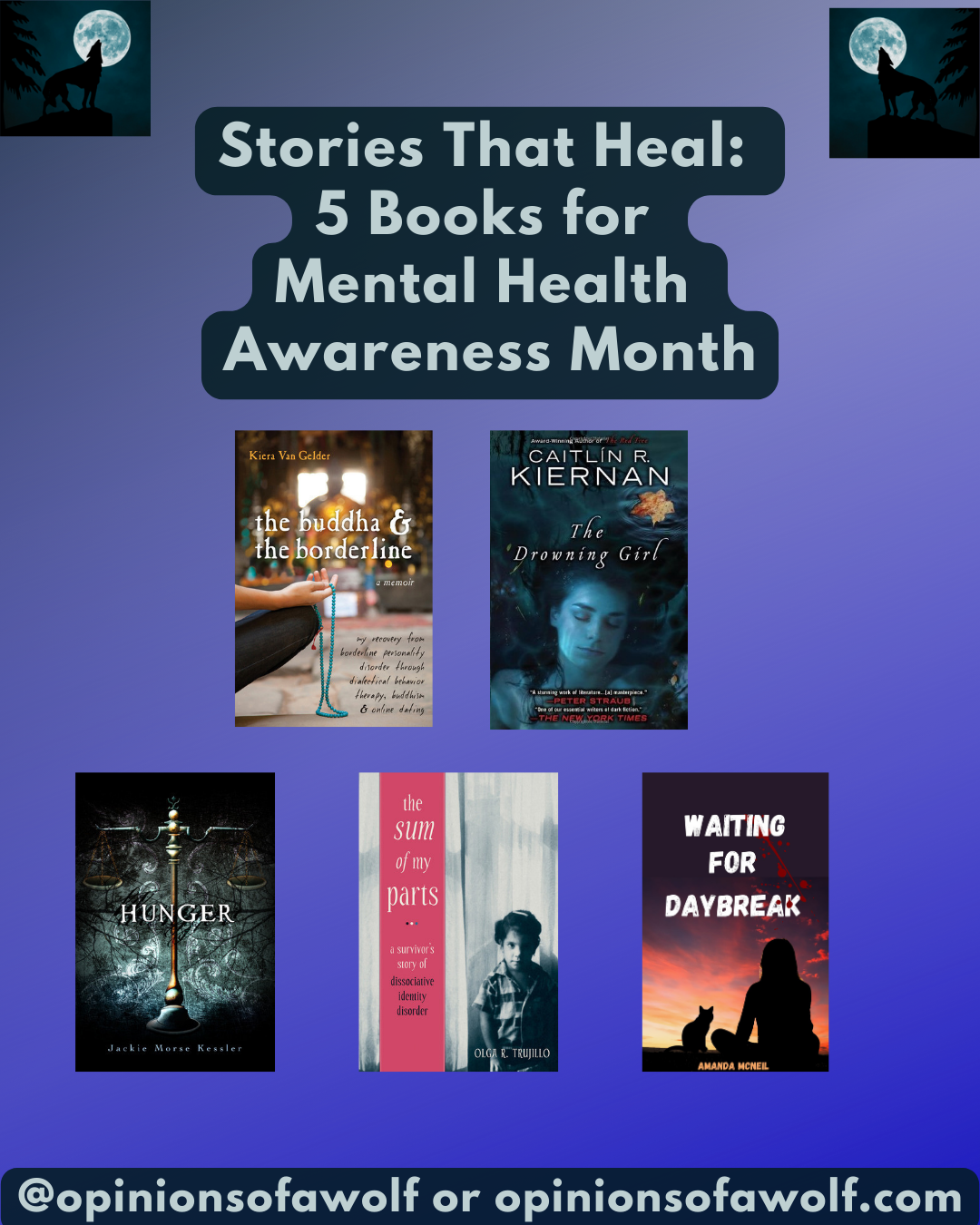
May is Mental Health Awareness Month—an annual observance founded by Mental Health America in 1949 to highlight the importance of mental wellbeing, educate the public, reduce stigma, and promote support for those affected by mental health conditions.
As someone who believes in the power of books to change lives, I thought this was the perfect time to share a mental health–focused reading list. Whether you frequently read books centered on mental health or are exploring this space for the first time, I hope you’ll find something here that resonates. This list includes a mix of fiction and nonfiction across genres—something for every reader.
The Buddha and the Borderline: My Recovery from Borderline Personality Disorder through Dialectical Behavior Therapy, Buddhism, and Online Dating by Kiera Van Gelder
(Amazon, Bookshop.org)
memoir
In this candid memoir set largely in Boston, Kiera Van Gelder traces her journey through Borderline Personality Disorder—from self-harm and addiction to healing through Dialectical Behavior Therapy and Buddhism. It’s an honest, hopeful account of finding stability and meaning after years of chaos.
(Read full review)
The Drowning Girl by Caitlin R. Kiernan
(Amazon, Bookshop.org)
literary fantasy, LGBTQIA+
In this haunting literary mystery, India Morgan Phelps—Imp to her friends—tries to untangle what really happened the summer she met Eva Canning. Was Eva a mermaid? A werewolf? Or is Imp’s memory altered by her schizophrenia? Told in lyrical, first-person prose, The Drowning Girl explores mental illness, identity, and unreliable memory, with nuanced queer representation and a mystery that unfolds entirely from within.
(Read full review)
Hunger by Jackie Morse Kessler
(Amazon, not available on Bookshop.org)
fantasy, YA
In this early 2010s YA standout, Hunger blends biting fantasy with raw realism to explore anorexia through a supernatural lens. When teen Lisabeth Lewis is visited by Death and becomes Famine—one of the Four Horsemen of the Apocalypse—she’s forced to confront the eating disorder that controls her life. With Buffy the Vampire Slayer-style humor and emotional honesty, this novel offers a powerful, metaphor-rich take on the inner voice of anorexia and the path to healing.
(Read full review)
The Sum of My Parts: A Survivor’s Story of Dissociative Identity Disorder by Olga Trujillo, JD
(Amazon, Bookshop.org)
memoir
In this powerful memoir, Olga Trujillo—once a successful attorney in D.C.—recounts their journey through the diagnosis, treatment, and recovery process of Dissociative Identity Disorder. As long-repressed memories of childhood abuse begin to surface, Olga works to integrate their parts and reclaim their life. With compassion, clarity, and survivor-centered care, this memoir offers both insight and hope to anyone seeking to understand trauma, dissociation, or the long path to healing.
(Read full review)
(Note: At the time I wrote my original review, Trujillo had not yet come out as nonbinary, so older references use previous pronouns.)
Waiting for Daybreak by Amanda McNeil
(Amazon, Bookshop.org)
zombie horror
In my own novel, Waiting for Daybreak, a young woman with Borderline Personality Disorder unexpectedly finds sobriety from alcoholism and strength when a zombie outbreak turns Boston upside down. Frieda has spent years battling emotional chaos and isolation—but when a mysterious virus brings society to a halt, she discovers survival suits her better than daily life ever did. As she sets out to save her sick cat, her solitary routine shatters, and she’s forced to reengage with a world that no longer plays by the rules. A character-driven post-apocalypse, Waiting for Daybreak explores mental illness, addiction recovery, and the fragile resilience that can grow in even the bleakest moments.
(See what readers are saying)
I hope you’ve found something here that speaks to you. If you have a favorite book that explores mental health—fiction or nonfiction—I’d love to hear about it in the comments!
Book Review: My Body Is Not a Prayer Request: Disability Justice in the Church by Amy Kenny

A disabled Christian woman shares her experiences with ableism in the church and offers solutions and actionable steps for fostering disability justice and inclusion.
Summary:
Much of the church has forgotten that we worship a disabled God whose wounds survived resurrection, says Amy Kenny. It is time for the church to start treating disabled people as full members of the body of Christ who have much more to offer than a miraculous cure narrative and to learn from their embodied experiences. Written by a disabled Christian, this book shows that the church is missing out on the prophetic witness and blessing of disability. Kenny reflects on her experiences inside the church to expose unintentional ableism and cast a new vision for Christian communities to engage disability justice. She shows that until we cultivate church spaces where people with disabilities can fully belong, flourish, and lead, we are not valuing the diverse members of the body of Christ. Offering a unique blend of personal storytelling, fresh and compelling writing, biblical exegesis, and practical application, this book invites listeners to participate in disability justice and create a more inclusive community in church and parachurch spaces. Engaging content such as reflection questions and top-ten lists are included.
Review:
Intertwining memoir, Biblical commentary, and disability justice scholarship, the author explores disability within the US American Christian church.I picked this book up as research for the second book in my closed-door paranormal romance series, which uses werewolfism as a metaphor for disability (look for it this year!). You can grab the first book on Amazon, Bookshop.org, or other retailers, or request an advanced copy of the sequel.
The book is organized into ten chapters—seven of which start with the title “disability” and three with “disabled.” Each chapter begins with a memoir vignette and delves into the theme of the chapter. One chapter I particularly resonated with is “Disability Blessings.” It opens with the author singing a pop song during a medical procedure, before discussing the societal pressure to “fix” disabled bodies rather than support them. She then brings the conversation to the Bible, exploring the story of Jacob, who becomes disabled after wrestling with God. This disability, Kenny argues, is a sign of blessing, not something to be eradicated.
Faith, then looks like wrestling–all night long–and emerging with a healing limp….I treasure this image, because it allows me to envision my limp as part of my healing instead of something that must be cured or killed off in hopes of inspiring nondisabled people. (page 51)
She ends each chapter with bullet-point listed calls to action for disability justice. For example, in this chapter, the reader is invited to re-explore disability narratives in the Bible and view them through a lens of celebrating disabled people. After this, she features a “top ten” list of things people have actually said to her as a disabled person with each chapter on a theme. The theme of this chapter is “I know how you feel,” with the message being, of course, no one really knows how anyone else actually feels to live in their body.
The themes of the rest of the chapters are curatives, discrimination, doubters, justice, mosquitoes, lessons, disabled foundations, disabled God, and disabled church. The most controversial seems to be that of disabled God, but I found it rather inspiring. For example, the resurrected Christ, God incarnate, has the marks of the nails on his hands and a hole in his side. He invites Thomas to touch these places. Jesus was not resurrected with a “perfect” body, so why is there so much pressure on disabled Christians to “faith their way” to one?
Sometimes the author’s writing challenged me, but I viewed it as an invitation to sit with the discomfort. Why was what the author was saying making me uncomfortable? Was it really how she was saying it or was it just an entirely new perspective being brought to me? For example, I didn’t like that she didn’t disclose exactly what condition she has. But I sat with that and wondered why I felt the right to know?
As someone who is writing about disability through metaphor myself, this book encouraged me to consider my character viewing his werewolfism as a blessing, not a curse. Of course, there is nuance to this. For example, Kenny points out that of course she would prefer to not be in pain. But it’s possible to both dislike the negatives of a disability while also seeing the blessings that come with it. This is a perspective I’m striving to bring to my own book.
Overall, this is an interesting mix of memoir, Christian exegesis, and disability justice. Recommended to Christian readers looking to become better disability justice advocates and disability justice advocates looking to understand the Christian perspective.
If you found this review helpful, please consider tipping me on ko-fi, checking out my digital items available in my ko-fi shop, buying one of my publications, using one of my referral/coupon codes, or signing up for my free microfiction monthly newsletter. Thank you for your support!
4 out of 5 stars
Length: 208 pages – average but on the shorter side
Source: Library
Buy It (Amazon or Bookshop.org)
Book Review: Slacks and Calluses: Our Summer in a Bomber Factory by Constance Bowman Reid & Clara Marie Allen

Explore the world of women working on airplane factory lines in this memoir with hand-drawn illustrations from 1944.
Summary:
In 1943 two spirited young teachers decided to do their part for the war effort by spending their summer vacation working the swing shift on a B-24 production line at a San Diego bomber plant. Welding torches and climbing into bomb bays, they learned to use tools that they had never seen before, live with aluminum shavings in their hair, and get along with supervisors and coworkers from all walks of life.
They also learned that wearing their factory slacks on the street caused men to treat them in a way for which their “dignified schoolteacher-hood” hadn’t prepared them. At times charming, hilarious, and incredibly perceptive, Slacks and Calluses brings into focus an overlooked part of the war effort, one that forever changed the way the women were viewed in America.
Review:
I knew the instant I flipped this book open it would be a new favorite. Two teacher friends set out to help the war effort in WWII in their summer off and document it. Constance was a writer, and Clara Marie (fondly called C.M. in the book) was an artist. The book maintains an upbeat tone throughout, in spite of being written prior to the authors having any knowledge of how the war would turn out.
This is an easy read. It feels like chatting with a friend about their unique summer. It starts off with a brief description of their friends’ reactions to their plan for their summer. It then goes through the process of signing up and their first day on the line. Subsequent chapters talk about specific issues. For example, the time the factory tried to make all the women employees fully cover their hair. Or what it was like to commute in pants. C and C.M. were surprised to find how differently they were treated in public in pants.
The characters are memorable, even with the authors doing due diligence to anonymize real people. In From the foremen to women colleagues to men colleagues to the folks they encounter on their commute. Everyone feels real. Some are of course more well-rounded than others. (The foremen or “Red Buttons” are particularly flat.) But this simply adds to the realness of the memoir. Isn’t that how we all encounter people in our lives? With some developing into full-fledged members of our lives and others staying two-dimensional background characters.
The illustrations are utterly charming and are throughout the book.

The authors reflect on things like the fact that while they will be returning to school in the fall, others will be working on factory lines throughout their life. They also consider the impact the war is having on gender roles in society, although not in academic language. They simply discuss things like how more women are wearing pants and how men treat them when they do. In general, though, the women try to keep the tone light.
Overall, this is a compelling primary document in memoir form of the women on the factory lines in WWII. It’s interesting they had the foresight to realize this was an important moment in history. Immediately writing the book and finding a publisher. They were published in 1944. Their factory work was just the year before in 1943. An easy gift for any WWII aficionado. Also, check out my other reviews of books dealing with WWII.
If you found this review helpful, please consider tipping me on ko-fi, checking out my digital items available in my ko-fi shop, buying one of my publications, using one of my referral/coupon codes, or signing up for my free microfiction monthly newsletter. Thank you for your support!
5 out of 5 stars
Length: 200 pages – average but on the shorter side
Source: Gift
Buy It (Amazon or Bookshop.org)
Book Review: Peace Child by Don Richardson

Part history of the 20th century for the Sawi people of New Guinea, part personal memoir by the first missionary to live with them.
Summary:
In 1962, Don and Carol Richardson risked their lives to share the gospel with the Sawi people of New Guinea. Peace Child tells their unforgettable story of living among these headhunters and cannibals, who valued treachery through fattening victims with friendship before the slaughter. God gave Don and Carol the key to the Sawi hearts via a redemptive analogy from their own mythology. The “peace child” became the secret to unlocking a value system that had existed through generations. This analogy became a stepping-stone by which the gospel came into the Sawi culture and started both a spiritual and a social revolution from within. With an epilogue updating how the gospel has impacted the Sawi people, this missionary classic will inspire a new generation of readers who need to hear this remarkable story and the lessons it teaches us about communicating Christ in a meaningful way to those around us.
Review:
There’s a lot of controversy about modern mission work. Not to mention the known atrocities committed by missionaries in the US, Canada, and other places in historic times. I support Indigenous peoples and condemn the horrific means used by these supposed “missionaries.” (I personally do not consider these people to be true believers bringing the gospel but rather colonizers acting on behalf of a nation. For example, Jesus loved children and yet these people murdered them.) So I approached this book with quite a bit of trepidation. Yet slowly over the course of it, I came to see the picture of a very different type of mission work.
Unlike many missionary memoirs, the perspective of the first third of the book is actually that of a historical account of approximately one year in the life of the Sawi before the missionaries arrived. It immerses you into the world of New Guinea and also gives a neutral depiction of the cannibalism as it existed at that point in time. Because Sawi culture honored duplicitousness and treachery, the different villages were quite isolated and small. Betrayal with the end result being death and, yes, cannibalized, was a real consistent threat. There was a Sawi saying about honoring this treachery – “fatten with friendship for the slaughter.” Starting the book from the Sawi perspective sets the expectation that this book is really about the Sawi, not Don and his wife Carol.
Something Don makes clear early on is that other cultures were encroaching on the Sawi. They were not going to continue to be left untouched for long due to the political situation in New Guinea. Essentially, the people with the hands-off approach were departing. It was clear the ones incoming were going to go into the jungles themselves but also allow hunters, prospectors, etc… in. Don’s belief was that the first people the Sawi encountered shouldn’t be out to exploit them for anything but rather should be there to help them in as many ways as possible, not solely with the gospel but also to adjust to their world shifting more dramatically than it had in generations. Don and his wife brought medical care and information on how the outside world that was coming into contact with them would work. A story that particularly struck me was how Don and Carol taught Sawi how to be shopkeepers. You might, like me, think at first, oh no, he’s destroying their hunter/gather society with money. But when he explained his reasoning, I was humbled at how forward-thinking and selfless it was.
Educating Papuans without training some of them to be shopkeepers invites non-Papuans to come in and take control fo the supply and pricing of manufactured goods. As non-Papuans enrich themselves, they eventually gain ownership of land bequeathed to Papuans by their ancestors. Papuans thus tend to end up as exploitable cheap labor or, worse yet, as beggars foraging on garbage cast off by non-Papuans. Hoping to spare our Sawi friends such a fat, we trained some of them to be, yes, shopkeepers! Shopkeepers who charge prices lower than non-Papuans care to compete with! Shopkeepers who see no need to sell their land because their shops are doing quite well, thank you!
location 3632
Beyond helping the Sawi to prepare for meeting the world, Don’s perspective on mission work is essentially that the culture you are visiting already has inbuilt messaging from God about Jesus. You just have to find what it is to help them see it, since they haven’t heard the message before. In the case of the Sawi, that is the cultural tradition of the peace child. I won’t go into the details of how the peace child works in Sawi culture. I think that is most impactful by actually reading the book. What is interesting to me to note, however, is how his method of missions doesn’t supplant the culture or force another culture upon it. It rather takes an aspect of the culture that already exists and builds upon it. Now, all cultures have good and bad aspects. Essentially what Don does is he tries to help enhance what is good within the culture and tamp down what is only hurting the people. The Sawi inability to trust anyone because of treachery being so upheld as a positive trait is an easy to understand example of this. Once the Sawi understanding of a peace child was uplifted higher instead and became more achievable for anyone, then the Sawi were able to start trusting each other and uniting so that they might remain that way when facing the world. I frankly found myself wishing someone could come help my own culture in such a way to help us be better, more communal, versions of ourselves!
I was also surprised by how things turn out. Ultimately, the mission group withdraws from the Sawi villages, not in defeat, but because they feel the Sawi are ready to stand on their own within the extended world they now find themselves in. Updates on the Sawi indicate they are still doing well and have even sent their own missionaries to another Indigenous group, the Sumo, further inland. This article also talks about the fact that Don use the Indonesian characters to write down Sawi and translate the New Testament. This means that when the Sawi were newly required to go to government schools and learn Indonesian they could also automatically read Sawi, helping to preserve the language.
Overall, this is a very engaging and informative read about one Indigenous nation encountering the larger world in the 20th century. It also gave me a new appreciation for how mission work can be done ethically. While I understand that some may disagree and say there is no such thing as ethical mission work, I think how Don and his wife Carol helped the Sawi maintain control of their land and literacy in their own language is a strong counterpoint.
If you found this review helpful, please consider tipping me on ko-fi, checking out my digital items available in my ko-fi shop, buying one of my publications, using one of my referral/coupon codes, or signing up for my free microfiction monthly newsletter. Thank you for your support!
4 out of 5 stars
Length: 256 pages – average but on the shorter side
Source: Library
Buy It (Amazon or Bookshop.org)
Book Review: How to Say Babylon: A Memoir by Safiya Sinclair
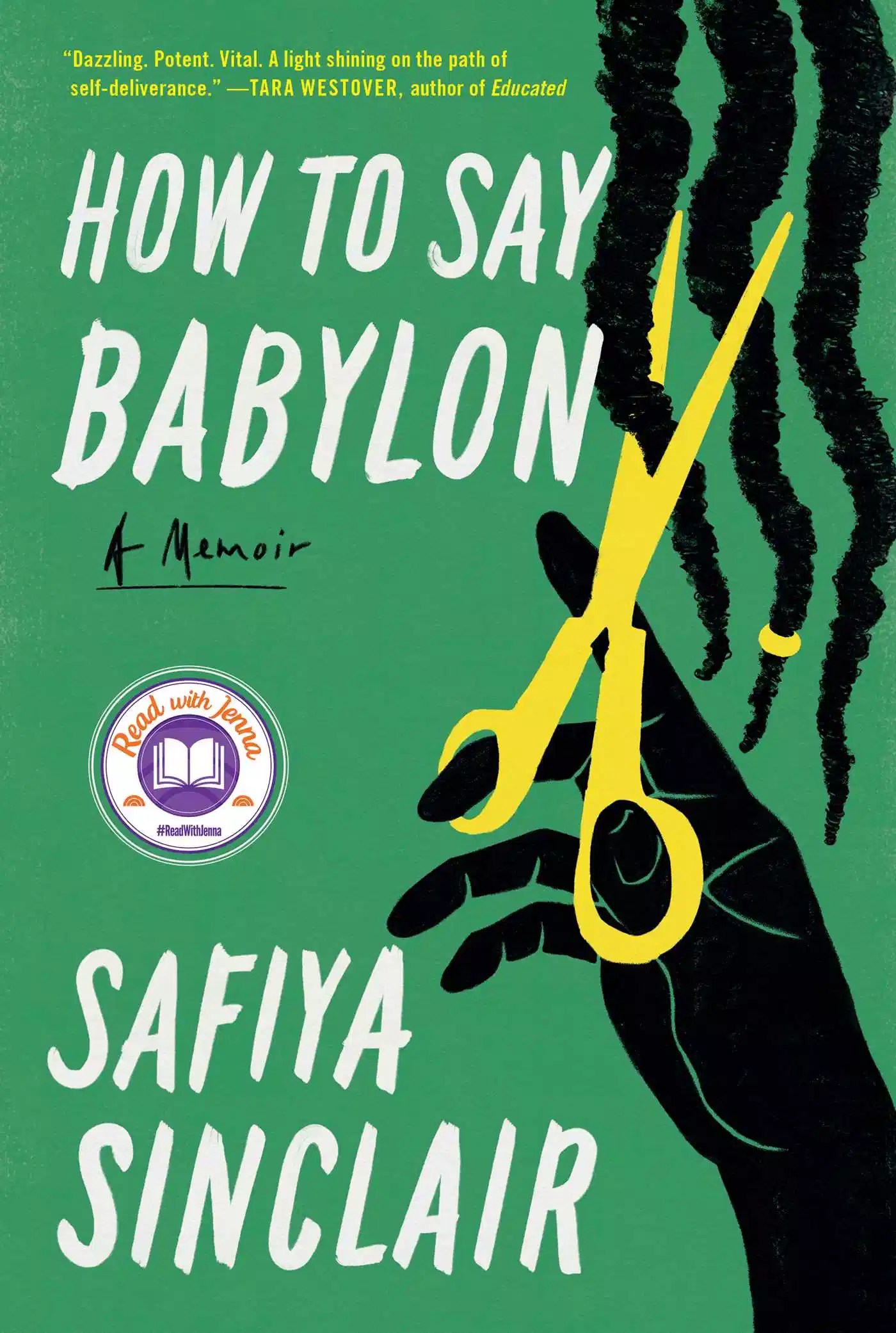
A poet recalls her childhood growing up as a minoritized Rastafarian in Jamaica with an abusive father.
Summary:
Throughout her childhood, Safiya Sinclair’s father, a volatile reggae musician and militant adherent to a strict sect of Rastafari, became obsessed with her purity, in particular, with the threat of what Rastas call Babylon, the immoral and corrupting influences of the Western world outside their home. He worried that womanhood would make Safiya and her sisters morally weak and impure, and believed a woman’s highest virtue was her obedience.
In an effort to keep Babylon outside the gate, he forbade almost everything. In place of pants, the women in her family were made to wear long skirts and dresses to cover their arms and legs, head wraps to cover their hair, no make-up, no jewelry, no opinions, no friends. Safiya’s mother, while loyal to her father, nonetheless gave Safiya and her siblings the gift of books, including poetry, to which Safiya latched on for dear life. And as Safiya watched her mother struggle voicelessly for years under housework and the rigidity of her father’s beliefs, she increasingly used her education as a sharp tool with which to find her voice and break free. Inevitably, with her rebellion comes clashes with her father, whose rage and paranoia explodes in increasing violence. As Safiya’s voice grows, lyrically and poetically, a collision course is set between them.
Review:
I picked this memoir up because I was interested in learning more about Rastafarianism. I was a religious studies minor in university, but Rastafarianism wasn’t something we’d touched on. The beginning of this book really delivered on educating me about the faith.
The memoir starts with a little introduction to Rastafarianism along with a brief history of Safiya’s father’s childhood and her mother’s childhood and what led each of them to convert to Rastafarianism. The religion sprang up in the 1930s as a faith of the most oppressed peoples in Jamaica. There is some disagreement as to whether Rastafarianism is a sect of Christianity or a separate faith entirely. Most Rastas believe that the Ethiopian Emperor Ras Tafari was the second coming of Christ. (In spite of him directly telling Rastas when he visited Jamaica that he was not Christ. Rastas felt that’s something Christ would say.) Just as with all faiths, there is a spectrum of beliefs and observances among Rastas. But there are three that are common.
First that the hair should not be cut, instead left in its natural state, leading them to dreadlocking it. Second, reggae as spiritual music. Third, smoking marijuana for spiritual experiences. Many Rastas are vegetarian, some are strict vegans. (Read more.) Something I found really beautiful was how Rastas adjust their speech, specifically how they will say “the I-and-I” as a reminder that God is indwelling in them. Safiya’s father will sometimes say “the I-man” to clarify when it was something limited to just him, and not him and God. The only thing I knew about Rastafarianism before I read this book was that it was common in Jamaica, so I learned a lot in an easy, beautiful way. The author didn’t just rely on her own childhood understanding of the faith but also interviewed Rasta elders and did some additional reading for the book. And it shows. To me, this was the strongest part of the book.
I thought when I picked this up it was a memoir of religion, but I think after reading it would be more accurate to say it was a memoir about an abusive father/daughter relationship that was at least a bit entwined with religion. So the focus was the abuse, not the religion. But it was necessary to understand the religion in order to understand some of where her father was coming from. Safiya’s father was on the more conservative end of the spectrum with regards to Rastafarianism. (He was also a reggae musician who kept running up against bad luck.) The family were strict vegans. He was more patriarchal and quite concerned about keeping his daughters safe from “Babylon” (the outside influence and dangers) in a way he wasn’t so much about his son.
But there are things that surprised me given the clear conservative lean of the family. The children all go to school. The daughters are encouraged to excel just as much as the son is. (The author even gets into an elite private school on scholarship, something that makes her parents very proud.) The children are allowed to continue living at home, even when they do things that go against the Rastafarian way. For example, the author models and cuts off her dreadlocks. I also was surprised to learn that Rastas were treated poorly in Jamaica while the author was growing up. She’s ridiculed due to being Rasta, and it wasn’t possible for her to pass as no one else seemed to have dreadlocks.
The abuse, though, is quite brutal. I was expecting from the book’s description emotional/spiritual abuse. Those do exist. But serious physical abuse does as well. One chapter titled “The Red Belt” made my chest ache to read. Any reader going into the book should be aware of this. I think some readers will relate to how Safiya deals with her father, and others will struggle to understand it.
The author is primarily a poet. Her work in poetry is what helped her achieve her goal of emigrating from Jamaica. Her poetic skills are evident in this book. I’m sure a reader who loves poetry will connect with this more than I did. I struggle to connect with poetry and so, even though I saw the beauty in the words, I struggled for them to move me. Similarly, while I always love to hear people talk about what they love doing, I didn’t connect with the author’s connection to poetry the way I would if I loved it similarly.
Overall, this is a book that will mean a lot to a reader who loves poetry and is able to read passages about physical and emotional abuse. Readers who like to root for someone to pivot into a life entirely different from how they grew up.
If you found this review helpful, please consider tipping me on ko-fi, checking out my digital items available in my ko-fi shop, buying one of my publications, using one of my referral/coupon codes, or signing up for my free microfiction monthly newsletter. Thank you for your support!
3 out of 5 stars
Length: 352 pages – average but on the longer side
Source: Library
Buy It (Amazon or Bookshop.org)
Book Review: The Woman in Me by Britney Spears

Two years after her conservatorship ended, pop star Britney Spears tells her story.
Summary:
In June 2021, the whole world was listening as Britney Spears spoke in open court. The impact of sharing her voice—her truth—was undeniable, and it changed the course of her life and the lives of countless others. The Woman in Me reveals for the first time her incredible journey—and the strength at the core of one of the greatest performers in pop music history.
Written with remarkable candor and humor, Spears’s groundbreaking book illuminates the enduring power of music and love—and the importance of a woman telling her own story, on her own terms, at last.
Review:
I think it’s important you know what sort of perspective you’re getting in my review. So let me be clear: I am a Britney Spears fan. From the moment I heard the first four notes of …Baby One More Time’s mp3 playing through the tinny speakers on my family’s pc when I was 13 years old, I was enamored – and I hadn’t even seen the music video yet! (And I didn’t for a while.) When I did finally start seeing Britney and not just hearing her, it got even better. Her fashion sense was, to me, spot on. I wanted nothing more than to wear those jeans and bare my midriff like her. (Although, I did not have the body confidence to do so.) Her eyeliner, her music videos, her sound.
Britney’s music was a perpetual backdrop to my rough teens and twenties. I laughed when Oops! I Did It Again mentioned the necklace in The Titanic. I got teary-eyed singing Lucky in my bedroom. I played I’m a Slave 4 U both because I liked it and because it drove my mother insane. I was terrified of snakes, and Britney DANCED with one while performing. I was a closeted bisexual, and when she kissed Madonna, I lost my mind. When she had kids, I was in college. I didn’t understand why she was so excited to be a mom, but I loved that she knew what she wanted so much. Blackout dropped my senior year, and I belted out Piece of Me on study breaks. I listened to Womanizer to make myself feel better when I was lonely in grad school Circus is still on my #GirlBoss playlist I listen to to help hype myself up when I’m doing something that feels scary in my various careers. (I’m on my second.)
When her conservatorship started, I didn’t understand what it meant. I thought she had trouble with her finances, and someone was helping her out. My husband took me to see her at her Vegas residency. I was so excited I threw up in our hotel room right before the show. I feel badly now knowing what she was going through (I did not know then), but I am here to tell you she still put on a phenomenal show for us fans in spite of all that.
When the #FreeBritney movement really started to take off, and I came to understand what a conservatorship actually meant, I joined in calling for her to be freed. I explained to anyone who would listen what was wrong with a conservatorship. And I believe this for anyone, not just for Britney. No one deserves to have their adult agency taken away, regardless of their mental abilities and/or mental health. Anything else is just ableist.
Anyway, that is who is reviewing this memoir for you. A fan who loves Britney for who she is.
The ghostwriters did a very good job of leaving Britney’s voice clearly in-tact throughout the book. It sounds like her. The story is told mostly chronologically from her childhood forward, although there is sometimes some jumping back and forth in some places. If you have read Britney’s Instagram captions, then you have some idea of the general tone of the book. But it has been edited so it is clearer than those. (And with less run-on sentences, and no emojis except in the Afterword.)
What stood out to me the most about the book was these things. First, Britney expresses that being put in the conservatorship caused her to regress sometimes. Essentially, treating her like a child made her act like a child. This is excellent insight, and a reason to not inflict conservatorships on people of any ability level. Everyone deserves to be treated with respect and like an adult. (I’d argue children deserve to be treated with more agency than they are, but that’s another topic for another blog post.) Second, Britney is of the opinion that what happened to her would never happen to a male pop star. How she was infantilized and not allowed space to be weird and creative was largely because she was a woman. Third, Britney feels part of why what happened to her did was because she tries so hard to be a “nice girl” that people end up walking all over her. She talks a bit about Madonna and how, “she demanded power, and so she got power.” (page 101) But that’s not part of Britney’s nature.
Fourth, Justin Timberlake broke up with her via text message then used the break-up to make her into the bad guy and spur on his solo career. Reminder to those who maybe weren’t around at that time – cell phones at that time didn’t let you write long messages. A break-up in a text message would have been necessarily character-limited. It makes it even worse. It seems that Britney was well and truly heart-broken and betrayed and society really piled on her on top of it. I didn’t realize that the paparazzi laws have changed since the early 2000s. I obviously wasn’t a celebrity but I remember how it was. You could see the paparazzi swarming celebrities constantly even in their own photos and videos. I used to wonder how they could stand it. (The answer is: a lot of them couldn’t.) The media was also incredibly cruel. I still have the internalized messages from just being a young woman at that time – and I wasn’t their target.
The magazines seemed to love nothing more than a photo they could run with the headline “Britney Spears got HUGE! Look, she’s not wearing makeup!” As if those two things were some kind of a sin–as if gaining weight was something unkind I’d done to them personally, a betrayal.”
The book makes it abundantly clear that the instigators of the conservatorship were her family. They swept in, claiming to be worried about her but actually wanting to control her. At the beginning of the book, she talks about her family history. How her father’s dad was abusive to him. This same grandfather also locked away her grandmother as “crazy” and left to rot there. The same thing her father tried to do to her. The intergenerational trauma gave me chills.
Ok, so why four stars instead of five? There were a few places where I wanted more. Not about any of her traumas. She has every right to only tell as much as she wants to tell. But some of the business stuff. I wanted to know more. I loved how she told us about what it was like to shoot her first music video and to dance with the snake at the awards show. I wanted more of that. What was it like to kiss Madonna? Why did she? (She says it was her idea, that they didn’t rehearse that way, but not much else.) I wish the ghost writers had nudged her a bit more to put more of those types of anecdotes in the book. Or when they came up to say more. (She says she threw a party with Natalie Portman but essentially nothing about what the party was like.) I wanted to know more about this part of Britney. Her successes, not just her traumas.
A question I was asked when I was seen reading the book was if I think Britney is really mentally unwell. My answer is this: this is a book written by a traumatized person. Britney was traumatized by her family, by the media, by various romantic partners, by the conservatorship. I don’t want to diagnose anyone. But I will say that trauma often leads to C-PTSD. And C-PTSD can often be misdiagnosed as other mental health conditions. So I hope people will keep these things in mind when looking at Britney and give her some grace. I do also think Britney is a simple, trusting person. Those type of people often end up being taken advantage of.
I’m assuming most fans have either already read the book or are (im)patiently waiting for their copy. If you’re on the fence, to you I say, this book is worth the read to explore intergenerational trauma and to dive down into late 90s/early 2000s culture. To be reminded (or learn) how misogynistic it was, even to women who were succeeding by its own rules.
If you found this review helpful, please consider tipping me on ko-fi, checking out my digital items available in my ko-fi shop, buying one of my publications, using one of my referral/coupon codes, or signing up for my free microfiction monthly newsletter. Thank you for your support!
4 out of 5 stars
Length: 288 pages – average but on the shorter side
Source: Library
Buy It (Amazon or Bookshop.org)
Book Review: Elvis and Me by Priscilla Beaulieu Presley and Sandra Harmon

The King of Rock and Roll’s first (and only) wife’s controversial memoir of their time together.
Summary:
Decades after his death, millions of fans continue to worship Elvis the legend. But very few knew him as Elvis the man. Here in her own words, Priscilla Presley tells the story of their love, revealing the details of their first meeting, their marriage, their affairs, their divorce, and the unbreakable bond that has remained long after his tragic death.
Review:
I picked up my library system’s only copy of this book in preparation for the A24 movie coming out this fall directed by Sofia Coppola. I am absolutely dying to see the movie, and I thought I should have read the memoir first. Now, this memoir is pretty controversial, especially in the Elvis fan crowd (who I count myself among.) So my review will be in three parts. First looking at the book as a memoir compared to other memoirs. Second, my thoughts on certain aspects of Elvis and Priscilla as she presents them in the book. Third, looking at the controversies.
As a memoir, this starts out very strong with Priscilla finding out about Elvis’s death, then we immediately get a flashback to when she met him in Germany. The first two-thirds of the book are engaging and engrossing. I could barely put it down. It was an easy read that made me want to know more. I also felt in this portion of the book that Priscilla was giving a fairly even hand to both herself and to Elvis. She was being relatively straightforward about everyone’s strengths and shortcomings. Unlike modern memoirs, which often eschew using dialogue with direct quotes, this is written more like a story with snippets of dialogue sprinkled throughout. This made it more readable but also less believable, because who really remembers exactly what people said decades ago? And I don’t believe that something being a pinnacle moment in your life makes it more likely for you to remember the exact words. I don’t remember my wedding vows I wrote without going to reread them.
The strengths present in the first two-thirds of the memoir are lacking in the last third. Priscilla glosses over big moments in the marriage without much reflection or insight. For example, the first time she has an affair, she essentially just says…then I had an affair. I don’t need the details of the sexual aspect of the affair, but some reflection as to what was the first touch that crossed the line, what made her willing to take the risk to have an affair (especially given how whole-heartedly she’d committed herself to the quest to be Mrs. Presley), etc… There are large swathes of time also that are communicated in just a few sentences. Perhaps distance and time was needed to be able to fully process everything that had happened. Perhaps she should have waited until more time had passed to allow for more meaningful reflection on these years. In any case, the last third of the book almost reads like a different book than the first two-thirds. Or like a different pair of authors wrote it.
Second, here are some things that were newly revealed to me in this read as an Elvis fan that I didn’t know before and that some research confirms seem to be accepted as true. Elvis talked a form of baby talk in his intimate relationships. (This has been confirmed by other women he was romantically involved with). Priscilla says this was similar to how Elvis spoke with his mother Gladys. I’m sure a lot of people speak in a special way with their significant other (look at how “bae” has entered the lexicon). I guess I’m just surprised that these women were willing to talk about it. I also learned that Priscilla suggested that Elvis burn his philosophy books after the Colonel ordered him to back off on it. Elvis acquiesced and did so. Earlier, he had told Priscilla that his soul mate would be interested in the things that interested him, even though she had no interest in the philosophy books at all. Both of these situations show how emotionally immature the two of them were in dealing with each other. Instead of building a healthy relationship built on two separate individuals who mutually respect each other, they each had strong expectations of how the other would behave. Priscilla didn’t want Elvis the spiritual guru. She wanted Elvis the rock star. Elvis didn’t want Priscilla to have a life of her own in addition to her life with him. He wanted her to be a side-kick at his beck-and-call.
Of course, the relationship started off on the wrong foot. Which leads me right into the controversies. I knew going into this that Priscilla was 14 and Elvis 24 when they met and began their relationship. Some fans think this is no big deal. Others think Elvis groomed Priscilla. Certainly passages in the book sound very much like grooming.
When we met, I had just turned fourteen. The first six months I spent with him were filled with tenderness and affection. Blinded by love, I saw none of his faults or weaknesses. He was to become the passion of my life. He taught me everything: how to dress, how to walk, how to apply makeup and wear my hair, how to behave, how to return love–his way. Over the years he became my father, husband, and very nearly God.
page 15
I find the folks who defend Elvis by talking about how they think Priscilla manipulated her way into being Mrs. Presley to be honestly abhorrent. She was ten years his junior and just 14 years old when they met. Even if we imagine that Priscilla was a super-fan hoping to be Mrs. Presley, as the adult in the situation who was also mega-famous and rich, he had all the power. Did Elvis really feel a true connection with Priscilla (that he should have ignored as she wasn’t an adult yet), or did he just identify a teenager he could partially raise into being exactly the type of wife he wanted? No one will ever know that for sure. Only Elvis knows. But I think it’s absolutely clear that the way in which the relationship started made it impossible for them to have a healthy marriage.
Some people say that Priscilla lies throughout the book. The main source of these accusations seems to be from Suzanne Finstad’s book Child Bride. She says she has recordings of interviews with Priscilla in which she admits to exaggerating in her memoir, but these tapes have not been released so no one can verify this. Priscilla won a defamation lawsuit against Currie Grant for his claims in this book but, interestingly, never sued Suzanne Finstad or the publisher. I haven’t read this book but I do think if the author has interviews with Priscilla backing up what the book says it would be interesting for her to release them.
At the end of the day, this memoir is an engaging read that further highlights aspects of Elvis that other biographies and memoirs I’ve read agree on. He kept a completely flipped schedule (up at night and asleep in the day) facilitated by downers and uppers. He had a short temper and yet was a consummate professional and a gentleman when he was working. He was almost always surrounded by his entourage. He never got over the death of his mother. The Colonel controlled his career in such a way that he didn’t get to pursue the artistic work he wanted to, and yet, he also allowed the Colonel to control these things because he was afraid of what would happen if he lost the fame and the ability to make the money. All in all an interesting entry in the mosaic that makes up outsider perspectives on what Elvis was like, a man who left behind no journals and very few letters.
If you found this review helpful, please consider tipping me on ko-fi, checking out my digital items available in my ko-fi shop, buying one of my publications, or using one of my referral/coupon codes. Thank you for your support!
4 out of 5 stars
Length: 320 pages – average but on the longer side
Source: Library
Buy It (Amazon or Bookshop.org)
Book Review: Appalachian Zen by Steve Kanji Ruhl

A memoir written throughout one man’s life looking back on his childhood in the Appalachian region of Pennsylvania and following his journey to becoming a Zen Buddhist minister in Massachusetts.
Summary:
Edgy, lyrical, and lovingly rendered, this book recounts how a kid from a Pennsylvania mill-town trailer park grew up—surrounded by backwoods farms and amid grief, violence, and passionate yearning—to become something a Buddhist minister teaching Zen. Throughout the book, Ruhl engages Buddhist themes of awakening and the death of the self by confronting the lives and deaths, including two by suicide, of his loved ones. This provocative memoir tells how it feels to practice Zen, and to move toward a life of hard-won forgiveness, healing, and freedom.
Review:
As a woman who grew up in the hills of Vermont, I’ve felt an affinity for other hill folk throughout my life, but especially ones who struggled with the local culture and left looking for something else. The title of this book drew me in instantly when I saw it on my library’s new book shelf, and I brought it home after quickly verifying it was, indeed, about both Appalachia and Zen Buddhism.
I’ve read a lot of memoirs and a lot of Buddhist books in my day. But I’ve never read a book that’s both. I’ve also never read a memoir that was written over decades. That’s something that fascinated me about this memoir – Ruhl actually wrote large section of it while he was living through those moments. Of course, some parts, like looking back on his childhood, were written in retrospect, but others were written in the moment. Thus, Ruhl’s own voice and perspective changes over the course of the memoir in ways I found fascinating. Perhaps the most noticeable to me was how he moved from exoticizing Japan a bit when he first visited to beautifully articulating why that needs to be avoided as an American Zen practitioner later in the book.
Ruhl beautifully articulates what it feels like to grow up rural white poor, how that culture is beautiful and painful simultaneously, and, similarly, how it is both a relief and an ache to leave and live elsewhere. I thought this book would pair nicely with reading Limbo: Blue Collar Roots, White Collar Dreams (review). As part of his training, Ruhl went back to Pennsylvania to bring Zen to these hills. I was so excited about this part of the book because I find the idea of Buddhist ministry to the rural parts of the US like where I grew up so fascinating. But unfortunately the book had very little to say about it. That disappointed me. I wanted to know more about how he felt going back, what it was like to be back as a forming Zen minister, and how people in the area responded to Zen. It seemed to me that he was quite motivated to go back and do this work and then after his training he, instead, returned to Massachusetts. I realize that even memoirists get to hold parts of themselves and their journey private. But in a book called Appalachian Zen, I felt like it wasn’t unreasonable of me as a reader to expect more clarity about what happened here. Even if something simple and straightforward was said like…I realized that type of ministry wasn’t for me.
In contrast the author is exquisitely honest when discussing the suicides of two women he loved dearly – his sister and a close friend (former girlfriend). This part of the book moved me so much, I could only read it a few pages at a time. The author reveals the full spectrum of grief, including guilt, and even includes some excerpts from his ex-girlfriend’s journals, which she mailed to him just before she committed suicide. This is one of the most raw and honest accountings of being bereaved for someone lost in that way. But do be aware the methods of suicide are described (although not in graphic detail).
Ruhl describes participating in trainings with both the Zen Peacemakers, and the Zen Mountain Monastery, along with some other organizations. His trainings with the Zen Peacemakers included taking on being unhoused for a few days and traveling to Dachau to confront the Holocaust. His time with the Zen Mountain Monastery seems to have been more traditionally Zen. You can read more about Ruhl’s current work on his website.
Overall, this is a unique and emotional memoir written throughout the author’s life. The reader should be prepared for some areas to be explored more in-depth than others and open to aspects of Zen Buddhist thought being incorporated throughout.
If you found this review helpful, please consider tipping me on ko-fi, checking out my digital items available in my ko-fi shop, buying one of my publications, or using one of my referral/coupon codes. Thank you for your support!
4 out of 5 stars
Length: 356 pages – average but on the longer side
Source: Library
Buy It (Amazon or Bookshop.org)
Book Review: Race Across Alaska: The First Woman to Win the Iditarod Tells Her Story by Libby Riddles and Tim Jones

Summary:
Libby Riddles wanted an adventure. At the age of 16 she left home for the snowy frontiers of Alaska, the Last Frontier. There, her love of animals drew her to the sport of sled dog racing. When she entered the Iditarod in 1985, the famous marathon from Anchorage to Nome, she was just another Iditarod Nobody. Twelve hundred miles later, having conquered blizzards, extreme cold, and exhaustion, she and her dogs crossed the final stretch of sea ice, miles ahead of the nearest competitor… and suddenly she realized: I will be the first woman to win the Iditarod. This is the story of a courageous woman and her heroic dogs. This is the story of Libby Riddles’s adventure.
Review:
First published in 1988, this book drips with the freshness of an event recently lived. Both in the assumption that everyone reading this knows at least some things about Libby and in the clarity with which she remembers the events. In fact, Libby was actually featured in Vogue magazine after winning the Iditarod, so the novelty of being the first woman to win meant it reached out further to the general population than it might have otherwise. Reading it in 2022 without previously having given much thought to women in the Iditarod made it feel like a fun, time-travel adventure.
Each chapter is one day of the Iditarod, and the book jumps right in with day 1. There’s no prologue or introduction to Libby. It’s just day one of the race. Each chapter also shows which part of the trail Libby completed that day, gives a note on the weather (highs, lows, and wind speed), and a brief summary of what that day was like for her. Throughout the book there are asides explaining various aspects of the Iditarod and mushing, everything from what clothes mushers wear and why to the history of the event. I found these very helpful. I just wish there’d been one introducing me to Libby too.
I expected the Iditarod to be a story of loneliness and individual perseverance. Instead, I learned that the race involves a lot of people, includes seeing people more than you might think, and is a meaningful event to various towns and villages along the trail. In retrospect I should have realized this. But the Iditarod is discussed as such a survivalist event that it never crossed my mind. Especially at the beginning of the race, the mushers are quite close to each other, and even sometimes travel in groups if they have a similar pace. Villages, towns, and even just individual homes are checkpoints throughout that the mushers must check in to. The locals open up their homes to the mushers, even giving over their beds for them to get an hour or two of shut-eye. At one point, Libby sleeps in a bed with two other mushers briefly. It’s really not the individual experience I was expecting! This sort of help is allowed only if it’s offered to all mushers equally, so when a person chooses to open up their home and feed and clothe people, they’re really offering it up.
Each checkpoint also has at least one veterinarian available to check in on the dogs. Dogsled racing is largely about the dog teams, after all. Many mushers actually breed their own sled dogs. Libby’s dogs were half hers and half her partner Joe’s. Throughout the book, we get to know her dogs a bit and see how much care she gives to them. Libby also won the award given by the vets to the musher who took best care of their dogs, an interesting accomplishment for the person who also won the whole thing that year.
This isn’t to say that mushers are never alone or reliant only on themselves and their dogs. As the race goes on, they get more spread out from each other. At one point, Libby must camp out on her sled in the middle of a blizzard completely alone. Also the further in front you are, the less clear the trail is, and the easier it is to get lost. So winning is also about having the fortitude to go ahead of everyone else.
I enjoyed how I learned about the Iditarod without ever feeling like it was a textbook. The learning happened naturally as I followed Libby on her route and rooted for her inevitable win I knew was coming. You can see some footage of Libby in the 1985 Iditarod and her induction moment into the Alaska Sports Hall of Fame here. If you have little ones in your life, you might like to get Libby’s children’s book about her historic Iditarod win. The adult memoir is a fun and educational read for anyone interested in the tale.
4 out of 5 stars
Length: 244 pages – average but on the shorter side
Source: PaperBackSwap
Buy It (Amazon or Bookshop.org)
If you found this review helpful, please consider tipping me on ko-fi, checking out my digital items available in my ko-fi shop, buying one of my publications, or using one of my referral/coupon codes. Thank you for your support!
 Support my work with a tip or browse my shop for curated book club guides, how to guides, cross-stitch patterns, and more!


This work by Amanda Nevius is licensed under a Creative Commons Attribution-Noncommercial-No Derivative Works 3.0 United States License.
 Opinions of a Wolf