
Archive
Stories That Heal: 5 Books for Mental Health Awareness Month
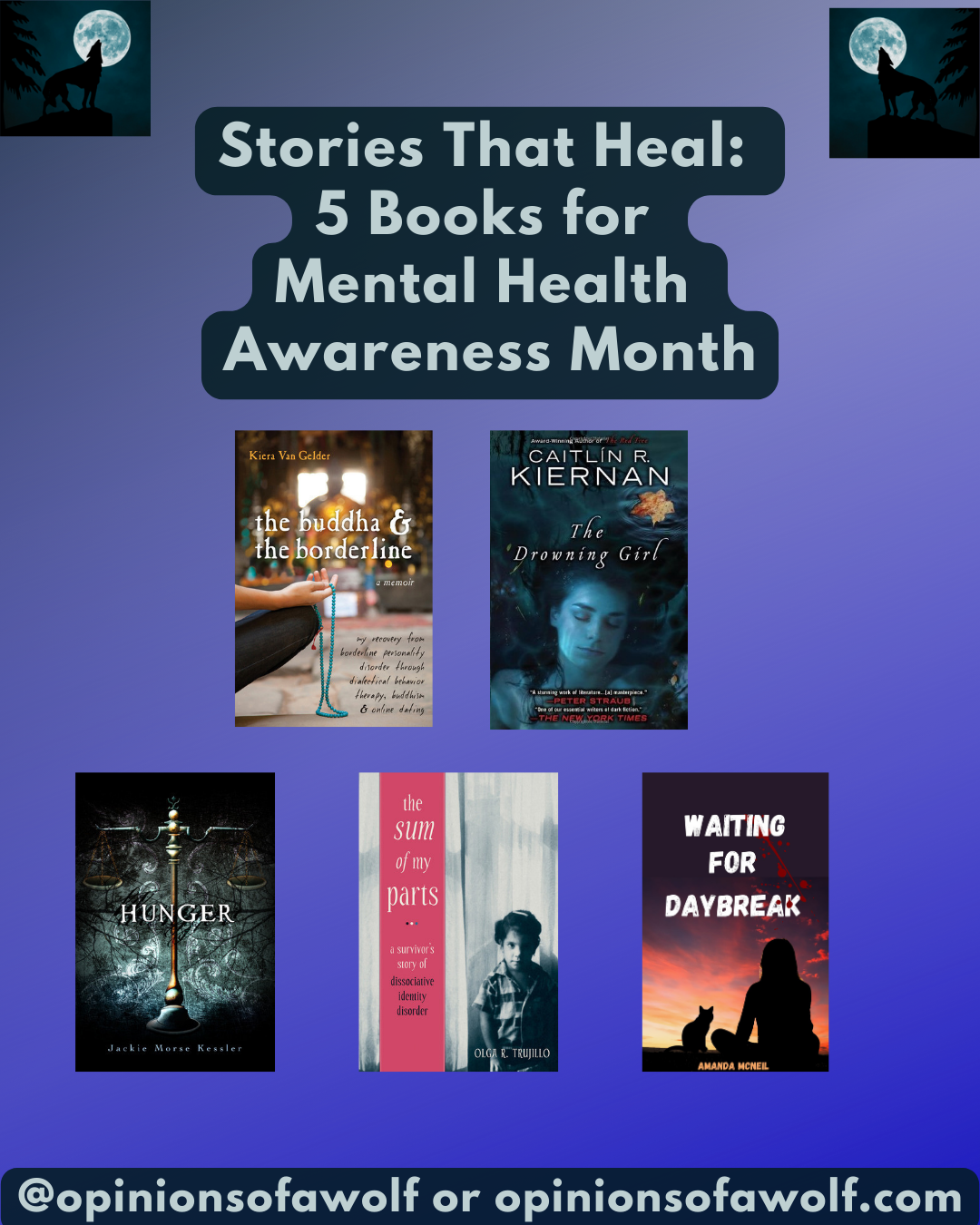
May is Mental Health Awareness Month—an annual observance founded by Mental Health America in 1949 to highlight the importance of mental wellbeing, educate the public, reduce stigma, and promote support for those affected by mental health conditions.
As someone who believes in the power of books to change lives, I thought this was the perfect time to share a mental health–focused reading list. Whether you frequently read books centered on mental health or are exploring this space for the first time, I hope you’ll find something here that resonates. This list includes a mix of fiction and nonfiction across genres—something for every reader.
The Buddha and the Borderline: My Recovery from Borderline Personality Disorder through Dialectical Behavior Therapy, Buddhism, and Online Dating by Kiera Van Gelder
(Amazon, Bookshop.org)
memoir
In this candid memoir set largely in Boston, Kiera Van Gelder traces her journey through Borderline Personality Disorder—from self-harm and addiction to healing through Dialectical Behavior Therapy and Buddhism. It’s an honest, hopeful account of finding stability and meaning after years of chaos.
(Read full review)
The Drowning Girl by Caitlin R. Kiernan
(Amazon, Bookshop.org)
literary fantasy, LGBTQIA+
In this haunting literary mystery, India Morgan Phelps—Imp to her friends—tries to untangle what really happened the summer she met Eva Canning. Was Eva a mermaid? A werewolf? Or is Imp’s memory altered by her schizophrenia? Told in lyrical, first-person prose, The Drowning Girl explores mental illness, identity, and unreliable memory, with nuanced queer representation and a mystery that unfolds entirely from within.
(Read full review)
Hunger by Jackie Morse Kessler
(Amazon, not available on Bookshop.org)
fantasy, YA
In this early 2010s YA standout, Hunger blends biting fantasy with raw realism to explore anorexia through a supernatural lens. When teen Lisabeth Lewis is visited by Death and becomes Famine—one of the Four Horsemen of the Apocalypse—she’s forced to confront the eating disorder that controls her life. With Buffy the Vampire Slayer-style humor and emotional honesty, this novel offers a powerful, metaphor-rich take on the inner voice of anorexia and the path to healing.
(Read full review)
The Sum of My Parts: A Survivor’s Story of Dissociative Identity Disorder by Olga Trujillo, JD
(Amazon, Bookshop.org)
memoir
In this powerful memoir, Olga Trujillo—once a successful attorney in D.C.—recounts their journey through the diagnosis, treatment, and recovery process of Dissociative Identity Disorder. As long-repressed memories of childhood abuse begin to surface, Olga works to integrate their parts and reclaim their life. With compassion, clarity, and survivor-centered care, this memoir offers both insight and hope to anyone seeking to understand trauma, dissociation, or the long path to healing.
(Read full review)
(Note: At the time I wrote my original review, Trujillo had not yet come out as nonbinary, so older references use previous pronouns.)
Waiting for Daybreak by Amanda McNeil
(Amazon, Bookshop.org)
zombie horror
In my own novel, Waiting for Daybreak, a young woman with Borderline Personality Disorder unexpectedly finds sobriety from alcoholism and strength when a zombie outbreak turns Boston upside down. Frieda has spent years battling emotional chaos and isolation—but when a mysterious virus brings society to a halt, she discovers survival suits her better than daily life ever did. As she sets out to save her sick cat, her solitary routine shatters, and she’s forced to reengage with a world that no longer plays by the rules. A character-driven post-apocalypse, Waiting for Daybreak explores mental illness, addiction recovery, and the fragile resilience that can grow in even the bleakest moments.
(See what readers are saying)
I hope you’ve found something here that speaks to you. If you have a favorite book that explores mental health—fiction or nonfiction—I’d love to hear about it in the comments!
Book Review: Model Home by Rivers Solomon

When Ezri’s parents die under mysterious circumstances, they return to their Texan childhood home—possibly haunted—in a gated community where their family is the only Black family.
Summary:
The three Maxwell siblings keep their distance from the lily-white gated enclave outside Dallas where they grew up. When their family moved there, they were the only Black family in the neighborhood. The neighbors acted nice enough, but right away bad things, scary things—the strange and the unexplainable—began to happen in their house. Maybe it was some cosmic trial, a demonic rite of passage into the upper-middle class. Whatever it was, the Maxwells, steered by their formidable mother, stayed put, unwilling to abandon their home, terrors and trauma be damned.
As adults, the siblings could finally get away from the horrors of home, leaving their parents all alone in the house. But when news of their parents’ death arrives, Ezri is forced to return to Texas with their sisters, Eve and Emanuelle, to reckon with their family’s past and present, and to find out what happened while they were away. It was not a “natural” death for their parents . . . but was it supernatural?
Review:
I’ve read most of Rivers Solomon’s books—they’re auto-reads for me at this point. I love their unique perspective and creative twists on speculative fiction. Solomon’s books always challenge me, so even though haunted house stories aren’t my favorite subgenre, I picked it up—and I’m glad I did. This turned out to be a queer psychological thriller that was hard to put down, keeping me up late reading.
The mystery starts early, with Ezri receiving texts from “mom,” but they suspect it’s the “other mother”—the ghost that haunted the family home in a gated community when they were children. It doesn’t take long before Ezri and discovers their parents dead in the backyard in what initially seems like a murder-suicide—but the siblings suspect it’s something far more complicated.
I appreciated how Solomon depicted the family dynamics under stress—three siblings thrown together for an unexpectedly long visit during a family tragedy. It’s the messy, real stuff of love and tension between people who care about each other but don’t always get along perfectly in a pressure cooker situation. The haunting also impacted each sibling differently, not just because of their age but due to the way their parents parented them, shaped by birth order.
I can’t discuss the most shocking part of the book without spoiling the twist. Suffice it to say, it was dark, gritty, and far less supernatural than anything else I’ve read by Solomon. That’s what made it so powerful—it felt so close to being like other psychological thrillers I’ve read but conveyed something profoundly different. It was deeply rooted in the Black experience in America, and it left me almost breathless.
Along with being a story about a Black family, Ezri is nonbinary, and both they and their child have diabetes. I really appreciated how Ezri’s gender identity was never an issue for their family—even when they were a child. This was refreshing and grounded in a sense of acceptance and love.
Please note that this book includes an explicit sex scene that is consensual. It also discusses predation on a minor and child sexual abuse (CSA).
Due to these sensitive topics, this was not a five-star read for me. While the book was beautifully written, I reserve five-star ratings for books I feel personally connected to. Books with such content usually don’t end up in my favorites category. (Grown by Tiffany D. Jackson was a big exception for me.)
Overall, this is a unique take on both the haunted house and psychological thriller genres. It offers a scathingly insightful analysis of being Black in America, while giving voice to a nonbinary sibling. Highly recommended for readers looking for a Black perspective on the haunted American house.
If you found this review helpful, please consider tipping me on ko-fi, checking out my digital items available in my ko-fi shop, buying one of my publications, using one of my referral/coupon codes, or signing up for my free microfiction monthly newsletter. Thank you for your support!
4 out of 5 stars
Length: 304 pages – average but on the longer side
Source: Library
Buy It (Amazon or Bookshop.org)
Book Review: How Far the Light Reaches: A Life in Ten Sea Creatures by Sabrina Imbler

A powerful blend of memoir and marine biology exploring environmentalism, queer theory, and biracial identity through the lens of deep-sea creatures and personal reflection.
Summary:
A queer, mixed race writer working in a largely white, male field, science and conservation journalist Sabrina Imbler has always been drawn to the mystery of life in the sea, and particularly to creatures living in hostile or remote environments. Each essay in their debut collection profiles one such creature: the mother octopus who starves herself while watching over her eggs, the Chinese sturgeon whose migration route has been decimated by pollution and dams, the bizarre Bobbitt worm (named after Lorena), and other uncanny creatures lurking in the deep ocean, far below where the light reaches. Imbler discovers that some of the most radical models of family, community, and care can be found in the sea, from gelatinous chains that are both individual organisms and colonies of clones to deep-sea crabs that have no need for the sun, nourished instead by the chemicals and heat throbbing from the core of the Earth. Exploring themes of adaptation, survival, sexuality, and care, and weaving the wonders of marine biology with stories of their own family, relationships, and coming of age, How Far the Light Reaches is a book that invites us to envision wilder, grander, and more abundant possibilities for the way we live.
Review:
A queer memoir intertwined with fascinating ocean facts? Yes, please! This is a beautifully written exploration where each chapter examines a unique sea creature and, surprisingly, connects it to the author’s own life.
I learned so much about marine biology in an easily digestible way, and here are three of my favorite facts:
- Octopuses die after spawning and starve themselves while incubating their eggs.
- Hydrothermal vents come and go across the ocean floor, creating temporary ecosystems.
- Selps, a type of jellyfish, move together, but at different speeds.
What really stood out to me, though, was Sabrina Imbler’s introspective and self-aware reflections on their life. As a white person, I was moved by how candid they were about their experiences of being biracial. I appreciated how they expressed that being mixed-race is an identity that doesn’t need to be “resolved”—“I am Chinese. I am white.” This honest exploration of their mixed-race identity resonated with me far more than their exploration of queerness, which, while meaningful, didn’t linger as strongly in my memory. If you’re drawn to memoirs that delve deeper into queer identity, check out my review of A Queer and Pleasant Danger.)
Please be aware that this book addresses the sensitive topics of racism, environmental injustice, and animal abuse. Sabrina also explores an instance of sexual violence they experienced as a youth, reflecting on how it shifted from being a “joke” to something they realized was deeply troubling.
I listened to the audiobook version, narrated by Sabrina themselves, which was stellar. Their narration felt like listening to a close friend, making the experience even more immersive.
Overall, this is an incredibly moving and educational memoir. It’s a unique blend of personal reflection and marine biology, offering readers a fresh way to explore the world. Highly recommended for those interested in memoirs with a scientific twist and a deep dive into the complexities of identity.e of the author’s favorite subjects – marine biology. Recommended to those interested in a unique storytelling method in a memoir, as well as those with a personal interest in marine biology.
If you found this review helpful, please consider tipping me on ko-fi, checking out my digital items available in my ko-fi shop, buying one of my publications, using one of my referral/coupon codes, or signing up for my free microfiction monthly newsletter. Thank you for your support!
5 out of 5 stars
Length: 263 pages – average but on the shorter side
Source: Library
Buy It (Amazon or Bookshop.org)
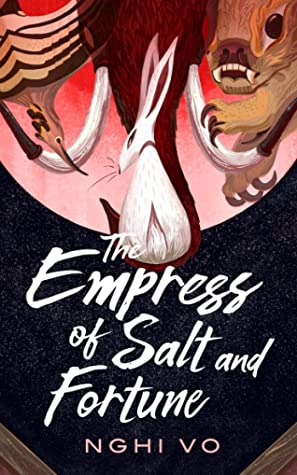
Book Review: The Empress of Salt and Fortune by Nghi Vo (Series, #1)
Summary:
Chih, a non-binary cleric, is on a walking journey when they meet an elderly woman, Rabbit, with a story to tell. Chih ends up staying and listening to Rabbit’s tale while cataloging the archives of her things. It slowly is revealed just how much of history Rabbit was quietly witness to and participant of.
Review:
The summary I read was nothing like the one I wrote above and, therefore, I was under the misimpression from the combination of the summary and the title that this was a magical realism book featuring an actual rabbit. I also didn’t know how each chapter would start with essentially an archives finding aid that Chih is writing. There was a time in my life when I wrote finding aids for work, and I must be honest – I didn’t enjoy it. The combination of these two things didn’t put me in a great headspace for this book. However, I do think it’s a good read when it finds its audience, and that’s what I’m hoping to do here.
This book features a non-binary main character whose sidekick is a fabulous talking bird. Female/female love is also well-represented here. It is set in a fantasy world inspired by Asian period dramas with dashes of fantasy (like the talking bird). The entire premise revolves around respecting and listening to an elder – treating her as important simply because she is elderly. It of course then turns out that she has a pivotal role in history, but Chih would have never known that if they hadn’t listened to her. Those who love the history of items will also likely really enjoy reading the descriptors of Rabbit’s possessions at the start of each chapter. While this is a short book (novella length), it is the first in a series, so you can visit its world, and, if you like it, you can keep on going with the rest of the series.
Recommended to those looking for a fantasy with an Asian period drama fantasy written by an own voices author with a dash of magical realism and queerness.
3 out of 5 stars
Length: 112 pages – novella/short nonfiction
Source: Library
Buy It (Amazon or Bookshop.org)
If you found this review helpful, please consider tipping me on ko-fi, checking out my digital items available in my ko-fi shop, buying one of my publications, or using one of my referral/coupon codes. Thank you for your support!
 Support my work with a tip or browse my shop for curated book club guides, how to guides, cross-stitch patterns, and more!


This work by Amanda Nevius is licensed under a Creative Commons Attribution-Noncommercial-No Derivative Works 3.0 United States License.
 Opinions of a Wolf