
Archive
Book Review: The Girl Who Drew Butterflies: How Maria Merian’s Art Changed Science by Joyce Sidman

A beautifully illustrated middle grade biography of Maria Merian—the 17th-century artist-scientist who transformed our understanding of butterflies, nature, and the role of women in science.
Summary:
Bugs, of all kinds, were considered to be “born of mud” and to be “beasts of the devil.” Why would anyone, let alone a girl, want to study and observe them?
One of the first naturalists to observe live insects directly, Maria Sibylla Merian was also one of the first to document the metamorphosis of the butterfly. In this nonfiction biography, illustrated throughout with full-color original paintings by Merian herself, author Joyce Sidman paints her own picture of one of the first female entomologists and a woman who flouted convention in the pursuit of knowledge and her passion for insects.
Review:
For my birthday in 2024, I went to The Butterfly Place in Westford, Massachusetts—a magical indoor garden filled with butterflies. In the gift shop, I found this stunning book, and my husband bought it for me. It was gorgeous just sitting on my shelf, but when I finally read it, I was even more blown away.
Told in lyrical yet accessible prose, it is structured around the butterfly life cycle, with chapter titles that mirror each stage from egg to molting to flight. It begins with a short glossary of entomological terms that makes the rest of the book easier to navigate, especially for younger readers.
Every page includes illustrations—historic images that ground us in Maria’s time, reproductions of her own scientific watercolors, and thoughtfully placed modern visuals. The full-color format is truly stunning, making this a standout book for readers of any age.
Maria Merian was born in 1647 in Frankfurt, Germany, into a world where women were expected to remain in the home or quietly assist with family businesses. Her father was a publisher, and, after he passed away, her stepfather was a painter—giving her rare early exposure to both printing and art. Yet as a woman, she was denied access to many materials and was considered a “hobbyist,” painting in watercolors, which were viewed as an inferior medium.

From childhood, Maria was drawn to caterpillars and butterflies—despite the scientific consensus at the time that butterflies spontaneously emerged from mud. She collected caterpillars, documented their transformations, and painted them in astonishing detail. She published a caterpillar book that was well-received. Shortly after this, she left her husband and moved into a Labadist community – a secluded religious group. This allowed her to eventually achieve a divorce for religious reasons. Six years after joining the Labadist community, she left for Amsterdam where she established a business of art supplies, art, and preserved insects with her two daughters.
Years later in her 50s, she did the unthinkable—she self-funded a trip to Suriname to study tropical insects firsthand. The journey took a toll on her health, but she returned with the materials to publish her most famous scientific work. She died a few years later, having defied nearly every expectation placed on women of her time.
The writing is geared toward a middle grade audience. While accessible for the young, it’s also rich enough for adults. Difficult topics are handled with sensitivity: the challenges of being a woman in science, the expectations of motherhood, and Maria’s time in Dutch-colonized Surinam. The author acknowledges Maria’s reliance on local knowledge and her resistance to the sugar trade, while also honestly confronting her complicity in a system of enslavement.
While reading, I couldn’t help but imagine this book sitting on the shelf of one of the characters in Bloemetje, my own literary space fantasy about a Dutch company colonizing Venus—lush with plants, bees, and quiet rebellion. Perhaps I should have included a few more butterflies too.
Overall, this is a beautiful, immersive read that educates about butterflies, art, and women’s history all at once. It’s a remarkable tribute to a woman who saw the natural world differently—and helped change how the rest of us see it too. Highly recommended.
If you found this review helpful, please consider tipping me on ko-fi, checking out my digital items in my ko-fi shop, buying one of my publications, using one of my referral or coupon codes, signing up for my free microfiction monthly newsletter, or tuning into my podcast. Thank you for your support!
5 out of 5 stars
Length: 120 pages – short nonfiction
Source: Gift
Buy It (Amazon or Bookshop.org)
Book Review: A Botanical Daughter by Noah Medlock
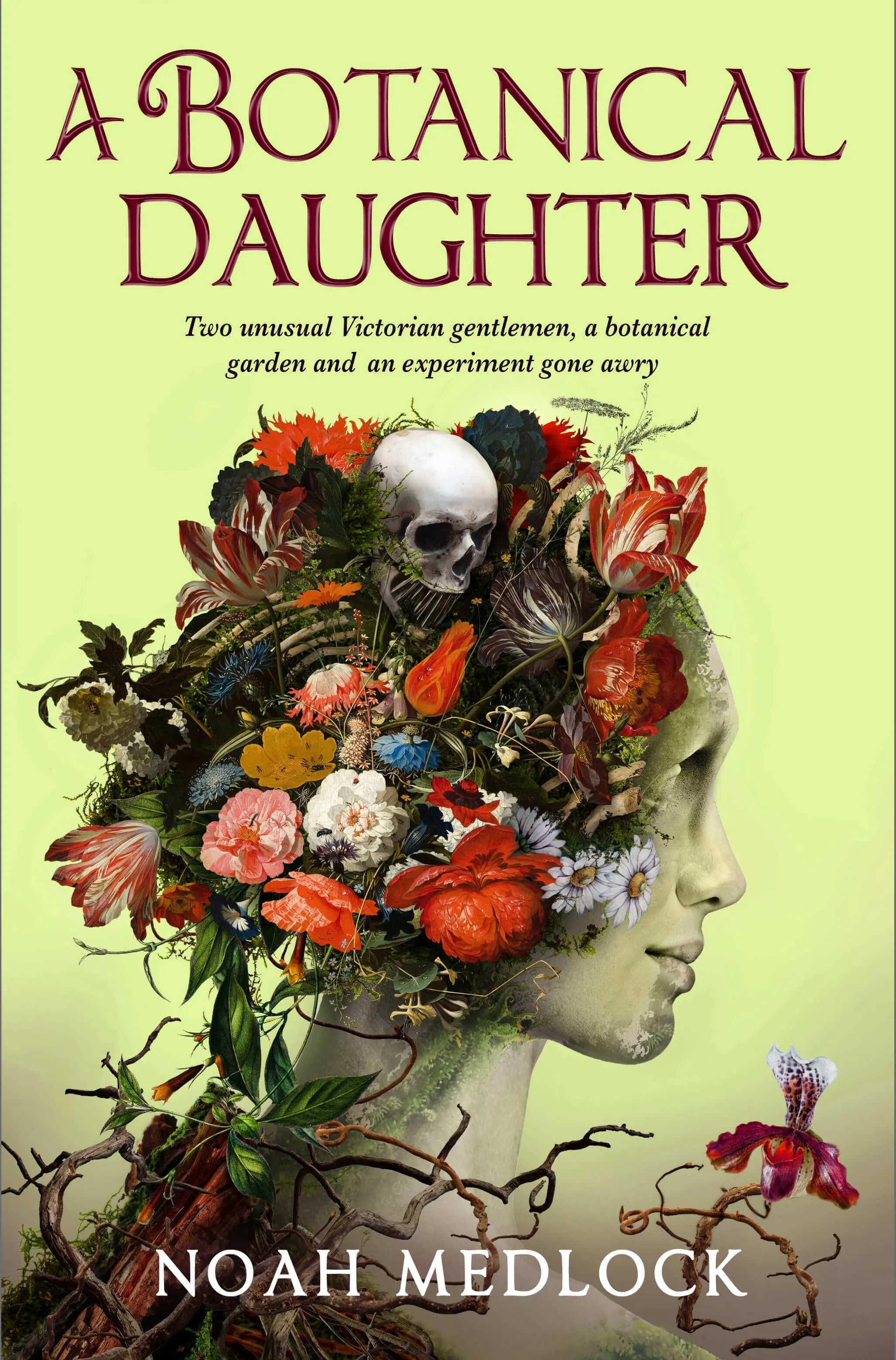
Imagine Frankenstein’s monster as a woman made of plants, with two gay dads and a woman love interest.
Summary:
It is an unusual thing, to live in a botanical garden. But Simon and Gregor are an unusual pair of gentlemen. Hidden away in their glass sanctuary from the disapproving tattle of Victorian London, they are free to follow their own interests without interference. For Simon, this means long hours in the dark basement workshop, working his taxidermical art. Gregor’s business is exotic plants – lucrative, but harmless enough. Until his latest acquisition, a strange fungus which shows signs of intellect beyond any plant he’s seen, inspires him to attempt a masterwork: true intelligent life from plant matter.
Driven by the glory he’ll earn from the Royal Horticultural Society for such an achievement, Gregor ignores the flaws in his plan: that intelligence cannot be controlled; that plants cannot be reasoned with; and that the only way his plant-beast will flourish is if he uses a recently deceased corpse for the substrate.
The experiment – or Chloe, as she is named – outstrips even Gregor’s expectations, entangling their strange household. But as Gregor’s experiment flourishes, he wilts under the cost of keeping it hidden from jealous eyes. The mycelium grows apace in this sultry greenhouse. But who is cultivating whom?
Review:
I absolutely loved the concept behind this retelling. It offers a biopunk take on Frankenstein with a blend of Victorian elements that’s both intriguing and thought-provoking.
As a gardener (and botanical garden member), I found the descriptions of the greenhouse and botanical garden both realistic and captivating. It was charming to see the couple living inside the greenhouse—who hasn’t daydreamed about that as a gardener? The contrast between the m/m and w/w relationships was also a standout, especially since neither would have been accepted in the historical time period.
However, the writing style didn’t suit my tastes. It was much too flowery (pun intended!) for what I typically enjoy reading. In fairness, I’m not particularly fond of Victorian literature, which this retelling modernizes while maintaining that tone. I struggled to connect with the two main characters and never quite understood their motivations. Though I’m a queer person and this is queer literature, I found myself disagreeing with the book’s overarching themes—it’s okay for queer people to have differing perspectives, and this is where I do.
Diversity is limited to sexuality. There is no diversity of race, ethnicity, or ability.
There are several violent scenes, including on-screen blood splatter, which is fairly graphic. There’s also a lengthy, explicit description of the w/w relationship, which was too intense for my taste, so I skimmed that section.
Overall, this is a unique take on Frankenstein with queer characters and a botanical twist. If you’re intrigued by the premise, I recommend reading the first few pages to see if the writing style resonates with you. Just be aware of the graphic violence and intimate chapter.
If you found this review helpful, please consider tipping me on ko-fi, checking out my digital items available in my ko-fi shop, buying one of my publications, using one of my referral/coupon codes, or signing up for my free microfiction monthly newsletter. Thank you for your support!
3 out of 5 stars
Length: 384 pages – average but on the longer side
Source: NetGalley
Buy It (Amazon or Bookshop.org)
5 Holiday Gift Ideas for the Sapphic Reader (with coupons)
Have someone in your life you need a gift for who loves sapphic (women loving women) books? Want a few book ideas but also a few ideas that aren’t reads to fill up the gift basket? Look no further, my friends, I’m here to help.
Let’s start with a holiday themed book.

In the Event of Love by Courtney Kae was just released this season, so it’s possible your intended recipient might not have read it. It’s a sapphic holiday small town romance. Think Hallmark movie but queer. Get it on Amazon or Bookshop.org. If you think they’d enjoy having a book club discussion about this read, I have a digital one available.

Whether your intended recipient already has a diversified shelf or not, Solo Dance by Li Kotomi translated from Japanese this year will likely be a welcome addition – provided they enjoy tear-jerkers. Get it on Amazon or Bookshop.org. If you think they’d enjoy having a book club discussion about this read, I have a digital one available.

What reader doesn’t also love notebooks? This blank, lined notebook features a three beautiful fairies that one could easily read in a sapphic manner, and it’s just $5.99.
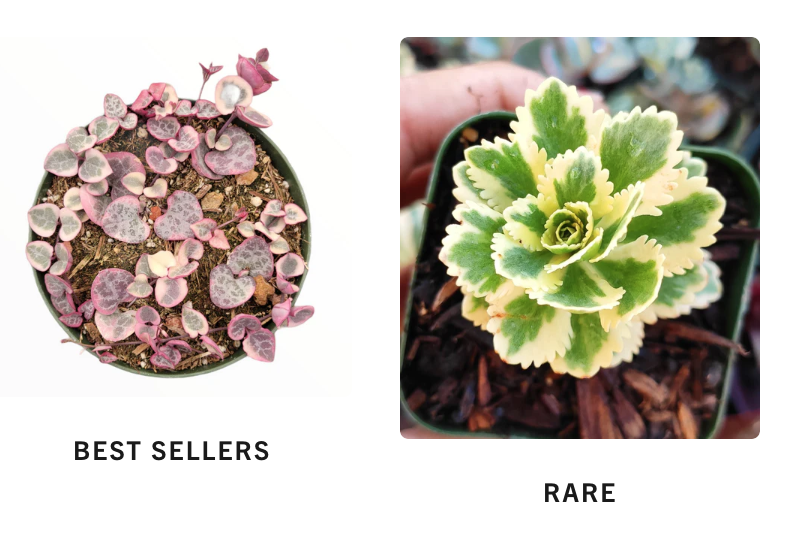
What reader doesn’t love a little greenery around the house? And succulents and cacti are easy to keep alive if the owner perchance forgets to water while engrossed in a read. Succulents Depot ships well and has a delightful collection of both popular and rare species. Get a 15% off coupon.

Help your reader pamper themselves with Ethique’s zero waste body care products ranging from scrubs to lotions to lipsticks. Plus they have holiday gift sets ready to go. Get 20% off your first order.
I hope you found this list helpful! Please share it if so.
*Note: I receive a 15% off coupon for every referral to Succulents Depot and 100 reward points for every referral to Ethique. I also receive a small commission for purchases made through my Amazon or Bookshop referral links.
Cross-Stitch #13: Rhubarb
Since I finished the Miffy / Nijnjte line for my shop, it was time to think of a new one! I knew I wanted to do something to pay homage to New England, both where I grew up and my current home. It’s a truly beautiful place. The spring weather and planting my (incredibly tiny) container gardening got me to thinking about plants. Then it struck me. I could make a line about the plants you can forage for in New England! Foraging is the act of gathering plants that grow wild to eat, as opposed to gardening. My grandmother on my father’s side was incredibly knowledgeable about foraging. She passed her knowledge on to my dad, who passed it on down to me. Of course, my father knows more about it than I do! I consulted him some on the new line on everything from which plants to choose (there are so many edible wild plants in New England!) to getting the look of each plant just right. I decided that I would include with the plant itself the common name and the scientific name. The line is intended both to decorate and educate.
The plant I chose to stitch up first for the new line is: rhubarb!
 Rhubarb features in my favorite pie, strawberry-rhubarb pie! It can also be used in everything from breads to jams to drinks. It has a savory, bitter flavor, so it generally is combined with something sweet to bring out its underlying sweetness. The pattern is stitched on oatmeal aida with the common name (rhubarb) above the plant, and the scientific name (Rheum rhabarbarum) below it. This is done to reflect older hand-drawn plant guidebooks.
ETA 3/5/15: I have closed my Etsy shop, but this pattern is available as a digital download for $2.99 in my Ko-fi shop.
Movie Review: Invasion of the Body Snatchers (1978)
 Summary:
Elizabeth wakes up one morning to discover her boyfriend, Jeffrey, being distant and acting odd. She nearly immediately intuitively senses that this man is not Jeffrey. The only people to believe her are her boss, Matt, and an author and his wife. Together the four of them struggle against the nearly invisible alien invasion of a type of plant that morphs human bodies in with their own personalities, thereby replacing the humans.
Review:
This is a remake of the 1956 movie of the same name. I was told you don’t need to watch the 1956 version first, but now I’m not so sure. A lot of the story just didn’t make any sense, and I’m wondering if those are plot points that were better addressed in the 1956 version. For instance, what makes someone at risk to become an alien hybrid? We know that the aliens came into Elizabeth’s household on a flower, yet her boyfriend morphs overnight whereas she does not. Why? Similarly, a process is started by the aliens and at some point it becomes dangerous for that person to sleep, for when they sleep, the metamorphosis completes. Why isn’t everyone transforming in their sleep? At what point is it dangerous to sleep? Why does sleep complete the metamorphosis? For that matter, why do the aliens duplicate the humans’ dna in a pod? Why don’t they just invade the body and combine dna that way? Why does the person’s body disappear when the pod is complete? Why have they come to earth? And for the love of god, why do they make that horrible screeching noise? I’m pretty sure plants don’t generally make noise. Obviously, this movie left me with a lot of questions and not many answers, and that’s something I don’t tolerate well from my scifi movies. If you’re going to do scifi, do it well. Build a world that is not our own but still makes sense! It ruins the experience for me if I’m continually yanked out of that world by my brain going, “Wait…..what?!”
On the other hand, the special effects are really good for the 1970s. The opening with the alien life wafting around space is impressive and reminded me of cgi. The pods are simultaneously realistic-looking and grotesque. Whatever noise they recorded for the aliens screeching is truly spine-chilling.
Two items of note. The first is that you get to see Jeff Goldblum of Jurassic Park in another brainy, geek role, which is fun. Also, there’s some brief nudity, which is always fun in a movie when it’s not in the context of awkward, obviously not really happening sex.
If you like scifi you won’t regret watching this movie. Just be sure to have something to do while you watch it–like knitting, or a game of Clue–to keep your mind off of the glaring plot holes and unanswered questions.
2 out of 5 stars
Source: Netflix

 Support my work with a tip or browse my shop for curated book club guides, how to guides, cross-stitch patterns, and more!


This work by Amanda Nevius is licensed under a Creative Commons Attribution-Noncommercial-No Derivative Works 3.0 United States License.
 Opinions of a Wolf