
Archive
Rereading the Chronicles of Narnia as a Progressive, Queer Christian Adult – Books 1 & 2

What does The Chronicles of Narnia look like through the eyes of a queer, progressive Christian rereading the series as an adult?
Summary:
The Lion, the Witch, and the Wardrobe – Four children sent to the countryside to escape the bombing of London of WWII open a door in their host’s home and enter Narnia. In the land beyond the wardrobe, the children meet the White Witch, discover the Magic, and meet Aslan, the Great Lion, for themselves. In the blink of an eye, their lives are changed forever.
Prince Caspian – Narnia . . . where animals talk . . . where trees walk . . . where a battle is about to begin.
A prince denied his rightful throne gathers an army in a desperate attempt to rid his land of a false king. But in the end, it is a battle of honor between two men alone that will decide the fate of an entire world.
Review:
This post kicks off a new kind of review for me—a reread series. I was raised in a fundamentalist Christian household, but through a long and winding journey, I’ve found my spiritual home in progressive Christianity, which affirms queer folks like me and focuses on social justice. Over the years, people from all backgrounds have asked me what I think of Narnia. I’ve been surprised by how widely beloved it is—even among children who weren’t raised in Christian environments.
My strongest early memory of Narnia comes from Jesus Camp, where it was one of the few books counselors were allowed to read to us. I remember sitting around the fire, half-listening to something about a silver chair. At the time, I didn’t connect with the stories. I often reject things that feel forced on me, and Narnia was everywhere. Maybe I also felt misled—there’s a hint of World War II at the beginning, which is one of my special interests, but the story quickly shifts to an icy kingdom ruled by a talking lion. Later, I heard critiques of how C.S. Lewis portrayed female characters and wondered if I had sensed that as a child, too.
This year, I decided to revisit the series through audiobooks. I’m reading in publication order, rather than chronological. I want to experience the books as readers did when they first came out—and hear Lewis’s voice as it developed over time.
Before I go further, I want to be clear: I don’t dislike all of Lewis’s work. I loved The Screwtape Letters—I’m a sucker for a good epistolary story—and I found Mere Christianity thoughtful and compelling during my faith journey. So this isn’t a hit piece. It’s an honest reflection on how these stories read to me now, as an adult queer woman of faith.
So what stood out to me in The Lion, the Witch, and the Wardrobe?
I can absolutely see the appeal. The idea of a secret world just through the wardrobe—a place full of talking animals that needs a savior—is enchanting. The allegory of Aslan’s sacrifice on the stone table, often critiqued by secular readers as too jarring and confusing, struck me as a strong, nuanced theological metaphor. It makes sense within Christian theology, and Lewis presents it with clarity.
But I now also understand why I didn’t enjoy these books as a child: the representation of gender roles. The female characters feel flat and constrained. Susan comes off as petty and unlikable. Lucy, while kind, is so passive that her forgiveness becomes a personality trait. The girls aren’t allowed to fight because “that’s not what girls do,” as the narrator—not a character—tells us. That omniscient narration gives the sexism an unchallenged authority. The White Witch is the only powerful female character, and of course, she’s the villain. Her assertiveness and autonomy are equated with evil.
As a progressive Christian who attends a church led by a woman pastor, I find this particularly disheartening. From the very beginning, Jesus uplifted women—Mary Magdalene, Martha, the Samaritan woman. Early church leaders like Lydia and Phoebe helped shape the faith. But those stories often get overshadowed by patriarchal interpretations. I see that dynamic echoed in Narnia.
Another theme that troubled me is the normalization of violence—especially how it’s gendered. Peter is praised for killing a wolf. Boys are encouraged to wield swords and lead armies. Meanwhile, Jesus rebuked Peter for cutting off a soldier’s ear and modeled nonviolence, even in moments of great personal risk. Paul and Silas stayed in a prison after an earthquake freed them, sparing the jailer’s life. Their faith led them to protect others, not conquer them.
In Prince Caspian, the battles escalate. The girls observe from a distance. And we learn that the children’s prior reign left Narnia in ruins, with many of the original inhabitants dead or scattered. The colonial undertones are hard to ignore. The children are outsiders who arrive, rule, and leave—upending the local ecosystem and political structure in the process. Even as a fantasy, it raises hard questions about heroism and power.
As a child, I didn’t like being told what girls couldn’t do. As an adult, I feel equally uneasy watching kind-hearted Peter be shaped into a glorified conqueror. The lens Lewis offers here reflects more about the cultural assumptions of his time—especially about gender and empire—than it does the radical love and subversive power of the Gospel.
That said, I’m curious to keep going. I remember The Silver Chair more vividly than the others, and I’m interested to see how it holds up. I’m not reading these books expecting them to reflect my beliefs. But I am reading them with both a theological imagination and a desire to understand the appeal of these stories. Perhaps we can craft new, long-lasting fables for our youth full of the values of equality and social justice.
If you found this review helpful, please consider tipping me on ko-fi, checking out my digital items in my ko-fi shop, buying one of my publications, using one of my referral or coupon codes, signing up for my free microfiction monthly newsletter, or tuning into my podcast. Thank you for your support!
3 out of 5 stars (The Lion)
3 out of 5 stars (Caspian)
Length: The Lion: 180 pages – average but on the shorter side; Caspian: 240 pages – average but on the shorter side
Source: Library
Buy It (The Lion: Amazon or Bookshop.org; Caspian: Amazon or Bookshop.org)
Movie Review: Guess Who’s Coming to Dinner (1967)
 Summary:
A liberal couple’s beliefs are challenged when their daughter comes home from a Hawaiian vacation with a surprise fiance who just so happens to be black.
Review:
I am chagrined to say that I saw the awful, horrible 2005 remake of this classic prior to seeing the classic version. That attempt at humor (that was totally unfunny) thus had me coming at this film rather skeptically, but it was in my suggested films pile on Netflix, and given that I’d just finished up The Real Help Reading Project, I thought a classic 1960s film exploring the black/white issues in America just might be interesting. It certainly was not what I was expecting.
First, the cast is absolutely stellar, featuring Katharine Hepburn, Sidney Poitier, Katharine Houghton, Spencer Tracy, Beah Richards, Cecil Kellaway, and Isabel Sanford. These people have serious acting chops, and I doubt a lesser cast could have pulled off this film. In particular, I cannot imagine another person in the role of the mother than Katharine Hepburn. Now THERE is an actress.
The film feels more like watching a dramatic play in three acts. There is a lot of dialogue and emotional speeches. It may feel a bit heavy-handed to the modern viewer, but it must be remembered the world this film was made in. One line really reminds the viewer, when the young couple are reminded that their relationship is still illegal in sixteen or seventeen states. Wow, ok, suddenly both sets of parents’ concern that their children are choosing an incredibly tough life for themselves doesn’t seem like such an over-reaction. It puts the whole film a bit more into perspective.
That’s what the film is really about. It isn’t about either set of parents being prejudiced against a skin color. They’re concerned that the prejudice of the world will make the marriage unbearable for their children. The movie is about choosing to stand up and hold on to the ones you love in the face of prejudice. That’s a powerful message and not at all the issue I was expecting to come to the surface in this film.
Now consider all of those to be reasons to watch this classic that’s a classic for a reason. I now want to talk about one character whose presence was totally different to me since doing The Real Help–that of the white family’s maid, Tillie. Tillie’s role seems to be that of reassuring the (white) audience that not just the white parents are concerned about this black man John. She immediately is in fisticuffs over the whole thing. She tells John, “I don’t care to see a member of my own race getting above himself. ” She threatens him that she knows his type and although he may be able to fool the white folks, he’s not fooling her. She even says, “Civil rights is one thing. This here is somethin else!” The daughter tells Tillie that she loves her and loving John is no different, and the parents even have her come sit down for the big finale stating that she’s “one of the family.” What is fascinating about this completely false and stereotyped role of Tillie in this film is that it is there in the midst of a forward thinking main plot. It is as if the filmmakers wanted to give the audience the familiar, non-threatening, stereotyped role of the trustworthy black help that is in favor of the status quo to help them feel more comfortable during the film. Perhaps that is the case. But even if the choice was deliberate and worked for the audience at the time, I personally found the role to be Tom-ing and distracting from the much better main storyline. However, it is also fascinating how a movie with a role like this *still* is better than The Help.
Overall, this is a classic deserving of the title. Although it is a bit dated, if the audience bares in mind the actual world of race and racism at the time the film was produced, they will be surprised at how progressive it actually was.
4 out of 5 stars
Source: Netflix

Reading Project Wrap-up: The Real Help–Helping Put “The Help” in Historical Context
On September 3, 2011, myself and Amy of Amy Reads announced our intention to co-host a reading project devoted to reading the list of recommended reads put out by the Association of Black Women Historians in response to the incredible popularity of Kathryn Stockett’s book (and later, movie) The Help. It’s hard to believe that we’ve already completed reading all 10 books. I sort of feel like I took a mini class on the history of black women’s labor in the US, and I’m so glad I did.
Although I was a US History major (and also English) in undergrad, I tended to focus more on colonization, westward expansion, and World War II. The Civil War was not a thing of mine, nor was the Great Migration or the Civil Rights movement. It may sound silly, but when you’ve only got 8 to 10 courses, some of which are taken up by requirements, to cover all of US history, some things just don’t get covered, especially if you don’t already have an interest in them. So, although I knew right away that something was WRONG with The Help, it was difficult for me to elaborate exactly what. I knew it was wrong for a white woman to be putting words in black women’s mouths about a time period that is so recent and still stings. I knew that having the main, white character come in and rescue the black help was wrong. And I knew that putting such a rosy color on a time period that was anything BUT rosy was revisionist and distasteful. But I didn’t know enough about black women’s history to say much beyond that.
Well, thanks to this project, I know so much more now. I know enough to elaborate in more detail what is offensive about The Help. But before we talk about that, I want to talk about some of the things that I learned.
In the first read, A Million Nightingales
The first nonfiction book–Labor of Love, Labor of Sorrow: Black Women , Work, and the Family, from Slavery to the Present
Our second fiction book–The Book of Night Women
The next nonfiction read was the memoir Coming of Age in Mississippi
Our next read was Like One of the Family: Conversations from a Domestic’s Life
Out of the House of Bondage: The Transformation of the Plantation Household
We then read The Street
To ‘Joy My Freedom: Southern Black Women’s Lives and Labors after the Civil War
Our final fiction read was Blanche on the Lam
Our final read was Living In, Living Out: African American Domestics in Washington, D.C., 1910-1940
So, given all of that, how would I characterize what is wrong with Kathryn Stockett’s The Help now? I would say it drastically oversimplifies the serious, life-threatening, soul-stealing world of racism in the American south and also innate in the employer/servant dichotomy. It places the reins of social change in the hands of a kind white woman who views the help like one of the family, when in reality it was through the courage and strength of black women that the civil rights movement had any chance at all. And they certainly did not view themselves as a member of the family for whom they worked for disgustingly low wages. It seeks to rewrite history in a way that will assuage white guilt (most likely foremost the white guilt of the author) and retroactively removes the very real civil rights agency demonstrated by black women in the south from them. It is a racist book because it oversimplifies and dumbs down what is a complex and sad chapter in American history that everyone should clearly understand for what it was to prevent us from ever reliving it.
Now, I know not everyone has the time or the energy to read all of the books on this list. So what are my recommendations?
If you want a popular-style, fun book to read instead of The Help, I recommend you pick up Blanche on the Lam
If you are more interested in the civil rights movement and the involvement of domestic help in it, then I suggest you pick up the memoir Coming of Age in Mississippi
If you like short stories and want to hear the voice of the real help from the 1950s, then I suggest you pick up Like One of the Family: Conversations from a Domestic’s Life
If you really enjoy a well-researched, well-documented piece of nonfiction in your life and want a much clearer understanding of race in the populous southern city of Atlanta, then definitely pick up To ‘Joy My Freedom: Southern Black Women’s Lives and Labors after the Civil War
Finally, if you want a short nonfiction read that quickly covers some of the issues innate in racially based domestic help through the voices of the women who lived it, then you should pick up Living In, Living Out: African American Domestics in Washington, D.C., 1910-1940
I am very grateful to the Association of Black Women Historians for taking the time to assemble and post this list. I learned so much from reading through it and am now able to eloquently defend my stance on why it’s sad and wrong that The Help became such a popular read. I encourage you all to follow your gut and question when something is popular that just doesn’t seem quite right to you. Read up on the real history and find the little-known gems of fiction that are brave enough to confront the real issues. The publishing industry will only change what it puts out and pushes on the public when we change our demands. I can say that Amy and I already saw at least two of the books on the list go from unavailable on the Kindle to available in the time that we worked on this project. We hope that this at least in a small part had to do with a new demand for the titles due to the release of the list from the ABWH or maybe even from ourselves talking about these lesser-known books on the blogosphere.
What I ask of each of you readers in conclusion is to choose just one book from the list to read. Challenge yourself and try something that isn’t “popular.” You’ll be surprised at what you discover and learn.
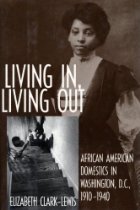
Book Review: Living In, Living Out: African American Domestics in Washington, D.C., 1910-1940 by Elizabeth Clark-Lewis (The Real Help Reading Project)
 Summary:
Clark-Lewis’ grandmother was part of the great migration of African-American women from the south to Washington, DC who then took on domestic work in the homes of the rich and powerful. Through her grandmother, Clark-Lewis was able to contact many of the elderly women who were part of this movement and assemble their oral histories. Utilizing their histories, she paints a picture of the typical life of the African-American women like her grandmother.
Review:
It’s hard to believe this is the final book in The Real Help Reading Project. I’ll be posting my wrap-up later this week, so be sure to check that out for reflections on the project overall. For right now, though, let’s talk about the last book.
In comparison to other pieces of nonfiction on the list, like Labor of Love, Labor of Sorrow
What I found most interesting was how these rural women were raised by their families specifically to do domestic labor.
Your people all trained you to do service work. It was what they all knew you had to learn—period. Now, maybe a teacher, aunt, or somebody would tell you that you could do other work, but you knew that you’d do service work. You knew, and sometimes you’d think about doing different work—but you knew it wasn’t to be. ‘Specially at home—service was all there was for you. They knew it. You knew it. (page 43-4)
I think if I hadn’t read and learned about the conditions in the south for African-Americans I would find this to be a very defeatist attitude, but really it was just practical. The girls’ families were just trying to give them the tools they needed to succeed as best they could in the culture they were in. Although the adult women look back on their hardworking childhoods with a bit of bitterness at the loss of the ability to be just a child, they also acknowledge that these tools helped them succeed in life.
Another interesting thing is that sending the women north had nothing to do with advancing their lives but everything to do with helping and saving the family and the family farm. The family unit was very strong for all of these women, even at a distance. They helped distant and close relatives in DC with childcare and other labor and sent all or the majority of their pay home to the family farm. This really fights the stereotype in American media about the weak or non-existent African-American family unit. I was, indeed, impressed at how these families managed to stick together across such a distance and among the different cultures of the north and south.
The other issue this book addresses that none of our other nonfiction reads really did was how dehumanizing it was for African-American women to “live in” aka to live within the house they were working as a servant for.
Living in you had nothing. They job was for them, not your life. [From the] time I could, I started to try to get something that let me have some rest. A rest at the end of the day. That’s why you try to live out. You’d be willing to take any chance to live out to just have some time that was yours. (page 124)
Personally I don’t find this surprising at all, since I feel a real need for personal space away from my job, and I think most, if not all, people do. However, the culture at the time seemed to think that African-Americans didn’t need that. I’m sure part of that thought process was due to racism.
If there is one thing that this book demonstrates above all else, though, as have many in this project, it’s that no matter what the family the domestic help labors for thinks, they themselves do not see themselves as “like one of the family.”
She [the domestic worker] was proud that they [the family she worked for] “didn’t even know where I lived.” She did not consider them nice people, friends, family, or even good employers. She worked for them strictly for the money. Period! Yet they insisted that she was “just like family. (page 188)
Things like this….they kind of give me the willies. What kind of a culture and society are we cultivating where this sort of disparity of perceptions of a working arrangement can exist? Employers shouldn’t be able to think an employee is “like one of the family” while that worker is simultaneously thinking the employers are bad people. I understand that we all fake it to survive, but it shouldn’t have to be that way. We should be able to do our jobs and be happy and have positive relationships with our employers. That, to me, is a basic human right, and I think one thing that this book demonstrates is that this is only possible in a job where the domestic help lives out. Where they come in, do the cleaning (in their own clothes, not a uniform), and leave. It is true that some people are frail and need help with those tasks or are so busy they can’t find the time to do it but can afford to pay someone else to. But it should be about getting the task done. Getting in and out. Not forcing uniforms and groveling upon people. That’s just evidence of classism at its worst.
Source: Public Library

Discussion Questions:
Note, originally Amy was going to host the discussion, but since she lost her book during all of the traveling she has to do for work, I thought I’d go ahead and post some questions for everyone. I am sure she will get her hands on another copy eventually. Alas, this book isn’t as readily available in Canadian libraries.
- The women in the book point out that their families wanted them to stay working with one family for their whole lives as “live ins.” Why do you think their parents wanted that?
- Clark-Lewis points out the value in gathering oral histories from the elderly. Have you ever gathered any oral histories and what did you learn from them?
- The women specifically point out how being in a city and exposed to other ways of doing things led them to defy their families, sometimes with bad consequences. What do you think about this sort of impact city life has on migrants from the countryside?
- One woman who grew up with the domestic worker quoted from page 188 working in her home referred to her as like one of the family, but the worker did not see it that way. What do you think leads children with domestic help in the home to see them like family when even the help does not see themselves that way?
Book Review: Out of the House of Bondage: The Transformation of the Plantation Household by Thavolia Glymph (The Real Help Reading Project)
 Summary:
Thavolia Glymph analyzes the power relations between black and white southern women within the plantation household in the antebellum, Civil War, and immediately post-Civil War American South utilizing primarily slave narratives/interviews and the diaries and letters of white mistresses.
Review:
I am chagrined to admit that not only is this the first time I was late on the schedule of The Real Help Reading Project I am co-hosting with Amy, but I was exactly a week late! The lesson I have learned? Never schedule a timely thing for a holiday weekend. I apologize to Amy and everyone following along for making you wait, but at least it was Amy’s turn to host! Moving right along….
Whereas Labor of Love, Labor of Sorrow was extraordinarily all-encompassing, here Glymph narrows her focus severely to only relationships between black and white women in traditional plantation households in the American South. She, alas, stops her analysis around the turn of the 20th century, only venturing into the unique relations within the domestic work realm depicted in The Help in the epilogue. However, this book is quite valuable in that it analyzes the relationships that led up to that odd dynamic of the 1950s and 1960s.
This book covers a lot of information, but what sticks out the most to me in retrospect was how much work and effort it took to maintain a racist, unequal society. The white mistresses had this odd, completely illogical dichotomy of viewing black women both as inferior and needing their guidance and as naturally suited to hard labor. My eyes practically bugged out of my head when reading of white women teaching black women to do chores that supposedly white women were too weak to do….and yet they were perfectly capable of doing them well enough to show the black women what they wanted done. Um….what? That is the sort of illogical situation that only someone entirely committed to a belief system, no matter how wrong, will be able to come to terms with.
Similarly, the former mistresses predicted the imminent downfall of their former house slaves only to find themselves hired by these same freedwomen to sew fine dresses for them with the money they earned by working the plantation. Yet, the former mistresses persisted in believing in the racial inferiority of the freedwomen. Perhaps the most mind-boggling to me was the story of one former mistress who wound up teaching at a freed black school, yet even though she was with these children daily, she still believed in white supremacy. Why this persistent need to believe you’re better than someone else? Personally, it seems to me that the white men were so constantly judgmental of the white women that they reacted by taking it out on those society deemed inferior to them. If black free women rose to their same status, then who would they take their frustrations out on? This logic doesn’t free the white women of the guilt that they definitely deserve, but it does help to make sense of their ability to take on completely illogical stances.
I feel that I am repeating myself a bit with this project, but the books repeatedly demonstrate how inequality on any level acts as a poison to the whole society. I hope that is something that we modern readers will bare in mind in our own daily lives.
3 out of 5 stars
Length: 296 pages – average but on the shorter side
Source: BookU
Buy It (Amazon or Bookshop.org)
Please head over to Amy’s post to discuss this book!
If you found this review helpful, please consider tipping me on ko-fi, checking out my digital items available in my ko-fi shop, buying one of my publications, or using one of my referral/coupon codes. Thank you for your support!
Friday Fun! (Thanksgiving, Cooking)
Hello my lovely readers! I hope those of you who celebrate had a wonderful Thanksgiving. I had a great time with my dad. We ordered in Thai food, which he’d never had before. (I believe it was a hit). I showed him one of my favorite indie bookstores. He took me grocery shopping! (Which has been wonderful for me, I can tell you). We spoiled my kitty rotten and went to a couple of my favorite pubs. It was a wonderful weekend, and I hope to get to see him again very soon!
This week I got to see my friend Nina for the first time in around a month. We went for a super long walk together in the random Indian summer weather we had at the beginning of the week and made this stir-fry out of baby bok choy, onions, pepper, garlic, parsnips, carrots, and fake steak tips (they were soy). Oh, and sesame seeds!
Those of you book bloggers who are looking for projects and/or challenges for 2012, please be sure to check out my Diet for a New America page and my Mental Illness Advocacy 2012 page. Even if you don’t choose to participate in them, any mentions on your blogs, facebook, and twitter are most welcome! These types of things are always more fun the more people participate!
Also, if you missed it, I have an international giveaway currently running thanks to the author. Be sure to check that out too!
This weekend I’ll be training in the gym, going to a tree trimming party, and editing zombies. Also hopefully cooking something up in the slow-cooker to freeze into single servings for lunches. Busy busy!
Happy weekends all!
Announcement: 2012 Reading Project!
I decided I won’t make you guys wait as long as I originally said to find out what my 2012 project is going to be. I made the reading list, the button, and created the page, so why not announce it now and get participation commitments going?
So! The Opinions of a Wolf hosted 2012 reading project is…..*drum-roll*

Woo! *Applause*
The gist of it is, I am concerned and downright fed up with the state of health in America. Congress just declared pizza a vegetable! It is time we took the power over our own health out of the hands of the government, society, the FDA, hospitals, and put it back where it belongs. With us! To this end, using my librarian and book blogger skills, I carefully selected 12 nonfiction titles to read addressing a variety of topics from how your diet can prevent and reverse heart disease to how the food industry manipulates science to how to avoid processed foods. It’s a great list that I’m really excited to explore!!
The third Saturday of every month will be dedicated to a discussion (hosted by me) of the book of the month. In addition, I will do my best to also review one healthy cookbook or fitness book each month, and I invite you to do so as well!
You’ve got a month to get yourself signed up, spread the word, and gather the first couple of books on the list. You don’t have to have a blog to participate, but it would be awesome if you at least had a LibraryThing or GoodReads account to help create the buzz this information needs.
Just head on over to the dedicated Diet for a New America Reading Project 2012 page and leave a comment noting your intent to participate and a link to either your blog post announcing your participation or to your account on LibraryThing or GoodReads.
I’m super-excited for this project and hope you all are too!!
Book Review: Like One of the Family by Alice Childress (The Real Help Reading Project)
 Summary:
Originally published as a serial in African-American papers in the 1950s this series of monologue-style short stories are all in the voice of Mildred–a daytime maid for white families in New York City. The monologues are all addressed to her best friend and downstairs neighbor, Marge, who is also a maid. The stories range from encounters with southern relatives of moderately minded employers to picnics threatened by the Ku Klux Klan to more everyday occurrences such as a dance that went bad and missing your boyfriend. Mildred’s spitfire personality comes through clearly throughout each entry.
Review:
With completion of this book, Amy and I are officially halfway through our The Real Help Reading Project! This book is our first piece of fiction to directly foray into the time era and relationships depicted in The Help, whereas the rest have shown the slave culture and racial issues leading up to that time period. I’m glad we got the historical context from our previous reads before tackling this one written during the Civil Rights era by an author who periodically worked as a maid herself.
The introduction by Trudier Harris is not to be missed. She provides excellent biographical details of Alice Childress, who was not only a black writer of fiction, but also wrote and performed in plays. I am very glad I took the time to read the introduction and get some context to the author. Harris points out that in real life some of the things the character Mildred says to her employers would at the very least have gotten her fired, so to a certain extent the situations are a bit of fantasy relief for black domestic workers. Mildred says what they wish they could say. Since we know Childress was a domestic worker herself, this certainly makes sense. I would hazard a guess that at least a few of the stories were real life situations that happened to her reworked so she got to actually say her mind without risking her livelihood. I love the concept of this for the basis of a series of short stories.
More than any other work we’ve read, Like One of the Family demonstrates the complexities of living in a forcibly segregated society. Mildred on the one hand works in close contact with white people and subway signs encourage everyone in New York City to respect everyone else, and yet her personal life is segregated. Mildred frequently points out how she can come into someone else’s home to work, but it wouldn’t be acceptable in society for that person to visit her as a friend or vice versa.
Another issue that Childress demonstrates with skill is how a segregated, racist society causes both black and white people to regard each other with undue suspicion. In one story Mildred’s employer asks her if it’s too hot for a dress Mildred already ironed for her and ponders another one. Mildred assumes that if she agrees with her employer that it’s too hot for the first dress, she’ll have to stay late to iron. Her employer instead of getting angry realizes that Mildred has been mistreated this way before and takes it upon herself to reassure Mildred that she herself is perfectly capable of ironing her own dresses and will not keep Mildred longer than their agreed upon quitting time. Of course, Mildred sometimes is the one who must hold her temper and calm irrational fears. In one particularly moving section she encounters a white maid in their respective employers’ shared washroom. The woman is afraid to touch Mildred, and it takes Mildred holding her temper and carefully explaining that they are more similar than different before the woman realizes how much more she has in common with Mildred than with her white employer. These types of scenes show that the Civil Rights movement required bravery in close, one-on-one settings in addition to the more obvious street demonstrations and sit-ins.
Of course the stories also highlight the active attempts at exploitation domestics often encountered. Mildred herself won’t put up for it, but Childress manages to also make it evident that some people might have to simply to get by. An example of this sort of exploitation is the woman who upon interviewing Mildred informs her that she will pay her the second and fourth week of every month for two weeks, regardless of whether that month had five weeks in it or not. What hits home reading these serials all at once that perhaps wouldn’t otherwise is how frequent such a slight was in a domestic’s life during this time period. Mildred does not just have one story like this. She has many.
Of course sometimes reading Mildred’s life all at once instead of periodically as it was intended was a bit desensitizing. Although Mildred had every right to be upset in each situation related, I found myself noticing more and more that Mildred was simply a character for Childress to espouse her views upon the world with. I quickly checked myself from getting bugged by that, though. Of course Childress had every right to be upset and did not originally intend this to be a book of Mildred’s life. Mildred was a vehicle through which to discuss current issues highly relevant to the readers of the paper. It is important in reading historic work to always keep context in mind.
Taking the stories as a whole, I believe they show what must have been one of the prime frustrations for those who cared about Civil Rights during that era, whether black or white. Mildred puts it perfectly:
I’m not upset about what anybody said or did but I’m hoppin’ mad about what they didn’t say or do either! (page 167)
Passivity in changing the system is nearly as bad as actively working to keep the system, and Mildred sees that. Of course what Mildred highlights is a key conundrum for the black domestic worker of the time–speak up and risk your job or stay silent at a cost to the overall condition of those stuck in the system? A very tough situation, and I, for one, am glad that many strong men and women of all races took the risk to stand up and change it.
Source: Copies graciously provided to both Amy and myself by the publisher in support of the project (Be sure to sign up for the giveaway. US only and International).

Discussion Questions:
- How do you think domestics decided where to draw the line in what they would and would not put up with in employment in white people’s homes?
- Some of Mildred’s employers seem to be sensitive to the racial and inequality issues and are very kind to Mildred. Be that as it may, do you think it is/was possible to hire a maid for your home and not have a racist mind-set?
- Do you think the employers Childress depicts attempting to exploit Mildred were doing so out of racism, a power-trip, or greediness or some combination or all three?
- Mildred points out multiple times that she feels that the public ads encouraging people to accept each other “in spite of” their differences are still racist. Do you think this is true?
Friday Fun! (New Foci. Yes, Foci Is the Plural of Focus)
Hello my lovely readers! I hope you’re all enjoying the new genres that have found their way to my blog since the start of the Real Help Reading Project a couple of months ago. I’ve been alternating between books for the project from the library and books from my tbr shelf at home, and I’ve certainly been enjoying the variety. African-American and African lit (outside of scifi) always felt a bit inaccessible to me. Perhaps it’s that it tends to be in its own special interest section in libraries and bookstores? Or maybe that it was never really included in regular English classes but instead in special interest classes? I’m not totally sure, but I do know that I needed the kick in the butt to realize just how accessible it actually is. In retrospect it seems silly that I never picked one of these books up. Reading is so universally accessible, and I’ve read stories set in pretty much every racial, cultural, and class surroundings. Who knows really why I’d never ventured into black lit before, but I’m really glad I have now. :-)
In light of this, I’ve planned out a new reading project for myself to embark on with the start of 2012. No, it does not have to do with black lit. I’m not telling you what it is! But I have already started assembling a list of possible titles to pull from and am stoked for it. You’re just going to have to wait until the end of December wrap-up/announcements bonanza that happen on book blogs to find out what it is.
My life has now adjusted to having a second job and has reached a nice rhythm. I am busy almost every minute of the day between job 1, job 2, commute, gym, friends, reading, writing, drawing, etc…. I only barely make time to watch my two favorite tv shows every week (Parks and Rec and Big Bang Theory). Periodically I play catch-up on The Biggest Loser and America’s Next Top Model when I’m cooking dinner. Other than that, though, I feel a sense of enrichment in my life that I haven’t felt since being completely immersed in learning culture in undergrad. It’s a good thing. :-) I love it that I can get home totally exhausted and still prefer to read a civil rights era memoir over watching the latest crap on tv. I’ve reconnected to what’s important–people, self-improvement, learning–and let go of the other things. When I compare now to a year ago, I can see marked improvement. So, yeah, being 25 is hard. Being in your 20s in an economic depression is hard. But I’ve got good people, good food, good books, and my health. That’s what’s important.
Happy weekends!
Book Review: Labor of Love, Labor of Sorrow by Jacqueline Jones (The Real Help Reading Project)
 Summary:
Professor Jacqueline Jones presents the extensively researched history of the dual working worlds of black American women–at home and in the workforce–from slavery to present. She highlights the ways in which the unique cultural history of slavery as well as being subject to both sexism and racism have impacted black American women’s lives.
Discussion:
This is the second book for the Real Help reading project I’m co-hosting with Amy. I specifically requested that she host the discussion for this book for a special reason. Jacqueline Jones was my professor for one of my classes required for my history major at Brandeis University (she now teaches at University of Texas), and suffice to say, she and I did not get along very well. I was concerned that this history might make it difficult for me to discuss this book, so I asked Amy to host. She obliged. I am going to do my best to discuss this book without bias, but my personal experiences with Jackie Jones (as the Brandeisians called her) definitely gave me my own perspective in reading the book.
I was completely engrossed in the slavery and Jim Crow sections of the book. They taught me a lot I was previously unaware of, as I always kind of avoided the Civil War in my American history classes. (I focused on colonization, Revolutionary War, westward expansion, and WWII). For instance, it was interesting to see how the matriarchy slave owners forced upon slaves affected and impacted black culture even to this day. It was also the first time I saw sharecropping explained and spelled out. It is easy to see how black women, particularly ones widowed or single mothers, would choose to move to a city and become domestic help to escape the back-breaking work of share-cropping.
The book also demonstrates how black American culture has come to depend upon the iconic image of the strong black woman to help them through horrible racism and working conditions. Yet, by the end of the book, we can see that this means a lack of support for black women that is reflected in long-term illnesses and mental illness. Although black women are to be respected and lauded for their role in helping their communities, it is time that less is laid upon them. One obvious thing? Less time spent serving whites.
Since this was read largely to combat The Help, which takes place specifically in a domestic environment during the Civil Rights movement, I want to take a moment to discuss what I learned about that specific era in this book, because the book as a whole obviously covers a very large period of time. The book clearly demonstrates that the Civil Rights movement was BLACK women fighting for BLACK people and sympathetic whites came down from the north to help with things like voter registration, and they were then housed by BLACK women who would literally sit on their porch with a gun to protect the workers. This is in stark contrast to the image laid out in The Help where a WHITE woman comes and convinces the black workers to talk to her for their rights.
Additionally, the book repeatedly demonstrates how black women constantly throughout American history have sought to get out of white homes for any other kind of labor (except in the case of sharecropping). The role of domestic simply rings too close to slavery, and can you blame them? It certainly is apparent that many, if not the majority, of white employers sought to use black domestics as as close an approximation to slave labor as possible. One issue I don’t think the book addressed well enough is that any situation where one is working as a servant in another person’s home serves to antagonize relationships between the two groups. There is no friendliness there. One person is doing a menial chore in the home of another that the other is wealthy enough to not have to do. How could that possibly bring about anything but negative feelings?
Now, ok, here’s my criticism of the book. I feel that in Prof Jones’ passion for the plight of minorities in the US, she can sometimes over-compensate the opposite direction. By that I mean, she sometimes presents minorities as super-human or at no fault for their own actions or she’ll ignore negatives entirely. For instance, we only got two paragraphs out of 480 pages on black women working in prostitution. Personally, I wanted to know more about this, as it is a type of work black women have engaged in (as have every color/race of women ever), and I wanted to know the specific roles sexism, racism, and a hostile culture played in that for them. Specifically, I was interested about how the idea of lighter colored black women being more desirable to white men that we saw in the first book of our challenge might have carried over to prostitution in the 1920s and 1930s. But Jones doesn’t talk about this, and from my own personal experience with her, I speculate this is partly a blinders on her eyes issue.
Similarly, one thing that really irritated me was every time Jones tells a story of a woman working herself to the bone trying to provide for her children only to have her husband abandon her, Jones excuses the man by saying….”Well…..racism,” and moves on. Certainly, I am sure that some of these men were simply stressed out and thus abandoned their families, but I’m also certain that some of them were just assholes and would have done so in a completely non-racist society. To wit, I believe Jones falls too hardly on the nurture side of nature/nurture, when psychiatry has repeatedly demonstrated that it actually is a combination of the two that determines an individual’s behavior. By this I mean, I am certain that a non-racist society would lead to a larger percentage of happy, healthy families, but it by no means would wipe out all questionable behavior by all members of that race. To suggest that all members of a race would be “good” minus racism is just as racist as to suggest that all members of a race are “bad.”
That said, while I enjoyed the earlier portions of the book, as well as the sections on domestic labor in the 1950s and 1960s, I do think the book tries to tackle a bit too much in one entry. The sweep is almost overwhelming at times when reading it. I’d recommend getting a print copy so you can skim for the chapters of most interest to you or so that you can read various sections as questions arise.
Source: Amazon

Please head over to Amy’s post to discuss this book!
 Support my work with a tip or browse my shop for curated book club guides, how to guides, cross-stitch patterns, and more!


This work by Amanda Nevius is licensed under a Creative Commons Attribution-Noncommercial-No Derivative Works 3.0 United States License.
 Opinions of a Wolf