
Archive
Book Review: Botanicaust by Tam Linsey (Series, #1)
 Summary:
When the world is devastated by GMO plants over-running the land and destroying cropland, humanity splits into multiple factions. There’s the people who firmly believe in transforming people so that they can photosynthesize food from the sun–and have green skin. There’s the cannibals, who have returned to a hunter/gatherer way and eat humans when necessary. Unbeknownst to the green folk, there’s a holdout of Old Order Amish. They’ve changed from how they were in the past but still hold onto many of their ways. In particular, they have decided that taking green skin is the Mark of the Beast, and will not go for it.
Tula is a scientist among the green folk who is tasked with assisting cannibal children who are kidnapped and converted. Levi is an Amish who leaves the compound against orders, seeking yet another group of scientists who are supposed to live in a mountain and may have the cure to his dying son’s Cystic Fibrosis. When Levi is swept up in a green raid of cannibal land, his and Tula’s worlds collide with unimaginable consequences.
Review:
I picked this up because the cover of a green-skinned woman in a desert appealed to me, and then the description seemed like an interesting post-apocalyptic future. This is certainly and interesting and unique read for any fans of post-apocalyptic or dystopian literature.
The future is imaginative with many different groups and reactions to the botanicaust (the destruction of plant matter that is considered this world’s apocalypse). As someone who has studied the Amish, I appreciated how the author imagined how the Old Order would handle such a crisis and address it for the future. Allowing people into the compound if they are willing to convert seems logical, and showing that the Old Order did accept some technological innovation also makes sense. Similarly, the green scientists who seek to photosynthesize everyone and don’t seem to care too much if the cannibals want to be photosynthesized or not make logical sense. The scientists believe this is the solution in a world without enough food, and hey haven’t bothered to do any cross-cultural studying to see if there is any rhyme or reason or value to the cannibal lifestyle. This again is a logical position for a group of scientists to hold. The other group of scientists who live in the mountain and have managed to find the solution to not aging are a great contrast to the groups of greens. Whereas the greens do sometimes do evil but don’t intend to, they only intend to be helping (with the exception of one bad guy character), the mountain dwellers have been turned inhumane by their abnormally long lives. These three groups set up a nice contrast of pros and cons of scientific solutions and advancement. At what point do we stop being human and at what point are we being too stubborn in resisting scientific advancement? How do we maintain ethics among all of this? The exploration of these groups and these questions was my favorite part of the book.
The plot is complex and fast-paced, visiting many areas of the land and groups of people. I wasn’t particularly a fan of the romance, but I can see where others would find that it adds to the book. I just wasn’t particularly a fan of the pairing that was established, but for no reason other than it seemed a bit illogical to me. Then again, romance is not always logical.
The one thing that really bothered me in the book was the representation of Down Syndrome and the language used to refer to it and those who have it. The mountain scientists have children, but as a result of tampering with their own genetics, all of their children have Down Syndrome. First, I don’t like that this makes it appear as if Down Syndrome is a punishment to the evil scientists who went too far with science. Down Syndrome is a condition some people are born with. It is not a condition as the result of anything a parent did, such as fetal alcohol syndrome. Second, all of the characters with Down Syndrome are presented as large, bumbling oafs with hearts of gold. There is just as much variety to the personalities and abilities of those with Down Syndrome as there are in those of us without Down Syndrome. Finally, the author persists in referring to these characters as:
a Down’s Syndrome woman (loc 2794)
or of course, “a Down’s Syndrome man.” First, the preferred term for Down Syndrome is Down Syndrome, not Down’s Syndrome. This is a mistake that is easy to make, though (I have made it myself), and I am willing to give the author a pass for that. The more upsetting element in the way she refers to these characters though is that she always lists the condition first and then the person, not the other way around. It is always preferred, in any illness or condition, to list the person first and the illness or condition second. For instance, a woman with cancer, not a cancerous woman. A man with PTSD, not a PTSD man. A child with Down Syndrome, not a Down Syndrome child. I cringed every single time this happened, and it happens a lot in the section of the book that takes place in the mountain. Given that this is an indie book, and it is thus quite easy to make editing changes and fixes, I would hope that the author would go through and fix this simple aspect of language. It would be a show of good faith to the entire community of people who have Down Syndrome, as well as their families. For more on the preferred language when referring to Down Syndrome and people who have Down Syndrome, please check out this excellent guide, written by the National Down Syndrome Society.
It’s a real bummer to me that the language about Down Syndrome and presentation of these characters isn’t better, because if it was, this would have been a five star read for me.
Overall, this is an interesting and unique post-apocalyptic future with an action-packed plot. Those who are sensitive to the language used to refer to Down Syndrome and representation of people with Down Syndrome may wish to avoid it, due to an unfortunate section where characters with Down Syndrome are referred to improperly and written a bit two-dimensionally.
If you found this review helpful, please consider tipping me on ko-fi, checking out my digital items available in my ko-fi shop, buying one of my publications, or using one of my referral/coupon codes. Thank you for your support!
4 out of 5 stars
Length: 348 pages – average but on the longer side
Source: Amazon

ETA:
The author has written a thoughtful and kind comment on this post. You may view it by going below. To sum up, she cannot make edits to those book, due to it also having an audiobook version. However, she has promised to edit for these issues in future books containing characters with Down Syndrome. This genuine and thoughtful response is much more than the community of those with Down Syndrome and their families and loved ones often get, and it is very much appreciated.
Book Review: Liar, Temptress, Soldier, Spy: Women Undercover in the Civil War by Karen Abbott
 Summary:
Abbott looks at the little discussed role of women in the Civil War by highlighting the lives of four different women spies, two with loyalties to the South and two to the North. By following their lives through the Civil War, Abbott demonstrates the critical role women played in the Civil War that is too often silenced.
Review:
Doing Dewey’s review of this book landed it on my wishlist, and I was really pleased to receive it for Christmas. It was everything I’d expected it to be. A look at the Civil War through a women’s history perspective and told in an easy to follow style with lots of respect for the historical source material.
Abbott notes at the beginning of the book that she only uses quotation marks around information she is directly quoting from source material. I knew from that second forward I was going to enjoy this work of nonfiction, because too often authors stray either too far toward hearsay and imagining how people felt or too far toward distancing themselves from anything other than the driest facts. Abbott beautifully switches among the four different women, following the timeline of the Civil War and telling their stories simultaneously. This lends a clearer perspective on the Civil War than I had before. It puts a humanizing eye on real events.
So who are the four women highlighted in this book? On the side of the North, there’s Emma Edmonds, who had already been living as a man to escape a marriage being forced upon her by her family. Emma enlisted as a Union soldier and soon wound up spying for them — pretending to be a man pretending to be a woman to cross the lines. There’s also Elizabeth Van Lew and her freed slave Mary Bowser in Richmond who worked together to spy on the Confederate president. On the side of the South there’s Rose O’Neale Greenhow, a socialite in DC who used her affairs with Northern politicians to spy. There is also Belle Boyd, a boisterous woman at first more interested in notoriety than in helping any cause but whose loyalty to the South became ever more strong.
This book makes it clear that women made ideal spies thanks to sexism. The men of the North and South both viewed women as the “delicate sex” that would never actually participate in anything so soiled as war, so when they attempted to cross the lines, they would be let through without being searched. The more high class a woman, the more protection she was afforded, so even though women were under suspicion, they were always treated better than men under the same suspicion. For instance, Belle Boyd was caught red-handed as a spy once. The penalty for a man would be death, but she was sent to prison and then later paroled and sent back to the South, basically with a slap on the wrist and demand she not do that again. Another example, in the case of Elizabeth Van Lew,
For now, at least, her social position and gender served as her most convincing disguise. No one would believe that a frail, pampered spinster was capable of plotting treasonous acts, let alone carrying them out right under the government’s nose. (page 47)
Abbott does a good job of presenting the reality of these women’s lives and their politics matter-of-factly with little judgment from the future. The women are allowed to basically speak for themselves, and the reader can ultimately decide how they feel about them. Abbott maintains the historic feel by referring to African-Americans as “Negroes.” This may bother some readers, and they should be aware to expect it.
The only element of the book that disappointed me was how the author handled Mary Bowser. First, this woman is not one of the four featured in the book description or the title, and yet she served as a spy inside the Confederacy presidential household. Mary Bowser was freed from slavery at a young age by Van Lew’s family. The Van Lew’s sent her North to be educated and kept her on in the household as a free servant. When Elizabeth heard that Confederate President Davis’s household needed more servants, she talked to Mary about her serving there. This educated and highly intelligent woman (she was rumored to have a photographic memory) proceeded to pretend to be the stupid, subservient person the Davises were expecting through their racism, and thus was able to do things like dust President Davis’s desk and memorize upcoming troop movements to report later. It was thanks to her work in conjunction with Elizabeth, who organized how to get the information out of the South to the North, that the Union was able to know so many of the Confederacy moves ahead of time. Yet, she is not featured as one of the four main women in the book. She is not listed as one of the women spies. The end of her life after the Civil War is not mentioned, not even to say whether or not Abbott was able to find any information about her. For a book highlighting the lives of those often erased from history, writing Mary as Elizabeth’s sidekick was quite disappointing.
The book ends by telling the reader what ultimately happened in these women’s lives after the Civil War. It’s a bit of a sad note, particularly for the Union women who fought for freedom and yet wound up with little of it themselves.
At last Elizabeth retreated, withdrawing entirely from public life. She had no target for her ferocious will. Her one political act was to attach a note of “solemn protest” to her annual tax payment, declaring it unjust to tax someone who was denied the vote. (page 426)
Overall, this book covers the history of the Civil War from the unique women’s history perspective of women spies. Those looking for an engaging alternate way to learn about Civil War history will enjoy this book and learning about the women who had an impact on history.
If you found this review helpful, please consider tipping me on ko-fi, checking out my digital items available in my ko-fi shop, buying one of my publications, or using one of my referral/coupon codes. Thank you for your support!
4 out of 5 stars
Length: 533 pages – chunkster
Source: Gift

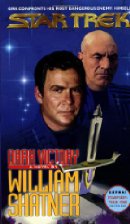
Book Review: Dark Victory by William Shatner, Judith Reeves-Stevens, and Garfield Reeves-Stevens (Series, #2) (Audiobook narrated by William Shatner)
 Summary:
Our universe has been invaded by the inhabitants of the Mirror Universe–a parallel universe that is a dark, twisted version of our own. Now, Captain Kirk, with the captains and crews of The Next Generation and Voyager must battle evil versions of themselves, led by the evil version of Kirk — Tiberius Kirk. What nightmares does Tiberius have planned for the Federation?
Review:
Back in December, my fiancé and I road-tripped to Michigan to visit his family. It’s about a 13 hour drive, and I had Audible credits, so I suggested we pick out a book. We both love Star Trek so we investigated what Star Trek options are available. This one jumped out at us for the obvious reason that it’s narrated by William Shatner himself! Other reviewers complained about sound effects, but that just made us more excited, so we downloaded it, oblivious to the fact that it’s the second book in a series. This book reads like a radio program version of a Star Trek movie featuring a crazy mash-up of the Original Series, Next Generation, and Voyager.
The action starts right away, which was admittedly a bit confusing, since we hadn’t read the first book. It starts with Tiberius and his crew escaping into our own universe, and Kirk and his trying to battle them. Also, Kirk’s hands are mysteriously mangled from something that happened in the first book. Ultimately, we were able to catch up with the plot and follow it somewhat. Kirk is in love with a woman who is pregnant with his baby. Tiberius seems intent on getting to some orbs that the Federation wants to protect. Kirk wants to stop him, but the Federation and some spy branch of theirs are trying to keep him from engaging in the fight anymore. They even go so far as to lie to him and tell him that Tiberius is dead. It’s a complex, twisting plot that makes some sense when listening to it, although summarizing it is nigh on impossible. Suffice to say, that if you enjoy the concept of the mirror universe and the characters from three series all interacting together, you’ll probably enjoy this plot. Plus, there’s also Kirk’s wedding in this book, and that is just not to be missed. (There are horses! And red leather outfits!)
What really made the book for me was the audiobook presentation of it. It is presented like a radio program, complete with amazing sound effects. The communicator actually beeps! There are impact noises from shots at the Enterprise! There are even whinnies from the horses. If you’re a more serious Star Trek fan, you might be irritated by the relative kitsch of this book and its reading, but if you enjoy Star Trek for its periodic utter ridiculous, then you’ll enjoy the way this audiobook is presented.
Shatner’s narration is sometimes good but often hilariously bad. His voice for women is unnaturally high and soft, making me giggle each time, and mysteriously, he uses the same voice for Captain Picard as for women. Listening to him narrate anyone who is not Captain Kirk is a bit like watching Captain Kirk “fight” in the Original Series. I enjoyed it for its ridiculousness, not for its quality.
Overall, if you’re a Star Trek fan who doesn’t take the show too seriously, you’ll enjoy this radio program like audiobook with a plot mashing up everything from a mirror universe to somehow placing Captains Kirk, Picard, and Janeway on the same ship.
If you found this review helpful, please consider tipping me on ko-fi, checking out my digital items available in my ko-fi shop, buying one of my publications, or using one of my referral/coupon codes. Thank you for your support!
4 out of 5 stars
Length: 303 pages – average but on the longer side
Source: Audible

Previous Books in Series:
Spectre

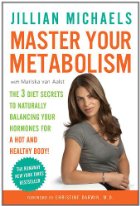
Book Review: Master Your Metabolism: The 3 Diet Secrets to Naturally Balancing Your Hormones for a Hot and Healthy Body! by Jillian Michaels and Mariska Van Aalst
 Summary:
Jillian Michaels became famous for being a personal trainer on The Biggest Loser, a show she has since left. In addition to being a personal trainer, she is also a woman with PCOS (Polycystic Ovary Syndrome), an illness that messes with hormones and often makes the sufferer gain weight due to these hormonal problems. Jillian, with the help of her doctor, takes her years of experience both dealing with her own hormonal issues and training others with them and offers up advice on how to adjust your diet and lifestyle to optimize your hormonal balance for easier health and weight loss.
Review:
Despite its title, this book primarily focuses on achieving health through making permanent changes to your lifestyle, advocating a gradual overhaul with the focus on improving health, with weight loss as a side bonus.
The book opens with an introduction from Dr. Christine Darwin. It then moves to Jillian giving a brief introduction to her own health journey. It was fascinating to learn about how she became a trainer in her late teens, got her job on The Biggest Loser, and was diagnosed with PCOS. This lends a personal touch to the entire book. Jillian isn’t “naturally fit.” She works hard at it and has an illness that actually makes it more difficult to maintain a healthy weight. This book is honest about the fact that achieving fitness is varying levels of difficult for people, but also takes a no-nonsense, if you want health you’ll fight for it, attitude. That attitude may rub some readers the wrong way, but I appreciate it.
The book next tackles explaining how your biochemistry impacts your health and weight and why it’s therefore important to keep them balanced. Readers who enjoy knowing the why’s behind certain bits of health advice (such as keeping your stress levels low, getting enough sleep, not eating after 9pm) will particularly enjoy this section, as it explains the biochemistry behind this advice. Readers who prefer to just get the advice without knowing the why’s can easily skip this bit and just partake of the advice if they so choose. My favorite part of this section is how kind Jillian is about how people may have beat up their bodies so far in life. She’s very encouraging that what’s in the past is in the past, and every body can be improved.
No matter how you’ve abused your body up until now–and I’m willing to bet you have, even if you didn’t mean to–you can make it better. (loc 583)
The next section talks about how various chemicals and hormones in our environments contribute to messed up hormones. Jillian is quite passionate about how things like BPA in cans and hormones in non-organic dairy can pile up to mess up human hormones. Jillian makes a point of saying that even changing one of these things (for instance, buying organic dairy) can help your body, because every little bit helps. However, she is also so passionate about these hormonal and chemical pollutants that it can sometimes seem as if she is telling the reader to change everything all at once, and that can be a bit overwhelming.
Next the recommended diet is tackled, and it’s actually fairly straight-forward. Limit processed foods (and all the HFCS and artificial sweeteners and preservatives that come with it). Focus on eating only things that grew in the ground or had a mother. Limit starchy root vegetables (less than 2 servings a day), alcohol (1 drink per day), caffeine (stick to green tea), soy (2 servings per week), full fat dairy and fatty meats, and canned food (to avoid BPA). She encourages including power nutrients, such as: legumes, alliums, berries, meat and eggs, colorful and cruciferous fruits and vegetables, dark leafy greens, nuts and seeds, organic dairy, and whole grains. Perhaps the most difficult part of the diet, besides cutting out processed food, is the timing of eating she recommends. Eat within an hour of waking up. Eat three more times in the day, once every four hours. Eat until you’re full but not stuffed. Don’t eat after 9pm. The explanation for the timing issue is to help balance your hormones. She also states that you must have fat, protein, and carbs at every meal, but to aim for higher protein, particularly in the evening meal and as you age. The reasoning behind this is you feel more satisfied with all three macros and also are more likely to not lack in any particular nutrient. Two other reasons are that protein increases your metabolism and as people age they need more protein to retain muscles. This is not a particularly challenging diet, nor is it far off from what is generally recommended by doctors and nutritionists as a healthy diet. Again, the most challenging part is the timing issue. Not everyone’s life lets them perfectly space out their meals.
For those readers who are new to eating a whole foods, unprocessed diet, the book includes a sample menu (I believe it covers two weeks, but can’t double-check as it was a library copy). The recipes are perfect for beginner cooks with nothing too complex and not too much time required. Jillian teamed up with a professional for the recipes, and is straight-forward about that.
The book next tackles the six most common hormonal disorders, including PMS, hypothyroid, metabolic syndrome, and PCOS. These hormonal issues require special recommendations and guidelines, and Jillian explains them quickly and clearly.
Finally the book ends with some tips on how to live out the recommended lifestyle, including how to afford and/or find organic food, how to clean your house without chemicals, etc… Just as earlier, Jillian is so passionate about this that it’s possible for the reader to feel overwhelmed at the thought of doing everything, even though Jillian does make a point to state that changing even one thing, or one thing at a time, will help. Perhaps it would help if the book ended with a checklist of the most important changes or how to adapt gradually or something like that to make it feel less overwhelming for the reader.
Besides the fact that sometimes the book can make the lifestyle feel a bit overwhelming, my only other issue with the book was when Jillian recommends that women stop taking hormonal birth control pills and use condoms instead. Condoms are nowhere near as good a form of birth control as hormonal methods, and randomly recommending everyone stop using hormonal birth control is more than just a bit irresponsible. It would have been far more responsible to do something such as suggest that if the reader is concerned about the level of hormones in her birth control to speak to her doctor about lower level hormone options, such as the mini-pill or the IUD, and see if those may work for her. Just flat-out saying everyone use condoms is not helpful. Plus, there is a risk/reward calculation that every individual must make for themselves.
Overall, this book mostly recommends diet and lifestyle changes that would also be recommended by most doctors and nutritionists. The timing of eating is something that is up for debate, but it certainly wouldn’t hurt the reader to try it. Jillian sometimes gets so passionate about all of the lifestyle and diet changes that it can feel overwhelming to the reader. Recommended to those interested in the science behind generally recommended lifestyle changes. Just remember that you don’t have to do everything at once and take the advice with a piece of salt. Do your own research and talk to your doctor before dropping medication/birth control.
If you found this review helpful, please consider tipping me on ko-fi, checking out my digital items available in my ko-fi shop, buying one of my publications, or using one of my referral/coupon codes. Thank you for your support!
4 out of 5 stars
Length: 288 pages – average but on the shorter side
Source: Library

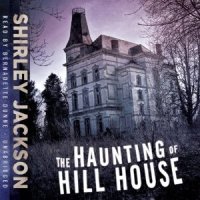
Book Review: The Haunting of Hill House by Shirley Jackson (Audiobook narrated by Bernadette Dunne)
 Summary:
Dr. Montague is a scholar of the occult, and he invites three other people to stay with him in Hill House, which is notorious for being haunted. There’s jovial Theodora, timid Eleanor, and the future heir of the house, Luke. What starts as a light-hearted adventure quickly turns sinister in this horror classic.
Review:
I actually started reading this audiobook way back in September for the Readers Imbibing Peril challenge. It’s only 7.5 hours long, so I thought it’d be a quick read. I think the fact that it wasn’t demonstrates quite well how not drawn into the story I was. This is a classic haunted house tale that perhaps might not work for the modern reader, depending on how much horror they generally imbibe.
This is going to be a quick review because I honestly don’t have too much to say about the book. Four people arrive at a house. Things appear normal, except one of them, Eleanor, clearly is a bit more emotionally unstable than the rest. She is, for instance, shocked that anyone is interested in her or asks her questions. She also has trouble with her own identity, such as knowing for sure what she likes to eat. Odd things start to happen in the house, and because Eleanor is odd, the others aren’t sure if it’s the house doing them or Eleanor herself. Eleanor becomes overly attached to Theodora. Drama ensues.
None of the house horror scenes really got to me, because frankly I’ve seen worse in plenty of other horror I read. I do love the genre. The parts that actually disturbed me were when the others in the household were inexplicably cruel to Eleanor. That dynamic of an odd woman randomly tossed in with strangers who proceed to be mean to her in a highschoolish way held my interest more than the house did. People and their cruelty are so much more frightening than a haunted house. I understand that the book is sort of leaving it up to the reader to wonder if the house or the people really drive Eleanor crazy, but frankly I think the ending removes all question on this point.
Similarly, there are definitely some undertones in the Theodora/Eleanor relationship that indicates they might possibly have had a fling early on and then Theodora abruptly distances herself from Eleanor when she gets too clingy. None of this is said outright, however it is heavily implied that Theodora’s roommate back home is her lover who she had a quarrel with, and she and Eleanor establish a close bond early on in the book. The problem is this all stays subtext and is never brought out in the open of the book. I get it that this book was published in 1959 so it probably had to stay subtext and was most likely shocking to a reader in the 50s. But to me, a modern reader, it felt like the book kept almost getting interesting and then backing off from it. The combination of the former issue and this one meant that I was left feeling unengaged and uninterested. Basically, I feel that the book didn’t go quite far enough to be shocking, horrifying, or titillating.
The audiobook narration by Bernadette Dunne was excellent as always, and the main reason I kept listening rather than just picking up a copy of the book and speed reading it. I love listening to her voice.
Overall, this classic was boundary pushing when it was first published but it might not come across that way to a modern reader. Readers who read a lot of modern horror might find this book a bit too tame for their tastes. Those interested in the early works of the genre will still enjoy the read, as will modern readers looking for horror lite. Readers looking for the rumored LGBTQIA+ content in this book will most likely be disappointed by the subtlety of it, although those interested in early representation in literature will still find it interesting.
If you found this review helpful, please consider tipping me on ko-fi, checking out my digital items available in my ko-fi shop, buying one of my publications, or using one of my referral/coupon codes. Thank you for your support!
3 out of 5 stars
Length: 182 pages – average but on the shorter side
Source: Audible

2014’s 5 Star Reads!
Since 2011, I’ve been dedicating a separate post from my annual reading stats post to the 5 star reads of the year. I not only thoroughly enjoy assembling the 5 star reads posts, but I also go back to them for reference periodically. It’s just useful and fun simultaneously! Plus it has the added bonus of giving an extra signal boost to the five star reads of the year. You may view the 5 star reads for 2011, 2012, and 2013 by clicking on the years.
With no further ado, presenting Opinions of a Wolf’s 5 Star Reads for 2014!

A Banquet for Hungry Ghosts
By: Ying Chang Compestine
Publication Date: 2009
Publisher: Henry Holt and Co.
Genre: Horror, Short Story Collection
Themes: Chinese history, food
Summary:
According to Chinese tradition, those who die hungry or wrongfully come back to haunt the living. Compestine presents here eight different ghost stories, each correlated along with a course in a banquet and richly steeped in Chinese culture and history.
Current Thoughts:
A cute book that I think of fondly. I really need to make at least one of the recipes in this book! This short story collection is presented in just the way that I most enjoy. Different stories surrounding one unifying theme. Plus, I learned something.
Full Review


Fudoki
By: Kij Johnson
Publication Date: 2003
Publisher: Tor
Genre: Fantasy
Themes: the meaning of family, identity, duty
Summary:
An aging empress decides to fill her empty notebooks before she must get rid of them along with all of her belongings to retire to the convent, as is expected of her. She ends up telling the story of Kagaya-hime, a tortoiseshell cat who loses her cat family in a fire and is turned into a woman by the kami, the god of the road.
Current Thoughts:
Warrior woman who was once a cat. Set in ancient Japan. What is not to love about that? My only regret is I waited so long to read this book. It languished on my TBR pile for far too long.
Full Review

Gone Girl
By: Gillian Flynn
Publication Date: 2012
Publisher: Broadway Books
Genre: Thriller, Contemporary
Themes: be careful who you marry, not everything is as it first appears
Summary:
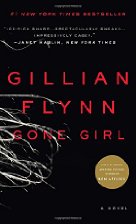
On Nick and Amy Dunne’s fifth wedding anniversary, Nick comes home from working at the bar he co-owns with his sister to find his wife gone. The door is wide open, furniture is overturned, and the police say there is evidence that blood was cleaned up from the floor of the kitchen. Eyes slowly start to turn toward Nick as the cause of her disappearance, while Nick slowly starts to wonder just how well he really knows his wife.
Current Thoughts:
It’s hard to give thoughts without revealing spoilers so let me just say that I still love the twist in this book, and I found the writing style to be perfect for a thriller. It’s a book that really curled my toes, and I’m glad it exists and has become so popular, and I’m looking forward to reading more Gillian Flynn this year.
Full Review


My Big Fat Demon Slayer Wedding
By: Angie Fox
Publication Date: 2013
Publisher: Indie, Self-Published
Genre: Urban Fantasy
Themes: weddings are hell but lifetime partnership is amazing
Summary:
Lizzie Brown, once preschool teacher turned demon slayer, is extremely excited to be marrying her true love, Dimitri Kallinikos, who just so happens to also be a magical shape-changing griffin. And she’s also fine with letting her adoptive mother run the whole show, even though her mother wants to make the wedding into a week-long event. She’s not so ok with having to tell her mother about being a demon slayer, though. Or about integrating her mother’s posh southern lady lifestyle with her recently discovered blood-related grandmother’s biker witch gang. She’s pleasantly surprised that her mother found a goth-style mansion to rent for the wedding. Maybe the magical and the non-magical can integrate fairly well, after all. But then it becomes evident that someone in the wedding is trying to kill her. Plus, they find demonic images around the property….
Current Thoughts:
I read this right after I got engaged, so I was in just the right frame of mind for an urban fantasy featuring a wedding. But even if I hadn’t just gotten engaged before reading it, I still would have loved it. This book knocks it out of the park with everything that makes urban fantasy delightful. A normal event kicked up a notch by fantastical characters and happenings. It also communicates the odd combination of the horror that is wedding planning and the pure joy that is finding your lifelong partner. Plus it’s hilarious and romantic.
Full Review

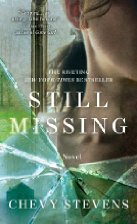
Still Missing
By: Chevy Stevens
Publication Date: 2010
Publisher: St. Martin’s Press
Genre: Thriller, Contemporary
Themes: be careful who you trust, hope and healing
Summary:
Annie O’Sullivan extremely forcefully declares in her first therapy session that she doesn’t want her therapist to talk back to her; she just wants her to listen. And so, through multiple sessions, she slowly finds a safe space to recount her horrible abduction from an open house she was running as an up-and-rising realtor, her year spent as the prisoner of her abductor, and of her struggles both to deal with her PTSD now that she’s free again and to deal with the investigation into her abduction.
Current Thoughts:
This book features a realistic depiction of PTSD plus it scared the pants off of me. Still does if I think about it too much.
Full Review

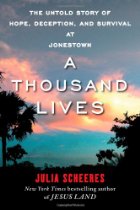
A Thousand Lives: The Untold Story of Hope, Deception, and Survival at Jonestown
By: Julia Scheeres
Publication Date: 2011
Publisher: Free Press
Genre: Nonfiction – History
Themes: understanding a tragedy, when spirituality goes awry
Summary:
On November 18, 1978, 918 people, mostly Americans, died on a commune named Jonestown and on a nearby airstrip in Guyana. The world came to know this event as that time that crazy cult committed mass suicide by drinking poisoned Kool-Aid. However, that belief is full of inaccuracies. Scheeres traces the origins of Jonestown, starting with its leader, Jim Jones, and his Christian church in Indiana, tracing its development into the People’s Temple in California, and then into Jonestown in Guyana. Multiple members’ life stories are traced as well, including information from their family members who, perplexed, watched their families give everything over to Jones.
Current Thoughts:
I am so glad I read this. I feel so much more informed and knowledgeable about Jonestown. It’s sad to me that the cultural myth of Jonestown is so different from what actually happened, particularly with regards to the mass suicide, when in many cases it was murder not suicide. This book presents an event that would be easy to brush off as “those people were just crazy” in a way that humanizes it and makes it more real.
Full Review

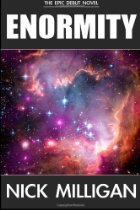
Book Review: Enormity by Nick Milligan
 Summary:
When Australian astronaut, Jack, crashlands on a planet during a mission and is the only survivor, he fears the worst. What he finds is a planet surprisingly similar to Earth–even speaking English–only with a culture of peace and non-violence. Seeking to survive as a homeless person, he starts busking with a guitar he finds, playing Earth songs. Before he knows it, he’s discovered and becomes a rock star, introducing the planet to Earth’s greatest rock songs, while claiming to have written them himself. But rock star is an awfully high profile for someone who is technically an alien.
Review:
This was my final accepted ARC from 2014, and I think it’s a fitting review for the last day of 2014 here on Opinions of a Wolf. This was an interesting read that kept me moderately entertained, although it wasn’t the rollicking good time I was initially expecting.
The book jumps right in to Jack as already a rock star on Heaven (the alien planet) and tells of his arrival and how he became famous through a series of flashbacks. This nonlinear storytelling works well with the plot. Starting with semi-familiar rock star territory, the book slowly reveals what is different about this planet, as well as about Jack.
It is evident that this was originally a three part series, as the plot consists of three distinct parts that, while connected, keep the book from having an overarching gradual build-up of suspense. Jack has three distinct episodes of action, and that lends the book and up and down quality that feels a bit odd in one novel. I actually think I might have enjoyed the book more if it was kept as a trilogy with each part’s plot fleshed out a bit and the overarching conflict made more evident. An overarching conflict does exist, but it is so subtle that the opportunity to build suspense is mostly missed.
Personally, Jack didn’t work for me as a main character. While I don’t mind viewing the world through a bad guy’s eyes, I usually enjoy that most when I get a lot of depth and insight into who that person is. Jack holds everyone, including the reader, at arm’s length, so I both saw the world through his objectifying eyes and couldn’t really get to know him at all. That said, I can definitely see some readers enjoying Jack and his viewpoint. He lends the unique ability to let people see the world both through a rock star’s eyes and through an astronaut’s. A reader who is into both famous people’s biographies/autobiographies and scifi would probably really enjoy him.
Similarly, the humor in the book just didn’t strike my funny bone. I could recognize when it’s supposed to be humorous, but I wasn’t actually amused. I know other people would find it funny, though. Readers expecting a Douglas Adams style humor would be disappointed. Those who enjoy something like Knocked Up would most likely appreciate and enjoy the humor.
There are certain passages that sometimes struck me as a sour note among the rest of the writing. Perhaps these are passages that would be humorous to other readers, but to me just felt odd and out of place in the rest of the writing. Most of the writing at the sentence level worked for me. It was just the right tone for the story it was telling. But periodically there are passages such as the one below that made me gnash my teeth:
Natalie is a rare beauty. A creature of potent sexuality. Someone you would step over your dying mother to penetrate. (loc 8803)
I take a seat in McCarthy’s desk chair. It’s comfortable. Luxurious in the way a set of stainless steel steak knives might feel to a psychopath. It’s beautiful and firm and smells nice, but in the wrong hands this chair could be used for evil. (loc 6821)
Again, perhaps this is humor that just didn’t work for me. I’m not certain. If you like the concept of the rest of the book, there are only a few of these passages that are easy to pass over. If you enjoy them and find them humorous, then you will most likely enjoy the book as a whole as well.
Overall, this is a piece of scifi with the interesting idea of turning an Earth astronaut into a rock star on another parallel planet. Potential readers should be aware that the book was originally told in three parts, and that is evident in the book. They should also be aware that the main character is both a self-centered rock star and a self-centered astronaut, while this viewpoint may work for some, it will not work for others. Recommended to those who enjoy both celebrity autobiographies/biographies and scifi who can overlook some bizarro coincidences.
If you found this review helpful, please consider tipping me on ko-fi, checking out my digital items available in my ko-fi shop, buying one of my publications, or using one of my referral/coupon codes. Thank you for your support!
3 out of 5 stars
Length: 470 pages – chunkster
Source: Kindle copy from author in exchange for my honest review

Book Review: The Keep by F. Paul Wilson (Series, #1) (Bottom of TBR Pile Challenge)
 Summary:
Captain Klaus Woermann isn’t a fan of the Nazis or the SS and doesn’t exactly keep this a secret. But he’s also a hero from the First World War, so the Nazi regime deals with him by sending he and a small troop to Romania to guard a pass the Russians could possibly use. They set up to guard the place in a building known as the keep. It should be a quiet assignment, but when the German soldiers start being killed one a night by having their throats ripped out, the SS is sent to investigate.
SS Major Kaempffer wishes to solve this mystery as soon as possible so he may start his new promotion of running the extermination camp for Romania. He is sure he can solve this mystery quickly.
Professor Cuza and his daughter Magda are Romanian Jews who have already been pushed out of their work in academia. They also just so happen to be the only experts on the keep. When the SS sends for them, they are sure it is the beginning of the end. But what is more evil? The mysterious entity killing the Germans or the Nazis?
Review:
It’s hard not to pick up a book that basically advertises itself as a vampire killing Nazis and the only ones who can stop the vampires are a Jewish professor and his daughter. I mean, really, what an idea! Most of the book executes this idea with intrigue and finesse, although the end leaves a bit to be desired.
The characterization of the Germans is handled well. They are a good mix of morally ethical people who are caught up in a regime following orders and see no way out (the army men) and evil men who enjoy inflicting pain upon others and are taking advantage of the regime to be governmentally sanctioned bullies, rapists, and murderers. Having both present keeps the book from simply demonizing all Germans and yet recognizes the evil of Nazism and those who used it to their advantage.
Similarly, Magda and her father Professor Cuza are well-rounded. Professor Cuza is a man of his time, using his daughter’s help academically but not giving her any credit for it. He also is in chronic pain and acts like it, rather than acting like a saint. Magda is torn between loyalty to her sickly father and desires to live out her own life as she so chooses. They are people with fully developed lives prior to the rise of the Nazis, and they are presented as just people, not saints.
In contrast, the man who arrives to fight the evil entity, Glaeken, is a bit of a two-dimensional deus ex machina, although he is a sexy deus ex machina. Very little is known of him or his motivations. He comes across as doing what is needed for the plot in the moment rather than as a fully developed person. The same could easily be said of the villagers who live near the keep.
The basic conflict of the plot is whether or not to side with the supernatural power that seems to be willing to work against the Nazis. Thus, what is worse? The manmade evil of the Nazis or a supernatural evil? Can you ever use a supernatural evil for good? It’s an interesting conflict right up until the end where a reveal is made that makes everything about the question far too simple. Up until that point it is quite thought-provoking, however.
The plot smoothly places all of these diverse people in the same space. The supernatural entity is frightening, as are the Nazis. These are all well-done.
One thing that was frustrating to me as a modern woman reader was the sheer number of times Magda is almost raped or threatened with rape, and how she only escapes from rape thanks to anything but herself. In one instance, the Nazi simply runs out of time because the train is about to move out. In another, she is saved by a man. In a third, she is saved by supernatural devices. While it is true that rape is a danger in war zones, it would be nice if this was not such a frequently used conflict/plot point for this character. Once would have been sufficient to get the point across. As it is, the situation starts to lose its power as a plot point.
The ending is a combination of a deus ex machina and a plot twist that is a bit unsatisfying. There also isn’t enough resolution, and it appears that the next books in the series do not pick up again with these same characters, so it is doubtful there is more resolution down the road. It is a disappointing ending that takes a turn that is nowhere near as powerful and interesting as the rest of the book.
Overall, this is an interesting fantastical take on a historic time period. The ending could possibly be disappointing and not resolve enough for the reader and some readers will be frustrated with the depiction of the sole female character. However, it is still a unique read that is recommended to historic fiction fans and WWII buffs that don’t mind having some supernatural aspects added to their history.
If you found this review helpful, please consider tipping me on ko-fi, checking out my digital items available in my ko-fi shop, buying one of my publications, or using one of my referral/coupon codes. Thank you for your support!
4 out of 5 stars
Length: 403 pages – average but on the longer side
Source: PaperBackSwap

Book Review: The Shade of the Moon by Susan Beth Pfeffer (Series, #4)
 Summary:
Jon Evans has spent the last two years living in an enclave as a slip — someone who received a VIP pass to get into an enclave that was originally intended for someone else. His stepmother and half brother live there as well, while his mother and older sister, Miranda, and her husband, Alex, live just outside of the enclave, working and serving it while living in filth. Jon isn’t like the rest of them. He can barely remember a time before the apocalypse of the moon being hit out of orbit. The enclave and its ways seem increasingly normal, even if he is haunted by the memories of what happened in the years between the apocalypse and the arrival at the enclave.
Review:
I was a bit startled to see that this book featured yet another new perspective, particularly after the return to Miranda’s diary in the third book. I was expecting a turn back to Alex, but instead we get Miranda’s little brother Jon’s perspective. I can understand the reasoning for this shift. Jon is the only young person from the original group living in the enclave. He is a bit of an antihero throughout most of the book, providing a unique look at the privileged elite in this post-apocalyptic society but one that could be alienating to some readers.
Whereas the first two books focused on the actual apocalypse and the third on the immediate aftermath, this book looks at the new society emerging from that wasteland, and it’s not good. It’s quite dystopian. Not everyone who enjoys apocalyptic and post-apocalyptic worlds also enjoy dystopian ones, so this is a bit of a risky move for a series, although it makes logical sense for the plot to progress this way. The dystopia that Pfeffer imagines is interesting. The elite have built up enclaves and use those who are not elite to work supporting them, basically killing themselves slowly mining coal and growing food while the elite stay safe and educated in the enclaves. It allows for a look at social class taken to the extreme while still seeming realistic within the world Pfeffer has created.
Jon also is a realistic character. He’s a bit spoiled rotten, after all, his brother, sister, and mother all routinely gave him extra food while they starved when the apocalypse first occurred. He’s the result of all the coddling they gave the youngest in an effort to keep him alive and healthiest. That said, some readers will be turned off by Jon. He’s unequivocally a jerk throughout at least half of the book before he eventually snaps out of it. While I personally enjoy a good antihero every now and then, not all readers will like visiting one, particularly after the more heroic presence of Miranda and Alex in the first two books.
There is one aspect of Jon’s character that really bothers me, and it has nothing to do with his snobbishness and antihero nature early on in the book.
*spoilers*
He lets on early on in the book that something bad happened to Alex’s sister Julie. He at one point misleads a female character to believe that he raped Julie to drive her away from him. This is done to protect her, and the reader is led to believe through this scene that Jon obviously didn’t rape Julie. Yet when we find out what actually happened, it’s not quite so crystal clear. Jon basically was making out with Julie and not stopping when she asked him to the first time. She then runs out into the storm and is killed in the tornado. Jon states that of course he would have stopped, he was just slow about it and reluctant because he didn’t think Julie’s protests were real. He thought she wanted him but wasn’t letting herself want him because of her religion. This is clearly many levels of fucked up. The reader is supposed to just believe Jon that he would have stopped because he says so? The reader is supposed to believe that Julie 100% over-reacted because Jon claims she did? It’s a squicky scene to read about, partially because it comes across as that the reader is supposed to absolve Jon from any guilt since he clearly didn’t rape Julie. He’s also upsetting because no one in the book treats this like the serious issue it is. Everyone just kind of shrugs and goes oh Julie over-reacted and goes on their merry way. Even if Jon really was about to stop when Julie ran out, he clearly needs to be spoken to about listening to your partner immediately, about seeking out enthusiastic consent, and about not victim blaming. Particularly given that this is a YA book and what an important issue this is, the way it’s glossed over left a really sour taste in my mouth.
*end spoilers*
I’m not against the presence of an antihero, including in a YA book, but I do think that Jon’s worse qualities could have been handled with a bit more deftness. His presence instead dances around the edges of certain issues, rather than drawing them out for examination within the context of a fun dystopia.
The plot gets a bit nuts, and one character in particularly has an ending that is rather anticlimactic. However, the plot does eventually move everyone into a new area of the dystopia that is quite fascinating and sets the series up well for another book that will hopefully be free of Jon’s perspective, if Pfeffer does decide to write one.
Overall, readers of the beginning of the series will enjoy seeing what ultimately happens to Miranda and Alex, although they may be frustrated to have to do it through Jon’s eyes. Jon is an antihero who may irritate some readers, and his presence brings up some issues that are then glossed over, rather than dealt with. Recommended to readers who really want to see more of Miranda and Alex who don’t mind spending some time with an antihero.
If you found this review helpful, please consider tipping me on ko-fi, checking out my digital items available in my ko-fi shop, buying one of my publications, or using one of my referral/coupon codes. Thank you for your support!
2 out of 5 stars
Length: 304 pages – average but on the longer side
Source: Library
Buy It (Amazon or Bookshop.org)
Previous Books in Series:
Life As We Knew It
The Dead and The Gone
This World We Live In
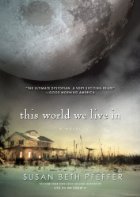
Book Review: This World We Live In by Susan Beth Pfeffer (Series, #3)
 Summary:
Miranda and her mother and brothers have barely survived the long winter that came right after the moon was knocked out of orbit by an asteroid, bringing an apocalypse. She’s been wondering for months what happened to her father and his pregnant new wife. She’s thrilled when they show up on the doorstep when her newborn half brother, but she’s not so sure about the three extra people they’ve brought with them — an adult man and a teenage boy and his little sister.
Review:
The third book in this series reverts back to the Miranda’s journal format of the first. While I appreciate bringing the diverse characters from the first two books in the series together, the use of Miranda’s journal exclusively in telling the story renders the tale a bit less interesting and strong than it could have been.
It should come as no surprise that a YA series featuring a girl in the first book and a boy in the second will bring the two together in the third. I must admit that although when I finished the first book I was very eager to read more about Miranda, when I finished the second I was intrigued at the idea of a series that saw the same apocalypse lived out in different places by different people throughout. That said, getting to know the extensive background of the love interest is appreciated and different but it is a bit jarring to go back to Miranda’s diary after getting to know Alex so thoroughly in the second book. The book could have been much more powerful if Miranda’s journals were interspersed with chapters from Alex’s perspective. Getting this perspective would have helped make their love seem more real, as opposed to just convenient. (Alex is the only teenage boy Miranda has seen in a year). Additionally, in spite of Miranda falling for Alex so fast, he mostly comes across as cold and overly religious in this book, whereas in his own book he was much more empathetic. Certainly the need for survival will make him come across stern, and we know that Alex has a tendency to say important things in Spanish, which Miranda cannot understand. Both of these facts means it would have worked much better to have alternating perspectives, rather than just Miranda’s.
The plot, with the exception of the instant love between Alex and Miranda, is good. It brings everyone into one place in a way that seems natural. The addition of new characters also breathes new life into Miranda’s situation. Plus, Pfeffer does a good job of forcing the family out of their stasis in the home, something that both makes logical sense (these people were not preppers, they are not equipped to stay in their home forever in the apocalypse) and also keeps the plot interesting (one can only read about people holed up in a house for so long). The plot developments also make more sense, scientifically, than in the previous books.
Religion is handled less smoothly here than in the previous two books. Everyone but Miranda’s mother and Miranda has church on Sunday (Protestant or Catholic), and Miranda doesn’t have enough of a reaction to or thoughts about this. She doesn’t really think about faith or spirituality. Church is just something some other people do. This is unrealistic. A teen who has just gone through a disaster and sees her father suddenly take up faith would definitely at the very least have some questions. Given that Alex has a very strong faith and they are interested in each other, one would think they would have some conversations about religion that go beyond whether or not they can have sex before they get married, yet they don’t. The first two books sets a great stage to talk about faith in its many forms, as well as lack of faith, yet the book backs away from actually tackling this issue. If it had, it would have offered something truly thought-provoking in the read. Instead it’s a post-apocalyptic survivor romance. Not a bad thing but not what I was expecting based on the first two books.
Overall, this is an interesting next entry in the series that brings Miranda and Alex back to the readers and moves the plot forward. However, it dances around the issue of faith vs. lack of faith brought up in the first two books, eliminates Alex’s voice from the story, and suffers from some instant romance. Those already invested in the series will still enjoy seeing what happens to Alex and Miranda, although skimming for plot points is recommended.
If you found this review helpful, please consider tipping me on ko-fi, checking out my digital items available in my ko-fi shop, buying one of my publications, or using one of my referral/coupon codes. Thank you for your support!
3 out of 5 stars
Length: 261 pages – average but on the shorter side
Source: Library
Previous Books in Series:
Life As We Knew It
The Dead and The Gone
 Support my work with a tip or browse my shop for curated book club guides, how to guides, cross-stitch patterns, and more!

This work by Amanda Nevius is licensed under a Creative Commons Attribution-Noncommercial-No Derivative Works 3.0 United States License.

