
Archive
Book Review: The Bound Soul by Joseph Robert Lewis (Series, #3)
 Summary:
The group from the first two Halcyon adventures are resting up in Marrakesh, albeit in their own separate mini-groups, when a mysterious assailant with a fiery sword shows up and manages to kill Don Lorenzo. Immediately bent upon revenge, Qhora takes Mirari and an old enemy with an interest in the famous seireiken (flaming swords) on a new airship piloted by Taziri on a chase not just to avenge the Don’s death but also to free his soul from the aetherium.
Review:
I discovered the hidden gem in the steampunk world that is Joseph Robert Lewis’s indie series The Other Earth back when he offered me the first copy in the series for review. The series consists of two trilogies and a set of companion novels. He sent me one of the trilogies for review, and I picked up the fourth book in the series (first in the second trilogy) on one of his frequent 100% off coupon code/giveaway days he has on his site (which you should definitely follow if you’re into the series and want a chance to flesh it out without buying them all at once). All of which is to say, I clearly am a fan of the series. I would certainly hope so. I can’t imagine reading a series beyond book 1 or 2 if you didn’t like it.
In any case, I’ve come to expect two things from Lewis’s writing that make me enjoy it so much: strong world-building and editing and creative stereotype-defining characters. Alas, these weren’t quite so strong in this entry. I think perhaps the book suffers from the classic third book in the trilogy problem that is seen in many many trilogies. Don’t get me wrong, I still enjoyed it. I simply found the earlier books to be better.
Part of what I enjoyed about the earlier books was the unique marriages going on, particularly Qhora and Lorenzo’s. They had just finished sorting out their differences, so killing off Enzo felt a bit like an odd choice to me. While I enjoyed the plot of the seireikens and discovering more of the East in this reimagining of the world, I wish that we hadn’t lost the unique pairing of a religious, pacifistish Caucasian man with a fiery, independent Incan woman. I know characters die, but it still took that unique aspect out of the book that I had so enjoyed. In fact, we now verged a bit too close to stereotype, what with a terrorist-style Aegyptian and a revenge-seeking Native.
Similarly, I don’t feel that Aegypt was as creatively built as the other alternate history areas of Marrakesh and Espani. Espani keeps some semblance of its Catholicism with its more conservative culture and following the “three-faced god,” but it still is creative with its vastly different climate of ice and culture that creates. In contrast, Aegypt is still a desert. It is full of undesirables and criminal culture from everywhere. People wear what appears to be the same clothing as one would expect in Egypt today, and women are still oppressed. If we’re imagining an alternate vision of Earth, why couldn’t we have a progressive Middle East? Maybe one where the women wear scarves for a practical reason (such as to keep dust out of their hair) but hold positions of power within the culture and city. That’s the sort of thing I was expecting from Lewis, so I was a bit disappointed to see such a stereotypical portrayal of the Middle East. Remember. This is an alternate history series. The whole idea is how things might be different if a few aspects of history were changed, such as weather and disease transmission. He’s not tied to reality, which leaves room for a lot more creativity than is seen in this reimagining of Egypt.
In contrast, the fantastical and scientific concepts are still strong. The idea of the seireiken–a sword made from aetherium that steals the soul of those it touches–is a great addition to the world Lewis has built. Similarly, Taziri’s new airship is yet again surprising, in spite of seeing two airships from her before. Another element of fantasy enters that I won’t reveal, because that would ruin the surprise and flair, but that I felt fit in well with the world and was a nice touch. Similarly, the fight scenes are well-written with neither too much description nor too little. Also, although more new characters are added, it never feels overwhelming or hard to keep track of them. Readers with an interest in having differently abled people represented will be pleased to know that one of these new characters is a well-written Little Person.
One other thought, I have to say that I was disappointed in this cover. Qhora does not look like a Native Incan woman to me. She struck me as Caucasian. In fact, it wasn’t until I was reading the book and realized that Turi (the eagle) only rests on Qhora’s arm that I realized this woman is supposed to be her. (Google Image Search “Incan woman” to see what I mean).
Overall then, although this book is not as impressive or thought-provoking as the first two in the series, it still tells an engaging story with lots of action. I’m hopeful that Lewis’s ability demonstrated in the first two books to see multiple possibilities for various cultures and peoples will return to its previous strength in the next books in the series.
3.5 out of 5 stars
Source: Kindle copy from author in exchange for my honest review

Previous Books in Series:
The Burning Sky
The Broken Sword
Book Review: Chasing the Moon by A. Lee Martinez (Audiobook narrated by Khristine Hvam)
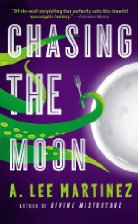 Summary:
Diana doesn’t have much going for her–a bad job and perpetual unwanted singledom, plus she’s been sleeping on friend’s couches since losing her apartment. So when a room in a building with a quirky landlord shows up, she grabs it instantly. Only to discover that a monster called Vom the Hungry is in her closet waiting for her to let him out, at which point he will probably eat her. In fact, the whole building is oddly connected to other dimensions full of monsters, creatures, mayhem, and madness….not to mention tentacles.
Review:
I obviously had to read this book. The cover has tentacles on it, and it’s clearly a Lovecraftverse story. These are both basically automatic must reads in Amanda-land.
The storyline is fairly straight-forward as far as the Lovecraftverse goes. There’s a place where the lines between dimensions and reality fade and threaten mere humans with madness. The monsters that Diana meets within her own apartment are fairly creative. There’s Vom the Hungry who is pretty endearing, there’s the hedgehog looking guy (whose name I can’t remember and can’t look up because: audiobook) who spawns copies of himself when he’s upset, and of course there’s the giant floating eye with tentacles who tries very hard to be prim and proper. They’re creative and funny.
The foes–the cult of the moon god–are not so creative. They’re your typical moon-loving shapeshifters, and the moon god even has three forms just like a certain other god of a religion we’re all familiar with. Compared to the creativity of the apartment and the apartment’s monsters, it just doesn’t feel like a worthy foe.
Similarly, although I liked Diana and the world she’s living in, she has basically no backstory. I have a hard time believing she’d have such an easy time mostly abandoning her friends and family from her time prior to the apartment. I can believe she’s not afraid and can handle the horrors, but it’d be nice if we got at least a toss-up to the concept of her having a family or even a mention of estrangement from them, if that’s the case. That doesn’t happen, so I was left feeling that Diana is very two-dimensional.
Given these elements, I’m sure I would have skimmed through it very quickly in print and probably missed the humor that it does contain, except that I read the audiobook. The audiobook narrated by Khristine Hvam. And she is an incredibly talented voice actor.
Every single character had their own entirely unique voice, and the voices perfectly matched the character, even an eyeless faceless omnivorous Vom the Hungry. Hvam is just….just so amazing to listen to! I kept listening more to just hear her perform than due to a true vested interest in the story. In fact, I looked up her voice actor page on Audible after just to maybe get another one of her books. She mostly narrates scifi/fantasy, unfortunately mostly YA, which we all know I don’t like. But I will be keeping my eye out for more of her adult work. She is just so amazingly talented.
So, overall then, the story itself rates 3 stars, but the narration rates 5, so my rating must average those two out. Be aware, though, that I recommend Khristine Hvam over the book, but if you are intrigued by the book and don’t mind a lack of backstory or average villains, then I recommend picking the audiobook for twice the fun.
4 out of 5 stars
Source: Audible

Book Review: Rabid: A Cultural History of the World’s Most Diabolical Virus by Bill Wasik and Monica Murphy
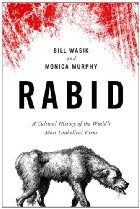 Summary:
Taking a cultural and public health perspective, husband/wife writing team, Wasik and Murphy, tell the history of the rabies virus through the present.
Review:
My new library (where I work as a librarian) serves a school of public health. Working with these students has opened up a whole new world of science to me. Public health is a fascinating combination of medicine, science, culture, and communication. So when I saw this public health book on Netgalley, I knew I needed to give it a shot.
This is a completely fascinating book. Prior to reading it, my main knowledge of rabies came from that episode of Dr. Quinn Medicine Woman where her adopted son’s dog gets rabies and bites her other adopted son’s fiancee. I didn’t really understand how much of a plague it used to be, but I did know that you’re required to get your pets vaccinated for it.
I learned SO MUCH from this book! And it wasn’t a struggle to read or absorb the information either. Wasik and Murphy strike that hard to find balance in writing science for the layman. They explain complex, scientific things without so much scientific terminology as to be a struggle for the average reader but with enough so that you’ve still learned something. For instance:
With most zoonotic leaps in disease, animal contact is the spark, but urbanization is the bone-dry tinder; a newly evolved pathogen can’t spread from person to person, after all, unless people run across one another in the first place. (location 453)
There are a few passages that use more scientific terminology than that, but they only use them after explaining them. You do not have to be a scientist to be able to read, enjoy, and learn from this book.
The basic structure of the book is typical of a history book. In fact, think of it kind of as a scientific history book. It starts with the earliest accounts of rabies and moves up through time to the present. The strongest passages are: Greco-Roman history of the disease, Dark Ages history of the disease, Pasteur’s creation of a vaccination, and the modern day outbreak in Bali. These strike the perfect balance of discussing the understanding and treatment of the disease and the reflections of rabies and fear of rabies in popular culture of that time period.
For instance, in the Greco-Roman period we learn:
Pliny’s thoughts tend to involve using the animal to treat the man. His best-known cure—to “insert in the wound ashes of hairs from the tail of the dog that inflicted the bite”—lives on today in our expression “hair of the dog,” referring to a not-quite-so-dubious hangover remedy. (location 473)
Or this fascinating bit of public health history in the Pasteur section:
Pasteur’s collaborator Roux believed that Pasteur selected rabies as a subject for research as a calculated bit of stagecraft, so that his ideas about vaccination would attract maximum public interest. (location 1714)
The other sections, particularly the era after the vaccine to about the 1980s, suffer a bit from a lack of focus and direction. There’s a part where the authors try to convince us that zombies are a reflection of a latent fear of rabies. Ok? But that’s rather speculative compared to the rest of the book. There are other elements of pop culture that are nowhere near as loosely connected that they discuss, such as the actual rabies books and movies that came out in the UK when the Chunnel was put in and people were afraid that rabid animals would come over to the island nation from France. That is a tight, interesting connection. The zombie one was a bit of a stretch. I was more interested in more information on things like Old Yeller and why the authors think that even with the vaccine in the US and very little threat at the time the public still was fascinated with the idea of a rabid dog.
The book also explores other zoonotic diseases (diseases that originate in non-human animals). Although this is also technically not rabies, this connection makes a lot more sense, particularly since more started cropping up in the 20th century after rabies was beaten down by vaccination. The knowledge we have from working against rabies and promoting vaccination of it via public health initiatives could really help with things like HIV/AIDS and H1N1. This is using past public health experience to aid in future endeavors, which helps give the book a certain umph and validity for modern readers.
So, although the book struggles a bit during the early 20th century time period, the rest of it is very well put-together. It is written at the appropriate level for a popular science history book. It is easy to learn from and includes lots of fascinating tid-bits in addition to the basic rabies history and information. It also demonstrates as a kind of side-story the history of public health. I recommend it to anyone with an interest in the history of rabies, the history of vaccination, and most especially to those with an interest in public health issues.
4 out of 5 stars
Source: Netgalley

Book Review: Where Late the Sweet Birds Sang by Kate Wilhelm (Audiobook narrated by Anna Fields)
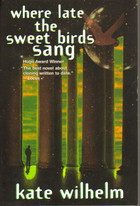 Summary:
When the world goes through an apocalypse consisting of virulent strains of the flu, lack of food, and nuclear warfare, one wealthy family manages to survive because they saw it coming. Made up of highly intelligent and highly educated people, such as doctors and scientists, the family creates a 200 bed hospital and uses this as their home base. But there is a serious fertility problem, and how they address it just might change the core of humanity.
Review:
I love reading classics of scifi. It’s endlessly fascinating how different people in different times imagine a future (or an apocalypse). This award-winning book had the bonus of being written by a woman, which isn’t always easy to find in older scifi. I also was intrigued by the cloning theme. How would someone in 1977 view something that was, as yet, nowhere near as close to a reality as it is now, with our cloned sheep?
The book starts out incredibly strongly. So strongly, in fact, that I actually had nightmares from it, which never happens to me ever. I am basically a rock of horror and scifi, but this one creeped the bejesus out of me. It’s that creepy combination of incest and cloning. The family are really not people you would want retooling the world. They’re everything that can be (and usually is) bad about the 1%. They’re selfish, self-centered, snobby, and routinely employ nepotism. I found the incest in the first third of the book talking about the first generation of the family to be an interesting metaphor for how the elite can become so backwards and grotesque from sheer isolation. It’s powerful and moving, and a scenario that will remain in my mind.
The second third of the book focuses in on a woman, Molly, from the first generation of clones. This is disturbing in its own way, because they don’t just clone everyone once and have done with it, no. They clone everyone multiple times until there are clusters of the same person at different ages wandering around. They call these clusters “brothers” and “sisters” with the name of the original person as the name of the group, even though the individual ones have their own names. It is profoundly disturbing. This second third looks at the society of clones that the original family unintentionally made. It’s fascinating in its own way and an interesting different way of telling a post-apocalypse story. Often we get only the first generation, but here we get multiple generations.
The last third, unfortunately, didn’t live up to the first two-thirds of the book. Without giving too much away, it looks at a boy who came about by natural methods who gets integrated into the clone society at the age of five. They decide not to clone him and give him brothers for unclear reasons. This last third then looks at his impact on the clone society. I didn’t feel that this worked as well for multiple reasons. For one, it’s almost as if Wilhelm freaked herself out and backed off from the profoundly disturbing story she was telling and went a more conventional direction. That was disappointing. For another, I found it disappointing that she chose to make this game-changer a boy. I expect women scifi authors to be at least a bit cognizant of the need in scifi for more female main characters. In this one, the first third is a man, the second third a woman, and the last third a boy. That is not the best stats from a woman author. I also found certain parts of this to be very boring and slow-moving compared to the first two-thirds. That makes for odd pacing in a book.
Of course, my complaints about the last third backing off, being more conventional, and being rather dull don’t take away from the first two thirds at all. They bring about so many interesting societal questions. For instance, is the incestuous nature of the elite necessarily bad or will it one day save humanity? Will cloning remove something that makes us human, even if they look right? Is it better to cling on to technology at all costs or release it and go back to simpler times? And what about sex? Is monogamy natural and polyamory unnatural? Or is polyamory more welcoming and loving than potentially possessive monogamy? The questions go on and on, which is what is great about scifi.
As for the science itself, it is quite well-done. Wilhelm clearly thought through both keeping a closed-off community alive and cloning and bringing to term embryos. She also put thought into the scientific basis for why clusters of clones would be different from individual humans, touching on psychology and twin studies. I was a bit irritated that she bases the survival of these people on cloning farm animals, when that is not a good use of their limited land resources. Studies have shown many many times that a combination of farming vitamin-rich plants and hunting/gathering are the best use of limited land resources, so this particular element rang a bit of bad science. However, I am not certain how much land usage had been studied in the 1970s, so that could possibly just be a sign of the times.
Now, I did read the audiobook, so I should touch on the narration. Overall, Anna Fields does a very good job. I really enjoyed that they chose a female narrator for a book written by a female author. It let me almost imagine that Kate Wilhelm herself was reading it to me. Fields mostly strikes a good balance of changing voices for different characters without going over the top. The one exception to this is when she narrates children. The voice for that made me cringe, but they mercifully speak only a few times. Mostly, Fields reads smoothly and is easy to follow. She narrates without accidentally putting her own interpretation onto the work, which is ideal for an audiobook.
Overall, then, this is a fascinating classic of scifi. It examines the apocalypse through the lens of the elite, thereby analyzing and critiquing them, but it also looks at possible consequences of cloning and ponders what ultimately makes us human. Although the last third of the book is a bit less creative and more conventional than the first two, it is still a fascinating read. Recommended to scifi fans, particularly those with an interest in group dynamics.
4 out of 5 stars
Source: Audible

Friday Fun! (In Which I Take Back Up Counted Cross-Stitching and Blog Tour Updates)
Hello my lovely readers!
I’ve been trying to keep things kind of quiet in my non-work life right now, since work is so busy with the beginning of the medical school academic year. So I don’t have too terribly much to tell you except that I now have something besides cooking and cleaning that I’m doing when listening to audiobooks. I’ve taken back up counted cross-stitching.
I’ve been searching for a crafty/productive hobby for a bit now. Knitting could only progress as far as scarves before things started to get thrown across the room. I couldn’t even learn how to do one stitch in crocheting. I knew I was capable of counted cross-stitching (and embroidery) because it was forced upon me….er, I learned it as a kid. However, I had this perception of it as being something steeped in old lady and overtly religious patterns. And then I saw something on tumblr.
It was a counted cross-stitch that quoted Fight Club saying, “Condoms are the glass slipper of our generation,” and had a glass slipper on the bottom. I about died laughing. And then I discovered the world of punk stitching, which is what the non-traditional stitchers call it. I was immediately excited and intrigued.
So I picked up a cross-stitching kit (before getting into designing my own patterns or buying other homemade patterns) to make sure that I wasn’t misremembering my abilities. After much hunting I found a wintry wolf scene that I thought would go well in my Native American themed bedroom area in my tiny apartment. I completed 400 stitches the first time I sat down. And I was remembering correctly. This is something I am good at! This is something that bafflingly relaxes me! All the counting and organizing that I so adore, and I wind up with prettiness! I am beyond excited about this rediscovered hobby, as my new pinterest board of patterns probably demonstrates. :-)
In Waiting For Daybreak
From Me To You… had previously reviewed my novella, Ecstatic Evil
The Paperback Pursuer offered up a review stating, “I was blown away by Amanda McNeil’s ability to develop such a unique and troubled character who every reader can relate to on some level.”
Kelsey’s Cluttered Bookshelf has an interview with me up where you can find out things like my future writing goals and advice for other writers. She is also offering a giveaway!
Bookishly Me also has an interview up in which I talk about the research I conducted for the book, among other things.
Last but certainly not least, Fangs for the Fantasy offers up a review from a social justice perspective stating, “But even better than a realistic and well-presented depiction of mental illness, we also have it become a strength in the zombie apocalypse.”
A big thank you again to all of the participants! I’m so glad folks have been enjoying the tour so far.
Happy weekends!
Book Review: The Wind Through the Keyhole by Stephen King (Series, #4.5)
 Summary:
There’s a tale we have yet to hear about the ka-tet in the time between facing the man in the green castle and the wolves of the Calla. A time when the ka-tet hunkered down and learned a special billy-bumbler talent, an old tale of Gilead, and the first task Roland faced as a young gunslinger after the events at Mejis.
Review:
When I heard there was going to be a new Dark Tower book, I had basically three reactions. 1) Yay! 2) Shit he better not ruin them. 3) Guess I didn’t actually finish that series after all, did I? May have written the series review a bit too soon…..
But mainly my reaction was a skeptical excitement. I love the world of the Dark Tower and was ecstatic to be able to get more of it (yes, I know there are the young gunslinger comic books, but they feel slightly less the same to me since they are in a different format). However, I was also terrified because well we’ve all been in an instance where we mess with something that was good to the point where it’s not good anymore, right? I was worried King was going to do that to the Dark Tower. I am so so so happy to be able to say that worry was unfounded.
This book goes to show just how clearly the entire world of the Dark Tower series exists in King’s mind. The format is a story within a story within a story. The ka-tet have to hunker down to wait out a storm, so Roland starts to tell them a story from when he was a young gunslinger. Within that story, the young Roland tells someone else an old story of Gilead. The Gilead story wraps up, then the young gunslinger, then the ka-tet. A writer must know his world very well to be able to handle such a structure smoothly without confusing his reader, and King does just that. There was no confusion and each story felt fully told. Or as fully told as anything is in the world of the Dark Tower.
I’ve said before that every book in the series basically is a different genre, which is part of what makes it so fun. So what genre is this one? I’d say it’s fairy tales. Once upon a times. And fairy tales generally have a lesson to be learned within them, so what is it in these three? Well, they vary, but I would say overall it’s about leaving aside childish things and childish ways to become an adult. (And, I might add, that happens much much earlier in the Dark Tower than it does in our particular world).
I will say, although I certainly had the impression that this book was going to be about Jake and Oy, it really isn’t. It isn’t much about the ka-tet at all. It’s about Roland and the role of billy-bumblers in the world. Although, personally I wanted more billy-bumblers, but I *always* want more billy-bumblers, because they are definitely my favorite fantastical creature. I’m still holding out hope that King will write something sometime entirely about Oy or billy-bumblers. But this book is not it.
That said, I was oddly not disappointed to see far less of the ka-tet than I was expecting, because the two stories within the frame of the ka-tet are so strongly told. They are just….wow. Terrifying, horrifying, unpredictable, and hilarious simultaneously.
That’s the thing that makes any Dark Tower book fun. It contains all of those things.
Lines can go from laugh out loud humor (with a touch of truth):
Turn yer ears from their promises and yer eyes from their titties. (page 43)
To the starkly sad truth:
Those were good years, but as we know—from stories and from life—the good years never last long. (page 110)
To the simply universal:
“What if I fail?” Tim cried.
Maerlyn laughed. “Sooner or later, we all do.” (page 255)
*shrugs* I admit I’m a bit of a fan girl of the series, but even a fan girl can be sorely disappointed, and I was really and truly not disappointed at all. I laughed, I nodded, I wondered, I quaked, I wished for an illustration sometime somewhere of billy-bumblers dancing in a clearing in the moonlight. Although, speaking of illustrations, how gorgeous is the US kindle cover?! So fucking gorgeous, that’s how.
Back to the point, I was not disappointed at all. I was ultimately elated and wishing for more. And other fans will be too.
5 out of 5 stars
Source: Amazon
Books in Series:
I’m listing all of the books so you can easily see where The Wind Through the Keyhole
The Gunslinger
The Drawing of the Three
The Waste Lands
Wizard and Glass
The Wind Through the Keyhole
Wolves of the Calla
Song of Susannah
The Dark Tower
Series Review (written before we knew there would be more)
Book Review: The Walking Dead Volume 15 by Robert Kirkman (Series, #8) (Graphic Novel)
 Summary:
Everyone’s world was rocked when the zombies got through the community’s fence. Will they respond by banding together or falling apart?
Review:
Ok, before I review, the numberings need a bit of explanation. Comic books are issued very similarly to academic journals. So there are skinny issues that come out every few weeks (generally). A few of these bound together make a volume. A bunch of these bound together make a book (what we call in academia a “bound journal.”) I *was* reading the books of The Walking Dead but then I caught up to the author. I decided I didn’t want to buy issues, because they’re flimsy and you read through them very quickly, so I’m now reading the volumes. I hope that makes some semblance of sense. This will probably be the case throughout the rest of the series, because you have to wait a long time for the books, and I just am too impatient for that. My reviews will then be much shorter, because a book contains a few volumes, and I am now reviewing one volume at a time. Moving right along to the review!
This volume is basically cleaning up the mess from the action of the previous one and prepping for the action of the next one. Classic in-between chapter. What this volume really reminded me of is the infamous “Live together or die alone” speech by Jack in Lost. In fact, this volume sees Rick basically trying to turn into Jack and failing miserably. Long-time readers know I’ve never liked the guy, so personally I got a lot of schadenfreude out of seeing him be so pathetic in this volume.
That said, the survivors are definitely going for a new strategy, which will lend itself well to future fresh storylines, which any long-running series needs.
Fans of the sex will be quite happy with the developments in that area. Drama! Intrigue! Changes of partners!
Overall, it’s an enjoyable entry, if not mind-blowing, that perfectly sets things up for the next volume. Fans won’t be disappointed!
4 out of 5 stars
Source: Newbury Comics

Previous Books in Series:
The Walking Dead, Book One
The Walking Dead, Book Two
The Walking Dead, Book Three
The Walking Dead, Book Four
The Walking Dead, Book Five
The Walking Dead, Book Six
The Walking Dead, Book Seven
Book Review: Soft Apocalypse by Will McIntosh (Audiobook narrated by Erik Davies)
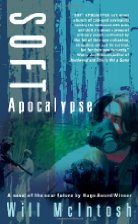 Summary:
Jasper can’t believe he’s actually homeless, although a lot more people are homeless now than used to be. But still. He got his BA in sociology. He’s worked hard. How did this happen? He’s living with a tribe of other 20-somethings. They keep hoping things will get better, but somehow they just seem to keep getting worse. The economy doesn’t improve. Home-grown terrorists known as Jumpy-jumps start routinely terrorizing people. Driving anywhere, having dependable food, actual working police forces, they’re all a thing of the past. Not all apocalypses happen overnight.
Review:
I actually hesitated over keeping this book on my wishlist, but I’m very glad I did. I found it to be not quite what I was expecting. In a good way.
I think a lot of men in particular will enjoy it, because it kind of reminds me of a Judd Apatow film. There’s this complete and utter loser guy who you entirely hate (and I suspect McIntosh hates too) but who is just so damn funny you keep reading it. A lot of apocalypse books focus in on a strong leader type, but Jasper is actually a coward who just keeps trying to squeak by. On top of that, he claims to be looking for true love, but is actually completely lacking in any understanding of women. One of his “apt” observations, for instance, consists of stating to a guy friend, “Have you noticed that fat women have been getting hotter?” He’s trying to say that the more starvation threatens, the more attracted he is to women who obviously have enough to eat. But he isn’t philosophical about it at all, and that’s kind of hilarious. He also tries to impress a girl at one point by commenting on the fact that she’s reading a book, but he says it in such a way that it’s obvious he himself doesn’t read at all, which is utterly baffling in a world that no longer has electricity or other entertainment. Basically the whole book is laughing at a cowardly dude-bro, and that’s fun.
The apocalypse itself is quite creative. As the title and blurb imply, it’s a slow one. Gradual. Things get bad and just never get better then more things get bad. It’s a creative mix of economics, homegrown terrorist groups, scientists trying to make things better but actually making it worse, and international politics. None of it came across as utterly absurd or ridiculous, which shows that McIntosh did a good job.
There are two scenes that are truly horrific, which of course I loved. There’s a very creative death scene that I think will haunt me for a long time. (Again, that’s a good thing). The plot overall is a bit meandering, but that makes sense since Jasper isn’t the most focused or proactive dude on the planet. I’m a little sad the book ended when it did. I get why McIntosh ended it there, leaving things open-ended for readers, but….I could have read about Jasper much much longer. Yes, he’s a guy I would hate beyond all reason in real life, but I guess that schadenfreude factor is what makes the book so fun.
Now, I did read the audiobook, and I have to say I was very disappointed in the narration by Erik Davies. It does not live up to the content of the book at all. My main problem with him is that he does that awful thing of putting on what he thinks is a woman’s voice every time one of them speaks, but what actually sounds like a small child and nothing like us. I actually had to stop and rewind a couple of times to double-check if I was angry at how the book was portraying women or if the narrator was making it seem like the book was portraying women as childish idiots. Suffice to say, it’s definitely the narration, not the book. Yes, Jasper objectifies women and basically calls any woman who doesn’t fit into his definition of what a woman should be “crazy,” but the whole book is laughing at him, so really the book is showing how ridiculous it is to view women like that. The narrator reading women in this childish voice really messes with that whole presentation. So, definitely don’t get the audiobook.
Overall, then, this is a fun apocalyptic scifi featuring a cowardly loser who is delightful to follow and laugh at. I highly recommend it to scifi fans who also enjoy slacker flicks, but definitely get the print or ebook versions, not the audio.
4 out of 5 stars
Source: Audible

Book Review: The Outside Boy by Jeanine Cummins (Bottom of TBR Pile Challenge)
 Summary:
Christy is a Traveller, what Irish gypsies call themselves, in the 1950s. He’s eleven, and his family is about to stay in one town for a whole 40 days and 40 nights for Lent so he and his cousin, Martin, can get ready for confirmation. Christy has always thought his mam died giving birth to him, but when his grandda dies, he finds a newspaper clipping that shows his mam holding him when he’s months old. Thus begins a quest to find out who he really is.
Review:
The particular copy I read I won on a book blog somewhere (I’m afraid I didn’t write down the name), but I also received an ARC during one of the holiday swaps one year. It’s interesting to me, then, that this book wound up on my tbr pile both because I was interested and because someone else thought I would enjoy it. And of course I did.
It is honestly, immediately abundantly clear that Christy’s mother isn’t a Pavee (a Traveller). I was thus skeptical that the story would hold my interest, since predictable ones don’t tend to. I am pleased to say that I was wrong about this on both counts. Although it’s true that Christy’s mother isn’t a Traveller, everything else about her and Christy’s history is actually quite surprising and moving. I’m glad I stuck with it.
The book examines many different issues, some universal and others specific to Irish history. There of course is the issue of identity. Who we are and what makes us that. Is it nature or nurture? The often tough relationship between fathers and sons during the son’s adolescence is also wonderfully presented. Of course a book about gypsies also addresses prejudice, stereotyping, and the norm. Cummins doesn’t sugar coat things. She shows the positive and negative aspects of Traveller culture, which is as it should be. No culture is all perfect or all bad. What the book does a great job of doing is showing how kids learn prejudice and how multiculturalism can enrich everyone’s lives. Some people are one way and some another, and neither is necessarily bad. The book also touches on the animosity between Protestants and Catholics in Ireland, as well as the very real issue of Irish society stealing babies from single mothers in that time period. I know that sounds like a lot, and honestly I’m surprised now that it’s all listed out at how much was touched upon. Cummins strikes the perfect balance of touching on real issues without ever seeming pushy or forced.
Although the storyline and characters are good, it didn’t 100% draw me in. I think it moves a bit too slowly for me in the first half or so of the book. I also, honestly, struggled to like Christy. I eventually came to understand his viewpoint and choices, but I still find him kind of annoying. His father, on the other hand, is incredibly interesting and wonderful, and I kind of wish we had a book about him instead of about Christy. But, some readers enjoy more slowly paced books and others might relate better to Christy than I did. It just personally is what made it a book I liked but didn’t love.
Overall, this book is an interesting entry in historic Irish fiction. It looks at Ireland in the 1950s through the eyes of a small band of gypsies, which is certainly a unique viewpoint. The writing is fluid, if a bit slow-moving, and the plot is not as predictable as it seems at first. Recommended to fans of historic fiction and works set in Ireland.
4 out of 5 stars
Length: 360 pages – average but on the longer side
Source: Won on a book blog (If it was yours, let me know, and I’ll link to you!)
Buy It
If you found this review helpful, please consider tipping me on ko-fi, checking out my digital items available in my ko-fi shop, buying one of my publications, or using one of my referral/coupon codes. Thank you for your support!
Friday Fun! (Six Books/Six Months Meme and Blog Tour Updates)
Hello my lovely readers!
This week I saw a new meme over on Jessica’s blog, The Bookworm Chronicles, and I immediately knew I’d want to participate. And what better place than in Friday Fun, eh? The Book Jotter created it after realizing we’re actually halfway through the year already (already!), so the theme is answers to the questions/categories in sixes.
Six New Authors to Me:
- S. A. Archer
- Kat Falls
- Steve Vernon
- David Anthony Durham
- Brandon Shire
- Susan Mallery
Six Authors I Have Read Before
- Brian K. Vaughan
- Robert Kirkman
- Joseph Robert Lewis
- Anne Rice
- Margaret Atwood
- Ann Brashares
Six Authors I Am Looking Forward To Reading More Of:
- Tera W. Hunter
- Joann Sfar
- Richelle Mead
- M. J. Rose
- Isaac Marion
- Roger Thurow
Six Books I Have Enjoyed the Most:
- To ‘Joy My Freedom: Southern Black Women’s Lives and Labors after the Civil War
by Tera W. Hunter (review)
- Dark Life
by Kat Falls (review)
- Warm Bodies
by Isaac Marion (review)
- Acacia
by David Anthony Durham (review)
- Vegan Vittles
by Jo Stepaniak (review)
- The Last Hunger Season: A Year in an African Farm Community on the Brink of Change
by Roger Thurow (review)
Six Books I Was Disappointed With:
- The Wolf Gift
by Anne Rice (review)
- Living Cuisine: The Art and Spirit of Raw Foods
by Renee Loux Underkoffler (review)
- Nano House: Innovations for Small Dwellings
by Phyllis Richardson (review)
- The Child Who
by Simon Lelic (review)
- To a Mountain in Tibet
by Colin Thubron (review)
- Robopocalypse
by Daniel H. Wilson (review)
Six Series of Books Read or Started:
- Y: The Last Man by Brian K. Vaughan
- Touched by S. A. Archer
- Dark Life by Kat Falls
- The Walking Dead by Robert Kirkman
- Georgina Kincaid by Richelle Mead
- The Reincarnationist by M. J. Rose
Phew! That was actually pretty tough to assemble. Super fun though! It’s always interesting to see your reading over a period of time summed up in different types of lists.
Now, it’s time for the Waiting For Daybreak
Earth’s Book Nook hosted a guest post in which I talk about why I made “What is normal?” the theme of the novel and tour. She is also hosting a giveaway!
The Chronicles of an Enamored Soul posted her review, and she said, “The reason it gets FIVE STARS, is because I simply loved how well-realized, and well-developed author McNeil’s characters were, ESPECIALLY Frieda. Amanda writes about mental illness with sensitivity, and yet never fails to make it interesting.”
Tabula Rasa‘s review said, “The book is, on the one hand packed with thrill and action, and on the other, has a very emotional and thought-provoking side. What I really appreciated was how none of it is overdone; I specially liked the subtlety of the relationship between Mike and Frieda.”
Tabula Rasa also hosted an interview! Be sure to check that out to find out everything from whether plot or characters come first in my writing to what my next project is.
Nicki J Markus also interviewed me. Check that out to find out what my favorite zombie book and zombie movie are.
Last but not least, Nicki J Markus is also hosting a giveaway. Two chances to win this week!
Thanks once again to all the participating blogs!
Finally, happy weekends to all my lovely readers! What did you think of the meme? Any surprises or thoughts?
 Support my work with a tip or browse my shop for curated book club guides, how to guides, cross-stitch patterns, and more!


This work by Amanda Nevius is licensed under a Creative Commons Attribution-Noncommercial-No Derivative Works 3.0 United States License.
 Opinions of a Wolf